47
Original Article
Convolution for The Offset Linear Canonical Transform
with Gaussian Weight and Its Application
Quan Thai Ha
1,*, Lai Tien Minh
2, Nguyen Minh Tuan
31Faculty of Mathematics, Mechanics and Informatics, VNU Hanoi University of Science,
334 Nguyen Trai, Hanoi, Vietnam
2
Department of Mathematics, Hanoi Architectural University, Hanoi, Vietnam
3Department of Mathematics, VNU University of Education, 144 Xuan Thuy, Hanoi, Vietnam
Received 26 November 2018
Revised 25 February 2019; Accepted 15 March 2019
Abstract: This paper presents the convolution for the offset linear canonical transform (OLCT) with the Gaussian weight and its applications. The product theorem is also studied. In applications, some ways to design the filters in the OLCT domain as well as the multiplicative filter and the Gaussian filter are introduced.
Keywords: Reconstruction, Shannon theorem, convolution, filter, signal, offset linear canonical transform, fractional Fourier transform, Fourier transform.
1.Introduction
Throughout this paper we shall consider parameters a b c d u, , , , 0,0 and i will be denoted the
unit imaginary number. The Offset Linear Canonical Transform (OLCT) (see [1]) of a signal f t
with real parameters A
a b c d u, , , , 0,0
, (adbc1) is defined as
2 0 0
( ) 2
0
, 0
: :
, 0
,
A
cd
A A
i u u i u
u t
u f
f t dt b
F
d e f d u u
t u
b
, (1.1)
________
Corresponding author.
E-mail address: [email protected]
where
2 1 2 ( 0 0) 0
2 2
( , ) :
b du u
d a
u tu t u t
b b b b b
i A
u t
K e
A
, and2 0
2
2
idu b
A e K
bi
.
The inverse OLCT expression is given by
1 1
( ) A A( ) A A ,
f t F u t C
F u u t du, (1.2)where 1
0 0 0 0
, , , , ,
A d b c a b du cu a , and
2 2
0 2 0 0 0
1
2cdu adu ab i
Ce . (1.3)
In this paper, we only consider b0 since the OLCT becomes a chirp multiplication operation otherwise.
The OLCT is generalization of many operations, as follows: the Linear Canonical Transform (LCT), the Fractional Fourier Transform (FRFT), the Fourier Transform (FT). When u0 0 0, we
back to the definition of the Linear Canonical Transform (see [2]).
The Fractional Fourier Transform (FRFT) (see [3]) is considered a special case of the OLCT when parameters A have the form A
cos ,sin , sin ,cos ,0,0
. For any real angle , the FRFT is defined as
1 cot cot2 2 sin cot2 2( ) , sin 0
2
ut
i u t
i
f u f t e dt
. (1.4)When the angle 2
, the FRFT becomes the Fourier Transform (FT) (see [4]). In this paper, we
will use the Fourier Transform and its inverse defined by
:
iutFT f t u f t e dt
, (1.5)
1
2
iut FT
f t f t u e du
, (1.6)respectively. If f h, L1( ), the classic Fourier convolution operation in the time domain is
defined as
f *h t
f
h t
d . (1.7) It is easy to see that
f*h
t f
t *h t , , (1.8) and
*
FT f h t u FT f t u FT h t u
. (1.9)
•
We also have the Young’s inequality (see [5]). If p
fL , hLq
, and1 1 1 1p q r ,
p q r, , 1
. Then the following inequality holds1
* r p q
f h C f h , (1.10)
Now we will exemplify some basic properties of A (see [6]).
Suppose fL1
, and
, , we have•
Time shift:
2
0 0
( ) 2
ac
i c u u a
A f t e F uA a
.
•
Modulation:
2 ( 0) 0
2
bd
i d u u b
i t
A e f t u e F uA b
.
•
Time shift/modulation:
2 2 2 2 0 0
ac bd
i bc
i c d u u i a b y
A e f t e e e F uA a b
.
•
A is a linear, continuous and one-to-one map from the Schwartz space onto (whoseinverse is obviously also continuous).
Let C0
be the Banach space of all continuous functions on that vanish at infinity and beingendowed with the supremum norm , and let 1: 1 ( ) 2
f f t dt
be the norm in L1
.•
(Riemann-Lebesgue type lemma for the OLCT). If fL1
, then AfC0
, and1
1 | |
Af f
b .
•
(Plancherel type theorem for the OLCT). Let f be a complex-valued function in the space
2L and let
| |
, : ,
Af u k
tk A u t f t dt.Then, as k , Af u k
, converges strongly (over ) to a function, say Af L2
, and, reciprocally,
1
| |
, : , A
A t k
f u k C u t f t dt
converges strongly to f u
, where C is the same as in (1.3).•
(Parseval type identity for the OLCT). For any f h, L2
the following identity holds, ,
Af Ah f h ,
where , is denoting the usual inner product in L2
. In the special case when h f , it holds2 2
Af f
.
For convenience, we denote
du0b0
2 2
,
2 0
2
u a
i t t
b b
A t e
,
f t
A
t f t , andthe Gaussian function
2 2
1 2
1 t
b
t e
b
2 2 0 0
b du
d iut
i u u
b b b
A A A
F u f t u K e f t e dt
. (1.11)There are many different types of convolutions for the OLCT. Most of them have the weight
functions in the form
2
i u u
e (see [1]). In [7], some convolutions for the FRFT with the Hermite
weights in the form i u2
ne u , and the Gaussian weight in the form
2 2 1
2u
i u
e e , are also obtained. In this paper, we focus on studying the convolution for the OLCT with the Gaussian weight in the form
2
1 2u
e , and its applications.
The paper is divided into two sections and organized as follows. In the next section, we provide the convolution for the OLCT with the Gaussian weight function and study its product theorem. Some special cases of this convolution are also deduced.
2.Convolution for the OLCT with the Gaussian weight function and product theorem
Definition 2.1. Let f h, L1
, the convolution for the OLCT of two signals f t
and h t
with the Gaussian weight function
t is defined by
fh t
KA
A( )t
1
f * *h
2t . (2.1)It easily seen that if f h, L1
then
1
fh t L . Moreover, 1
1 2 1
fh C f h ,
where C2 is a positive constant.
Theorem 2.1. Assume that
1
,
f hL
, z t
fh t
and F uA
, ZA
u , HA
u denotethe OLCT of the signals f t
, z t
, h t
with a set of parameters A, respectively. The factorization following identity is fulfilled
1 24
2 2
u
A A A
u u
Z u e F H
.
Moreover, if
2
1
1 4
2 2
u
A A A
u u
e F H L
then
2
1
1 4
2 2
u
A A
A
u u
z t e F H t
. (2.2)
Proof. Based on classic Fourier convolution (1.7), the convolution (2.1) can be expressed as
1
( ) 2
A A
fh t K t
f u h v t u v dudv. (2.3)Since (1.11), we realize that
2 0 0
2 2 2( )
1 1
2
2 2
b du
d iu iuv
i u u
u u
b b b b
A A A
e F u H u e K e f h v e e d dv
0 0 2 2 2 1 2 2 1 2 b dud iu iuv
i u u
t iut b b
b b
A
e dtK e f h v e e d dv
2 1 ( 0 0) 12
2 ( ) ( 2 )
2
2
b du d
i u v bt u u t
b b b
A K
e f h v e d dvdt
.
By making s v bt, we obtain
2
1 2u
A A
e F u H u
2 0 0
1
1
2 2 2
2 2 2
2 2
b du
d s A A
i u u u
b b b
A A s K s K e b
2 21 2b s v
f h v e d dv ds
1
2
2, ( ) ( ) ( )
2 2 A A A s K s s
u f h v s v d dv d
b
2,2 2 2
A
s s s
u f h d
2A f h u
.
The proof is completed.
Remark 2.1. Furthermore, using the fomula (1.8) the convolution (2.1) can also be rewritten as
1
2 A A 2 * 2 * 2
fh t K t f t h t t . (2.4)
Remark 2.2. In particular, if we chosse h t( )( )t , where
( )t is the Dirac delta function, we then have
1
1
1
* 2 2 2 * 2
A A A A A
f t K t f t K t f t t . (2.5)
3.Applications
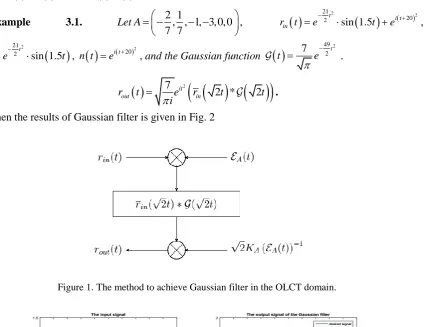
The output signal rout
t can be expressed as following
1
2 2 * 2
out t A A t in
r K r t t . (3.1)
The method to achieve the multiplicative filter in the OLCT domain through the convolution (2.1) is shown in Fig 1.
In this following example, our objective is using the proposed filters to restore an observed signal
in
r t y t n t where y t n t
, denote the desired signal and the additive noise, respectively.Example 3.1. Let 2 1, , 1, 3,0,0
7 7
A
,
2 2
21
20 2t sin 1.5 i t
in
r t e t e ,
212
2t sin 1.5y t e t ,
2
20
i t
n t e , and the Gaussian function
2
49 2
7 t
t e
.
7 2
2 * 2
it
out t in
r e r t t
i
.
Then the results of Gaussian filter is given in Fig. 2
Figure 1. The method to achieve Gaussian filter in the OLCT domain.
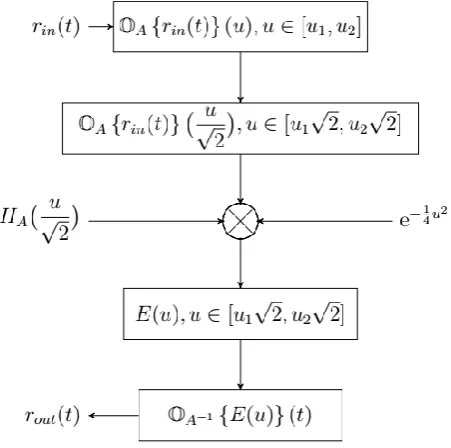
3.2. The multiplicative filter in the OLCT domain.In this subsection, rin
t and rout
t are denotedas the input signal and output signal, respectively.
The output signal of OLCT can be obtained as following
2
1
1 4
2 2
u
out t in A A in A
u u
r r h t e r t H t
. (3.2)
Let
2
1 2u
A u e HA u
H , since the OLCT-frequency spectrum is usually interested only in the
region
u u1, 2
, then the filter impulse response h t
can be selected such that HA
u is constant over
u u1, 2
, and zero or rapid decay outside that region. In paticular, we then have
1
, 1 2, 2 22
out t A A in t
u
r r t u u u
.
Moreover, HA
u can also be chosen equal the constant over
u u1, 2
, and zero outside that region. Thus, we can get
2
1
1 4
1 2
, 2, 2
2
u
out t A A in t
u
r e r t u u u
.
By denoting
2
1 4
2 2
u
A in t A
u u
E u e r H
, the realization method is given by Fig.3.
Therefore, when the OLCT becomes the LCT or the FRFT, it is easy to implement in the designing of multiplicative filters through the product in the OLCT domain (see [2]).
References
[1] Q. Xiang, K.Y. Qin, Convolution, correlation, and sampling theorems for the offset linear canonical transform, K. SIViP 8(3) (2014) 433:442. https://doi.org/10.1007/s11760-012-0342-0.
[2] A. Koc, H.M. Ozaktas, Cagatay Candan, and M. Alper Kutay, Digital computation of linear canonical transforms, IEEE Transactions on Signal Processing 56(6) (2008) 2383-2394. https://doi.org/10.1109/TSP.2007.912890 [3] H.M. Ozaktas, Z. Zalevsky, M.A. Kutay, The Fractional Fourier Transform with Applications in
Optics and Signal Processing, Wiley, New York, 2001.
[4] R.N. Bracewell, The Fourier Transform and its Applications, 3rd ed, McGraw-Hill Press, New York, 2000. [5] W. Beckner, Inequalities in Fourier analysis, Annals of Mathematics 102(1) (1975) 159-182.
https://doi.org/10.2307/1970980.
[6] L.P. Castro, L.T. Minh, N.M. Tuan, New convolutions for quadratic-phase Fourier integral operators and their applications, Mediterr. J. Math. (2018) 15:13. https://doi.org/10.1007/s00009-017-1063-y.