Journal of Engineering Sciences, Volume 6, Issue 1 (2019), pp. C 1–C 5 C 1 JOURNAL OF ENGINEERING SCIENCES
ЖУРНАЛ ІНЖЕНЕРНИХ НАУК
ЖУРНАЛ ИНЖЕНЕРНЫХ НАУК
Web site: http://jes.sumdu.edu.ua DOI: 10.21272/jes.2019.6(1).c1 Volume 6, Issue 1 (2019)
UDC 621.74
Experiment of Polylactic Acid as a Material for Candle
Molding on Origami-Shaped Crash Box Patterns
Kusyairi I.1*, Himawan H. M.1, Choiron M. A.2, Irawan Y. S.2
1
Politeknik Kota Malang, 3 Jalan Raya Tlogowaru, 65141 Malang, Indonesia; 2
Universitas Brawijaya, Jalan Veteran, 65145 Malang, Indonesia
Article info:
Paper received:
The final version of the paper received: Paper accepted online:
October 15, 2018 December 3, 2018 December 7, 2018
*
Corresponding Author’s Address:
[email protected]
Abstract. This paper study experiment by utilizing Polylactic Acid (PLA) which was printed with 3D Printing technology by taking the form of origami-shaped crash box pattern designed for MPV cars. The first step is to design crash box origami patterns with CAD software, and continue with the mold wax design. Then print the model in the Cura software. Then print the mold with approximately 56 hours 31 minutes and spend a 16.38 m long PLA filament weighing 128 g. Then pour wax, as for the wax used is carnauba wax with the temperature of pouring into the mold approximately 110 °C, let it chilled for 11 minutes then the mold is released from the wax. The final step is inspec-tion. The result of this experiment is that the PLA-based mold is capable of printing the origami-shaped crash box pattern well, shown by clear printing of sharp indentations both inside and outside. Percentage of nonconformity with design area A of 0.52 %, area B of 0.43 %, area C of 0 %, area D of 10.8 %, area of E1–4 of 0 % and area E5 of 3.2 % are obtained. A comparison of the overall size of the design with the experiment was 0.29 mm. PLA tends to show consistency of experimental results. This is shown in the consistency of experimental results 1 to 3 in areas A, B, C and E. But there are inconsistencies in the experimental results in area D which represents the thickness dimen-sion. This is influenced by changes in mold patterns which are affected by temperature pour wax into the mold and trigger the change of mold due to heat received continuously.
Keywords: carnauba wax, mold, PLA, sharp indentation, crash box pattern.
1
Introduction
Investment casting is a metal casting process with re-sults having high precision. This method is used to pro-duce several diverse and complex industrial components (Huang and Lin, 2015). This consists of several process-es, namely: making wax patterns, coating ceramic por-ridge, and pouring (Liu et. at, 2015). In the process of making mold wax, in some industries using iron so that the resulting pattern can be precise. However, wax molds made of iron requires a high cost for some circles. The researchers conducted experiments to solve this issue, using silicone rubber-based wax molds (Kuo and Shi, 2012). The advantages of rubber-based silicon molds producing precised assembly and 2.19 % shrinkage di-mensions. As it develops, the silicone rubber mold is given by the taguchi method, producing optimal tempera-ture in the tax process is the injection temperatempera-ture of 82 °C, injection time of 2 seconds, injection pressure of 0.06 MPa and mold temperature of 60 °C (Kuo and Tsai,
2015). Other study produced an optimal temperature of 5 °C mold temperature, 85 °C for wax temperature, at 5.05 MPa (Rahmati et. al., 2007). The research also de-veloped for aluminum-filled of epoxy resin mold. The main benefits of this technique include low production costs, a simple manufacturing process, and a short time of total process (Kuo et. al., 2017). At present the three-dimensional (3D) printer moves are fast, not least in en-gineering. Some researchers conducted research using 3D printers combined with changing the material phase for making wax molds (Wang and Millogo, 2012).
C 2 MANUFACTURING ENGINEERING: Materials Science
2
Research Methodology
2.1
CAD modelling
The pattern used in this paper is the origami-shaped crash box pattern (Ma and You, 2013) which has been modified to be applied to the MPV (Multi-Purpose Vehi-cle) Car which circulates in Indonesia (Kusyairi, 2017). This experiment prints half of the origami pattern crash box, as seen in Figure 1. The cross section is rectangular in shape and has a thickness of 3 mm in all parts. This will be a challenge when pouring wax into the mold, which has sharp angles and curves.
Figure 1 – Origami-shaped crash box pattern
The mold wax design in this paper is as shown in Figure 2. In Figure 2.a, it is divided into 2 parts, the in-side and the outer parts of the mold. In the inner mold, the outline consists of two parts, but the actual part is the most complicated part, because in the 3D printing process it is divided into 5 parts. This is so that the mold is easily removed and does not have to damage the wax. The outer mold generally consists of 1 part, but in the 3D Printing process is divided into 2 parts, where between the inner and outer mold is connected to the nut so that there is no shift when pouring wax into the mold.
a b c
Figure 2. Origami-shaped crash box pattern mold: a – inner part; b – outer part; c – mold hilistically
2.2
3D printing process
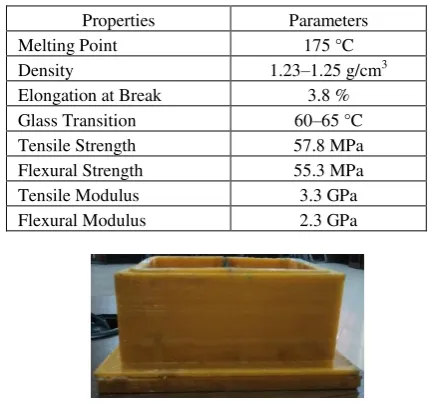
After designing the pattern of the object to be printed and the mold wax design, the next step is to print the mold with 3D Printing which is operated with cura soft-ware. The material used is PLA and its properties can be seen in Table 1. Setting the cura software by entering temperature data of 240 oC, diameter of 1.75 mm at a speed of 30 mm/s. The time required for the mold making process is 56 hours 31 minutes and consumes a 16.38 m PLA filament weighing 128 g. The results of the 3D Printing process can be seen in Figure 3, with a not-so-smooth surface.
Table 1 – Material properties of PLA (Farbman, McCoy, 2016)
Properties Parameters Melting Point 175 °C Density 1.23–1.25 g/cm3 Elongation at Break 3.8 % Glass Transition 60–65 °C Tensile Strength 57.8 MPa Flexural Strength 55.3 MPa Tensile Modulus 3.3 GPa Flexural Modulus 2.3 GPa
Figure 3 – 3D Printing result
2.3
Wax pouring
In this experiment, carnauba wax material is used. This material was obtained from palm trees that grow in Brazil with the Latin name Copernicia pruniferacerifera. The content of these waxes are fatty esters (80–85 %), free alcohols (10–15 %), acids (3–6 %) and hydrocarbons (1–3 %) (Sandhu and Sharma, 2012). Carnauba wax is widely used in the investment casting process because it has high dimensional accuracy. The carnauba wax prop-erty material is shown in Table 2. After the mold has been printed, the next step is to coat the mold with a non-sticky liquid, which functions to make the wax easily separated from the mold. The next step is heating the wax to a temperature of 85–120 °C. After a while, the wax is poured into the mold and is chilled for 11 minutes. Next, separating the mold one by one from wax.
Table 2 – Material properties for a carnauba wax (Rani, 2013)
Density Melting point Flash Point
Volumetric shrinkage 970 kg/m3 82–86 °C 300 °C 5.45
2.4
Inspection
Journal of Engineering Sciences, Volume 6, Issue 1 (2019), pp. C 1–C 5 C 3
Figure 4 – Measurement area:
A1 – length of distance between the outer corner; A2 – length of distance between the middle angles; A3 – length of distance between inner angles; B1 – width The distance between the outer corner; B2 – width distance between the middle angles;
B3 – width distance between inner angles; C1–4 – height of objects; D1–4 – thicknesses; E1–4 – angular width;
E5 – high angle
3
Results
Experiment results can be seen in Figure 5. It looks like the pattern has been successfully printed; this is evi-denced by the formation of wax in accordance with the design. The inside of the experiment results can follow the outer grooves so well that the inner sharp angles are
able to form, this can be seen in Figure 5.a. On the out-side, the shape matches the design and the curve of the angular pattern is able to form, this can be seen in Figure 5.b and 5.c. The roughness of the wax surface tends to follow from the surface structure of the mold. In this experiment, the molds made from PLA from the 3D pro-cess have a non-smooth surface. This affects the results of the smooth surface of the wax.
a b c
Figure 5 – Experimental results: top (a), front (b) and side (c) views
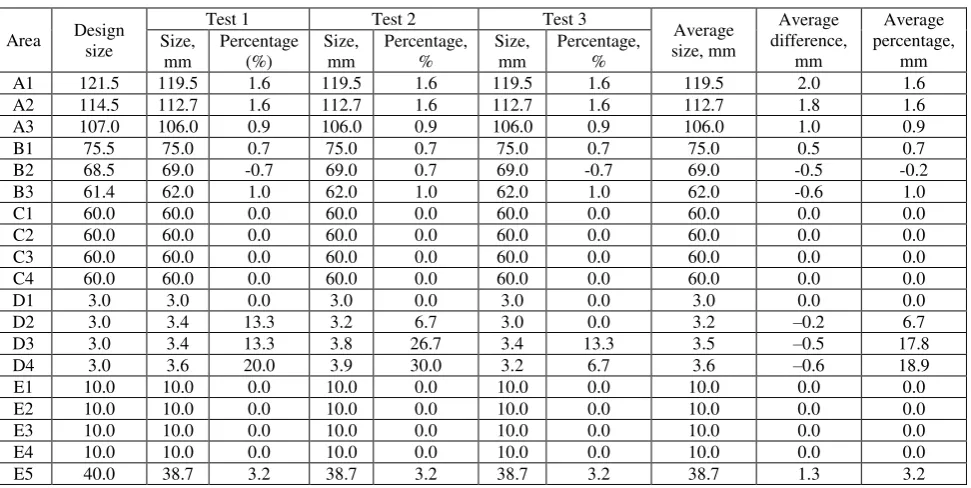
In Table 3, there is a comparison of the size and per-centage of non-conformity with the experiment. In area A which represents the long dimension, the percentage of non-conformity with the design is 0.52 %, in area B is 0.43 %, in area C is 0%, in area D is 10.8 %, in the area of E1–4 – 0 % and in the E5 area the height of the angle is 3.2 %.
Data Table 3 shows that PLA can be used as a wax-making mold. This is evidenced by the comparison of the overall size of the design with the experiment of 0.29 mm, as shown in Figure 6. Mold wax made from PLA has an average difference with experiments in the length dimension 0.6 mm, width of 0.17 mm, height of 0.05 mm and thickness of 0.65 mm. This means that PLA can be used for parts that have a tolerance below 1 mm.
Table 3 Results of the size experiment and presentation of non-conformity design
Area Design size
Test 1 Test 2 Test 3
Average size, mm
Average difference,
mm
Average percentage,
mm Size,
mm
Percentage (%)
Size, mm
Percentage, %
Size, mm
Percentage, %
A1 121.5 119.5 1.6 119.5 1.6 119.5 1.6 119.5 2.0 1.6 A2 114.5 112.7 1.6 112.7 1.6 112.7 1.6 112.7 1.8 1.6 A3 107.0 106.0 0.9 106.0 0.9 106.0 0.9 106.0 1.0 0.9 B1 75.5 75.0 0.7 75.0 0.7 75.0 0.7 75.0 0.5 0.7 B2 68.5 69.0 -0.7 69.0 0.7 69.0 -0.7 69.0 -0.5 -0.2 B3 61.4 62.0 1.0 62.0 1.0 62.0 1.0 62.0 -0.6 1.0 C1 60.0 60.0 0.0 60.0 0.0 60.0 0.0 60.0 0.0 0.0 C2 60.0 60.0 0.0 60.0 0.0 60.0 0.0 60.0 0.0 0.0 C3 60.0 60.0 0.0 60.0 0.0 60.0 0.0 60.0 0.0 0.0 C4 60.0 60.0 0.0 60.0 0.0 60.0 0.0 60.0 0.0 0.0
D1 3.0 3.0 0.0 3.0 0.0 3.0 0.0 3.0 0.0 0.0
C 4 MANUFACTURING ENGINEERING: Materials Science
Figure 6 – Average difference between the design and experiments
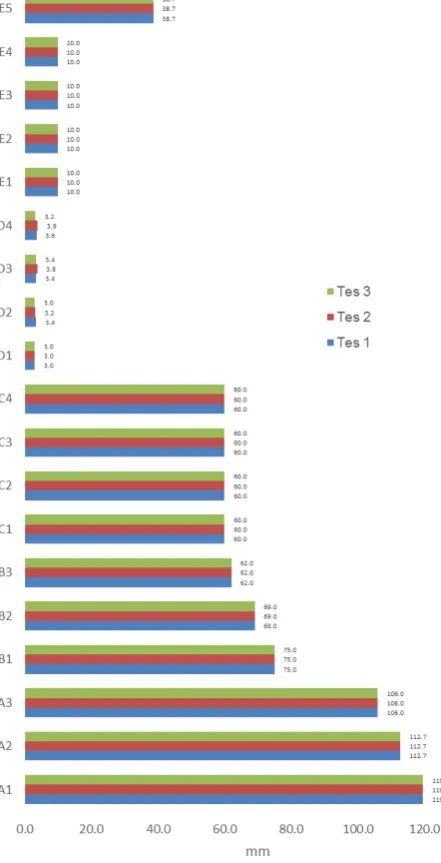
Table 3 shows the consistency of experimental results 1 to 3. It can be seen that the results of the area A1 of the overall wax pattern consistently produce a measurement of 119.5 mm. Likewise for A2 and A3 areas produce consistent sizes. In area B, there is also a consistent measurement between the first experiment and the third. In area C, which represents a high dimension, it is con-sistent with all experimental results and also in accord-ance with the size of the design. PLA-based molds are also able to form angles consistently, this can be seen in the E1–4 areas which still show the same size in each experiment, and more than that the resulting dimensions are the same as the design size. This can be seen further in Figure 7, which shows the constitution of experimental results.
But this is different from area D which represents the thickness dimension; there are inconsistencies size of experimental result 1, 2 and 3. This is due to the PLA pattern that has shaped mold wax has changed. The first change occurs when the mold is finished with 3D Print-ing, the second change occurs when the mold is poured into wax which reaches a temperature of approximately 110 °C. This makes PLA experience a sideways change in shape, where the inner and outer molds are narrowed and widened. This can be seen when experiments 1, 2, and 3 results vary. Form changes can be reduced by en-larging the thick dimensions of the mold.
PLA is able to form a wax pattern that has the com-plexity of objects with the same results in each process, but this is only to produce in small quantities. If used continuously with quantity equated with molds made of metal, PLA-based mold will change shape and will pro-duce products that are not precise anymore. Continuous heat when pouring wax into molds made from PLA will cause the mold to change shape continuously, this is what will cause inconsistency.
4
Conclusions
PLA-based molds are able to print origami pattern crash box well, this can be seen by the clear printing of sharp indentations both inside and outside. But the sur-face does not have a smooth sursur-face, this is because fol-lowing the results of the surface roughness of 3D Printing products. It is necessary to examine more effective ways to smooth the surface of the results of 3D Printing.
Percentage of nonconformity with design area A at 0.52 %, area B at 0.43 %, area C at 0 %, area D at 10.8 %, area E1–4 at 0 % and area E5 – at 3.2 %.
Figure 7 – Consistency of the experimental results
PLA can be used as a mold composition used for wax making. This is evidenced by the comparison of the over-all size of the design with the experiment of 0.29 mm.
Journal of Engineering Sciences, Volume 6, Issue 1 (2019), pp. C 1–C 5 C 5
5
Acknowledgements
The researchers would like to express a deep gratitude to the Ministry of Research, Technology and Higher Edu-cation, the Directorate General of Strengthening Research
and Development, and the Directorate of Research and Community Service that has financed the entire research, Announcement 0045/E3/LL/2018, January 16, 2018.
References
1. Farbman, D, & McCoy, C. (2016). Materials Testing of 3D Printed ABS and PLA Samples to Guide Mechanical Design. ASME
International Manufacturing Science and Engineering Conference, Vol. 2, V002T01A015, doi: 10.1115/MSEC2016-8668.
2. Huang, P.-H., & Lin, C.-J. (2015). Computer-aided modeling and experimental verification of optimal gating system design for investment casting of precision rotor. International Journal of Advanced Manufacturing Technology, Vol. 79(5–8), pp. 997– 1006, doi: 10.1007/s00170-015-6897-5.
3. Kuo, C.-C., Chen, W.-H., & Xu, W.-C. (2017). A cost-effective approach for rapid manufacturing wax injection molds with complex geometrical shapes of cooling channels. International Journal of Advanced Manufacturing Technology, Vol. 91(5–8), pp. 1689–1695, doi: 10.1007/s00170-016-9886-4.
4. Kuo, C.-C., & Shi, Z.-S. (2012). Fabrication of a high precision silicon rubber mold for replicating wax patterns of cylinder heads. Indian Journal of Engineering and Materials Sciences, Vol. 19, pp. 157–162.
5. Kuo, C.-C., & Tsai, R.-L. (2015). Fabrication and Application of Low-pressure Wax Injection Rapid Toolings. Polymers and
Polymer Composites, Vol. 23(9), pp. 647–652.
6. Kusyairi, I. (2017). The Influence Of Origami And Rectangular Crash Box Variations On MPV Bumper With Offset Frontal Test Examination Toward Deformability. Journal of Energy, Mechanical, Material and Manufacturing Engineering, Vol 2, No. 2, pp. 1–8.
7. Liu, C., et al. (2015). Influence of complex structure on the shrinkage of part in investment casting process. International
Jour-nal of Advanced Manufacturing Technology, Vol. 77(5–8), pp. 1191–1203, doi: 10.1007/s00170-014-6523-y.
8. Ma, J., & You, Z. (2013). Energy Absorption of Thin-Walled Square Tubes With a Prefolded Origami Pattern – Part I: Geome-try and Numerical Simulation. ASME Journal of Applied Mechacics, Vol. 81(1), art. no. 011003-011003-11, doi: 10.1115/1.4024405.
9. Rahmati, S., Akbari, J., & Barati, E. (2007). Dimensional accuracy analysis of wax patterns created by RTV silicone rubber molding using the Taguchi approach. Rapid Prototyping Journal, Vol. 13(2), pp. 115–122, doi: 10.1108/13552540710736803. 10. Rani, D. (2013). Recycling of Pattern Wax In The Investment Casting Process Using Microwave Dewaxing. IOSR Journal of
Engineering, Vol. 3, pp. 5–10, doi: 10.9790/3021-03520510.
11. Sandhu, C. S., & Sharma, A. (2012). Investigation Of Optimize Wax Pattern In The Investment Casting By Using The Different Form Of Waxes. IOSR Journal of Mechanical and Civil Engineering, Vol. 3(4), pp. 1–6, doi: 10.9790/1684-0340106.
12. Wang, S., & Millogo, J. (2012). Rapid prototype mold for wax patterns with the help of phase change materials. International
Journal of Advanced Manufacturing Technology, Vol. 62(1–4), pp. 35–41, doi: 10.1007/s00170-011-3784-6.
Дослідження полілактиду
як матеріалу для свічкового лиття
в
руйнівних шаблонах у формі орігамі
Кусяірі І.1, Хімаван Х. М.1, Хоірон М. А.2, Іраван Й. С.2
1Державний політехнічний інститут м. Маланґ , вул. Джалан Сукарно Хатта,9, 65141, м. Маланґ, Індонезія; 2Університет Бравіджайа, вул. Джалана, 65145, м. Маланг, Індонезія
Анотація. Стаття присвячена експериментальним дослідженняи полілактиду, надрукованого за технологією тривимірного друку руйнівного шаблону формі орігамі, призначеного для автомобільної промисловості. Перший етап досліджень присвячений моделюванню шаблона з подальшим проектуванням
форми для свічкового лиття із застосуванням відповідного програмного забезпечення. Другий етап
стосується лиття приблизно 56год. і 31 хв. з витратами волокон полілактиду довжиною 16,38 м вагою 128 г.
Після виливання карнаубського воску з температурою розливання у прес-форми 110 °С, матеріал
охолоджується впродовж 11 хв., після чого форма виділяється. На останньому кроці відбувається перевірка.
У результатіексперименту встановлено, що форма з полілактиду здатна відбивати добре вираженийрисунок руйнівного шаблону.Підтверджене чітке відбиття різких відступів як внутрішніх, так і зовнішніх. Відсоткова
невідповідність форми у зоні A складає 0,52 %, B – 0.43 %, C – 0 %, D – 10.8 %, E1–4 – 0% і E5 – 3.2 %.
Порівняльний аналіз підтвердив загальне відхилення форми від експериментальних даних 0,29 мм. Таким
чином, продемонстрована послідовність експериментальних досліджень полілактиду в зонах A, B, C і E.
Проте є невідповідність експериментальних даних узоні D, що відповідає за товщину, урезультаті зміни
форми шаблона під впливом температури розливання воску.