The objective of this study is to examine the role of consumer global orientation and the inferior image of foreign brands in young, educa-ted consumers’ admiration for foreign brands and their willingness to pay more for foreign brands. The sample of this study was used students of the University of Mataram. Data collected in a classroom at the end of lecture by using a carefully developed instrument that has been carefully developed and well validated. Its findings suggest that consumer global orientation and the inferior image of local brands have no direct effect on consumers’ willingness to pay more for foreign brands. Nonetheless, they do indirectly affects consumer intentions by creating positive emotions about foreign brands. This positive emotion, i.e. foreign brand admiration, seems to have a critical role, as it fully mediates the effects of the two constructs. Consumer global orienta-tion and the inferior image of local brands nurture consumers’ positive views of foreign brands, which in turn increase consumer willingness to pay higher prices for foreign brands. This study also conceptualizes consumer global orientation and provides the essential recommenda-tions for future research.
Tujuan dari penelitian ini adalah untuk menguji peran orientasi global konsumen dan citra inferior merek lokal terhadap kekaguman merek asing dan kesediaan untuk membayar lebih untuk merek asing di kalangan konsumen muda yang berpendidikan. Penelitian ini menawarkan konseptualisasi orientasi global konsumen dan menguji dampaknya terhadap kekaguman pada merek asing dan kesediaan untuk membayar lebih untuk merek asing. Sampel penelitian adalah mahasiswa Universitas Mataram melalui pengaturan kelas yaitu kegiatan disisipkan diakhir perkuliahan. Instrumen dikembangkan secara hati-hati dan diuji secara bertahap. Temuan menunjukkan bahwa orientasi global konsumen dan citra inferior merek lokal tidak berpengaruh secara langsung pada kesediaan konsumen untuk Keywords:
Consumer global orientation, inferior image of local brands, foreign brand admiration
Corresponding author: [email protected]
Sulhaini, Rahman Dayani, Sulaimiah, Rusdan
Universitas Mataram, Jl. Majapahit no 62, Selaparang, Kota Mataram, Nusa Tenggara Barat - IndonesiaA R T I C L E I N F O A B S T R A C T
Consumer Global Orientation and Its Impact
on Consumers’ Positive Emotions
S A R I P A T I
INTRODUCTION
The development of information technology has created greater opportunities for consumers to learn about global brands and their products. They have a wider selection, as well as the ability to evaluate a wide range of brands from various countries. Consumers in developing countries have become more familiar with global brands, as well as greater opportunity to compare said brands with local ones when shopping on- or offline. They can evaluate and assess product features and brand attributes in selecting from the various options available. The rapid development of information technology has also allowed consumers to continually collect information about various objects in the global world, including global products and brands. As a group, young, educated consumers frequently rely on advanced technology, which enables them to access information from various domestic and international sources. Technological developments have also allowed young consumers in developing countries to become key consumers in the global market, as they have shown a strong orientation towards global products and brands.
Although this trend has been widespread in developing countries, the literature on global marketing has yet to provide sufficient explanations. It has, however, shown that consumers have
interests and emotional connections with specific brands, which may be positive or negative depending on these brands’ country of origin. Previous studies in developing countries have shown that consumers have a strong preference for brands from developed countries (Zhuang, Wang, Zhou, & Zhou, 2008; Dikčius & Stankevičienė, 2010). Consumers in developing countries consider brands from developed countries to be of better quality than those from their own countries. They prefer these brands for social status, prestige, and pride, but owing to financial limitations many cannot afford them. They admire foreign brands, which are often also global brands, and crave them. Conversely, they have poor perceptions of local brands, which they consider inferior. This study offers a conceptualization of global consumer orientation and examines its impact on foreign brand admiration and willingness to pay more for products by foreign brands. It seeks to examine the role of global consumer orientation and the inferior image of foreign brands in young, educated consumers’ admiration for foreign brands and willingness to pay more for them.
Defining Consumer Global Orientation
Consumer global orientation has emerged and grown stronger over time, as widely implied in previous studies in developing countries (i.e. Lee, Knight & Kim, 2008; Bhardwaj, Kumar, & Kim,
membayar lebih untuk merek asing. Meskipun demikian, keduanya memiliki efek tidak langsung pada niat konsumen melalui dampaknya pada emosi positif konsumen terhadap merek asing. Emosi positif yaitu kekaguman pada merek asing memiliki peran penting karena sepenuhnya memediasi efek dari konstruk tersebut. Orientasi global konsumen dan citra merek lokal yang inferior memupuk emosi positif konsumen terhadap merek asing, yang pada gilirannya menginspirasi niat konsumen untuk membayar dengan harga yang lebih tinggi untuk merek asing. Artikel ini membangun konsep orientasi global konsumen dan memberikan implikasi manajerial dan saran bagi penelitian yang akan datang.
2010; Gineikiene, Schlegelmilc, & Auruskeviciene, 2017), but it has not been explicitly conceptualized and measured. Reifler (2012) did propose a concept of global attitude and global consumer orientation, defining the latter as consumer response to the availability of global products and services that form consumer lifestyles. Global attitude differs from global consumer orientation; where the first covers attitudes towards the globalization of the world market (macro-level) the second refers to consumers’ lifestyles in relation to global products (micro-level). Riefler (2012) also explains the term globalization attitude (GA) can refer to the support or opposition to globalization. This attitude demonstrates consumers’ overall attitudes towards the global integration process, including the free movement of labor, capital, and products, especially those that have liberalized their markets. Global brands such as Coca-Cola, Levi’s, and McDonald’s may be perceived as symbols of a global lifestyle, depicting the diversity of consumer culture, but are also frequent targets of anti-globalization groups. Consumers in different countries show different attitudes towards market globalization, in which global companies have a central role. It is not surprising that differences in attitudes towards globalization are often addressed by consumers’ interactions with global products or brands. Consumers may exhibit preferences for global brands (thereby showing a positive attitude toward globalization) or opposition to said brands, often paired with support for local ones (thereby showing a negative attitude towards globalization).
Similarly, Naseem, Verma & Yaprak (2015) define global consumer orientation as consumers’ attitudes towards the spreading of global consumption culture. However, for the purpose of this study, we understand consumer global orientation as an orientation held by consumers. We define it as consumers’ tendency to support the globalization of markets and follow brand-and product-related trends as a consequence of market globalization, based on the belief that globalization
is a symbol of modern civilization. This includes consumers’ tendencies as related to the macro and micro sides of market globalization. Consumers with a high global orientation will demonstrate a strong and positive attitude towards globalization, know and track the development of global products and brands, be proud to be part of the global community, and feel great as consumers of global products and brands. Conversely, contrary, consumers with a weak global orientation will show a weak orientation towards globalization and foreign brands/products.
Hypothesis Development
The liberalization of trade on the world market has opened opportunities for brands from developed countries to gain ground rapidly abroad, especially in developing countries. In such countries, despite the impetus for purchasing domestic brands and products, foreign brands, especially from western/ developed countries, are preferred because they are considered of superior quality, and thus contribute to consumers’ social prestige and pride (Kinra, 2006).
Brands from the developed world have emerged and expanded rapidly, supported by media deve-lopments and consumer mobility. This has crea-ted a uniform global consumer culture, in which consumers show a strong preference for global brands where purchasing or consuming goods (Lee, Knight & Kim, 2008). The more they know global brands, the more positive their attitudes towards global/foreign brands (Frank, 2016).
(i.e. a high standard of quality) (Chang, 2008). This has motored the tendency for local companies in developing countries to use foreign branding strategies to reach domestic consumers.
In general, young consumers in developing countries have become increasingly interested in materialistic lifestyle and consumption, part of their desire to maintain their status. Young consumers in developing countries hope that, by following a Western lifestyle and purchasing global brands, they will appear superior (Kumar, Lee, & Kim, 2009). They crave the glamor of the lifestyle they see through various electronic media. Foreign brands are seen as symbols of cosmopolitan society, and modernization is desired by consumers who are oriented towards emulating the (often materialistic) values of advanced (Western) societies (Zhuang, Wang, Zhou, & Zhou, 2008).
Foreign brands in developing countries are seen as creating certain impressions that create social status and respect (Lee, Knight & Kim, 2008).
Therefore, young consumers, who tend to be open to foreign cultures, are frequently more open to foreign brands as they are associated with global participation and citizenship (Pham & Richard, 2015). This has been reinforced by a view that foreign brands (mostly from the West) and modern lifestyles are important symbols of global society. Consumers admire foreign brands and their effect on their social status (Pham & Richard, 2015) and means of expressing their identities as modern human beings (Halkias, Davvetas, & Diamanopoulos, 2016). Young consumers generally want to distinguish themselves from others through brands that make them feel ’’cool’’, and they are not reluctant to pay a high price for such brands (Noh, Runyan, & Mosier, 2014). Young consumers, who have a strong tendency to support globalization, frequently express positive views of global brands, or other brands that generally come from developed countries. Owing to the many perceived benefits of foreign brands,
they are compelled to pay more for these brands. Foreign brands are seen as being worth a higher price, as they offer more benefit to consumers. As such, the first and second hypotheses of this study are as follows:
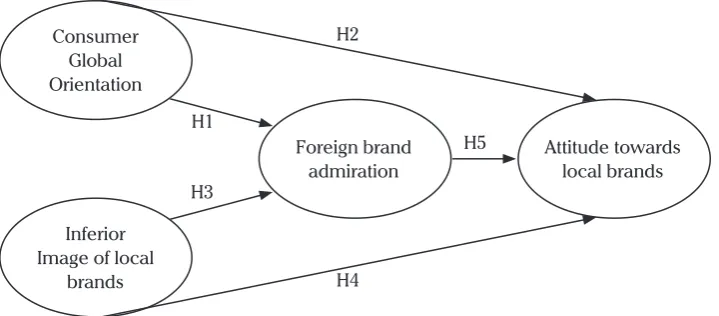
H1: The stronger the global consumer orientation, the stronger the foreign brand admiration.
H2: The stronger the global consumer orientation, the stronger the willingness to pay more for foreign brands.
Perspectives of brand origins show that consumers often use their impressions of these brands’ source countries to evaluate them, ignoring all other brand attributes. The image of the source country thus informs consumers’ evaluation of brands (Diamantopoulos, Schlegelmilch, & Palihawadana, 2009). A brand’s image is associated with its source country’s, and thus varies based on the source country’s (economic, technological, and political) developmental stage. In general, more developed countries have brands with better brand images; this demonstrates the halo effect in brand evaluation, as discussed above. Conversely, unfavorable views of source countries can harm the image of brands from these countries. As such, where consumers in developing countries have an inferior image of their own countries, they will have an inferior image of local brands. Consumers prefer brands from countries with superior abilities, the positive reputations of which strengthen their brands. Consumers, especially young ones in developing countries, have a strong fondness for foreign (Western) brands, while generally perceiving local brands negatively. They lack trust and pride in local brands (Balabanis & Diamantopoulos 2011), seeing them as low quality brands with bad reputations. They are seen as embarrassing, problematic, and unpleasant.
& Hu, 2016). Bhardwaj, Kumar, & Kim, 2010) found that Indian consumers view local brands as inferior, instead preferring foreign brands. Often, local brands are seen as having lower quality than foreign brands (Herstein, Roger. & Jaffe, 2014), with little functional value, low prestige, and limited social value (Halkias, Davvetas, & Diamanopoulos, 2016; Zhou, Yang, & Hui, 2016; Kaufmann, Laureiro, & Manarioti, 2016), and being unreliable, unsafe, and offering little status or reward (Kinra, 2006). Local brands cannot provide the benefits of foreign brands, which are seen as offering uniqueness, emotional value, and better quality (Kumar, Lee, & Kim, 2009), and being luxurious, glamorous, exclusive, innovative, and more upscale (Jin, Chansarkar, & Kondap, 2006). This is the driving force behind consumers’ strong admiration for global brands in developing countries (Zhou, Yang, & Hui, 2016; Kaufmann, Laureiro, & Manarioti, 2016). Therefore, it is reasonable to assume that young, educated consumers in developing countries are willing to pay more for foreign brands as they perceive the brands as being more beneficial and of higher quality than local brands. The following hypotheses can thus be submitted:
H3: The more inferior the image of local brands, the stronger the admiration for foreign brands
H4: The more inferior the image of local brands, the stronger the desire to pay more foreign brands.
Aaker, Garbinsky, & Vohs,. (2012) understand brand admiration as a positive emotions held by consumers for particular brands. Consumers who admire a brand will regard it as exceptional, and evaluate it and its capabilities positively. This emotional response can arise without any actual consumption by consumers, who may admire a brand or show great willingness to own/use but lack sufficient resources to acquire it (either due to cost or lack of availability). For young consumers, many of whom are not yet working, foreign brands are seen as too expensive, and being better suited
to the rich. As such, owing to their limitations they are very likely crave a brand without actually having had a positive experience consuming it. As such, consumers’ admiration does not merely arise from the satisfaction of using or enjoying the benefits of a brand. This is particularly prominent in developing countries, where consumers often admire foreign brands that they see in Hollywood movies but are unable to consume. This admiration of foreign brands means showing positive emotions towards brands from developed/Western countries, as they have been perceived as superior by consumers. This may be expressed in the following forms: interest, thought, desire, passion, admiration, and attraction.
Young consumers are viewed as ’’status seekers’’,
looking for the products or brands that offer them status, prestige, and self-image (Bhardwaj, Kumar, & Kim, 2010). They have a strong desire to own and consume foreign brands that are seen as prestigious (Nejati & Moghaddam, 2012; Noh, Runyan, & Mosier, 2014) and signal wealth, status, and power (Kumar, Lee, & Kim, 2009; Zhu, Yu, & Hu, 2016). This strong desire will result in greater willingness to pay at higher prices (Thanasuta, Patoomsumawan, Chaimahawong, & Chiaravutthi, 2009). For this, they are willing to pay higher prices (Srivastava, 2011). The following hypothesis is thus proposed:
H5: The greater the foreign brand admiration, the greater the willingness to pay more for foreign brands.
Briefly, the identifiable discussions and hypotheses can be described as fitting the conceptual framework below.
METHODS
Sampling
Sampling involved students of the University of Mataram, who had very diverse backgrounds in terms of origin, ethnicity, religion, and race. A total of 214 students, from eight faculties, were used as samples. Members of the sample group were
aged between 17 and 24 years; 44.9 percent of students were male and 55.1 percent were female. Sampling took into consideration the argument of Phau (2010) that students can be appropriate and representative samples in consumer behavior research, as they are representative of the future behavior of domestic consumers and will ultimately become decision makers promoting national welfare. Furthermore, they are very open to foreign brands, making them a target market for these brands’ owners (Frank, 2016). This research will provide an important insight into the potential for strengthening local brands’ ability to face competition in the domestic market. As Indonesia has become an increasingly open market, local brands require the support of domestic consumers to compete with imported brands.
The Instrument
The instrument was carefully developed through several stages. First, a literature study was used to develop a deep understanding of all variables under study and identify their dimensions. The second stage involved discussions and reviews with lecturers at marketing management courses. Third, qualitative interviews were conducted with five respondents to verify the dimensions identified in the first stage. This allowed the researchers to revise the items developed in previous stages.
Foreign brand
admiration Attitude towards local brands Consumer
Global Orientation
Inferior Image of local
brands
H1
H2
H4 H3
H5
Respondents were given a brief introduction regarding the questionnaire’s purpose. They were also provided with short, clear instructions on answering it. Each respondent was asked to
rate every statement on the questionnaire on a scale from 0 to 10. For the purpose of the study, electronic products were selected, as Indonesian electronic products suffer an unfavorable image
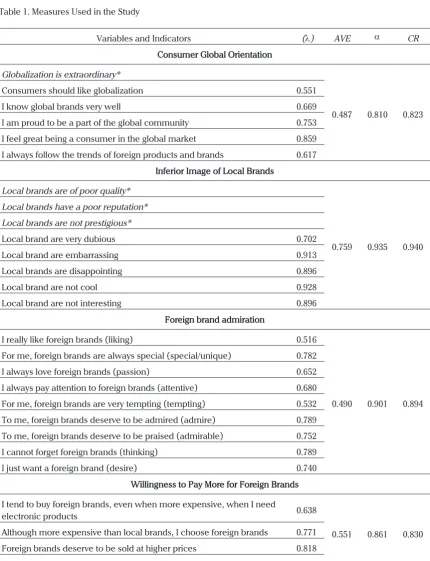
Variables and Indicators (λ) AVE α CR
Consumer Global Orientation
Globalization is extraordinary*
0.487 0.810 0.823
Consumers should like globalization 0.551
I know global brands very well 0.669
I am proud to be a part of the global community 0.753 I feel great being a consumer in the global market 0.859 I always follow the trends of foreign products and brands 0.617
Inferior Image of Local Brands
Local brands are of poor quality*
0.759 0.935 0.940 Local brands have a poor reputation*
Local brands are not prestigious*
Local brand are very dubious 0.702
Local brand are embarrassing 0.913
Local brands are disappointing 0.896
Local brand are not cool 0.928
Local brand are not interesting 0.896
Foreign brand admiration
I really like foreign brands (liking) 0.516
0.490 0.901 0.894 For me, foreign brands are always special (special/unique) 0.782
I always love foreign brands (passion) 0.652
I always pay attention to foreign brands (attentive) 0.680 For me, foreign brands are very tempting (tempting) 0.532 To me, foreign brands deserve to be admired (admire) 0.789 To me, foreign brands deserve to be praised (admirable) 0.752
I cannot forget foreign brands (thinking) 0.789
I just want a foreign brand (desire) 0.740
Willingness to Pay More for Foreign Brands
I tend to buy foreign brands, even when more expensive, when I need
electronic products 0.638
0.551 0.861 0.830 Although more expensive than local brands, I choose foreign brands 0.771
Foreign brands deserve to be sold at higher prices 0.818 High-quality foreign brands are worth selling at a higher price 0.731
*Item deleted as its loading was less than the threshold
in the world market (Chu, Chang, Chen, & Wan,
2010).
Measurement Model Analysis
Assessing the validity and reliability of measurement models was conducted. The measure was purified through a stepwise procedure on the basis of substantial cross loading. The results are displayed in Table 1, which reveals that only one item of consumer global orientation and three items of local brand inferior image were deleted as they had a loading factor under the threshold of 0.50 (Hair, Black, Babin, Anderson, & Tatham, 2010); others were well above the threshold, and all were significant at p<0.05. This also indicates Cronbach’s alpha values and composite reliability as being greater than the common cut-off value of 0.70 (Hair, Black, Babin, Anderson, & Tatham, 2010). Nonetheless, the Average Variance Extracted (AVE) for two constructs was just below the threshold of 0.50, suggesting the inadequacy of convergent validity. Support for reliability and convergent validity was, however, provided by composite reliability. The values were all above 0.80, exceeding the threshold of 0.70.
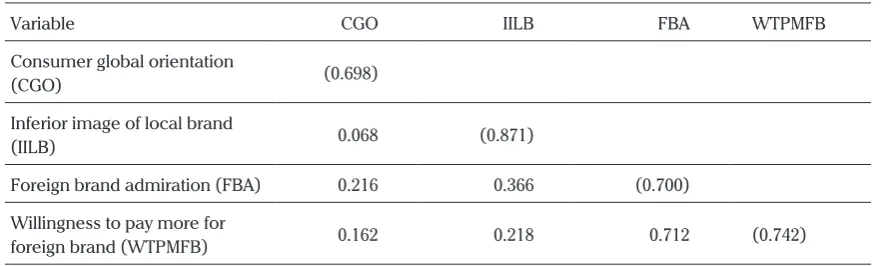
Furthermore, another important validity test (i.e. the discriminant validity test) was conducted by comparing the AVE of each construct with the shared variance/squared correlation between each pair of constructs (Fornell & Larcker, 1981)
and by constructing 95 percent confidence intervals. Table 2 displays the values of correlation and squared correlation between constructs. In all cases, the AVE was greater than the squared correlation. The results show that discriminant validity is established.
RESULTS AND DISCUSSIONS
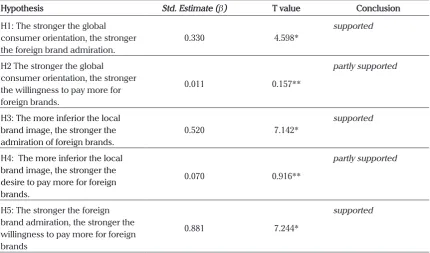
After going through the processes of validity and reliability analysis, the analysis process continued with analysis of structural models for hypothesis testing. Before interpreting the structural model, we first analyzed its fit to the structural model to assess whether the data was feasible as structurally modeled. The results were as follows: CMIN / DF: 1.908; RMSEA: 0.065, GFI: 0.859; CFI: 0.944; TLI: 0.932. This shows that the model fit satisfactorily. Table 3 displays the result of hypothesis test.
The results indicate that direct effects global consumer orientation and local brands’ inferior image on consumers’ willingness to pay more for foreign brands were not supported by the data. However, these constructs affect willingness through foreign brand admiration. As such, foreign brand admiration fully mediates both constructs.
The results of data processing, as indicated in the table above, show that consumers’ global orientation and the inferior image of local brands have no significant effect on their willingness
Variable CGO IILB FBA WTPMFB
Consumer global orientation
(CGO) (0.698)
Inferior image of local brand
(IILB) 0.068 (0.871)
Foreign brand admiration (FBA) 0.216 0.366 (0.700)
Willingness to pay more for
foreign brand (WTPMFB) 0.162 0.218 0.712 (0.742)
All significant at p< .05; the diagonal (in italics) shows the square root of the average variance extracted for each construct
to pay more for foreign brands. This shows that, when young consumers have a strong global orientation, they are not necessarily willing to pay more for foreign brands (of electronic products). Similarly, when consumers have bad perceptions of local brands, this does not make them willing to pay more for foreign brands. However, these two variables indirectly influence consumers’
willingness to pay more for foreign brands through foreign brand admiration; as such, this variable acts as a moderator of both variables.
Globalization is against trade protection, and cultivates an open attitude to foreign brands (Maher, Clark, & Maher, 2010). The results of this study show that young, educated consumers react
Table 3. Hypotheses test result
Hypothesis Std. Estimate (β) T value Conclusion
H1: The stronger the global consumer orientation, the stronger the foreign brand admiration.
0.330 4.598*
supported
H2 The stronger the global consumer orientation, the stronger the willingness to pay more for foreign brands.
0.011 0.157**
partly supported
H3: The more inferior the local brand image, the stronger the admiration of foreign brands.
0.520 7.142*
supported
H4: The more inferior the local brand image, the stronger the desire to pay more for foreign brands.
0.070 0.916**
partly supported
H5: The stronger the foreign brand admiration, the stronger the willingness to pay more for foreign brands
0.881 7.244*
supported
*significant at p < 0.001. ** insignificant at p<0.05
F B A W T P M F B C G O
I I L B
H1 0.330*
H2 0.011
H4 0.070 H3
0.520*
H5 0.881*
Figure 2: The Structural Model
positively to foreign brands due to their orientation towards globalization. This orientation nurtures positive emotions on foreign brands through brand admiration. Young, educated consumers seem to have a strong sense of foreign brand admiration, and where they have a strong orientation toward the dispersion of globalization they generally show a strong preference for global brands. Globalization thus makes young, educated consumers favor foreign brands/products. They are open to these products. They know more of them, and always update their knowledge of them. They show positive attitudes or evaluate them positively and cultivate positive emotions. They are proud to be part of the global market and for them global brands are symbols of the global community. All of this reinforces their fondness for foreign brands, which they consider better than local ones, and as global consumers they feel it appropriate to desire foreign brands, especially those from developed countries.
Similarly, the inferior image of local brands was found to promote foreign brand admiration, and thereby affected students’ willingness to pay more for foreign brands. When young, educated consumers perceive local brands as having inferior image, they will search for alternatives. When they view local brands as unpleasant, unprofessional, disappointing, embarrassing, and unattractive, they will admire foreign brands, especially those from developed countries that are considered more qualified and worthy of admiration. This confirms the findings of Zhou, Yang, & Hui. (2016) and Kaufmann, Laureiro, & Manarioti (2016), who explain that foreign brands are perceived as having higher (quality and prestige) value than local brands. Foreign brands are seen as having a superior position in developing countries. Young, educated consumers consider foreign brands to be more prestigious because they come from more reputable countries. Furthermore, this study shows that young consumers have a desire to pay more for foreign brands because they love their names, a fondness that motors their willingness
to spend more money for brands. Kumar, Lee, & Kim, 2009) found that positive emotions may give rise to stronger buying desire; this study likewise shows that positive emotions towards foreign brands can reinforce the desire to pay more for foreign brands.
MANAGERIAL IMPLICATIONS
This study has some important managerial implications for local brand owners. First, the results of this study shows that consumer global orientation positively influences their willingness to pay more for foreign brands through foreign brand admiration. Also, as shown by many previous researchers, admiration of local brands can be developed using a foreign brand name strategy (i.e. using brand names that imply that the brand comes from a country from a more positive image). However, in the long term, this can ultimately strengthen admiration of foreign brands and adversely affect belief in the nation’s ability to produce strong brands (as well as the country’s image in the minds of young domestic consumers). Second, this research confirms that, when young consumers have a negative image of local brands, they will admire foreign brands. The owners of local brands must strive to improve the quality of their products, thereby creating positive emotional value and communicating superiority without much emphasis on brand origin. Third, local brand owners actually have an advantage over foreign brands, because they are closer and more familiar with domestic consumers. This knowledge can inspire innovation and creativity in product production and marketing communications, thereby increasing the desirability of local brands
CONCLUSION
they interact with local brands and foreign brands, as well as their desire to pay more for foreign brands.
This research has shown that a strong global consumer orientation leads young consumers to show positive emotions in the form of strong admiration. They support globalization and are proud to be global consumers and love foreign brands as symbols of their position. However, they have a negative view of local brands, craving instead foreign brands that they considered more qualified and more prestigious. When they view local brands as disappointing, they will crave foreign brands as alternatives. The study also shows that, when young, educated consumers hold strong, positive emotions about foreign brands, they will have a stronger intention to pay more for foreign brands that they perceive as better.
Limitation and future research directions
This research has made an important contribution to the literature on international/global marketing,
but as with most research, nothing is perfect. This study has several limitations that reduce the general applicability of its findings. First, only one type of product category was discussed: electronics. Other studies must test these findings with other categories such as food, cosmetics, and clothing, which may be more immune from the effects of globalization. Second, the surveying of a sample of students also limits the generalization of the findings. Subsequent research should include a variety of consumer segments to represent the consumer population. Third, research can be replicated in other developing countries using samples that emphasize diversity in demographic backgrounds. Fourth, this research involves the construction of consumers’ desire to pay more for foreign brands; future studies can incorporate actual purchase decisions, rather than intentions, i.e. willingness to pay more. Fifth, subsequent research should integrate the various concepts in the literature, such as the country of brand origin, consumer ethnocentrism, local brand consciousness, etc. to obtain a broader explanation.
R E F E R E N C E S
Aaker, J.L., Garbinsky, E.N., and Vohs, K.D. (2012). Cultivating admiration in brands: warmth, competence, landing in the golden quadrant, Journal of Consumer Psycology, 22,191-194.
Balabanis, G., Diamantopoulos, A., Mueller, R.D and Melewar, T.C. (2001) The impact of nationalism, patriotism and internationalism on consumer ethnocentric tendency, Journal of International Business Studies, .32(1), 157 -175. Bhardwaj, V., A. Kumar, and Y.-K. Kim. (2010). Brand Analyses of U.S. Global and Local Brands inIndia: The Case of Levi’s.
Journal of Global Marketing 23 80–94.Wine Business Research, 26(2 ), 97-119.
Chang, C. (2008). The Effectiveness of Using global look in an Asian Market. Journal of Advertising Research, June, 199 - 214 Chu, P.-Y., C.-C. Chang, C.-Y. Chen, and T.-Y. Wang. (2010). Countering negative country of origin effects The role of evaluation
mode. European Journal of Marketing, 44 (7/8),1055-1076.
Diamantopoulos, A., B. B. Schlegelmilch, and D. Palihawadana. (2009). Country of Origin: A construct past its sell by date?, American Marketing Association, winter, 318-327.
Dikčius, V., and G. Stankevičienė. (2010). Perception of country of brand origin and country of product manufacturing among Lithuanians and emigrants from Lithuania. Organizations and Markets in Emerging Economies, 1(2),108 - 122.
Fornell, C., & Larcker, D. F. (1981). Evaluating structural equation models with unobservable variables and measurement error, Journal of Marketing Research, 18(1), 39–50.
Gineikiene, J., Schlegelmilc, B.B., and Auruskeviciene,V. (2017). ’’ours’’ or ’’Theirs’’? Psycological ownership and domestic products references, Journal of Business Research, 72,93-103.
Halkias, G., Davvetas, V. and Diamanopoulos. (2016). The interplay between country stereotypes and perceived brand globalness/localness as drives of brand preference. Journal of Business Research, September, 3621-3628.
Hair, J.F., Black, W.C, Babin, B.J., Anderson, R.E., and Tatham, R.L. (2010). Multivariate Data Analysis. Pearson Education International. New Jersey.
Herstein, R., Roger. R. and Jaffe, E.D. (2014). How Companies from developing and emerging countries can leverage their brand equity in terms of place branding, Competitiveness Review, 24(4), 293-305.
Jin, Z., Chansarkar, B., and Kondap, N.M. (2006). Brand origin in an emerging market: perceptions of Indian consumers, Asia Pacific Journal of Marketing and Logistic. 18(4),283-302.
Kaufmann, H.R, Laureiro, S.M.C, and Manarioti, A., (2016). Exploring behavioral branding, brand love and brand co-creation. Journal of Product and Brand Management, 25(6), 516-526.
Kinra, N. (2006). the effect of country of origin on foreign brand names in the Indian Market, Marketing Intelligence and Planning, 24(1),15-30.
Kumar, A. Lee, H. and Kim, Y. (2009). Indian Consumers’ purchase intention toward a united states versus local brand, Journal of Business Research, 62,521-527.
Lee, M., Knight, D. and Kim, Y. (2008). Brand Analysis of a US global brand in comparison with domestic brands in Mexico, Korea and Japan. Journal of Product and Brand Management, 17(3),163-174.
Maher, A.A., Clark, P. and Maher. A. (2010). International consumer admiration and the persistence of animosity, Journal of Consumer Marketing, 27(5), 414-424.
Naseem, N. Verma S., and Yaprak, A. (2015). “Global Brand Attitude, Perceived Value, Consumer Affinity, and Purchase Intentions: A Multidimensional View of Consumer Behavior and Global Brands”, In International Marketing in the Fast Changing World, Advance in International Marketing, 26, 55-288. http://dx.doi.org/10.1108/S1474-797920150000026012 Nejati, M. and Moghaddam, P.P. (2012). Gender differences in hedonic values, utilitarian values and behavioural intentions of
young consumers: insight from Iran, Young Consumers, 13(4), 337-344.
Nelissen, R.M.A., and Meijers, M.H.C. (2011). Social benefits of luxury brands as costly signals of wealth and status. Evolution and Human Behaviour, 32, 343-355.
Noh, M., Runyan, R. and Mosier, J. (2014). Young consumer’s innovatiness and hedonic/utilitarian cool attitudes, International Journal of Retail and Distribution Management, 42(4), 267-280.
Phau, I. (2010). An Australian perspective of the effects of brand image and product quality on diffusion brands of designer jeans. Journal of Global Business and Technology, 6(1/Spring), 41-51.
Pham, H. C., and B. Richards. (2015). The western brands in the minds of vietnamese consumers. Journal of Consumer Marketing, 32(5). http://dx.doi.org/10.1108/JCM-09-2014-1159
Riefler, P. (2012). Why consumers do (not) like global brands: The role of globalization attiitude, GCO and global brand origin, International Journal Research in Marketing, 29, 25-34.
Srivastava, R. K. (2011). Understanding brand identity confusion. Marketing Intelligence & Planning 29(4), 340-352.
Thanasuta, K. Patoomsumawan, T. Chaimahawong, V. and Chiaravutthi, Y. (2009). Brand and country of origin valuations of automobiles, Asia Pacific Journal of Marketing and Logistic. 21(3), 355-375.
Zhou, L., Z. Yang, and M. K. Hui. (2010). Non-local or local brands? A multi-level investigation into confidence in brand origin identification and its strategic implications, Journal of the Academy Marketing. Science. 38, 202-218.
Zhu, X., Yu., C. and Hu, S. (2016). Love for one’s country or oneself: A brand-choice framework in emerging markets, Social Behaviour and Personality, 44(2), 325-338.