www.astrophys-space-sci-trans.net/7/453/2011/ doi:10.5194/astra-7-453-2011
© Author(s) 2011. CC Attribution 3.0 License. Astrophysics and Space Sciences
Transactions
A method for real-time GLE modeling
E. V. Vashenyuk1, Yu. V. Balabin1, A. V. Germanenko1, and B. B. Gvozdevsky1 1Polar Geophysical Institute, KSC Russian Academy of Sciences, Apatity, Russia
Received: 15 November 2010 – Revised: 27 February 201 – Accepted: 30 March 2011 – Published: 26 October 2011
Abstract. By now real time systems of data collection of neutron monitor network have been created. The main goal of such systems is early detection of dangerous events of space weather, such as GLE, caused by arrival to the Earth of relativistic solar protons. Characteristics of these parti-cles are determined from the data of the worldwide neutron monitor network by methods of GLE modeling. Traditional GLE modeling requires data of no less than 30−35 stations and takes a long time of computations. We developed a trun-cated technique of solar proton spectrum determination by data of limited number (20−25) of neutron monitor stations and with a simplified procedure of computations adapted for operative diagnostics of relativistic solar protons just arriving to the Earth. Possibilities of this truncated GLE modeling for the early forecast of radiation-dangerous fluxes of solar par-ticles with moderate energies are also shown.
1 Introduction
The worldwide network of neutron monitors still remains a unique reliable source of data on relativistic solar protons (RSP) registered during Ground Level Enhancement (GLE) events. Characteristics of these particles are determined from the data of the worldwide neutron monitor (NM) network by means of GLE modeling (Shea and Smart, 1982; Cramp et al., 1997; Vashenyuk et al., 2009). At present, the sys-tems of real-time neutron monitor data are created. One of such systems is the NMDB (Neutron Monitor Data Base (www.nmdb.eu)). It is created within the framework of the European project PFP-7. It collects the data of 23 neutron monitor stations in real-time. In this connection, the task
Correspondence to: E. V. Vashenyuk
of express-analysis of neutron monitor data for derivation of characteristics of solar protons has arisen.
After obtaining an Alert-signal signifying the GLE onset (Anashin et al., 2009), the data of NM stations start being read out from the NMDB Internet-database. 1-min data of a counting rate of neutron monitors and barometric pressure are recorded. Subsequently the data are corrected for the barometric effect. Increase values relative to the background level before the event are computed. Asymptotic accepting cones for each station are computed simultaneously. The data arrays of increases and asymptotic directions for 23 sta-tions obtained in such a manner are input data for the least square problem. A solution of the problem is flux parame-ters of relativistic solar protons.
The traditional GLE modeling for determination of pa-rameters of RSP includes solving of an inverse problem (least square procedure) on the data of the worldwide neu-tron monitor network. At least 30–40 stations are neces-sary for such analysis (Shea and Smart, 1982; Cramp et al., 1997; Vashenyuk et al., 2009). The detailed computations of asymptotic viewing cones of the neutron monitors in mod-ern models of the geomagnetic field (Tsyganenko, 2002) are also required. For accurate determination of a spectrum of solar protons in the rigidity range of 5−20 GV, the asymp-totic directions are calculated with a step1R=0.001 GV for vertical and obliquely incident particles (Cramp et al., 1997; Vashenyuk et al., 2009).
Thus the number of calculated trajectories for one station could reach 200 000. The solving of the least square prob-lem to determine the characteristics of the solar proton flux from neutron monitor data takes a large amount of process-ing power and time. From this it is clear that the above mentioned technique (Cramp et al., 1997; Vashenyuk et al., 2009), which uses the data of a large number of neutron mon-itor stations, is not appropriate for an operative forecast of radiation hazards.
mod-proton flux parameters.
3. Application of the least square technique for determi-nation of primary solar proton parameters (such as energy spectrum, anisotropy axis direction, and pitch-angle distribu-tion) outside the magnetosphere by comparison of computed ground based detector responses with observations.
The first detailed description of a GLE modeling technique was given in Shea and Smart (1982). The improved tech-nique was presented in Cramp et al. (1997), which included the contribution into the NM response of both vertically and obliquely incident particles. The inclusion of obliquely inci-dent particles is also present in our version of the GLE mod-eling technique (Vashenyuk et al., 2009). It is described in the next section.
2.1 Calculations of primary solar proton parameters from neutron monitor data with using the complete technique
The response function of ajt hneutron monitor to anisotropic flux of solar protons can be given by the following expression (Shea and Smart, 1982):
1N
N
j
=
n
X
i=1
Jk(Ri)S(Ri)F (θ (Ri))A(Ri)1R (1)
where(1N/N )j is a percentage increase in the count rate
Nj at a given NM stationj corrected for barometrical effect
by the two-attenuation length method (McCracken, 1962; Kaminer, 1967). Summation is performed over the whole range of rigidity variation from R of 1 GV, which is an atmo-spheric cutoff for a NM, up to 10 GV, which is the upper limit for energy spectrum of solar cosmic rays suggested in this study. Thus the current value of rigidity is: Ri=1+i·1R,
GV, wherei=1,n,n=(10−1)/1R Jk(R)=J0R−γ
∗
is the modified power rigidity spec-trum along the anisotropy axis direction with a variable slope (Cramp et al., 1997):
γ∗=γ+1γ·(R−1),
γ is the power-law spectral exponent atR=1 GV, 1γ the rate ofγ increase per 1 GV.
θ (R)is the pitch angle for a given rigidity. The function A(R)is equal to 1 for allowed and equal to 0 for forbidden trajectories. Thereby, six parameters have to be determined: J0, γ , 1γ , C, 3, 8that describe the relativistic solar proton flux outside the magnetosphere by solving the least square problem, i.e. finding the minimum of the following function: G(J0,γ ,1γ ,C,3,8)
=X
L
(1NL(J0,γ ,1γ ,C,3,8)−1DNL)2 (2)
whereL is the number of a station,1NLis calculated and
1DNL is the observed count rate increase at the NM
sta-tionL, respectively. As a measure for the quality of the opti-mization we use the quantity16/6where16is right hand part of relation (2) and6is the sum of percentage increases at all stations. According to our experience16/6≤5% is a good condition of the optimization process (Vashenyuk et al., 2009).
It is necessary to note that expression (1) is suitable only for simplified calculations including only particles with ver-tical incidence.
In the advanced computational models (Cramp et al., 1997; Vashenyuk et al., 2009) the contribution into the re-sponse from obliquely incident particles is taken into ac-count. These models also use pitch-angle distribution func-tions that are more complicated than the Gaussian. Still, in the simplified computational model considered below, we use the response function described by Eq. (1) and Gaussian pitch-angle distribution.
2.2 The simplified procedure for operative determina-tion of RSP parameters during a GLE in a real-time application
For determination of RSP flux parameters in real- time the truncated version of a complete technique was designed. It includes the following restrictions:
1. Smaller number of NM stations accessible in real- time: up to 25 stations NMDB against 30−40 in the complete technique;
Fig. 1. (a) profiles of ground level enhancements at NM stations Apatity (Apa) and Mawson (Maw). (b) energy spectra of RSP obtained
from the NM data at moments I (PC) and II (DC). Blue and red lines are the DC spectra obtained with the complete and truncated techniques, respectively. The dashed line is extrapolation of spectrum II (DC). The points indicate the spectrum of the time of maximum (TOM), according to the direct measurements of solar protons on GOES-10.
used instead of up-to-date Tsyganenko (2002) one in the complete GLE modeling. As input parameter the Tsyga-nenko (1989) model uses theKp index. In our truncated
technique we use an estimated Kp-index, obtained in real-time and published at a site: http://www.swpc.noaa.gov: 80/wingkp/wingkp list.txt.
3. Limited time for asymptotic cones computations. That is, trajectories of vertically incident particles are only computed. In the complete technique the contribution of obliquely inci-dent particles is included.
4. Larger step on rigidity (1R): 0.01 GV against 0.001 GV in the complete technique. The 0.001 GV rigidity step is used only in the penumbra region.
Thus computational time of one asymptotic cone takes about 1 s on a computer such as the Pentium IV. Accordingly, the total computational time of cones of 23 available stations takes no more than 1 min. The computation of the cones of acceptance is made in real-time for each 15-min interval.
The reduction of number of the input parameters also pro-vided a reduction of the time of solving the least square prob-lem. Examples of GLE modeling with deriving solar proton spectra from NM data with the complete and truncated tech-niques are presented below.
3 Examples of GLE modeling
Here we present a few examples of comparison of RSP spec-tra determined with the complete (Vashenyuk et al., 2009) and truncated GLE modeling techniques. The modeled spec-tra obtained from ground base data are compared with direct solar proton intensities measured on balloons and spacecraft in the adjacent energy interval of hundreds to tens of MeV. For test calculations with the truncated model we used a set of 23 NM stations which are now included in the NMDB.
3.1 GLE No 59 of 14 July 2000
GLE event No 59 on 14 July 2000 (the “Bastille Day” GLE) has been associated with the solar flare of importance 3B/X5.7, and heliocoordinates N22 W07. The onset of a ra-dio burst of type II, the probable time of acceleration of par-ticles, was reported at 10:19 UTC. In Fig. 1(a) the profiles of the increase at the NM stations Apatity and Mawson (Antarc-tica) are shown. Arrows I and II mark the times when the prompt component (PC, I) and delayed component (DC, II) were dominated in the flux of RSP. Accordingly, spectra of PC (I) and DC (II) are marked in Fig. 1(b). The spectrum of PC was observed at the very beginning of the event. It had an exponential dependence on energy and flattens in the range of moderate and small energies. The spectrum of DC was dom-inated in the flux of solar protons during the maximum and decline phase of the GLE. It had a power-law dependence on energy (Vashenyuk et al., 2006a; Perez-Peraza et al., 2009).
The DC spectrum is calculated using the complete GLE modeling technique (blue line) and the truncated technique (red line). We observe good agreement for both cases. Maxi-mal difference between the spectra obtained with the com-plete and truncated models is 36% at energy of 430 MeV (Fig. 1), which is of the same order as the methodical error of spectra determination in the complete technique (Vashenyuk et al., 2006a).
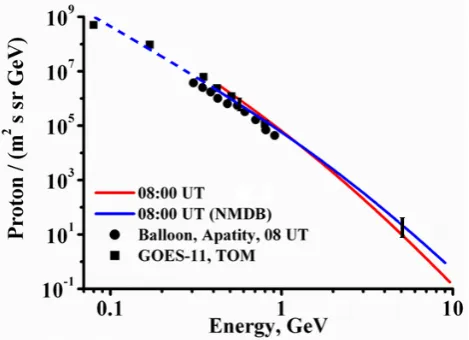
Fig. 2. Energy spectra of the delayed component of RSP, obtained
from the NM data. Blue and red lines are the DC spectra obtained with the complete and truncated techniques, respectively. Methodi-cal errors of GLE modeling with the complete technique are shown. The dashed line is extrapolation of the DC spectrum. Points is a spectrum of the time of maximum (TOM), according to direct mea-surements of solar protons on the spacecraft GOES-11 and balloon measurements.
∼150 MeV. At lower energies (<100 MeV) the spectrum of direct measurements of solar protons is declined toward lower energies.
Thus, there is a reasonable agreement between the extrap-olated spectrum of the DC obtained in one hour after the start of a solar flare and simultaneous direct measurements of maximal fluxes of solar protons on the spacecraft GOES-10 in the energy range from 700 to 150 MeV. As the TOM spectrum at lower energies was obtained in the time inter-val 11:00−18:00 UTC, and at energies detected by neutron monitors already at about 11:00 UTC, it is possible to make a forecast of maximal intensities of solar cosmic ray protons with energies below hundreds MeV based on neutron moni-tor data.
At the same time, at energies<100 MeV the spectrum of direct solar protons is declined (Fig. 1(b)) and the forecast gives overestimated values.
As to PC, its calculation by simplified procedure is ham-pered. PC has a strong anisotropy and its reliable determi-nation from data of limited number of stations is uncorrect. However, the PC does not agree in the range of small energies with the data of direct solar protons. Therefore for operative tasks we have to consider DC only.
3.2 GLE No 69 of 20 January 2005
The super GLE No 69 occurred on 20 January 2005 and was the greatest event since 23 February 1956. The parent solar flare 2B/X7.1 had heliocoordinates N14, W61. The type II radio onset was reported at 06:44 UTC (Vashenyuk et al.,
Fig. 3. Energy spectra of the delayed component of RSP, obtained
from the NM data. Blue and red lines are the DC spectra obtained with the complete and truncated models, respectively. The dashed line is extrapolation of the DC spectrum. The filled black squares represents the proton spectrum of maximal fluxes or the time of maximum (TOM) spectrum, according to direct measurements on the spacecraft GOES-11.
2006a,b; Perez-Peraza et al., 2009). Figure 2 shows energy spectra of RSP delayed component (DC) obtained with the complete (blue line) and truncated (red line) techniques. One can see a rather good agreement between the two curves. A maximal difference in intensities at E=430 MeV is 35%, i.e. of the same order as the methodical error of spectra deter-mination in a complete technique (Vashenyuk et al., 2006a). At the same time, the good agreement is seen between the extension of the spectrum obtained from ground based ob-servations and direct solar protons. They were measured by a balloon at the same time (08:00 UTC) as the DC spectrum was determined. And TOM intensities at GOES-11 s/c were taken for the period 10:00−12:00 UTC.
3.3 GLE No 70 of 13 December 2006
GLE No 70 on 13 December 2006 was related to a X3.4/2B class solar flare at heliocoordinates S06, W24 which oc-curred at 02:26 UTC (onset of type II solar radio burst)
the agreement between direct and modeled spectra is per-fect. TOM intensities at GOES-11 s/c were taken for the period 04:30−06:30 UTC. It should be noted that maximal intensities of direct solar protons with energies from 400 to 700 MeV were reached near to a time 04:30 UTC when the DC spectrum on the NM data have been obtained. Coin-cidence of model intensities with the data of simultaneous direct measurements is seen. Maximal intensities at smaller energies have been reached later.
4 Discussion
The presented examples are typical and are chosen from 12 investigated GLEs.
It is convincingly shown, that truncated GLE modeling gives spectra of RSP with small deviation from the complete technique.
Our experience has also shown that the truncated tech-nique is reliable enough for an operative forecast of the GLE development and the early warning of a radiation hazard at medium and low solar proton energies.
Such a forecast is possible due to the fact of the good con-sent of DC spectra, obtained with GLE modeling with time of maximum (TOM) spectra of solar protons of moderate en-ergies (Vashenyuk et al., 2006a). Thus, for the forecast pur-poses it is necessary to use only the DC modeled spectra. The PC has too little intensity in the moderate and low energy domains (Vashenyuk et al., 2006a), and it does not represent serious radiation danger in some cases.
The observed accordance spectra of the delayed compo-nent of RSP, and the TOM spectra of the maximum fluxes of solar protons of moderate energies, can be a consequence of unique mechanism of particle acceleration on the Sun. The probable mechanisms of particles acceleration of de-layed component can be a stochastic acceleration by plasma turbulence (Perez-Peraza et al., 2009) or the acceleration at a shock wave (Ellison and Ramaty, 1985). Both of these mechanisms provide a power law energy spectrum and are effective enough both at low, and at high energies. Therefore, the energy spectra of solar cosmic rays at high and low en-ergies show the close consent among themselves. Although the high-energy particles come from the sun and reach the maximum intensity before the low-energy ones.
For the prompt component the probable generation mecha-nism is the acceleration by an electric field in the area of mag-netic reconnection of solar flare (Vashenyuk et al., 2008b; Perez-Peraza et al., 2009; Podgorny et al., 2010). This mech-anism gives an exponential energy spectrum, which flattens at moderate and low energies. Derived from the NM data spectra of PC do not agree with solar proton intensities of moderate energies. Besides, truncated technique can not model the PC with an adequate accuracy. Therefore we do not consider here PC in a context of the article.
At energies<100 MeV the spectrum of solar protons is frequently declined and the forecast gives the overstated val-ues. Despite of it, advantage of such prognosis permitting in lack of the direct measurements data to state rather precise estimation of SCR fluxes at energies, inaccessible to ground level observations is evident.
With the algorithms obtained by us for the truncated mod-eling the self-acting program of calculation of parameters of RSP in real-time was created. The program automatically starts to work after receiving the Alert signal about a GLE onset. The result of operation of the program are spectra of relativistic solar protons (Ep>430 MeV), obtained in
real-time. On the basis of these spectra it is possible to give also the forecast of maximum intensity of solar protons in the en-ergy range from 100 up to 400 MeV.
Of course, there is no reason to refuse completely from complete modeling. It is irreplaceable when it is necessary to obtain precise and detailed characteristics not only spectra, but anisotropy, and also pitch-angular distributions.
5 Conclusions
In this paper, the simplified procedure of GLE modeling per-mitting to determine in real-time energy spectra of relativis-tic solar protons from the data of the ground based neutron monitor network is described. As against of complete mod-eling the truncated procedure uses limited number of neutron monitor stations and the simplified system of calculations.
Nevertheless, the spectra obtained with the truncated eling little differ from one’s obtained with the complete mod-eling during a maximum and post maximum phases of a GLE.
It is shown, that with extrapolation of post maximum RSP spectra to the moderate energies it is possible to estimate maximal intensities of solar protons in the energy range of tens to hundreds MeV. The maxima of intensity in moderate energies delays concerning maxima on neutron monitors on 1−10 h. Thus, using the spectra obtained from NM data, we can predict maximal intensities of protons of moderate energies several hours in advance.
Solar protons of moderate energies have the greater ioniz-ing abilities and duration in matchioniz-ing with protons of high energies. Therefore large fluxes of these protons can rep-resent radiation danger to man and electronic equipment in space flights. And, thus, with the help of the spectra obtained in real time from NM data, we can predict also radiation dan-ger in space from protons of moderate energies.
Acknowledgement. Authors are grateful to anonymous reviewers
characteristics, Geophys. Res., 102, 24237–24248, 1997. Debrunner, H., Flueckiger, E., and Lockwood, J. A.: Response of
Neutron Monitors to Solar Cosmic Ray Events: 8th European Cosmic Ray Symposium, Rome, Book of abstracts, 1984. Ellison, D. C. and Ramaty, R.: Shock acceleration of electrons and
ions in solar flares, Astrophys. J., 298, 400–408, 1985.
Kaminer, N. S.: About accounts of the barometrical coefficient dur-ing cosmic ray flares, Geomagnetism and Aeronomia, 7, 806– 809, 1967.
McCracken, K. G.: The cosmic ray flare effect 1. Some new meth-ods and analysis, Geophys. Res., 67, 423–434, 1962.
Perez-Peraza, J., Vashenyuk, E. V., Miroshnichenko, L. I., Bal-abin, Yu. V., and Gallegos-Cruz, A.: Impulsive, Stohastic, and shock wave acceleration of relativistic protons in large solar events of 1989 September 29, 2000 July 14, 2003 October 28, and 2005 January 20, Astrophys. J., 695, 865–873, 2009.
Vashenyuk, E. V., Balabin, Yu. V., and Gvozdevsky, B. B.: Rela-tivistic solar protons in the event of 20 January, 2005. Modeling study, Geomagn. Aeronomy, 46, 449–455, 2006b.
Vashenyuk, E. V., Balabin, Yu. V., Gvozdevsky, B. B., and Schur, L. I.: The characteristics of relativistic solar cosmic rays in the event December 13, 2006, Geomagn. Aeronomy, 48, 249– 153, 2008a.
Vashenyuk, E. V., Balabin, Yu. V., and Gvozdevsky, B. B.: Rela-tivistic solar cosmic ray dynamics in large ground level events, in: Proc. 21-st ECRS, Kosice, Slovakia, 9–12 September, 2008., Inst. of Exp. Phys., Slovak Academy of Sci., 264–268, 2009. Vashenyuk, E. V., Balabin, Yu. V., and Miroshnichenko, L. I.: