ESF Forward Look
Technological Breakthroughs
for Scientifi c Progress
European Science Foundation (ESF) The European Science Foundation (ESF) was established in 1974 to provide a common platform for its Member Organisations to advance European research collaboration and explore new directions for research. It is an independent organisation, owned by 66 Member Organisations, which are research funding organisations, research performing organisations and academies from 29 countries. ESF promotes collaboration in research itself, in funding of research and in science activities at the European level. Currently ESF is reducing its research programmes while developing new activities to serve the science community, including peer review and evaluation services.
www.esf.org
Forward Looks
Forward Looks enable Europe’s scientific community, in interaction with policy makers, to develop medium- to long-term views and analyses of future research developments with the aim of defining research agendas at national and European level. Forward Looks are driven by ESF’s Member Organisations and, by extension, the European research community. Quality assurance mechanisms, based on peer review where appropriate, are applied at every stage of the development and delivery of a Forward Look to ensure its quality and impact.
www.esf.org/flooks
TECHBREAK Scientific Committee
• Dr Martin Cullum, ESO, Germany (retired) • Professor Colin Cunningham, STFC, United
Kingdom
• Dr Paul Kamoun, Thalès Alenia Space, France • Dr Jean-Jacques Tortora, EUROSPACE, France • Professor Jean-Pierre Swings, University of Liège
and ESSC Chairman, Belgium
Editors
• Dr Emmanouil Detsis, ESF Science Officer • Dr Jean-Claude Worms, ESF Head of Science
Support Office
Contacts
• Dr Emmanouil Detsis, ESF Science Officer
• Ms Johanne Martinez-Schmitt, ESF Administrative Coordinator
Tel: +33 (0)3 88 76 71 51 / 71 84
Email: [email protected] / [email protected]
www.esf.org/techbreak
Cover pictures and illustrations pages 20, 23, 24, 27, 28: Tino, www.tinoland.com
Contents
Foreword 3
Executive Summary 5
1 Introduction 9
1.1 Objectives 10
2 TECHBREAK Activity 11
2.1 TECHBREAK inputs 12
2.2 ESA interviews 13
2.3 Thematic workshops 15
2.4 Space needs and challenges 16
2.5 Expert interviews 16
3 Overwhelming Drivers 19
3.1 Reduce mass, maintain stiffness 21
3.2 Build a spacecraft and space missions that can last 50 years 21
3.3 Deploy a 30m+ telescope into space (assembling, deploying, self-supporting, positioning, maintaining) 25
3.4 Autonomous geophysical survey of planets 26
3.5 Enable humans to stay in space for more than two years (Mars mission) 29
4 European Key Enabling Technologies 30
4.1 Technologies that have not been included 31
4.2 Technology assessment in TECHBREAK 31
5 Nanotechnology 33
5.1 Nanophononics 33
5.2 Surface plasmon resonance 35
5.3 Nanoantennas 36
5.4 Nanostructured surfaces 36
5.5 Nanoparticles for water purification 37
5.6 Conclusion 37
5.7 Section references 38
6 Advanced Materials 40
6.1 Advanced structural and functional materials 40
6.2 2D materials 42
6.3 Topological insulators 43
6.4 Ferromagnetic and superconducting materials 44
6.5 Nanoenergetic materials 44
6.6 Carbon nanotubes (CNT) 44
6.7 Boron nitride nanotubes 45
6.8 Transparent electrodes 45
6.9 Biomimetic design 46
6.10 3D printing 47
6.11 Active structures 50
6.12 Multiscale modelling 51
6.13 Conclusions 52
7 Photonics and Metamaterials Research 56
7.1 Photonics on a chip 58
7.2 Photonic crystal fibres 58
7.3 Micro-resonators 59
7.4 Astrophotonics 60
7.5 Metamaterials 62
7.6 Conclusions 65
7.7 Section references 66
8 Micro and Nano Electronics 69
8.1 Advanced Random Access Memory Elements 69
8.2 Organic light-emitting diodes 70
8.3 Organic photovoltaics 71
8.4 Fully depleted silicon on insulator (FD-SOI) 71
8.5 Silicon 3D 72
8.6 Flexible electronics 72
8.7 Cryoelectronics 73
8.8 Smart networks 73
8.9 Biological monitoring systems 74
8.10 Robotics – Truly autonomous agents 75
8.11 Conclusions 77
8.12 Section references 77
9 Biotechnology and Medicine 79
9.1 Biological and environmental sensors 80
9.2 Human stress factors 81
9.3 Torpor and hibernation 81
9.4 Nanomedicine 82
9.5 Synthetic life 82
9.6 Conclusion 83
9.7 Section references 84
10 Conclusions 86
Appendix A – TECHBREAK interviewees 90
Appendix B – Technologies arranged by community interest 93
Appendix C – Overwhelming Drivers Mapping 97
Appendix D – Contact Points for European technology platforms 99
Photonics21 99
Advanced Materials 99
Micro- and Nano-electronics 100
Nanotechnology 100
Biotechnology 101
Information and Communication Technologies 101
Appendix E – TECHBREAK workshop participants 103
References 107
Te
ch
nol
o
gic
a
l B
re
ak
th
ro
ug
h
s f
or
S
ci
en
ti
fic
P
ro
gr
es
s (
TE
CH
BR
EA
K)
3 The European Science Foundation (ESF) was
con-tacted at the end of 2009 to conduct a foresight activity for ESA, addressing the delicate matter of technological breakthroughs for space originating in the non-space sector. A joint ESF-ESA “Forward Look” project called ‘TECHBREAK’ was initiated as a result. Its goals were to forecast the develop-ment of such breakthrough technologies to enable novel space missions in the 2030-2050 timeframe, and to identify related partnerships through syner-gies with non-space specialists.
This report to ESA’s Director General and High-level Science Policy Advisory Committee (HISPAC) is the result of this exercise. It was not prepared to serve as a definitive guide for very specific technolo-gies to be developed for future space missions, but to inform on and flag up the main developments in various technological and scientific areas outside space that may hold promise for use in the space domain. The report does this by identifying the current status of research for each domain, assert-ing the development horizon for each technology and providing some entry points, in the form of key European experts and institutions with knowledge of the domain. The European Union’s concept of Key Enabling Technologies (KETs) was chosen as a guide through this technological search.
The identification of problems and solutions spe-cific to the space area led to focus the discussion around the concept of “Overwhelming Drivers” for space research and exploration, i.e. long-term goals that can be transposed into technological develop-ment goals. This is the main focus of TECHBREAK. We firmly hope that these Overwhelming Drivers will be used throughout ESA’s Directorates as a novel categorisation of programme concepts and useful red thread to guide the reflexion about future missions and related technological maturation.
Dr Martin Cullum
Chair, TECHBREAK Scientific Committee
Professor Jean-Pierre Swings
Chair, European Space Sciences Committee
Mr Martin Hynes ESF Chief Executive
Te
ch
nol
o
gic
a
l B
re
ak
th
ro
ug
h
s f
or
S
ci
en
ti
fic
P
ro
gr
es
s (
TE
CH
BR
EA
K)
5
Executive Summary
l l l
technologies, with the aim of developing interac-tions and partnerships between space and non-space communities.
The European Science Foundation was con-tacted in 2009 to conduct this foresight activity, and a joint ESF-ESA Forward Look project called ‘TECHBREAK’ was initiated as a result. The ESF has been collaborating with European scientists across all disciplines for the last 40 years and is an integral part of the European scientific land-scape. Furthermore, the European Space Sciences Committee (ESSC), which operates under the umbrella of the ESF, is very well connected with the European space sector. The TECHBREAK project, equally funded by ESA and ESF, was created to lev-erage these connections, with the objectives of: 1. Taking stock of breakthrough scientific
objec-tives;
2. Identifying partnership schemes through syner-gies with non-space specialists;
3. Forecasting the development of technologies for the achievement of scientific breakthroughs to enable novel space missions in the 2030-2050 timeframe;
4. Foreseeing the evolution of the technologies in space and non-space domains;
5. Preparing a final Forward Look report to be sub-mitted to ESA’s Director General and High-level Science Advisory Committee.
The goal of this report is not to serve as a defini-tive guide on which exact technologies should be developed for future space missions. Rather, it was prepared to inform on and flag up the main develop-ments in various technological and scientific areas outside ‘space’ that might hold promise for use in the space domain. The report does this by identify-In space sciences, as well as in ‘mainstream’ science,
the development of innovative technologies opens new fields of research and provides sophisticated new tools for scientists. However, the experience of the past decades of space research has demon-strated that a conservative approach to technology is too often followed: self-censorship is often applied regarding space technologies that are not yet fully proven, for fear of losing in competitive assessment phases. The result is that evolution is gradual and breakthroughs do not happen as frequently as they could.
The European Space Agency’s end-to-end pro-cess for technology development is user driven, which means that work plans for technology devel-opment are mostly identified from the needs of the candidate space missions that are selected under established transparent mechanisms, where feasibil-ity and level of maturfeasibil-ity are key criteria for selection. When missions are selected, failure to make tech-nology available in a timely manner results in cost and schedule overruns which result, in the frame of given budgets, in new missions being delayed. The risk analysis and avoidance procedure that is built into the project selection process, coupled with the risks associated with new technologies, thus auto-matically leads to penalising proposals that are based on new and untried technologies. As a result, ESA may have to deal with obsolete technologies in a fast developing field, thereby losing competitive-ness and leadership.
Te
ch
nol
o
gic
a
l B
re
ak
th
ro
ug
h
s f
or
S
ci
en
ti
fic
P
ro
gr
es
s (
TE
CH
BR
EA
K)
6
ing the current status of research for each domain, asserting the development horizon for each technol-ogy and providing some entry points, in the form of key European experts and institutions with knowl-edge of the domain.
The project started concretely in early 2010 with a defi nition phase during which the Scientifi c Committee elaborated a foresight strategy and methodology and set up a series of consultations with experts. As a result of these consultations, some of the objectives that were mentioned in the previous section were re-assessed and it was decided jointly with ESA to concentrate on the identifi cation of relevant non-space technologies for infusion into the space sector that had not been known nor used so far in the space context, and might hold promise for this sector. An important point therefore was to identify the right level of granularity at which the availability of such technologies could be assessed for potential spin-in. Th e concept of Key Enabling Technologies was chosen as a result, in particular to maximise commonalities with the European Union (EU) and synergies.
In addition to the meetings of the Scientifi c Committee supervising the project, a total number of six events and workshops were organised dur-ing the course of the project. An early conclusion of the related discussions was that this foresight activity should focus on defi ning the needs and challenges of the space sector in relation to the potential off ered by non-space critical technologies in these domains. Th e needs and challenges should then be defi ned and mapped against technological sub-areas in terms of their space relevance. Th ese space needs and challenges were further refi ned at the various workshops and transformed into specifi c areas of potential interest for future space missions, i.e., large structures, miniaturisation, propulsion, systems longevity and self-repair capacity, energy supply, sample collection and handling, search for life, new environments and bioengineering, com-munication, and cryogenics. Th ese were refi ned throughout the process and fuelled the identifi ca-tion of the technological sub-fi elds to be considered. Finally, and most importantly, the discussion concerning the identification of problems and solutions specifi c to the space area led to focus the discussion around the concept of ‘Overwhelming Drivers’ for space research and exploration, i.e., long term goals that can be transposed into techno-logical development goals. Th ese drivers represent the main areas where technological improvements are needed in order to be able to generate break-throughs in space capabilities. Th e drivers also served as a brief introduction to the space
environ-ment and space operations for non-space experts and acted as a stimulant for the identifi cation of potential helpful technologies, therefore bridging the knowledge gap between space and non-space experts. Th eir defi nition and utilisation aimed at providing the ‘food for thought’ stimulus that might result in a spin-in idea, from a KET fi eld into the space domain. Beyond this goal, it is believed that these fi ve Overwhelming Drivers could also be used throughout ESA’s Directorates as a novel categorisa-tion of programme concepts and useful red thread to guide refl exion about future missions and related technological maturation.
Th e following drivers were identifi ed:
1. Reduce mass, maintain stiffness
Te
ch
nol
o
gic
a
l B
re
ak
th
ro
ug
h
s f
or
S
ci
en
ti
fic
P
ro
gr
es
s (
TE
CH
BR
EA
K)
7
3. Deploy a 30m+ telescope into space
4. Autonomous geophysical survey of planets
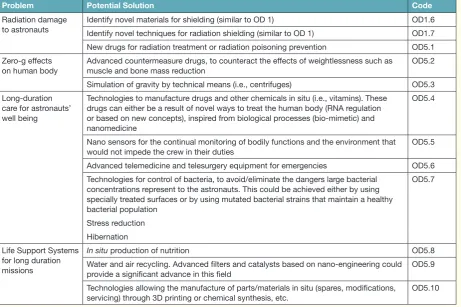
5. Enable humans to stay in space for more than two years
Th ese fi ve drivers are described in detail in the report, along with a codifi cation of the potential solutions from available non-space technologies that are analysed in the various sections of the report.
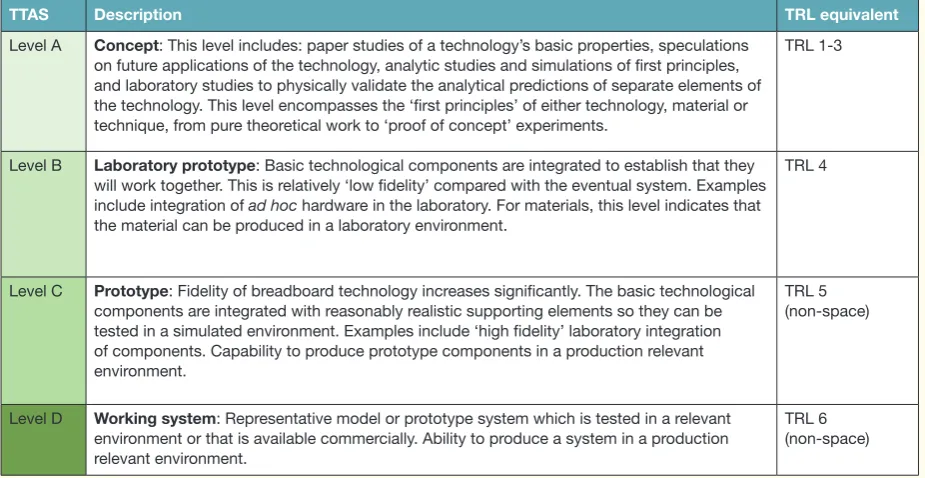
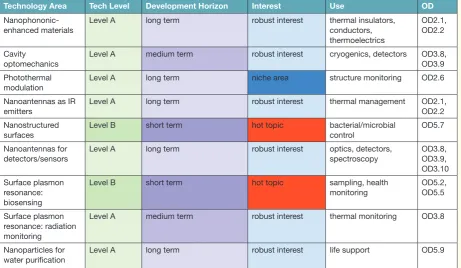
Th e assessment of the various technologies that have been encountered in TECHBREAK follows a simplifi ed version of the well known Technology Readiness Level (TRL) used in the space context. Th e system has been adapted from the descrip-tion of the TRLs, excluding the space qualifi cadescrip-tion part, since the technologies are for terrestrial sys-tems. Th e system contains four levels that indicate the technology readiness level. Th ese technologies were also described, when possible, in terms of the expected time to the next breakthrough as well as the size of the community. Th ese assessments are based primarily on the perception of the experts from the TECHBREAK interviews and/or research literature assessment and framework funding infor-mation where available.
Te
ch
nol
o
gic
a
l B
re
ak
th
ro
ug
h
s f
or
S
ci
en
ti
fic
P
ro
gr
es
s (
TE
CH
BR
EA
K)
9 In space science, as well as in ‘mainstream’ science,
the development of innovative technologies opens new fields of research and provides sophisticated new tools for scientists. However, the experience of the past decades of space research has demon-strated that a conservative approach to technology is too often followed: self-censorship is often applied regarding space technologies that are not yet fully proven, for fear of losing in competitive assessment phases. This may be partly due to the very long development times in that domain, but the result is that evolution is gradual and breakthroughs do not happen as frequently as they could.
The European Space Agency’s end-to-end pro-cess for technology development is user driven. Work plans for technology development are mostly identified from the needs of the candidate mis-sions. Although some significant effort is devoted to breakthrough innovation, most of this effort goes into enabling those specific candidate missions. ESA space missions are selected under established trans-parent mechanisms, where feasibility and level of maturity are key criteria for selection. Therefore, in proposing missions, scientific teams tend to rely on gradual technological innovation. When missions are selected, failure to make technology available in a timely manner results in cost and schedule over-runs which result, in the frame of given budgets, in new missions being delayed.
The risk analysis and avoidance procedure that is built in in the project selection process, coupled with the risks associated with new technologies, automatically leads to the penalisation of propos-als that are based on new and untried technologies. Furthermore, Member States do not invest enough in the development of advanced instrumentation for not-yet-approved missions. As a result, ESA
may have to deal with obsolete technologies in a fast developing field, thereby losing competitive-ness and leadership. Nevertheless, Europe looks to ESA for innovation in space, with the expectation of acceleration of the pace of scientific discovery through the utilisation of advanced technologies.
A way of removing blocking factors and enabling scientific breakthroughs in space could be spinning-in advanced technologies, even if not developed for space. Therefore the search for sources of technol-ogy in this foresight exercise was focused outside the traditional space technologies. The infusion of the best technology to achieve scientific break-throughs requires interaction between space and non-space communities and the establishment of partnerships. It is thus necessary to look for the desired breakthroughs in science and technology (forward looking), as well as to the concurrent development in enabling technological fields (par-allel looking).
The European Science Foundation was contacted to conduct a foresight activity dealing with such technology breakthroughs. ESF therefore launched with ESA in December 2009 a Forward Look pro-ject 1 to reply to this request, called ‘TECHBREAK’. The topics to be covered in the TECHBREAK report go beyond space-related technologies and address various fields of physics and engineering, since in many domains technology is evolving faster than in the space domain.
The ESF has been collaborating with European scientists across all disciplines for the last 40 years and is an integral part of the European scientific landscape. Furthermore, the European Space Sciences Committee, which operates under the
1. http://www.esf.org/activities/forward-looks.html
1.
Te
ch
nol
o
gic
a
l B
re
ak
th
ro
ug
h
s f
or
S
ci
en
ti
fic
P
ro
gr
es
s (
TE
CH
BR
EA
K)
10
umbrella of the ESF, is very well connected with the European space sector. The TECHBREAK project was thus created to leverage these connections. The project was equally funded by ESA and ESF (after approval by its governing council).
1.1
Objectives
The general objectives of the TECHBREAK fore-sight activity, as stated in the initial Statement of Work, were to:
• Take stock of breakthrough scientific objectives; • Identify partnership schemes through synergies
with non-space specialists;
• Forecast the development of technologies for the achievement of scientific breakthroughs. These technologies should enable novel space missions in the 2030-2050 timeframe;
• Foresee the evolution of the technologies, in space and non-space domains;
• Prepare a Final Forward Look Report to be sub-mitted to ESA to advise its High-level Science Advisory Committee.
During the duration of the information gathering process, it became apparent that the complexity of risk assessment on such a fluid topic as technologi-cal evolution was beyond the scope of the effort. The TECHBREAK report will therefore fulfil all the objectives, except conducting a thorough risk analysis. Some elements of perceived risk regarding the technological development landscape in Europe are included in the report, together with suggestions on how to navigate in this landscape, as commu-nicated to the TECHBREAK team by prominent actors in the various technological areas.
Te
ch
nol
o
gic
a
l B
re
ak
th
ro
ug
h
s f
or
S
ci
en
ti
fic
P
ro
gr
es
s (
TE
CH
BR
EA
K)
11 The project started concretely in early 2010 with
a definition phase during which the Scientific Committee elaborated a foresight strategy and methodology with the support of an external fore-sight consultant from the ISI Fraunhofer Institute (Dr Kirsten Cuhls). Additionally, experienced ESA personnel were interviewed, regarding the pragmat-ics of technology development and planning in the various ESA programmes.
As a result of these consultations, some of the objectives that were mentioned in the previous sec-tion were re-assessed and it was decided jointly with ESA to concentrate on the identification of relevant non-space technologies for infusion into the space sector that had not been known nor used so far in the space context, and might hold promise for this sector. An important point therefore was to identify the right level of granularity at which the availability of such technologies could be assessed for potential spin-in. The concept of Key Enabling Technologies (KETs) was chosen to maximise commonalities with the European Union (EU) and synergies with the other ongoing activities at ESF.
For the purpose of this foresight exercise, these fields were grouped as follows:
• Nano- and microelectronics (NAMI) • Photonics (PHOT)
• Advanced materials (ADVM) • Biotechnologies (BIOT) • Nanotechnologies (NANO) • Robotics (ROBO)
• Biomimetics (BIOM)
• Energy and propulsion (ENEP)
Figure 1. Relationship between key enabling technologies
This classification was used in organising thematic workshops, with invitations to prominent research-ers, institutions and policy makers in those fields.
After several workshops in the various KET areas, the TECHBREAK team undertook one-to-one interviews with prominent European researchers who are active in those areas. These interviews provided several insights to the KET fields as well as several, often different, viewpoints on technology transfer and development across vari-ous disciplines.
The output from the interviews and the work-shops was catalogued and expanded further, with bibliographical research, in order to identify the most prominent technologies for the TECHBREAK report. The following sections expand on the initial inputs to TECHBREAK and present a brief synop-sis of the TECHBREAK workshops.
2.
Te
ch
nol
o
gic
a
l B
re
ak
th
ro
ug
h
s f
or
S
ci
en
ti
fic
P
ro
gr
es
s (
TE
CH
BR
EA
K)
12
2.1
TECHBREAK inputs
In addition to the methodology defi nition report provided by ISI Fraunhofer, two main inputs into the foresight exercise were commissioned, to the European Space Policy Institute (ESPI – Ms Christina Gianopappa) and to ESA’s Advanced Concepts Team (ACT).
2.1.1 Reports
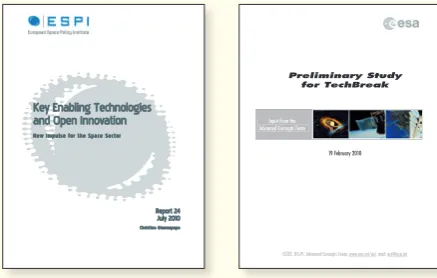
Th ese two reports (fi gure below) were helpful in (a) framing the exercise, and (b) deciding which tech-nological areas, and at which level of granularity, the foresight exercise should focus on. It was decided that the project would make use of the classifi ca-tion of disciplines under the broad headings of ‘Key Enabling Technologies’, as identifi ed in 2009 by the European Commission, i.e., nanotechnology; micro and nano-electronics; photonics; advanced materi-als; and biotechnology.
Other areas such as energy, robotics, biomimet-ics or advanced propulsion and, more generally, materials science were also addressed. Th ese KETs are relevant at various levels for EU’s ‘Grand Challenges’ (Energy, Healthcare and Security). Th ose key technologies already have a strong or a developing industrial base, should receive consider-able funding in the future and would be the target of the bulk of Horizon 2020 funding. Th erefore, strong ties between ESA and the main players and innovators in those key fi elds would be of signifi -cant benefi t. Th e Key Enabling Technologies will be defi ned in the main part of the report.
A summary of the key findings of the ESPI report is presented here and should be considered by ESA, and even the EU:
1. The Key Enabling Technologies identified by the EU as being nanotechnologies, micro and nanoelectronics, advanced materials and biotechnology, should be considered compre-hensively by ESA’s research and development
programmes. In this regard, Information and Communication Technologies (ICT) should also be considered, creating the ‘ESA Enabling Technologies’ concept. These categories are essentially very broad and specifi c subcategories should be identifi ed, in consultation with space and non-space experts in these fi elds, in order to identify the ones most relevant for the space sectors to be able to develop coherent roadmaps. 2. At low Technology Readiness Levels, such new technologies do not need to be developed exclu-sively by space funding schemes. Th is may allow the utilisation of funding from the non-space sector by jointly investing in the KET’s build-ing blocks.
3. Public and private partnerships should be set up for co-fi nancing research and development in Key Enabling Technologies, since they require large investments that ESA alone would not be able to aff ord.
4. ESA should proceed to apply for participation in research and technology development under the non-space components of the Framework Programme. Th is participation, by performing research and development in ESA laboratories, should be enhanced.
5. An eff ective technology watch ‘Technowatch’ mechanism is necessary in order to be able to identify new and disruptive technologies early enough; a Technowatch that can facilitate spin-in, spin-out and spin-together. ESA does currently have mechanisms which are used as observatories for following science that is likely to produce technology. Th is could be institution-alised with clear targets and responsibilities in a more integrated model. Th e possibility of hav-ing a Technowatch independent from ESA or jointly with other technology watch institutions should also be considered. It is suggested that a Technowatch should be an independent body as these are seen as more credible when they are not governmental agencies or those that conduct the research.
Th e ESA Advanced Concepts Team provided insight to very low TRL technologies that have the poten-tial to become ‘game changing’ technologies in the future. Th e input proved useful in identifying experts in various fi elds who could further elabo-rate on these technologies. Th e following areas were highlighted in the report, as topics with signifi cant ‘breakthrough’ capability:
1. High-fi delity dynamical simulation and optimi-sation
2. High precision formation flying Figure 2. ESPI and ESA-ACT input reports to TECHBREAK
Report 24 July 2010
Christina Giannopapa
Key Enabling Technologies and Open Innovation N e w I m p u l s e f o r t h e S p a c e S e c t o r
Input from the Advanced Concepts Team
19 February 2010
Te
ch
nol
o
gic
a
l B
re
ak
th
ro
ug
h
s f
or
S
ci
en
ti
fic
P
ro
gr
es
s (
TE
CH
BR
EA
K)
13 3. Autonomous manoeuvres for low-thrust deep
space mission 4. Pulsar navigation
5. Relativistic reference systems
6. Application of Bose-Einstein condensates 7. High precision spectroscopy
8. Diffractive focussing 9. Metamaterials 10. Soft matter
11. Structural biomimetics 12. Neuromorphic electronics 13. Bionics
14. Neural engineering
15. Truly internally motivated robots 16. Multi-agent robotic systems using GPS
17. Multidisciplinary Design Optimisation (MDO) 18. Space Nuclear Power Sources (NPS)
2.2
ESA interviews
Another input into the project was the ESF survey that targeted ESA experts regarding breakthrough technologies and ESA technology development programmatics. The following questions were for-warded to the ESA experts:
1. In general, do you believe that science teams tend to moderate their ambitions because they fear their proposals might not get selected for technological readiness reasons?
2. If not, what do you think are the main reasons for gradual – not breakthrough – technological evolution in space missions (please prioritise)? 3. From your experience of experiment selection
processes in your field of competence, were there scientifically highly-ranked proposals rejected because of their low technological maturity and/ or high risk of cost overruns?
4. If yes, can you provide some level of details con-cerning such ‘case studies’? For each case what do you think was the main reason for rejection: TRL? Cost? Please detail.
5. Have missions been selected despite a low TRL or high risk of cost overruns? Please detail. 6. Do you think this approach/model (technology
push/pull) is still valid? Within which bounda-ries?
7. Do you believe that this set of KETs can ade-quately capture the concerns addressed by this foresight exercise? Which of these KETs should in your view become of strategic importance to ESA through, e.g., partnerships with public and private entities, to co-fund R&D that ESA alone cannot support?
8. Is there a continuity of developments from the
advanced stages to fully operational systems? Do we have in Europe the appropriate tools for mat-uration of technologies (cf. the DARPA model in the USA)?
9. Do you believe that this set of KETs can ade-quately capture the concerns addressed by this foresight exercise? Which of these KETs should in your view become of strategic importance to ESA through, e.g., partnerships with public and private entities, to co-fund R&D that ESA alone cannot support?
10. Are there specific sectors that you think should become involved in partnerships with ESA, e.g., energy, automobile, healthcare, etc?
11. In your domains and in recent years, have you identified ideas/cross-domain topics that sci-entists have not necessarily thought about but could lead to innovative scientific developments? 12. More generally, do you think the innovation potential and experience of European industry could be more deeply exploited? Do you have further suggestions for future improvements and new mechanisms?
The following experts responded to the survey: • Pierluigi Silvestrin (Earth Observations) • Scott Hovland (Human Space Flight) • Alain Pradier (Human Space Flight) • Rafael Lucas Rodriguez (Navigation)
• Fabio Favata (Science Planning and Community Coordination)
Interview synthesis
There was general consensus amongst the ESA experts that the scientific communities are not technologically conservative when it comes to mis-sion concept proposals. It is important that there is a distinction between the two-step approach to a call. Often, the experience that the community is ‘techno-logically conservative’ in mission proposals is based on a misunderstanding. The scientific community is invited to be imaginative in looking for answers to science challenges or techniques of conducting sci-ence. The selection is made on the basis of multiple criteria established at the beginning of the call, which normally emphasise the scientific value of the mis-sion rather than technical-programmatic feasibility. Furthermore, the criteria are finally applied by a group of scientists, within the Science Advisory Committee, whose concern is primarily with the sci-entific excellence and answer to the challenges than to the technology readiness. The technological readi-ness itself is evaluated by the Agency and presented to the committee.
Te
ch
nol
o
gic
a
l B
re
ak
th
ro
ug
h
s f
or
S
ci
en
ti
fic
P
ro
gr
es
s (
TE
CH
BR
EA
K)
14
industrial consortium that will implement the selected mission. The choice is made on the basis of the system requirements elaborated during the Phase 0 and A activities. To achieve these, different technical solutions may be possible and obviously industry tends to look for those solutions that mini-mise their risk. This is the reason that sometimes missions may be driving towards technologies that are less ‘frontier technologies’, but nonetheless the achievement of the system requirements is a must and strong innovation is in general required at least in the payload area.
Despite the risk aversion of industry, the sci-ence teams strive to formulate demanding scientific objectives. Normally, TRL levels do not come into consideration during the proposal submissions. Of course, there are always exceptions. A user commu-nity that is focused more on applications, such as a GNNS payload for aviation, might be de facto con-servative in the proposals put forward, in order to accommodate the real constraints in the capabilities of the system. For scientific applications, the way of thinking is less constrained.
There are, of course, proposals that are rejected for too low TRL and/or cost estimates above the limits set by the Calls. These two elements are in fact coupled: a low TRL means a long development time and high risk, which requires adding large margins in cost estimates. There is also an aspect of fairness to proposers when missions that are way above the cost limit are rejected: those proposing such expen-sive missions can claim stronger scientific returns than those who have properly considered the cost aspect in their proposals as required by the Calls, but it would obviously be unfair to privilege those who have not observed the rules of the Call (which are discussed and approved by the Programme Board). All considered, the ESA Calls aim at the best ratio ‘science-return per euro’, and the level of technological innovation is linked to the imposed budgetary and schedule constraints, which vary between Calls.
The view that technological breakthroughs do not happen was considered partly inaccurate, as there have been missions that can be considered showcases of breakthrough technologies and con-cepts. The Gravity Field and Steady-State Ocean Circulation Explorer (GOCE) mission is a prime example. Nevertheless, there are numerous fac-tors that do influence a space mission and prevent breakthrough missions from being the norm. These factors were identified as:
Long development time: The development of space projects has a very long time span. From inception to operation it can easily take 10 years. The long
time frame might create the impression that the technologies are not cutting-edge, as a technology which was a breakthrough at the time the project was initiated might be perceived as old when the project is completed.
High costs: The costs of developing and launching space projects are very high, so the risks/costs of failure have to be minimised. This would mean that the use of off-the-shelf technologies (or as close as possible) would be preferable to the development of a new breakthrough technology which is untested. Organisation of space projects: This is related with the high costs of space projects. The project organi-sation needs to be rather rigid in order to guarantee the success of a mission. The project baseline and the associated technology are gradually frozen at each milestone of the development process (Phase A,B,C,D). Once a milestone has been passed, it is very difficult to go back to reconsider decisions since this would lead to delays and cost overruns. A more flexible structure of organising the project would be more suited to encouraging technology break-throughs, e.g., more collocated teams, lesser number of distributed subcontractors.
Not sufficient new needs: For a new technology to be developed, the needs of the project should be suf-ficiently different from the needs of past projects. Incremental science can be operated with incremen-tal technology developments.
Few missions: The number of missions is limited; therefore the opportunity to experiment with new technologies is also limited.
R&D investment effort in low TRL emerging tech-nologies is often not adequate to bring them to an acceptable level for project implementation in a timely way.
Ultimately, the reason that breakthrough missions are not often implemented is closely related to the management of risk. The ExoMars mission can serve as an example: one of the main scientific objectives was to detect traces of past or present life on Mars. The Life Marker Chip (LMC) instrument was pro-posed by scientists at the University of Leicester and Cranfield University. It was supposed to utilise biotechnology measurement techniques to detect specific molecules that may be associated with past or present life on Mars. A TRL assessment gave rise to serious concerns related to a too low level of tech-nical maturity which made a timely implementation in the ExoMars mission quite questionable. Despite its very high scientific relevance and strong political support in the UK, the LMC was dropped out.
Te
ch
nol
o
gic
a
l B
re
ak
th
ro
ug
h
s f
or
S
ci
en
ti
fic
P
ro
gr
es
s (
TE
CH
BR
EA
K)
15 or the inability to push the level from TRL 4 to TRL
6 in a timely manner would lead to cost overruns as the mission is either delayed or a substitute technol-ogy is sought out.
Despite the major obstacle that the maturation of technologies poses for space missions, it might be difficult for a solution to come from broad R&D efforts. Space technology R&D is very expensive. A vast number of disciplines have to be addressed, and the resources devoted to this are far too lim-ited. Sometimes efforts are made even less effective due to conditioning by industrial-political aspects (e.g., in GSTP). Under these conditions, consider-ing that there are a priori countless R&D activities that could be pursued, a technology push approach risks under-sampling the possible directions of technological developments, with the risk that the technologies actually needed to implement the mis-sions are not there (at the right TRL) when required. There is also the risk that many parallel routes are pursued in a field without reaching adequate TRL in any of them (examples can be given, e.g., in the area of propulsion). Nevertheless, many applications today are a result of a technology push and an effort to make the users aware of the many possibilities of the new technology.
The possible collaboration in the R&D effort with the EU R&D efforts in the various Key Enabling Technologies was seen positively, in order to benefit from the much larger investments in other sectors. The innovation potential of European indus-try could be better optimised and exploited. The sole definition of strategic technical R&D themes along with a lean ‘hands-off’ management approach is not deemed the most effective way to drive the current significant EU R&D effort to substantial results having strong relevance for future space applica-tions. The current state of ESA-EU relationships in the area of advanced technology development is far from ideal to really ensure a good return of investment. A more sustainable political commit-ment to supporting the R&D industrial sector in Europe might eventually lead to a game changing situation, provided that the technical management of European R&D effort having relevance for space applications is appropriately delegated to competent entities.
2.3
Thematic workshops
The original intention was to organise thematic workshops in at least four domains, i.e., ADVM, NAMI, PHEP and BIOT. A total number of five workshops were organised:
• Scoping workshop to frame the activity and decide on goals and work plan; this workshop took place before the official start of the activity and brought together ESA, ESF and EC representatives. • Kick-off conference (Brussels, 29-30 November
2010) – 27 attendees, with experts in various KETs.
• Advanced Materials thematic workshop (Obernai, 27-28 September 2011) – 10 attendees.
• Multi-thematic workshop (Brussels, 22-23 February 2012) – 13 attendees.
• Photonics workshop (Barcelona, 27 March 2013) – 15 attendees.
In addition to the events detailed above, the TECHBREAK Scientific Committee met six times during the lifetime of the project. It is composed of the following individuals, supported by ESF (Dr Jean-Claude Worms and Dr Emmanouil Detsis as of December 2012):
• Dr Martin Cullum (ESO, DE, retired) • Professor Colin Cunningham (STFC, UK) • Dr Paul Kamoun (Thalès Alenia Space, FR) • Dr Jean-Jacques Tortora (EUROSPACE, FR) • Professor Jean-Pierre Swings (University of Liège
& ESSC Chairman, BE)
Finally, a ‘Review Meeting’ was organised in Brussels, on 31 October 2013, in order to finalise input to the TECHBREAK report. The meeting par-ticipants included, apart from the TECHBREAK committee, several experts in European KETs. A list of all participants in the TECHBREAK workshops can be found in Appendix E.
2.3.1 Multi-thematic workshop highlights
This workshop brought together 13 participants including the TECHBREAK Scientific Committee (3), ESF and ESA staff (2). The participants were experts in the fields of nanotechnology, biotechnol-ogy, propulsion and advanced materials. Photonics and Energy were not covered at that event.
Several generic issues were discussed, and in particular:
1. Spin-in technologies for the space sector; 2. Future dedicated calls by ESA to target specific
communities;
3. Interdisciplinary workshops.
Te
ch
nol
o
gic
a
l B
re
ak
th
ro
ug
h
s f
or
S
ci
en
ti
fic
P
ro
gr
es
s (
TE
CH
BR
EA
K)
16
interesting KET domains (Table 1).
The discussions at the kick-off conference led to a mind-mapping of technology sub-domains (see Table 1) of potential specific interest to the space sec-tor, using the eight fields defined at the beginning of section 2. The mind-mapping exercise isolated the KET areas that have the potential to produce ground-breaking results. This exercise produced the first level of granularity for TECHBREAK and identified the interesting fields in the key enabling technologies.
2.4
Space needs and challenges
The conclusion of those discussions was that this foresight activity should focus on defining the needs and challenges of the space sector in relation to the potential offered by non-space critical technologies in these domains. The needs and challenges should ideally be defined and then mapped against tech-nological sub-areas to create a series of matrices, ranked in terms of their space relevance.
These space needs and challenges were then fur-ther refined at the ADVM thematic workshop, and transformed into specific areas of potential interest for future space missions, as listed below.
1. Large structures 2. Miniaturisation 3. Propulsion
4. Systems longevity/self-repairing capacity 5. Energy supply: reach a theoretical maximum for
solar power conversion
6. Sample collection and handling 7. Search for life
8. New environments/bioengineering 9. Communication
10. Cryogenics
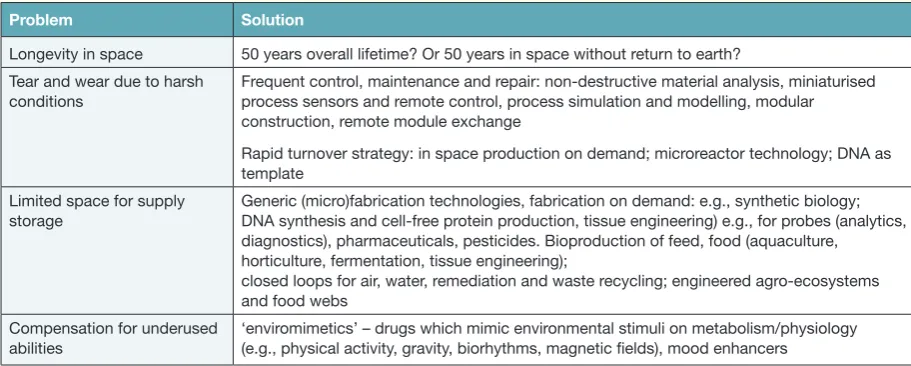
The discussion and analysis of this specific case led to the selection of four main problems and solutions that are depicted in Table 1. These became the new space needs and challenges for that particular long term mission scenario, and fuelled the identification of the technological sub-fields to be considered.
Finally, and most importantly, the discussion concerning the identification of problems and solutions led to focus the discussion around the con-cept of ‘Overwhelming Drivers’ for space research and exploration, i.e., long term goals that can be transposed into technological development goals (cf. section 3).
2.5
Expert interviews
After the conclusion of the thematic workshops, the TECHBREAK committee engaged leading researchers in Europe in one-to-one interviews, in order to gauge their expert opinion in the techno-logical areas that could potentially be relevant to the space sector. The concept of the Overwhelming Drivers was used for the first time, in order to stimu-late the discussion. The following list of questions was provided to 20 experts (the names and contact details can be found in Appendix A).
2.5.1 Interview question list
a. Can you please provide a short summary of your research interest and activities?
b. In your field(s), what do you think the most important developments will be in the next 5 years? In the next 10 years? Are there any ‘game-changing’ technologies that you foresee? c. Are there any niche technologies in your field
that have the potential to play an important role and perhaps they are not known to the space sec-tor?
Problem Solution
Longevity in space 50 years overall lifetime? Or 50 years in space without return to earth? Tear and wear due to harsh
conditions
Frequent control, maintenance and repair: non-destructive material analysis, miniaturised process sensors and remote control, process simulation and modelling, modular construction, remote module exchange
Rapid turnover strategy: in space production on demand; microreactor technology; DNA as template
Limited space for supply storage
Generic (micro)fabrication technologies, fabrication on demand: e.g., synthetic biology; DNA synthesis and cell-free protein production, tissue engineering) e.g., for probes (analytics, diagnostics), pharmaceuticals, pesticides. Bioproduction of feed, food (aquaculture,
horticulture, fermentation, tissue engineering);
closed loops for air, water, remediation and waste recycling; engineered agro-ecosystems and food webs
Compensation for underused abilities
‘enviromimetics’ – drugs which mimic environmental stimuli on metabolism/physiology (e.g., physical activity, gravity, biorhythms, magnetic fields), mood enhancers
Te
ch
nol
o
gic
a
l B
re
ak
th
ro
ug
h
s f
or
S
ci
en
ti
fic
P
ro
gr
es
s (
TE
CH
BR
EA
K)
17 d. How do you think the landscape of research in
Europe will be shaped in the decades to come in your field(s)? Which are the institutions/compa-nies that will be prominent in the next decades in your field? Are there any major research initia-tives that we should be aware of?
e. Whom else should we talk to next?
f. In your field(s), what is the potential for solv-ing any specific Overwhelmsolv-ing Driver for Space
(refer to accompanying document)? How would you rate the relevance?
g. Regarding the identification and ‘spin-in’ of breakthrough technologies, what should European Space Agency do to reach out to new communities and research fields?Are there good and adaptable models at the international level that could be used in your field? How?
h. What would be the most interesting ways for researchers in your field(s) to get involved in European space projects?
2.5.2 Interview synthesis
The interviews conducted with additional experts helped focus the TECHBREAK technology search to the areas that are at the forefront of the European research effort. It also provided identifi-cation of potential breakthrough technologies, as indicated by the world class experts working daily with these technologies. The main output of this exercise can be seen in the following chapters of the TECHBREAK report, where the technologies themselves are presented.
The interviews were also designed to inquire about ways of collaboration between ESA and the various research communities that the experts believed to be the most appropriate for their fields. A synthesis of the main points extracted from the interviews is given in the following paragraphs.
Structure of the research landscape
It is a general trend that the large (international) collaborations will be the predominant way to maintain and further increase the pace of research activities. Furthermore, the applicability to and impact of the societal value of the research proposal is quickly becoming the most significant factor in research funding grants.
Another significant trend in many research fields is to use a cross-disciplinary approach. This is exem-plified by the FP7 funded THESEUS exploration roadmap that stressed the need to integrate many aspects from habitat design to habitat atmospheres and life support systems when man is subject to extreme conditions of stress and in order to main-tain their health, which is the ultimate goal.
What this effectively means is that it is impor-tant to foster flagship projects to bring Europe to a sufficiently competitive position. Regrouping of forces from laboratories and industries is needed in order to strongly invest in a small number of key directions. There is a need to increase the role of large centres with shared resources and create international centres though agreements between countries. The more different technologies at differ-ent stages of maturity can be combined, the more Europe will have a competitive advantage.
The resulting projects might be too big for a sin-gle funding entity. ESA must, therefore, pass from a critical framework (sanction) to the framework of accompaniment in large projects. Europe masters key technologies but fails to appropriately dissemi-nate them. Developments in the space domain will also generate spin-offs in other domains and cre-ate a virtuous circle. Conversely, the space domain can attract other domains and thus support break-throughs that SMEs would not be able to sustain by themselves.
Motivation for technology development
Several options were presented, with the request for significant and sustainable funding being the most prominent motivation for researchers (if not the most original). Other options include:
• Prizes to reward best cooperation between space and non-space sectors. Non-space industry is not motivated to take part in a programme that will only go to market within 20 years; the prize would serve to foster cooperation despite the long matu-ration horizon.
• Identify laboratories (non-space) and allocate funding and specific problem-solving tasks to them. The various scientific disciplines exist in their own right and they know very well who does what in their own field. They should be able to manage the task of gathering the appropriate researcher to tackle the new problem.
• ESA could get involved with researchers and help them document what that impact could be with respect to the space sector. That would create an incentive for the researchers to work on research that could have space application, as this might improve their grant applications. As mentioned before, most non-space researchers are not famil-iar with space-related boundary conditions, or with the potential impact of their research if applied to space.
Existing examples of successful spin-off models
technol-Te
ch
nol
o
gic
a
l B
re
ak
th
ro
ug
h
s f
or
S
ci
en
ti
fic
P
ro
gr
es
s (
TE
CH
BR
EA
K)
18
ogy domain can be found within the Fraunhofer institutes, which create a large number of patents and companies. In the Japanese model, the gov-ernment launches programmes with all industrial partners and when the programme is mature, each partner goes its own way, but common laboratories exist for several years. In the CSEM Swiss model, several industrial partners invest in an institute to develop a specific technology. In France there was a similar system with the watch-making industry in Besançon.
Risk management in technology development
High level technology is correlated with high risks (financial and delays). There are three main players that can potentially bear these risks: industry, scien-tific programmes and technology programmes. The first two options are probably not the most appropri-ate to do so. First, industry can only bear assessable risk and a ‘potential breakthrough’ represents an undefined risk. Secondly, scientific programmes must be secured in order to keep up with timeline and budget. Risks should be integrated in the sci-ence policy itself and on the programmes. That only leaves the technology programme development agencies as the bearers of the technology develop-ment risk.
Most technology programmes are focused on early stages of development. What is missing is another kind of programme to accompany technol-ogy developments, in order to get the technoltechnol-ogy to the right level of performance. These technology maturation programmes are missing in Europe. The most prominent example is possibly in the USA, with DARPA playing a major, if not the leading, role in that regard.
Niche technologies
Te
ch
nol
o
gic
a
l B
re
ak
th
ro
ug
h
s f
or
S
ci
en
ti
fic
P
ro
gr
es
s (
TE
CH
BR
EA
K)
19 One of the main problems that the TECHBREAK
committee encountered during the various work-shops and other communications with European scientists and experts (non-space), was how to actually explain what the problems are that ESA in particular and the space industry in general are facing. This is obviously an important issue when trying to identify technologies that may offer poten-tial spin-in to the space sector.
Space is often quite cut off from other techno-logical areas, either due to perception, distance or design. Even everyday interaction with space infra-structure and processes happens in a way that is opaque to the everyday user. A driver consulting the car navigation display in order to identify the best possible route or even a researcher who uses the latest, extremely accurate Earth geoid doesn’t necessarily understand what it takes to put a Galileo satellite in orbit or the intricacies of designing GOCE able to fly at very low altitude.
Beyond this goal, however, it is believed that these five Overwhelming Drivers could be used throughout ESA’s Directorates as a novel categori-sation of programme concepts and useful red thread to guide reflexion about future missions and related technological maturation.
The following drivers were identified:
Table 2: The Overwhelming Drivers for space (ODs) that serve as an introduction to the looked-for solutions from other scientific and technological fields
Overwhelming Drivers
1 Reduce mass, maintain stiffness 2 Build a spacecraft and space missions
that can last 50 years
3 Deploy a 30m+ telescope into space (assembling, deploying, self-supporting, positioning, maintaining)
4 Autonomous geophysical survey of planets 5 Enable humans to stay in space for more than
two years (Mars mission)
Initially, there was a sixth driver, ‘Advanced Propul-sion’. Despite the obvious significance of propulsion for space (launch and in-space propulsion included), it was either:
a. Difficult to frame the complexities of the issue in such a way as to readily identify connections with KET areas; or
b. Difficult to have access to the industrial informa-tion necessary, in order to make the connecinforma-tions; c. ESA is in the forefront of the development of
most of the technologies.
For these reasons, advanced propulsion has not been explicitly mentioned as an overwhelming driver for space.
3.
Overwhelming Drivers
l l l
Te
ch
nol
o
gic
a
l B
re
ak
th
ro
ug
h
s f
or
S
ci
en
ti
fic
P
ro
gr
es
s (
TE
CH
BR
EA
K)
20
Overwhelming Driver 1: Reduce mass, maintain stiffness
“I always fi gured we were born to fl y, one way or other, so I couldn’t stand most men shuffl ing along with all the iron of the earth in their blood. I never met a man who weighed less than nine hundred pounds.”
Te
ch
nol
o
gic
a
l B
re
ak
th
ro
ug
h
s f
or
S
ci
en
ti
fic
P
ro
gr
es
s (
TE
CH
BR
EA
K)
21
3.2
Build a spacecraft and space
missions that can last 50 years
Space environment is a harsh environment in which spacecraft need to operate for long periods of time. A lifetime in excess of 50 years might not be an unreasonable requirement for a spacecraft. There are two main reasons for this time scale. The first reason is operational: for missions to the outer solar system, it might be necessary to establish such a long mission timeline (for example, Voyager 1 has been operating for 36 years and the New Horizons space-craft has a nominal operations timeline of around 20 years). The second reason is financial: with the very high costs associated with some of the space missions, it is logical to demand that the asset can be utilised over very long time spans. In order to achieve this, space systems need to be durable, reli-able and with redundant design and/or the ability to self-repair.
It must be noted that this is in contrast to ground based instruments. For example, ground based telescopes are build with lifetime expectations of comparable length (for example, ESO’s VLT had a designed lifetime of 25 years). The fact that instru-ments can be replaced on the ground raises the issue of technology obsolescence higher than that of instrument lifetime. The main issue in a space based observatory, with a mission profile that will disallow any upgrades in space (outer solar missions), is pre-ventive maintenance, since the technology is frozen for the duration of the mission, with the possible exception of software upgrades.
Main sources of ‘wear and tear’ of a spacecraft are temperature fluctuations and radiation, in par-ticular for spacecraft operating outside the protected
3.1
Reduce mass, maintain stiffness
The core problem of access to space is that the launch cost is too high. Every kilogram contributes to the total cost on the order of 5,000 – 20,000$, depending on the vehicle and desired orbit. Given current launcher technology, there is no indication that there will be significant change in the near future. Reducing the weight of spacecraft is there-fore a critical goal.
Space structures account for a significant por-tion of the mass budget of a spacecraft and serve the role of holding the instruments in place. It is therefore important that not only are they light-weight, but that they also provide a stable platform for the scientific instruments by having the appro-priate stiffness. Heavy bulk material is also needed for radiation shielding, which also adds to the mass budget.
The goal would be to identify materials and technologies in order to reduce the overall weight of the spacecraft bus. Primary targets are the large spacecraft structures such as booms and masts. It is important for such structures to be able to main-tain their stiffness, despite potential reductions in mass. Improvements would also be accomplished by reducing the weight of cabling in a spacecraft, by replacing or completely eliminating current cabling materials with other, lighter cables or even optical or wireless links. The mass of the cables accounts for a significant percentage of the spacecraft dry mass.
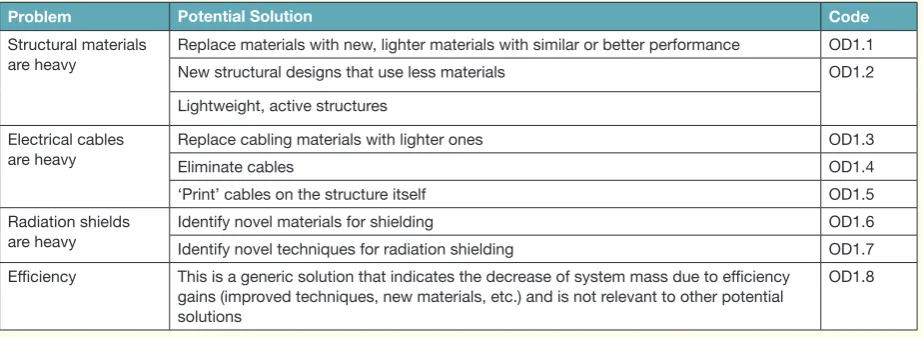
The problems stemming from this Overwhelm-ing Driver can be seen in the followOverwhelm-ing table. The third column codifies the potential solutions and will be used in a later chapter to map potential solu-tions to available technologies.
Table 3. Reduce mass, maintain stiffness Overwhelming Driver problematic areas and potential solutions
Problem Potential Solution Code
Structural materials are heavy
Replace materials with new, lighter materials with similar or better performance OD1.1
New structural designs that use less materials OD1.2
Lightweight, active structures
Electrical cables are heavy
Replace cabling materials with lighter ones OD1.3
Eliminate cables OD1.4
‘Print’ cables on the structure itself OD1.5
Radiation shields are heavy
Identify novel materials for shielding OD1.6
Identify novel techniques for radiation shielding OD1.7
Efficiency This is a generic solution that indicates the decrease of system mass due to efficiency gains (improved techniques, new materials, etc.) and is not relevant to other potential solutions
Te
ch
nol
o
gic
a
l B
re
ak
th
ro
ug
h
s f
or
S
ci
en
ti
fic
P
ro
gr
es
s (
TE
CH
BR
EA
K)
22
area of the Earth magnetosphere. Solar radiation (the solar wind) and cosmic rays deluge the space-craft with charged particles constantly. Solar and cosmic radiation in space are deadly for biological tissues as well as electronics and materials, result-ing in unavoidable degradation and embrittlement, which accumulates over time. Additionally, during its lifetime the spacecraft can often operate under extremely cold conditions or direct sunlight that increases the temperature significantly or even oper-ate with high temperature gradients due to one side being in sunlight and the other in shadow. Materials that can withstand the high fluctuations and tem-perature gradients are necessary in order to protect the payload and offer an operating environment for the instruments.
Another significant problem for spacecraft is operating in the vacuum of space. Since the ambient pressure in the operating environment is extremely low, structural materials experience outgassing or sublimation, which may result in mass loss over a significant period of operation. The most direct problem arising from this issue is the deposition of the evaporated material, which can be hazardous for sensitive optical or electronic surfaces. Mass loss particularly affects plastic layers and oxide coatings. As a consequence of this, traditional lubricants are not used in space, since their high vapour pressure will result in significant and rapid mass loss. Solid lubricant coatings and low-volatility oils are used instead.
Another source of structural damage is the space debris that orbit the Earth. Whilst large debris are
tracked and commands can be given to the space-craft to avoid them, there is a significant flux of small debris that impact the spacecraft. Given the high-velocity collisions due to the high orbital velocities, even tiny particles can cause significant damage. For spacecraft in Low Earth Orbit (LEO), the attenuated presence of the Earth’s atmosphere causes collision between the spacecraft and oxygen atoms that results in significant erosion of surfaces, leading to significant degradation.
Fifty years is a long time for a machine to oper-ate, even if it were not in space. Mechanical failures are to be expected due to the prolonged use of sys-tems, without a direct connection to radiation damage or temperature fluctuations necessarily. The ability to self-repair may be necessary, in order to maintain a functional system.
There are three ways to circumvent the afore-mentioned problems: materials that can withstand the harsh conditions, the ability to repair in space or the ability to replace damaged instruments and materials.
Finally, and perhaps most crucially, it is impor-tant to be able to simulate and test the behaviour of the spacecraft, taking into account the long timeline and doing so within a reasonable cost and time-frame. If the goal is to have a spacecraft that lasts 50 years, it is important to be able to model the behav-iour of the craft after decades in space. Laboratory testing techniques need to evolve in order to be able to simulate the ageing of a spacecraft accurately and simulation software must be able to factor such long timescales into the designing phase.
Table 4. Build a spacecraft/space missions that can last 50 years Overwhelming Driver problematic areas and potential solutions
Problem Potential Solution Code
Temperature cycling
Materials that can withstand high temperature gradients OD2.1
Advanced thermal control OD2.2
Radiation Novel shielding techniques that don’t rely on bulk material shielding and can provide protection for longer periods of time
OD2.3
Degradation, erosion, mass loss
Automatic repair of damaged material. Self-healing materials and structures are needed OD2.4
Mechanical failures Self-healing mechanisms, automated repairs, design redundancy OD2.5
Modelling and accelerated life tests OD2.6
Fuel storage The storage of hydrogen is made more efficient. Hydrogen is extremely difficult to store for long period of times. One solution would be the development of a polymer tank to store hydrogen
OD2.7
Improved energy sources
Being able to provide energy for a long period of time is a problem that will require not only the capability to prevent/repair degradation for the involved systems (i.e., degrada-tion of solar cells), but will also require advances in the efficiency of existing power pro-duction systems in order to reduce weight or size or both
Te
ch
nol
o
gic
a
l B
re
ak
th
ro
ug
h
s f
or
S
ci
en
ti
fic
P
ro
gr
es
s (
TE
CH
BR
EA
K)
23
Figure 12. Representation of acceptable, tolerable and unacceptable size range for unsterilised particle released.
Overwhelming Driver 2: Build a spacecraft and space missions that can last 50 years
“Fifty years,” I hackneyed, “is a long time.”
“Not when you’re looking back at them,” she said. “You wonder how they vanished so quickly.”
Te
ch
nol
o
gic
a
l B
re
ak
th
ro
ug
h
s f
or
S
ci
en
ti
fic
P
ro
gr
es
s (
TE
CH
BR
EA
K)
24
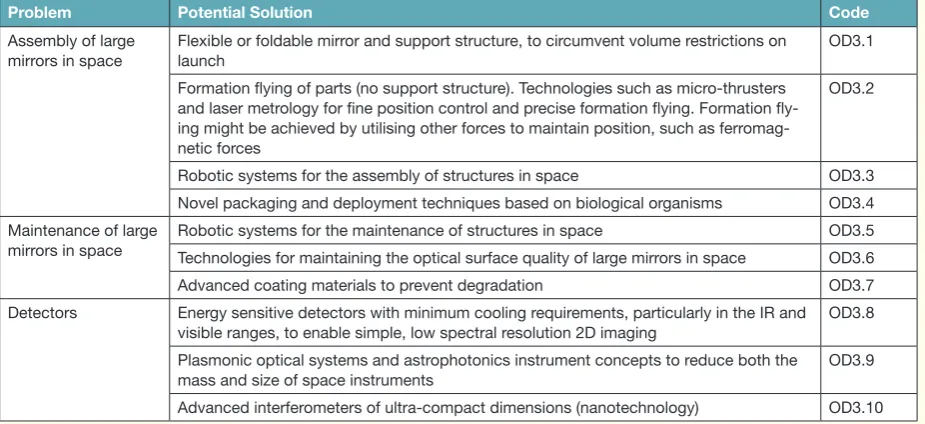
Overwhelming Driver 3: Deploy a 30m+ telescope into space
“Nature composes some of her loveliest poems for the microscope and the telescope.”