Asian J. Med. Biol. Res. 2015, 1 (3), 487-494; doi: 10.3329/ajmbr.v1i3.26466
Asian Journal of
Medical and Biological Research
ISSN 2411-4472 (Print) 2412-5571 (Online) www.ebupress.com/journal/ajmbr
Article
Effects of selected vitamins and minerals on growth rate and hematological
parameters in broilers
Mohammad Harun-Ar-Rashid1, Nazim Ahmad2, Mohammad Rohul Amin3 and Mohammad Lalmoddin Mollah4*
1
Abul Bashar Krishi College, Dhamrai-1350, Dhaka. Bangladesh
2
Department of Physiology, Faculty of Veterinary Science, Bangladesh Agricultural University, Mymensingh - 2202, Bangladesh
3
Department of Physiology and Pharmacology, Faculty of Animal Science and Veterinary Medicine, Patuakhali Science and Technology University, Barisal-8210, Bangladesh
4
*Corresponding author: Dr. Mohammad Lalmoddin Mollah, Department of Medicine, Surgery and Obstetrics, Faculty of Animal Science and Veterinary Medicine, Patuakhali Science and Technology University, Barisal-8210, Bangladesh. Tel.: +88 04327-73047; Fax: +88 04427-56112; E-mail:
Department of Medicine, Surgery and Obstetrics, Faculty of Animal Science and Veterinary Medicine, Patuakhali Science and Technology University, Barisal-8210, Bangladesh
Received: 15 November 2015/Accepted: 13 December 2015/ Published: 30 December 2015
Abstract: The present study was designed with a view to study the body weight and hematological parameters; total erythrocyte count, haemoglobin concentration, packed cell volume and erythrocyte sedimentation rate of growing broilers fed with standard poultry ration. Broilers were kept under close observation for a period of 14 days and body weight was measured at each 7 days interval up to the end of the 35 days of experimental period. A total of 20 (7 days old) broiler chicks were reared throughout the entire period of study. These chicks were randomly divided into four equal groups (n=5). Group A considered as control, fed only standard ration. Group B, C and D was considered as treated group. Group B with vitamin AD3E 1 ml/5 liter drinking water. Group C
treated with mineral 1 ml/5 liter dirking water and Group D treated with vitamin (AD3E) 1 ml/5liter and
mineral 1 ml/5 liter dirking water with standard ration. It was observed that body weight of broiler increased significantly (p<0.01) in group D compare to group A, B, & C. Total erythrocyte count, haemoglobin concentration and erythrocyte sedimentation rate values were significant (p<0.01) in the treated groups as compared to that of control group A. So it is concluded that vitamin (AD3E) and mineral supplementation with
standard ration is beneficial for broiler production and economically profitable.
Keywords: erythrocyte; haemoglobin; packed cell; vitamin (AD3
Broiler production is growing rapidly in Bangladesh. It is the important part of commercial poultry enterprise. It provides a large scale of increasing demand for animal protein and creating employment opportunities. Broilers are known as live machinery for quick return of edible meat. Broiler production reveals the fact of maximum return with minimum expense. Broiler is the most efficient for the production of quality meat in the shortest period. The broiler industry demands a fast growing chick capable of converting feed into meat with great efficient. The major objectives of poultry are the conversion of feed stuff into human food. For this reason, the efficient use of feed is extremely important. Commercial poultry producers are trying in different approaches for better growth and economic meat production of broiler. But broiler industries are facing some problems; diseases deficiencies are the major one which causes mortality at the growing stage, reduced body growth and resistance etc. Deficiency diseases are concerned with vitamin and mineral which occur in ordinary ration. The
E); broiler
optimum vitamin mineral premix supplementation are required for poultry and formulating premixes are to be necessary (McDowell, 2000).
Vitamin mineral premix is the combination of vitamins and minerals which is added to the formulated ration to meet up the requirement of at least few vitamins and minerals that are deficient in the formulated diet. Inclusion of vitamin-mineral premix in the formulated diet has become indispensable practice because feed ingredients do not contain all essential vitamins and minerals at the right amount needed for chicken. Selected vitamins (vita-A, vita-D3 and vita-E) and minerals (calcium, phosphorus, copper, iodine, iron, manganese, sodium and zinc) in
the diet. Vitamins and minerals contribute only 10% of the total cost of feed (Singh and Panda, 1988). In comparison to other species, chickens are more susceptible to vitamin deficiency because gut flora can synthesize very little vitamins but compete with the host for dietary vitamins and intensively kept chickens undergo many stresses (Ward, 1996). should be checked carefully Vitamin A, D, riboflavin and B12 are usually
low in poultry diets.
However, adding other vitamins to poultry diets is a good insurance to protect birds from deficiency diseases and disorders. Deficiency of vitamin and mineral causes various diseases and disease condition in poultry such as retarded growth, weakness, in-coordination, ruffled plumage, ataxia, blindness, xerophthalmia due to deficiency of vit-A, rickets, osteomalacia for vita-D, encephalomelacia, exudative diathesis for Vit-E and selenium, polyneuritis, curled toe paralysis, perosis impairment of food utilization for vit-B complex and anaemia for vita-B12
a) To study the effect of vitamin and mineral on growth of broiler chicks.
and folic acid deficiency (Pappenheimer et al., 1993). In recent years the importance of certain trace minerals in immune function has become increasingly evident. Selenium, copper, Zinc, cobalt and iron have been shown to alter various components of the immune system (Suttle and Jones, 1989).
Sharmin (Sharmin 2004) detected the effect of hematinics on general health and hematological parameters in Black Bengal goat. The author observed that live weight gain increased significantly (p<0.01) when treated with hematinics. She reported that there was a significant increase (P<0.01) in blood levels of hemoglobin, packed cell volume, total erythrocyte count, mean corpuscular volume, mean corpuscular hemoglobin, and mean corpuscular hemoglobin concentration. She also suggested that supplementation of hematinics might be used to improve the general health and hematological parameters in Black Bengal goats. Sarker (Sarker 1992) studied the performance of broiler, fed different types of premixes and ration composed of locally available, feed ingredients is not balanced for vitamin and mineral. Therefore, vitamin and mineral premixes should be added to the broiler ration to reduce mortality and to ensure proper growth rate.
Now a days, various types of vitamin and mineral, Revit ADE and DCP plus (Dicalcium phosphate) etc as produced by different pharmaceutical companies, are available in the market. In Bangladesh, those vitamin-mineral premixes are marketed to the poultry farmers. The poultry farmers occasionally get confused by the advertisement of different pharmaceutical companies claiming their products as the best. The vitamin mineral premixes are used by the farmers without knowledge about it. Research should be done on different vitamin mineral premixes performance before being used in the broiler diet. But there is little reliable experimental evidence about the performance of these selected vitamin and mineral such as Revit ADE and DCP plus (Opsonin Pharma Limited, Agrovet unit) on the performance of broiler chicks (Sarker 1992). Considering the above facts the present study was undertaken with the following objectives:
b) To study the effect of vitamin and mineral supplementation on haematological parameters.
2. Materials and Methods 2.1. Experimental design
2.2. Preparation of the experimental shade
The experimental shade was cleaned, washed using clean tap water and disinfected using Iosan(R). Then it was kept empty for 3 days before placing the experimental birds. The litter of rice husk was used before placing the bird in the shade. All necessary equipments were set properly to care the broiler chicks successfully.
2.3. Experimental birds
Seven days old, broilers chicks were purchased from CP Bangladesh Co. Ltd., Mymensingh for the present study. They were brought to the Kadir Poultry Farm in a well ventilated cartoon boxes to avoid suffocation. Broiler chicks were housed in proper atmosphere and hygienic condition. They were feed with standard boiler starter and finisher formulated by quality feed Ltd. throughout the experimental period. On day twenties the broilers were randomly assigned to one of four equal groups and each consisting of five birds. Diet and water were made available to the broiler daily for the entire period of the experiment.
2.4. Management practices
Fresh and clean drinking water was supplied available in all times. Feeder and waterer spaces were provided to the birds according to the recommendation of Panda et al. (1987). Each pen was 2.5ft ×2 ft and was allotted for 5 birds. Therefore, floor space provided for each bird was 1 ft2. Fresh and dried rice husk was used as litter, at a depth of about 5 cm. As per schedule (Panda et al. (1987).the old litter material was changed using new rice husk to prevent birds from fungal and coccidial attack. The birds were always exposed to a continuous lighting of 12 hours, a day. During night electric bulbs were used to provide necessary light. In order to maintain required temperature and humidity inside the shade all the windows were kept open during day and at night electric bulbs were provided as a source of heat. Feeder and waterer were cleaned and dried daily before use. Proper hygienic and strict sanitary measures were also taken during the experimental periods.
2.5. Body weight of broiler chicks
The body weight of each bird was measured with the help of balance on the 1st day of the experiment sequential at 7 days interval upto the end of the experiment (35 days).
2.6. Blood collection
A series of sterile test tubes containing anticoagulant 4% (sodium citrate) at a ratio of 1: 10 was taken. Sequential killing was done and blood was collected from each bird. The hematological studies were performed within two hours of blood collection.
2.7. Determination of total erythrocyte count (TEC)
The counting and calculation of erythrocytes were performed. For erythrocyte count, dry clean red piptte was dipped into the blood and exactly 0.5 mark blood was drawn into the pipette. Then the tip of the pipette was cleaned by cotton and immediately placed into Hayem’s solution and was filled upto 101 marks. The pipette was shaked vigorously by an electric shaker for proper mixing. The unit was expressed in millions per mm3
cm
in
blood
total
of
Height
cm
in
column
cell
red
the
of
Height
of blood.
2.8. Estimation of haemoglobin (Hb)
0.1N Hydrochloric acid (Hcl) was taken in the graduated diluting tube upto 2 mark with the help of a dropper. Exactly 0.02 ml of sample blood was added directly into the diluting fluid by Sahli pipette. Distilled water was added drop by drop and stirred unit the color of the content matches to that of the standard color of the comparator. The haemoglobin (Hb) was recorded within 10 minutes and was expressed in gm%.
2.9. Determination of packed cell volume (PCV)
After completion of ESR recording the Wintrobe’s tubes were placed in the centrifuge machine and centrifuged @ 3000 rpm for 30 minutes. Then the hematocrit of pcv was recorded. The percent volume occupied by the hematocrit was calculated by using the following formula.
2.10. Determination of erythrocyte sedimentation rate (ESR)
The fresh heparinized blood was placed into the Wintrobe’s Hematocrit tube by using Wintrobe’s pippete exactly upto the 0 (zero) mark. Excess blood above the mark was wipped away by using cotton. Then the filled tubes were placed verticallty in the wooden rack. after one hour the erythrocytes sedimentation rate was recorded from the top of the pipette. The result was expressed in mm in 1st hour.
2.11. Statistical analysis
The recorded data were compiled and tabulated for statistical analysis. Analysis of variance was done with the help of computer package MSTAT. The mean differences among the treatments were determined as per Duncan’s Multiple Range Test (Gomez and Gomez, 1984). Values of p < 0.05 were considered significant.
3. Results and Discussion
Exogenous vitamin and mineral supplementation were used in broilers to observe the effects on body weight gain and hematological parameters such as total erythrocyte count millions/mm3, hemoglobin concentration gm/dl, packed cell volume %, erythrocyte sedimentation rate (mm in first hour).
3.1. Effect on the body weight
Body weight of different groups of birds is presented in Figure. 1. Body weight on day 7 (0 day of experiment) was more or less similar 139.00±1.30 gm in group A, 144.40±1.81 gm in group B, 147.40±1.78 gm in group C and 149.80±3.20 gm in group D.
On 14th days of age (7th day of experiment) it was observed that the body weight in control group A was 415.00±5.00 gm and in the treated group B was 497.00±5.39 gm, in group C was 508.00±4.64 gm and in group D was 540.00±18.71 gm.
On 21 days of age (14th day of experiment) the body weight in control group A was 669.60±5.71 gm and in the treated groups were 706.00±4.30 gm in group B, 710.00±3.22 gm in group C and 735.00±5.48 gm in group D. On 28 days of age (21st day of experiment) the body weight in control group A was recorded 1088.00±3.39 gm and in the treated group B was recorded 1150.00±3.54 gm, group C was 1150.00±3.54 gm and group D was 1173.00±5.39 gm.
On 35 days of age (28th
Rahman (Rahman 2000) observed the mean body weight in normal broiler birds was 1612.50 -±201.56 gm at 4-5 week of ag
day of experiment) the body weight in control group A was recorded 1616.00±51.44 gm and in the treated group B was recorded 1720.00±26.08 gm, group C was 1740.00±13.04 gm and group D was 1868.00±57.48 gm. The body weight gradually increased due to vitamin and mineral supplementation with water and at the terminal day of experiment, the average body weight of all treated groups were statistically significant (p<0.01) than the control group. The highest body weight was recorded in group D (1868.00±57.48 gm).
Data cataloged on 7, 14, 21, 28 and 35 days of age shows that body weight increased significantly. The body weight increased slowly in the control group A in respective days of experiment but rise of body weight was noticed in the treated groups (B, C and D) in compared with control. The increased rate of body weight gain in the treated groups might be due to an increased feed absorption, utilization, digestion and metabolism of supplied nutrient specially protein essential for their health and body weight gain. The increased weight recorded in present finding resembles to that of Deyhim (Deyhim et al., 1995) who reported that weight gain and feed efficiency increased statistically with vitamin mineral supplementation. The findings of the present study are in agreement with the findings (Huff et al., 1992).
shown that ascorbic acid supplementation increased body weight
gaiet al. 2008) determined the effect of vitamin E on growth performance and excreta and
liver vitamin E concentrations of broilers. They found that the mean excreta vitamin E concentration at day 7 post-hatching was 17.2 IU/kg (DM basis). The percentages of vitamin E excreted were based on analyzed vitamin E concentrations in the diet. Increased concentration of vitamin E increases liver alpha-tocopherol concentrationset al.2006) studied the effects of selenium and vitamin E supplementation on some immune parameters. Chicks were immunized against Newcastle disease virus (NDV) vaccine at 21 d of age and produced significantly higher HI antibody titers. The result suggested that vitamin E (0-200mg/kg) and selenium (0-0.2mg/kg diet) have synergistic effects on immune responses.
inhibition and antibody production was determined in broilers. Maximum body weight gain and best efficiency of food utilization were obtained in chicks fed diets containing 0.50 mg/kg Se and 300 IU/kg vitamin E. Significantly higher antibody titers (HI and ELISA) at 10 d PI were attributed to 0.06 mg/kg and 150 IU/kg Se and vitamin E, respectively. These data suggest that optimum growth and immune response may be achieved at supplemental level of Se of 0.06 mg/kg and vitamin E at 150 IU/kg. Ali (Ali et al. 1995) conducted an experiment with commercial broiler given a basal diet supplemented with 4 different commercially available premixes (Vitamin-mineral premix, Nutripol, Rousselot SA and Nutrimix B) and with a home product premix. There was no significant difference among treatment in the rate of weight gain or feed conversion efficiency. The incidence of deficiency diseases were zero with home produced premix and ranged from 6.7 to 13% for the commercially available premixes. The present findings are also suggested that the selected vitamins and minerals significant increased in body weight in treated groups.
Figure 1. Body weight changes after 35 days of treatment with commercial feed, fed with vitamin, fed with mineral and fed with both vitamin and mineral in broiler (n = 5 in each group). Data are expressed as mean ± SD, * p < 0.01 significantly different for broiler control. Feed with vitamin, mineral, vitamin and mineral supplementation at 1ml/5 liter of drinking water.
Figure 3. Effect of exogenous vitamin and mineral on haemoglobin (Hb) in different group of broiler. Data are expressed as mean ± SD, * p < 0.01 significantly different for broiler control. Feed with vitamin, mineral, vitamin and mineral supplementation at 1ml/5 liter of drinking water.
Figure 4. Effect of exogenous vitamin and mineral on packed cell volume (PCV) in different group of broiler. Data are expressed as mean ± SD, * p < 0.01 significantly different for broiler control. Feed with vitamin, mineral, vitamin and mineral supplementation at 1ml/5 liter of drinking water.
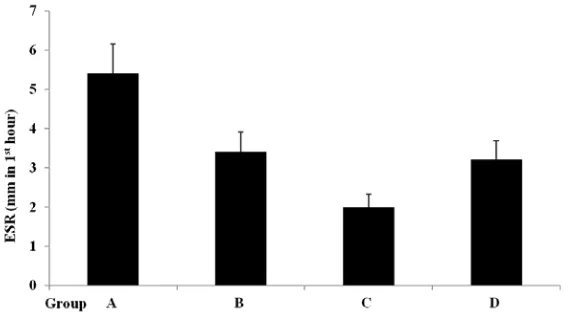
Figure 5. Effect of exogenous vitamin and mineral on erythrocyte sedimentation rate (ESR) in different group of broiler. Data are expressed as mean ± SD, * p < 0.01 significantly different for broiler control. Feed with vitamin, mineral, vitamin and mineral supplementation at 1ml/5 liter of drinking water.
3.2. Effects on hematological parameters
million/mm3 and group D was 2.93±8.35 million/mm3. The highest values of TEC in the group C (3.26±12.86 million/mm3) and lowest in control group A (2.76±11.86 million/mm3) as shown in figure 2. The Hb content in control group A was 7.36±0.1 gm/dl, group B was 8.00±0.17 gm/dl, group C was 8.44±0.12 gm/dl and group D was 7.60±0.17 gm/dl as shown in figure 3. The highest value of Hb content was recorded in group C (8.44±0.12 gm/dl) and lowest value of Hb was in group A (7.36±0.1 gm/dl). As shown in figure 4. The value of packed cell volume (PCV) of groups A, B, C and D were 19.40±0.81 %, 21.00±0.71%, 24.80±1.11% and 21.80±0.66 % respectively. The highest value was found in group C (24.80±1.11%) and lowest was in control group A (19.40±0.81%). The erythrocyte sedimentation rate (ESR) value of groups A, B, C and D were 5.4±0.8, 3.4±0.5, 2.00±0.32 and 3.20±0.49 mm in first hour respectively. The lowest value was found in group C (2.00±0.32 mm in first hour) and highest was in control group A (5.40±0.75 mm in first hour) as shown in figure 5.
Javed (Javed 2003) reported that hematological parameters studied there is no significant differences between treatment and control groups in hemoglobin concentration and total erythrocyte count. Williams (Williams 1986) carried out an experiment in 34 male domestic chicks of 21 days old to study packed cell volume. He found that the mean packed cell volume was 28.7 percent with range from 23 to 39 percent. The ESR of day old chicks was found to be very high which was not related to protein contain of plasma. The ESR in female birds was also higher than the male especially in first hour.
The increased level of total erythrocyte, hemoglobin and packed cell volume might be due to the effects on hemopoietic organs. Some vitamins such as vitamin B12, pantothenic acid, folic acid, biotin etc which are
essential for normal growth of the hemopoietic organs and erythropoiesis. The hematological parameters of erythrocytes and other components of blood varied due to the influence of age, sex, environment, exercise, nutritional status and climate. This present finding differs with the earlier report of (Trans et al., 2000), who observed no significant effect of vitamin E supplementation on any of the hematological parameters (TEC, Hb, PCV and ESR).
4. Conclusions
The present study indicates that vitamin-mineral premix supplementation enhanced the growth of broilers. At the final day of the experiment the body weight was significantly increase in the treated groups in comparison with that of the control group. Initial day of experiment hematological parameters like TEC, Hb concentration, PCV and ESR values were more or less similar among all groups but after feeding of commercial vitamin-mineral premix the values were started increase significantly in the treated groups compared to that of control group. The findings it could be suggested that supplementation of vitamin mineral premix and standard poultry ration are essential for proper growth, to increase body resistance capacity, prevents of deficiency diseases and decrease mortality rate of poultry especially growing broiler chicks and this prevent great economic loss.
Conflict of interest None to declare
References
Ali S, Aktam M, Farque AR, Ashraf M and Amin Z, 1995. Comparative efficiency of different vitamin supplementation in broiler’s starter ration. Pakistan Veterinary Journal, 5: 140-142.
Deyhim F, Sloceker BS, Adeleye BG and Teeler RG, 1995. The effects of heat distress environment, vitamin and trace mineral supplementation on performance, blood constituents and tissue mineral concentrations in broiler chicken. Nutrition Research, 15: 521-526.
Gomez KA, and Gomez AA, 1984. Duncan’s Multiple Range Test. Statistical procedures for Agricultural Research. 2nd
Edi. John Wiley and Sons, 207-215.
Huff WE, Kubena LF, Harvey RB and Philips TD, 1992. Effect of vitamin-mineral supplementation on growing chicks. Poultry Science, 71: 64-69.
Javed MT, Ahmad F, Rafique NZ and Bashir M 2003. Effects of higher levels of chromium and copper on some hematological parameters and serum proteins in broilers. Pakistan Veterinary Journal, 23: 31-35.
composition of broiler chicks exposed to a high ambient temperature
McDowell LR, 2000. Vitamin supplementation is a critical part of good animal nutrition. Poult. Abs, 15: 97. Panda B, Ahuja SD, Shrivastav AK, Singh RD and Thomas PC, 1987. Poultry Production Technology
Publication No. 4187, CARI, Izanagar, India.
Pappenheimer A M, Goettsch M and Jungherr E, 1993. Nutritional encephalomalacia in chicks and certain related disorders of domestic bird. Agr. Exper. Sta. Bul, p. 229.
Rahman MM, Islam MM and Haque MM, 2000. Effect of experimental transverse mid-shaft fractures on certain physiological values and weight bearing capacity in broiler birds. Bangladesh Veterinary Journal, 35: 47-51.
Sarkar SK, 1992. Effects of feeding locally feed ingredients with or without supplementation of vitamin-mineral premix in broiler. MS in Poultry Science, BAU, Mymensingh.
Sharmin ML, 2004. Effects of hematinics in sheep and goat. M.S. Thesis Department of Physiology, BAU, Mymensingh, pp.15-20.
the two on antibody responses of broilers
Suttle N F, and J ones DG, 1986. “Copper and D is ase Resistance in Sheep: A Rare Natural Confirmation of Interaction Between a Specific Nutrient and Infection.” Proc. Nutr . Soc. 45:317.
different combinations on the performance and immune response of broilers Trans B, Inal F, Bas AL, Altunok V, Elmas M and Yazar E, 2000. Effect of continuous supplementation of
ascorbic acid, aspirin, vitamin E and selenium on performance immune response and some biochemical parameters under normal environmental and management conditions in broilers Archiv-fur-Gerflugelkunde, 65: 187-192.
Williams RB, 1986. Packed cell volume of blood from male domestic chicks. British Poult. Sci, 27: 483-485. Ward NE, 1996. Commercial vitamin supplementation for poultry. Poultry Adviser, New Jerrey, USA, 29: