http://www.ijcmph.com pISSN 2394-6032 | eISSN 2394-6040
Original Research Article
Internet addiction and performance of health science students
Shashi Bhushan
1*, Shobhit Piplani
1, Bheemsain V. Tekkalaki
2INTRODUCTION
There has been an exponential rise in the number of internet users in India from 10% in 2011 to 30% in 2016.1 This surge in the usage of the Internet recently has led to a huge impact on communication and interpersonal behaviour. On one hand, Internet has become an important tool for education, entertainment, communication, and information-sharing while on the other hand, the internet has empowered people to be in an easy relationship with strangers, to create social connections that are not easily achievable in modern life and to opine their feelings and thoughts without any
restraints.2-4 Excessive internet usage, also called as pathological internet use or internet addiction, causes problems in social and personal life.5
Goldberg coined the term ―internet addiction‖ in 1995 for pathological compulsive internet use.6 Young linked this unrestrained internet usage very minutely to pathological gambling, a disorder of impulse control in DSM IV and adapted this criterion to associate to internet use in the Internet Addiction Test developed by her.7,8
In the community, adolescents have been found to spend more time on the Internet than adults, predisposing
ABSTRACT
Background: The unmonitored surge in the usage of Internet recently has led to Internet Addiction. Internet is a classical instrument known to stimulate addictive behaviour which is on the verge of developing into a considerable public health emergency in the future in a densely populated country like India. Adolescents are more susceptible to this as they spend more time browsing the web. This cross sectional study intends to find out the co-morbidities associated with Internet Addiction in students of health sciences in India.
Methods: The study was conducted in an Indian Medical and Dental College. 900 students were randomly selected to fill up the questionnaire. 618 students fulfilled the selection criteria. Young’s Internet Addiction Test was used for assessing the prevalence of Internet Addiction. The Rosenberg self-esteem scale was used to measure the self-esteem.
Results: 19.5% students were not addicted to Internet. 61% of students were mildly addicted while 19.5% students were moderately addicted. Significant association was found between academic performance and Internet Addiction. Also, Internet Addiction had no significant association with Self- Esteem and Obesity.
Conclusions: Proper screening methods should be used for prompt detection and management of Internet Addiction and awareness should be made about the same. It should be given more attention and students should be made to understand about healthy and safe practices to use internet. There is a need of an improved questionnaire which can provide us better understanding of internet usage by people in terms of amount of time and purpose of using the internet.
Keywords: Internet addiction, Academic performance, Self esteem, Obesity
1
Jawaharlal Nehru Medical College, KLE University, Belagavi, Karnataka, India
2
Department of Psychiatry, Jawaharlal Nehru Medical College, KLE University, Belagavi, Karnataka, India
Received: 12 July 2018
Revised: 14 August 2018
Accepted: 16 August 2018
*Correspondence:
Dr. Shashi Bhushan,
E-mail: [email protected]
Copyright: © the author(s), publisher and licensee Medip Academy. This is an open-access article distributed under the terms of the Creative Commons Attribution Non-Commercial License, which permits unrestricted non-commercial use, distribution, and reproduction in any medium, provided the original work is properly cited.
themselves to Internet addiction. The advent of smartphones has only contributed to this problem. The Internet can have a negative impact on youths and young adults in particular if it is not utilized in a controlled and proper way. People suffering from Internet Addiction are more prone to develop psychosocial disorders.9
The Internet Addiction is on the verge of developing into a considerable public health emergency in the coming time in a densely populated and rapidly developing country like India, China and Russia. More and more students are getting addicted to the internet. Such gratification is injurious to their health, study, sleep and family relationship.4,8
There has been a lot of research in this area but there has been a large difference in the results due to due to diverse study designs, different assessment methods, and sampling from different sub-populations across the world. Students from health sciences have not been assessed properly for this. Also, there are some limitations with the standardized questionnaire used for assessment of Internet Addiction. Therefore, this cross-sectional study intends to assess the lifestyle, self-esteem and academic performance associated with Internet Addiction in students of health science in South India.
METHODS
The study was conducted in a South Indian Medical and Dental College from November 2016 to June 2017.
A sample size of 384, using determinants of Internet Addiction with 95% Confidence Interval (CI) and 20% tolerable error was estimated. Keeping in mind larger drop-out rate from the study, 900 (Design Effect=2) students were randomly selected (620 from Medical College and 280 from Dental College). Institutional ethical clearance was taken for the same (IEC Reference No.–MDC/DOME/181). A written consent explaining the study was taken from the participants. Out of 900 students, 618 students answered the questionnaire completely. Two standardized questionnaires were used for assessment.
The internet addiction test (IAT; Young, 1998) is a 20-item 5-point Likert scale that measures the severity of
self-reported compulsive use of the internet. Total internet addiction scores are calculated, with possible scores for the sum of 20 items ranging from 20 to 100. The scale showed very good internal consistency, with an alpha coefficient of 0.93 in the present study.10
According to Young's criteria, total IAT scores 20-39 represent mildly addicted users with complete control of their internet use, scores 40-69 represent moderately addicted users with frequent problems caused by their internet use, and scores 70-100 represent highly addicted users with significant problems caused by their internet use. In this study, mild, moderate and severe users were taken as addicted population.
The Rosenberg self-esteem scale (RSES) was used to measure the self-esteem. It was a scale of 0-30 where a score less than 15 may indicate a problematic low self-esteem. The RSES was designed similar to social-survey questionnaires. It was a ten-item Likert-type scale with items answered on a four-point scale—from strongly agrees to strongly disagree. Five of the items had positively worded statements and five had negatively worded ones. The scale measured state self-esteem by asking the respondents to reflect on their current feelings.11
Additionally, questions regarding the purpose of Internet Usage, socio-demographic and academic performance of the 1st year assessed by their final examination marks, along with family/medical/drug history were asked.
The association between explanatory variables and categorical outcomes was assessed by comparison of percentages. Chi-square test was done. P value <0.05 was considered statistically significant. IBM SPSS version 22 was used for statistical analysis.12
RESULTS
There were 618 participants comprising of 461 students from the medical college and 157 students from the dental college who were screened. The mean ages of the participants were 20.03±1.45 years. A total of 382 females and 236 males participated in the study.
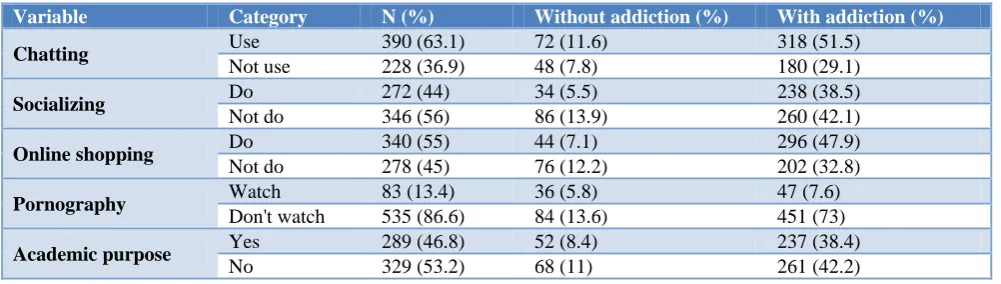
Table 1: Risk factor for internet addiction (N=618).
Variable Category N (%) Without addiction (%) With addiction (%)
Chatting Use 390 (63.1) 72 (11.6) 318 (51.5)
Not use 228 (36.9) 48 (7.8) 180 (29.1)
Socializing Do 272 (44) 34 (5.5) 238 (38.5)
Not do 346 (56) 86 (13.9) 260 (42.1)
Online shopping Do 340 (55) 44 (7.1) 296 (47.9)
Not do 278 (45) 76 (12.2) 202 (32.8)
Pornography Watch 83 (13.4) 36 (5.8) 47 (7.6)
Don't watch 535 (86.6) 84 (13.6) 451 (73)
Academic purpose Yes 289 (46.8) 52 (8.4) 237 (38.4)
Table 2: Association of BMI with internet addiction in the study population (N=618).
BMI Internet addiction interpretation Chi square P value
Addicted (%) Not addicted (%) Under weight (N=74) 56 (75.67) 18 (24.32)
2.674 0.44
Normal (N=399) 323 (80.95) 76 (19.05)
Over weight (N=123) 99 (80.48) 24 (19.51)
Obese (N=22) 20 (90.90) 2 (9.09)
Table 3: Association of self-esteem with internet addiction in the study population (N=618).
Self –esteem Internet addiction interpretation Chi square P value
Addicted (%) Not addicted (%) High (N= 499) 406 (81.36) 93 (18.64)
1.008 0.315
Low (N= 119) 92 (77.31) 27 (22.69)
Table 4: Association of position with internet addiction in the study population (N=618).
Position Internet addiction interpretation Chi square P value
Addicted (%) Not addicted (%) Distinction (N=44) 38 (86.36) 6 (13.64)
13.261 0.01
First class (N=239) 176 (73.64) 63 (26.36)
Second class (N=189) 157 (83.06) 32 (16.93)
Pass (N=41) 37 (90.40) 4 (9.76)
Fail (N=105) 90 (85.71) 15 (14.29)
The results of the Young’s internet addiction test showed that there were no severely addicted students. 376 (61.1%) students were mildly addicted and 128 (20.5%) were students are moderately addicted while 114 (18.4%) students were normal internet users. The average score was 32.16±16.36. Table 1 shows the purpose of Internet Usage by students. These variables were asked in a separate questionnaire as there is no standardized questionnaire to assess the purpose and time spent on Internet. They were chosen after reviewing previous studies done on this topic.
On studying the association of Internet Addiction with lifestyle, it was found that there was no significant association between the BMI and Internet Addiction which can be inferred from the Table 2.
On using RSES for measuring the Self-Esteem of the students, we found that there was also no significant difference in the ratio of participants who had low self-esteem in the students who were at risk of developing Internet Addiction which is seen in Table 3. Therefore no significant association was found between Internet Addiction and low self-esteem.
As evident from Table 1, students having Internet Addiction are using Internet for non-academic activities. Furthermore, it was found that Internet Addiction had a statistically significant association with the poor academic performance of the students as seen in Table 4.
DISCUSSION
India has recently become a hotspot for multiple fold increase in the number of internet users. Because of the advent of smart phones, many young people have got unregulated access to internet which has had a considerable effect on their social and personal lives.
Firstly, we studied about the association of Internet Addiction with the lifestyle and dietary habits in the students. We found that there was no significant association between the two factors. This was inconsistent with the findings of previous studies. A study conducted in Turkish adolescents found a positive correlation between internet addiction and BMI.13 Another study conducted by Bozkurt et al also had the same results.14 On the contrary, there was a study where no significant association has been found between internet addiction and BMI.15 This shows that there has been a disparity in the results. Our outcome can be explained by the fact that medical students have better knowledge of healthy lifestyle which could be used to overcome problems like obesity.16 Furthermore, none of the participant came under the severe internet addiction category, and hence their lifestyle was not affected much.
supported the previous findings.18 A recent cross-cultural study done in Brazil and Portugal also had the same results.19 Even in a study conducted in India, the results were identical.20 Our findings could be justified by the fact that although students of health sciences were at a higher risk of developing internet addiction, they were already academically very qualified and at par with their peers thus showing better coping abilities and self-esteem.
We found a negative association between Internet Addiction and academic performance of the students. This result was in line with the previous studies. A study done in Pakistan showed a significant negative correlation between internet addiction and academic performances of medical students.21 Another study conducted by Mishra et al had the same findings.22 However, there has been a multi-country study where this result has been countered although the sample size was very small.23 This negative association can be very well explained by the fact that the more students will use internet, more their academics will be hampered.
The limitation of our study has been that firstly, it was a self-assessment questionnaire that was used and no interview was conducted to confirm the clinical diagnosis of internet addiction. Thus we could not rule out the social desirability bias. Secondly, it was a cross-sectional study where the generalization of the result should be limited only to college student population. Further studies are needed in India with larger population size in general setting and special importance should be given assessing the multiple psychosocial comorbidities associated with internet addiction.
The major findings of the study state that although internet addiction does not affect the BMI and self-esteem of students of health sciences, it does affect their academic performance. It is very important to understand the detrimental effects that internet addiction can have on the youth. There is an immediate need for stringent control over the internet usage at the institutional level. Internet addiction should be given more attention and the students should be made to understand about the healthy and safe practices about the internet use. Further, there is a need of an improved questionnaire which can provide us a better understanding of internet usage by people in terms of the amount of time and the purpose of using the internet.
ACKNOWLEDGEMENTS
Dr. Naresh Kumar Tyagi, Professor and Head, KLE University Department of Epidemiology and Biostatistics, Belagavi.
Funding: No funding sources Conflict of interest: None declared
Ethical approval: The study was approved by the Institutional Ethics Committee (Reference No.– MDC/DOME/181)
REFERENCES
1. Facts I. Topic: Internet usage in India. 2017. Available at: https://www.statista.com/topics/2157 /internet-usage-in-india/. Accessed on 29 November 2017.
2. Buckingham D. The electronic generation? children and new media. In: Lievrouw LA, Livingstone S, eds. The handbook of new media: Social Shaping and social consequences of ICTs. London, SAGE Publications Ltd; 2002: 77-89.
3. Teo TSH, Lim VKG. Gender differences in Internet usage and task preferences. Behavior Inf Techno. 2000;19(4):283-95.
4. Young KS. Internet addiction: Symptoms, evaluation and treatment. In vande Creek L, Jackson T, eds. Innovations in clinical practice: a source book. sarasota, FL: Professional Resource Press; 1999.
5. Widyanto L, Griffiths M. Internet addiction: does it really exist? (revisited). In: Gackenbach J, eds. Psychology and the Internet: intrapersonal, interpersonal, and transpersonal implications. 2nd ed. San Diego, CA: Academic Press; 2007: 141-163. 6. Goldberg I. Internet Addiction 1996. Available from: http://web.urz.uniheidelberg.de/Netzdienste/ anleitung/wwwtips/8/addict.html. Accessed on 29 November 2017.
7. Young KS. Internet Addiction: The emergence of a new clinical disorder. Cyberpsychol Behav. 1998;3:237–44.
8. Young KS. Internet addiction: A new clinical phenomenon and its consequences. Am Behav Sci. 2004;48:402–15.
9. Wallace P. Internet addiction disorder and youth. EMBO reports. 2014;15(1):12-6.
10. Widyanto L, McMurran M. The Psychometric Properties of the Internet Addiction Test. Cyber Psychol Behavior. 2004;7(4):443-450.
11. Rosenberg, M. Society and the adolescent self-image. Princeton, NJ: Princeton University Press; 1965.
12. Machines IB. IBM SPSS Statistics for Windows, Version 22.0. IBM Corp Armonk, NY; 2013. 13. Canan F, Yildirim O, Ustunel T, Sinani G, Ozturk
O, Gunes C et al. 467 – The relationship between internet addiction and body mass index in turkish adolescents. European Psychiatry. 2013;28:1. 14. Bozkurt H, Özer S, Şahin S, Sönmezgöz E. Internet
use patterns and Internet addiction in children and adolescents with obesity. Pediatr Obes. 2018;13(5):301-6.
15. Cam H, Nur N. A Study on the prevalence of Internet addiction and its association with psychopathological symptoms and obesity in adolescents. TAF Prevent Med Bulletin. 2015;14(3):181.
Baghdad. World Family Med J/Middle East J Family Med. 2012;12(3):37-47.
17. Bahrainian S, Haji Alizadeh K, Raeisoon M, Hashemi Gorji O, Khazaee A. Relationship of Internet addiction with self-esteem and depression in university students. Journal of Preventive Medicine and Hygiene, 2014;55(3):86–9.
18. Aydm B, San S. Internet addiction among adolescents: The role of self-esteem. Procedia - Social and Behavioral Sciences. 2011;15:3500-5. 19. Seabra L, Loureiro M, Pereira H, Monteiro S,
Marina Afonso R, Esgalhado G. Relationship Between Internet Addiction and Self-Esteem: Cross-Cultural Study in Portugal and Brazil. Interacting with Computers. 2017;29(5):767-78.
20. Fortes L, Fernandes M. The Effect of Mobile and Internet Addiction on Self-esteem among Adolescents. Int J English Language, Literature Humanities. 2016;4(9):120-209.
21. Rajput TA, Khan MA, Shabbir F, Alvi AA. Effect of internet addiction on academic performance of medical students. J Islamic Int Med College. 2016;11:48-51.
22. Mishra S, Draus P, Goreva N, Leone G, Caputo D. The impact of Internet addiction on university students and its effect on subsequent academic success: A survey based study. Issues in Information Systems. 2014;15(2):344-52.
23. Usman N, Alavi M, Shafeq S. Relationship between Internet Addiction and Academic Performance among Foreign Undergraduate Students. Procedia - Social and Behavioral Sci. 2014;114:845-51.