Automated Skin Disease Identification using
Deep Learning Algorithm
Sourav Kumar Patnaik, Mansher Singh Sidhu,
Yaagyanika Gehlot, Bhairvi SharmaandP Muthu*
Department of Biomedical Engineering, SRM Institute of Science and Technology, Kattankulathur, Chennai, Tamil Nadu, India.
*Corresponding author E-mail: [email protected]
http://dx.doi.org/10.13005/bpj/1507
(Received: 26 June 2018; accepted: 28 August 2018)
Dermatological disorders are one of the most widespread diseases in the world. Despite being common its diagnosis is extremely difficult because of its complexities of skin tone, color, presence of hair. This paper provides an approach to use various computer vision based techniques (deep learning) to automatically predict the various kinds of skin diseases. The system uses three publicly available image recognition architectures namely InceptionV3, InceptionResnetV2, MobileNet with modifications for skin disease application and successfully predicts the skin disease based on maximum voting from the three networks. These models are pretrained to recognize images upto 1000 classes like panda, parrot etc. The architectures are published by image recognition giants for public usage for various applications. The system consists of three phases- The feature extraction phase, the training phase and the testing / validation phase. The system makes use of deep learning technology to train itself with the various skin images. The main objective of this system is to achieve maximum accuracy of skin disease prediction.
Keywords: Computer Vision, Deep Learning, Image Recognition, Learning Algorithms, Skin Disease.
TTHE Dermatology remains the most uncertain and complicated branch of science because of it complicacy in the procedures involved in diagnosis of diseases related to hair, skin, nails. The variation in these diseases can be seen because of many environmental, geographical factor variations. Human skin is considered the most uncertain and troublesome terrains due to the existence of hair, its deviations in tone and other mitigating factors. The skin disease diagnosis includes series of pathological laboratory tests for the identification of the correct disease. For the past ten years these diseases have been the
matter of concern as their sudden arrival and their complexities have increased the life risks1. These
Skin abnormalities are very infectious and need to be treated at earlier stages to avoid it from spreading. Total wellbeing including physical and mental health is also affected adversely. Many of these skin abnormalities are very fatal particularly if not treated at an initial stage. Human mindset tends to presume that most skin abnormalities are not as fatal as described thereby applying their own curing methods. However if these remedies are not apt for that selective skin problem then it makes it even worse. The available diagnosis procedure
Published by Oriental Scientific Publishing Company © 2018
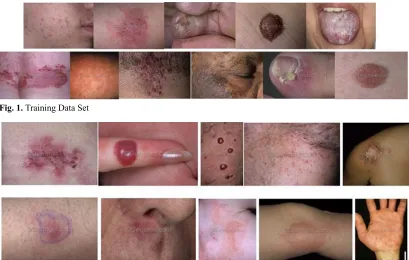
Fig. 1. Training Data Set
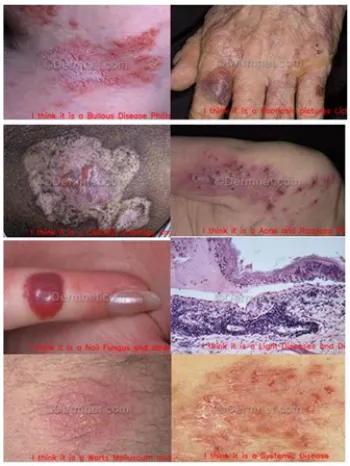
Fig. 2. Testing Data Set
consists of long laboratory procedures but this paper proposes a system which will enable users to predict the skin disease using computer vision.
Computer based diagnosis of skin disease
With the increase in medical technology the concept of computer being used for the diagnosis of skin diseases has been around recently. Use of computer technology can make it simpler to detect the diseases just from the images of the infected skin image and could assist the human’s ability to analyze complex information. Artificial Intelligence is taking up automation in all fields of application even in the healthcare field3.
A computer can efficiently and effortlessly interpret a lot of images where it is difficult for the human to interpret such a high number of data and look into the details of the image inside. Therefore Computer-Aided-Detection and Computer-Based-Diagnosis have become desirable and are under development by many research groups4. Computer
based diagnosis have proven to be very helpful in disease diagnosis.
The most prevalent technology which is being used for the prediction is Artificial Intelligence using Machine Learning. Artificial
Intelligence uses learning methods to learn about the images to predict the diseases based upon the common patterns. The machine interprets the images and its slices and processes the image and predicts.
Machine learning
Machine Learning is that branch of computer studies that gives the potentiality to the computer to grasp without being characteristically programmed. Machine learning is employed in a wide range of computing functions where building and designing specific algorithms with better performances is difficult or impractical. Machine Learning is also firmly attached to computational statistics which makes prediction through computers easier and feasible. In commercial terms Predictive Analysis is machine learning used to design multiple algorithms and models that greatly helps the process of prediction. Here the machine learns itself and divide the data provided into the levels of prediction and in a very short period of time gives the accurate results5.
Deep Learning
Fig. 3. Flowchart of the methodology used Fig. 4. Confusion Matrix of Inception V2
can be supervised, unsupervised or semi supervised. Deep learning unlike machine learning uses a large dataset for the learning process and the number of classifiers used gets reduced substantially6.
The training time for the deep learning algorithm increases because of the usage of the very large dataset. Deep learning algorithm chooses its own features unlike the machine leaning making the prediction process easier for the end user as it does not use much of pre-processing7.
Supervised Learning
Supervised learning is a data mining chore which concludes a function from a characterized training data which contains series of training instances. Each example, in supervised learning, is
a combination comprising of an input object, which usually is a vector, and a desired output response value, also known as the supervisory signal8. Unsupervised Learning
The problem that arises in both data science world and data mining in an unsupervised learning task is locating the hidden structure in an uncharacterized or unlabeled data. Therefore when the learner is given an unlabeled example, no error or reward signal is present for evaluation of an impending solution8.
Semi Supervised Learning
There is a class of supervised learning techniques and tasks which employs unlabeled data (for training) known as Semi-Supervised learning. This unlabeled data is usually an undersized quantity of labeled data which has a huge quantity of unlabeled data. This type of learning falls in between of supervised (completely labeled) and unsupervised learning (not labeled)9.
MATERIALS AND METHOD
Data Set
Table 1. Results Of Inception V2
No. of Precision Recall F1 – Score Diseases
0 0.70 0.79 0.78
1 0.60 0.61 0.75
2 0.77 0.79 0.73
3 0.77 0.71 0.76
4 0.65 0.76 0.75
5 0.76 0.74 0.75
6 0.76 0.77 0.77
7 0.70 0.79 0.73
8 0.70 0.71 0.70
9 0.79 0.70 0.74
10 0.79 0.83 0.75 11 0.77 0.77 0.75 1213 0.890.72 0.700.66 0.780.79 1415 0.770.64 0.780.72 0.670.67 16 0.78 0.66 0.67 17 .76 0.73 0.79 18 0.78 0.64 0.66 19 0.70 0.61 0.71 Total 0.78 0.78 0.77
Table 2. Results Of Inception V3
No. of Precision Recall F1 – Score Diseases
0 0.77 0.77 0.66
1 0.69 0.74 0.71
2 0.78 0.77 0.72
3 0.73 0.71 0.75
4 0.73 0.71 0.72
5 0.73 0.76 0.73
6 0.77 0.75 0.76
7 0.76 0.73 0.75
8 0.78 0.71 0.79
9 0.75 0.78 0.71
10 0.67 0.82 0.74 11 0.62 0.76 0.79 12 0.78 0.73 0.70 13 0.66 0.77 0.61 14 0.74 0.66 0.70 15 0.79 0.77 0.78 16 0.71 0.76 0.76 17 0.85 0.85 0.80 18 0.78 0.76 0.87 19 0.77 0.79 0.78 Total 0.78 0.79 0.78
Table 3. Results Of Mobilenet
No. of Precision Recall F1 – Score Diseases
0 0.48 0.65 0.55
1 0.48 0.46 0.47
2 0.41 0.42 0.41
3 0.09 0.04 0.05
4 0.24 0.23 0.24
5 0.62 0.52 0.57
6 0.45 0.42 0.44
7 0.33 0.34 0.33
8 0.44 0.39 0.41
9 0.51 0.52 0.52
10 0.64 0.78 0.71 11 0.38 0.27 0.32 12 0.52 0.50 0.51 13 0.39 0.28 0.32 14 0.53 0.60 0.56 15 0.30 0.27 0.28 16 0.48 0.38 0.43 17 0.39 0.29 0.34 18 0.41 0.38 0.40 19 0.44 0.48 0.46 Total 0.46 0.47 0.46
In this method, the divide mode is set to 90% for the training of the data, 10% for the validating/testing of the data.
Methodology
Development of a widespread plan to test the special features and general functionality on a range of platform combination is firstly initiated by the test process. The procedures used are strictly quality controlled. The method involves use of pre-trained image recognizers with modifications to identify skin images.
The process verifies that the application is bug free and it meets the requirements stated in the requirements document of system10. The
following are the considerations used to develop the framework from developing the testing methodologies.
Module design
are:-1) Feature extraction module. 2) Training module.
3) Validation/ Testing phase.
Fig. 5. Confusion Matrix of Inception V3 Fig. 6. Confusion Matrix of MobilNet
Fig. 7. Predictions pop ups
streamlined architecture that uses deep-wise separate convolutions11. Though these process
same as inception these have light weights. The other two networks used are Inception V3 and InceptionResnetV2
Inception V3 involves two fragments
1) Feature extraction part with a convolutional neural network.
2) Classification part with fully-connected layer.
The pre-trained Inception V3 model attains advanced accuracy in recognition of general
materials with 1000 classes, like Zebra, Dalmatian and Dishwasher etc. The model extracts several features from the input images in the feature extraction part and then classifies them established on those obtained features.
In transfer learning, when a new model is built to categorize an original dataset, the feature extraction and classification parts are reused and retrained respectively with the dataset12. In transfer
learning the last layer of the model is trained again with the new dataset so that the model can learn about the application.
RESULTS AND DISCUSSIONS
This study projects a method that uses techniques related to computer vision to distinguish different kinds of dermatological skin abnormalities. We have employed various types of Deep learning algorithms (Inception_ v3, MobileNet, Resnet, xception) for feature extraction and learning algorithm (preferably Random forest or Logistic Regression) for training and testing purpose. Using the state of the art architecture considerably increases the efficiency up to 88 percentage. And further more by using ensemble features mapping, combing the models trained using Inception V3, MobileNet, Resnet, Xception a voting based model will be ensembled and thereby increasing the efficiency13. For
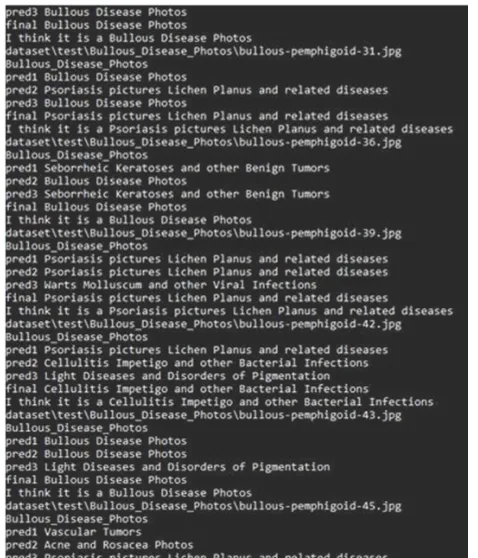
Fig. 8. Command window predictions 1
data, 10% for the validating/testing of the data. To characterize the efficiency of a classification model (or “classifier”) on a set of test data for which the true values, a table of confusion matrix is used.
Result of Inception V2
Confusion Matrix for Inception V2 is displayed in (Fig. 4.) and the diagonal in the matrix describes about the accuracy of the algorithm. So in this case the highest correct answers were for the 14th prediction and 14th label. X-axis depicts
Prediction and Y-axis depicts Labels.
The efficiency of inception V2, as presented in Table I is Rank-1: 68.15%, Rank-5: 85.62%.
Result of Inception V3
Confusion Matrix for Inception V3 is displayed in (Fig. 5.) and the diagonal in the matrix describes about the accuracy of the algorithm. The highest correct answers were for the 14th prediction and 14th label
The efficiency of inception V3, as presented in Table II is Rank-1: 79.07%, Rank-5: 88.28%.
Results of MobileNet
Confusion Matrix for MobileNet is displayed in (Fig. 6) and the diagonal in the matrix describes about the accuracy of the algorithm. So in this case the highest correct answers were for the 14th prediction and 14th label. X-axis depicts Prediction and Y-axis depicts Labels
The efficiency of MobileNet, as presented in Table III is Rank-1: 46.72%, Rank-5: 69.12%.
Predictions
These are the images in (Fig. 7) which were predicted upon running the algorithm. The image pops out with the written message of, what is predicted by the algorithm.
The results in (Fig. 8 and 9) were the predictions for all the three algorithms and the final result is displayed according to the majority or the algorithm with highest accuracy.
CONCLUSION
In this work a model for prediction of skin diseases is done using deep learning algorithms. It is found that by using the ensembling features and deep learning we can achieve a higher accuracy rate and also we can go for the prediction of many more diseases than with any other previous models done
before. As the previous models done in this field of application were able to report a maximum of six skin diseases with a maximum accuracy level of 75%. By implementing deep learning algorithm we are able to predict as many as 20 diseases with a higher accuracy level of 88%. This proves that deep learning algorithms have a huge potential in the real world skin disease diagnosis. If even a better system with high end system hardware and software with a very large dataset is used the accuracy can be increased considerably and the model can be used for clinical experimentation as it does have any invasive measures. Future work can be extended to make this model a standard procedure for preliminary skin disease diagnosis method as it will reduce the treatment and diagnosis time.
REFERENCES
1. Rahat Yasir, Md. Ashiqur Rahman, and Nova Ahmed, “Dermatological Disease Detection using Image Processing and Artificial Neural Network”, 8th International Conference on Electrical and Computer Engineering, December 2014.
2. M. Shamsul Arifini , M. Golam Kibria, Adnan Firoze, M. Ashraful Amini, Hong Yan, “Dermatological Disease Diagnosis Using Color-Skin Images”, 2012 International Conference on Machine Learning and Cybernetics, July 2012. 3. Vinayshekhar Bannihatti Kumar, Sujay S Kumar,
Varun Saboo, “Dermatological Disease Detection using Image Processing and Machine Learning”, Artificial Intelligence and Pattern Recognition (AIPR) International Conference on, pp. 1-6, 2016.
4. Kunio Doi, “Computer-Aided Diagnosis in Medical Imaging: Historical Review, Current Status and Future Potential”, Computerized Medical Imaging and Graphics, June 2007. 5. Pedro Domingos, “A Few Useful Things to
Know about Machine Learning”, Department of Computer Science and Engineering, University of Washington, Seattle, WA, U.S.A.
6. BrainStation, “Machine Learning 101 | Supervised, Unsupervised, Reinforcement & Beyond”, Towards Data Science, Available: https://towardsdatascience.com/machine- learning-101-supervised-unsupervised-reinforcement-beyond-f18e722069bc. Accessed: March 29, 2018.
based on deep learning,” 2017 IEEE/ACIS 16th International Conference on Computer and Information Science (ICIS), Wuhan, 2017, pp. 851-856.
8. P.Anitha, G.Krithka, Mani Deepak Choudhry, “Machine Learning Techniques for learning features of any kind of data: A Case Study”,
International Journal of Advanced Research in Computer Engineering & Technology
(IJARCET),3(12): (2014).
9. Jason Weston, “Large-Scale Semi-Supervised Learning”, NEC LABS America, Inc., 4 Independence Way, Princeton, NJ, USA. Available: http://www.thespermwhale.com/ jaseweston/papers/largesemi.pdf. Accessed: March 30, 2018.
10. Wasif Afzal, “Metrics in Software Test Planning and Test Design Processes”, School of
Engineering, Blekinge Institute of Technology, Sweden, January 2007.
11. Andrew G. Howard, Menglong Zhu, Bo Chen, Dmitry Kalenichenko, Weijun Wang, Tobias Weyand, Marco Andreetto, Hartwig Adam, “MobileNets: Efficient Convolutional Neural Networks for Mobile Vision Applications”, Google Inc., arXiv:1704.04861v1 [cs.CV], April 2017.