Original Research Article
Educating undergraduate students on malaria: results from a
pragmatic pre-test post-test intervention study
Sanjay Kini
1, Akshay Nabar
2*, Muthukumar R.
3, Nishanth Krishna K.
4INTRODUCTION
Malaria is a major public health problem in India as it causes hundreds of deaths, thousands of episodes of sickness which lead to a burden on its economy and a loss in its productivity.1
India’s National Vector borne Diseases Control Programme (NVBDCP) prioritizes the prevention and control of malaria to protect the health of its people and
harvest its economic and social benefits. Its multi-pronged strategies for eliminating malaria, such as source reduction, early notification of cases, prompt diagnosis and radical treatment as well preventive interventions like indoor residual spraying, sleeping under long-lasting insecticide-impregnated nets (or insecticide-treated nets) as well as personal protective and household measures heavily depend on community knowledge and adoption to succeed.2-4
ABSTRACT
Background: To tackle the major public health problem of malaria, India has launched the National Vector borne Diseases Programme. Various strategies of this programme strongly depend on community’s knowledge and participation. However, there is a deficiency in evidence on the same from India.
Methods: A single-group pre-test post-test study was carried out among consenting adult students of hotel
management in Mangalore, India using a self-administered pre-tested questionnaire with an innovative scoring scheme. Following pre-test, an interactive audio-visual health education session was delivered. The intervention, which was prepared after reviewing the latest guidelines, incorporated many pictures and diagrams. The session covered aetiology, transmission, diagnosis and treatment aspects as well as personal, household and community level measures for prevention and control. Thereafter, post-test was administered.
Results: 91 out of 120 students approached agreed to participate in the study. 4 out of these were lost at post-test yielding an overall response rate of 72.5%. The final participants’ mean age was 20.43 years (SD 1.12 years); 69% were male and all had completed 10+2 education. The median pre-test score was 8.4 points with inter-quartile range from 6.5-9.75; the median post-test score was 9.68 points with inter-quartile range from 7.76–11.1. Wilcoxon signed-ranks test yielded a p value of 0.001365 which was highly significant.
Conclusions: Pending the conduct of better-designed intervention evaluation studies, this study provides a good starting point for designing pragmatic and scalable health education interventions against malaria.
Keywords: Malaria, Health education, Pre-test post-test, India
Department of Community Medicine, 1K.S. Hegde Medical Academy, Mangaluru, Karnataka, 3Sri Ramachandra Medical College, Chennai, Tamil Nadu, 4Father Muller Medical College, Mangaluru, Karnataka, India
2
Independent Researcher, Mumbai, Maharashtra, India
Received: 01 April 2018
Revised: 06 May 2018
Accepted: 08 May 2018
*Correspondence: Dr. Akshay Nabar,
E-mail: [email protected]
Copyright: © the author(s), publisher and licensee Medip Academy. This is an open-access article distributed under
the terms of the Creative Commons Attribution Non-Commercial License, which permits unrestricted non-commercial use, distribution, and reproduction in any medium, provided the original work is properly cited.
However, unlike some other important public health problems like tuberculosis, HIV-AIDS, maternal and child health, the responsibility of malaria prevention and control mostly rests on the shoulders of central, state and local public health authorities. Field workers – who already shoulder a host of several other responsibilities, could find it challenging to fill the gaps in the community’s knowledge 5,6
on a large-scale. Both private and government medical colleges could play a greater role here by sharing this burden with their expertise in this area.
Although investigators have evaluated the effectiveness of health educational interventions in areas such as
sub-Saharan Africa,7-9 the volume of such research from India remains scant. We thus propose to evaluate the effectiveness of one such pragmatic, scalable intervention carried out among lay students in Mangalore city of south-western coastal India as a starting point towards this end.
METHODS
The study was carried out on in April 2015, as part of a malaria prevention campaign aimed at the students of hotel management institute in Mangalore, using a single-group pre-test post-test quasi-experimental design. The study was approved by the institutional ethics committee.
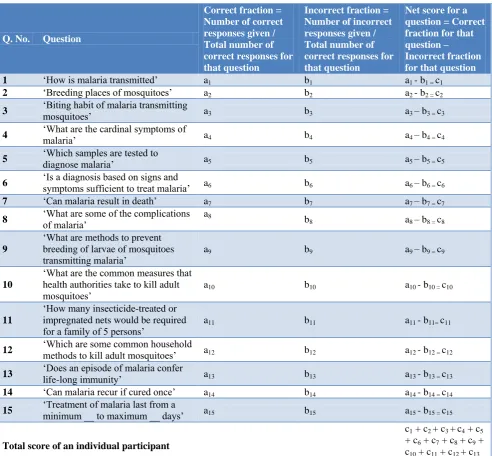
Table 1: Equation to calculate the total score of an individual participant in tabular format (n=87).
Q. No. Question
Correct fraction = Number of correct responses given / Total number of correct responses for that question
Incorrect fraction = Number of incorrect responses given / Total number of correct responses for that question
Net score for a question = Correct fraction for that question – Incorrect fraction for that question
1 ‘How is malaria transmitted’ a1 b1 a1 - b1 = c1
2 ‘Breeding places of mosquitoes’ a2 b2 a2 - b2 = c2
3 ‘Biting habit of malaria transmitting mosquitoes’ a3 b3 a3 – b3 = c3
4 ‘What are the cardinal symptoms of malaria’ a4 b4 a4 – b4 = c4
5 ‘Which samples are tested to
diagnose malaria’ a5 b5 a5 – b5 = c5
6 ‘Is a diagnosis based on signs and symptoms sufficient to treat malaria’ a6 b6 a6 – b6 = c6
7 ‘Can malaria result in death’ a7 b7 a7 – b7 = c7
8 ‘What are some of the complications of malaria’ a8 b8 a8 – b8 = c8
9
‘What are methods to prevent breeding of larvae of mosquitoes
transmitting malaria’ a9 b9 a9 – b9 = c9
10
‘What are the common measures that health authorities take to kill adult
mosquitoes’ a10 b10 a10 - b10 = c10
11
‘How many insecticide-treated or impregnated nets would be required
for a family of 5 persons’ a11 b11 a11 - b11= c11
12 ‘Which are some common household methods to kill adult mosquitoes’ a12 b12 a12 - b12 = c12
13 ‘Does an episode of malaria confer
life-long immunity’ a13 b13 a13 - b13 = c13
14 ‘Can malaria recur if cured once’ a14 b14 a14 - b14 = c14
15 ‘Treatment of malaria last from a minimum __ to maximum __ days’ a15 b15 a15 - b15 = c15
Total score of an individual participant
c1 + c2 + c3 +c4 + c5
+ c6 + c7 + c8 + c9 +
c10 + c11 + c12 + c13
+ c14 + c15
Pre-test
First, the authors developed a pre-tested self-administered questionnaire consisting of 15 multiple-choice questions aimed at testing the respondents’ knowledge of malaria. Questions were allowed to have several correct and incorrect responses. The questionnaire was scored in points as shown in Table 1.
This scoring technique might better reflect the soundness of the respondents’ knowledge as it adjusts for their incorrect knowledge.
All consenting students above the age of 18 years were eligible to be recruited. Assuming a standard deviation of 3 points, at 5% significance level, for a power of 80%, a sample size of 71 was determined to be adequate to demonstrate a difference of 1 point between total pre-test and total post-test scores.
Eligible and willing participants were recruited into the study after they gave their informed consent at the pre-decided venue at their institute. They were briefed regarding how to answer the questions and were free to ask any doubts and seek clarifications. Thereafter, they were administered the pre-test questionnaire to be answered in 30 minutes’ time. After this, the intervention was given as follows:
The intervention
We prepared an interactive audio-visual information, education and communication session keeping in mind the knowledge needs of the audience after reviewing the latest guidelines on diagnosis, treatment, prevention and control.2,10 The style of explaining the concepts was simple and lucid, incorporating a lot of pictures and diagrams, keeping technical jargon to a minimum. The speaker regularly asked the audience questions and elicited their prior knowledge and experiences before delivering the educational content, thus making learning easier and dispelling misconceptions at the same time.
After having elicited the cardinal signs and symptoms of malaria from the audience, the speaker enumerated various life-threatening complications of malaria. The speaker explained how malaria harms individual and public health and the economy.
Thereafter, the speaker informed the audience on the causative agent and vectors of malaria, breeding places of vector larvae, duration of various phases of the life cycle of the vector, correlating these with corresponding strategies for malaria control – divided as community level (involving public health authorities), household and personal protective level. Emphasis was given on how important it is to test a malaria suspect’s blood to identify the causative species of the parasite as also on completing the full course of treatment even after symptoms subside,
as not doing so may result in incorrect treatment, treatment failure and even relapse.
The session also informed the audience on how to notify and involve particular local health and other civic authorities in the event of an outbreak. It also briefly touched upon other acute febrile illnesses of the monsoon period such as dengue, leptospirosis and influenza, and underlined how important it is to promptly seek the right health care to distinguish between these and institute correct treatment. The lecture was delivered over about an hour’s time.
Post-test
The same students were followed up a week later at the same venue and administered the post-test questionnaire, which was identical to the pre-test questionnaire.
The data from both the questionnaires were checked and entered in SPSS software, version 15.0 maintaining anonymity. Continuous variables were summarized as means and standard deviations if normal and as medians and inter-quartile range if skewed; categorical variables were summarized as proportions. The outcome variables were total pre-test and post-test scores. A p value of <0.05 was taken as statistically significant.
RESULTS
91 out of total 120 eligible students approached consented to participate in the study, yielding an initial response rate of 75.8%. 27 (22.5%) refused citing ‘lack of time’, while the remainder gave no reason. Among these 91, 4 were absent at the time of answering the post-test. Thus, we have 87 students completing both pre-test and post-test, yielding an overall response rate of 72.5%.
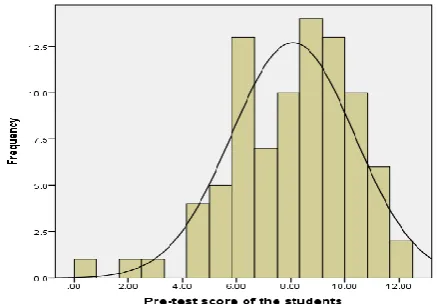
Figure 1: Histogram of pre-test scores of the students with frequency overlay (n=87).
All the participants had completed education till pre-university (10+2) level.
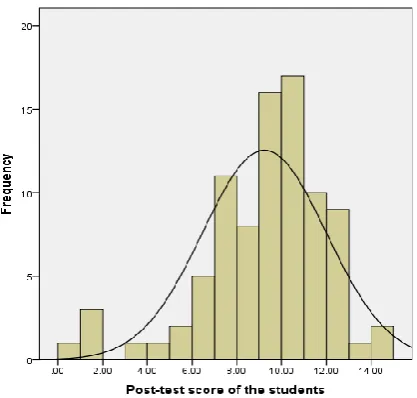
Figure 2: Histogram of post-test scores of the students with frequency overlay (n=87).
The median pre-test total score was 8.4 points with inter-quartile range from 6.5 to 9.75 points while the median post-test total score was 9.68 with inter-quartile range from 7.76 to 11.1 points. The histograms of the pre-test and post-test scores with an overlay of the frequency distribution are shown above.
A Wilcoxon signed-ranks test applied to the participants’ pre-test and post-test total scores yielded a p value of 0.001365, which was significant considering the pre-determined cut-off of 0.05.
DISCUSSION
The study received a fair initial response of over 75% and had a low attrition rate of about 5%. Thus, we can be fairly confident about the applicability of the study’s findings to this as well as other young lay populations.
The study population in this study differs in many ways from those of the previous ones: it is younger and more educated than the Chinese expats in the study by Li et al or the rural older Nigerian adults in the one by Amoran et al.9,8 However, this should not be considered a limitation of the study as such populations represent a large proportion of youth leaders and thus potential agents of social change in a young and rising economy like India.
The negatively skewed distributions of both the total pre-test and post-pre-test knowledge scores affirm higher levels of malaria knowledge in this population. Considering a modest sample size of 87, the p value of 0.001365 can be considered as highly significant. However, the relatively small quantum of shift in knowledge scores’ distribution,
as seen in the histograms, indicates further scope for improvement of the intervention.
Going by the p values yielded by statistical tests of significance, our intervention appears to have been as effective as the one evaluated by Li et al among Chinese expats in Niger.9 The latter study, which was a randomized trial by design, has better internal validity due to the presence of a control group. However, the true effect size of the latter might be lesser owing to the role of larger sample size in that study as well as the fact that multiplicity of testing does not seem to have been accounted for by the authors.
The study conducted by Amoran et al in rural Nigeria is also a non-randomized study similar in design to ours but with a comparison group.8 This study, however, focused only on behaviour change with respect to long-lasting insecticide-treated nets and not on an overall change. Again, going by the p values, the intervention in this study did much better than ours. However, this too could be offset by not accounting for multiplicity of testing and more importantly, not adjusting for baseline differences in confounders inherent to this design by techniques like regression modelling.
This study is one of the few of its kind to be developed and carried out in India. The strength of our study lies in the intervention it sought to evaluate: a cost-effective and scalable intervention, easily replicable in a wide variety of settings. Also, the innovative method of scoring the respondents’ knowledge can be applied in future interventions to evaluate effect on malaria knowledge. The pairing of respondents’ knowledge scores caused by the single-group pre-test post-test study design also addresses the effect of confounding factors which could have independently influenced them. The effect of confounding (even time-varying) appears to be minimal as the time gap between pre- and post-test was only a week. Assuming minimal regression to the mean, the intervention appears to have worked.
However, lack of a comparison arm with randomization does remain a limitation of this study from the point of view of establishing aetiological evidence. Also, a mixed methods formative research approach, especially around barriers to uptake of recommended behaviours would have made the intervention more robust. However, this study does provide a starting point for further research around content, methodology and evaluation of intervention. Better-designed studies could be carried out in the future to address these questions.
ACKNOWLEDGEMENTS
Funding: No funding sources Conflict of interest: None declared
Ethical approval: The study was approved by the
Institutional Ethics Committee of K.S. Hegde Medical
Academy, Mangaluru
REFERENCES
1. Malaria situation 2005. Available from: http://nvbdcp.gov.in/Doc/malaria-situation.pdf. Accessed 10 January 2018.
2. Operational manual for implementation of malaria programme 2009. New Delhi: Ministry of Health and Family Welfare, Government of India; 2009:263 pp. In collaboration with WHO country office for India.
3. Whittaker MA, Dean AJ, Chancellor A. Advocating for malaria elimination – learning from the successes of other infectious disease elimination programmes. Malar J. 2014;13:221.
4. Bhatia R, Rastogi RM, Ortega L. Malaria successes and challenges in Asia. J Vector Borne Dis. 2013;50(4):239-47.
5. Dambhare DG, Nimgade SD, Dudhe JY. Knowledge, attitude and practice of malaria transmission and its prevention among the school going adolescents in Wardha district, central India. Glob J Health Sci. 2012;4(4):76-82.
6. Anand T, Kumar R, Saini V, Meena GS, Ingle VK. Knowledge and use of personal protective measures against mosquito-borne diseases in a resettlement colony in Delhi. Ann Med Health Sci Res. 2014;4:227-32.
7. Malenga T et al. Malaria control in rural Malawi: Implementing peer health education for behaviour change. Global Health. 2017;13(1):84.
8. Amoran OE, Fatugase KO, Fatugase OM, Alausa KO. Impact of health education intervention on insecticide treated nets uptake among nursing mothers in rural communities in Nigeria. BMC Res Notes. 2012;5:444.
9. Li W, Han LQ, Guo YJ, Sun J. Using WeChat official accounts to improve malaria health literacy among Chinese expatriates in Niger: An intervention study. Malar J. 2016;15(1):567. 10. Diagnosis and treatment of malaria. New Delhi:
Directorate of National Vector borne Diseases Programme; 2013: 20.
Cite this article as: Kini S, Nabar A, Muthukumar R,