Original Research Article
An assessment of the awareness and practices regarding HIV/AIDS
among married women of the reproductive age group in urban slums of
Eastern Uttar Pradesh
Huma Khan
1, Saurabh Mishra
1*, Dhirendra K. Srivastava
2, Reena Srivastava
3INTRODUCTION
Human immunodeficiency virus (HIV)/ acquired
immunodeficiency syndrome (AIDS) is a major and one of the most serious public health challenges in today’s world.1 In a developing country like India where the health care services are not accessible to a large proportion of population any disease burden which is preventable must be tried to be prevented. People living in slum areas are at high risk of HIV infection/AIDS due to high population density, migrant population, and a
higher prevalence of substance dependence.2 Prevention and control of HIV/AIDS depends on general knowledge and attitude towards HIV/AIDS.3 HIV/AIDS is such dreaded disease which can be prevented if the people are aware about the ways to do so. Urban slums share a specific position in the demographic profile of district because of the inequalities of health care system where the rural health care system is far to reach and the more flourished private health care system is unaffordable for most of the inhabitants.
ABSTRACT
Background: HIV/AIDS is such a dreaded disease which can be prevented if the people are aware of the ways to do so. Urban slums share a specific position in the demographic profile of district because of the inequalities of health care system where the rural health care system is far to reach and the more flourished private health care system is unaffordable for most of the inhabitants. HIV/AIDS is not only a health-related problem but it also has socioeconomic, behavioral and cultural aspects.
Methods: Descriptive cross-sectional among currently married women in reproductive age group (15-49 years) residing in any of the selected urban slums of district Gorakhpur. Cluster sampling was used and clusters were chosen by probability proportional to size (PPS) method of cluster sampling from a list of urban slums obtained from District Urban Development Authority (DUDA), Gorakhpur. The final sample size was 600.
Results: 82% of women had ever heard about HIV/AIDS and 72% of women got the knowledge about HIV through television followed by 56% of woman who got knowledge by relatives and friends. 68% of woman believes that the mode of transmission of HIV is unsafe sex followed by 58% of women who believed that infected blood transfusion is the mode of transmission of HIV.
Conclusions: Awareness is crucial in the prevention and control of HIV/AIDS. Women should have more access to the knowledge resources and facilities for testing and prevention of HIV/AIDS.
Keywords: Slums, HIV/AIDS, KAP, Information sources
1
Department of Community Medicine, Shri Ram Murti Smarak Institute of Medical Sciences, Bareilly, 2BRD Medical College ,Gorakhpur, 3Department of Obstetrics and Gynaecology, BRD Medical College, Uttar Pradesh, India
Received: 24 April 2019
Revised: 15 July 2019
Accepted: 16 July 2019
*Correspondence:
Mr. Saurabh Mishra,
E-mail: [email protected]
Copyright: © the author(s), publisher and licensee Medip Academy. This is an open-access article distributed under the terms of the Creative Commons Attribution Non-Commercial License, which permits unrestricted non-commercial use, distribution, and reproduction in any medium, provided the original work is properly cited.
Many times the people who settle themselves in the outskirts of big cities in slum setting include those families in which the earning member alone or with family has migrated into that city from small towns or villages. Gorakhpur is a city which attracts migrants.
HIV/AIDS is not only a health related problem but it also has socioeconomic, behavioural and cultural aspects. Current study tried to assess the awareness and practices of currently married women living in the slums of Gorakhpur city.
Objectives
To assess the knowledge among women about HIV/AIDS.
To study the factors affecting knowledge among women about HIV/AIDS.
To assess the gap between knowledge and practice towards prevention of HIV/AIDS.
METHODS
Study design: Descriptive cross-sectional.
Study unit
The study unit consisted of currently married woman in reproductive age group (15-49 years) residing in any of the selected urban slum of district Gorakhpur.
Study place: Urban slums of district Gorakhpur.
Study period: September 2013.
Sample size
The required sample size was calculated by the formula:
( )
n=sample size, P=estimated prevalence of RTI, d= precision, Z=1.96.
Prevalence was taken as 50%. (So as to yield the maximum sample size at a defined confidence interval and precision)
Taking precision d=6%
n= (1.96)2 ×0.5×0.5/(0.06)2 =267.
Since the subjects were chosen by cluster sampling method, a design effect due to complex sample design comes into picture. Taking into account the design effect of 2, the sample size was
2×267=534.
So from each cluster 20 currently married females of reproductive age group were interviewed (taking 10% more from each cluster).
Sampling technique
Cluster sampling was done to select the representative population of the urban slums of district Gorakhpur. Clusters were chosen by probability proportional to size (PPS) method of cluster sampling from a list of urban slums obtained from District Urban Development Authority (DUDA), Gorakhpur.
Inclusion criteria
All currently married females who were permanent residents of that area (guests were excluded) of reproductive age group (15-49 years) of age who were agree for the interview.
Exclusion criteria
Exclusion criteria were currently married females who did not give consent to participate in the study.
Study procedure
A preformed pretested semi open ended interview schedule was used after taking informed consent from the study participants.
Statistical software
Data was entered and analysed using Microsoft Excel 2010.
Ethical clearance
Ethical clearance was taken before start of study from ethical committee of the institute.
RESULTS
Table 1 reveals the distribution of study participants on the basis of socio demographic factors. 69.2% participants were in the age group of 21-30 years, 245 (40.8%) were illiterate and 325 (54.2%) had consummated marriage before 18 years of age.
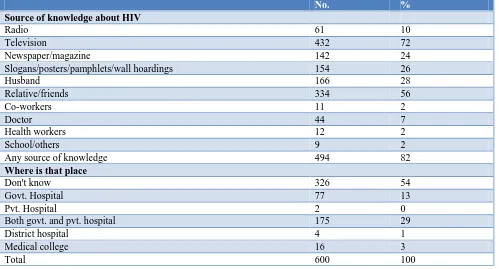
Table 2 depicts that 72% women got the knowledge about HIV through television followed by 56% of woman who got knowledge by relative and friends. As far as the knowledge about the place of getting tested for HIV, 54% women said they don’t have knowledge about the place for testing the HIV while 29% of woman said the test could be done in government as well as private hospitals.
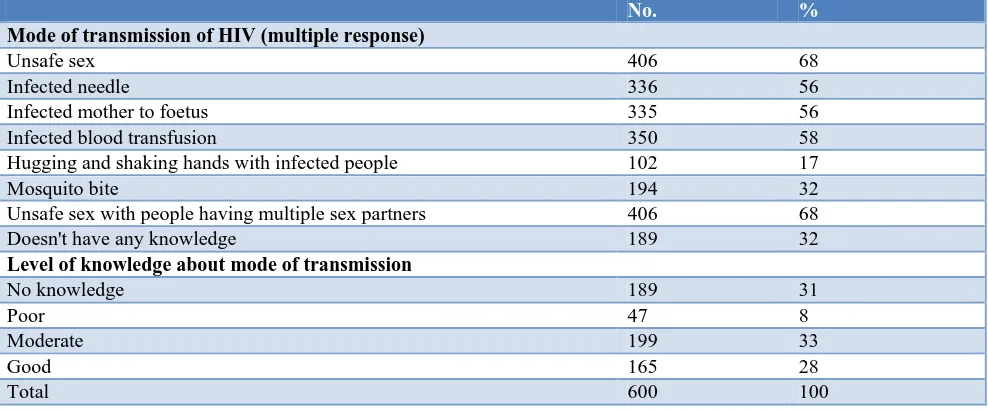
unsafe sex followed by 58% women who believed that infected blood transfusion is the mode of transmission of HIV. 61% of women have sufficient knowledge about the
mode of transmission of HIV while 39% of women have poor knowledge.
Table 1: Sociodemographic profile of respondents.
No. %
Age group (woman)
Less than 20 28 4.7
21-30 415 69.2
31-40 128 21.3
41-50 29 4.8
Total 600 100.0
Religion
Muslim 148 24.7
Hindu 452 75.3
Total 600 100.0
Socioeconomic class
Lower 134 22.3
Lower/upper lower 411 68.5
Middle/lower middle 47 7.8
Upper middle 8 1.3
Total 600 100.0
Educational status
Illiterate 245 40.8
Primary 126 21.0
Up to 8th std. 79 13.2
Up to 10 77 12.8
12th std. 29 4.8
Graduate and above 44 7.3
Total 600 100.0
Table 2: Knowledge about HIV (multiple responses).
No. %
Source of knowledge about HIV
Radio 61 10
Television 432 72
Newspaper/magazine 142 24
Slogans/posters/pamphlets/wall hoardings 154 26
Husband 166 28
Relative/friends 334 56
Co-workers 11 2
Doctor 44 7
Health workers 12 2
School/others 9 2
Any source of knowledge 494 82
Where is that place
Don't know 326 54
Govt. Hospital 77 13
Pvt. Hospital 2 0
Both govt. and pvt. hospital 175 29
District hospital 4 1
Medical college 16 3
No. % Mode of transmission of HIV (multiple response)
Unsafe sex 406 68
Infected needle 336 56
Infected mother to foetus 335 56
Infected blood transfusion 350 58
Hugging and shaking hands with infected people 102 17
Mosquito bite 194 32
Unsafe sex with people having multiple sex partners 406 68
Doesn't have any knowledge 189 32
Level of knowledge about mode of transmission
No knowledge 189 31
Poor 47 8
Moderate 199 33
Good 165 28
Total 600 100
Table 3: Association between level of knowledge about HIV and socio-demographic factors.
Association between level of knowledge about HIV and education
Poor Moderate Good Total
Illiterate 27 42 47 116 P=0.00
Up to 10th 15 113 97 225 Chi-square-28.85
More than 10th 5 44 21 70 df-4
Total 47 199 165 411
Association between level of knowledge about HIV and age
<20 1 10 6 17 P=0.14
21-30 29 144 117 290 Chi-square-8.62
31-40 17 38 35 90 df-6
41-50 0 7 7 14
Total 47 199 165 411
Association between level of knowledge about HIV and socioeconomic class
Lower 47 163 149 359 P=0.00
Middle 0 36 16 52 Chi-square-19.43
Total 47 199 165 411 df-2
Association between level of knowledge about HIV and age at consummation of marriage
<21 40 171 144 355 P=0.90
>21 7 28 21 56 Chi-square-0.21
Total 47 199 165 411 df-2
Table 4: Association between having knowledge about HIV and practices regarding HIV.
Association between having knowledge about HIV and they have been tested
Tested Not tested Don't know Total
Yes 95 282 33 410 P=0.00
No 5 150 35 190 Chi-square-47.05
Total 100 432 68 600 df-2
Association between having knowledge about test centre for HIV and they have been tested Tested Not tested Don't know Total
Yes 84 172 18 274 P=0.00
No 16 260 50 326 Chi-square-75.28
Table 3 shows that there is association found between the level of knowledge about HIV and their education, the p value is highly significant (p<0.01). There is no association found between the level of knowledge about HIV and age, the p value is not significant. Statistically significant association was found between the level of knowledge about HIV and their socioeconomic class, (p<0.01).
There is no association found between the knowledge about HIV and years of consummation of marriage, the p value is not significant.
Table 4 shows that there is association between knowledge about HIV and having been tested, p value is found to be highly significant (i.e., <0.01). There is association between knowledge about HIV test centres and having been tested, p value is found to be highly significant (i.e., <0.01).
DISCUSSION
In our study out of 600 women, 494 (82%) women had ever heard the about HIV/AIDS. Biradar et al have reported that among their study population majority (77.5%) had heard about HIV/AIDS.4 In the study conducted by Chatterjee et al.5 Only 236 (67%) of the 350 women interviewed had heard of AIDS and Basuet al had reported that 633 (100%) of the study population had heard about HIV/AIDS.6 Ye et al 91.6% reported that they had ever heard of HIV/AIDS obtained from various sources.7Similar to the results of the study conducted by Sylviaet al.8 Contrary to only 16% respondents who had
ever heard of HIVin the study byRanjan.9
Majority of our study participants that is 432 (72%) got the knowledge about HIV through television followed by 56% of woman who got knowledge by relative and friends. The main source of knowledge about HIV/AIDS was television (55.3%), followed by magazine/ newspaper (34.9%) in the study by Ye et al.7 In the study conducted by Biradaret al(45.6%) study participants had gained knowledge about HIV/AIDS through health worker, (29.3%) through media and (14.9%) through doctors.4
When enquired about the mode of transmission, 68% of woman believes that the mode of transmission of HIV is unsafe sex followed by 334 (58%) women who believed that infected blood transfusion is the mode of transmission of HIV. Whereas only (19.35%) participants in the study by Sylviaet al did not mention about sexual route of HIV transmission.8 In our study 58% women believed that infected blood transfusion is the mode of transmission of HIV which was more than 90% in the study conducted by Basuet al.6 In the study conducted by
Biradar et al 20.4% participants told that HIV/AIDS spreads through unprotected sex, 17.0% participants told that HIV/AIDS spreads through blood products and 6.3% participants told that HIV/AIDS spreads through mother
to child.4Nearly half of the study participants according to Juliet Sylviaet al had misconceptions regarding routes of transmission such as mosquito bites and sharing food similar to that found in our study where 49% study participants reported that HIV/AIDS can be transmitted by mosquito bite and hugging the infected person.8 As far as the knowledge about the place of getting tested for HIV, 54% women said they don’t have knowledge about the place for testing the HIV while 29% of woman said the test could be done in government as well as private hospitals. It was similar to the results as reported by Sylvia et al.8 364 (61%) of women had sufficient knowledge about the mode of transmission of HIV while 236 (39%) of women had poor knowledge in our study.
There is association found between the level of knowledge about HIV and their education, the p value is highly significant (p<0.01). Statistically significant association was found between the level of knowledge about HIV and their socioeconomic class, (p<0.01) There is association between knowledge about HIV and they have been tested, p value is found to be highly significant (i.e., <0.01). There is association between knowledge about HIV test centres and they have been tested, p value is found to be highly significant (i.e., <0.01).
Except caste (subgroup within a religion), none of the demographic factors were found significantly associated with knowledge level about HIV/AIDS in the study
conducted by Ranjan.9
Funding: No funding sources Conflict of interest: None declared
Ethical approval: The study was approved by the Institutional Ethics Committee
REFERENCES
1. Mehra B, Bhattar S, Bhalla P, Rawat D. HIV/AIDS Awareness among VCT Clients: A Cross-Sectional Study from Delhi, India. BioMed Res Int. 2015;2014:269404.
2. Arun P, Chavan BS, Singh G. Attitude towards Acquired Immune Deficiency Syndrome and its determining factors: a community survey in rural and slum areas in India. Delhi Psychiatry J. 2007;10:(2).
3. Kawale SK, Sharma V, Thaware PP, Mohankar AD. A study to assess awareness about HIV/AIDS among rural population of central India. Int J Community Med Public Health. 2018;5(1):373-6. 4. Biradar MK, Biradar SM. Knowledge, attitude, and
perception of HIV/AIDS among married women. Indian J Pharm Biol Res. 2014;2(4):36-40.
5. Chatterjee N, Hosain GMN. Perceptions of risk and behaviour change for prevention of HIV among married women in Mumbai, India. J Health Popul Nutr. 2006;24(1):81-8.
Attending General Out Patient Department of a Tertiary Care Hospital of Kolkata. Natl J Community Med. 2014;5(1):46-50.
7. Ye P, Wu X, Keita H, Zhou W, Lin J, Lou Y, et al. Knowledge, Attitudes and Behaviours Related to HIV/AIDS among female migrant workers in the restaurant industry in Guangzhou, China. West Indian Med J. 2013;62(4):329-36.
8. Sylvia J, Basavanthappa, Richard. A Study to Compare and Correlate the Knowledge and Attitude Regarding HIV/AIDS among Young Married and Unmarried Women in Selected Urban Slums of Madurai, Tamil Nadu. Asian J Nur Educ Red. 2012;2(3):118-25.
9. Ranjan A, Babu GR, Detels R. Knowledge, attitude and perception about HIV/AIDS among the wives of migrant workers of Muzaffarpur District in Bihar. J Community Med Health Educ. 2015;5:361.