5105
Optimization Model For Fighter Squadron
Scheduling And Sortie Allocation
John Burns, Andrew Ziskin, Christine J. Sohn, Han-Suk Sohn
Abstract— This paper presents optimization models and their application for fighter squadron scheduling and sortie allocation. The applicability of the proposed model is demonstrated in the case study of the U.S Air Force. The results demonstrate that the proposed models are practical and flexible tools for (1) establishing an optimal squadron schedule taking consideration for pilots with special conditions and (2) optimizing the number of dedicated support sorties each pilot should fly in lieu of their primary mission in order to ensure all pilots receive an equitable share of desired training sorties.
Index Terms— Scheduling, Fighter squadron, Sortie allocation, mixed-integer linear program, Quadratic integer program, Optimization, U.S. Air Force.
—————————— ——————————
1
I
NTRODUCTIONCombat aircraft in the U.S. Air Force (USAF) are operated in units called squadrons. A fighter squadron typically has around fifteen to forty pilots assigned to it. Pilots have a number of training requirements to fulfill in order to maintain Combat Mission Ready (CMR) status. The CMR status allows the pilot to be sent on combat missions, which is the primary purpose of a fighter squadron. The USAF makes certain its pilots are prepared for combat primarily by ensuring that they fly frequently. The number of flights, or “sorties”, a pilot must receive each month in order to be considered CMR is dictated by a document called the Ready Aircrew Program Task Memorandum, which is published annually and breaks up training requirements by the pilot’s experience level and job assignment. The inexperienced pilots are required to fly the most. After fulfilling the requirements to be considered “experienced”, that pilot’s monthly sortie minimum goes down. The definition of “experienced” typically includes a total sortie requirement as well as a “flight lead” qualification. There are three levels of pilot qualification: wingman (WG), flight lead (FL), and instructor pilot (IP). When a new pilot arrives at the squadron, he/she must go through Mission Qualification Training (MQT), in order to become a CMR WG. This is a syllabus program with specific missions directed to be flown under the supervision of an IP. Once becoming CMR, they can then fly under the supervision of a FL. Fighter aircraft operate in combat in units of two or four, called a “two-ship” or “four-ship,” depending on the mission they are performing. The FL is qualified to lead either of these formations, as well as fly as the third aircraft in a four-ship. The WG may only fly as the second or fourth aircraft in these formations, as they must always fly with reference to a FL. Pilots of a higher qualification, such as FLs, can continue to fly as any lower qualification (see Fig. 1).
Fig. 1. A Typical Four-Ship Formation
Once WGs are sufficiently experienced, they are again entered into a syllabus in order to become FLs. In this program, IP’s fly as the upgrading FL’s wingman. Finally, once FLs demonstrate the required proficiency and aptitude, they become IP’s through another syllabus, still under the supervision of existing IP’s. Adding further complexity to the training requirements, some pilots are assigned to other organizations on the base in order to oversee support functions. These pilots are considered “attached” to the flying squadron and are required to fly fewer sorties each month in order to accommodate the extra time they must devote to their office job. In order to fulfill these training requirements, some pilots must play the role of adversary aircraft. This involves simulating enemy tactics so that the pilots receive training with realistic scenarios. The aircraft that receive training are called “blue-air”, while the aircraft acting as adversaries are called “red-air”. Generally, one-third to half of the aircraft scheduled to fly will be acting as the red-air. Though the red-air sorties count towards the monthly requirement, they are not desirable to fly. That is, a pilot who solely flies the red-air will lose proficiency at flying his/her own tactics. The job of ensuring that the squadron’s pilots fulfill their necessary training requirements falls to the squadron’s Director of Operations (DO). The DO works with the aircraft maintenance organization to determine the number of sorties to schedule per week, which is generally constrained by how many aircraft are broken and if the maintenance organization has the manning to fix them. Sorties are scheduled into two or three flying periods, where all aircraft will launch within a short ————————————————
John Burns, United States Army TRADOC Analysis Center, TRAC-WSMR, White Sands MR, NM 88002, USA. E-mail: [email protected]
Andrew Ziskin, United States Army TRADOC Analysis Center, TRAC-WSMR, White Sands MR, NM 88002, USA. E-mail: [email protected]
Christine J. Sohn, College of Letters and Science, University of California-Los Angeles, Los Angeles, CA 90095, USA. E-mail: [email protected]
5106 period, fly, then return to the base for maintainers to refuel
them and prepare them to launch during the next period. The DO must optimize the limited number of sorties the maintenance organization can provide to ensure that all pilots receive optimal training and remain proficient. The DO delegates the work of developing the schedule to the scheduling office. This office consists of three to five pilots who must build a weekly schedule, with consideration given to the numerous factors mentioned previously. This is a time-consuming and tedious task, which often requires a scheduler to be taken off the flying schedule for a week in order to give them sufficient time to build a schedule that satisfies the training requirements and inputs from the DO, such as which syllabus events to fulfill for an individual during the week being scheduled. Additionally, the scheduler must ensure a pilot gets a reasonable number of the blue-air sorties and is not solely scheduled to fly the red-air. There are also restrictions on feasibility the scheduler must consider. By regulation, pilots must be away from work for twelve hours prior to being scheduled to fly, which is known as “crew rest”. This requirement applies to the time the pilot reports for work, not the takeoff time. Pilots will generally report for work about three hours prior to their takeoff time so that they may accomplish a flight briefing with the other members of their formation. Additionally, pilots cannot perform flying duties within the twelve hours immediately after they reported for work, a limitation known as “duty day”. This limitation becomes a factor for a pilot who is scheduled for multiple sorties in one day. Even if the planned takeoff and land times allow for a pilot to be scheduled for multiple sorties, it is generally inadvisable to do so. After flying, pilots return to the squadron to debrief the events of the sortie. The debrief can range in time from one to many hours and is where most the learning from the sortie takes place. The DO will typically avoid scheduling a pilot for multiple sorties, known as “double turning”, to preserve the ability to get a full debrief from the first sortie, which will extend well into the next flying period.
2
L
ITERATURER
EVIEWFighter squadron scheduling is a decision-making process that addresses the allocation of limited resources to tasks over time. In general, it is assumed that there are a fixed number of tasks to be scheduled. However, in more complex squadron scheduling situations, new tasks with different objectives are added and already scheduled tasks are re-scheduled continuously. Therefore, the squadron scheduling needs to be dynamic and may require slack times be built into the schedule with the expectation of changes [1]. When applied, random events may require major changes and reactive re-scheduling. The problems with multi-objective functions such as the fighter squadron scheduling rarely have points that simultaneously optimize all of the objective functions. The solution can be obtained by optimizing each of the objectives to the greatest extent possible [2]. Over the past decade, several tools have been developed to facilitate fighter flight scheduling. Belton and Elder (1996) introduced a software called Visual Interactive Modeling (VIM), which uses assigned scheduling rules to find a feasible schedule [3]. The VIM generates an initial schedule, from which the scheduling officer makes iterative adjustments until an acceptable schedule is found. An attrition model simulates the different variables and percentages which could lead to the loss of a scheduled sortie. It simulates the attrition of sorties that are typically found in a
training environment including operational issues, weather, and maintenance. Historical rates are leveraged to determine the percentages used for the model. Scheduling officers and maintenance shops have used these rates to plan for sortie requirements [3]. Aslan of the Air Force Institute of Technology developed a decision support system for scheduling an F-16 pilot training squadron [4]. This decision support system provided a tool for the development of a Daily Flight Schedule (DFS). A premium solver platform was utilized for flight scheduling that uses a minimum cost network flow model to build weekly flight schedules [5]. Newlon [6] created a mathematical programming model for fighter pilot training squadrons by scheduling to minimize the cost of utilizing non-squadron pilots and to minimize the penalties associated with noncompliance of sortie requirements. Two other well-known case studies include an F-16 squadron weekly pilot schedule for the Turkish Air Force (see [7]) and interactive decision support system for scheduling fighter pilot training (see [8]). Note that Turkey is a member of NATO and it has very similar flight qualification requirements, which indicates the United States is not the only air force to address these issues. In each case, the complexity of the problems and the extensive number of requirements were consistent. Yavuz [7] attempted to solve the problem by creating a feasible and more effective weekly pilot schedule to be built in a short amount of time, while Nguyen [8] attempted to develop a method to make pilot flight scheduling less ad hoc and not rely on manual corrections when changes occur. Despite all of these fruitful researches, the formal investigation of optimizing the fighter squadron schedule is still insufficient. The common problem is as daily changes occur; the flight schedulers make adjustments based on changing circumstances. However, as these changes occur schedulers must still satisfy the requirements within the changing availability of resources. The fixed flight requirements and availability of pilots and/or instructor pilots are difficult to consistently fill and maintain their qualifications. Obviously, the problem becomes the balance of not over-tasking pilots, while still meeting the requirements. In this short paper, therefore, we present simple yet practical optimization approaches, which employ a mixed integer linear program and a quadratic integer program, to address these issues.
3
P
ROBLEMS
TATEMENT5107
3.1 Data
The pilot’s qualifications and minimum sortie requirements are summarized in Table 1. Additionally, two pilots (Pilot 7 and Pilot 8) are listed as being in a qualification upgrade, necessitating that they be scheduled with instructor pilots several times per week in order to progress through the syllabus.
TABLE 1
SQUADRON PILOT QUALIFICATIONS AND SORTIE REQUIREMENTS
Pilo t ID
Qualificatio n
Experience d Status
Attache d
Qualificatio n
Upgrade
Minimu m Sorties
1 IP Yes Yes No 5
2 IP Yes No No 8
3 IP Yes No No 8
4 FL Yes No No 8
5 FL Yes Yes No 5
6 FL No No No 10
7 WG No No Yes 10
8 WG No No Yes 10
9 WG No No No 10
10 WG No No No 10
11 WG No No No 10
12 WG No No No 10
13 WG No No No 10
14 WG No No No 10
15 WG No No No 10
While this squadron is notional, it is representative of typical qualifications, experience, and sortie requirements for a squadron of that size. Data concerning actual combat squadron composition is restricted, compelling the need for this study to develop its own data set. The sorties to be allocated, as well as the allowable qualifications for each aircraft, are summarized in Tables 2 and 3. This weekly schedule is consistent for four weeks in order to simplify the monthly sortie constraints. Two aircraft per flying period will be allocated to red-air, which is consistent with the syllabus capstone mission, in which a four-ship of blue-air fight a two-ship of red-air into simulated enemy territory in order to deliver bombs to their assigned targets.
TABLE 2
WEEKLY FLYING SCHEDULE AND ALLOWABLE QUALIFICATION
SUMMARY (AMFLYING PERIOD)
Aircraf t ID
Monday Tuesday Wednesda y
Thursda y
Friday
1 IP/FL IP/FL IP/FL IP/FL IP/FL
2 IP/FL/W
G
IP/FL/W G
IP/FL/WG IP/FL/W G
IP/FL/W G
3 IP/FL IP/FL IP/FL IP/FL IP/FL
4 IP/FL/W
G
IP/FL/W G
IP/FL/WG IP/FL/W G
IP/FL/W G
5 IP/FL IP/FL IP/FL IP/FL IP/FL
6 IP/FL/W
G
IP/FL/W G
IP/FL/WG IP/FL/W G
IP/FL/W G
TABLE 3
WEEKLY FLYING SCHEDULE AND ALLOWABLE QUALIFICATION
SUMMARY (PMFLYING PERIOD)
Aircraft ID
Monday Tuesday Wednesda y
Thursda y
Frida y
1 IP/FL IP/FL IP/FL IP/FL -
2 IP/FL/WG IP/FL/W G
IP/FL/WG IP/FL/WG -
3 IP/FL IP/FL IP/FL IP/FL -
4 IP/FL/WG IP/FL/W G
IP/FL/WG IP/FL/WG -
5 IP/FL IP/FL IP/FL IP/FL -
6 IP/FL/WG IP/FL/W G
IP/FL/WG IP/FL/WG -
Squadron schedulers must also consider when pilots are planning to take leave days and ensure they are not committed during that time. This schedule will consider Pilot 9 taking leave during the second week of the month and Pilot 13 taking leave during the fourth week of the month. Lastly, schedulers should attempt to limit red-air sorties for pilots who flew more than their share so far in the year in order to keep blue-air training equitable. Table 4 lists the notional number of red-air sorties flown so far in the year by each pilot.
TABLE 4
RED-AIR SORTIE TOTALS THIS YEAR
Pilot ID
# of Red-Air Sorties
Pilot ID
# of Red-Air Sorties
Pilot ID
# of Red-Air Sorties
1 20 6 30 11 29
2 14 7 18 12 37
3 12 8 22 13 24
4 26 9 37 14 15
5 14 10 42 15 20
3.2 Assumptions
Before proceeding to the problem formulation, some special conditions and assumptions under which this study was conducted should be noted, which are consistent to many other fighter squadron scheduling models:
The flight currency are the requirements of pilots to perform a mission within a number of days since their last mission. Otherwise, the pilot must perform the mission with an IP.
The pilot’s currencies are considered in order to prevent assigning a pilot to a mission improperly.
Pilots must fly a minimum of number of sorties. Each pilot is supposed to fly a specific type of sortie each month and fly certain missions each year.
The beginning of each month, pilots begin with zero sorties and they cannot be transferred to the next month.
The pilot status is important to match pilots with their particular skill level. This determines the pair of pilots to fly on each mission.
Pilot availability is a factor because pilots have other duties besides flying or may be on leave.
A pilot can fly at most two sorties a day and must have 12 hours of crew rest before the next day’s flight briefing.
5108
Aircraft maintenance affects the availability of aircraft and is a constant factor for scheduling sorties.
4
P
ROBLEMF
ORMULATIONIn this research, we present two optimization models. The first is a mixed integer linear program that will produce an optimal squadron schedule, which ensures that pilots meet their minimum sortie requirements. The second is a quadratic integer program that establishes a guideline for equitable red- and blue-sortie allocation, while utilizing the number of sorties output from the first model for each pilot as an input.
4.1 Fighter Squadron Scheduling
For convenience, all notations used in the model formulation are summarized as below:
Sets:
I Set of all flying periods indexed by i J Set of all pilots indexed by j WG Set of all wingmen indexed by j IP Set of all instructor pilots indexed by j FL Set of all flight leads indexed by j
Q Set of all pilots qualified to be upgraded, which are indexed by j
Input Parameters:
j
m
Required minimum number of sorties for the jth pilotj
s
Designated set of flying periods during which pilot j ina qualification upgrade will be scheduled for a syllabus event, which in this case is Pilot 7 and Pilot 8. Therefore, both S7 and S8 specify the flying periods that
the DO has directed for the upgrade pilots to do their syllabus events in.
i
a
Required number of aircrafts to be scheduled in flying period i, which in this case is sixDecision Variables:
ij
X
1 if jth pilot fly in the ith flying period, 0 otherwise.The objective function (1) maximizes the number of sorties that the wingmen are flying, which are represented by Pilots 7 through 15. Since wingmen are the most restricted by what position they can fly in, and they typically outnumber the more experienced members of a squadron, they often are scheduled to fly the least.
Maximize ij
i I j WG
X
(1)This objective function is subject to various constraints as follows:
1
1
ij i j
X
X
,
i
I
(2)Constraint (2) prevents pilots from being scheduled for consecutive flying periods, either within the same day or from the PM flying period of one day to the AM flying period of the next. This ensures that crew rest requirements and the ability to debrief are preserved. Actually, the Friday flying periods are excluded from the constraint in our case since flying does not occur on the weekend.
ij i
j J
X
a
,
i
I
(3)1
2
ij i
j WG
X
a
,
i
I
(4)Constraint (3) ensures each flying period is filled with the required minimum number of pilots, while constraint (4) prevents more than half of the aircraft in a flying period from being scheduled with wingmen, so as to satisfy the qualification requirements of a formation.
ij j
i I
X
m
,
j
J
(5)Each pilot’s minimum monthly sortie requirement is guaranteed with constraint (5). Constraint (6) ensures that at least the upgrade pilot and an instructor will be scheduled during the specified flying periods. In our case, by requiring the sum of the three instructor pilot decision variables and four times the upgrade pilot’s decision variable to be at least five, this constraint represents that the DO’s desire for the two pilots (i.e., Pilot 7 and Pilot 8) in qualification upgrades to be scheduled for syllabus events with an instructor pilot. Syllabus sorties are typically spaced out by at least a day in order to allow the upgrading pilot time to study and prepare for each event.
4
5
ij iq
j IP
X
X
,
i
s
j&
q
Q
(6)This model was run using the OpenSolver add-in for Microsoft Excel.
4.2 Sortie Allocation
The second optimization model presented in the following establishes a guideline for the scheduler to determine equitable red- and blue-sortie allocation decision in each flying period.
Sets:
J Set of all pilots indexed by j WG Set of all wingmen indexed by j IP Set of all instructor pilots indexed by j FL Set of all flight leads indexed by j
Q Set of all pilots qualified to be upgraded, which are indexed by j
Input Parameters:
j
t
Number of sorties assigned to the pilot j from the firstoptimization model
j
p
Number of red-sorties the pilot j has flown so far thisyear
Average number of red-sorties that will be flown per pilot to include the present months
Total number of scheduled sorties, which in this case is 2165109 n Minimum weekly required number of blue-air sorties
for upgrading pilot, which in this case is 8
Decision Variables:
j
R
The number of red-sorties to assign pilot jj
B
The number of blue-sorties to assign pilot jThe objective function (7) minimize the variance between the number of red-sorties each pilot flies.
Minimize
2
j j
j J
R
p
(7)This objective function is subject to various constraints as follows:
1
3
j j JR
s
(8)2
3
j j JB
s
(9)1 1
2 3
jj WG
R
s
(10)1 2
2 3
jj WG
B
s
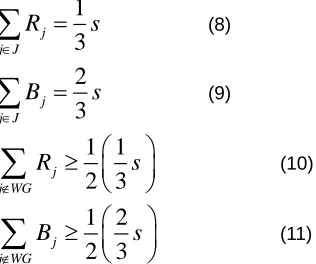
(11)Constraints (8) and (9) ensure that the total number of red- and blue-sorties in the schedule are allocated, respectively. Both of these constraints compel the model to use the previously determined number of sorties each pilot will fly to divide between red and blue, i.e., combine Rj with Bjresults in
tj for all j∈J. Constraints (10) and (11) ensure that the number
of flight lead and instructor qualified pilots will be at least as many as the wingmen for red and blue missions, respectively. Here, the right-hand-side values are given by the fact that one third of the 216 scheduled sorties will be red, with the remaining two-thirds being blue, and at least half of both must be flight lead or instructor qualified.
j
B
m
,
j
Q
(12)j
B
n
,
j
Q
(13)Constraint (12) ensures the model does not schedule a pilot to only fly red-air the entire month in an effort to minimize variance; pilots should fly blue-sorties at least once per week to remain proficient. Constraint (13) guarantees that the upgrading pilots (i.e., Pilot 7 and Pilot 8 in this case) are allocated the eight syllabus events (which are, by definition, blue sorties) that were scheduled in the preceding model.
5
R
ESULTS ANDD
ISCUSSIONThe first optimization model successfully built a feasible monthly schedule. For example, the second week of the schedule is shown in Table 5, where a “1” in the cell indicates the pilot is scheduled to fly during that period.
TABLE 5
SAMPLE RESULTS (WEEK TWO SCHEDULE)
Qualificatio n
I P
I P
I P
F L
F L
F L
W G
W G
W G
W G
W G
W G
W G
W G
W G
Pilot ID 1 2 3 4 5 6 7 8 9 10 11 12 13 14 15
Mon AM 1 0 0 1 1 0 1 0 0 0 0 1 1 0 0
PM 0 1 1 0 0 1 0 1 0 1 0 0 0 1 0
Tue AM 1 0 0 1 1 0 1 0 0 0 0 1 1 0 0
PM 0 1 1 0 0 1 0 1 0 0 0 0 0 1 1
Wed AM 1 0 0 1 1 0 1 0 0 1 1 0 0 0 0
PM 0 1 1 0 0 1 0 1 0 0 0 1 1 0 0
Thu AM 1 0 0 1 1 0 0 0 0 1 1 0 0 0 1
PM 0 1 1 0 0 1 0 0 0 0 0 1 1 1 0
Fri AM 1 0 0 1 1 0 1 0 0 0 1 0 0 0 1
PM - - - - This scheduling problem was heavily constrained by flight lead and instructor availability. All six of those qualified pilots are scheduled for every other period, just meeting crew rest and duty day requirements. Each wingman is scheduled to fly significantly less, which is an unfortunate reality for squadrons where inexperienced pilots outnumber experienced pilots. Though they should be flying the most based on their higher minimums, they are unable to due to their lack of qualification. It was directed that Pilot 7 be scheduled for an upgrade sortie with an instructor during the Monday and Wednesday AM period, as well as Pilot 8 during the Monday PM and Wednesday PM period. The model has placed Pilot 1, an instructor, during both of those periods with Pilot 7, and Pilots 2 and 3 during the specified periods with Pilot 8, either of which can perform the upgrade sortie. Additionally, Pilot 9 was on leave the entire week, and has been appropriately left off the schedule. This was easily feasible since there is an abundance of wingmen to fill the other lines. A flight lead or instructor attempting to take leave during this month would have been infeasible. This is reflective of reality, as most squadrons restrict leave for flight leads and instructors based off the number of available similarly-qualified pilots. The remaining weeks of the schedule are built similarly and so will not be presented here. The number of total sorties the first model scheduled for each pilot, as well as the recommended allocation of blue and red sorties from the second model is shown in Table 6.
TABLE 6
TOTAL SORTIES PER PILOT AND RECOMMENDED RED-AIR
ALLOCATION
Pil ot ID
Qualificati on
Min Sorti es
Total Sorti
es
Blue Allocati
on
Red Allocati
on Re
d Thi s Ye ar
Re d Tot al
1 IP 5 19 15 4 20 24
2 IP 8 18 8 10 14 24
3 IP 8 17 5 12 12 24
4 FL 5 18 18 0 26 26
5 FL 8 19 9 10 14 24
6 FL 10 17 17 0 30 30
5110
8 WG 10 14 8 6 22 28
9 WG 10 10 10 0 37 37
10 WG 10 12 12 0 42 42
11 WG 10 12 12 0 29 29
12 WG 10 10 10 0 37 37
13 WG 10 10 4 6 24 30
14 WG 10 13 4 9 15 24
15 WG 10 14 4 10 20 30
The total sortie allocation easily met the minimums required for each pilot, as all pilots are flying at least ten times, which is the highest minimum. The sum of sorties allocated to wingmen is 108, exactly half of the 216 total in the month, which indicates the objective was successful in ensuring that wingman flying is maximized. By comparing the “Red This Year” column with the new “Red Total” column, one can see the second model made a significant impact on the red-sortie inequity among pilots that had been present so far this year. Pilots that had logged well above the average of 28.8 were recommended to get significantly more blue-sorties than red. Pilot 7 and Pilot 8’s requirement of 8 blue-sorties due to their syllabus events was preserved. The decision was made using the second model’s sortie allocation as a recommendation rather than a constraint to feed back into the first model due to the first model’s susceptibility to infeasibility. Though the correct number of blue- and red-sorties are allocated for both wingmen and flight leads or instructors to fit the schedule, the additional complexities of crew rest, pilots on leave, and scheduled upgrade sorties could not be accommodated in a feasible schedule. However, the scheduler may use the solution report of the second model as a tool to determine which recommended sortie allocations are the most critical to reducing inequity through the use of sensitivity analysis. That is, the variable with the largest reduced cost is Pilot 10’s red sortie allocation. Therefore, increasing Pilot 10’s red-sortie allocation will increase the total variance the most, and so is the most critical to adhere to. Alternatively, many pilots have a red-sortie allocation variable whose value of reduced cost is near zero, so deviating from the recommended number for any of those pilots in order to achieve feasibility will not significantly impact the objective function value. By analyzing the dual prices, the scheduler can see which constraints are nonbinding, and therefore eligible for deviation from the recommendation. In this case, the sortie allocation constraints for Pilots 9, 10, 12, 13, and 15 have negative dual prices and are thus nonbinding. Therefore, the scheduler can reallocate sorties for those pilots and still achieve a feasible total allocation.
6
C
ONCLUSIONThis research presented a way to use a rather common mathematical programming technique to gain insight into fighter squadron scheduling and sortie allocation. Through the case study of the U.S. Air Force, we have found that the proposed optimization models provide fighter squadrons with an automated tool to replace the time-consuming and tedious process of building a schedule by hand. Additionally, it provides a more rigorous approach to ensuring pilots are equally sharing the burden of flying red-air sorties than manual scheduling has typically allowed. However, the results of total sortie equity between similar pilot qualification could be improved. While both Pilot 9 and Pilot 13 met their minimum sortie requirement despite each taking a week of leave, Pilot 12 was also scheduled for only ten sorties and was available the entire month. This is understandable since no effort was
made in the model to reduce variance in sorties between wingmen (merely to maximize the wingman sortie total) but could be incorporated in future models.One useful feature of the proposed model is that it would allow the DO to quickly ascertain whether a given number of sorties per day can feasibly be scheduled by varying the right-hand-side of the associated constraints. Pilot leave is restricted based on the number of available pilots of each qualification, but this is not currently a rigorous process. Now, the DO can make an informed decision on whether to allow a pilot to take leave. The largest challenge in fighter squadron scheduling is its heavily constrained nature. Deciding which scheduling considerations to hold as constraints and which to accept deviations from present a significant problem for any squadron scheduler. The scheduling scenario presented was one in which the schedule was most heavily constrained by pilot availability. However, if more pilots were assigned to this squadron but the same number of aircraft were available, the schedule would then be more heavily constrained by each pilot’s minimum sorties. In reality, either of these considerations may occasionally be relaxed. Though this model held each pilot to one sortie per day, they can legally fly more. A pilot will lose Combat Mission Ready status if they do not fly enough, but they can regain it the following month if they fly the minimum. Further research should focus on a model that is feasible when these undesirable, but not improbable, circumstances arise. This could be accomplished through a weighting system in the objective function that penalizes such scheduling practices.
R
EFERENCES[1] M. Pinedo, Scheduling: Theory, Algorithms, and Systems, 3rd Edition, 2008
[2] R.E. Steuer, Multiple Criteria Optimization: Theory, Computation, and Application, John Wiley & Sons, 1986 [3] V. Belton and M. Elder. “Exploring a Multicriteria Approach to
Production Scheduling,” Journal of the Operations Research Society, 1996.
[4] D. Aslan, “A Decision Support System for Effective Scheduling in an F-16 Pilot Training Squadron”, MS thesis, AFIT/GOR/ENS 03-01. Graduate School of Management and Engineering, Air Force Institute of Technology (AU), Wright Patterson AFB OH, March 2003.
[5] J.A.H. Boyd, C.A. Cunningham, D.P. Gray, and J.L. Parker, “Network Flow Model For Optimizing Fighter Squadron Scheduling”, Graduate Research Project, AFIT/ENV ISL-06J. Graduate School of Management and Engineering, Air Force Institute of Technology (AU), Wright-Patterson AFB OH, June 2006
[6] T.M. Newlon, ”Mathematical Programming Model for Fighter Training Squadron Pilot Scheduling”, MS Thesis, AFIT/GOR/ENS 07-17. Graduate School of Engineering and Management, Air Force Institute of Technology (AU), Wright-Patterson AFB, OH., March 2007
[7] M. Yavuz, "Optimizing an F-16 Squadron Weekly Pilot Schedule for the Turkish Air Force" (2010). Thses and Dissertations. 2100.