Case Study Available online www.ijsrr.org ISSN: 2279–0543
International Journal of Scientific Research and Reviews
A Modified Single Visit Inside/Outside Power Bleaching Technique For
Discoloured Non-Vital Tooth- A Case Report
Nayak Moksha
and Jose Angeline
*KVG Dental College and hospital, Sullia, Karnataka, India E. mail [email protected], Mobile number: 8618733308
___________________________________________________________________________________________
ABSTRACT
Discoloration of tooth may be of great concern to patients and lead them to seek professional dental advice and or treatment. The aesthetic improvement of a patient’s smile can have a profound effect on the patient’s confidence and oral health. Treatment options for discolored non-vital teeth are bleaching, crowns or veneers. The advantage of bleaching is that it offers simple conservative approach for whitening discolored teeth without damaging tooth structure. The conventional inside/outside bleaching technique, which utilizes the application of bleaching agent on the internal and external surface of the tooth has a main drawback of leaving access cavity open. It causes the accumulation of food debris in the access cavity and leads to the colonization of coronal dentin by bacteria. This case report discusses successful management of discoloured non-vital tooth using a modified inside/outside power bleaching technique in single visit.
KEYWORDS:
Inside outside Bleaching, Endodontic Treated Tooth, Non-Vital Tooth Discoloration. ___________________________________________________________________________________________*
CORRESPONDING AUTHOR:
Angeline Jose
Post graduate student*
KVG Dental College and hospital, Sullia, Dakshina Kannada
Karnataka, India- 574327
INTRODUCTION
The presence of noticeable discoloration of teeth can be a physical handicap that can impact
upon a person’s self-image, self-confidence, physical attractiveness and may significantly impair smile.
Discoloration can be of intrinsic and extrinsic discoloration. Intrinsic discoloration of the tooth can
occur due to trauma, loss of vitality, endodontic treatment, and restorative procedures apart from known
local and systemic factors.1,2,3 Extrinsic tooth stains occur due to poor tooth brushing techniques,
smoking, dietary intake of tannin-rich foods, excess use of chlorhexidine mouth wash, and/or
consumption of metal salts.4 Many techniques have been evolved for the purpose of managing
discolored non-vital tooth. The various treatment options for discolored non-vital teeth are bleaching,
crowns or veneers. Restorative crown or veneer approach has a significant drawback of being an
invasive technique. The advantage of bleaching over crown is that it offers simple conservative
approach and aid in whitening discolored teeth without damaging tooth structure. Intervention is
minimal and does not compromise future restorative options. Amongst various bleaching techniques,
inside/outside bleaching technique is an effective and minimally invasive treatment option compared to
placing restorations.5,6,7 This technique is a modified walking bleach technique’ to produce an almost
immediate ‘on the day’ whitening result. Inside outside bleaching technique allows bleaching to be
carried out within the pulp chamber and on the outside of the tooth simultaneously and enhances the
bleaching action of bleaching agents.7
In this case report, a maxillary central incisor with intrinsic discolouration was managed
conservatively using a modified inside/ outside power bleaching technique to restore the smile.
CASE REPORT
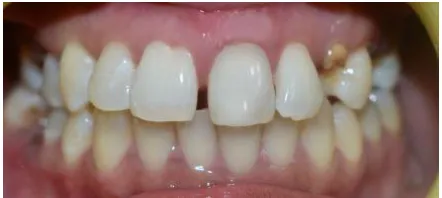
A 34-year-old female patient reported to K.V.G Dental College with a chief complaint of
discolored upper front tooth since 2 years (Figure 1). Medical history was noncontributory. On intraoral
examination, maxillary left central incisor tooth (21) showed brownish discoloration with structurally
intact tooth structure. Vital testing of the said tooth showed no response. Tooth was asymptomatic and
the periodontal findings were normal. Intra oral peri-apical radiograph of maxillary left central incisor
revealed ill-defined peri-apical radiolucency (Figure 2). Based on the clinical and radiographic
examination diagnosis was made as pulpal necrosis with asymptomatic apical periodontitis i.r.t 21.
Treatment plan was decided as Root canal treatment, oral prophylaxis, inside/outside power bleaching
and consent for the inside and outside in-office power bleaching therapy to correct discolored tooth was
obtained.
Fig 1- Preoperative clinical photograph Fig 2- Preoperative radiograph
Treatment procedure
Under rubber dam isolation root canal therapy was initiated followed by biomechanical
preparation using Protaper next rotary files along with copious irrigation with 3%NaOCl, 17% EDTA,
and saline. After completion of obturation (Fig.3) oral prophylaxis and polishing were carried out before
starting the bleaching procedure.
Fig 3 Obturation radiograph
Procedure for inside and outside in-office power bleaching
The tooth to be bleached was isolated using liquid dam. The obturated material was removed
from the tooth up to 2 mm below the CEJ. Stains in the pulp chamber were removed using round bur
with the minimal destruction. 1 mm glass ionomer cement (type 2, GC Corporation, Singapore) was
USA), bleaching agent was mixed into thick paste and placed immediately in the pulp chamber and on
the external labial surface of the tooth and was activated using LED device for 30sec (Figure 4). After
15 min, the tooth was cleansed and the residual bleach inside was removed with water using a high
suction unit. The procedure was repeated 3 times. Following the final wash, tooth shade was evaluated,
which matched with adjacent tooth (Figure 5). In this case satisfactory result was achieved with
bleaching in single appointment. The access cavity was restored using composite resin. Six month
follow up of the bleached tooth showed no difference in the shade (Figure 6).
Fig 4 inside/outside power bleaching Fig 5- Post operative clinical photograph
Fig 6- Six month follow up
DISCUSSION
Bleaching is a conservative method for whitening and restoring the normal color of the teeth.
The advent of newer bleaching techniques has made tooth bleaching a single most noninvasive aesthetic
treatment modality for mild to moderate discolored vital or root filled teeth.8 In-office bleaching and
dentist prescribed, home applied bleaching are the most commonly used whitening procedures which
utilizes different concentrations of hydrogen peroxide (15-38%) formulation directly on the tooth
concentration, its ability to affect the chromospheres molecules, the duration and number of times it is in
contact with the chromosphere molecules, patients age, original shade of tooth color.11
Bleaching of the nonvital teeth can be done using walking bleach technique and inside outside
bleaching technique.9,10 The technique of inside outside bleaching was proposed by Settembrini et al. In
this technique after obtaining a cervical barrier, access cavity is left open and a custom made bleaching
tray is used to keep the bleaching agent in and around the tooth so that both internal and external
aspects of the discoloured root-filled tooth can be bleached.12 Bizhang et al and settembrini et al
reported that the result of the combined technique (inside outside ) is superior to walking-bleach
technique and provides quicker results.12,13 In contrast to these studies, various authors have reported
the recurrence of discoloration following combined technique and concluded that the results cannot be
considered permanent.14,15,16 Gupta et al. reported the main factor of dissatisfaction among patients is
the need for multiple visits in nonvital bleaching technique.17 The other drawbacks of the combined
technique are that the cavity remains open during treatment which leads to the accumulation of food
debris and microbial colonization of dentinal tubules, increased risk of fracture, need for multiple
visits to obtain the desired outcome.12
Hence to overcome the disadvantages of conventional inside outside technique, a modified
single visit inside outside bleaching technique was adopted in this case report. This modified technique
included the placement of bleaching agent inside the pulp chamber and on the external surface
simultaneously followed by light activation to obtain an immediate effect in single visit. The modified
technique used in this case reduced the number of in-office appointments, saved chair time, eliminated
the use of custom made tray, avoided the need for leaving the access cavity open and provided
immediate effect.
The mechanism of power bleaching is thought to work by the permeation of oxygenating
perhydroxyl free radicals through enamel micropores along a diffusion gradient and into the dentine
where it oxidizes the stains and thereby bleaches the teeth.18,19 The major advantages of power bleaching
over other technique includes complete control of the process throughout the treatment, during the
application soft tissues are protected, and the teeth bleach more quickly than other
methods.11,20 Hydrogen peroxide can induce chemical and morphological changes in the enamel due to
the large quantity of hydrogen ions that can bind to the calcium and phosphorus ions present in the
demineralization.21,22Torres et al indicated the use of LED devices to enhance the bleaching effect due
to their greater security in promoting selective heating and to obtain quicker results.23 Similarly,
immediate effect was observed following power bleaching using LED in the present case. Joiner
and Lima et al evaluated the efficacy of light activated bleaching techniques with nonlight activated
techniques and concluded that light sources decompose peroxide faster to form free radicals which
whiten teeth at a faster rate.24,25 However, in contrast to these studies, various studies reported that the
use of light sources did not improve the in-office bleaching treatment and showed less color
stability.26,27 In the present case, a 6 month follow up showed no shade changes in the bleached tooth.
Hence considering the advantages of modified inside outside bleaching technique, it can be used as a
conservative, safe and effective bleaching technique for the management of discoloured nonvital teeth
in single visit.
CONCLUSION
This case report demonstrates successful management of a discolored nonvital tooth using
modified inside outside bleaching in single visit. This technique allowed the placement of bleaching
agent inside the pulp chamber and on the external surface of the tooth simultaneously followed by light
activation to obtain quick effect in single visit. Modified inside/outside bleaching technique provides
immediate bleaching effect in single visit, avoids multiple appointments and delivers economical benefit
to the patients, hence can be adopted in preference to the walking-bleach technique.
REFERENCES
1. Ten Bosch JJ, Coops JC. Tooth color and reflectance as related to light scattering and enamel
hardness. Journal of dental research. 1995 Jan;74(1):374-80.
2. Walton RE, Torabinejad M: Principles and practice of endodontics. 3rd ed. Saunders:
USA;2002;406. Available from: http://www.trove.nla.gov.au/work/18625445
3. Wray A, Welbury R, Faculty of Dental Surgery, Royal College of Surgeons. UK National
Clinical Guidelines in Paediatric Dentistry: Treatment of intrinsic discoloration in permanent
anterior teeth in children and adolescents. Int J Paediatr Dent 2001; 11:309-15
4. Nathoo SA. The chemistry and mechanisms of extrinsic and intrinsic discoloration. The Journal
of the American Dental Association. 1997 Apr 1; 128:6S-10S.
5. Nixon PJ, Gahan M, Robinson S, Chan MF. Conservative aesthetic techniques for discoloured
6. Tavares M, Stultz J, Newman M, Smith V, KENT R, CARPINO E, GOODSON JM. Light
augments tooth whitening with peroxide. The Journal of the American Dental Association.
2003 Feb 1;134(2):167-75.
7. Lee SS, Zhang W, Lee DH, Li Y. Tooth whitening in children and adolescents: a literature
review. Pediatric dentistry. 2005 Sep 1;27(5):362-8.
8. Attin T, Paque F, Ajam F, Lennon AM. Review of the current status of tooth whitening with the
walking bleach technique. International endodontic journal. 2003 May; 36(5):313-29..
9. Nakamura T, Saito O, Ko T, Maruyama T. The effects of polishing and bleaching on the colour
of discoloured teeth in vivo. Journal of oral rehabilitation. 2001 Nov;28(11):1080-4.
10. He LB, Shao MY, Tan K, Xu X, Li JY. The effects of light on bleaching and tooth sensitivity
during in-office vital bleaching: a systematic review and meta-analysis. Journal of dentistry.
2012 Aug 1;40(8):644-53.
11. Dahl JE, Pallesen U. Tooth bleaching—a critical review of the biological aspects. Critical
Reviews in Oral Biology & Medicine. 2003 Jul;14(4):292-304.
12. Settembrini L, Gultz J, Kaim J, Scherer W. A technique for bleaching nonvital teeth:
inside/outside bleaching. The Journal of the American Dental Association. 1997 Sep
1;128(9):1283-4.
13. Bizhang M, Heiden A, Blunck U, Zimmer S, Seemann R, Roulet JF. Intracoronal bleaching of
discolored non-vital teeth. Operative dentistry-university of washington-. 2003 Jul
1;28(4):334-40.
14. Howell RA. The prognosis of bleached root‐filled teeth. International endodontic journal. 1981
Jan;14(1):22-6.
15. Holmstrup G, Palm AM, Lambjerg‐Hansen H. Bleaching of discoloured root‐filled teeth.
Dental Traumatology. 1988 Oct;4(5):197-201.
16. Feiglin B. A 6-year recall study of clinically chemically bleached teeth. Oral Surgery, Oral
Medicine, Oral Pathology. 1987 May 1;63(5):610-3.
17. Gupta SK, Saxena P. Evaluation of patient satisfaction after non‐vital bleaching in traumatized
discolored intact anterior teeth. Dental Traumatology. 2014 Oct;30(5):396-9.
18. Abdelkader NN. Modified technique for nonvital tooth bleaching: a case report. Electronic
19. Arens D. The role of bleaching in esthetics. Dental Clinics of North America. 1989
Apr;33(2):319-36.
20. Chandra B Suresh, GopiKrishna V. Grossman’s Endodontic practice, Bleaching of discolored
teeth, Twelfth edition,Wolter kluwer health;India; 2010 :345.Available from
https://www.researchgate.net/publication/235928342_Grossmans_Endodontic_Practice-12th_Edition
21. Lee KH, Kim HI, Kim KH, Kwon YH. Mineral loss from bovine enamel by a 30% hydrogen
peroxide solution. Journal of Oral Rehabilitation. 2006 Mar;33(3):229-33.
22. Park Hj, Kwon Ty, Nam Sh, Kim Hj, Kim Kh, Kim Yj. Changes in bovine enamel after
treatment with a 30% hydrogen peroxide bleaching agent. Dental materials journal.
2004;23(4):517-21.
23. Torres CR, Barcellos DC, Batista GR, Borges AB, Cassiano KV, Pucci CR. Assessment of the
effectiveness of light-emitting diode and diode laser hybrid light sources to intensify dental
bleaching treatment. Acta Odontol Scand. 2011;69:176–81
24. Lima DA, Aguiar FH, Liporoni PC, Munin E, Ambrosano GM, Lovadino JR. In
vitro evaluation of the effectiveness of bleaching agents activated by different light sources. J
Prosthodont. 2009;18:249–54
25. Joiner A. Tooth colour: a review of the literature. Journal of dentistry. 2004 Jan 1;32:3-12.
26. Luk K, Tam L, Hubert M. Effect of light energy on peroxide tooth bleaching. The Journal of
the American Dental Association. 2004 Feb 1;135(2):194-201.
27. Marson FC, Sensi LG, Vieira LC, Araújo E. Clinical evaluation of in-office dental bleaching
treatments with and without the use of light-activation sources. Operative dentistry. 2008
Jan;33(1):15-22.