The Effectiveness Of The Use Of Statistics
Textbooks In Improving The Statistical Reasoning
Of Building Engineering Education Students
Zulkifli Matondang, Enny Keristiana Sinaga, Harun Sitompul
Abstract. : The research aims to develop statistics textbooks and measure their effectiveness in improving the statistical reasoning abilities of students in building engineering education. This study is based on the results of learning statistics courses that are still low. In g eneral, studying statistical material requires the ability to reason in solving problems in the context of everyday life. To help understanding concepts, statistics textbooks need to be developed with SPSS software-assisted analysis that can be used in learning. This research was conducted on students majoring in PTB FT Unimed. This type of research is research and development. This research procedure was modified from the 4-D learning device development model which consisted of 4 stages namely define, design, develop, and disseminate. Data analysis was performed covering the validity, practicality, and effectiveness of the textbooks that were developed. The results showed that: 1) expert validation on the feasibility of statistics textbook s obtained very good categories with details of material experts with an average score of 79.29, media experts with an average score of 85.33 and linguists with an average score 77.78, 2) lecturers' responses about the practicality of statistics textbooks were obtained in a very practical category with an average score of 85.37 and 3) the use of statistics textbooks was quite effective in increasing student reasoning with at count of 11.44 and significance 0.00. Based on the data analysis and effectiveness test, it can be concluded that the developed statistical textbook can improve students' reasoning abilities.
Keywords: -development, textbooks, reasoning ability, effectiveness.
————————————————————
1.INTRODUCTION
One of the compulsory courses in the Building Engineering Education Study Program (BEE) of the Faculty of Engineering, State University of Medan (FT Unimed) is a statistics course. Statistics courses are prerequisite courses before preparing the final project/thesis. Competence of statistics courses is the mastery of statistical concepts in research, presentation of research data, data processing, test requirements analysis and test hypotheses of the research. Statistics courses equip students to be able to dig up information and process quantitative and qualitative research data. (Yusuf, 2017) suggests that statistics are specifically used to describe and predict phenomena that occur based on data collection results from measurements. For that, we need a statistical ability to be able to interpret, understand, and make good decisions based on data obtained from research. (Garfield & Chance, 2000) suggests that to be able to use statistics optimally, statistical capabilities are needed, namely in understanding statistical concepts, graphical representations, and interpretation of data and opportunities. This is in line with the opinion of (Rumsey, 2002) that the purpose of statistical learning is that students understand statistics well so that they can get information from existing data, criticize and make decisions based on that information and aim to develop research skills. One of the statistical abilities in statistical reasoning. (delMas, 2002) states that statistical reasoning (statistical reasoning) as a way of thinking statistics in producing statistical information.
This includes the ability to interpret a set of data, graphics and some statistical information. (Maryati, 2017) argues that the ability of statistical reasoning is the ability to understand information in daily life based on data or ideas, which means the ability to understand how to choose, present, reduce, and present data used in existing problems. Therefore, students' statistical reasoning abilities need to be trained in statistical lectures. Based on the observations and experiences of the authors of statistical learning activities in the FT Unimed BEE study program, it was found that the statistical learning outcomes of the 2018/2019 academic year students from 60 people obtained an A grade of 9 people (15%), a B grade of 23 people (38.33 %), and a C value of 28 people (46.67%). This shows that there are still many students who get a C value. Students who get a C grade have reasoning abilities that need to be developed or improved. In the learning process of statistics courses, BEE study program students are active in analyzing the material being studied. Some students have difficulty in interpreting the data from the research analysis. For example, students have difficulty in recognizing and classifying types of research data, resulting in errors in data processing. Another difficulty is that the students are confused and are not even able to interpret the results of research data processing, so it is difficult to conclude. Based on the results of the analysis of student difficulties in learning statistics, it is necessary to assist with the preparation of teaching materials. Students will understand the material well if students learn the material independently. One alternative is the use of teaching books (lecture notes) which can be developed to direct the student's mindset and build student independence. Textbooks are intended as completeness of the learning process with a limited scope of curriculum and syllabus characteristics. Textbooks contain information, discussion, and evaluation. The role of the lecturer as a facilitator can be maximized. Textbooks are one of the suggestions for the success of the teaching and learning process (Mintowati, 2003). Then to improve the ability of statistical reasoning
-__________________________________
Zulkifli Matondang1, Enny Keristiana Sinaga2, Harun Sitompul3 1,2,3Universitas Negeri Medan, Medan, Indonesia
3288 students in statistical learning can use SPSS software. Fey
and Heid ( (Kusumah, 2012) explained that the use of computer software for learning activities is very unlimited. Through the use of SPSS software students can apply the concepts provided in data processing by using computer media to solve real problems. Computers as learning media can empower lecturers and students because by using computers, students can learn a textbook in new, more interactive ways. Every student can study textbooks in different ways and whenever they will, not only when there are lecturers. This is in line with the opinion of Hannafin & Peck (Uno & Lamatenggo, 2011), the potential of computer media that can streamline the learning process, among others: (1) Enabling direct interaction between students and subject matter; (2) The learning process can take place individually according to students' learning abilities; (3) Able to display audio-visual elements to increase learning interest (multimedia); (4) Can provide feedback on student responses immediately; (5) Being able to create a continuous learning process. For this reason, this research was conducted to develop statistical textbooks assisted by SPSS software in statistics courses at the BEE FT Unimed study program. Based on the description above, the formulation of the problems in this paper are: 1) What is the process of developing statistics textbooks assisted by SPSS software; 2) How is the quality of textbooks developed based on validity and practicality; and 3) how the effectiveness of statistics textbooks in improving the reasoning ability of BEE FT Unimed study program students.
2. THEORETICAL STUDY
1. Statistics Textbooks
Textbooks are student handbooks in a course written and arranged by an expert/person according to their field. Textbooks are arranged according to the rules of the textbook and are officially published and distributed. Important elements in textbooks are: (1) is a textbook that is shown to students/students, (2) always associated with certain subjects/subjects. (3) is a book that conforms to the standard, (4) is written for certain instructional purposes, and (5) is written to support a particular learning activity. (Arifin, 2009). So textbooks are a collection of materials arranged according to standards or competencies intended for students to support learning activities in certain subjects. Husaini (2008), states that statistics are a collection of material that aims to obtain data, process data, draw conclusions, and make decisions based on the analysis of data collected. Tiro in Karwati (2015) states that statistics are scientific ways to collect, organize, present, and analyze data, and draw valid conclusions and make appropriate decisions based on the analysis conducted. Thus statistics are a method or way to collect, present, analyze data, and draw conclusions and make decisions based on analyzes conducted by scientific steps or procedures. So a statistical textbook is a book or collection of material that is a guide for students to follow lessons that contain data collection, presentation and analysis, and can draw conclusions and make decisions based on these data. To be able to draw conclusions and make decisions based on the analyzed data is reasoning ability. Reasoning ability is the ability to analyze research data and make
conclusions by the facts in the field. Chervaney, Benson, and Iyer (in Garfield, 2002) define statistical reasoning as a way of working with statistical content (remembering, acknowledging, and distinguishing between statistical concepts) and the skill of using statistical concepts in specific problem-solving stages. Dasari (2009) argues that statistical reasoning is the ability to draw conclusions and provide an explanation based on data orientation by paying attention to structured procedures, unstructured procedures, and statistical concepts as well as providing critical comments on a statistical process or outcome. Garfield (2002) states that statistical reasoning has five levels, namely: 1) Idiosyncratic Reasoning, 2) Verbal Reasoning, 3) Transitional Reasoning, 4) Procedural Reasoning, and 5) Integrated Process Reasoning. In learning statistics courses, the ability of the five levels is needed to make conclusions that are right and right. Reasoning ability is very needed in statistics, moreover, data analysis uses SPSS software.
2. Development of Statistics Textbooks
Textbooks were developed in the form of print media equipped with SPSS applications. The SPSS application in textbooks is presented to facilitate students in calculating and analyzing data according to the problem at hand. The use of SPSS-assisted statistics textbooks helps students improve their ability to reason inferring problems in statistics. Textbooks are learning tools that can be developed with several models by the objectives. One model of development of learning tools or textbooks is the 4-D model (Define, Design, Develop and Disseminate). The development model of learning tools in the form of textbooks with 4-D was developed by S.Thiagarajan, Dorothy S.Semmel, and Melvyn I, Semmel. Broadly speaking, the four stages are presented in Table 1 below:
Table 1
Stages of the 4-D Device Development Model
Stages
Define
Define learning requirements. This stage begins with an analysis of the objectives of the boundaries of the material developed by the textbook, which includes several main steps, namely: (a) front end analysis, (b) student analysis, (c) task analysis, (d) concept analysis, and ( e) formulation of learning objectives.
Design
Design Preparing a prototype of learning devices, namely the preparation of benchmark reference tests, the selection of media according to the objectives, to convey subject matter, and the selection of formats.
Develop Develop produces learning tools that have been
revised based on expert input.
Disseminate
The use of tools that have been developed on a broader scale, for example in other classes, in other study programs, by other lecturers. Another aim is to test the effectiveness of the use of devices in teaching and learning activities..
Adopted from (Trianto, 2010)
3. Use of Textbooks in Improving Reasoning Capabilities
textbooks are presented systematically and interesting so that students easily understand them. With the textbook, students can learn and repeat the material that has been presented in lectures. With the use of textbooks, each student will try to understand each material and if necessary do the assignments or questions contained in the button. With the use of textbooks, aka can learn independently according to the willingness and availability of time they have. The use of textbooks will be able to improve the ability or competence of students according to the contents of the book. So the use of textbooks will be able to improve students' reasoning abilities in studying statistical subjects.
3.RESEARCH METHOD
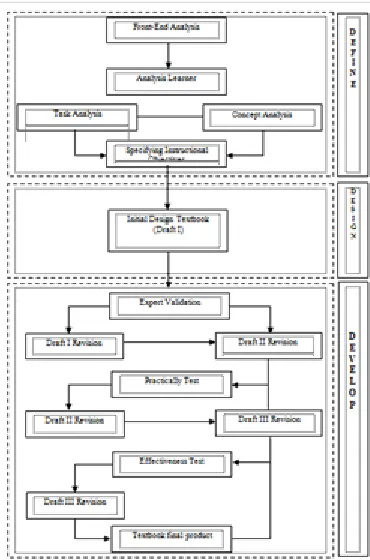
The study was conducted on BEE FT Unimed study program students who took statistics courses in odd semester 2019/2020 Academic Year. The study was conducted in the BEE study program lecture room during the lecture. The procedure for developing a statistical textbook is based on the 4-D learning device development model developed by S. Thiagarajan, Dorothy S. Semmel, and Melvyn I. Semmel, which consists of 4 stages: define, design, develop, and disseminate (Trianto, 2010 ). In this study three stages were carried out, namely define, design and develop. The procedures for developing a statistical textbook are presented in Figure 1 below.
Fig. 1 procedures for developing a statistical textbook
To collect data in this study, several instruments were used in the form of assessment sheets to assess the validity of content and the paternity test as well as a test of statistical reasoning ability to test the effectiveness of the textbooks compiled. Data obtained from experts (material, media, and language) and practicality data (from lecturers) are used to
revise textbooks that are developed to obtain appropriate textbooks according to criteria. The validity and practicality criteria for the textbooks developed were based on the following table.
Table 2
Conversion of Quantitative Data into Qualitative Data with 5 Criteria
Quantitative Score Range
Qualitative Criteria
̅ ̅ Very good
̅ ̅ ̅ Well
̅ ̅ ̅ Pretty good
̅ ̅ ̅ Not good
̅ ̅ Very Poor
Adopted from Widoyoko (2009)
To test the effectiveness of using pretest and posttest data from the ability to understand statistical concepts with the use of textbooks. According to Matondang (2013) to test the effectiveness of textbooks can be done using the paired t-test 95% significance level.
4.
RESULT AND DISCUSSION
The research process starts with the development of statistics textbooks with a 4-D approach (define, design, develop, and disseminate). In this study carried out until the third stage of development. In the initial stage, a needs analysis is conducted on the development of textbooks, furthermore, the preparation of material and assignments is carried out to improve students' understanding of reasoning. The concepts and description of the material and other components are further developed in developing the textbook. All materials compiled are designed systematically to produce a draft of a textbook. Furthermore, expert validation and practicality of the use of the textbooks were carried out. Based on the results of the validation by the material expert on the appropriateness of the contents of the material presented in the statistical textbooks are presented in Table 3.
Table 3
Expert Material Validation Results About the Feasibility of Book Content
Table 3, shows that the teaching scores arranged in a straight line have an average score of 3.96 with a value of 79.29 and are categorized as valid. When viewed from every aspect judged by material experts, the highest average score is given in the aspect of suitability of the material with the achievement of learning subjects with a score of 4.17. The lowest average score is focused on aspects of material expertise with a score of 3.58. This shows that the expertise of the material presented in the statistics textbook needs to be improved.
1 The suitability of the material with the Learning Objectives 4,17 83,33 Very Valid
2 Material accuracy 4,14 82,86 Very Valid
3 Material updates 3,58 71,67 Valid
Total 3,96 79,29 Valid
Criteria
3290
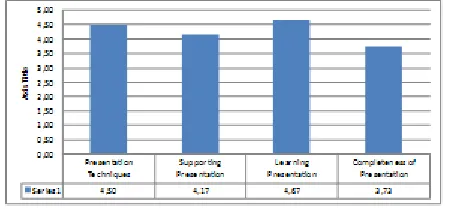
Fig 2. Media Expert Validation Results on Book Display
Figure 2 shows the results of the validation of the media/book expert on the statistics textbook display made. Overall the textbooks arranged have a valid category. Based on the appearance of the book, the aspect of presenting learning has the highest average score of 4.67, while the lowest average score is on the completeness aspect of the score presentation of 3.73. This shows that some aspects that must be in the textbooks must be added again so that the statistics textbooks are better. The results of the validation of linguists on the presentation of the contents of the developed statistical textbooks are presented in Table 4.
Table 4
Results of Language Expert Validation of Book Content
Table 4, shows that the overall teaching scores compiled when viewed from the language used have an average score of 3.89 with a value of 77.78 and are considered valid. When viewed from each aspect judged by experts, the highest average score was obtained in the aspects of miscarriage, communicative and dialogic and instructive with a score of 4.00. The lowest average score is found in the aspect of using symbols and icons with a score of 3.67. This shows that the language used in writing statistical textbooks needs improvement. Overall, there are still languages that are used in textbooks with long sentences and use vocabulary that has a double meaning. This is a concern for the improvement or revision of the textbook. Based on input from the material, media and language experts, the statistical textbooks were improved. Furthermore, before the book is used, first the opinions of the statistical lecturers are asked to assess the practicality of the textbook. From 5 statistics teachers gave responses to the textbooks with a summary of the results of the validation as in the following picture.
Fig 3. Lecturer Validation Results About Practicality of
Books
Figure 3 shows that in general statistics textbooks are quite practical in learning. Based on the scores given by the lecturers, the aspect of textbook functioning in learning has the highest average score of 4.44 while the lowest average score is found in the aspect of the textbook display with a score of 4.08. This shows that the textbooks that are prepared are quite practical to be used in learning activities for students. Furthermore, to determine the effectiveness of the use of statistical textbooks in learning is measured based on student reasoning in attending statistics courses. To measure reasoning ability, using a test which amounted to 25 questions. In general, the question items are arranged to be able to measure the reasoning ability with statistical material, especially in presenting data and calculating the size of data concentration. The test is conducted on students before and after using the textbooks that are prepared. The mean pretest and posttest results of 29 students who took statistics courses are presented in Table 5 below.
Table 5
Average Test Results of Students Reasoning Capabilities
Table 5 shows that there are differences in students' reasoning abilities before and after using statistical textbooks. The average pretest score of students is 71.63 with a standard deviation of 2.25. While the average posttest score of students was 97.13 with a standard deviation of 1.02. This shows that there is an average difference in students' reasoning abilities after using statistics textbooks. To test the difference in the average reasoning ability of students with the use of statistical textbooks in learning is done by paired t-test. The average difference test results using SPSS software, obtained results as presented in Table 6 below.
Table 6
The calculation results show that the calculated value of t is 11.44 with a significance of 0,000. The results indicate that the average difference in students' reasoning abilities is quite significant with the use of statistical textbooks provided in learning. So it can be argued that statistics textbooks given in learning are effective for improving students' reasoning
abilities in statistics courses.
5.
CONCLUSION
The results of the study can be concluded that: 1) the process carried out in compiling statistical textbooks that starts the process of definition, design and developing, 2) the feasibility level of the developed textbooks is categorized well, with the results of expert validation test on the feasibility of statistical textbooks obtained on average an average score of 79.29, media experts with an average score of 85.33 and linguists with an average score of 77.78. Lecturer responses about the practicality of statistics textbooks were obtained in a very practical category with an average score of 85.37 and 3) the use of statistics textbooks was quite effective in improving student reasoning with at count of 11.44 and significance 0.00.
ACKNOWLEDGEMENTS
Thanks to the Department of Building Engineering, at the Medan State University for competitiveness research at the faculty level (KDBK) in 2019.
REFERENCES
[1] delMas, R. C. (2002). Statistical Literacy, Reasoning, and Learning : A Commentary. Journal of Statistics Education .
[2] Eko, W. P. (2009). Evaluasi Program Pembelajaran. Yogyakarta: Pustaka Belajar. [3] Garfield, J., & Chance, B. (2000). Assessment in
Statistics Education: Issues and Challenges. . Mathematics Thinking and Learning , 99-125. [4] Kusumah, Y. S. (2012). Aplikasi Teknologi
Informasi dan Komunikasi dalam Pembelajaran Matematika untuk Meningkatkan Kemampuan Berpikir Matematis Siswa. Seminar Nasional Pendidikan Kerjasama Ikatan Alumni Pendidikan Matematika dan Himpunan Mahasiswa Matematika, FKIP Universitas Sriwijaya. Palembang.
[5] Maryati, I. (2017). Peningkatan Kemampuan Penalaran Statistis Siswa Sekolah Menengah Pertama melalui Pembelajaran Kontekstual. Mosharofa , 129-140.
[6] Matondang, Zulkifli. 2013. Statistik Pendidikan. Medan. Unimed Press.
[7] Mintowati. (2003). Panduan Penulisan Buku Ajar. Jakarta: Depdikbud.
[8] Rumsey, D. J. (2002). Statistical Literacy as a Goal foe Introductory Statistics Courses. Journal of Statistics Educations .
[9] Trianto. (2010). Model Pembelajaran Terpadu. Jakarta: Bumi Aksara.
[10]Uno, H. B., & Lamatenggo. (2011). Teknologi Komunikasi & Informasi Pembelajaran. Jakarta: Bumi Aksara.