INTRODUCTION
Some of the sources of trace elements as pollutants are, vehicle emission, agricultural, industrial and shipping activities1-3. The health risk of trace elements in aquatic environment and subsequent uptake in the food chain by aquatic organisms and humans, can results in morphological abnormalities and genetic alteration of cells. In addition, trace elements can affect enzymatic and hormonal activities1. It is important to evaluate metal content in sediments because under certain conditions, sediment can act as a
www.orientjchem.org
Est. 1984
An International Open Free Access, Peer Reviewed Research Journal CODEN: OJCHEG
2013, Vol. 29, No. (2): Pg. 645-653
Determination of Some Trace Elements in Marine
Sediment using ICP-MS and XRF (A Comparative Study)
AMEL YOUSIF AHMED
1, MD. PAUZI ABDULLAH
1-2, ABDUL KHALIK WOOD
3,
M. SUHAIMI HAMZA
3and MOHAMED ROZALI OTHMAN
1-21School of Chemical Sciences and Food Technology, Universiti Kebangsaan Malaysia, 43600 UKM Bangi, Selangor, Malaysia.
2Centre of Water Research and Analysis, Faculty of Science, Universiti Kebangsaan Malaysia, 43600 UKM Bangi, Selangor, Malaysia.
3Malaysian Nuclear Agency, Bangi, 43000 Kajang, Malaysia. *Corresponding author E-mail: [email protected] (Received: April 03, 2013; Accepted: May 11, 2013)
ABSTRACT
Marine sediment samples were collected from 22 sampling sites along the coastal area of Sabah and Sarawak, Malaysia at various depths. The samples were digested using microwave program and then analyzed for Al, Fe, Mn, Cu, Cr, Co, Cd, As, V, Ni and Pb. For comparison purpose a direct measurement of solid samples was carried out using XRF. Results obtained by ICP-MS were compared with those obtained from XRF using different statistical methods such as two side t-test and paired t-test. Quality control of the obtained data was carried out using different standard reference materials.
Key words: ICP-MS, XRF, trace elements, marine sediment.
sink as well as a source of metals. Moreover, the amount of a given metal that can be released from contaminated sediment depends critically on the metal species4.
The aim of this study is to compare the applicability of ICP-MS and XRF techniques for the determination of trace elements in marine sediment samples. The comparison will define the possible element concentrations levels determined by the techniques and assist in identifying the best technique for analyzing specific elements in marine sediments.
MATERIAL AND METHODS Samples Collection
Sediment samples were collected from coasts of Sabah and Sarawak states, located in East Malaysia, where oil and gas exploration and production activities are the major cause of marine pollution. The area lay between 1°45.93´ to 7 °24.68´ N latitude and 109 °49.20´ to 119° 03.78´ E Longitude. 22 sites, as shown in Figure 1, were selected along the coasts where a total of 75 samples were collected at different distances from the coast (between 0.7-113 m) Another 12 surface sediment samples (depth 1 meter) were collected at the coast of Taman Negara Bako Sarawak (six samples) and from the coast of Taman Negara Pulau Talang Sarawak (another six samples). Both areas, as shown in Figure 2, are considered as pristine as both were the national parks and used as control samples.
All sediment samples were collected using sediment grab and stored in polyethylene containers.
All samples were dried in an oven at 50ºC and homogenized by powdering in an agate mortar. Before analysis, the powder samples were heated at 50º C until constant weight was established. The moisture content of the samples was determined prior to analysis.
Samples preparation for ICP-MS Method of digestion
Microwave digestion program as reported by Delphin et al.,8 and Sandroni9 was used. 0.5 g of each dry sample was accurately weighed and added with 6 ml of 17 M HNO3, 2 ml of 8.8M H2O2 and 2 ml of 0.02 M HF. The samples were digested in a microwave oven (MARS 5 from CEM) using program as of Perez-Santana10: 5min at 300W,
20min at 540W, 5min at 60 W. For quality control purposes, standard reference materials (SRM) (soil -7), marine sediment (PACS-2) and stream sediment (SL-1)) were treated as above. Blank samples were also prepared for each set by adding the digestion acids mixture used above without adding the sample.
Sample analysis using ICP-MS
All samples, standards and blanks solutions as prepared above were analyzed using PE SCIEX ELAN 6000 ICP-MS system.
Samples preparation for XRF
1.00 g of each dry sample was accurately weighed and pressed using manual hydrolic pressing machine (20 tons). The pellet diameter was 40mm. Standard reference material SRM (soil-7) was treated as above. Blank or control samples were also prepared for each set.
The prepared pallets of samples, standards and blanks were then analyzed using BRUKER S8 TIGER XRF system.
Statistical Analysis
Two statistical analysis methods for the analysis of the data namely the two sided t-test and the paired t-test, were applied in this work: Two Sided T-tests
The two sided t-test is applied to check if methods under comparison provide same results, by comparing their means and standard deviations. For the comparison of the means without assuming equal variances equation (1) is used11-12:
...(1)
degrees of freedom as in equation (2) 12.
...(2)
When the , it can be
concluded that the difference between the means obtained by the two methods is statistically significant. If the , it can be concluded that there is no significant difference between the two methods.
Paired t- test
In this test equal numbers of measurements must be done in both methods, since each sample is measured in both methods. Then the mean of the differences between the two methods was calculated for each of the samples, , and also the standard deviation of the differences, s. The statistic t is calculated by the equation (3)
...(3)
Where n is the number of pairs (samples
measured by both methods) and the degrees of freedom, df is equal to (n-1) [10].
RESULTS AND DISCUSSION ICP-MS measurements
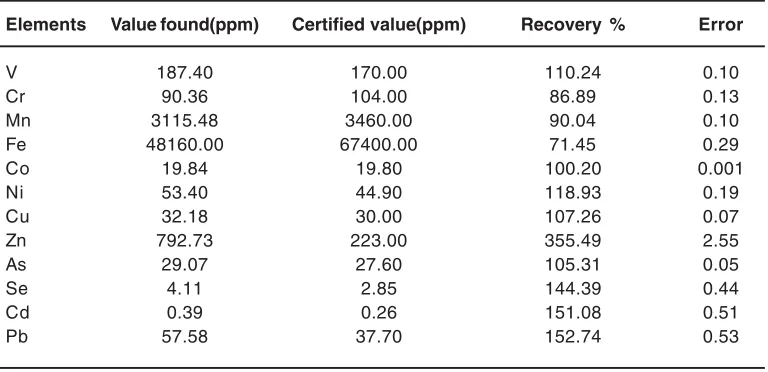
Quality control of the obtained data was performed through the analysis of the certified reference materials (CRMs).Tables 1-3 show the analytical and the certified values, the error, and recovery for the studied elements with the respect to the CRMs
From Table1 it can clearly be observed that for soil-7 Mn, Se, Cr, show good recovery and low error, and to some extend Ni, Co, As, and Pb. For PACS-2 in Table 2 Al, Mn, Cr, Co, V, Ni, Cu and to some extend Se, As, and Pb show acceptable results.
For Sl-1 (Table 3) V, Cr, Mn, Co, Cu, As, and to some extend Ni show acceptable results.
From these observations (Table 1, 2 and 3) it can be concluded that in this study the ICP/MS give acceptable results for all elements under study except for Cd, Fe, and Zn. For Cd this may be due to isobaric interference because all isotopes of Cd may interfere with various isobaric ions and/or oxide or hydroxide ions of other trace elements. If the concentrations of these interference elements are
Table1: Comparison of the ICP-MS results obtained in this work with the certified values for the CRM of soil-7
Elements Value found(ppm) Certified value(ppm) Recovery % Error
Al 33407.00 47000.00 71.08 0.29
V * 66.00 * *
Cr 51.40 60.00 85.67 0.14
Mn 635.50 631.00 100.71 0.01
Fe 19550.00 25700.00 76.07 0.24
Co 10.01 8.90 112.43 0.12
Ni 30.39 26.00 116.89 0.17
Cu 19.38 11.00 176.22 0.76
Zn 188.46 104.00 181.22 0.812
As 15.46 13.40 115.35 0.15
Se 0.38 0.40 94.00 0.06
Cd 2.78 1.30 213.86 1.14
Table 2: Comparison of the ICP-MS results obtained in this work with the certified values for the CRM of PACS-2
Elements Value found(ppm) Certified value(ppm) Recovery % Error
Al 5922.00 6620.00 89.46 0.11
V 140.05 133.00 105.30 0.05
Cr 87.59 90.70 96.57 0.03
Mn 446.64 440.00 101.51 0.02
Fe 35656.00 4090.00 871.78 7.72
Co 11.47 11.50 99.70 0.003
Ni 42.42 39.50 107.39 0.07
Cu 346.39 310.00 111.74 0.12
Zn 717.17 364.00 197.02 0.97
As 30.60 26.20 116.80 0.17
Se 1.09 0.92 118.91 0.19
Cd 3.59 2.11 169.96 0.70
Pb 223.17 183.00 121.95 0.22
Table 3: Comparison of the ICP-MS results obtained in this work with the certified values for the CRM of SL-1
Elements Value found(ppm) Certified value(ppm) Recovery % Error
V 187.40 170.00 110.24 0.10
Cr 90.36 104.00 86.89 0.13
Mn 3115.48 3460.00 90.04 0.10
Fe 48160.00 67400.00 71.45 0.29
Co 19.84 19.80 100.20 0.001
Ni 53.40 44.90 118.93 0.19
Cu 32.18 30.00 107.26 0.07
Zn 792.73 223.00 355.49 2.55
As 29.07 27.60 105.31 0.05
Se 4.11 2.85 144.39 0.44
Cd 0.39 0.26 151.08 0.51
Pb 57.58 37.70 152.74 0.53
larger than the Cd concentration in soils or sediments, it could lead to significantly erroneous results14. For Fe, usually there is polyatomic interference as reported by (May)15-16 especially for the isotope Fe 56 (abundance 91%) and the concentration of Fe calculated using the other isotopes of the element which their abundance is very low. For Zn the high results appear in the three CRMs may be due to its high first ionization potentials (9.4 V) which may make it more sensitive to ‘spatial effects’ within the plasma17.
To compare between the concentrations of the elements in the sediment samples and control samples using ICP-MS the two sided t-test is applied. The comparison is carried out between the samples from the depth A and the control samples, and the results are listed in Table 4.
Table 4: Comparison of the elements concentration between samples and control samples using ICP-MS
Element Samples Control Samples t (cal) df
Average (ppm) SD Average(ppm) SD
As 17.30 11.50 36.43 51.83 -1.262 12
Cd 0.90 1.90 0.24 0.23 1.608 22
Co 12.10 7.10 5.12 0.56 4.585 21
Cr 71.00 67.90 43.06 20.67 1.784 27
Cu 34.30 40.20 9.69 4.07 2.845 22
Fe 26119.70 12103.20 9049.82 2707.41 6.331 25
Mn 495.00 249.00 343.37 56.23 2.731 25
Ni 51.20 46.90 11.83 2.91 3.924 21
Pb 49.80 41.60 18.78 4.02 3.468 22
Se 3.40 1.80 3.26 3.22 0.139 15
V 125.90 66.00 46.56 33.22 4.659 32
Zn 311.00 133.70 157.70 65.60 4.480 32
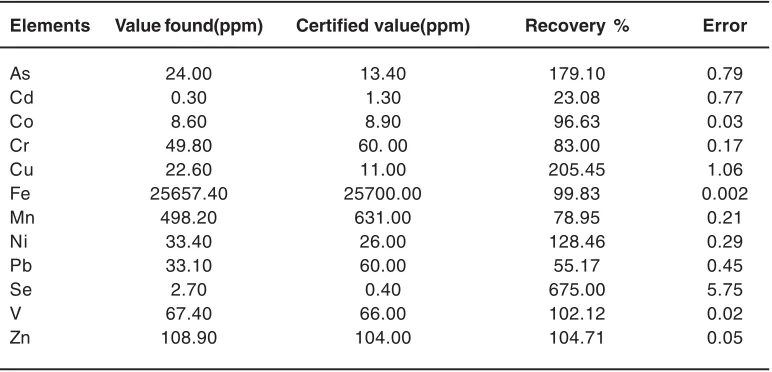
Table 5: Comparison of the XRF results obtained in this work with the certified values for the CRM of soil-7
Elements Value found(ppm) Certified value(ppm) Recovery % Error
As 24.00 13.40 179.10 0.79
Cd 0.30 1.30 23.08 0.77
Co 8.60 8.90 96.63 0.03
Cr 49.80 60. 00 83.00 0.17
Cu 22.60 11.00 205.45 1.06
Fe 25657.40 25700.00 99.83 0.002
Mn 498.20 631.00 78.95 0.21
Ni 33.40 26.00 128.46 0.29
Pb 33.10 60.00 55.17 0.45
Se 2.70 0.40 675.00 5.75
V 67.40 66.00 102.12 0.02
Zn 108.90 104.00 104.71 0.05
indication that all elements may have anthropogenic sources except As, Cd, Cr and Se since the control samples were collected from area supposed to be free from anthropogenic input.
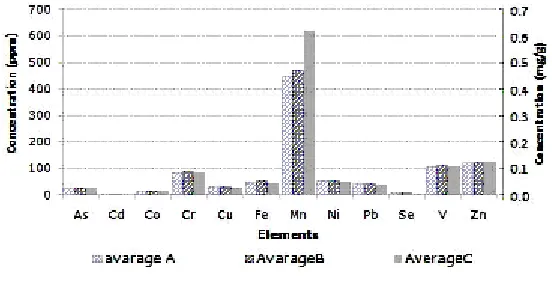
From Figure 3 it’s clear that no significant variation in elements concentrations in the three depths, which implies that no significant anthropogenic input over the years at the study area. XRF measurements
Quality control for the obtained data was carried out using standard reference material (CRM) of soil-7. Table 5 shows the analytical and the certified values, the error, and recovery for the studied elements with the respect to the CRM.
Table 6: Comparison of the elements concentration between samples and control samples using XRF
Element Samples Control Samples t (cal) df
Average (ppm) SD Average(ppm) SD
As 1.30 25.10 1.86 25.27 -0.28 17
Cd 0.20 0.30 0.01 0.29 0.23 21
Co 1.80 13.60 1.06 8.59 10.20 32
Cr 22.70 80.80 3.92 52.98 5.60 23
Cu 2.30 28.30 0.65 25.29 5.74 27
Fe 10805.10 44474.00 6576.78 20.21 14.89 31
Mn 107.80 442.50 74.39 346.62 3.05 30
Ni 16.90 51.10 1.44 33.53 4.84 22
Pb 1.70 34.50 2.86 34.66 -0.18 15
Se 0.20 3.30 0.09 3.30 0.10 31
V 14.70 100.10 10.15 63.00 8.65 30
Zn 8.80 115.80 7.12 82.02 12.14 27
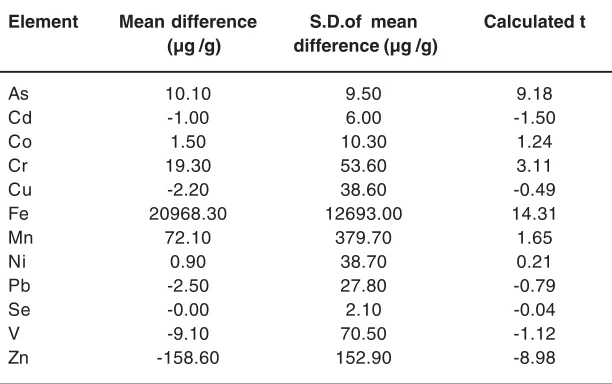
Table 7: Comparison of XRF and ICP/MS by mean of paired t-test Element Mean difference S.D.of mean Calculated t
(µg /g) difference (µg /g)
As 10.10 9.50 9.18
Cd -1.00 6.00 -1.50
Co 1.50 10.30 1.24
Cr 19.30 53.60 3.11
Cu -2.20 38.60 -0.49
Fe 20968.30 12693.00 14.31
Mn 72.10 379.70 1.65
Ni 0.90 38.70 0.21
Pb -2.50 27.80 -0.79
Se -0.00 2.10 -0.04
V -9.10 70.50 -1.12
Zn -158.60 152.90 -8.98
Theoretical t: p=95% 2.021, p=98% 2.423, p=99% 2.704.
To compare between the concentrations of the elements in the sediment samples and control samples using XRF the two sided t-test is also applied. The comparison is carried out between the samples from the depth A and the control samples which are surface samples, and the results are listed in Table 6.
From Table 6 and from the table of values for the two-sided t-distribution all the elements concentrations show that there are significant
differences between the samples and the control samples except for As, Cd, Pb and Se. This result and the result from table 4 give indication that all elements may have anthropogenic sources except As, Cd, and Se.
Fig. 3: Average of elements concentration in different depths using ICP-MS
Fig. 4: Average of elements concentration in different depths using XRF
Elements concentration in ppm except Fe in mg/g
Comparison between XRF and ICP-MS results To compare between the ICP-MS and XRF used in this work paired t –test was applied. The results are shown in table 7.
As shown in Table 7, for 95%, 98% and 99% confident levels, Cd, Co, Cu, Mn, Ni, Pb, Se and V did not give significant differences, while As, Cr, Fe and Zn give significant differences at all confident levels. From this test it can be concluded that the two techniques agree for most of the elements under study accept for As, Cr, Fe and Zn.
CONCLUSION
In view of the results obtained by the two techniques, we can look at two aspects. In terms of sample preparations, the XRF has advantage over
ICP/MS. This is because ICP/MS not only require the use of strong acids, but also the longer digestion time. In addition ICP/MS is also a destructive technique. However, in terms of the range of elements that can be detected, ICP/MS has advantage over XRF since it has lower detection limit for most elements. The results from this study clearly indicates that the two detection techniques agree with each other on Cd, Co, Cu, Mn, Ni, Pb, Se and V results and did not agree on As, Cr, Fe and Zn.
ACKNOWLEDGEMENTS
1. Bubb, J. M. and J. N. Lester, The impact of heavy metals on lowland rivers and the implications for man and the environment, Science of The Total Environment 100(0): 207-233 (1991).
2. Forstner, U., G. T. W. Wittmann, Metal pollution in the aquatic environment, Goldberg. Berlin; Springer-Verlag (1979).
3. Idris, A. M., M. A. H. Eltayeb, Assessment of heavy metals pollution in Sudanese harbours along the Red Sea Coast, Microchemical Journal, 87: 104-112 (2007). 4. Marqu´es, M. J., A. Salvador, Trace element determination in sediments: a comparative study between neutron activation analysis NAA/ and inductively coupled plasma-mass spectrometry ICP-MS/, Microchemical Journal, 65: 177-187 (2000).
5. Smirnova, E. V., I. N. Fedorova, Determination of rare earth elements in black shales by inductively coupled plasma mass spectrometry, Spectrochimica Acta Part B: Atomic Spectroscopy, 58(2): 329-340 (2003). 6. Boyle, J. F., Rapid elemental analysis of sediment samples by isotope source XRF, Journal of Paleolimnology, 23(2): 213-221 (2000).
7. J.L. C. Ladu, T.T. Wei, X. Lu and M. Zhang., Orient J. Chem., 29(1): 23-32 (2013). 8. Delphine, N.-M., M.-R. Maria-Paz, New
application of microwave digestion-inductively coupled plasma-mass spectrometry for multi-element analysis in komatiites, Analytica Chimica Acta, 628(2): 133-142 (2008).
9. Sandroni, V. and C. M. M. Smith, Microwave digestion of sludge, soil and sediment
samples for metal analysis by inductively coupled plasma-atomic emission spectrometr y, Analytica Chimica Acta, 468(2): 335-344 (2002).
10. Perez-Santana, S., M. Pomares Alfonso, Total and partial digestion of sediments for the evaluation of trace element environmental pollution, Chemosphere, 66(8): 1545-1553 (2007).
11. Alfassi, Z. B., Z. Boger, Statistical treatment of analytical data, Blackwell Science, (2005). 12. Urdan, T. C., Statistics In Plain English, Mahwah, New Jersey, Lawrence Erlbaum Associates, Inc, (2005).
13. Davenport, J. M. and J. T. Webster, Metrica, (1975).
14. Guo, W., Shenghong, Direct Determination of Trace Cadmium in Environmental Samples By Dynamic Reaction Cell Inductively Coupled Plasma Mass Spectrometry, Chemosphere, 81: 1463-1468 (2010) .
15. C.W. Zhen, K. Nadarajah and Y. Farina., Orient J. Chem., 28(1): 131-139 (2012).
16. May, T. W. and R. H. Wiedmeyer A Table Of Polyatomic Interferences In ICP-MS, Atomic Spectroscopy, 19: 150-155 (1998).
17. Campbell, M. J. and A. To¨rve´nyi, Non-Spectroscopic Suppression Of zinc In ICP-MS In A Candidate Biological Reference Material (IAEA 392 Algae), J. Anal. At. Spectrom, 14: 1313-1316 (1999).
18. Moros, J., A. Gredill, Partial Least Squares X-Ray Fluorescence Determination of Trace Elements In Sediments From The Estuary of Nerbioi-Ibaizabal River, Talanta 82: 1254– 1260 (2010).