INTERNATIONAL JOURNAL OF SCIENTIFIC & TECHNOLOGY RESEARCH VOLUME 9, ISSUE 01, JANUARY 2020 ISSN 2277-8616
Blockchain Technology In Food Supply Chain
Security
Dinesh Kumar K, Manoj Kumar D.S, Anandh R
Abstract: Safety and security system to trace the supply chain of the food production and transportation is not up to the mark in India. The lack of transparency between the producer and consumer by means of food safety and security is always lags. Food safety is increasing ly serious threat globally lack of food security system would affects the people‟s health and life directly or indirectly. The Indian economy, politics and society as a whole have a greater impact based on food sourcing and supply. To ensure the effectiveness of produc t quality and safety management and control many countries working on developing technologies on traceability to trace the traditional supply chain system, although these tec hnologies have not been able to achieve the goal. Therefore, this paper introduces the concept of Blockchain Technology, to enhance the food supply chain with information security and comparing it with existing supply chain management.
Index Terms: Blockchain, Supply Chain Management, Food Security, Information Security, Safety Management
—————————— ——————————
1.
INTRODUCTION
Foodborne diseases still increase several customers became less dependent on food, so making a necessity for many elaborated data on food production. In previous couple of years, India has entered an amount of frequent food safety incident - Low-quality powdered milk, plastic rice, etc., that cause serious consequences. This study steered that the Blockchain provides an innovative resolution for achieving these goals: foremost, it provides a permanent record for every dealings section that sorted into individual blocks and cannot be tampered with. Secondly, it will replace those ancient paper following systems and manual observance system, thus on forestall the standard approach of the provision chain from suffering the wrong impact. In different words, the provision chain following is a very important live to shield food safety, promoting food safety and food certification.
2
LITERATURE
REVIEW
The logistics supply chain management theory, analysis of how to improve the level of supply chain management of agricultural products and logistics enterprises, not only have advanced supply chain management technology but also improve the market service system and quality management system, and actively play a government function. To further explore the concept of traceability for safe and sustainable agriculture and Agri-food supply chains, traceability is a preventive strategy for food quality and safety management that contributes to increasing
consumer confidence in the food system. [1] In this paper, Blockchain technology was used to solve the problem of agricultural food supply chain traceability, further addressing the food safety issues, and to demonstrate its link in each supply chain in the implementation process details. Aiming at
national conditions of India, a set of theoretical methods were used to adapt to India's current situation in order to make agricultural product supply chain management more efficient and reliable, as well as the quality and safety of agricultural products.
3 HYPOTHESIS
A. Blockchain insure the traceability and reliability of each transaction in the food supply chain
There is still no good resolution for achieving the traceability and reliability in food supply chain system. Building associate Agri-food provide chain traceability system is treated as an indispensable mission once ancient logic of management and traceability therefore the adaptation of invasive food market [2]. However, the application of Blockchain in the supply chain may have been the optimal choice until now. Verifying authenticity of the document can be done by using Blockchain and eliminates the need for centralized authority. Reference [3], every transaction requires verifying the last transaction, thus guaranteeing the traceability of each transaction.
B. Blockchain can fulfill the demand of governments, enterprises and consumers
If the first hypothesis is established, applying the technology of Blockchain can meet with the demand of governments, enterprises and consumers. The technical advantages of the Blockchain bring new regulatory ideas to the government, improving the existing management flaws of the government. For enterprises, the application of the Blockchain can insure merchandise quality and giving quick response to the Changing market. In fact, the application of the Blockchain can protect the rights of consumers.
———————————————
Dinesh Kumar K, Assistant Professor, Department of Information Technology, AMET Deemed to be University, Chennai, Tamil Nadu, India, [email protected]
Manoj Kumar D.S, Assistant Professor, B.S Abdur Rahman Cresent Institute of Science and Technology, Chennai, Tamil Nadu, India, [email protected]
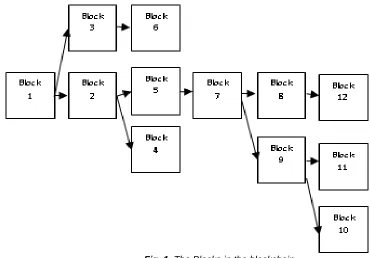
Fig. 1. The Blocks in the blockchain
INTERNATIONAL JOURNAL OF SCIENTIFIC & TECHNOLOGY RESEARCH VOLUME 9, ISSUE 01, JANUARY 2020 ISSN 2277-8616
Fig. 2. Block Structure .
Each block as shown in Fig. 2 consists of block header such as previous block hash, Time stamp, version, nonce, merkle root hash. Apart from blockheader there is n number transaction are stored.
3. SYSTEM
ARCHITECTURE
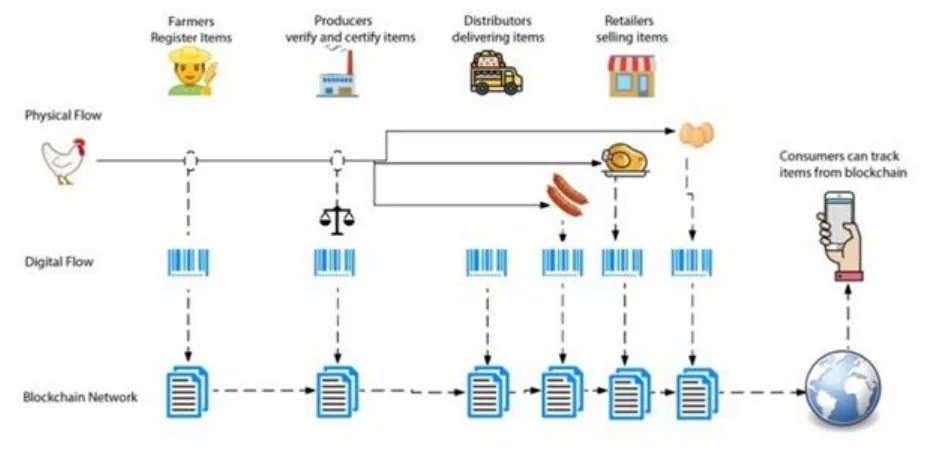
The Supply chain activities are farming, refining, designing, manufacturing, packaging, transportation. The model cold-chain system that is decentralized and distributive in nature, and uses the Internet of things for collecting and transferring information on the blockchain technology. For storing and
managing all relevant data of products in the perishable supply chain, the immutable blockchain technology and the application of smart contracts for automated processing of predefined terms and conditions with utmost authenticity. All the parties from producers to manufactures in the proposed blockchain. Each of these members is capable of adding, updating and checking the production information. RFID tags attached to each of the cold-chain product are unique digital cryptographic identifiers, which connect these physical items with a virtual identity stored on the distributed ledger. Every products‟ information profile is represented in the form of a virtual identity on the blockchain.
4.
RESULTS
AND
DISCUSSION
In this paper, we use the methods of information science, management science, system science and other theories and empirical research methods, mainly using the PEST analysis to analyze, contrast and demonstrate studying the application of Blockchain in the food supply chain. PEST is an analytical model that analyzes the macro-environment location of the industry. All parts of the PEST are the external environment of the industry that cannot be controlled by themselves. The paper also carries on the demand analysis of the Blockchain system platform of the food supply chain. Firstly, this paper qualitatively analyzes the current situation of food security. The second is the demand analysis of the food supply chain traceability system platform, analyzing the food supply chain can be traced back to the root causes and the need for development. Thirdly, it analyzes the traditional traceability system of food supply chain. Fourthly, aiming at the problems existing in the food supply chain system, applying the block chain technology to build a supply chain system platform for production processors, brokers and consumers.
A.Blockchain Application Theory
The Blockchain stores the food information as a transaction. All the transaction are stored in the blockchain are distributed and transparent other participants. Anyone in the blockchain network can validate the transaction meanwhile all the nodes are allowed to trace food information, which achieves the transparency and traceability for food safety. Due to the characteristic of the blockchain, all the transactions will be packed in one or several blocks. All the nodes also update the book on native when a new block is verified and recorded on the main chain, which means all the nodes have same transaction that records all the transactions. If someone want to change one of the transaction record, an attacker who has a high fake credibility score can possibly succeed in a 51% attack [4]. However, such process may vastly consume computing power to modify over half of the node‟s chain and calculate the eligible hash to repack the block. The blockchain transaction secured cryptographically using Hashing algorithm Double SHA 256 [5]. The blockchain can keep the information safe without manipulation.
B. Decentralized Food Supply Chain Authentication Model.
In Blockchain distributed system each flow of transactions are recorded in the ledger [6]. The entry in the ledger are immutable so that individual cannot tamper or alter the transactions. The participants in the networks as per the figure 1. Farmers, producers, distributors, delivery partners, Retailers and customers. The farmers register the item in the ledger as an initial transaction, some transactions validated and valid transactions are added in the ledger [9]. The producer verify the transaction based on time, quality and many factors. The distributor does transporting the item from once source to another place these transactions like starting place and destination are considered as transaction also stored in ledger
the issues of food regularity and authority process. Some of the food regulatory authority requirements are
(1) Accurately collect the data on all viewpoints of the food supply chain.
(2) Information acquiring and storage of the planting to the whole process
(3) Transfered to the government authority through blockchain. Therefore transactions are cryptographically secured using double SHA 256 Bit algorithm also ensures immutability, transparency, distributed and easy to maintainance
5.CONCLUSION
The proposed blockchain supply-chain reasonably increases efficiency, transparency and low cost for handling. In addition, blockchain adds the features like immutability and transparency, which disallows any fraudulent modifications to the data. The decentralized and permissionless blockchain system can deliver real time information to all the parties such as producer and consumer ecosystem on the safety status of food products at all time.
REFERENCES
[1] KONG Hongliang, LI Jianhui, „Application of Global niform Marking System in Food Safety Tracking and Traceability System‟, Food Science, p.188-194, 2004. [2] FENG Tian, 2016, An Agri-food Supply Chain
Traceability System for China Based on RFID & Blockchain Technology, 2016.
[3] Michael Crosby, Nachiappan, Pradan Pattanayak, Sanjeev Verma, Vignesh Kalyanaraman, BlockChain Technology: Beyond Bitcoin, 2016.
[4] Hiroki, Blockchain Contract: Securing a Blockchain Applied to Smart Contracts, IEEE International Conference on Consumer Electronics (ICCE), p.468, 2016.
[5] Szabo.N. The idea of smart contracts http://szabo.best.vwh.net/smart_contracts_idea.html, 1997.
[6] S. Nakamoto, Bitcoin: A Peer-to-Peer Electronic Cash System,bitcoin.org/bitcoin.pdf,2008.
[7] Dennis Miller, IBM, Blockchain and the Internet of Things in the Industrial Sector, IT professional, 2018. [8] Daniel Tse, Bowen Zhang, Yuchen Yang, Chenli
Cheng, Haoran Mu , Blockchain Application in Food supply information system, IEEE Conference, 2017. [9] Nir Kshetri, Blockchain and Economic of food safety,
IT Professional, 2019.
[10]B. M. A. L. Basnayake, C. Rajapakse, A Blockchain-based decentralized system to ensure the transparency of organic food supply chain, IEEE Conference (SCSE), 2019.
INTERNATIONAL JOURNAL OF SCIENTIFIC & TECHNOLOGY RESEARCH VOLUME 9, ISSUE 01, JANUARY 2020 ISSN 2277-8616
Engineering and Computer Science Vol. 8, No. 3, pp. 719 - 720, December 2017.