Subterranean termite baiting systems
This factsheet describes baiting systems used for managing termites in Australia. It discusses concepts of baiting termites, termite aggregation in baiting stations and toxicant application with respect to feeding habits and behaviour of some termites that damage timber-in-service in Australia. There is also information about the economic impact of termites, the history and
development of termite baiting systems and commercial termite baiting systems.
Until recently, subterranean termite
management in Australia relied on chemically treated soil barriers using highly persistent cyclodiene insecticides. These chemicals were de-registered and withdrawn from use from 30 June 1995. There were alternative strategies for subterranean termite
management in buildings and structures well before this date. One of these uses ’termite baiting systems’.
Economic importance
Australia’s diverse termite fauna includes 258 described, and at least 90 undescribed species from about 30 genera in five families (Mastotermitidae, Termopsidae,
Kalotermitidae, Rhinotermitidae and
Termitidae). Termites fall broadly into three categories: dampwood, drywood and subterranean termites.
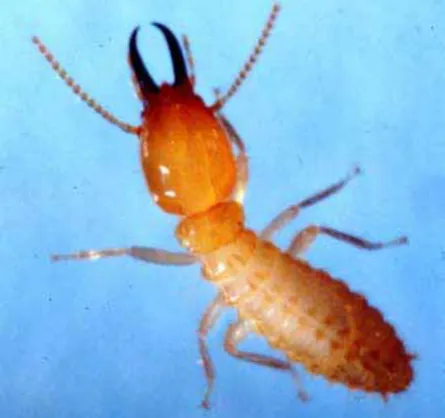
Most species of termites that damage timber-in-service in Australia are subterranean termites. Mastotermes darwiniensis and Coptotermes spp. are the most destructive. Coptotermes acinaciformis
(Figure 1) is responsible for more economic loss than all the other Australian species combined. This is because it has an
extensive range, causes severe damage and can survive in cities and large towns.
Figure 1: Coptotermes acinaciformis soldier.
Some species of Schedorhinotermes and
Nasutitermes are also important
economically. Nasutitermes exitiosus is particularly widespread in the cool temperate regions of the southern, mainland states.
The annual cost of termite damage to buildings in Australia is estimated to exceed $100 million, while the cost of imported chemicals for termite management may exceed $20 million annually. Termites can cause significant damage with devastating financial and social implications for building owners.
Feeding habits and behaviour
Subterranean termite baiting systems Version October 2013
© State of Queensland, Department of Agriculture, Fisheries and Forestry, 2013.
2 Figure 2 : Galleries of Nasutitermes walkeri.
Several timber species have natural
properties that make the heartwood resistant to termite damage. Most termites that infest timber can damage the sapwood of
softwoods, for example hoop, slash and radiata pines. However, wood-feeding
Nasutitermes spp. only damage hardwoods.
Subterranean termites forage for food using covered runways (galleries) extending from the central nest to food sources above (Figure 2) or below ground. The gallery system of a single colony may exploit food sources over as much as one hectare, and individual galleries may be up to 50 m long. In the case of the giant northern termite M. darwiniensis, individual galleries may extend as far as 200 m.
Usually, only workers and soldiers visit the feeding sites, but nymphs are sometimes present. Other members of the colony
generally remain in the nest. Foraging activity is seasonal, and may slow down or even stop during winter. Most termites need a plentiful supply of water, part of which they obtain from damp soil. Foraging termites aggregate in warm, moist areas containing susceptible timber, although exploratory foraging is thought to be at random.
Termites have a thin skin (integument) and desiccate readily. Apart from some grass-eating species that forage in the open, all termites remain within a closed system of
galleries, devoid of light and high in humidity. The only exceptions are during swarming flight, or periods of repair or new
construction. The advantages to the termites of this closed system are twofold. It protects them from natural enemies such as ants, and they gain a measure of protection from temperature and humidity extremes.
Termites share food, feed their young, regularly groom one another and often cannibalise their dead. These important behavioural aspects are exploited by puffing small quantities of arsenic trioxide dust into active termite galleries as a remedial
treatment. The dust adheres to the bodies of the passing termites and is distributed into the colony. Death of the termite queen and eventually the colony may follow, though colony suppression rather than colony death may be the eventual outcome. Similarly, termites can consume cellulose-based bait containing a toxicant, ultimately causing the colony to die.
Termite baiting concepts
Although termites are not strictly attracted or lured to most baits, as in a conventional baiting system, the principle is to have a susceptible substance in a ’bait station’ on which the termites aggregate and continue to feed once they have found the bait station. Bait stations are placed in-ground or aboveground. Placing them in areas conducive to termite activity (directed placement) improves the chance of contact with foraging termites. A bait toxicant in timber or a cellulose matrix is placed in the station, or the colony may be destroyed indirectly by dusting aggregated termites.
Some bait toxicants have the potential to eliminate the colony while others only suppress the colony. Importantly, however, both methods reduce further, potential damage to timbers.
Subterranean termite baiting systems Version October 2013
© State of Queensland, Department of Agriculture, Fisheries and Forestry, 2013.
3 strategy. Colony elimination or suppression
should be followed by hazard reduction and regular inspection. Monitoring should continue because only a small amount of toxin is used and it will only affect a single colony. This does not prevent foraging by other termite colonies that may be present in the foraging range of a timber structure.
Termite aggregation
Several techniques aggregate termites in stations prior to treatment in in-ground and aboveground situations. Care should be taken when inspecting stations because termites, especially Schedorhinotermes spp., tend to retreat from, and avoid, disturbed areas.
In-ground aggregation
Termites appear to forage randomly through the soil, but can quickly recruit large numbers to a new food source. They probably regulate the number of foragers at a food source directly according to the mass of susceptible timber available. This behaviour has
implications with regard to aggregating large numbers of termites. Large timbers buried in the ground are likely to be found more readily and will amass larger numbers of termites than small blocks of wood. Aggregation devices include the termite bait box
(developed from a CSIRO design) and plastic conduits.
The termite bait box
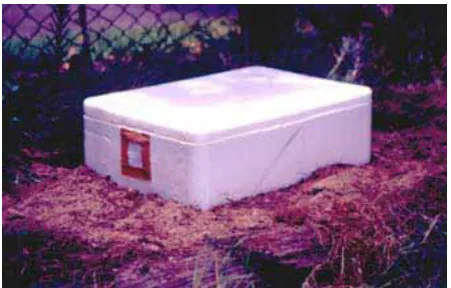
There are few critical dimensions or materials. Typically, boxes are about 200x300x500 mm and constructed of polystyrene (e.g. broccoli box, Figure 3), polyethylene (e.g. worm farm box) or untreated timber, and buried in soil to about 100 mm. The lid should seal tightly, to prevent ants from entering and the contents from drying. Holes in the base of the box permit termite entry. The inside can be inspected through a small window, covered with clear plastic, in the top or end of the box. A sheet of white tissue or blotting paper
Figure 3: The termite bait box.
against the inside of the window may be used to detect termites (because termites will eat and stain the paper) without disturbing them. Wetted corrugated cardboard and thin strips of susceptible wood are laid alternately as the bait substrate. These are easily removed to obtain the termites.
Plastic conduit devices
Again, there are few critical dimensions or materials. Various do-it-yourself plastic-conduit devices have been used. These include plastic conduit (25 mm diameter), perforated with small holes (4 mm diameter) drilled every 100 mm, with wetted corrugated cardboard inserted. The device is buried (100–150 mm deep) in wetted soil diagonally across the under-house area, around the outside of the building, or near active galleries. Plastic T pieces, inserted about every metre, are fitted with vertical tubing (200 mm). A small plastic box (100x130x200 mm) is attached to each of these and filled with layers of wetted corrugated cardboard to aggregate termites.
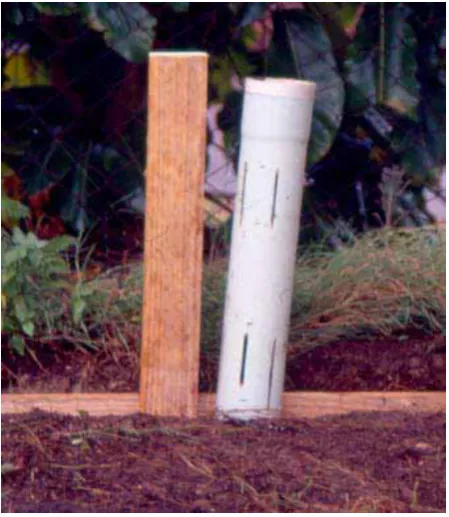
‘Stud’ size pine timber (35x70x2400 mm) with a slotted PVC stormwater pipe (500 mm long x 90 mm diameter, containing timber)
positioned in the ground vertically along the stud (Figure 4) has been used successfully. A removable cap aids inspection.
Subterranean termite baiting systems Version October 2013
© State of Queensland, Department of Agriculture, Fisheries and Forestry, 2013.
4 Figure 4: Termite aggregation station showing the
timber and the slotted, PVC pipe before installation.
Figure 5: Installing a termite aggregation station with the plastic T piece and timber.
(500x90 mm diameter, containing timber) can be attached to the T piece, as necessary.
Above-ground aggregation
Stations placed in direct contact with infested timbers aboveground enables foraging termites to find the bait easily. However, access to suitable sites may be difficult,
especially in association with brick-veneer, slab-on-ground construction.
Trees and stumps
Some termite species build nests in large trees. These trees appear unaffected and although the whole trunk may be hollow, the only external signs may be hollow, broken branches. Termites can be detected by drilling the tree. All trees, especially large trees within 50 m of a building should be checked. Using a long auger bit (20 mm diameter), several holes are bored towards the centre of the tree trunk, approximately 1 m from the ground. If termites are present (or have been active previously) the trunk centre will be hollow, or filled with muddy material (‘mudgut’). The auger will suddenly penetrate easily as it reaches the hollowed centre.
There are a number of ways to test for termites in the tree. First, examine the auger when it is withdrawn from the tree. If termites are not found on the auger bit, insert a length of dowel into each bore hole. The diameter of the dowel should be slightly smaller than that of the hole, as the sap causes the dowel to swell. Allow at least 150 mm of the dowel to protrude to serve as a handle. The dowel should be withdrawn after one to two weeks and checked for signs of termites, which include chewed areas or brown, faecal spotting. Economically important species of termites found in trees should be treated.
Subterranean termite baiting systems Version October 2013
© State of Queensland, Department of Agriculture, Fisheries and Forestry, 2013.
5 (45x350 mm) is placed in the conduit and one
end plugged with a rubber stopper. The box is then connected to the colony by inserting the plastic conduit into a hole (20 mm diameter) drilled in the side of the tree or infested stump. Termite entry is verified by inspection.
Placing baits
In Australia, the main problem with baiting techniques for Coptotermes spp. has been the inconsistency of termites locating and accepting the baits.
Directed placement of in-ground stations should be in dark, moist, quiet places (especially where termite activity has been confirmed), rather than at regular intervals around a structure. Primary areas for directed placement include areas around drains, areas directly adjacent to ‘wet areas’ (bathroom, laundry and kitchen) where plumbing may enter the structure, garden beds adjacent to the structure and around trees or stumps.
Competing termite food sources are difficult to remove, and food choices are always available to the termites being baited. In some cases, baits have been pre-decayed with a suitable fungus to improve its acceptability to termites. The fungus used varies with the termite species. Similarly, nitrogen additives, principally urea and selected amino acids, have been used to increase Coptotermes spp.feeding on baits.
In above-ground stations, baits should be placed in contact with infested timbers or active termite galleries. Electronic devices to detect termite movement have been
developed. One such a device is Termatrac
(www.termatrac.com ).
Applying toxicant
The station may contain a bait toxicant or ‘bait-and-switch’ techniques work by
replacing the initial bait with one laced with a toxicant. Alternatively, the toxin is applied
topically, usually to several thousand termites, as a dust. Whichever strategy is employed, success depends on the aggregated termites taking a slow-acting toxin back to the nest, which eventually kills or suppresses the colony. The toxin-affected individuals must move away from the bait site because accumulation of dead termites will repel other individuals from approaching the bait.
Ideally, the toxicant should be non-repellent to termites, or at least masked by other agents to prevent avoidance behaviour by the foraging termites. The intent is to starve the termites by killing the gut protozoa or
bacteria, or to starve the colony by upsetting the social system or to otherwise interfere with the colony.
Bait toxicant
Several chitin-synthesis inhibitors (for example, chlorfluazuron, flufenoxuron, hexaflumuron, noviflumuron and triflumuron) and metabolic inhibitors (for example, hydramethylnon and sulfluramid) have delayed activity against some termites. As a bait toxicant, they can be used to manage foraging populations of subterranean termite colonies, reducing the potential damage.
Dusting
Termites may be aggregated and dusted using a hand blower. Alternatively, the
aggregated termites may be removed, dusted and then returned to the site of activity. Removal and dusting should be done quickly to avoid stressing the termites and to prevent others from sealing galleries as they retreat.
Subterranean termite baiting systems Version October 2013
© State of Queensland, Department of Agriculture, Fisheries and Forestry, 2013.
6 containing aggregated termites. The toxin, in
theory, transfers between termites and through the colony.
Arsenic trioxide is commonly used by professional operators as a ‘termite dust’. Arsenic trioxide is highly toxic to humans. For the method to be effective and safe, operator skill is required in judging both the quantities and placement of dust and in handling the toxin and the termites. The treatment must be carried out only by an experienced, licensed operator.
Fipronil, permethrin and triflumuron are also registered as dust applications. Experimental biological control has been successful using insect pathogenic bacterial spores, the fungus Metarhizium anisopliae and
roundworms (nematodes) Heterorhabdis spp. and Steinernema spp. Commercial products are not yet on the Australian market.
Because each termite colony generally forages in its own gallery system, isolated from other termite colonies and organisms, it is considered that treating a colony with bait toxicants will not lead to widespread
contamination of the soil. It should, therefore, not cause damage to other termite colonies, or other soil-dwelling organisms, of
importance in woodland and urban ecosystems.
Commercial baiting systems
Several manufacturers have termite bait toxicants registered with the Australian Pesticides and Veterinary Medicines Authority (APVMA, website:
www.apvma.gov.au ) Details of these are
available from the manufacturer’s websites.
Conclusion
Termite-baiting systems are largely in a developmental or refinement phase in Australia. They are most beneficial when used as part of an integrated pest
management strategy, and are not the complete answer to termite management. Colony elimination or suppression should be followed by hazard reduction and regular inspection. A better understanding of termite foraging habits and behaviour will enhance bait-station design and placement for termite aggregation and bait-toxicant application.
More information
Customer Service Centre: 13 25 23
Website: www.daff.qld.gov.au
Further reading
Gerozisis J, Hadlington P & Staunton I (2008). Urban pest management in Australia. 5th Edition. University of New South Wales Press, Sydney, 326 pp.
Standards Australia (2000) AS 3660.1: 2000
Termite Management – Part 1: New Building Work. Australian Standard, distributed by SAI
Global Limited. www.saiglobal.com
Standards Australia (2000) AS 3660.2: 2000
Termite management – Part 2: In and around existing buildings and structures - Guidelines. Australian Standard, distributed by SAI Global
Limited. www.saiglobal.com
Standards Australia (2000) AS 3660.3: 2000
Termite management – Part 3: Assessment criteria for termite management systems. Australian Standard, distributed by SAI Global