Recommending Audio Mixing Workflows
Christian Sauer, Thomas Roth-Berghofer, Nino Auricchio, and Sam Proctor
School of Computing and Technology, University of West London, St Mary’s Road, London W5 5RF, United Kingdom
{first.lastname}@uwl.ac.uk
Abstract. This paper describes our work on Audio Advisor, a work-flow recommender for audio mixing. We examine the process of eliciting, formalising and modelling the domain knowledge and expert’s experi-ence. We are also describing the effects and problems associated with the knowledge formalisation processes. We decided to employ structured case-based reasoning using themyCBR 3 to capture the vagueness en-countered in the audio domain. We detail on how we used extensive sim-ilarity measure modelling to counter the vagueness associated with the attempt to formalise knowledge about and descriptors of emotions. To improve usability we added GATE to process natural language queries within Audio Advisor. We demonstrate the use of the Audio Advisor software prototype and provide a first evaluation of the performance and quality of recommendations ofAudio Advisor.
Keywords: CBR, myCBR, audio, mixing, audio engineering, similarity measures, workflow recommendation, knowledge formalisation
1
Introduction
With automatic composition and improvisation of music expressing the individ-ual style of a human composer as well as the automatic expressive performance of music, the two main steps of music creation are quite well researched [15,16]. There are a variety of approaches to automated composition of expressive mu-sic and the expressive performance of mumu-sic, see e.g., [15,4]. They all need to deal with the problem of formalising emotions in order to relate to the intended emotional effect of a composition and/or performance. The formalisation of af-fective, emotional statements or descriptive adjectives of an emotion is still a problem [10,6], often encountered by applications dealing with art and deeply linked to emotions and perception of such.
warm’ or ‘make it sound less harsh’ and onomatopoeia in the language of audio engineers.
The experience of audio engineers is in the linkage between queries containing timbre descriptors such as ’warm’ or ’bright’ as well as amount descriptors and constrains, and in the choice and application of spectral modifications used to achieve the desired timbre change of the sound. Additionally the effect of such a query is also linked to the context in which it occurs. The modelling and (re-)use of such context embedded queries to recommend the adequate workflows was the main goal of ourAudio Advisor prototype workflow recommender.
This paper introduces our work onAudio Advisor, a workflow recommender system that allows its users to formulate natural language queries for the auto-matic case-based retrieval of workflows that, when applied to the audio product changes its timbre and/or applies an effect to it. The workflow itself is provided as a sequence of so called presets, where a preset can be described as a selection of frequency descriptors with definite decibel change values for said frequencies. A preset can further contain information on defined effects such as reverb or delay and the decibel values to be applied to these effects. An example is to define a preset to reduce high frequencies and emphasise lower frequencies while adding a slight echo effect to the sound.
The rest of the paper is structured as follows: We interlink our approach with the current state-of-the-art in the field of artificial music composition and perfor-mance in Section 2. Based upon the goals and aims ofAudio Advisor(Section 3) we examine the domain of audio mixing and its specific knowledge as well as our approaches to elicit and formalise the knowledge in Section 4. In Section 5 we show how we useGATE1to develop the natural language processing component
that enables Audio Advisor to ’understand’ natural language queries posted to the system. We then demonstrate how we use myCBR 32 for Audio Advisor
and examine the overall structure and workflow of the Audio Advisor applica-tion. Section 6 details on the performed experiments regarding the quality of the workflow recommendations and evaluate the performance of Audio Advisor. A summary and outlook on future work then concludes the paper.
2
Related work
A variety of approaches to formalise emotional annotations and/or descrip-tive terms that either describe the mood of the music or the way it is to be played [16,14] already exists. Such approaches deal with either playing music in a certain defined way to convey an emotion [7] or to select songs or sounds that are associated with a mood or emotional state [21]. For automated composing, the question of integrating a formal description of the mood the composed music should match is already well researched [16,4].
Emotions or, in our context, the timbre of a sound and its perception are not easy to be a) defined and b) quantised/formalised [12,8,10]. Another problem
1 http://gate.ac.uk/ 2
we were facing during the domain knowledge formalisation was that we tried to quantify and cluster descriptive adjectives based on very vague data given by the individual descriptions of the emotional effect a sound has on a person describing this effect. The difficulties of capturing a sounds timbre are [9]: “It is timbre’s ‘strangeness’ and, even more, its ‘multiplicity’ that make it impos-sible to measure timbre along a single continuum, in contrast to pitch (low to high), duration (short to long), or loudness (soft to loud). The vocabulary used to describe the timbres of musical instrument sounds indicates the multidimen-sional aspect of timbre. For example, ‘attack quality, ‘brightness,’ and ‘clarity’ are terms frequently used to describe musical sounds.” The vagueness of the data is based on said variation in the individuals perceptions when they either should describe an emotional effect or perceive something that is annotated with a par-ticular emotion but have a complete different idea of the actual emotion this percept triggers [17,9,11].
The problems caused by the described vagueness of timbre descriptors, which we initially examined in [20], were one of the most prominent ones during the knowledge formalisation process employed for the Audio Advisor application’s knowledge model. We were able to counter said vagueness by employing complex similarity measures, following the knowledge modelling procedures described for example in [1]. Additionally we also investigated how to extract the meaning, thus the semantics of a natural language query posted to ourAudio Advisor. We did so mainly by following an approach we developed for a previous Information Extraction (IE) application, KEWo, that extracts taxonomies of terms to be used as similarity measures in CBR systems from natural language texts [19].
3
Aims and Opportunities of our work
A way to circumvent the lack of quantifiable measures and vagueness is to allow for vagueness and a certain amount of ambiguity within the techniques used for formalising and retrieving problem descriptions based on descriptive adjectives. The vagueness accompanying the formalisation of these descriptive adjectives, mainly the timbre descriptors, can be handled by the use of similarity knowl-edge in Case-Based Reasoning (CBR) systems [2,22]. The ability of CBR to handle said vagueness has already been used to guide the emotional component of automatic composition as well as performance of music, see e.g., [7,3,18,16].
The aim of Audio Advisor is to make audio mixing experience available to its users and to allow them to use and learn the special vocabulary employed by experienced audio engineers. By making the audio engineers experience available through ourAudio Advisor we thus are able to fulfil the following goals:
– UsingAudio Advisor in a teaching approach for audio engineering students – Allowing lay persons to practise / improve mixing skills
– Re-use the knowledge of experienced audio engineers
– Speed up the mixing process and, thus, reduce expensive studio time – Improve usability to audio mixing software by integrated workflow
4
The Audio Mixing Domain
The most common mixing task is to change an input sound and consequently an input timbre to a desired target timbre by a specified amount. This basic problem description can be extended by a number of sub timbres to be changed simultaneously and constraints on the desired changes such as ’Make the flute sound more airy but not so breathy.’. Following this basic assumptions about the audio mixing domain, we present in this section our approach to elicit the domain knowledge from experienced audio engineers as well as the knowledge artefacts we were able to elicit. We then consider the problems we faced during the knowledge formalisation process and their influence on our choice of the formalisation techniques that we employed. We then review our resulting initial knowledge model that we modelled usingmyCBR 3 and which is currently used as the reasoning component of theAudio Advisor.
4.1 Domain Knowledge
The knowledge representing the experience of audio engineers has a high grade of abstraction and is highly encoded. For example the knowledge how to apply a set of frequency changes in a specific order to change a sound in a specific context with a desired effect is simply encoded in a sentence like: ’Make the trumpet a lot fatter and a bit more toppy, like in Jazz music’. This sentence is implicitly associated by the experienced audio engineer with a workflow like: Increase the 6 kHz frequency in the high shelf segment by 3 dB, then increase the 150 Hz segment by 9 dB with a wide bandwidth and finally reduce the 2.7 kHz segment by 2 dB with a narrow bandwidth.
Due to this high level of abstraction and encoding we faced the problem of choosing the best suited techniques for the necessary knowledge elicitation. We opted for employing a variety of techniques to minimise the danger of knowledge loss and to maintain a high level of accuracy. To get insight into the audio mixing domain we arranged for several studio sessions where the audio engineers provided actual hands on experience on how to mix an audio product in a studio. Second to these sessions we arranged for a couple of interview sessions with two audio engineers. During these interviews we questioned the experts so they could provide their experience in increasing grades of formalisation.
The knowledge elicitation process also yielded some unexpected artefacts. For example, the audio engineers came up with Venn diagrams classifying the timbre descriptors. Such artefacts were very helpful while building the taxonomic similarity measures for the timbre descriptors.
4.2 Initial Knowledge Modelling
descriptors. We decided to counter this challenge by employing structured CBR as we expected to counter the vagueness of the timbre descriptors and amount descriptors by modelling complex similarity knowledge that describes their re-lationships. We quickly identified the main domain relationship, presets being applied to timbres, as a perfect candidate to divide the domain into a problem and solution part
The most foreseeable challenge we encountered was the challenge of finding an optimal grade of abstraction. This was of importance as we were, like in any knowledge formalisation task, facing the trade-off between an over engineered too specific knowledge model and the danger of knowledge loss by employing too much abstraction e.g. choosing the abstraction levels too high. Together with the domain experts we chose two additional abstraction levels of frequency segments for the timbre descriptors. We further chose to use a taxonomic order for the timbre descriptors and the amount descriptors, as well as the instruments to be used as structures to model the respective abstraction layers of these knowledge artefacts. Thus we designed taxonomies describing timbres, amounts and instruments from a most abstract root node down to the most specific leafs, see our initial work on this approach [20] for details.
The next modelling step consisted of determining the best value ranges for the numerical attributes we wanted to integrate into our initial knowledge model. Again after discussing this with the domain experts we agreed to use two way to represents amounts in our domain. We provide a percentage approach, ranging from 0 to 100% as well as a symbolic approach. The symbolic approach was chosen because the domain experts mentioned that from their experience the use of descriptors for amounts, such as ’a slight bit’ or ’a touch’ were by far more common in audio mixing sessions then a request like ’make it 17% more airy’. So we integrated, next to the simple and precise numerical approach, a taxonomy of amount descriptors into our initial knowledge model. The taxonomy was ordered based on the amount the symbol described, starting from the root, describing the highest amount down to the leaf symbols describing synonyms of smallest amounts. Additionally to modelling the amounts we also needed to represent the workflow steps, so the application of presets. For this we elicited that the application of spectral modification’s is always specified in decibels (dB) and that these settings always follow a certain rasterization, due to the knobs and dials on a mixing board clicking into place with certain amounts of dB being tuned in on this dials. We thus provided the amounts in the workflow descriptions in decibel.
5
Prototype implementation
In this section we will detail on how we implemented theAudio Advisor appli-cation prototype using the GATE framework and myCBR 3.
5.1 Using GATE for Natural Language Query Processing
Audio Advisor allows a user to enter a natural language queries such as ’Make the trumpet a bit brighter but not too airy.’ Such a query requires the Audio Advisor to be able to parse the natural language into settings for the attribute values of the mixing task’s problem description. Figure 1 shows the automatically set attribute values based on a real sample query.
Fig. 1.Problem description section of theAudio Advisor application GUI
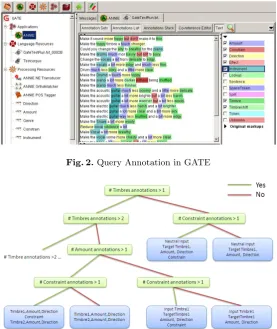
To extract the correct attribute values and their context from the natural language query we employ the GATE Architecture, i.e., a modified version of the ANNIE application3. To, for example, distinguish between a query with and without a constraint, we analysed the structure of a number of example queries with the use of the GATE Developer 7.0 GUI application, see Figure 2 for details. After designing the necessary specially built language processing resources, i.e., Gazetteers and Jape grammar rules, we modified the ANNIE Application to allow for the Annotation of the following term categories: amount, constraint, direction, effect, instrument, timbre and timbre-shift. By using these annotations we were able to analyse the query structure as the following figure demonstrates: The structural analysis of the queries enabled us to build a classification tree that represents typical semantics formulated in a certain type of query. In this way we can map the queries to reoccurring kinds of problem descriptions and set the values specified within the query to the correct attributes describing specific mixing tasks. Figure 3 shows a section of the classification tree.
The customised ANNIE is embedded in theAudio Advisor. The annotations generated by the customised ANNIE application are stored in an XML file that is then parsed to make the annotations available for the query assembly.
3
Fig. 2.Query Annotation in GATE
Fig. 3.Classification tree derived from query analysis (excerpt)
5.2 CBR Engine modelling
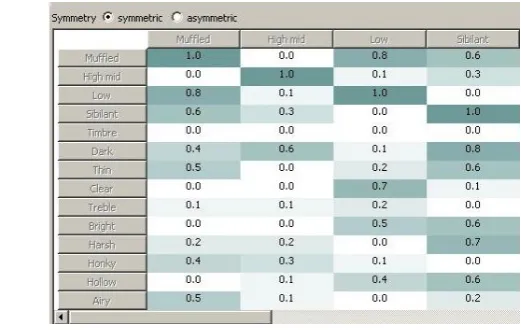
myCBR 34 provides the knowledge engineer with a variety of graphical user interfaces that allow for rapid prototyping of CBR knowledge models. We used myCBR 3 Workbench to swiftly transfer our initial knowledge model into a structured CBR knowledge model. Figure 4 provide an insight in the modelling of the local similarity measure for timbre descriptors. The first figure shows the taxonomic modelling on the left and a section from the same similarity measure being modelled in a comparative symbolic table on the right.
The problem description consists of two attributes, MainInputtimbre and SubInputtimbre1 describing the current sound. Additionally the problem de-scription contains the two Attributes MainTargettimbre and SubTargettimbre1 that are used to specify the timbres into witch the sound should be changed. The
4
Fig. 4.Timbre descriptor taxonomy
attributesTimbreAmountEffectDescriptor,AmountDirectionDescriptor and op-tionallyTimbreAmountPercentage are available for the Main as well as the Sub timbre. They are used to describe the amount of change that is intended to take place and its direction e.g. if the timbre should be increased or decreased. The last two attributes of our case structure are a String,WorkflowDescription, which holds a String that is describing the workflow necessary to achieve the desired timbre change described in the Problem description part. Additionally the Case holds the original natural language query on which it was modelled as a reference. Regarding our initial case base we were able to elicit 30 commonly encountered audio mixing tasks from our domain experts. Based on these 30 initial cases we conducted a series of retrieval tests together with our domain experts.
5.3 Audio Advisor at work
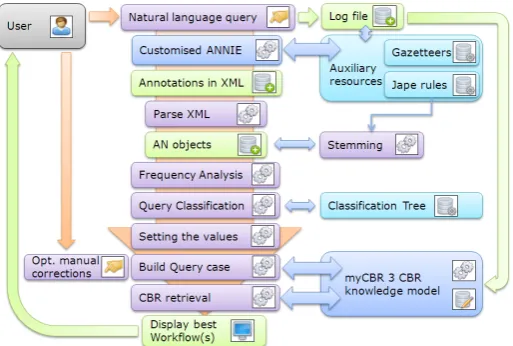
In the following we will give a brief overview over the process of recommending a mixing workflow byAudio Advisor (cf. Figure 5). Upon starting the application it initialises a new instance of the Gate framework using the GATE embedded functionalities. Into this instance the customised ANNIE Application is loaded and initialised Audio Advisor then uses themyCBR 3 API to initialise a new mycbr3 project. Loading the case base into the CBR project finishes the initial-isation sequence of theAudio Advisor and the program is ready to be used.
Fig. 5.Recommendation process diagram
descriptors, amount descriptors, timbreshifts, amount directions and constraints in an XML file, which is then read and unmarshalled by an instance of the QueryExtractor class. Within this class the annotations are analysed regarding the frequency of certain types of annotations, e.g. how many timbres are an-notated or if there are annotations present annotating a constraint. Based on this analysis the classifier tree is searched for a query structure best matching the query characteristics (annotation frequencies: Number of timbres, number of amount descriptors, presence of constraint annotations) to identify the most likely structure of the natural language input query. Based on the best identified query structure the drop down menus of identified attributes are populated with the extracted values. The user can always adjust the values manually and/or add additional values. By clicking the ’Recommend workflow’ button the user triggers the recommendation process.
The GUI of theAudio Advisoris quite straight forward (Figure 6). The upper part of the GUI provides all the elements necessary for a user to specify the audio mixing problem at hand. Additionally the user can select which amalgamation function should be used for retrieval. This allows retrieval of mixing tasks in the context of different genres. The query is then analysed and a workflow is recom-mended by a similarity based retrieval within the CBR Engine. The resulting order of best matching audio mixing workflows is then presented to the user in the lower section of the GUI.
6
Experiments and Evaluation
In this section we explain the aims and setup of the experiments we performed withAudio Advisor.
Fig. 6.Audio Advisor reading a natural language query containing a constraint
o A set of 39 timbre descriptors with varying grades of abstraction o A set of 21 amount descriptors
o A set of 15 Direction descriptors
o A set of 20 Effect descriptors with varying grades of abstraction
o Similarity of timbre descriptors in taxonomic and comparative table form o Similarity of amount descriptors in taxonomic and comparative table form o Similarity of amount descriptors as Integer function (distance function) o Similarity of Context of Genre in taxonomic form
o Similarity of Context of Instrument in taxonomic form o Similarity of the Effect descriptors in taxonomic form
o Global Similarities of the problem description of the mixing task depending on the selected Genre and Instrument context
o 30 Screenshots of application settings of the used mixing software o 30 initial cases describing 30 common mixing tasks
knowledge model. Our third goal was to establish the usability and applicabil-ity of our overall approach of workflow recommendation in day to day audio mixing work and teaching scenarios. Our fourth goal is it to establish if the use of taxonomies or the use of comparative symbolic tables yields more accurate similarity measures and thus better recommendations.
6.1 Setup of the Experiments
We performed two series of experiments. The first series aims at establishing the usability, quality of recommendation and performance of theAudio Advisor application in the day to day use of the software by experienced audio engineers. The second series of experiments aims at establishing the usability of theAudio Advisor application for teaching audio engineering students and gather feedback on the quality of the application’s recommendations.
At the current time we have conducted experiments from the first series and are currently preparing experiments for the second series. The setup for the first experiment was the following: Two experienced audio engineers were asked to use theAudio Advisor software to enter natural language queries into it describing common audio mixing tasks. The engineers were to provide feedback on the us-ability of the recommended workflows. They were also asked to provide feedback on the correctness of the similarity ordering or sequence of the 5 best matching cases that were retrieved. The data gathering for this experiment was accom-plished by logging the natural language queries the audio engineers entered into Audio Advisoras well as by providing the audio engineers with questionnaires to provide us with their feedback on Audio Advisor’s workflow recommendations. The questionnaire asked for the description of problems encountered with the retrieved workflow, for example, not being applicable for a certain instrument. Further the questionnaire asked for a rating of the quality, applicability of the recommended workflow ranging from 1 (worst) to 5 (best). The third informa-tion we gathered was the comparison of the case sequence retrieved to the case sequence deemed optimal by the audio engineers.
The second series of experiments will also use questionnaires to gather feed-back from audio engineering students. Students will bring in their own work, consisting of sound samples and songs which they still need to optimise and use theAudio Advisorapplication to get recommendation on how to do so. They will then employ these recommendations on their work (sounds) and rate the actual outcome with regard of the extent the sound has changed as it was intended by the student. Additionally the students are asked for feedback on how fast, in terms of iterations of: Entering query, retrieve workflow, apply workflow in studio, they deem a learning effect to set in. This estimated learning effect will be verified by audio engineering lecturers in the form of a small practical test.
6.2 Evaluation
Here are first results from our first series of experiments. Each audio engineer was asked to enter 10 queries and provide us with feedback on the applicability of the recommended workflow and the sequence of the first 5 most similar cases retrieved by the Audio Advisor. To provide an idea of what kind of natural languages queries were entered by the engineers here is a short excerpt from the actualAudio Advisor log file: ’Can you make the drums more toppy?, ’Make the drums more toppy.’, ’Change the bass to be more bassy but not toppy.’, ’Make the flute more airy but not breathy.’, ’The drums need to be way more heavy but not to boomy for a pop song.’
As stated before, the questionnaire we used, asked for the description of problems encountered with the retrieved workflow, for example, not being ap-plicable for a certain instrument. Further the questionnaire asked for a rating of the quality, applicability of the recommended workflow ranging from 1 (worst) to 5 (best). As an informal kind of feedback both engineers reported that if the recommendation was above their rating of 2 it usually was quite useful and perfectly applicable. The third information we gathered was the comparison of the case sequence retrieved to the case sequence deemed optimal by the audio engineers. Table 1 lists the aggregated feedback from both audio engineers with regard to the similarity of the best retrieved case to their query in per cent and the applicability of the recommended workflow:
Table 1.Ratings of results
Rating by Audio Engineer 1 Best Worst Average Match of query case to best retrieved case 95% 69% 79% Applicability of workflow [1:worst to 5:best] 4 1 2.7
Rating by Audio Engineer 2 Best Worst Average Match of query case to best retrieved case 98% 57% 77% Applicability of workflow [1:worst to 5:best] 4.5 1 2.13
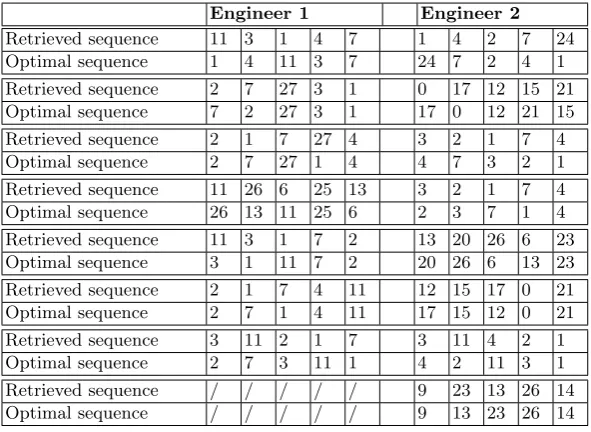
15 sequences are shown in the following table 2 displays the case sequences with the retrieved sequence in the top row and the engineers suggested optimal sequence in the lower row and starting with the best cases being on the left side of the table:
Table 2.Case retrieval sequence comparisons
Engineer 1 Engineer 2
Retrieved sequence 11 3 1 4 7 1 4 2 7 24
Optimal sequence 1 4 11 3 7 24 7 2 4 1
Retrieved sequence 2 7 27 3 1 0 17 12 15 21 Optimal sequence 7 2 27 3 1 17 0 12 21 15 Retrieved sequence 2 1 7 27 4 3 2 1 7 4
Optimal sequence 2 7 27 1 4 4 7 3 2 1
Retrieved sequence 11 26 6 25 13 3 2 1 7 4 Optimal sequence 26 13 11 25 6 2 3 7 1 4
Retrieved sequence 11 3 1 7 2 13 20 26 6 23 Optimal sequence 3 1 11 7 2 20 26 6 13 23 Retrieved sequence 2 1 7 4 11 12 15 17 0 21 Optimal sequence 2 7 1 4 11 17 15 12 0 21
Retrieved sequence 3 11 2 1 7 3 11 4 2 1
Optimal sequence 2 7 3 11 1 4 2 11 3 1
Retrieved sequence / / / / / 9 23 13 26 14 Optimal sequence / / / / / 9 13 23 26 14
7
Summary and Outlook
In this paper we presented our development of a case-based workflow recommen-dation system for audio engineering support. We detailed on the entire process of developing theAudio Advisor software. We described our approach to formalise the special vocabulary, consisting of vague descriptors for timbres, amounts and directions. We introduced CBR as a methodology to amend the problem of for-malising emotions and/or adjectives describing timbres, i.e., the problem of the vagueness of terms and the variance of emotions invoked by the same sound in different humans. We further detailed on our approach to design a Case-based reasoning knowledge model based on the elicited knowledge artefacts. We then described how we designed and implemented the Audio Advisor application. While doing so we inspected theGATEbased natural language processing abil-ity that we integrated intoAudio Advisor to enable it to process queries posted to it in natural language. We further detailed on the use ofmyCBR 3 to rapidly prototype and refine the CBR knowledge model that poses the reasoning com-ponent of the Audio Advisor. We finished this paper with an overview of our experiments with theAudio Advisorand an introduction to a first evaluation of the performance of the Audio Advisor and the quality of its recommendations which overall are very promising in both possible roles of theAudio Advisor as a support tool for professionals as well as a teaching aid to students.
For the imminent future we plan to refine our knowledge model further based on the evaluated data from the first series of experiments. The next step is the conduction of the teaching related experiments and the further refinement of the knowledge model as well as the GUI employed by Audio Advisor.
As a medium future aim we want to investigate the possibility and usefulness of using ‘negative similarity values’ of the timbre descriptors provided by the domain experts during the knowledge elicitation phase. We therefore want to integrate a negative similarity measure into our knowledge model and perform experiments to establish as this might be useful to be employed as adaptation knowledge as we already suggested in our initial study of the formalisation of knowledge from the audio mixing domain.
References
1. Aamodt, A.: Modeling the knowledge contents of CBR systems. In: Proceedings of the Workshop Program at the Fourth International Conference on Case-Based Reasoning. Citeseer (2001)
2. Aamodt, A., Plaza, E.: Case-based reasoning: Foundational issues, method-ological variations, and system approaches. AI Communications 1(7) (Mar 1994), ftp://ftp.ifi.ntnu.no/pub/Publikasjoner/vitenskaplige-artikler/ aicom-94.pdf; letzte Verifikation 11. Juni 2007
4. Arcos, J., De Mantaras, R., Serra, X.: Saxex: A case-based reasoning system for generating expressive musical performances*. Journal of New Music Research 27(3), 194–210 (1998)
5. Bergmann, R., et al.: On the use of taxonomies for representing case features and local similarity measures. In: Proceedings of the 6th German Workshop on Case-Based Reasoning. pp. 23–32 (1998)
6. Broekens, J., DeGroot, D.: Emotional agents need formal models of emotion. In: Proc. of the 16th Belgian-Dutch Conference on Artificial Intelligence. pp. 195–202 (2004)
7. Canamero, D., Arcos, J., de M´antaras, R.: Imitating human performances to au-tomatically generate expressive jazz ballads. In: Proceedings of the AISB99 Sym-posium on Imitation in Animals and Artifacts. pp. 115–20. Citeseer (1999) 8. Darke, G.: Assessment of timbre using verbal attributes. In: Conference on
Inter-disciplinary Musicology. Montreal, Quebec (2005)
9. Donnadieu, S.: Mental representation of the timbre of complex sounds. Analysis, Synthesis, and Perception of Musical Sounds pp. 272–319 (2007)
10. Fellous, J.: From human emotions to robot emotions. Architectures for Model-ing Emotion: Cross-Disciplinary Foundations, American Association for Artificial Intelligence pp. 39–46 (2004)
11. Halpern, A., Zatorre, R., Bouffard, M., Johnson, J.: Behavioral and neural corre-lates of perceived and imagined musical timbre. Neuropsychologia 42(9), 1281–1292 (2004)
12. Hudlicka, E.: What are we modeling when we model emotion. In: Proceedings of the AAAI spring symposium–Emotion, personality, and social behavior (2008) 13. Katz, B., Katz, R.: Mastering audio: the art and the science. Focal Press (2007) 14. de M´antaras, R.L.: Towards artificial creativity: Examples of some applications of
AI to music performance. 50 Anos de la Inteligencia Artificial p. 43 (2007) 15. de Mantaras, R.: Making music with AI: Some examples. In: Proceeding of the 2006
conference on Rob Milne: A Tribute to a Pioneering AI Scientist, Entrepreneur and Mountaineer. pp. 90–100 (2006)
16. de Mantaras, R., Arcos, J.: AI and music: From composition to expressive perfor-mance. AI magazine 23(3), 43 (2002)
17. Pitt, M.: Evidence for a central representation of instrument timbre. Attention, Perception, & Psychophysics 57(1), 43–55 (1995)
18. Plaza, E., Arcos, J.: Constructive adaptation. Advances in Case-Based Reasoning pp. 306–320 (2002)
19. Sauer, C., Roth-Berghofer, T.: Web community knowledge extraction for myCBR 3. In: Research and Development in Intelligent Systems XXVIII: Incorporating Applications and Innovations in Intelligent Systems XIX Proceedings of AI-2011, the Thirty-first SGAI International Conference on Innovative Techniques and Ap-plications of Artificial Intelligence. p. 239. Springer (2011)
20. Sauer, C., Roth-Berghofer, T., Auricchio, N., Proctor, S.: Similarity knowledge formalisation for audio engineering. In: Petridis, M. (ed.) Proceedings of the 17th UK Workshop pn Case-Based Reasoning. pp. 03–14. University of Brighton (2012) 21. Typke, R., Wiering, F., Veltkamp, R.: A survey of music information retrieval
systems (2005)
22. Watson, I.: Case-based reasoning is a methodology not a technology. Knowledge-Based Systems 12(5), 303–308 (1999)