Active Prior Tactile Knowledge Transfer for Learning
2Tactual Properties of New Objects
3Di Feng, Mohsen Kaboli∗and Gordon Cheng 4
Institute for Cognitive Systems (ICS), Technische Universität München, Arcisstrasse 21, 5
80333 München, Germany 6
* Correspondence: [email protected] 7
8
Abstract: Reusing the tactile knowledge of some previously-explored objects helps us to easily 9
recognize the tactual properties of new objects. In this paper, we enable a robotic arm equipped 10
with multi-modal artificial skin, like humans, to actively transfer the prior tactile exploratory action 11
experiences when it learns the detailed physical properties of new objects. These experiences, or prior 12
tactile knowledge, are built by the feature observations that the robot perceives from multiple sensory 13
modalities, when it applies the pressing, sliding, and static contact movements on objects with 14
different action parameters. We call our method Active Prior Tactile Knowledge Transfer (APTKT), 15
and systematically evaluated its performance by several experiments. Results show that the robot 16
improved the discrimination accuracy by around 10% when it used only one training sample plus 17
the feature observations of prior objects. By incorporating the auxiliary features, the transfer learning 18
improved the discrimination accuracy by over 20%. The results also show that the proposed method 19
is robust against transferring irrelevant prior tactile knowledge (negative knowledge transfer). 20
Keywords:tactile sensing; artificial robotic skin; active tactile object perception; active tactile object 21
learning; active tactile transfer learning 22
1. Introduction 23
1.1. Motivation 24
We humans perceive tactual properties of an object (e.g. stiffness, textures, temperature, weight) 25
by applying exploratory actions (e.g. pressing, sliding, static contact, lifting). After applying different 26
exploratory actions on an object, we can attain its different tactile information. Conversely, making 27
the same exploratory action on different objects will produce different tactile observations. Therefore, 28
when we learn about an object, we always link its physical properties with the exploratory actions that 29
we apply on it. 30
Besides different kinds of exploratory actions, the tactile information we perceive from an object is 31
also dependent on how we apply an action. Consider an example of pressing on two objects. The object 32
1 is made of soft sponge, and the object 2 is made by covering a soft sponge surface on a solid metal. 33
When pressing our fingertips on both objects with a small normal force, we can recognize similar 34
object deformations. However, if we press with a larger normal force, object 1 deforms much more 35
than object 2, since we have reached the metal part in object 2. A similar situation can also be found 36
when we apply the sliding movement on the object surfaces with different forces and velocities. As a 37
result, by applying different exploratory actions in different ways, we can build adetailedknowledge
38
of the object tactual properties which we call tactile exploratory action experiences. 39
Prior tactile knowledge
Pressing (P)
…
…
Sliding (S)
…
…
…
Static contact (C)
…
…
Prior objects
#1
#2
#3
#4
#5
#6
#7
#8
#9
#10
Metal toolbox Icetea bottle Detergent bottle Glass plate Alcohol bottle
Smooth sponge Hard box Ice cream box Bamboo box Fish can
New objects
#1
#2
#3
#4
#5
Chocolate box Biscuit box Cardboard box Rough sponge Paper box
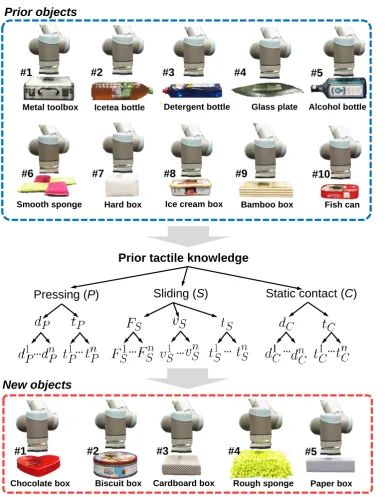
Figure 1.The robot leverages the prior tactile exploratory action experiences built by applying the pressing, sliding, and static contact movements with different action parameters on the old objects (with index #1 - #10) to learn about new objects (with index #1 - #5) physical properties. The feature observations of prior objects (prior tactile instance knowledge) were used to transfer the action experiences.
We humans learn about new objects in an active and incremental way. We actively select the most 40
informative exploratory actions to interact with them. More importantly, we relate these new objects 41
with the experiences of exploring the objects that we have previously encountered. By transferring 42
the prior tactile knowledge, or prior tactile exploratory action experiences, we can largely reduce the 43
amount of exploratory actions required to discriminate among new objects. In this way, we humans 44
Can robotic systems with a sense of touch also performs like humans to actively transfer the past 46
tactile exploratory action experiences when learning about new objects (transfer learning)? 47
1.2. Background 48
Over the past decades, researchers have developed various tactile sensors and mounted them on 49
robotic systems (e.g. [1–6]). In this way, the robots with a sense of touch can perceive different object
50
tactual properties by applying exploratory actions. For example, a robot can slide its sensory parts on 51
objects to sense their textural properties [7–9], build a static contact to perceive the temperature [10], or
52
lift objects to obtain their center of mass [11]. Furthermore, several methods has been proposed for the
53
active object exploration problem, in which the robot actively applies multiple exploratory actions to 54
discriminate among objects (e.g. [12–17]).
55
However, The problem of transferring the robotic prior tactile knowledge has been rarely 56
investigated. Even though many transfer learning techniques has been successfully applied to various 57
areas (e.g. Natural Language Processing: [18]; WiFi-based localization: [19]; Computer Vision: [20–22];
58
Bio-informatics: [23]), it was our works that introduced tactile transfer learning. Previously, Kaboli
59
et al. [24] developed a novel textural descriptor. Using the descriptor, a ShadowHand dexterous 60
robotic hand equipped with BioTac sensors on its fingertips could efficiently discriminate among object 61
surface textures. Later, we designed a transfer learning method [25] so that the robotic hand could
62
reuse the prior texture models from 12 objects to learn 10 new object textures. However, since only the 63
sliding movement was applied, the robot could only transfer the object textural properties. In a later 64
work [26], we proposed an active learning method that an UR10 robotic arm with an artificial skin
65
on its end-effector could not only apply sliding movement, but also apply pressing and static contact 66
movements on objects to learn about their different physical properties (surface texture, stiffness, and 67
thermal conductivity). Even though our active learning method enables the robot to efficiently learn 68
about objects, the robot still needs to learn from scratch given a new set of objects. In this regard, 69
recently we proposed an algorithm called Active Tactile Transfer Learning (ATTL) [27] to actively
70
transfer the knowledge of multiple physical properties from prior objects. Using ATTL, the UR10 71
robotic arm could actively select prior knowledge of different object physical properties (surface texture, 72
stiffness, and thermal conductivity by applying sliding, pressing, and static contact movements) to 73
transfer. As a result, the robot could use less training samples to achieve higher recognition rate, when 74
it learned about new objects. 75
The robotic systems in the above-mentioned works only applied exploratory actions with fixed 76
action parameters, e.g. sliding with a fixed velocity to perceive surface textures. Therefore, the robots 77
can only transfer limited prior tactile knowledge and learn the coarse physical properties of new 78
objects. In order to learn objects’detailedphysical properties so as to better discriminate among objects,
79
the robots should be able to apply an exploratory action in different ways, similar to us humans. 80
1.3. Contribution 81
In this paper, we focus on actively transferring the prior tactile exploratory action experiences to 82
learn the detailed physical properties of new objects. Our contributions are two-folds: 83
• We enable a robot to apply more exploratory actions with various action parameters. In this way, 84
the robot gains a more detailed object tactile knowledge. 85
• We propose a tactile transfer learning algorithm so that the robot actively leverages the detailed 86
tactile knowledge of some previously-explored objects (i.e. prior tactile exploratory action 87
experiences), when it learns about new objects. The feature observations of prior objects are 88
transferred, which are perceived from multiple sensory modalities. 89
In the sequel, we first introduce the robotic system (Sec.2). Then, we illustrate how the robot
90
applies exploratory actions and obtain the physical properties of objects (Sec.3). Afterwards, we
91
illustrate our proposed tactile transfer learning in detail (Sec.4), followed by a systematic evaluation
Table 1.Technical information of sensors in the artificial skin ([7]).
Type Sensor Range Accuracy Resolution
Proximity VCNL4010 200mm N.A. 0.25lx
Acceleration BMA250 ±2g 256LSB/g 3.91 mg Temperature LM71 −40 −150◦C ±1.5◦C 31.25m◦C Normal force customized >10N 0.05N N.A.
(a) Robotic system
UR 10
Accelerometer Normal force sensors
Proximity sensor
Temperature sensor
Front side
Four ports (b) HEX-O-SKIN
Back side Multi-modal
artificial skin
Figure 2. (a): The UR10 robotic arm equipped with a multi-modal artificial skin.(b): The HEX-O-SKIN (skincell) in the artificial skin.
of the method (Sec.5). We finalize this paper with a conclusion and a discussion about future works
93
(Sec.6).
94
2. System Description 95
2.1. Multi-modal Artificial Skin 96
To enable the robot to perform more human-like behaviours with different tactile sensing 97
modalities, we designed and manufactured multi-modal artificial skin (Fig.2(a)) made by seven
98
active tactile modules called “HEX-O-SKIN" (Fig.2(b)) [1]. Each module is a small hexagonal printed
99
circuit board equipped with off-the-shelf sensors (one temperature sensor, one accelerometer, three 100
normal force sensors, and one proximity sensor). In this way, robots equipped with this artificial skin 101
with seven temperature sensors, seven accelerometers, 21 normal force sensors, and seven proximity 102
sensors can emulate the human tactile sensing about temperature, vibrations, force, and light touch. 103
Their technical information is summarized in Tab.1.
104
2.2. UR10 Robotic Arm 105
We mounted the multi-modal artificial skin on the end-effector of an Universal Robotic Arm 106
(UR10) with six DoF (Fig.2(a)). The UR10 was controlled in collaboration with the aritificial skin in
107
(a) Pressing (b) Sliding (c) Static contact
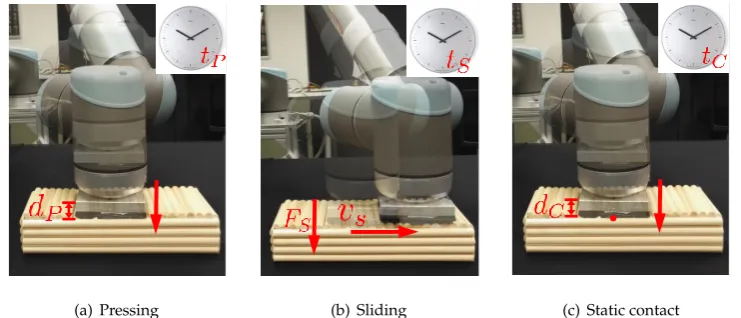
Figure 3.Visualization of the exploratory actions.(a): The pressing movement defined by the action parametersdPandtP.(b): The sliding movement with action parametersvS,FS, andtS.(c): The static contact movement defined bydCandtC.
3. Exploratory Actions and Perception 109
3.1. Exploratory Actions Definition 110
By applying exploratory actions on objects with different action parameters, the robot can attain 111
different feature observations. In this work, we consider three types of exploratory actions:pressing
112
(denoted asP),sliding(denoted asS), andstatic contact(denoted asC). Formally, we defineNanumber
113
of exploratory actions asA={αθnn}nN=α1, whereθnis the action parameters that define “how" the robot
114
can apply the exploratory action. We further defineθn∈ {θP,θS,θC}, whereθP,θS, andθCrepresent
115
the action parameters for the pressing, sliding, and static contact movements respectively. 116
3.1.1. Pressing 117
The robotic system presses its sensory part on the object surfaces in order to perceive its stiffness. 118
The pressing movement consists of pressing until a depth ofdPand holding the artificial skin fortP
119
seconds, i.e.θP= [dP,tP]. During the pressing, the multi-modal artificial skin can record the normal
120
force feedbacks from each normal force sensor:Fnf,ns ={Fnmf,ns}
tP·fs
m=1in order to measure the object
121
stiffness, whereNf is the number of normal force sensors in one skincell (in our caseNf = 3), and
122
Nsis the number of skincells in the artificial skin (in our caseNs =7). Moreover, it can record the
123
temperature feedbacks from each temperature sensor for the purpose of attaining the object thermal 124
conductivity:Tnt,ns ={Tnmt,ns}
tP·fs
m=1,nt=1, ...,Nt, withNtbeing the number of temperature sensors in
125
one skincell (in our caseNt=1). fsis the sampling rate of the artificial skin, andmthe sampling time
126 step. 127
3.1.2. Sliding 128
The robot slides the artificial skin on the object surface and perceives its textural properties. 129
To do this, the robot first builds a contact with objects with the normal force of FS, then it linearly
130
slides on the objects with a speed ofvS fortS seconds,θS = [FS,vS,tS]. During sliding, the robot
131
collects the outputs of accelerometers (in three axes:x,y,z):an(xa),ns ={a
(x),m na,ns}
tS·fs
m=1,a (y)
na,ns ={a
(y),m na,ns}
tS·fs
m=1, 132
a(nza),ns ={a
(z),m na,ns}
tS·fs
m=1. Then the robot combines these signals together:a={ana,ns}
Na,Ns
na=1,ns=1;ana,ns = 133
[a(nxa),ns,a
(y)
na,ns,a
(z)
na,ns],na=1, ...,Na, whereNais the number of accelerometers in one skincell (in our case
134
Na=1). Besides, the change of temperature during sliding is also collected as an extra information
135
Tnt,ns ={Tnmt,ns}
tS·fs
Table 2.Exploratory actions And Perception
Exploratory actions
Action Parameters (
θ
)
Sensory feedbacks
Features
Pressing
d
P,
t
PF
,
T
F
¯
,
[
T
¯
,
∇
T
¯
]
Sliding
F
S,
t
S,
v
Sa
,
T
TD
,
[
T
¯
,
∇
T
¯
]
Static contact
d
C,
t
CF
,
T
F
¯
,
[
T
¯
,
∇
T
¯
]
3.1.3. Static Contact 137
The object thermal cues can be attained by the robotic system by applying static contact movement: 138
the robot presses its sensory part against the object surface until a depth ofdC and maintains the
139
contact fortCseconds, i.e.θC= [dC,tC]. The normal force feedbacks and temperature feedbacks are
140
recorded:Fnf,ns ={Fnmf,ns}
tC·fs
m=1,Tnt,ns ={Tnmt,ns}
tC·fs
m=1. 141
3.2. Object Physical Properties Perception 142
3.2.1. Stiffness 143
We use the normal force averaged over all normal force sensors and time steps as an indicator for 144
the object stiffness. For the pressing movement with pressing time stepstP· fs, object stiffness can be
145
estimated by ¯F= t1
P·fs 1
Nf N1s ∑
tP·fs
m=1∑
Nf
nf=1∑
Ns
ns=1F
m nf,ns. 146
3.2.2. Textural Property 147
In this work, we use the same textural feature extraction method in [26]: The vibration signals
148
ain the artificial skin are used to calculate the activity, mobility and complexity, denoted as A(a),
149
M(a), C(a). We also computed the linear correlation of accelerometer signals between different
150
directions (xy,yz,xz) denoted as L(a). The final descriptor of textural features combines activity,
151
mobility, complexity and linear correlation together [26]:TD= [A(a),M(a),C(a),L(a)].
152
3.2.3. Thermal Conductivity 153
To extract the features that describe the object thermal cues, we first calculate the average 154
temperature sequence from all the temperature sensors: ¯T=∑Nt
nt=1∑
Ns
ns=1
Tnt,ns
Nt·Ns. We then calculate its
155
gradient at each time step as: ∇T¯, and combine it with the average temperature sequence:[T¯,∇T¯].
156
To avoid curse of dimensionality, we further reduce this combination to ten dimensions via Principle 157
Component Analysis (PCA) method and use it as the final feature to describe the object thermal 158
conductivity. 159
Tab2. summarizes the exploratory actions, the sensory feedbacks and the corresponding tactile
160
features. 161
4. Transferring Prior Tactile Exploratory Action Experiences 162
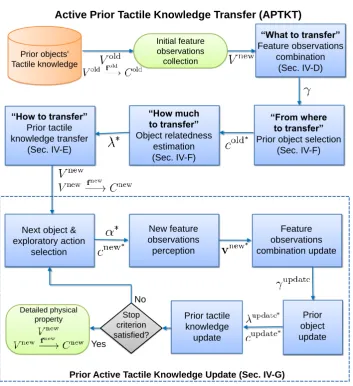
This section describes our proposed transfer learning method (APTKT) in detail. First, we 163
formulate our problem in Sec.4.1. Then, we illustrate our transfer learning method, including its
164
process (Sec.4.3), what to transfer (Sec.4.4), how to transfer (Sec.4.5), from where to transfer, and how
165
much to transfer (Sec.4.6). The motivation of our method is demonstrated in Fig.1.
166
4.1. Problem Formulation 167
Assume that a robotic system has gained prior tactile knowledge of someoldobjects, on which
168
the robot has previously applied different exploratory actions with different action parameters. These 169
sensors and observation models from the old objects. Now, the robot is tasked to learn about a set of 171
newobjects. Since the old objects might share some similar physical properties with the new objects,
172
by leveraging the related tactile exploratory action experiences, the robot can learn about new objects 173
more efficiently. 174
We defineNnewnumber of new objects (Cnew = {cnewj }Nj=new1 ) the robot is tasked to efficiently
175
learn about through different exploratory actionsA={αθnn}nN=α1(For simplicity, we will denoteαas
176
an exploratory action in the rest of the paper). In other words, the robot should actively attain object 177
feature observations (Vnew
α = {V
new
c1 ,V new
c2 , ...,V
new
cNnew}) for each exploratory actionαand construct
178
reliable observation modelsVαnew
fnew
α
−−→Cnew. We further define the robot prior tactile experience for
179
an exploratory actionαforNoldnumber of prior objects (Cold={coldi }
Nold
i=1) as the prior object feature
180
observations (Vold
α ={voldc1 ,V old
c2 , ...,V
old
cNold}) and the observation models of old objectsV
old α
foldα
−−→Cold. 181
These feature observations are collected by the multiple tactile sensors from the artificial robotic skin. 182
We formulate our problem as the transfer learning in the Gaussian Process Classification (GPC) 183
framework [28], where each object is regarded as a class, and for each exploratory action, a GPC model
184
is built as the observation model. The robot iteratively applies the exploratory actions and leverages 185
prior tactile knowledge to improve the GPC observation models of new objects. 186
187
4.2. Gaussian Process Classification 188
The Gaussian Process Classification (GPC) model describes the mapping between the observation 189
setX and the output setY by: X −→f Y. The latent function g(x)in the GPC model is assumed
190
to be sampled from a high-dimensional gaussian distribution called GP prior [28]: g(x) ∼
191
GP(m(x),K(x,x0)), where each sampleg(xi)is a random variable. In this work, we use one-vs-all
192
multi-class classification. For each object class, a binary GPC whose output label is converted to 193
{−1,+1}is trained for each of the Nlabels: fn(·). Given a new samplex∗, each binary classifier
194
predicts the observation probability of its labelp(yn|x∗). The sample is assigned to the class with the
195
largest prediction probabilityy∗=arg maxyn∈Y p(yn|x
∗).
196
4.3. Process 197
The robot following our proposed method first applies each exploratory action one time on each 198
new object, in order to collect a small number of feature observationsVnew = {Vαnewn }
Nα
n=1(Initial
199
data collection). Then, the robot reuses its prior tactile exploratory action experiences to improve the 200
observation models foreachnew object (Initial prior knowledge transfer). During this process, the
201
robot compares the relatedness between its prior tactile exploratory action experiences and the new 202
objects (Sec.4.6), and chooses the most related one to transfer the old object feature observationsVold
203
(Sec.4.5). Afterwards, the robot begins to iteratively collect and combine the feature observations and
204
update the prior tactile knowledge in order to improve the observation models. At each iteration of 205
prior tactile knowledge updating, the robot (1) actively selects the next object and the next exploratory 206
action in order to attain a new feature observation, and (2) updates the prior tactile knowledgeonly
207
for the selected exploratory action. The iteration terminates when there is no improvement in the 208
observation models of new objects. Our algorithm is demonstrated by Fig.4.
209
4.4. What to Transfer 210
When the robotic system applies an exploratory action on objects, it perceives multiple feature 211
observations (e.g. by the pressing movement, the robot can perceive the object stiffness and thermal 212
conductivity). The prior tactile exploratory action experiences are built using the prior objects feature 213
observations from multiple sensory modalities that are combined together and the corresponding GPC 214
Active Prior Tactile Knowledge Transfer (APTKT)
“What to transfer” Feature observations
combination (Sec. IV-D)
“From where to transfer” Prior object selection
(Sec. IV-F) “How much
to transfer” Object relatedness
estimation (Sec. IV-F) “How to transfer”
Prior tactile knowledge transfer
(Sec. IV-E)
Stop criterion satisfied?
Detailed physical property
No
Yes Next object & exploratory action
selection
Prior object update Initial feature
observations collection
New feature observations perception
Feature observations combination update
Prior tactile knowledge
update
Prior Active Tactile Knowledge Update (Sec. IV-G) Prior objects'
Tactile knowledge
Figure 4.Flowchart of the Active Prior Tactile Knowledge Transfer algorithm.
In order to combine the observations perceived from different tactile sensors, we first define
vα as the feature observation of an exploratory actionα. It is comprised of multiple observations:
vα = [v (1)
α , ...,v
(mα)
α , ...,v
(Mα)
α ], wherev
(mα)
α is an observation from the sensor modality mα. For the
pressing and static contact movements, we use the normal force and temperature sensing, for the
sliding movement the accelerometer and temperature sensing (Tab.2). Then, we assume that for a
sensor modalitymα, a kernel functionK(mα)is given. To combine multiple feature observations so as
to exploit the information from all sensors after applying the exploratory actionα, we linearly combine
the kernels:
Kα0 =γ (1) α K
(1)+...+ γ(αmα)K
(mα)+...+γ(Mα)
α K
(Mα) (1)
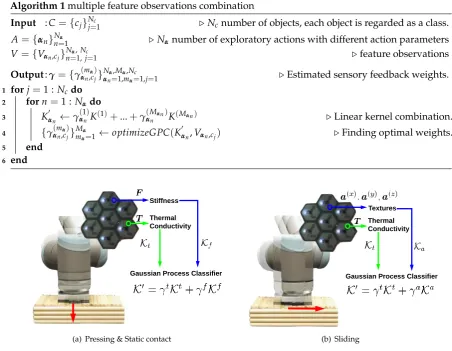
where γ(αmα) ≥ 0. This hyper-parameter controls how much the robot can rely on the sensor
216
modality mα. It ranges between 0 and 1, with γα(mα) = 0 indicating that the sensor feedback is
217
not informative, andγ(αmα)=1 highly useful. We further constrain these hyper-parameters withL1
218
norm:|∑Mα
mα=1γ
(mα)
α |=1. For each exploratory action, a GPC observation model is built usingK
0. The
219
hyper-parameters ofγand kernels are selected by maximizing the log marginal likelihood [28]. Fig.5
220
illustrates our multiple feature observations combination method. It is also demonstrated by Alg.1.
Algorithm 1multiple feature observations combination
Input :C={cj}jN=c1 .Ncnumber of objects, each object is regarded as a class.
A={αn}Nn=α1 .Nαnumber of exploratory actions with different action parameters
V={Vαn,cj}
Nα,Nc
n=1,j=1 .feature observations
Output:γ={γ(αmn,αc)j}
Nα,Mα,Nc
αn=1,mα=1,j=1 .Estimated sensory feedback weights.
1 forj=1 :Ncdo 2 forn=1 :Nαdo
3 K
0 αn ←γ
(1) αnK
(1)+...+
γ(αMnαn)K
(Mαn) .Linear kernel combination.
4 {γα(mn,αc)j}
Mα
mα=1←optimizeGPC(K
0
αn,Vαn,cj) .Finding optimal weights.
5 end
6 end
Gaussian Process Classifier Stiffness
Thermal Conductivity
(a) Pressing & Static contact
Textures Thermal Conductivity
Gaussian Process Classifier
(b) Sliding
Figure 5.Illustration of multiple feature observations combination method.(a)The robotic system combines the normal force sensing and temperature sensing to learn about objects by applying pressing and static contact movements.(b)The robot slides on the object surface to sense its textural property and thermal conductivity.
4.5. How to Transfer 222
We now describe how the robotic system transfers the feature observations of a prior objectcoldi
to learn the GPC observation model of a new objectcnewj , based on an exploratory actionff. For
simplicity, we hereby refer toiandjascoldi andcnewj , respectively. We definegoldi as the Gaussian
Process latent function values [28] for the old objectcoldi andgnewj for the new objectcnewj . We assume
that these two function values are not independent from each other, but are sampled together over a dependent Gaussian Prior (GP). This dependent GP is then used to construct the GPC observation
model of the new object. The latent function can be modified accordingly:gnewj 0 ←[goldi ,gnewj ]. We
further incorporate the relatedness between prior object and new object into the dependent GP model by introducing the following dependent kernel function:
K0=
"
K(Viold,Viold) λK(Viold,Vjnew) λK(Vjnew,Viold) K(Vjnew,Vjnew) #
(2)
K(·,·) serves as the basic kernel function that measures the similarity between two feature
223
observations that belong to the old object and the new object, respectively. λK(·,·)measures the
224
feature observations between the old object and the new object.λcontrols the relatedness between
10 20 30 40 50
# feature observations
0.3 0.5 0.7 0.9
Discrimination accuracy
P1
STIF Thermal-C Multi
10 20 30 40 50
# feature observations
0.4 0.6 0.8 1.0
Discrimination accuracy
P2
STIF Thermal-C Multi
10 20 30 40 50
# feature observations
0.35 0.45 0.55 0.65 0.75
Discrimination accuracy
C1
STIF Thermal-C Multi
10 20 30 40 50
# feature observations
0.35 0.45 0.55 0.65 0.75
Discrimination accuracy
S1
Texture Thermal-C Multi
10 20 30 40 50
# feature observations
0.2 0.4 0.6 0.8 1.0
Discrimination accuracy
S2
Texture Thermal-C Multi
10 20 30 40 50
# feature observations
0.3 0.5 0.7 0.9
Discrimination accuracy
S3
Texture Thermal-C Multi
10 20 30 40 50
# feature observations
0.2 0.4 0.6 0.8 1.0
Discrimination accuracy
S4
Texture Thermal-C Multi
10 20 30 40 50
# feature observations
0.3 0.4 0.5 0.6 0.7 0.8 0.9
Discrimination accuracy
Average
Feature 1 Feature 2 Multi
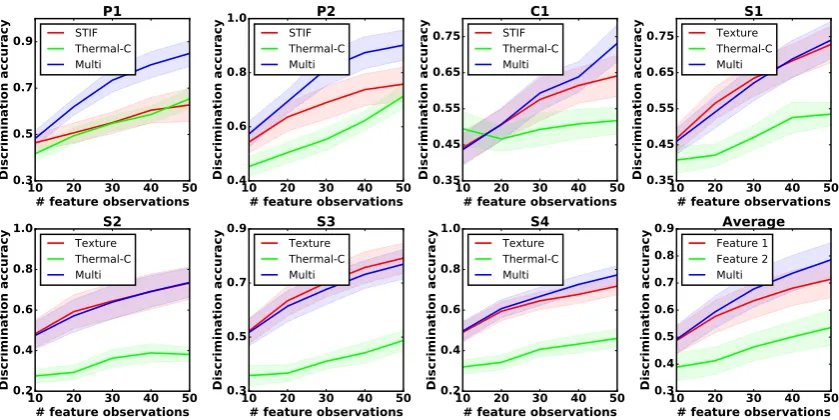
Figure 6.Multiple feature observations combination results for exploratory actionsP1,P2,C1,S1,S2, S3,S4 and the averaged result. STIF: building the GPC observation model based on object stiffness; Thermal-C: thermal conductivity; Texture: object surface textural properties; Multi: combined feature observations. The horizontal axis represents the number of feature observations. The vertical axis represents the discrimination accuracy of the test dataset.
cold
i andcnewj . We constrain its range within[0, 1]. As Chaiet al.[29] evaluated,λ=0 indicates that the
226
old object and the new object are not related, whileλ=1 indicates that the two objects are the same.
227
4.6. From Where and How Much to Transfer 228
Sec.4.5describes how to transfer the prior tactile knowledge to learn about new objects. This
section illustrates how the robotic system selects the most related old object (from where to transfer) and how to determine the relatedness (λ) between two objects (how much to transfer). To do this, we
take advantage of the prediction from the GPC observation models of old objects. Letp(coldi |vnewj )be
the prediction probability that a feature observation from the new objectvnewj is assigned to the old
objectcold
i . We measure the average prediction to all the observationsvnewj ∈Vjnewthat belong to the
new object: ¯p(coldi |Vjnew) = Nnew1
j ∑p(c old
i |vnewj ), withNjnewbeing the number of new object feature
observations. This average prediction value indicates the similarity between the old objectcoldi and the
new objectcnewj . A larger value indicates that these two objects are highly similar. Therefore, we can
use it to select the most related old object (denoted ascold∗) for a new object regarding the exploratory
actionff. Furthermore, to avoid transferring irrelevant tactile information, we add a thresholdeneg
which prevents the robot from selecting any old object when the prediction value is smaller thaneneg.
The final old object selection criterion is:
cold∗=
arg max cold
i ∈Cold
¯ p(cold
i |Vjnew), if ¯p(cold ∗
|Vnew
j )≥eneg
None, otherwise
(3)
Once we selectcold∗, we further use the predictions from the observation model of old objects to
229
determineλ∗:λ∗ =p¯(cold
∗
|Vnew). 230
1 10 20 30 40 # training samples 0.36
0.50 0.66
Discrimination accuracy
[1, 3, 9]
With transfer No transfer
1 10 20 30 40 # training samples 0.36
0.50 0.66
Discrimination accuracy
[3, 8, 1]
With transfer No transfer
1 10 20 30 40 # training samples 0.36
0.50 0.66
Discrimination accuracy
[3, 10, 2]
With transfer No transfer
1 10 20 30 40 # training samples 0.36
0.50 0.66
Discrimination accuracy
[5, 8, 1]
With transfer No transfer
1 10 20 30 40 # training samples 0.36
0.50 0.66
Discrimination accuracy
[7, 6, 10]
With transfer No transfer
1 10 20 30 40 # training samples 0.36
0.50 0.66
Discrimination accuracy
[7, 9, 3]
With transfer No transfer
1 10 20 30 40 # training samples 0.36
0.50 0.66
Discrimination accuracy
[7, 10, 1]
With transfer No transfer
1 10 20 30 40 # training samples 0.36
0.50 0.66
Discrimination accuracy
[9, 1, 5]
With transfer No transfer
1 10 20 30 40 # training samples 0.36
0.50 0.66
Discrimination accuracy
[9, 4, 7]
With transfer No transfer
1 10 20 30 40 # training samples 0.36
0.50 0.66
Discrimination accuracy
[10, 6, 3]
With transfer No transfer
1 5
10 15 20 25 30 35 40
# training samples
0.35
0.40
0.45
0.50
0.55
0.60
0.65
0.70
Discrimination accuracy
Average
With transfer
No transfer
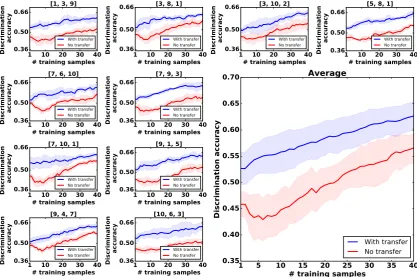
Figure 7.Transferring the exploratory actions experiences from three old objects. The small plots show the learning process from 10 groups of old objects. The large plot on the right shows the averaged results. Horizontal axis: the growing number of feature observations the robot collected. Vertical axis: the discrimination accuracy of the test dataset.
4.7. Evaluation of Multiple Feature Observations Combination Method 232
4.8. Prior Exploratory Action Experiences Update 233
When the robot updates its prior exploratory action experiences, it needs to iteratively collect 234
a new feature observation by applying an exploratory action on an object. We use the Active Touch 235
for Learning Physical Properties (AT-LPP) algorithm proposed in [26] so that the robot actively
236
decides which new object to explore next (denoted ascnew∗) and which exploratory action to apply
237
next (denoted asff∗). Once the robot collects a new feature observation, it updates the prior tactile
238
exploratory action experiences only from action ff∗. This process includes updating the feature
239
observation combination, updating the object relatedness λ, and transferring these prior feature
240
observations to the observation models of new objects. 241
5. Experimental Results 242
5.1. Experimental Objects 243
In order to evaluate the performance of APTKT, we deliberately selected 10 daily objects 244
with different physical properties which served to build the robotic prior tactile exploratory action 245
experiences (see Fig.1Prior objects). Furthermore, we selected five new objects about which the robotic
246
system was tasked to learn (Fig.1New objects). For each new object, there existed one or more old
247
objects that shared similar physical properties. For example, both rough sponge and smooth sponge 248
1 5 10 15 20 # training samples 0.3
0.4 0.5 0.6 0.7 0.8 0.9
Discrimination accuracy
P1
With transfer
No transfer
1 5 10 15 20
# training samples 0.3
0.4 0.5 0.6 0.7 0.8 0.9
Discrimination accuracy
P2
With transfer
No transfer
1 5 10 15 20
# training samples 0.2
0.3 0.4 0.5 0.6 0.7 0.8 0.9
Discrimination accuracy
C1
With transfer
No transfer
1 5 10 15 20
# training samples 0.30
0.35 0.40 0.45 0.50 0.55 0.60 0.65
Discrimination accuracy
S1
With transfer
No transfer
1 5 10 15 20
# training samples 0.30
0.35 0.40 0.45 0.50 0.55 0.60 0.65 0.70 0.75
Discrimination accuracy
S2
With transfer
No transfer
1 5 10 15 20
# training samples 0.40
0.45 0.50 0.55 0.60 0.65 0.70
Discrimination accuracy
S3
With transfer
No transfer
1 5 10 15 20
# training samples 0.25
0.30 0.35 0.40 0.45 0.50 0.55 0.60 0.65
Discrimination accuracy
S4
With transfer
No transfer
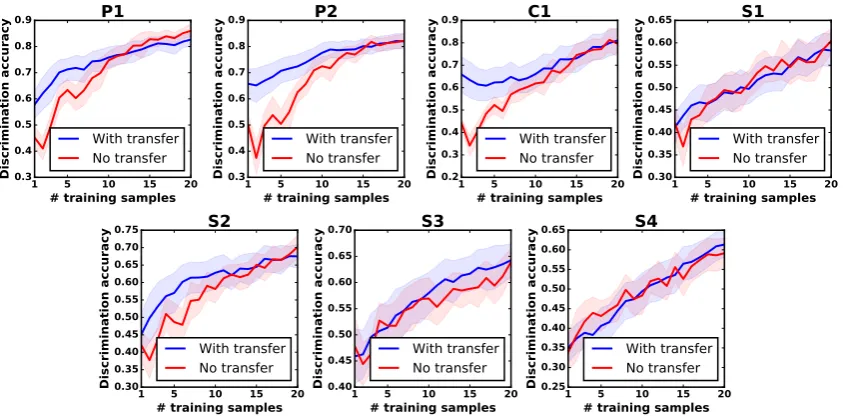
Figure 8.Transfer learning using only one exploratory action.
thermal conductivity. In this way, when learning about new objects based on their physical properties, 250
the robot can leverage the related prior tactile instance knowledge. 251
5.2. Exploratory Action Determination and Test Data Collection 252
In our experiment, we defined seven exploratory actions from the pressing, sliding, and static 253
contact movements with various action parameters (Pressing:P1,dP =1 mm,tP =3 s;P2,dP=2
254
mm,tP =3 s. Sliding: S1,FS =0.1 N,tS =5 svS = 1 cm/s;S2,FS = 0.1 N,tS =1 s,vS = 5 cm/s;
255
S3, FS = 0.2 N,tS = 5 s,vS = 1 cm/s; S4, FS = 0.2 N,tS = 1 s,vS = 5 cm/s. Static Contact: C1,
256
dC=2 mm,tC=15 s). Before applying any of the 7 exploratory actions, the robot established light
257
contact with the objects which, detected once the total normal force on the the artificial skin increased 258
above 0.05 N. Furthermore, after applying an exploratory action, the robot was controlled to raise its 259
end-effector for 30 s such that the temperature sensors could be restored to the ambient temperature. 260
We evaluated the performance of our proposed method based on a test dataset built by the robot 261
by applying each actions 20 times on each object. During this process, objects were manually shifted 262
and rotated so that the data was robust against the variations in the object contact locations with the 263
artificial skin. 264
We first evaluated the performance of our proposed robotic multiple feature observation 265
combination algorithm. To do this, the robot selected 10 groups of objects (shown in Fig.1) to construct
266
the GPC observation models for each of the seven exploratory actions. Each group contained five 267
objects that were selected randomly from the old and new object lists, following a uniform distribution. 268
The algorithm performance was evaluated by the discrimination accuracy of the test dataset predicted 269
by the GPC models with the growing number of feature observations. We compared our method with 270
the baseline methods that built the GPC models using only a single sensor modality. 271
The experiments were conducted 10 times for each object group. For a fair comparison, we used 272
RBF kernel [28] for each sensor modality. Results are plotted in Fig.6. For all seven exploratory actions,
273
our proposed algorithm either took advantage of combining different sensor modalities to reach the 274
best discrimination accuracy (P1,P2,C1,S4 in Fig.6), or performed the same as the best single-sensor
275
result (S1,S2,S3 in Fig.6), indicating that the robot actively selected the most informative sensory
276
1 5 10 15 20 25 30 35 40
# training samples
0.35 0.40 0.45 0.50 0.55 0.60 0.65 0.70
Discrimination accuracy
No Transfer With Transfer Auxiliary features
(a) 5 old objects
1 5 10 15 20 25 30 35 40
# training samples
0.40 0.45 0.50 0.55 0.60 0.65 0.70
Discrimination accuracy
No Transfer With Transfer Auxiliary features
(b) 7 old objects
1 5 10 15 20 25 30 35 40
# training samples
0.35 0.40 0.45 0.50 0.55 0.60 0.65 0.70
Discrimination accuracy
No Transfer With Transfer Auxiliary features
(c) 10 old objects
1 5 10 15 20 25 30 35 40
# training samples
0.35 0.40 0.45 0.50 0.55 0.60 0.65 0.70
Discrimination accuracy
No Transfer With Transfer Auxiliary features
(d) Feature augmentation
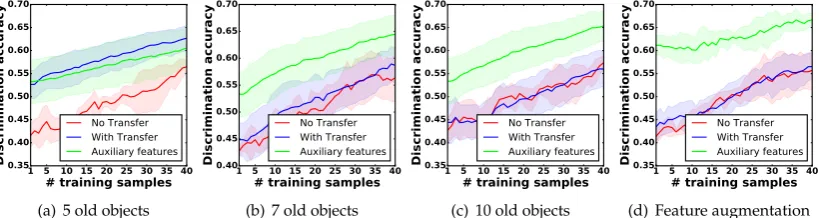
Figure 9.Increasing the number of old objects from 3, 5, 7 to 10, and comparing the performance of different learning methods. Red: baseline method; Blue: APTKT without auxiliary features; Green: APTKT with auxiliary features.
5.3. Evaluation of the Transfer Learning Method with Different Groups of Prior Objects 278
In this experiment, we evaluated the performance of APTKT with different groups of prior objects. 279
To start the learning process, the robot applied each of the seven actions once on each new object. 280
When the robot iteratively learned the new objects’ physical properties, it updated both the multiple 281
feature observations combination and the prior tactile knowledge built by the dependent GPC models 282
with all the feature observations collected so far. At each learning iteration, we measured the object 283
discrimination accuracy of the test dataset. The transfer learning performance was compared with the 284
learning process without prior knowledge as the baseline method. 285
We randomly shuffled the prior objects into ten groups. Each group consisted of the feature 286
observations and the observation models from three prior objects. We conducted the experiment 287
with five trials for each group. In each trial, the robot followed the transfer learning approach and 288
no-transfer approach to collect 40 feature observations in total, allowing a fair comparison between 289
different learning strategies to be made. Fig.7illustrates that with the help of prior knowledge, the
290
robot consistently outperformed the learning process without prior knowledge with a discrimination 291
accuracy of 10%. In order to further evaluate the robustness of APTKT, the robot was tasked to learn 292
about objects via applying onlyoneof the exploratory actions. The experimental procedure was the
293
same as the one described above. The results are shown in Fig.8. As can be seen, by actions P1, P2
294
and C1, The robot had a larger improvement than actions S1, S2, S3 and S4. For example, the robot 295
increased the discrimination accuracy by 25%, when it reused the prior tactile instance knowledge from 296
the movement P2. However, when learning about objects by actions S1 and S4, little improvement 297
was seen. This was due to the fact that different exploratory actions produced different object feature 298
observations. For action P2, there existed higher related prior tactile knowledge than S1 and S4, and 299
the robot could benefit more on it. 300
In all scenarios, using our proposed transfer learning algorithm, the robot could achieve a higher 301
discrimination accuracy than the baseline method with the same number of feature observations. 302
Therefore, we can conclude that APTKT helps the robot build reliable observation models of new 303
objects with fewer training samples, even when only one kind of the exploratory action is applied. 304
5.4. Increasing the Number of Prior Objects 305
We further evaluated the performance of our proposed method with an increasing number of 306
prior tactile experiences. Intuitively, as the number of old objects grows, it is more likely that the robot 307
can find highly-related prior tactile knowledge, so that the learning performance can continue to be 308
improved. In this regard, following the same procedure described above, we increased the number 309
of old objects from 5, 7 to 10 and conducted each experiment five trials. Unexpectedly, as Fig.9(b),
310
Fig.9(c)and Fig.9(d)shows, the growing number of prior tactile knowledge reduced the transfer
1 2 3 4 5 6 7 8 9 101112131415 1 2 3 4 5 6 7 8 9 10 11 12 13 14 15 0.6 0.5
0.6 0.3 0.1 0.1 0.7 0.2 0.2 0.7
0.30.7
0.3 0.7
1.0 0.8 0.3
0.3 0.1 0.5 1.0 0.20.3 0.3
1.0 0.1 0.3 0.6
0.1 0.9
0.1 0.9
P1
1 2 3 4 5 6 7 8 9 101112131415
1 2 3 4 5 6 7 8 9 10 11 12 13 14 15 1.0
0.5 0.30.1 0.1
0.8 0.1 1.0 1.0 0.8 0.2 1.0 1.0 0.5 0.5 0.1
1.0 0.9 0.1 0.30.6 0.1 0.9 0.8 0.1 1.0
P2
1 2 3 4 5 6 7 8 9 101112131415
1 2 3 4 5 6 7 8 9 10 11 12 13 14 15 0.9 0.1 0.4 0.6
0.10.5 0.1 0.3 1.0 1.0 0.8 0.2 1.0 1.0 1.0 1.0 1.0 1.0 0.10.2 0.7 0.5 0.5 1.0
C1
1 2 3 4 5 6 7 8 9 101112131415
1 2 3 4 5 6 7 8 9 10 11 12 13 14 15 0.9
0.7 0.1 0.1
0.5 0.1 0.3
0.4 0.6 0.9 0.1 0.8 0.1 0.9 0.5 0.5 0.9 0.1 0.5 0.3 0.1 0.1 0.70.1 0.9 0.1 0.9
0.10.9 0.2 0.30.6
S1
1 2 3 4 5 6 7 8 9 101112131415
1 2 3 4 5 6 7 8 9 10 11 12 13 14 15 1.0
0.3 0.1 0.20.3 0.9
0.10.3 0.40.1 0.10.8
0.10.3 0.5 0.80.1
0.1 0.30.20.1 1.0
0.3 0.6 0.2 0.8 0.1 0.1 0.5 0.1 0.50.3
0.10.7 0.9
S2
1 2 3 4 5 6 7 8 9 101112131415
1 2 3 4 5 6 7 8 9 10 11 12 13 14 15 1.0
0.70.1 0.1 0.10.7 0.1
0.4 0.30.1 0.2 0.7 0.1 0.1
0.1 0.8
0.20.3 0.3 0.1 0.8
1.0 0.10.7 0.1
0.70.10.1 0.10.1 0.30.3 0.10.8 0.3 0.8 0.9
S3
1 2 3 4 5 6 7 8 9 101112131415
1 2 3 4 5 6 7 8 9 10 11 12 13 14 15 1.0 0.3 0.7 0.7 0.10.1 0.70.1 0.8 0.1 0.4 0.1 0.4
0.8 0.9 1.0 0.8 0.1 0.30.4 0.1 0.60.10.1 0.1 0.1 0.7
0.1 0.8
0.3 0.6
S4
1 2 3 4 5 6 7 8 9 101112131415
1 2 3 4 5 6 7 8 9 10 11 12 13 14 15 0.9 0.1
0.5 0.2 0.1
0.6 0.10.10.1 0.60.1 0.1 0.1 0.10.8
0.5 0.1 0.3 0.8 0.1
0.7 0.1 0.1 0.1 0.8 0.1 0.8 0.1 0.7 0.1 0.10.7 0.1 0.7 0.3 0.7 0.1 0.8
All
Figure 10.object confusion matrices (value normalized between 0 and 1) for each exploratory action and the average. The blue indices represent the old objects. The red indices represent the new objects, with #11 - #15 indicating new objects #1 - #5. Best viewed in magnification.
learning improvement. This was because the object relatednessρpredicted by the old object GPC
312
models was underestimated, when there existed many old objects. 313
To compensate for this, we proposed using a feature augmentation trick that ulitized the
predictions as auxiliary features to describe the physical properties of the objects. We definedp(coldi |v)
as the prediction probability that a feature observation from the new objectvis assigned to the old
objectcold
i . Then we augmented a feature observationvfrom a new object as:
v0= [ v, |{z}
original features
p(cold1 |v), ...,p(coldi |v), ...,p(ooldN
old|x)
| {z }
predictions from old objects’ observation models
]. (4)
The auxiliary features[p(cold1 |x), ...,p(coldN
old|x)]can be regarded to be perceived from an auxiliary
314
sensor. Therefore, we directly employed our proposed multiple feature observation combination 315
method to the augmented feature observations by casting a weight to its kernel. The augmented 316
feature observations were then used to build the new object dependent GPC models. 317
We tested our proposed feature augmentation technique when the robot leveraged 3, 5, 7, and 10 318
prior objects’ prior tactile knowledge to learn about new objects via all seven actions. The learning 319
performance is shown by the green curves in Fig.9(a)- Fig.9(d). Clearly, by introducing the probability
320
predictions as auxiliary features, the robot was able to reuse the prior tactile knowledge again, and 321
achieved similar improvement of discrimination accuracy for 3 prior objects, and higher improvement 322
for 5, 7, and 10 prior objects compared to the other methods. Specifically, when resuing 10 prior objects, 323
the robot achieved 20% higher discrimination accuracy than the baseline method, when onlyonenew
324
feature observation was collected, showing the one-shot learning behaviour. This experiment also 325
indicates that with a further growing number of prior objects, a further improvement of discrimination 326
accuracy is achievable. 327
5.5. Negative Prior Tactile Knowledge Transfer Testing 328
When the constructed prior tactile exploratory action experiences are not relevant to the new 329
1 5 10 15 20
# training samples
0.3 0.4 0.5 0.6 0.7 0.8 0.9 1.0
Discrimination accuracy
P1
No Transfer Transfer1 5 10 15 20
# training samples
0.2 0.3 0.4 0.5 0.6 0.7 0.8 0.9
Discrimination accuracy
P2
No Transfer Transfer1 5 10 15 20
# training samples
0.3 0.4 0.5 0.6 0.7 0.8 0.9 1.0
Discrimination accuracy
C1
No Transfer Transfer1 5 10 15 20
# training samples
0.30 0.35 0.40 0.45 0.50 0.55 0.60 0.65 0.70 0.75
Discrimination accuracy
S1
No Transfer Transfer1 5 10 15 20
# training samples
0.2 0.3 0.4 0.5 0.6 0.7 0.8
Discrimination accuracy
S2
No Transfer Transfer1 5 10 15 20
# training samples
0.40 0.45 0.50 0.55 0.60 0.65 0.70 0.75
Discrimination accuracy
S3
No Transfer Transfer1 5 10 15 20
# training samples
0.30 0.35 0.40 0.45 0.50 0.55 0.60 0.65 0.70
Discrimination accuracy
S4
No Transfer Transfer1 5 10 15 20 25 30 35 40
# training samples
0.30 0.35 0.40 0.45 0.50 0.55 0.60
Discrimination accuracy
All
No Transfer TransferFigure 11. Negative prior tactile knowledge transfer testing. The prior objects were deliberately selected that were unrelated to the new objects.
knowledge transfer phenomena. In this case, the transfer learning algorithm should stop leveraging 331
irrelevant prior knowledge. 332
In order to evaluate APTKT against the negative tactile knowledge transfer, we deliberately 333
selected irrelevant prior objects and compared the transfer learning performance with the baseline 334
method, following the same experiment process described in Sec.5.3. When finding which objects
335
were relevant (or irrelevant) to each other, we built object confusion matrices to roughly evaluate the 336
object similarity. To do this, for each of the seven exploratory actions, we trained a Gaussian Mixture 337
Model (GMM) and calculated the object confusion matrix. We further calculated the confusion matrix 338
averaged over all exploratory actions. The results are shown in Fig.10. According to Fig.10, objects
339
{1, 5, 7} were dissimilar to the new objects (objects {11 - 15}) regarding the exploratory movement P1, 340
objects {1, 4, 7} for P2, objects {4, 7, 10} for C1, objects {1, 6, 9} for S1, objects {1, 7, 10} for S2, objects {1, 341
3, 9} for S3, and objects {1, 3, 8} for S4. We thus used these objects as prior objects to test the transfer 342
learning performance via the single exploratory action. We further selected objects {1, 5, 10} to test the 343
learning process via all exploratory actions, since these three objects shared relative small similarity to 344
the new objects. 345
The results in Fig.11illustrate that the discrimination accuracy achieved by APTKT was similar
346
to the baseline method, when the robot applied either one or all seven exploratory actions. The results 347
indicate that our proposed algorithm stopped transferring negative prior tactile instance knowledge. 348
6. Conclusions 349
In this work, we proposed a transfer learning method for a robot equipped with multi-modal 350
artificial skin to actively reuse the prior tactile exploratory action experiences when learning about 351
the detailed physical properties of new objects. These prior action experiences are built by the 352
feature observations, when a robotic arm equipped with a multi-modal artificial skin applies the 353
pressing, sliding and static contact movements with different action parameters on objects. The feature 354
observations are perceived from multiple sensory modalities. Using our proposed tactile transfer 355
learning method, the robot has a “warm start" of the learning process. It applies fewer exploratory 356
actions and gains a more precise tactile knowledge of new objects. 357
In the future, we will extend our method to more exploratory actions (such as tapping and lifting), 358
of an object, such as auditory feedback and center of mass. Furthermore, it would be an interesting 360
topic to research how to transfer the prior tactile knowledge across different exploratory actions, e.g. 361
transferring the tactile knowledge from pressing to static contact movement. 362
References 363
1. Mittendorfer, P.; Cheng, G. Humanoid multimodal tactile-sensing modules. IEEE Transactions on robotics 364
2011,27, 401–410. 365
2. Jamali, N.; Sammut, C. Material classification by tactile sensing using surface textures. Robotics and 366
Automation (ICRA), 2010 IEEE International Conference on. IEEE, 2010, pp. 2336–2341. 367
3. Chu, V.; McMahon, I.; Riano, L.; McDonald, C.G.; He, Q.; Perez-Tejada, J.M.; Arrigo, M.; Fitter, N.; Nappo, 368
J.C.; Darrell, T.; others. Using robotic exploratory procedures to learn the meaning of haptic adjectives. 369
Robotics and Automation (ICRA), 2013 IEEE International Conference on. IEEE, 2013, pp. 3048–3055. 370
4. Papakostas, T.V.; Lima, J.; Lowe, M. A large area force sensor for smart skin applications. Sensors, 2002. 371
Proceedings of IEEE. IEEE, 2002, Vol. 2, pp. 1620–1624. 372
5. Song, A.; Han, Y.; Hu, H.; Li, J. A novel texture sensor for fabric texture measurement and classification. 373
IEEE Transactions on Instrumentation and Measurement2014,63, 1739–1747. 374
6. Watanabe, K.; Sohgawa, M.; Kanashima, T.; Okuyama, M.; Norna, H. Identification of various kinds of 375
papers using multi-axial tactile sensor with micro-cantilevers. World Haptics Conference (WHC), 2013. 376
IEEE, 2013, pp. 139–144. 377
7. Kaboli, M.; Mittendorfer, P.; Hügel, V.; Cheng, G. Humanoids learn object properties from robust tactile 378
feature descriptors via multi-modal artificial skin. Humanoid Robots (Humanoids), 2014 14th IEEE-RAS 379
International Conference on. IEEE, 2014, pp. 187–192. 380
8. Friedl, K.E.; Voelker, A.R.; Peer, A.; Eliasmith, C. Human-inspired neurorobotic system for classifying surface 381
textures by touch. IEEE Robotics and Automation Letters2016,1, 516–523. 382
9. Baishya, S.S.; Bäuml, B. Robust material classification with a tactile skin using deep learning. Intelligent 383
Robots and Systems (IROS), 2016 IEEE/RSJ International Conference on. IEEE, 2016, pp. 8–15. 384
10. Bhattacharjee, T.; Wade, J.; Kemp, C. Material Recognition from Heat Transfer given Varying Initial 385
Conditions and Short-Duration Contact. Proceedings of Robotics: Science and Systems; , 2015. 386
11. Yao, K.; Kaboli, M.; Cheng, G. Tactile-based Object Center of Mass Exploration and Discrimination. 387
Humanoid Robots (Humanoids), 2017 17th IEEE-RAS International Conference on. IEEE, 2017. 388
12. Xu, D.; Loeb, G.E.; Fishel, J.A. Tactile identification of objects using Bayesian exploration. Robotics and 389
Automation (ICRA), 2013 IEEE International Conference on. IEEE, 2013, pp. 3056–3061. 390
13. Schneider, A.; Sturm, J.; Stachniss, C.; Reisert, M.; Burkhardt, H.; Burgard, W. Object identification with 391
tactile sensors using bag-of-features. 2009 IEEE/RSJ International Conference on Intelligent Robots and 392
Systems. IEEE, 2009, pp. 243–248. 393
14. Lepora, N.F.; Martinez-Hernandez, U.; Prescott, T.J. Active touch for robust perception under position 394
uncertainty. Robotics and Automation (ICRA), 2013 IEEE International Conference on. IEEE, 2013, pp. 395
3020–3025. 396
15. Fishel, J.A.; Loeb, G.E. Bayesian exploration for intelligent identification of textures2012. 397
16. Tanaka, D.; Matsubara, T.; Sugimoto, K. An optimal control approach for exploratory actions in active tactile 398
object recognition. 2014 IEEE-RAS International Conference on Humanoid Robots. IEEE, 2014, pp. 787–793. 399
17. Saal, H.; Ting, J.A.; Vijayakumar, S. Active sequential learning with tactile feedback. Proceedings of the 400
Thirteenth International Conference on Artificial Intelligence and Statistics, 2010, pp. 677–684. 401
18. Guo, H.L.; Zhang, L.; Su, Z. Empirical study on the performance stability of named entity recognition model 402
across domains. Proceedings of the 2006 Conference on Empirical Methods in Natural Language Processing. 403
Association for Computational Linguistics, 2006, pp. 509–516. 404
19. Yang, Q. Activity Recognition: Linking Low-level Sensors to High-level Intelligence. IJCAI, 2009, Vol. 9, pp. 405
20–25. 406
20. Tommasi, T.; Orabona, F.; Caputo, B. Safety in numbers: Learning categories from few examples with multi 407
model knowledge transfer. Computer Vision and Pattern Recognition (CVPR), 2010 IEEE Conference on. 408
21. Tommasi12, T.; Orabona, F.; Kaboli, M.; Caputo, B.; Martigny, C. Leveraging over prior knowledge for online 410
learning of visual categories2012. 411
22. Rodner, E.; Denzler, J. One-shot learning of object categories using dependent gaussian processes. Joint 412
Pattern Recognition Symposium. Springer, 2010, pp. 232–241. 413
23. Yang, X.; Kim, S.; Xing, E.P. Heterogeneous multitask learning with joint sparsity constraints. Advances in 414
neural information processing systems, 2009, pp. 2151–2159. 415
24. Kaboli, M.; Walker, R.; Cheng, G.; others. In-hand object recognition via texture properties with robotic 416
hands, artificial skin, and novel tactile descriptors. Humanoid Robots (Humanoids), 2015 IEEE-RAS 15th 417
International Conference on. IEEE, 2015, pp. 1155–1160. 418
25. Kaboli, M.; Walker, R.; Cheng, G. Re-using prior tactile experience by robotic hands to discriminate in-hand 419
objects via texture properties. 2016 IEEE International Conference on Robotics and Automation (ICRA), 420
2016, pp. 2242–2247. 421
26. Kaboli, M.; Di, F.; Kunpeng, Y.; Pablo, L.; Cheng, G. A Tactile-based Framework for Active Object Learning 422
and Discrimination using Multi-modal Robotic Skin. IEEE Robotics and Automation Letters (RAL), 2017. 423
27. Kaboli, M.; Di, F.; Cheng, G. Active Tactile Transfer Learning for Object Discrimination in an Unstructured 424
Environment using Multimodal Robotic Skin. International Journal of Humanoid Robotics (IJHR), 2017. 425
28. Rasmussen, C.E. Gaussian processes for machine learning2006. 426
29. Chai, K.M. Generalization errors and learning curves for regression with multi-task Gaussian processes. 427
![Table 1. Technical information of sensors in the artificial skin ([7]).](https://thumb-us.123doks.com/thumbv2/123dok_us/1007149.1600582/4.595.123.477.99.406/table-technical-information-sensors-articial-skin.webp)