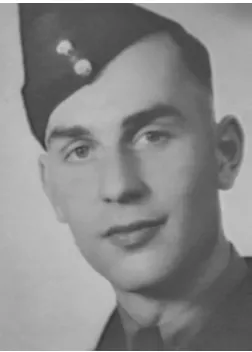
Robert Goddard Young,
DC, ND
:
Searching for a better way
Douglas M. Brown,
DC*This biographical study tracks the life of Robert Goddard Young; a member of the Canadian Memorial
Chiropractic College’s (CMCC) Class of 1950. The paper begins with an overview of Robert Young’s origins, his childhood and early training, moves to his tour of duty in World War II, followed by his education at CMCC, before converging on the core of this matter; Robert Young’s professional career, which spanned over half a century. Now in his twilight years, the paper ends with a discussion on the substance of Dr. Young’s largely-forgotten contributions.
(JCCA 2009; 53(3):205–214)
k e y w o r d s: Robert Young, biography
Background
Robert Young was born in Toronto on March 13, 1921, and raised in his family’s home at 994 Ossington Ave-nue. His father, William Robert Young, came from Gore Bay, on Manitoulin Island, Ontario, working as a black-smith to build ferry boats that plied the waters between the Island and the mainland. After moving to Toronto, William Young joined IBM Canada, where he served with distinction as an inventor and senior executive for 25 years. Probably his most important contribution was modifying and refining the punch card tabulating ma-chines invented by Herman Hollerith, which were the precursors of present day computers. “Bob” remembers his father building equipment in the basement of their house and calls him “a creative genius.” [Interview, Young by Brown, Nov. 14, 2007]
When he was five years old, his father gave Bob an electric car; sparking a lifelong interest in electronics. At age 13, he built a radio that could pick up programs as far off as Cuba; at 17 he was designing pharmaceutical manufacturing equipment; and by 19, was creating sur-veillance equipment for police departments and govern-ments.1 Bob attended Humber West Public School and received his senior matriculation diploma from Run-nymede Collegiate before accepting a job in Malton, with the National Steel Car Company of Hamilton, Ontario, as-sembling bombers for the Royal Canadian Air Force (RCAF).
The Royal Canadian Air Force
By 1942, Bob was studying electrical engineering at the University of Toronto, but left to enlist in the RCAF. At
* 281 Ridgewood Road, Toronto, ON M1C 2X3. Tel: 416-284-1168. E-mail: [email protected] © JCCA 2009.
Cette biographie retrace la vie de Robert Goddard Young; un membre du Canadian Memorial Chiropractic College’s (CMCC), classe de 1950. Le document
commence avec un aperçu des origines de Robert Young, son enfance et le début de sa formation, sa période de service pendant la Deuxième Guerre mondiale, suivie par sa formation au CMCC, avant de se concentrer sur le cœur du sujet; la carrière professionnelle de Robert Young, s’est étendue sur un demi-siècle. Maintenant, au crépuscule de sa vie, la biographie se termine par une discussion sur la substance des contributions en grande partie oubliées du Dr Young.
(JACC 2009; 53(3):205–214)
the time he was 6⬘3⬙ tall, very strong and weighed over 200 pounds. Unfortunately, he was about to endure three traumatic mishaps that would compromise his vitality. During induction procedures, Bob suffered an adverse re-action to a vaccination for Scarlet Fever, which disabled him for weeks. Then, studying to become a bomber pilot, both his eardrums were accidentally ruptured, while training in a high altitude pressure chamber. This dramat-ically altered his balance and depth perception, making it impossible for Bob to handle a plane properly. His last practice flight was disastrous. Coming in for a landing, Bob was unaware that he was 50 feet above the ground. The plane crashed to the airfield, smashing the landing gear, the propeller and Bob’s dreams of becoming a pilot.
Demoted to groundcrew, Bob began correspondence courses in radar electronics and instrumentation through the Scottish University Co-operative, to qualify as a “Leading Aircraftman” for the Canadian Coastal Com-mand in places such as Goose Bay, Labrador, the Artic Circle, Gander, Newfoundland and Mont Jolie, Québec. His first job was “converting the electrical systems of British aircraft to the American style ... which had not been accomplished previously. Next his expertise was utilized to perfect an advanced form of electronic surveil-lance for other branches of the service.”2
Leading Aircraftman Young was taking off on a rou-tine flight from Mont Jolie when he inadvertently stepped on an improperly secured escape hatch. Dropping through the floor, he landed on the tarmac and was struck by the plane’s rear wheel. Luckily, he was not cut in half as had been the case in similar incidents, however, he re-ceived a serious low back injury which affected his legs and compromised his ability to walk. Although hospital-ized for several months, Bob’s recuperation was negligi-ble. One day, when hobbling to the canteen with the aid of two canes, Bob was stopped by a Mustang fighter pilot in the United States Air Force who happened to be a chi-ropractor in civilian life. The pilot offered to help, gave Bob an adjustment and soon after, to everyone’s surprise, his condition began to improve.
CMCC
Following an honourable discharge from the RCAF, Bob traveled home from Québec to Toronto, by train. Enter-ing the MarshallEnter-ing Yards in the Exhibition grounds, he noticed a large billboard on Lakeshore Boulevard, an-nouncing a new chiropractic college (CMCC) which had opened at 252 Bloor Street West, on September 18, 1945. He remembered his serendipitous encounter with the American fighter pilot in Mont Jolie who had introduced him to the benefits of chiropractic and decided to investi-gate what CMCC had to offer. Bob talked to the registrar, John A. Henderson, DC, and entered the second class, in September 1946. Enrolment at CMCC was much larger than expected for the first two years, due to the influx of World War II veterans returning to civilian life, whose tuition and modest living expenses were paid by the Ca-nadian Department of Veterans Affairs (DVA). Of the 239 individuals who graduated from CMCC in 1949 and 1950, over 80% had served in the Armed Forces.
In the 1950s students received instruction in four different methods of spinal correction: Meric; Specific Upper Cervical; Logan Basic; and Carver. A. Earl Home-wood, DC, was a charter member of the faculty, teaching anatomy, palpation and Carver technique. Dr. Homewood had graduated from the University of Natural Healing Arts in 1941, where he was taught the structural approach of Willard Carver, LLD, DC, which encompassed the whole body. Homewood recalled that “As students we were never allowed to forget the value of structural cor-rection ... Great stress was laid upon the ability to utilize the dynamic adjustive thrust and control exact depth and direction, with every effort made to apply the impulse with exactitude ...”3
Homewood was fascinated by the interaction between the structure of the body and its internal organs, via the nervous system. His book, “The Neurodynamics of the Vertebral Subluxation,” contains a neurological explana-tion of the mechanics by which somatic distorexplana-tions (sub-luxations) can produce visceral dysfunction and tissue change.4 Bob, with his background in engineering and electronics, gravitated toward Homewood’s approach and they developed a lasting, mutually supportive friend-ship.
At CMCC, Bob’s early training was useful. Electro-therapy machines were costly and his colleagues had lit-tle money, so Bob taught them how to build a device which delivered Faradic, Sinusoidal and Galvanic cur-rents. These were cumbersome appliances, meant to be used in a clinical setting, but some of his pals lugged them out on house calls when they first entered practice. Predictably, their Class President, Edgar Reinhart, gave Bob the nickname “Galvani.” This was somewhat pro-phetic as Luigi Galvani (1737–1798), an Italian physician and physicist, has been described as a skilled teacher and the first scientist to appreciate the relationship between electricity and life. (Wikipedia)
Professional Career
One hundred and twenty-five classmates graduated with Dr. Robert Young, in May 1950. That number would not be surpassed until the mid 1970s, when CMCC was lo-cated on our expanded second campus at 1900 Bayview Avenue. Upon graduation, Young immediately opened a private practice in the west end of Toronto; purchasing three adjoining properties on Dundas Street West, at
Burnhamthorpe Road. On that day, Young began his “search for a better way” to serve his patients by develop-ing instruments and techniques for the detection, analysis and correction of any joint dysfunction which interferes with normal nerve expression, particularly in the spine.
X-Ray
Using a workshop in the lot behind his office, he founded the International X-ray Co., Inc., to design and manufac-ture his own apparatus, which he first sold to chiroprac-tors and then to hospitals, throughout North America. In the early 1950s Young attended a meeting of the Radio-logical Society of North America, in Chicago, and saw 14⬙ by 36⬙ X-ray films (known as full spine). Their quali-ty was poor; similar to those then being produced by chi-ropractors. Taken using a bucky with an 8:1 ratio, which means the lead grid lines were wide apart; coupled with a tube to bucky focal distance of 40⬙, producing a widely divergent X-ray beam; the images were badly distorted, and that distortion was magnified. Young traveled to Chicago and had General Electric assemble 14⬙ ⫻ 36⬙ buckys with the same fine line grids used in smaller buckys such as 14⬙ ⫻ 17⬙. He named them “Nomax” buckys because they had no maximum, or infinite, focal distance. Able to take X-rays at a distance of 80” or more, his system was significantly better and was pur-chased by several children’s hospitals for performing scoliosis studies.
Another problem with full spine x-rays was the dispar-ity in densities between the cervical, thoracic, and lumbar areas, requiring different exposures. Young’s first solu-tion was to paste three different speeds of intensifying screens into the bucky. This improved the films but
patients were receiving a lot more radiation exposure than they should. By this time collimators were being at-tached to the front of X-ray tubes to control the beam’s and size and shape. Young’s next move was to build a set of lead shutters to fasten to the collimator’s face in such a way that the lumbar area of the spine received full expo-sure, the thoracic half expoexpo-sure, and the cervical one-quarter. This reduced total radiation to the patient but the shutter mechanism was complex, difficult to engineer and expensive. Young persevered and eventually devel-oped “Young’s Alloy Filter System.” It comprised small, metal alloy sheets of various thicknesses that were cost-effective, easily modifiable and could be quickly attached to the collimator by two Velcro strips.
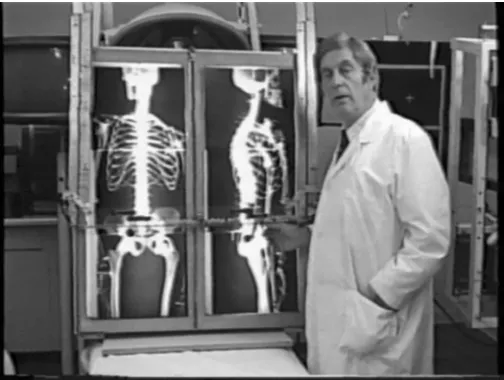
Young had made large improvements in full spine X-ray technology, yet his films still held certain disadvan-tages over smaller views. First, the 14⬙⫻ 36⬙ film covered a much larger area and some distortion and magnification remained. Second, to be effective, his methods of compen-sating for variations of density required a skilled techni-cian, who was frequently not present. Young admitted that, for the most part, his full spine films, particularly the lateral views, were diagnostically poor. On the other hand, although smaller films were clearer, sharper and superior in revealing pathological conditions, they didn’t provide an accurate picture of the overall spinal configuration. Dissatisfied, Young began to investigate changing the method by which the X-ray beam itself, was delivered to the film. His final solution was to initiate the prototype of what he termed a “Pana Scanner” X-ray machine. This system could take different-sized X-rays, from 8⬙⫻ 10⬙ to 14⬙⫻ 36⬙ and was semi-automatic. The technician simply picked the size of film he wanted to produce and pressed a button. Since the X-ray beam was enclosed in a protec-tive tunnel, surrounding tissues were protected from radi-ation. With full spine radiology, the patient stood on a turntable and was stabilized by straps to ensure no change in body or foot position. For the anterior/posterior (A/P) view, the device started at the base of the skull and took a series of exposures as it moved down the spine, frame by frame, to the pelvis. Next the patient was rotated 90º on the turntable, and the process repeated for the lateral view, duplicating the exposures taken in the A/P position. Indi-vidually, these frames were diagnostically equal to spot X-rays and collectively, gave more comprehensive infor-mation about overall spinal distortion. Measurements of Figure 3 Dr. Robert Goddard demonstrating AP and
individual vertebrae, taken from these A/P and Lateral films, could be combined via computer technology to pro-duce three-dimensional print-outs.
Microscopic Bone Alignment
Shortly after opening his office in 1950, Dr. Young be-came aware of the pervasive antipathy of other health care disciplines and the public, toward chiropractic in general and aggressive spinal manipulation in particular. “Statistics revealed that only 10% of the public used the services of a chiropractor, whereas 90% of the population could benefit from the chiropractic profession.” After he was introduced to a large audience in Florida as a “bone cruncher” he determined “that chiropractic needs to de-velop a more gentle form of adjustment.”5
In the 1950s and 60s Young was busy designing, man-ufacturing, selling and installing X-ray units in chiroprac-tic offices and hospitals in Canada, the United States and Mexico. Working in hospitals gave him “access to their multimillion dollar equipment” and introduced Young to image intensifiers which became for him, the most im-portant device in the study of chiropractic technique. In this regard, Young had help from Jack D. Ellis, DC, Brampton, Ontario, who let him use his private video-fluoroscopy system for research purposes. Dr. Ellis ex-plained that the image intensifier attached to the fluoro-scope, allows the milliamps (MA) for spinal motion studies, to be greatly reduced from 200 MA to as low as 1 MA. Intensification tubes also convert the X-ray beam to an electronic signal which can be recorded on video-tape, CD, DVD or computer. [Phone call, Brown to Ellis, Aug. 5, 2008]
Image intensification permitted Young to see vertebrae in three dimensions and in motion, on a nine inch screen. Anatomists have determined the play between spinal joints to be two to three millimeters. Young found the amount of change in bone position following a Micro ad-justment to be almost imperceptible. Although never able to record this change using X-rays or image intensifiers, on one occasion he had access to an instrument designed to measure the amount of space between a connecting rod in an automobile engine and its bearing and used it to de-termine the clearance between the bones of his shoulder. Other than side clearance, it was only one-thousandth of an inch. Looking at the movement of vertebrae as they were adjusted conventionally, he observed them
re-bounding from the force applied. Rather than being trans-mitted into the intended spinal articulations, much of the energy was deflected up and down the spinal column.
Young knew that leverage is capable of generating great force with little effort. He experimented taking a contact against the spinous process of a vertebra, using either the pisiform or the eminence of the second digit, as a fulcrum. Flexing the wrist caused the pisiform to act as a rotary cam; producing a gentle prying action to lever the vertebra into place. The pisiform is augmented by the forearm which provides a 60:1 mechanical advantage and the spinous process, another 5:1 advantage.
Young first used his levering system to develop specif-ic techniques for adjusting the spine and pelvis. Impor-tant steps to remember are: locking the wrist in a neutral position against the spinous process; restraining the spine on the opposite side with the other hand; then flexing the wrist to apply controlled pressure against the spinous process and complete the procedure. Mild force can be directed three-dimensionally, in saggital, coronal and transverse planes. Because the impulse is light and the velocity low, variable vectors can be employed in a con-trolled environment to nudge bones into precise posi-tions. This eliminates “follow-through” which can have negative repercussions by carrying the procedure too far.
Young stresses the importance of understanding the construction of the spine as it relates to the differing sizes, shapes and angles of vertebrae, their spinous pro-cesses and inter-vertebral articulations. A/P and Lateral X-rays are needed to exclude contra-indicated patholo-gies and get an in-depth understanding of misalignments; spinal palpation should be conducted with the eyes closed to increase tactile sensation and “get a feel” for what needs to be done.
Young also originated specific techniques for manilating the cartilages of the throat, the ribs, acetabulae, pu-bic symphasis and coccyx. Other areas covered were the occiput, sutures of the skull, sinuses, nasal bones, ears, temporomandibular joints, shoulders, scapulae, clavicles, elbows, wrists, hands, knees, ankles and feet.
principal: the use of mild force at timed intervals to move teeth. Young refers to Wolff’s Law, which states that bone in a healthy person or animal will adapt to the loads placed upon it. Mechanobiology is an emerging disci-pline which might add credence to Young’s assertion. It joins the older science of mechanics with the newer spe-cialties of molecular biology and genetics. At the center of mechanobiology is the cellular process of mechan-otransduction, or the way cells sense and respond to me-chanical forces.
Teaching
In the1960s CMCC began purchasing X-ray equipment from Dr. Young and from 1969 through 1972 he taught X-ray Physics, chaired the X-ray Committee and was di-rector of X-ray Research. Young was in the X-ray busi-ness and his students benefited from examining actual parts, rather than looking at pictures in a textbook. For example, he taught the creation of an X-ray beam by bringing stationary and rotating anode tubes to class with pieces of the outer casings cut away, so they could see the anode rotate and watch the tungsten filament redden as MA was applied. He also brought in a miniature dental X-ray machine and introduced the class to stationary, re-ciprocating and (his own) Nomax buckys.
After one of his lectures, a student approached Young regarding a spinal problem that had not responded to tra-ditional therapy. Young administered a Micro adjustment and the student obtained almost immediate relief. Class-mates Peter MacKay and Dennis Colenello were in-trigued by this new technique and persuaded Young to give them a series of informal workshops. By the time they graduated in 1979 Drs. MacKay and Colenello were skillful advocates of Micro, traveling with Young as as-sociate lecturers throughout North America and using it extensively in their private practices.
Young held Micro seminars at CMCC, the Parker Col-lege of Chiropractic, the New York Chiropractic Associ-ation and the New York Chiropractic College, where he was listed as a faculty member for 10 years. Barbara James, DC, had been involved with Young for three years by the time she graduated from CMCC in 1988. Dr. James was impressed with Young’s “profound” understanding of the human body, his precise analysis and the results he got for his patients. “I realized that I wanted to spend more time with Bob. When he asked me to join him in practice
and help him teach his programs, I agreed to stay in To-ronto for two years before moving back to British Colum-bia.” [Email, James to Brown, Sept. 3, 2008]
Articles on Microscopic Bone Alignment have appeared in chiropractic journals such as The Ameri-can Chiropractor, Today’s Chiropractor and Chiro-practic Economics, where Homewood published six articles.6,7,8,9,10,11 Dr. Homewood’s papers focus on Micro manipulation of the spine and the skills necessary to properly analyze and deliver appropriate force in a spe-cific way, to a particular area. He provides detailed infor-mation regarding anatomical differences throughout the spine that must be considered and delves into the complexities of the nervous system and how its various divisions influence, and are influenced by, structural dis-tortion and its correction. Homewood declares the under-lying principles of Micro manipulation to be “leverage and direction.”
Young began documenting his Micro lectures in elec-tronic format in 1980 and by1988 had succeeded in pro-ducing a version on four videotapes.12 Young is assisted on these tapes by Drs. Colenello and MacKay. It took him 10 years, but in 1990 he completed a greatly expand-ed series, recordexpand-ed on 22 DVDs. Young is the main actor with cameo performances by Donald W. Lavis, DC and Barbara James, DC. This program, developed as a Spe-cialist Certification Program, has never been released.
Inventions
automo-biles. He took the back half of a rear-wheel drive Toyota Cressida, which he powered by batteries; welded it to the front half of a front-wheel drive Volkswagen Jetta with a Diesel engine; and attached a drive shaft, housing a gen-erator from a B52 Bomber. During highway driving the car ran on Diesel fuel as the batteries were recharged. When the brakes were applied, the Diesel engine turned off and the batteries took over, bringing the car to a stop and simultaneously conserving a lot of energy
In addition to his contributions to the field of X-ray, Young developed cardiographs, electroencephalographs and a wide range of electronic medical equipment for hospital use. For decades Young has been convinced that chiropractic must move from the “horse and buggy” era into the modern scientific world of instrumentation. To this end he generated a number of devices to facilitate the analysis, delivery and documentation of Microscopic Bone Alignment.
Young envisions the well-equipped chiropractic office of the future as featuring a “Robotized Computer Operat-ing Theatre ... This device carries the chiropractor around the operating theater while a computer automatically and robotically controls all movements of the doctor’s chair, the operating table and X-ray monitors. This allows doc-tors to remain seated, as they are carried effortlessly around the room.”13 Young’s “alignment” table was simi-lar to a conventional “adjusting” table except that it de-scended to the floor, providing accessibility for disabled or elderly patients. As well, supported by a central re-cessed base, rather than legs, it was easier for the practi-tioner to move around.
In 1954 Young constructed his first “Chiroscanner.” Inspired by BJ Palmer’s Electroencephaloneuromentim-pograph,14 it was based on newer technologies borrowed from electroencephalography and surface electromyolo-gy. Impulses from hundreds of electrodes strategically at-tached to the patient’s body were fed into a computer to be analyzed and recorded. He also utilized computer technology to generate instruments for detecting subluxa-tions, measuring spinal range of motion, muscle testing, postural studies and three dimensional X-ray analysis.
Chiropractors and patients often feel that crepitus sig-nals an effective adjustment. Since movement of vertebrae in Micro adjusting is miniscule, joint noise is absent or slight. Some individuals questioned Micro’s validity on this basis. Young answered their queries by devising a
“bone noise analyzer.” Consisting of a sensitive vibration microphone, coupled with a Sanborn oscilloscope, it dem-onstrated that in numerous instances, Micro manipulation produces noise which is inaudible to the human ear.
Discussion
Dissatisfaction seems to have been at the heart of Young’s “search for a better way.” His father accused him of finding fault with most of the mechanical devices he encountered but admitted that “Bob usually figures out a way to improve them.” His discontent made Young a practical inventor, more interested in solving problems than in delving into the theories and reasoning behind them. Unable to purchase quality X-ray equipment, Young began building his own machines and went on to develop a new system for taking, analyzing, and record-ing the findrecord-ings from full spine films. Young’s Pana Scanner X-ray machine and Robotized Computer Operat-ing Theatre, never got much beyond the prototype stage because both were complex and too expensive for most practitioners. In 1990, he showed how effective his Oper-ating Theatre could be when a colleague, who was a brain surgeon in Montréal, lost both feet in a motor vehi-cle accident. Young resuscitated his friend’s career by constructing a room with a motorized, computer-control-led chair; enabling him to perform all his delicate tasks while seated and reducing the time it took to perform them by one-third.
Sadly, I could not find any concrete evidence of his ac-complishments, other than videos of Young in his clinic, demonstrating his inventions. I also have photos of three tractor-trailers which he kept in the lot behind his clinic and have talked to several individuals who remember seeing them loaded with diagnostic and therapeutic de-vices which Young designed and built. He had planned to take these trailers to various locations such as the Canadi-an National Exhibition, in Toronto, to inform the public about the therapeutic and scientific competency of chiro-practic. Unfortunately, before this occurred, Etobicoke’s zoning department ruled that the back lot where Young stored them was residential, not commercial and he was forced to get rid of the trailers and their contents.
Unhappy with traditional methods of adjusting, Young spent 30 years creating Microscopic Bone Alignment; an effective and less invasive form of spinal correction.
the chiropractic profession interested in Micro manipula-tion. James provides three possible reasons. “1. Bob was unable to communicate clearly that this is a new tech-nique paradigm which involves using the pisiform as a moving fulcrum that creates changes in the body from the lever action ... When I presented at the CORE (California Chiropractic Association Conference on Research and Education) program in San Diego in 1996, there was no interest shown in this new paradigm of adjusting. Many researchers simply state that all techniques work, and they have no interest in promoting one over any other. 2. I believe Micro has been discounted because there was no organized and standardized approach to presenting it and most students did not feel they had enough training to start using the technique with confidence. Bob took al-most 10 years to develop his training videos and was not able to build up momentum for people to start learning it. 3. Very few professionals will commit to learning some-thing that is not accepted as the standard practice, and our profession is no different in this regard. I have had more enthusiasm from American DCs when I demonstrated and presented at Parker seminars than we saw in Canadi-an DCs. And I definitely see greater interest from other professionals who have no existing paradigm to contend with.” [Email, James to Brown, Sept. 15, 2008]
Summary
Microscopic Bone Alignment is at the heart of Dr. Young’s accomplishments. His experimentation with im-age intensification revealed the possibilities of Micro ma-nipulation; his refinements to X-ray technology helped pinpoint areas of spinal distortion requiring attention; and computerized equipment such as the Robotized Operat-ing Theatre, facilitated and recorded the delivery of this technique. There is a parallel between Young’s system of Micro adjusting and the Avro Arrow jet airplane under construction at Malton, Ontario, in the 1950’s. Both were left in limbo because they were ahead of their time, were not widely publicized, and their significance was not grasped. Although Young and his associates delivered numerous seminars throughout North America and in colleges such as CMCC and the NYCC, Micro was never incorporated into the curriculum of any educational insti-tution. Had this been the case, thousands rather than hun-dreds of chiropractors would have been being exposed to Micro, and there would presently be a number of
compe-tent instructors in this field, rather than only one, or per-haps two. Right now, Micro faces the distinct possibility of becoming extinct.
In the 1980’s Dr. Homewood declared, “From the fer-tile mind of Dr. Robert Goddard Young, comes the micro-scopic bone alignment technique, a form of light force adjustment with emphasis on the exact direction required for correction. One personal experience at the hands of Dr. Young was an eye-opener and encouraged my desire for a greater knowledge of this skillful method.” Homewood’s testimonial says a lot about the value of Micro for he was an avid scholar of every aspect of chiropractic education and a skilled practitioner. At CMCC (1951–55), I was for-tunate to attend Homewood’s technique classes. “Here he emphasized attention to detail and drilled his pupils to de-velop a controlled, dynamic adustive thrust, to make it specific yet safe for the patient, while protecting the prac-titioner from injury. He reiterated that the purpose of ad-justive technique was to normalize neural function while the intent of diagnosis was to influence the type of treat-ment administered. As always, he was guided by the dic-tums of DD Palmer. ‘It is unsafe and unwise to teach adjusting, unless it is taught intelligently.’”15,16 Obvious-ly, Homewood found Microscopic Bone Alignment both “safe” and “intelligent.”
Dr. James remembers that, “From the moment I began learning his technique, I knew that his understanding of the body was profound ... In thinking about the impact Bob has made on my life as a chiropractor it becomes re-ally difficult, since I have practiced Micro for 20 years now, and have never used high velocity traditional ad-justments. It has certainly been the overall factor in my success as a chiropractor, and has led me to really let the body teach me what to do, since I have complete confi-dence in what I can adjust and how that will be received by patients. Many times I see patients who will not go for traditional treatments and this is truly the undiscovered value of what Bob invented. He has provided an ap-proach to healing the body which is very well received and appreciated by patients. Every day I am asked why more chiropractors do not use this technique!” [Email James to Brown, Sept. 5, 2008]
On November 9, 2007, I was surprised to find Dr. Young on the front page of the Toronto Star newspaper.17 The headline, “Ottawa to grab scooter from veteran 86,” describes his plight at being told by Veterans Affairs Canada, that he was being stripped of his electric scooter because he was a “dangerous driver.” Although severely disabled, Young remains a fighter and called the Star, to tell his side of the story. Excerpts from a letter he wrote to the Minister of Veterans Affairs help explain his con-sternation.
Young begins his letter to the Hon. Gregory Thomp-son, by describing the injuries he acquired in the RCAF that left him with a permanent heart condition, impaired hearing, disturbed balance and spinal injuries which have rendered him “badly crippled, extremely weak in both the arms and the legs and unable to walk.” He continues, de-scribing the damage inflicted on his home by DVA con-tractors, in their failed attempt to make his home wheelchair accessible, and the personal cost when forced to hire his own people to do the job properly.
Young outlines the problems he encountered with the DVA scooter, calibrated to run at 22 mph in the house, and the fiasco of his “power mobility assessment.” When he asked for a retest, Young was told to consult a psychi-atrist at his own expense. The following paragraph helps to explain why all artifacts from Young’s inventions have vanished.
“I was a practicing chiropractor on Dundas Street at Burnhamthorpe Road, in Toronto, for 53 years. I owned
my office and a workshop at the back where my compa-ny, International X-ray Inc., designed and manufactured machines for doctors and hospitals, here and in the Unit-ed States. I also had three tractor trailers fillUnit-ed with valu-able research equipment, an apartment building on Bloor Street, as well as a house and two subdivisions I was de-veloping at Wasaga Beach, on Georgian Bay. Over the years, business reverses, three robberies, bank fraud, and the increasing cost of trying to maintain a semblance of normality, despite severe physical limitations, have left me financially vulnerable. Although I receive the maxi-mum benefits from DVA it isn’t enough to keep me from dipping into my meager savings.
“Once proudly self-sufficient, I am fortunate to be in the hands of competent, compassionate care-givers, but forced by the DVA’s decision to repossess my electric scooter, to use a manual wheelchair which I can only op-erate by scuffling my feet in such a manner as to painful-ly propel myself around the house.” [Letter, Young to Thompson, March 20, 2008]
This disturbing story has a mildly happy ending. Al-though the DVA did nothing to redress its absurd ruling, dozens of letters poured into the Star in support of this valiant Canadian soldier. One “Good Samaritan” donated a new scooter, which Young describes as “cleverly de-signed, reliable, easy to operate, constructed of steel, and a pleasure to drive.”
Dr. Young is reasonably independent and comfortable in the home formerly owned by his parents, at 34 Clis-sold Road. Still busy writing books and contemplating more inventions, he remains optimistic that a saviour will appear to “spread the good word about Microscopic Bone Alignment.”
References
1 Young RG. Manual of microscopic bone alignment. Unpublished, Circa 1990: 3.
2 Homewood AE. Micro-manipulation Part 1, Digest of Chiropractic Economics, 1985; 28(5):45.
3 Keating JC. The Homewood influence in Canada and beyond. JCCA 2006; 50(1):51–89.
4 Brown DM. A. Earl Homewood, DC, chiropractic educator. JCCA 1989; 33(3):144.
5 Young RG. Manual of microscopic bone alignment. Unpublished, Circa 1990: 4.
CCRF
Canadian Charter of Rights and Freedoms?
No. It’s your Canadian
Chiropractic Research
Foundation!
Are you a member?
7 Homewood AE. Micro-manipulation Part 2, Digest of Chiropractic Economics, 1985; 28(6):26, 28, 29. 8 Homewood AE. Micro-manipulation Part 3, Digest of
Chiropractic Economics, 1986; 29(1):46, 48, 49. 9 Homewood AE. Micro-manipulation Part 4, Digest of
Chiropractic Economics,1986; 29(2):18–20.
10 Homewood AE. Micro-manipulation Part 5, Digest of Chiropractic Economics,1986; 29(3):40, 42, 43, 44. 11 Homewood AE. Micro-manipulation Part 6, Digest of
Chiropractic Economics,1986; 29(4):30, 33.
12 Young RG. Micro-manipulation. CMCC Library 1988. WB 905.9 MG26 VC.
13 Young RG. What’s wrong with chiropractors? Unpublished, circa 1990: 3.
14 Erikson, NA. Electroencephaloneuromentimpograph. Chiropractic History 2002; 22(2):31–44.
15 Brown DM. A. Earl Homewood, DC, chiropractor educator. JCCA 1989; 33(3):144.
16 Palmer DD. Chiropractor’s adjuster. Portland: Portland Printing House Co. 1910: 362.