with Access Guarantees
Antonio Fern ´andez Anta, IMDEA Networks Institute
Dariusz R. Kowalski, University of Liverpool
Miguel A. Mosteiro, Pace University
Prudence W. H. Wong, University of Liverpool
We study a dynamic resource-allocation problem that arises in various parallel computing scenarios such as mobile cloud computing, cloud computing systems, Internet of Things systems and others. Generically, we model the architecture as client mobile devices and static base stations. Each client “arrives” to the sys-tem to upload data to base stations by radio transmissions, and then “leaves”. The problem, calledStation Assignment, is to assign clients to stations so that every client uploads its data under some restrictions, including a target subset of stations, a maximum delay between transmissions, a volume of data to upload, and a maximum bandwidth for each station. We study the solvability of Station Assignment under an ad-versary that controls the arrival and departure of clients, limited to maximum rate and burstiness of such arrivals. We show upper and lower bounds on the rate and burstiness for various client arrival schedules and protocol classes. To the best of our knowledge, this is the first time that Station Assignment is studied under adversarial arrivals and departures.
CCS Concepts:rTheory of computation→Parallel algorithms; Online algorithms; Approximation algorithms analysis;
Additional Key Words and Phrases: Station Assignment, Mobile Cloud Computing, Radio Networks, Con-tinuous Adversarial Dynamics, Internet of Things, Health Monitoring Systems
ACM Reference Format:
Antonio Fern ´andez Anta, Dariusz R. Kowalski, Miguel A. Mosteiro, and Prudence W. H. Wong, 2018. Scheduling Dynamic Parallel Workload of Mobile Devices with Access Guarantees.ACM Trans. Parallel Comput., , Article (March ), 20 pages.
DOI:0000001.0000001
1. INTRODUCTION
We study a dynamic allocation problem that arises in various parallel computing sce-narios where minimum volume of data transferred with some regularity must be guaranteed. For instance, mobile access to cloud computing services through multi-ple devices (e.g. smart phones, tablets, etc.) that connect to the cloud through access points using radio communication. Also, cloud computing systems where virtual chines with various user-defined resource requirements must be allocated to real ma-chines. Another example is Internet of Things subnetworks such as wearable health-monitoring systems where ambulatory patients carry physiological sensors and the data gathered must be periodically uploaded.
To comprise all the above applications, we consider a general model assuming a con-tinuous arrival of client mobile devices who have to upload data to static base stations
Author’s addresses: Antonio Fern ´andez Anta IMDEA Networks Institute, Madrid, Spain; Dariusz R. Kowal-ski and Prudence W. H. Wong University of Liverpool, Department of Computer Science, Liverpool, UK; Miguel A. Mosteiro Pace University, Seidenberg School of CSIS, New York, NY, USA.
Permission to make digital or hard copies of all or part of this work for personal or classroom use is granted without fee provided that copies are not made or distributed for profit or commercial advantage and that copies bear this notice and the full citation on the first page. Copyrights for components of this work owned by others than ACM must be honored. Abstracting with credit is permitted. To copy otherwise, or repub-lish, to post on servers or to redistribute to lists, requires prior specific permission and/or a fee. Request permissions from [email protected].
c
ACM. 1539-9087//03-ART $15.00
via radio transmissions. Clients have a life interval and a fixed subset of stations to communicate. Mobility can then be modeled as multiple instances of the same client with subsequent life intervals and possibly different subsets of stations. Under this model, we study theStation Assignmentproblem of allocating clients to base stations so that every client transmits to some station in its subset, limited by maximum delays between transmissions and data bandwidths in the client and station side.
We show upper and lower bounds on the rate and burstiness of client arrivals for solvability of Station Assignment under various client arrival schedules and protocol classes. We assume the presence of an adversary that controls the arrival and depar-ture of clients. The adversary is limited by two parameters that model the rate and burstiness of the arrival. We also study the connections of this problem with online load balancing and scheduling, usually studied using competitive analysis. To the best of our knowledge, this is the first study of Station Assignment under adversarial ar-rivals.
2. ADVERSARIAL MODEL AND PROBLEM DEFINITION
Model. We consider a Mobile Radio Network composed of a setSof base stations, or simplystationsfor short and a setCofclientsthat want to transmit packets to some station. Throughout we denoten,|C|andm,|S|. The time is assumed to be slotted and the time domain isN. Each time slot is long enough to transmit one packet.
Each clientc∈Chas the following characterization.
— A life interval, which is the set τc = [a, b] ⊆ N of consecutive slots in which c is
active.
— Agroup of stations, which is the set Sc ⊆ S of stations to which c may transmit
packets.
— Alaxitywc ∈N,0< wc ≤ |τc|, such thatc ∈C must transmit to some station inSc
at least once within everywcconsecutive time slots inτc.
— Abandwidthbc∈R+that models a resource requirement (such as frequency
band-width).
On the other hand, each stations∈Shas the following characterization.
— AbandwidthBs∈R+, which limits the sum of the bandwidth of the clients
trans-mitting tos.
We refer to the set of stations (with their parameters) as thesystemand to the set of clients (with their parameters) as theclient arrival schedule. The model described above is very rich and allows for many different combinations of system and client arrival schedule. In this work, we focus only on a subset of these combinations, which have been found to have enough variety of challenging cases to explore, leaving the rest for future work. Hence, we assume in the rest of the paper systems in which all stations have the same bandwidthB, and client arrival schedules in which all clients have the same laxityw.
To carry out a worst-case analysis, we consider adversarial client arrival schedules where the adversary is limited as follows. For anyC0 ⊆C, letS(C0) =S
c∈C0Sc. For a
given pair of valuesρ >0andβ ≥0(that limit the rate and burstiness of the stations load, which in turn limits the arrival/departure of clients), we say that a client arrival schedule is(ρ, β)-admissibleif the following conditions hold:
∀C0⊆C:∀T = [t, t0]⊆N: X
c∈C0
bc
|τc∩T|
w ≤ |T||S(C
0)|ρB+β (1)
The first condition (1) restricts the load of the stations for any set of clientsC0 and any time interval T. In particular, given anyC0 and any T, the total bandwidth re-quested by the clients in C0 (specifically, P
c∈C0bc|τc∩T|/w) has to be no larger that
a fractionρof the bandwidth that can be provided by the stations that can serve the clients inC0(S(C0)) plus a constant termβ (that allows for some burstiness). The sec-ond csec-ondition (2) imposes that the requested bandwidthbc of each client must be no
larger that the bandwidth B of each station. Naturally, if some client had a request of bandwidth larger thanBit would be impossible to satisfy it. Adversarial methodol-ogy characterized as above is typically used for performing worst-case analysis of the considered problem [Borodin et al. 2001; Andrews et al. 2001; Blesa et al. 2009].
Problem. TheStation Assignment problemis defined as follows. For a given sys-tem and admissible client arrival schedule, for each time slott ∈N, schedule a set of
clients to transmit to each station int, so that
(1) Each client c ∈ C transmits to some station in Sc at least once within each w
consecutive time slots inτc using a bandwidthbc;
(2) For each stations∈Sthe sum of the bandwidths of the clients transmitting tosin any time slot is at mostB.
Protocols.We consider the following classes of protocols, commonly used in schedul-ing literature.
— A Station Assignment algorithm is called irrevocable if for each client c all the transmissions ofcare to the same stations. We say that the algorithmirrevocably assignsthe clientcto stations.
— A Station Assignment algorithm is calledonlineif the information about any client
cis revealed to the algorithm only at the arrival time ofc.
— A Station Assignment algorithm is called improvident if the algorithm does not know when a client will leave the system.
3. OUR RESULTS
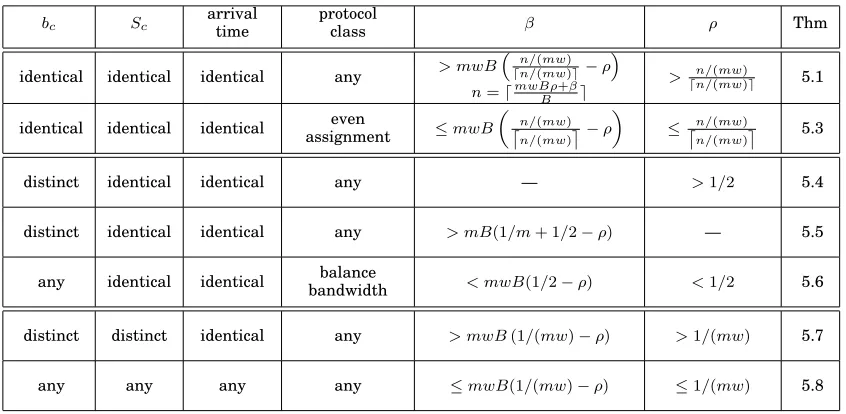
The results presented in this work are summarized in Tables I and II. The tables are organized by the system characteristics (columns) and the rows are further subdivided by double lines into comparable settings for which upper and lower bounds are pre-sented. The terms “distinct”, “identical”, and “any” in these tables refer to the values that the system characteristics can take. For instance, forbc, “identical” means that all
clients have the same bandwidth, “distinct” means that different clients have different bandwidth, and “any” means that it is not restricted. The bounds are on the adversary limitationsρand β. Thus, lower bounds are for impossibility whereas upper bounds are for solvability.
We introduce the Station Assignment problem motivated by wireless networks. Our main contribution is a variety of separation results that expose the complexity of Sta-tion Assignment according to various model assumpSta-tions. Starting from an optimistic scenario where all clients have the same bandwidth and the same group of stations, we gradually remove assumptions making the model more pessimistic (hence, realistic), which gives insight on what the inherent algorithmic challenges of Station Assign-ment are. We note in Tables I and II that not all combinations of systems assumptions have been considered. That is, the question of whether other combinations could lead to more separations is open.
Table I. Summary of bounds on problem solvability forofflineprotocols.
bc Sc arrivaltime protocolclass β ρ Thm
identical identical identical any > mwB
n/(mw) dn/(mw)e−ρ
n=dmwBρ+β
B e
> dn/(mw)n/(mw)e 5.1
identical identical identical assignmenteven ≤mwB
n/(mw)
n/(mw)−ρ
≤n/(mw)
n/(mw) 5.3
distinct identical identical any — >1/2 5.4
distinct identical identical any > mB(1/m+ 1/2−ρ) — 5.5
any identical identical bandwidthbalance < mwB(1/2−ρ) <1/2 5.6
distinct distinct identical any > mwB(1/(mw)−ρ) >1/(mw) 5.7
any any any any ≤mwB(1/(mw)−ρ) ≤1/(mw) 5.8
Table II. Summary of bounds on problem solvability foronlineprotocols.
bc Sc arrivaltime τc protocolclass β ρ Thm
1 distinct distinct open irrevocable ≥0 >1+ln1m 6.1
1 distinct distinct open irrevocable > mB ln1m−ρ
>ln1m 6.3
1 distinct distinct distinct
irrevocable improvident randomized
> mB
3
√
2m−ρ
>√3
2m 6.4
1 distinct distinct distinct
irrevocable improvident deterministic
> mB
1
√
2m−ρ
>√1
2m 6.4
identical any any open improvidentirrevocable ≤ρB < 1
2(m+1) 6.5
ρB≤b <mB−1 any any open irrevocable
improvident ≤ρB ρ <
1
m−1 6.6
can solve the problem, even if all clients arrive simultaneously and have the same life interval. The intuition is the following. Leaving aside rounding (i.e.,β > mwB(1−ρ)), which is similar to ignoring the effect of one station poorly used, and noticing that
mwB conveys a measure of the overall resources of which a ρfraction may be “reg-ularly” used, what Theorem 5.1 shows is that if the adversary is allowed to inject a burst larger than the resources available, the system is overloaded. Given that it must be β ≥ 0, this lower bound for non-solvability implies also a lower bound of
Then, we move to a class of client arrival schedules where clients may have different bandwidths, although the group of stations is still the same for all. In this scenario, Theorem 5.4 shows that, for eachρ >1/2, there exists a(ρ, β)-admissible client arrival schedule such that no Station Assignment algorithm can solve the problem, even if all clients must arrive simultaneously. Changing the adversarial client arrival schedule slightly, Theorem 5.5 shows a bound ofβ > mB(1/m+ 1/2−ρ)for the same conditions. This bound implies a bound onρas well, but it is subsumed by Theorem 5.4. Under the same conditions, Theorem 5.6 shows that an algorithm that (somehow) balances the station-bandwidth usage solves Station Assignment, for any (ρ, β)-admissible client arrival schedule such thatβ < mwB(1/2−ρ)andρ <1/2.
The last class of client arrival schedules we consider in our offline analysis does not restrict groups of stations or bandwidths. In Theorem 5.7, it is shown that, for each β > mB(1/m−ρ), there exists a (ρ, β)-admissible client arrival schedule such that Station Assignment cannot be solved by any algorithm, even if all clients arrive at the same time. This result implies ρ > 1/mbecause β ≥ 0. Theorem 5.8 matches those bounds, showing that if ρ ≤ 1/(mw) and β ≤ mwB(1/(mw)−ρ) the Station Assignment problem is solvable.
Moving to online protocols (c.f., Table II), we prove in Theorem 6.3 that for any irre-vocable algorithm, that is, algorithms where the station-client assignments are final, ifm >1, there is a client arrival schedule such that ifβ > mB(1/lnm−ρ)the Station Assignment problem is not solvable. The latter lower bound implies a lower bound of
ρ > 1/lnm because β ≥ 0. If the algorithm is additionally improvident, that is, the departure time of clients already in the system is not known in advance, by showing a reduction from Load Balancing [Azar et al. 1994], Theorem 6.4 shows lower bounds of β > mB 3/√2m−ρ
andβ > mB 1/√2m−ρ
for randomized and deterministic algorithms respectively. Those bounds imply that if ρ > 3/√2m and if ρ > 1/√2m
respectively the Station Assignment problem cannot be solved. Finally, Theorem 6.5 shows that, when all clients have the same bandwidthb≤Band do not depart, even if the groups of stations and arrival times are different, ifρ <1/(2(m+ 1))andβ≤ρB
the algorithm that distributes clients evenly (restricted to groups of stations) solves Station Assignment. For a similar scenario but with restrictedρB≤b < B/(m−1), a better bound ofρ <1/(m−1)is shown in Theorem 6.6.
We also show in Theorem 6.1 (not included in Table II) a lower bound onρfor non-solvability with irrevocable algorithms that applies to systems with distinct station-bandwidths. Corollary 6.2 shows that instantiating Theorem 6.1 on a system where all stations have the same bandwidthB, the lower bound on ρfor non-solvability is
ρ >1/(1 + lnm).
4. RELATED WORK
Adversarial queuing was introduced in [Andrews et al. 2001; Borodin et al. 2001], applied to store-and-forward networks, to measure stability of buffers and packet la-tency of dynamically injected packets. Later, there were approaches to apply it in the context of wireless networks: modelled as time-varying channels [Andrews and Zhang 2005], radio channels with collisions [Chlebus et al. 2012; Anantharamu et al. 2009], or SINR networks [Kesselheim 2012]. A more detail competitive analysis of dynamic and stochastic traffic was performed in a single-hop radio channels with collisions [Bi-enkowski et al. 2012]. The difference between this line of research and our work is that it considered simple packet forwarding requests without additional scheduling constraints.
Table III. Competitive ratios of load balancing problem
Unknown duration Known duration Permanent Identical 2−o(1) [Graham 1966; Azar
et al. 1994]
2−o(1) [Graham 1966; Azar et al. 1994]
2−[Karger et al. 1996] Related Θ(1)[Azar et al. 1997] Θ(1)[Azar et al. 1997] Θ(1)[Azar et al. 1997] Restricted O(√m)[Azar et al. 1997] O(logmT)[Azar et al. 1997] Θ(logm)[Aspnes et al. 1993]
Ω(√m)[Azar et al. 1994]
temporary (as opposed to permanent when tasks do not depart), and task arrivals and departures always occur in time. Each task has an associated weight that represents the load that processing of such a task adds to a machine. Additionally, each task has an associated subset of machines that may process the task (restricted assignment). Upon arrival, a task must be assigned to a machine immediately and cannot be trans-ferred to another machine later. The machine starts processing the task immediately and continues until the task departs. An assignment algorithm selects a machine to assign each task upon arrival. In the online version the algorithm does not know fu-ture arrivals or deparfu-tures, whereas an offline algorithm has complete knowledge. The cost of an assignment of a given input is the maximum load of the machines for such assignment.
The load balancing problem is related to our Station Assignment problem when the laxity is the same for all clients. One main difference is the objective function. In load balancing the load can be unbounded and the objective is to minimize the maximum load over the machine, while in the Station Assignment problem the maximum load of the server is bounded and the objective is to find criteria for a feasible schedule. As will shown later (Theorem 6.4), some special instance of the load balancing problem can be mapped to some instance of the Station Assignment problem. However, this mapping is not generic, and there is no evidence that an algorithm that works well for one objective would work for the other. Moreover, the fact that our adversary has two limitations also separates the problems. Indeed, allowing a larger burst (β) imposes a more stringent limitation on arrival rate (ρ) in the Station Assignment problem, while intuitively the restriction on the load in the load balancing problem corresponds only to one of these parameters, mainly the arrival rate.
For the load balancing problem, the authors in [Azar et al. 1994] study the compet-itive ratio of an online algorithm with respect to an offline one as the supremum over all inputs of the cost ratio. Specifically, for the greedy online algorithm that assigns each task to the least loaded machine, they show matching upper and lower bounds of ((3m)2/3/2)(1 +o(1))on the competitive ratio, and a lower bound ofΩ(√m)for any de-terministic or randomized algorithm. The lower bound is matched in [Azar et al. 1997]. Variants of the problem include relaxing the constraint such that the duration of a job is known on arrival (temporary) or the job never depart (permanent). Another direc-tion of relaxadirec-tion includes making all machines to be available for all jobs (identical or related). Table III gives a summary of the results.
In [Alon et al. 1997], Alon et al. studied a similar model for permanent tasks. They consider two cases: (i) the tasks have associated weights and can be assigned to any machine (unrestricted), (ii) the tasks have unit weights and can be assigned only to a subset of the machines (restricted). They provide an -approximation scheme for the
Lp norm of the loads. Interestingly, for the restricted unit-weights model, they show
that there exists an assignment that is optimal for all norms. For further references on dynamic online scheduling and load balancing, see the chapters [Pruhs et al. 2004; Azar 1996].
2007; Chan et al. 2008]. In the windows scheduling problem, items (cf. clients) with windows wi have to be broadcasted on a channel periodically such that every two
broadcasts of the same item cannot be more than wi timeslots apart. In the context
of our problem, this is analogous to the scenario where the bandwidth of a station and the bandwidth requirement of a client is the same. The objective has been however to minimize the number of channels (cf. stations). Windows scheduling has been studied as a restricted version of bin packing of unit-fraction items [Bar-Noy et al. 2007; Chan et al. 2008] where the size of the items is the reciprocal of the windows. The objective has been again to minimize the number of bins (cf. stations).
5. ANALYSIS OF OFFLINE PROTOCOLS
In this section, we study the impact of ρ and β on the offline solvability of Station Assignment.
5.1. Unique Group of Stations and Client Bandwidth
We start with a very optimistic scenario (for Station Assignment algorithms) where all clients have the same group of stations and the same bandwidth. We show a lower bound for non-solvability that holds even under those optimistic conditions. Given that
β ≥0by definition, the bound obtained implies a lower bound onρ.
THEOREM 5.1. Given a system ofm stations each with bandwidth B, even if all clients have the same group of stations and the same bandwidth, for any
β > mwB
n/(mw) dn/(mw)e−ρ
,
wheren≥ d(mwBρ+β)/Be, n∈Z+, there exists a(ρ, β)-admissible client arrival sched-ule such that no algorithm can solve the Station Assignment problem, even if all clients have the same life interval.
PROOF. Consider a client arrival schedule of n clients, for any n ≥
(mwBρ+
β)/B, n ∈ Z+, with the same bandwidth b = (mwBρ+β)/n and the same life
in-terval of length w. Such schedule is (ρ, β)-admissible because, for any n0 ≤ n and any subinterval T of the life interval of the clients (i.e., |T| ≤ w), it holdsn0b|Tw| ≤ nb|Tw| = (mwBρ+β)|Tw| ≤ m|T|Bρ+β, andb = mwBρn +β ≤ mwBρ+β
(mwBρ+β)/B ≤ B.
How-ever, by the pigeonhole principle, there is at least one station and one slot for which the sum of bandwidths of the clients assigned to the station in the slot is at least
dn/(mw)eb =dn/(mw)e(mwBρ+β)/n. Replacingβ > mwB((n/(mw))/dn/(mw)e −ρ), the latter is bigger thanB.
Given that the client arrival schedule is adversarial, by choosing the station group to be a singleton in the above proof, that ism= 1, and the laxityw= 1, the lower bound obtained becomesβ > B(1−ρ), which implies that ifρ > 1 the Station Assignment is not solvable. We assume that ρ ≤ 1 throughout the rest of the paper. This result can also be used to show that, for some higher values ofβ, Station Assignment is not solvable for anyρ >0.
COROLLARY 5.2. Given a system of m stations each with bandwidth B, even if all clients have the same group of stations and the same bandwidth, if ρ > 0 and
PROOF. From Theorem 5.1, it is enough to prove thatβ > mwB(n/(mwdn/(mw)e)− ρ), forn=d(mwBρ+β)/Beandρ >0. This holds ifβ≥mwBdn/n/((mwmw))e = dn/nB(mw)e.
Now we show a matching upper bound for solvability in the same optimistic scenario. That is, all clients have the same group of stations and bandwidth.
THEOREM 5.3. Given any(ρ, β)-admissible client arrival schedule ofnclients, such that all clients have the same bandwidth, the same station group of size m > 0, and the same arrival time, ifβ ≤mwB
n/(mw)
n/(mw)−ρ
,the algorithm that assigns clients
evenly among stations and intervals of w times slots solves the Station Assignment problem on any system of at leastmstations each with bandwidthB.
PROOF. Let b be the client bandwidth. In order to show the claim, it is enough to show it for the initial w time slots after the arrival of the clients, given that, if some client departs, the bandwidth usage of the assigned station is reduced. Note that the life interval of all clients is at least w, by the definition of laxity. Given that the assignment of clients is even, the station most used has at mostdn/(mw)eclients assigned per slot. Hence, in order to prove the claim, it is enough to proved n
mweb≤B.
Due to admissibility (Equation (1)) forwslots (i.e.,|T|=w), we know thatnb≤mwBρ+
β. Replacing this bound onb, it is enough to show thatd n mwe
mwBρ+β
n ≤ B. Replacing
the bound onβ, it can be seen that the inequality holds.
5.2. Unique Stations Group and Different Client Bandwidth
We now consider a less optimistic scenario where the client bandwidths may be differ-ent. Theorems 5.4 and 5.5 show lower bounds for non-solvability on ρand β respec-tively.
THEOREM 5.4. Given a system of m stations each with bandwidth B, even if all clients have the same station group, for any ρ > 1/2, there exists a (ρ, β)-admissible client arrival schedule such that no algorithm can solve the Station Assignment prob-lem, even if all clients have the same life interval.
PROOF. Consider a client arrival schedule ofmw+ 1clients with the same station groupS and the same life interval of lengthw. One of the clients, call itx, has band-width b = (ρ−δ)mwB for some value δ such that 1/2 < δ < ρ and ρ−1/(mw) ≤ δ < (ρmw−1)/(mw−1). Each of the remainingmw clients has bandwidthδB. Such schedule is(ρ, β)-admissible since, for any subset ofn≤mw+ 1clients that includesx, Equation (1) becomes∀T :|T| ≤w: ((n−1)δB+ (ρ−δ)mwB)|Tw| ≤ |T|mρB+β, which is true becausen−1 ≤mwandβ ≥0. On the other hand, if we consider then≤mw
clients that do not includex, Equation (1) becomes∀T :|T| ≤w:nδB|Tw|≤ |T|mρB+β, which is true because n≤mw,β ≥0, and δ < ρ. Finally, Equation (2) also holds be-causeρ≤1and henceδB < ρB≤B, and(ρ−δ)mwB≤Bforδ≥ρ−1/(mw). However, given that there aremw+ 1clients, due to the pigeonhole principle two clients have to be assigned to the same slot of the same station. Then, there is a slot in some station such that the sum of the assigned clients is either2δB > BorδB+ (ρ−δ)mwB > B
becauseδ <(ρmw−1)/(mw−1).
The following theorem shows a lower bound on β for this scenario. The proof uses an adversarial client arrival schedule similar to the schedule used in the proof of The-orem 5.4.
(ρ, β)-admissible client arrival schedule such that no algorithm can solve the Station Assignment problem, even if all clients have the same arrival time.
PROOF. Consider a client arrival schedule of m+ 1 clients with the same station groupS, laxityw = 1, and life intervalτc ≥w. One of the clients, call itx, has
band-widthB. Each of the remainingmclients has bandwidthδB, for some valueδ >1/2. We show that forβ > mB(1/m+ 1/2−ρ)andρ >0such schedule is(ρ, β)-admissible as follows. Given that all clients arrive at the same time and are active at least one slot, it is enough to consider the first slot upon arrival. This is true since, if some clients depart, the schedule is still admissible because the station group of all clients is S. Consider any subset ofn≤m+ 1clients that includesx. Then, Equation (1) becomes
(n−1)δB+B ≤mρB+β
which is true becausen−1≤mforβ =mB(1/m+δ−ρ)> mB(1/m+ 1/2−ρ). On the other hand, if we considern≤mclients that do not includex, Equation (1) becomes
nδB≤mρB+β
which is true becausen≤mandβ=mB(1/m+δ−ρ)> mB(1/m+ 1/2−ρ). Finally, Equation (2) also holds becauseδB < B. However, given that there arem+ 1clients andw= 1, due to the pigeonhole principle two clients have to be assigned to the same slot of the same station. Then, there is a slot in some station such that the sum of the assigned clients is either 2δB > B or δB+B > B. Hence, the Station Assignment problem cannot be solved.
Now we show an upper bound for solvability for the same scenario. That is, the group of stations is unique among clients but the bandwidth may be different. This scenario is similar to packing items intomw bins and the major difference is that typcially in bin packing the number of bins is not given but the objective to be minimized. First we present the algorithm that computes the assignment, and then we prove its properties.
ALGORITHM 1:Computation of Station Assignment for a set of clients that arrive simultane-ously having all the same group of stationsS. The transmissions schedule obtained corresponds to time slots in[1, w], and after periodically with periodw. LetAbe the output transmissions schedule implemented as a Boolean matrix of size|C| × |S| ×w. LetBs,t(A)be the bandwidth us-age on stationsand timetinA, andBmax(A)be the maximum bandwidth usage at any station and time slot inA.
1 foreachc∈Cdo
2 choose some stations∈Suniformly at random;
3 choose some time slott∈[1, w]uniformly at random;
4 Ac,s,t←true;
5 whileBmax(A)> Bdo
6 find stationsand time slottsuch thatBs,t(A) =Bmax(A);
7 find stationss0, s00and time slotst0, t00such thatBs0,t0(A) +Bs00,t00(A)≤B;
8 foreachc∈Cdo
9 if Ac,s0,t0 =truethen
10 Ac,s0,t0←f alse;
11 Ac,s00,t00←true;
12 find some clientcsuch thatAc,s,t=true; 13 Ac,s,t=f alse;
THEOREM 5.6. Algorithm 1 computes in polynomial time a Station Assignment for any(ρ, β)-admissible client arrival schedule such that all clients have the same arrival time, the same group of stations of sizem >0, each with bandwidthB, the same laxity
w, and β < mwB(1/2−ρ). The transmission schedule of such assignment is periodic with periodw.
PROOF. Consider a(ρ, β)-admissible client arrival schedule where all clients have the same station group, arrive simultaneously, and all have laxityw. Let the time slot of arrival be labeled as1. Algorithm 1 computes the assignment for the first interval of slots[1, w]. The assignment in all the subsequent intervals[iw+ 1,(i+ 1)w], for each integeri >0, is identical.
Algorithm 1 initially assigns each client at random to one of themstations and one of thewslots (cf. Lines 1 to 4). Call such assignmentA. Then, as long as the maximum bandwidth used inAin some slott in some stationsis aboveB, the algorithm finds two stationss0, s00and two time slotst0, t00such that the sum of bandwidth used ins0, s00
in time slotst0, t00is at mostB(cf. Line 7).
To see whys0, s00andt0, t00exist, assume they do not. Then, adding in pairs, the total bandwidth used throughout all stations and slots is at leastmwB/2. But, according to Equation (1), the total bandwidth used must be at mostmwρB+β < mwB/2. Which is a contradiction.
Then, in Lines 8 to 14, Algorithm 1 reassigns all clients from s0, t0 to s00, t00 (thus keeping the total bandwidth ins00 at timet00at mostB) and reassigns one client from
sat timettos0at timet0(which was left available). Such client exists since otherwise the client arrival schedule would violate Equation (2).
The polynomial running time follows by simple inspection of Algorithm 1. From Line 6 of the algorithm, when the algorithm stops it holds thatBmax≤B.
A similar bound can be obtained if clients never depart, even if they arrive at differ-ent times.
5.3. Distinct Stations Group and Client Bandwidth
Now we consider the harshest scenario where clients may have different station groups and different bandwidths. Given thatβ ≥0by definition, the bound obtained implies that ifρ >1/mthe problem is not solvable.
THEOREM 5.7. Given a system ofmstations each with bandwidthB, for eachβ > mwB(1/(mw)−ρ), there exists a(ρ, β)-admissible client arrival schedule such that no algorithm can solve the Station Assignment problem, even if all clients have the same life interval.
PROOF. Consider a client arrival schedule ofn+ 1clients, wheren=amw, for some integera≥1, such thatn≥(mwBρ+β−B)/B. The firstnclients have a singleton sta-tion group so that, for each stasta-tionsi,i= 1,2, . . . , m, the number of clients with station
group{si}isaw. The bandwidth of each of thesenclients isb = (mwBρ+β−B)/n.
There is one additional clientxwith station groupM and bandwidthB. All then+ 1 clients in the client arrival schedule have the same life interval of lengthw≥1). Such client arrival schedule is (ρ, β)-admissible because, for any subinterval T such that
|T| ≤w, the total bandwidth of any subset ofn0≤n+ 1clients is, ifxis included then ((n0−1)b+B)|Tw|= ((n0−1)mwBρn+β−B+B)|Tw|≤(mwBρ+β)|Tw|≤ |T|mBρ+β. Otherwise, ifxis not included, and hencen0 ≤n, the total bandwidth isn0b|wT| =n0mwBρn+β−B|Tw| =
n0
awBρ|T|+n
0β−B n
|T|
w ≤
n0 aw
all clients. However, for any assignment, there must be at least one slot of one station with bandwidth usageB+ab=B+mwn b=B+mwn mwBρn+β−B =B(1 +ρ) +βmw−B, which is bigger thanBforβ > mwB(1/(mw)−ρ).
Now we show a matching upper bound for solvability for the same strict scenario. That is, both, the group of stations and bandwidth, may be different among clients. Let a valid assignment be one where each clientc is scheduled to transmit to some station inScat least once in each sequence ofwslots. The particular relation between
β andρin this upper bound guarantees that, as long as the client arrival schedule is (ρ, β)-admissible,anyvalid Station Assignment solves the problem.
THEOREM 5.8. For any system ofm >1stations, each with the same bandwidthB, if the client arrival schedule is(ρ, β)-admissible with
β≤mwB
1
mw−ρ
,
any valid assignment solves the Station Assignment problem.
PROOF. Consider an assignment of a given(ρ, β)-admissible client arrival schedule. Consider the set C0 ⊆ C of clients that are active at any given time step t in such assignment. Because the client arrival schedule is(ρ, β)-admissible, making|T|=win Equation (1) and using thatw≤ |τc|, it must bePc∈C0bc≤w|S(C0)|ρB+β≤wmρB+β.
Replacing in the latter the upper bound on β, we have thatP
c∈C0bc ≤ B. Thus, no
station can have a bandwidth usage bigger thanB.
6. ANALYSIS OF ONLINE PROTOCOLS 6.1. Lower Bounds for Non-Solvability
We show now conditions under which irrevocable algorithms do not solve the Station Assignment problem. Theorem 6.1 applies to a more general model where the station bandwidths may be different. The corollary that follows instantiates the result on a model where the station bandwidth is unique.
THEOREM 6.1. For any system ofm stations, where stations has bandwidth Bs,
any β ≥ 0, and for each irrevocable online algorithm A, there is a station labeling
{s1, . . . , sm}and a(ρ, β)-client arrival schedule withbc= 1,∀c∈C, such that, if
ρ > Bsm
Bsm+
m−1 X
j=1
m
X
i=j
Bsi− max
j∈[j,m] Bsj
1
m−j+ 1
m−j
Y
k=2
1−1 k
,
Acannot solve the Station Assignment problem.
PROOF. Consider the following(ρ, β)-client arrival schedule.∀c∈C:bc= 1. The life
interval of all clients is open ended. That is, upon arrival, clients stay active forever. Clients arrive in batches. That is, groups of clients arrive simultaneously, rather than in separate time slots. A new batch of clients arrives after the previous batch has been irrevocably assigned by algorithmA. Time is conceptually divided intorounds, which are enumerated sequentially as1,2, . . . , m. A new round starts when a new batch of clients arrive. That is, clients will arrive inmgroups, each group at a different time, and rounds are defined by those arrivals. The set of clients arriving at the beginning of round i is called Ci. All clients arriving in the same round have the same group
because after this number of rounds all stations have been removed.) For any station
s, letγs(i)be the number of clients assigned byAtosup to the end of roundi, and let
the available capacityof stationsat the end of roundi bewρBs−γs(i). Then, for
roundi+ 1the station removed is some stations0 with the largest available capacity at the end of roundi, with ties broken arbitrarily. In other words,s0is not in the group of stations of clients arriving at the beginning of roundi+ 1. For the purpose of this analysis, we label the stations as follows. For any0 < i < mthe station removed in roundiis labeledsi, and the station left in roundmis labeledsm. Using this notation,
for roundi, the group of stations is∀c∈Ci:Sc ={si, si+1, . . . , sm}, and the number of
clients injected in roundiis
|Ci|=
wρmaxj∈[1,m]Bsj ifi= 1
wρ maxj∈[i,m]Bsj −maxj∈[i−1,m]Bsj+Bsi−1
if2≤i≤m
To show that this client arrival schedule is admissible, consider any set of clientsC0 ⊆ C. LetB(C0) =P
s∈S(C0)Bs. To show that Equation (1) holds, it is enough to show
∀T = [t, t0]⊆N: X
c∈C0
|τc∩T|
w ≤ |T|B(C
0)ρ+β
which is true if
|C0| ≤B(C0)wρ . (3)
To show that the latter inequality holds, consider a partitionP ={C0
1, C20, . . . , Cm0 } of
C0 such that, for eachi∈[1, m], it isCi0=C0∩Ci. That is,Ci0is the subset of clients in
C0 that arrived in roundi. From the client arrival schedule, we know that|C0
i| ≤ |Ci|.
Additionally, for each roundisuch that|C0
i|>0, we know that all stationssj,i≤j≤m,
are in the group of stations of clients inC0
i. Letr = min{i :|Ci0| >0}. Then, we know
thatB(C0) =Pm
i=rBsi. After replacing in Equation (3), it is enough to show
X
i:|C0
i|>0
|Ci| ≤wρ m
X
i=r
Bsi
which is true if
m
X
i=r
|Ci| ≤wρ m
X
i=r
Bsi.
Ifr >1, it is enough to prove
m
X
i=r
max
j∈[i,m]
Bsj − max
j∈[i−1,m]
Bsj +Bsi−1
≤
m
X
i=r
Bsi .
Expanding and cancelling, it is enough to prove
− max
j∈[r−1,m]
Bsj +Bsr−1
+Bsr+· · ·+Bsm≤
m
X
i=r
Bsi
which is true becausemaxj∈[r−1,m]Bsj ≥Bsr−1. Forr= 1, the derivation is similar but this term does not appear on the left-hand side.
We show now thatAdoes not solve the Station Assignment problem for this admis-sible client arrival schedule as follows. Let the total bandwidth of stations{si, . . . , sm}
be Bi = P m
j=iBsj. Let the total number of clients assigned to stations {si+1, . . . , sm} at the end of round i beΓi = P
m
round |C1| clients arrive, and that at the end of that round, after A assigns these clients, the stations1 is removed from the group of stations for the second round be-cause it has the largest available capacity at the end of round 1. After the assign-ment of round 1 is done, the available capacity ofs1 iswρBs1 −γs1(1), which, being the largest, is at least the average available capacity(wρB1− |C1|)/m. Then, s1 has γs1(1) ≤wρBs1 −(wρB1− |C1|)/mclients assigned. Therefore, for the second round, there are
Γ1=|C1| −γs1(1)≥wρ
max
j∈[1,m]
Bsj−Bs1 1− 1 m + 1 m m X i=2 Bsi
!
clients that are already assigned to stations in{s2, . . . , sm}, and|C2|new clients arrive, yielding a total of |C2|+ Γ1. After the assignment of round 2 is done, the available capacity ofs2is the largest, and therefore it is at least the average available capacity. Thus,s2has
γs2(1) +γs2(2)≤wρBs2−
wρB2−Γ1− |C2| m−1 clients assigned. Therefore, for the third round, there are
Γ2=|C2| −γs2(1)−γs2(2) + Γ1
≥(|C2|+ Γ1−wρBs2)
1− 1 m−1
+wρ
Pm
i=2Bsi
m−1
≥wρ max
j∈[2,m]
Bsj−Bs2 1− 1
m−1
−
max
j∈[1,m]
Bsj −Bs1
1
m
1− 1 m−1
+
m
X
i=2 Bsi
1
m
1− 1 m−1
+
m
X
i=3 Bsi
1
m−1
clients that are already assigned to stations in{s3, . . . , sm}, and|C3|new clients arrive, yielding a total of|C3|+ Γ2. Proceeding similarly, for them-th round, there areΓm−1= |Cm−1| −P
m−1
i=1 γsm−1(i) + Γm−2 clients that are already assigned to station sm, and |Cm|new clients arrive. Lower boundingΓm−1as before, it yields a total of
|Cm|+ Γm−1≥
wρ
Bsm+
m−1 X j=1 m X
i=j
Bsi− max
j∈[j,m] Bsj
1
m−j+ 1
m−j
Y
k=2
1−1 k
.
However,smmay receive at mostwBsm transmissions withinwsteps. Thus, for any
ρ > Bsm
Bsm+
Pm−1
j=1
Pm
i=jBsi−maxj∈[j,m]Bsj
1
m−j+1 Qm−j
k=2 1− 1
k
the Station Assignment problem cannot be solved.
COROLLARY 6.2. For any system ofmstations each with bandwidthB, and for each irrevocable algorithmA, and for anyρ >1/(1 + lnm)andβ ≥0, there is a(ρ, β)-client arrival schedule withbc = 1,∀c ∈C, such thatAcannot solve the Station Assignment
PROOF. Replacing all bandwidths in the lower bound ofρin Theorem 6.1 byB, we
getρ >Pm
j=11/j −1
=H−1
m >1/(1 + lnm).
Observe that for the above proof to work it is not needed that an irrevocable algo-rithm assigns a client to a station forever. It is enough that it assigns it form+wsteps to reach the same result.
The following theorem for irrevocable algorithms relatesβ andρfor the case where the bandwidth of all stations is the same andm > 1. Given thatβ ≥0 by definition, the bound implies that ifρ >1/lnm, the Station Assignment problem is not solvable.
THEOREM 6.3. For any system ofm > 1 stations, such that all stations have the same bandwidthB, and for each irrevocable algorithmA, there is a(ρ, β)-client arrival schedule withbc= 1,∀c∈C,andw= 1 such that, ifβ > mB(1/lnm−ρ), thenAcannot
solve the Station Assignment problem.
PROOF. Consider an adaptive adversary that decides which clients arrive according to the actions ofA. The adversarial client arrival schedule is the following. Letw= 1. For each clientc, it isbc= 1. The life interval of all clients is open ended. That is, upon
arrival, clients stay active forever. Clients arrive in batches. A new batch of clients arrive after the previous batch has been irrevocably assigned by algorithmA. Time is conceptually divided inmrounds, which are enumerated sequentially as1,2, . . . , m. A new round starts when a new batch of clients arrive. The number of clients arriving in each round isρB+β/m. (We omit ceilings and floors throughout the proof for clarity.) All clients arriving in the same roundihave the same group of stations Si. Starting
from the whole set of stationsSin the first round, the group of stations for each new round is reduced by one station. We say that such station isremoved. Thus, for round 1the group of stations has sizem, for round2the size ism−1, and so on until round
mwhen the group of stations has size1. For any round r >1, the station removed is the station with the smallest number of clients assigned.
First we notice that the client arrival schedule defined is(ρ, β)-admissible. For this purpose, it is enough to show that the property is preserved after each batch of arrivals. Consider any round i = 1, . . . , m. Let Cj be any subset of clients arriving in round
j = 1, . . . , i with group of stations Sj. Given that, by definition of the client arrival
schedule,ρB+β/mclients arrive in each round, we know that |Cj| ≤ρB+β/m. So,
in Equation (1), the ρB term can be applied to the station removed in roundj, and putting together all theβ/mterms they add up toiβ/m≤β.
We show now that, with the above client arrival schedule, the sum of the bandwidths of the clients assigned to the station inSmis more thanB. Let the number of clients
arriving in each round be called X = ρB +β/m. In round 1 the overall number of clients is X. Given that the station removed is the one with the smallest number of clients, in round 2the overall number of clients assigned to stations inS2 is at least X(1−1/m) +X. Likewise, in round3, the overall number of clients assigned to stations inS3is at least((X(1−1/m) +X)(1−1/(m−1)) +X. Inductively, the number of clients assigned to the station inSmis at least
. . . Xm−1
m +X
m−2
m−1+X
m−3
m−2. . .
1 2 +X =
X 1
m+
1
m−1 +· · ·+ 1 2 + 1
> Xlnm.
That is, the total bandwidth of the clients assigned to the station in Sm is at least
The following theorem shows that the restriction onρfor solvability with irrevocable assignments is stronger for improvident algorithms. Theorem 6.4 shows that, for ran-domized online algorithms, ifβ > mB 3/√2m−ρ
the Station Assignment problem is not solvable, and ifβ > mB 1/√2m−ρ
the Station Assignment problem is not solv-able online deterministically. Given thatβ ≥0by definition, the bound implies that if
ρ >3/√2m, or ifρ >1/√2mrespectively, the problem is not solvable.
THEOREM 6.4. For any set of m stations each with bandwidth B, the following holds, even if all clients have the same bandwidth:
(1) For any m ≥ 5 and β > mB 3/√2m−ρ, there exists a (ρ, β)-admissible client arrival schedule such that no online irrevocable improvident randomized algorithm can solve Station Assignment.
(2) For anym≥1 andβ > mB 1/√2m−ρ, there exists a(ρ, β)-admissible client ar-rival schedule withw= 1 such that no online irrevocable improvident deterministic algorithm can solve Station Assignment.
PROOF. Ifβ > mB(1−ρ), the claim follows from Theorem 5.1. So, for the rest of the proof we assume thatβ ≤mB(1−ρ).
For the Load Balancing problem, where computing tasks have to be assigned to servers, the proof of Theorem 3.3 in [Azar et al. 1994] shows a sequence of unit-weight tasks such that, the maximum (over the servers) off-line load at all times is 1, and the competitive ratio of any randomized irrevocable improvident algorithm is at least (√2m/3)(1 +o(1)). (The theorem is stated in asymptotic notation, but the bound ob-tained in the proof is the expression given here.) We reuse such adversary mapping tasks to clients, servers to stations and weights/loads to bandwidths. Let the band-width of such clients be instead ρB+β/m and the laxity w = 1. This client arrival schedule is(ρ, β)-admissible because(i)β ≤mB(1−ρ)and thenρB+β/m≤B, and (ii)the maximum off-line bandwidth at all times on each station is at mostρB+β/m. However, the bandwidth used at some station is at least(√2m/3)(ρB+β/m), which is larger than B if β > mB 3/√2m−ρ, which is feasible for m > 9/2. The same argument can be used for deterministic algorithms and competitive ratio of√2m.
6.2. Upper Bounds for Solvability
The following upper bound applies to a setting where the station bandwidth is unique and all laxities are w = 1, but the station group may be different for each client. First we present the algorithm that computes the assignment, and then we prove its properties.
ALGORITHM 2:Online computation of Station Assignment for a set of stationsSwith unique bandwidthB, and clients with unit laxity.Csis the set of clients assigned to stations.
1 foreach stations∈Sdo
2 Cs← ∅;
3 foreach arriving clientcdo
4 find a stations∈Scsuch thatPc0∈C
sbc0= mins0∈Sc
P
c0∈C
s0bc
0;
THEOREM 6.5. For any system ofmstations each with bandwidthB, ifρ <1/(2(m+ 1)), β ≤ρB, and all clients have the same bandwidthb ≤ B, laxityw = 1, and never depart, Algorithm 2 solves the Station Assignment problem.
PROOF. For the sake of contradiction, assume that some station gets overloaded. Consider the clients in the order they arrive and are assigned to stations. In particular, the first clientbc whose assignment (at some time slott) makes some stations ∈S to be overloaded. Let us assume, without loss of generality, thatbdivides exactlyB,1and
denote r , B/b. Then, after the assignment of bc, we have that s has exactly r+ 1 clients assigned, and the rest of stations no more than rclients assigned each. That is, the total number of clients assigned is at most rm+ 1. We will show that in this scenario the actual number of clients has to be higher, reaching a contradiction.
LetCbbe the set ofr+ 1clients assigned tosup tobc. Recall that, for anyC0 ⊆Cb, it is S(C0) =S
c∈C0Sc. Also, given that the bandwidth of all clients is the same valueb, we
have thatP
c∈C0bc =|C0|b. Replacing in Equation 1 and considering as time interval
the time slott, we have for anyC0⊆Cb,
|C0|b≤ |S(C0)|ρB+β, given thatβ ≤ρB,
≤(|S(C0)|+ 1)ρB.
Hence, the following holds.
|S(C0)| ≥|C
0|
ρr −1, for anyC
0⊆
b
C. (4)
Consider a labeling of clients inCb={c0, c1, c2, . . . , cr=bc}, where the subindex is the
order in which the clients were assigned tos. Let us define subsetsCi containing the latestr−i+ 1clients assigned tosup tocr=bc. That is,
Ci ={ci, . . . , cr}, for eachi= 0, . . . , r.
Then, from Equation 4 we have that
|S(Ci)| ≥ r−i+ 1
ρr −1, for eachi= 0, . . . , r. (5)
The following observations will be used. Observe that S(Ci) ⊆S(Ci−1), sinceCi ⊂ Ci−1. The set of stationsS(Ci)contains by definition the stations to which at least one of the clients cj ∈ Ci could be assigned, where j ≥ i. Also, notice that Algorithm 2
assigns cj to the station in Scj with the largest available bandwidth, breaking ties arbitrarily. Then, when cj (which is thej+ 1st client assigned tos) was processed in
Line 4 of Algorithm 2, all stations in Scj had at leastj clients already assigned. In order to lower bound the number of clients in all the stations afterbc =cr is assigned
tos, we will use the latter argument for each station inS(Cb).
Let the number of clients in all stations afterbc=cris assigned tosbe denoted asX.
We associate to each stations0 ∈S(Cb)the largestj, denotedk(s0), such thats0 ∈Scj. In other words, we associate to each stations0 the maximum of the minimum number of clients that should have been assigned tos0, due to assignments tos. Then, we have the following lower bound.
X≥1 + X
s0∈S(Cb)
k(s0). (6)
Where the additive one corresponds to client bc. If we show that the latter sum is
P
s0∈S(Cb)k(s0) > rm we reach a contradiction proving the theorem. So, in the rest
of the proof we focus on proving the latter inequality.
First, we re-write the sum in Equation 8 grouping the stations that have the same
k(·), as follows.
X ≥ 1 +r|S(Cr)|+ r−1 X
i=1
i(|S(Ci)| − |S(Ci+1)|)
= 1 +
r
X
i=1 |S(Ci)|
≥ 1 +
r
X
i=1 r
−i+ 1
ρr −1
, from Equation 5,
= 1 +r(r+ 1)
2ρr −r= 1 + r+ 1
2ρ −r.
Sinceρ <2(m1+1) < 2(mr+1+1)r, it isX > rm+ 1, which is a contradiction.
THEOREM 6.6. For any system of m stations each with bandwidthB, ifβ ≤ ρB, and all clients have the same bandwidthbsuch thatρB≤b < B/(m−1), laxityw= 1, and never depart, Algorithm 2 solves the Station Assignment problem.
PROOF. For the sake of contradiction, assume that some station gets overloaded. Consider the clients in the order they arrive and are assigned to stations. In particular, the first clientbc whose assignment (at some time slott) makes some stations∈ S to be overloaded. Let us assume, without loss of generality, thatbdivides exactlyB,2and denote r , B/b. Then, after the assignment of bc, we have thats has exactlyr+ 1 clients assigned, and the rest of stations no more thanr clients assigned each. That is, the total number of clients assigned is at most rm+ 1. We will show that in this scenario the actual number of clients has to be higher, reaching a contradiction.
LetCbbe the set ofr+ 1clients assigned tosup tobc. Recall that, for anyC0 ⊆Cb, it
isS(C0) =S
c∈C0Sc. The following property holds.
PROPERTY 6.7. ∀C0 ⊆
b
C:|C0| ≤ |S(C0)|.
That is, for each group of clients of cardinalityx, there are at leastxstations to which these clients can be assigned. To see this, consider a setC0 ⊆Cb, the corresponding set S(C0), and considering as time interval the time slott. Given that the bandwidth of all clients is the same, we have thatP
c∈C0bc =|C0|b. Replacing in Eq. 1 we have the
following.
|C0|b≤ |S(C0)|ρB+β, given thatβ < ρB,
<(|S(C0)|+ 1)ρB, given thatb≥ρB,
≤(|S(C0)|+ 1)b,
which proves the property.
Consider a labeling of clients inCb={c0, c1, c2, . . . , cr=bc}, where the subindex is the
order in which the clients were assigned tos. Let us define subsetsCi containing the
latestr−i+ 1clients assigned tosup tocr=bc. That is, Ci ={ci, . . . , cr}, for eachi= 0, . . . , r.
Then, from Property 6.7 we have that
|S(Ci)| ≥r−i+ 1, for eachi= 0, . . . , r. (7) The following observations will be used. Observe that S(Ci) ⊆S(Ci−1), sinceCi ⊂ Ci−1. The set of stationsS(Ci)contains by definition the stations to which at least one of the clients cj ∈ Ci could be assigned, where j ≥ i. Also, notice that Algorithm 2
assigns cj to the station in Scj with the largest available bandwidth, breaking ties arbitrarily. Then, when cj (which is thej+ 1st client assigned tos) was processed in
Line 4 of Algorithm 2, all stations in Scj had at leastj clients already assigned. In order to lower bound the number of clients in all the stations afterbc =cr is assigned
tos, we will use the latter argument for each station inS(Cb).
Let the number of clients in all stations afterbc=cris assigned tosbe denoted asX.
We associate to each stations0 ∈S(Cb)the largestj, denotedk(s0), such thats0 ∈Scj. In other words, we associate to each stations0 the maximum of the minimum number of clients that should have been assigned tos0, due to assignments tos. Then, we have the following lower bound.
X≥1 + X
s0∈S(Cb)
k(s0). (8)
Where the additive one corresponds to client bc. If we show that the latter sum is
P
s0∈S(
b
C)k(s
0) > rm we reach a contradiction proving the theorem. So, in the rest of the proof we focus on proving the latter inequality.
First, we re-write the sum in Equation 8 grouping the stations that have the same
k(·), as follows.
X ≥ 1 +r|S(Cr)|+ r−1 X
i=1
i(|S(Ci)| − |S(Ci+1)|)
= 1 +
r
X
i=1 |S(Ci)|
≥ 1 +
r
X
i=1
(r−i+ 1), from Equation 7,
= 1 +r(r+ 1).
Sincer+ 1 =B/b+ 1> m, it isX > rm+ 1, which is a contradiction.
7. CONCLUSIONS
This paper presented worst-case (adversarial) analysis of scheduling periodic commu-nication between base stations and mobile clients. We considered various classes of scheduling settings and protocols, and provided limitations on feasible mobility pat-terns given in the form of upper and lower bounds on client injection rates and bursti-ness.
but the group of stations is not. Or what is the impact in online protocols of having different client bandwidths if the group of stations is the same for all clients. Also, in our study, we assumed that all clients have the same laxity, but the additional com-binatorial problem of having different laxities may yield more complexity separations. The answers to these questions are open.
In this paper we explored the solvability of Station Assignment, without evaluating the performance of the algorithms proposed. A future line of work could explore these algorithms (and other that may be proposed) in terms of some goodness parameter that would have to be defined. For instance, one could allow the algorithms to refuse service to some of the arriving clients, and measure their goodness by the volume of clients that are in fact granted service. The analyses may also explore the competitiveness of the algorithms, and their performance in simulated scenarios and real traces.
ACKNOWLEDGMENTS
This research was partially supported by the UK Royal Society International Exchanges 2017 Round 3 Grant #170293, Pace University SRC and Kenan Fund, the initiative Networks Sciences & Technologies (NeST) by School of EEE & CS, University of Liverpool, the Polish National Science Center (NCN) grant UMO-2017/25/B/ST6/02553, the Regional Government of Madrid (CM) grant Cloud4BigData (S2013/ICE-2894), cofunded by FSE & FEDER, the Spanish Ministry of Science, Innovation and Universities grant DiscoEdge (TIN2017-88749-R), the EU Commission H2020 project RECAP (RIA 732667), and the NSF of China grant 61520106005.
REFERENCES
Noga Alon, Yossi Azar, Gerhard J. Woeginger, and Tal Yadid. 1997. Approximation Schemes for Scheduling. InProceedings of the 8th Annual ACM-SIAM Symposium on Discrete Algorithms (SODA). 493–500. L. Anantharamu, Bogdan S. Chlebus, and Mariusz A. Rokicki. 2009. Adversarial multiple access channel
with individual injection rates. InProceedings of the 13th International Conference on Principles of Distributed Systems (OPODIS) (LNCS 5923). Springer-Verlag, 174–188.
Matthew Andrews, Baruch Awerbuch, Antonio Fern ´andez, Frank Thomson Leighton, Zhiyong Liu, and Jon M. Kleinberg. 2001. Universal-stability results and performance bounds for greedy contention-resolution protocols.J. ACM48, 1 (2001), 39–69.
Matthew Andrews and Lisa Zhang. 2005. Scheduling over a time-varying user-dependent channel with applications to high-speed wireless data.J. ACM52, 5 (2005), 809–834.
James Aspnes, Yossi Azar, Amos Fiat, Serge A. Plotkin, and Orli Waarts. 1993. On-line load balancing with applications to machine scheduling and virtual circuit routing. InProceedings of the 25th Annual ACM Symposium on Theory of Computing (STOC). 623–631.
Yossi Azar. 1996. On-line Load Balancing. InOnline Algorithms, The State of the Art (the book grow out of a Dagstuhl Seminar, June 1996) (Lecture Notes in Computer Science), Amos Fiat and Gerhard J. Woeginger (Eds.), Vol. 1442. Springer, 178–195.DOI:http://dx.doi.org/10.1007/BFb0029569
Yossi Azar, Andrei Z. Broder, and Anna R. Karlin. 1994. On-Line Load Balancing.Theor. Comput. Sci.130, 1 (1994), 73–84.
Yossi Azar, Bala Kalyanasundaram, Serge A. Plotkin, Kirk Pruhs, and Orli Waarts. 1997. On-Line Load Balancing of Temporary Tasks.Journal of Algorithms22, 1 (1997), 93–110.
Amotz Bar-Noy and Richard E. Ladner. 2003. Windows Scheduling Problems for Broadcast Systems.SIAM J. Comput.32, 4 (2003), 1091–1113.DOI:http://dx.doi.org/10.1137/S009753970240447X
Amotz Bar-Noy, Richard E. Ladner, and Tami Tamir. 2007. Windows scheduling as a restricted version of bin packing.ACM Trans. Algorithms3, 3 (2007), 28.DOI:http://dx.doi.org/10.1145/1273340.1273344 Marcin Bienkowski, Tomasz Jurdzinski, Miroslaw Korzeniowski, and Dariusz R. Kowalski. 2012.
Dis-tributed Online and Stochastic Queuing on a Multiple Access Channel. InProceedings of the 26th Inter-national Symposium on Distributed Computing (DISC). 121–135.
Maria J. Blesa, Daniel Calzada, Antonio Fern ´andez, Luis L´opez, Andr´es L. Mart´ınez, Agust´ın Santos, Maria J. Serna, and Christopher Thraves. 2009. Adversarial Queueing Model for Continuous Network Dynamics.Theory of Computing Systems44, 3 (2009), 304–331.
Joseph Wun-Tat Chan, Tak Wah Lam, and Prudence W. H. Wong. 2008. Dynamic Bin Packing of Unit Frac-tions Items.Theoretical Computer Science409, 3 (2008), 172–206.
Bogdan S. Chlebus, Dariusz R. Kowalski, and Mariusz A. Rokicki. 2012. Adversarial Queuing on the Multi-ple Access Channel.ACM Trans. Algorithms8, 1, Article 5 (Jan. 2012), 31 pages.
R. L. Graham. 1966. Bounds on Multiprocessing Timing Anomalies.The Bell System Technical Journal45 (1966), 1563–1581.
David R. Karger, Steven J. Phillips, and Eric Torng. 1996. A Better Algorithm For an Ancient Scheduling Problem.Journal of Algorithms20 (1996), 400–430.
Thomas Kesselheim. 2012. Dynamic packet scheduling in wireless networks. InProceedings of the31st ACM Symposium on Principles of Distributed Computing (PODC). 281–290.
Kirk Pruhs, Jir´ı Sgall, and Eric Torng. 2004. Online Scheduling. InHandbook of Scheduling - Algorithms, Models, and Performance Analysis., Joseph Y.-T. Leung (Ed.). Chapman and Hall/CRC, Chapter 15, pp. 15–1 to 15–41. http://www.crcnetbase.com/isbn/978-1-58488-397-5