The International Journal of the First Year in Higher
Education
ISSN: 1838-2959
Volume 2, Issue 2, pp. 9-22
July 2011
Planning sustainable peer learning
programs: An application and reflection
Andrea Adam, Jane Skalicky and Natalie Brown
University of Tasmania
Abstract
A Peer Learning Framework was proposed at the University of Tasmania (UTAS) to foster a coherent approach to peer learning programs and to guide the effective design and planning of new initiatives (Skalicky & Brown, 2009). A planning tool was constructed within a theoretical framework underpinned by a community of practice model (Lave & Wenger, 1991). The framework is examined through its application to a program which offers student-facilitated drop-in learning skills support. The framework’s community of practice perspective on peer learning provided insights into the UTAS Student Learning Mentor program. A reflection on the usefulness of the Peer Learning Framework and on the process of application is presented. Questions to facilitate deeper consideration of design for peer learning are proposed for addition to the framework.
Please cite this article as:
Adam, A., Skalicky, J., & Brown, N. (2011). Planning sustainable peer learning programs: An application and reflection. The International Journal of the First Year in Higher Education, 2(2), 9-22. doi: 10.5204/intjfyhe.v2i2.81
This article has been peer reviewed and accepted for publication in Int J FYHE. Please see the Editorial Policies under the ‘About’ section of the Journal website for further information.
Introduction
Peer learning and mentoring has been established as a powerful learning tool, with the potential to facilitate students’ development in a range of academic areas, and to enhance confidence and ownership of learning (Biggs, 2003; Ramsden, 1992; Topping, 1996). Peer learning programs in the tertiary education sector are designed not only to target specific learning outcomes, but also to enhance students’ overall university experiences (Anderson & Boud, 1996). Peer learning has been recognised as a proactive and effective approach to support student learning within a context of broadening participation (van de Meer & Scott, 2008). However, it is important that this engagement with peers is of quality, well‐conceived and supported. The purpose of this paper is to present an exploration of a Peer Learning Framework (PLF; Skalicky & Brown, 2009) proposed at the University of Tasmania (UTAS) to structure and guide the development of new peer learning programs.
Institutional background
Peer learning is becoming well established at UTAS primarily through the success of the peer assisted study sessions (PASS) program. The PASS program was first piloted at UTAS in 2007, and has since grown into a program supporting 53 first year units, with 46 student leaders offering approximately 90 sessions per week across seven campuses in Tasmania. The success of the program, particularly for first year students, both in terms of supporting them to achieve higher grades and to improve overall student retention (Skalicky, 2010), has led to an increasing demand from teaching staff to offer PASS in their units.
This is unsurprising in the context of an institution and a sector striving to address issues of first year retention, transition and engagement in a climate of significant growth in numbers and diversity of students (Adam, Hartigan, & Brown, 2010; Kift & Nelson, 2005). However, the underpinning principles of a PASS program (Australasian Centre for PASS, 2010) mean that not all requests for PASS in units, or in response to perceived areas of student need, fitted with the nature of PASS or were possible with the available resources without sacrificing quality. The inception and design of the PLF was set against this context.
In essence, the PLF was proposed as a means of providing a common structure for emerging peer learning programs at UTAS and a quality assurance assessment tool for existing programs, with a focus on the sustainability of such endeavours. Furthermore, as the name implies, the PLF was intended to focus attention and effort on the learning opportunities provided by peer-led groups of the university. While the PASS program is by no means the only model of a successful peer learning program at UTAS or elsewhere, for the reasons outlined, it was vital to the drive and character of the PLF. The aim of the PLF was to ensure that students’ learning outcomes and experiences remained a priority in any of the new and varied ways in which peer learning might be enacted at the institution.
The
Peer
Learning
Framework
The framework conceptualises peer learning programs as communities of practice (Lave & Wenger, 1991). Peer learning contexts are considered to be a subset of communities of practice because they involve the collective and active participation of peers towards a stated goal or goals (Skalicky & Brown, 2009). Within the framework, two levels of community of practice are proposed, one amongst the peers leading the interactions (the peer leaders) and one incorporating all of the peers interacting in the network for the purpose defined by the program (the peer learners). The framework is targeted at describing and guiding the operation of formal, co-curricular peer learning groups or programs. The PLF does not address the nature of informal learning networks or peer groups, nor those emerging or utilised
within the core teaching and learning activities of a unit or course.
The framework is presented in the form of a planning tool, informed by a social constructivist view of peer learning (Schunk, 2008) and guiding the planner through considerations pertinent to the implementation of a community of practice (Wenger, McDermott, & Snyder, 2002). This planning tool is comprised of questions addressing three elements: 1) Community of practice, 2) Peer learning and 3) Evaluation. The first two elements correspond to the community of peers leaders and the interactions of the leaders within the broader community of peers, respectively. Wenger et al.’s (2002) three elements of a community of practice, the domain, community and practice, are also reflected in the first two levels of the framework. The third element of the PLF, evaluation, acknowledges the critical role that collection and analysis of data, both quantitative and qualitative, and ongoing reflection play in informing improvement in teaching and learning endeavours. Evidence exists for the positive benefits to both tutees and tutors in peer learning relationships, in areas such as writing skills, higher order thinking and confidence (Topping, 1996). This learning potential is assumed in the framework, which focuses on facilitating peer learning at a formal, program level rather than strategies for managing individual peer learning interactions.
how the PLF has been applied to a new peer learning initiative, the Student Learning Mentor (SLM) Program and is accompanied by a reflection on the process and suggestions for the framework’s extension.
Case study: The Student
Learning Mentor Program
At UTAS, a recently adopted First Year and Transition Framework (FYTF; Brown & Adam, 2010) provides an institution-wide view of what contributes to successful study at University. Drawing on literature and models from other Australian institutions (e.g., Lizzio, 2006; University of Sydney, 2001), and the UTAS context, it proposes five Elements of Success in first-year: Sense of purpose; Being connected to peers, staff, discipline and community; Knowledge and experience of discipline; Independence; and Academic preparedness and development. The SLM Program aims to provide peer-led support for the development of UTAS students’ writing and general study skills, addressing the Academic preparedness, Independence and Connectedness elements of the FYTF. It is part of a suite of initiatives provided by the Centre for the Advancement of Learning and Teaching (CALT) that also includes a pre-semester academic orientation and transition program, generic workshops in study and writing skills, discipline- and assignment-specific workshops and individual student consultations.
A proposal was raised in 2008 to offer a drop-in service (inspired by the Flinders Writing Centre, but using student leaders instead of staff), because of the potential benefits to students on a range of levels, including persistence (Cooper, 2010;
Roscoe & Chi, 2007; Young & Fritzsche, 2002). The SLM Program was trialled in 2009, and now operates with five mentors each on the two major UTAS campuses: Hobart and Launceston, and an additional member (from 2011) dedicated to providing online peer support for distance and remote campus students. The mentors receive training and ongoing support from a coordinator based in CALT. The drop-in service operates out of dedicated spaces on each main campus three or four hours per day, Tuesdays to Thursdays. The drop-in supports students from across the undergraduate community, though the majority of attendees are in their first year of study.
particularly in the case of peer writing support.
Evaluation of the SLM
Program with the PLF
Planning Tool
The purpose of this case study was to examine the insights that could be afforded by the PLF into one particular peer learning program. This was with a view not only to examine the program, but also to apply and critique the PLF itself. In this way, recommendations could be made regarding the transferability of the PLF to other programs.
In order to progress the study, the questions in the planning tool were answered with reference to documentary evidence collected from the SLM Program.
A review of available data was made from the electronic folder for the program on the Centre’s shared server and hard copy material stored in the student learning spaces on each campus.
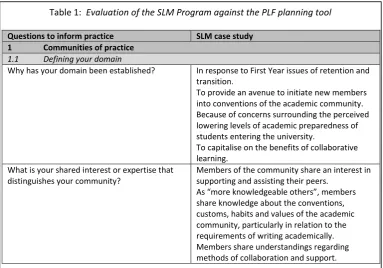
Sources of data used were: the original program proposal, training materials, agenda items for meetings, SLM resources folders, advertising materials, email communications with mentors and staff, and reports to the UTAS Student Transition and Retention Taskforce (START). For each of the questions in the planning tool, evidence was collated and where it was absent, or limited, the question was flagged to indicate an area for development. The evaluation of the SLM program against the planning tool is presented in Table 1
.
Table 1: Evaluation of the SLM Program against the PLF planning tool
Questions to inform practice SLM case study
1 Communities of practice
1.1 Defining your domain
Why has your domain been established? In response to First Year issues of retention and
transition.
To provide an avenue to initiate new members into conventions of the academic community. Because of concerns surrounding the perceived lowering levels of academic preparedness of students entering the university.
To capitalise on the benefits of collaborative learning.
What is your shared interest or expertise that distinguishes your community?
Members of the community share an interest in supporting and assisting their peers.
What principles have guided the establishment of your domain?
Co-construction of knowledge by working with peers just beyond the level of the student themselves, or peers providing alternative perspectives on learning or writing.
All students can develop their writing and study skills.
Principles of social learning. How do these principles fit with the institutional
goals?
These principles align with the institution’s strategic objectives (EDGE2; UTAS, 2011) and the focus areas of the first-year focussed START committee. In particular, the principles align with:
A1 and A2 in Priority A: Fully embed a high-performance culture; and B5 and B10 in Priority B: Create and implement a distinctive UTAS teaching and learning model.
START Focus Areas 3: Transition Support and 7: Student Leadership and Peer Learning.
How is your domain established? Primarily through recruitment, training and
mentor meetings.
SLM Code of Conduct and Ethics Agreement.
How is your domain developed? Community members’ own experiences of study
and learning, training, collaborations and discussions.
1.2 Defining and establishing your community
Who is your community? SLMs, Student Learning Skills staff
Who will lead the community (who is responsible)? Coordinator of Student Learning, CALT, and Student Learning Skills staff on each campus What are the qualities of the people who will form
your community?
High-achieving undergraduate students with an interest in assisting other students, good interpersonal skills, patience and commitment to working as a team developing skills.
What are your guidelines for selecting or inviting members of the community?
Target high-achieving students in areas of study from which we have many students seeking assistance (Distinction in targeted unit and at least a Credit average) and which complement our skills set within the community. Select on the basis of qualities outlined above.
What are the processes for selecting/inviting your members?
How are your guidelines and processes inclusive of diversity?
Students are invited to apply for the position on the basis of their grades. Alternative methods of interviewing are available for students
experiencing difficulty attending campus for interview. Students can be interviewed by phone if unable to attend campus in person. Inherent requirements of the position have precluded participation by students with physical disabilities such as sight or speech. A role providing online support only is being trialled currently, which would potentially open the positions to a wider range of student physical abilities.
The diversity of the community reflects that of the peer participants, in that neither group includes international students due to funding restrictions.
How will personal and professional development be facilitated?
One-day training at start of year and mid-year. Monthly meetings amongst peer leaders across campuses. Reflection and response at end of year.
Opportunities to participate in a range of activities in relation to primary peer role, such as advertising (speaking to large groups), etc. Members participate in shaping the delivery and decision-making surrounding the program.
1.3 Supporting practice
How do the members of your community develop their shared resources: experiences, tools and ways of addressing problems?
Reflection and development occur at training and mentor meetings.
Mentors are rostered on to share time with at least one other mentor.
Mentors contribute resources to folders on each campus and a shared central electronic
repository. What opportunities for reflection on learning
are built into the practice?
Mid-year training.
End of year reflection on their experiences.
How will this be coordinated? Student Learning Skills staff on each campus &
the Student Learning Coordinator, CALT.
How will this be resourced? The program is part of an enabling and
supporting program supported by
2 Peer Learning
Who are the stakeholders in the peer learning? Peer leaders, Peer learners (domestic
undergraduate students), Student Learning Skills staff, Faculty teaching staff, Student Advisers. How will the stakeholders be inducted into the
purpose of the peer learning?
Flyers, presentations as part of the Student Learning Support Network, presentations at lectures by peer leaders (SLMs), training.
With whom will the community be interacting? Primarily with peers/fellow students.
Incidental interactions with faculty teaching staff and Student Advisers.
How will the peers with whom they interact be engaged?
Flyers, presentations at lectures by peer leaders (SLMs), emails and other communications by Student Advisers, reminders from teaching staff (lecturers and tutors).
How will the peers with whom they interact be inducted into the purposes of the community of practice?
Information on advertising. Guidelines displayed in drop-in area.
Verbal prompts or responses from peer leaders.
How and where will this interaction take place? Central locations on the Hobart and Launceston
campuses: 11am to 2/3pm, Tuesday to Thursday, in or adjacent to the CALT area.
What will be the characteristics of the interactions?
Peer leaders will provide feedback and guidance for students on written work in terms of structures and conventions of academic writing (but not content), assistance with planning, personal strategies for learning and study, and referral to other services as required/appropriate.
How will this interaction be resourced? As above, a mixture of Commonwealth and
institutional funding. How will the quality of the interactions with peers
be evaluated?
AREA for DEVELOPMENT. Currently, rely on self-report and training. There is a need for observation.
How will student leadership be recognised? AREA for DEVELOPMENT. No direct recognition
currently provided. Experience can be used when applying for other positions or opportunities.
3 Evaluation
How will the community of practice be evaluated in relation to the purposes outlined in the domain section, the resources required and sustainability?
AREA for DEVELOPMENT. Activities are evaluated by peer learners’ self-reports (invited at the end of
the year) and peer-leaders’ self-report. Evaluation
Reflection
Using the planning tool to consider the SLM Program raised interesting observations about not only the SLM Program but also the PLF planning tool itself. Each will now be discussed.
Observations and reflections
of the SLM Program
The PLF planning tool highlighted areas of improvement for the sustainability of the program. In particular, the evaluation and recognition of peer leaders’ performance and evaluation of the program are areas for development. Topping (1996, p. 325) stresses the vital importance of “monitoring and quality control” in any peer learning endeavour. In and of themselves, these were not startling revelations. There was already an awareness of the deficits in these areas of the program. However, the planning tool did help to highlight these issues, in part, because other aspects of the program were perhaps better defined than anticipated. As is probably the case with many programs as they begin, it is easy to feel that you have missed important considerations. In this case, this sensation was not borne out by the evaluation. In turn, this highlighted a significant value of the PLF: that the planning tool prompted careful consideration of the SLM Program. It necessitated the devotion of time to the consideration of what was happening in the program, and why. In this regard, it is significant that the first question of the planning tool relates to the “why” of the domain, before the “what” We are so often seeking to respond to areas of need, to react, fill up and rescue in student support and academia in general, that under the time pressures so pervasive in the area,
there is the potential to jump in a-theoretically or, once in, not to allocate sufficient time for reflection (Ede, 1989). If for no other reason, the planning tool was useful for providing a theoretical framework and a process requiring that careful thought and reflection.
learners1 rather than a
community of
practice. Even then, the claim to
“community” is contestable.
However, the “apprenticeship” aspect of the community of practice model is evident in the relationships and practices of the peer leaders and peer learners together. In this context, the boundaries of the domain extend well beyond the drop-in relationship. Particularly as viewed from the perspective of the peer learners, mentors represent the central participants in a community of practice encompassing the university or tertiary education experience. They are the “old-timers” (in Wenger’s, 1998, description) who have knowledge in experience of the practices of this community. All potential students are therefore members of this community, with students moving from periphery towards the centre and back again as they move in and out of the relationship with the mentor. This conceptualisation opens consideration of the potential for peer learners themselves to become central to the community of practice as they pass on understanding and build new knowledge in this domain through their own practices and through interactions with their own peers outside drop-in. However, the domain of this community is potentially hidden to many of the members, as is their membership of the community itself. Nonetheless, this way of thinking about the interactions between peer leaders and learners is a helpful one in so far as it prompted consideration of the potential of
1 Though not a “learning community” as it has
come to be defined in the higher education sphere: as a purposeful linking of units across the curriculum to encourage collaborative and social learning (see e.g., Engstrom & Tinto, 2008; Tinto, 2003; though see Kilpatrick, Barrett, & Jones, 2003, for a broader definition).
continuing transmission and secondary dissemination of understanding and knowledge generated by attendees to drop-in (our primary peer learners) in collaboration with the mentors (peer leaders), to new groups of peers who have not themselves been party to that initial interaction and collaborative learning process.
Observations
about
the
framework planning tool
The process of applying the framework has not only drawn out elements of the investigated program in need of further attention, but also helped to clarify the scope of operation of the planning tool. This process highlighted the framework’s focus on the community of peer leaders, in contrast with other models of peer learning that focus on the processes of peer learning interactions and/or the outcomes for the peers involved, particularly the “targets” of the program: the peer learners. This focus on the community of peer leaders is consistent with the aims of the framework: to foster a consistent, quality approach to peer learning programs and to guide the development of new programs at the university. A focus on the community of peer leaders is therefore appropriate, as these are the elements of the interaction most under the control of the organisers (the “planners”) of the peer learning program. This also highlights the value of the framework as an addition to that wider section of the literature dealing the immediacy of the interactions between peers as they learn together.
of setting up an effective community of practice or peer learning situation that is evidence-based. It removes the need for the practitioner to be familiar with the literature. At the same time, the questions are designed to prompt the planner to connect their practice with the theory by thinking more deeply about these issues than they might otherwise do.
Viewing peer leaders as part of a community of learners removes the expectation that the administrator of such a group be the sole repository of knowledge and guidance. A community of practice conceptualisation can therefore increase sustainability by taking some of the pressure off the organiser to micro-manage everything. The participants of the community themselves, through practice, move from periphery to centre and share the “burden” of responsibility for their interactions. This is not to say that good planning or administration is unnecessary or against the ethos of a peer learning program – it merely represents the character of central participants in the community.
The limitations of the current PLF relate mainly to the second level of community of practice: that of the broader community of peer learners. It would be helpful to have questions that more specifically address whether or not the interactions within this community of learners follow principles designed to foster effective peer learning. There is the potential for the planned peer learning activity defined as the domain in section 1.1 to be self-sustaining but not an effective peer learning environment, before evaluation and monitoring occur. Specifically, an expansion of the question “What will be the characteristics of the interaction?” is suggested to address known principles of peer learning.
There are a myriad of considerations for someone wishing to implement a peer learning scheme. Some of the key considerations when thinking of peer learning in a formal, co-curricular program are ways of ensuring that the leaders are fostering a positive, active and collaborative environment in which the learner maintains ownership of their learning. The five sub-processes of Topping and Ehly’s (2001) model of the peer assisted learning process: organisation and engagement, cognitive conflict, scaffolding and error management, communication, and affect, provide a theoretical grounding for these questions. Four additional questions are suggested for the PLF, drawing on Topping’s sub-processes and providing a starting consideration for the community of peer leaders seeking to foster peer learning:
“How will leaders ascertain individual learners’ needs?”
“What activities or methods will be used to achieve your learning outcomes?”
“What forms of communication (explaining, questioning, prompting, etc.) will you use to emphasise building over knowledge-telling?”
2001). These additional questions are intended to draw the attention of planners to some of the key considerations in peer learning that may not have been addressed by other sections of the framework.
Conclusion
The community of practice model for peer learning programs is a positive conceptualisation that promotes a participatory, and therefore more likely to be sustainable, organisation and leadership. The process of applying the PLF planning tool to the SLM Program proved a valuable exercise. It provided a timely reminder of those aspects of the program that require attention, namely the evaluation and recognition of peer leader performance. It also stimulated consideration of the clients in the program, the majority of whom are in first year, as active participants in a wider community of learners at the university, which potentially generates new directions for the service. It is suggested that the efficacy of the framework as a planning tool could be enhanced by the addition of questions designed to guide planners of new programs in the creation of effective peer learning environments. The PLF should prove a valuable tool for establishing a consistent, quality peer learning approach at UTAS and potentially other institutions undertaking advancement in this area.
References
Adam, A., Hartigan, C., & Brown, N. (2010). The value of an open, early academic development program to students’ transition and first year experience: The UTAS UniStart
program. The International Journal of the First Year in Higher Education, 1(1), 43-54.
Anderson, G., & Boud, D. (1996). Extending the role of peer learning in university courses.
Proceedings of HERDSA: Different approaches: Theory and practice in higher education. Retrieved February 16, 2011, from
http://www.herdsa.org.au/confs/1996/an derson.html
Australasian Centre for PASS. (2010). Peer Assisted Study Sessions (PASS) – Guidelines for best practice. Wollongong, Australia: University of Wollongong.
Biggs, J. (2003). Teaching for quality learning at university (2nd ed.). Maidenhead, UK: The Society for Research into Higher Education & Open University Press.
Brown, N., & Adam, A. (2010, June). UTAS First Year Framework – Proposal. Report to the UTAS Student Transition and Retention Taskforce. Hobart, Australia: Centre for the Advancement of Learning and Teaching, University of Tasmania.
Cooper, E. (2010). Tutoring center effectiveness: The effect of drop-in tutoring. Journal of College Reading and Learning, 40(2), 21-34. Ede, L. (1989). Writing as a social process: A
theoretical foundation for writing centers?
The Writing Center Journal, 9(2), 3-13. Engstrom, C., & Tinto, V. (2008). Access without
support is not opportunity. Change: The Magazine of Higher Learning, 40(1), 46-50. Kift, S., & Nelson, K. (2005). Beyond curriculum
reform: Embedding the transition experience. In Brew, A. & Asmar, C. (Eds.),
Proceedings of the 28th HERDSA Annual Conference. Higher Education in a Changing World: Research and Development in Higher Education (pp. 225-235). Milperra, Australia: HERDSA.
Kilpatrick, S., Barratt, M., & Jones, T. (2003). Defining learning communities. Centre for Research and Learning in Regional Australia Discussion Paper D1/2003. Launceston, Australia: University of Tasmania. Retrieved February 18, 2010, from http://www.crlra.utas.edu.au/files/discuss ion/2003/D1-2003.pdf
Lave, J., & Wenger, E. (1991). Situated learning: Legitimate peripheral participation.
Lizzio, A. (2006). Designing an orientation and transition strategy for commencing students: A conceptual summary of research and practice. Griffith University: First Year Experience Project, 2006. Retrieved February 7, 2010, from http://www.griffith.edu.au/__data/assets/ pdf_file/0008/51875/Alfs‐5‐Senors‐Paper‐
FYE‐Project,‐2006.pdf
Martin, D. (2008). Foreword. Australasian Journal of Peer Learning, 1(1), 3-5. Retrieved February 16, 2011, from http://ro.uow.edu.au/ajpl/vol1/iss1/2 Murphy, C., & Law, J. (Eds.). (1995). Landmark essays
on writing centers. Davis, CA: Hermagoras. O'Neill, P. (2008). Using peer writing fellows in British
universities: Complexities and possibilities [Special issue on writing fellows]. Across the Disciplines, 5. Retrieved February 14,
2011, from
http://wac.colostate.edu/atd/fellows/oneil l.cfm
Ramsden, P. (1992). Learning to teach in higher education. London: Routledge.
Roscoe, R. D., & Chi, M. T. H. (2007). Understanding tutor learning: Knowledge-building and knowledge-telling in peer tutors’ explanations and questions. Review of Educational Research, 77(4), 534-574. doi: 10.3102/0034654307309920
Schunk, D. H. (2008). Learning theories: An educational perspective (4th ed.). Columbus, OH: Pearson Education.
Skalicky, J. (2010, July). Peer Assisted Study Sessions (PASS) Program: 2007-2010. Hobart, Australia: Centre for the Advancement of Learning and Teaching, University of Tasmania.
Skalicky, J., & Brown, N. (2009, October). Peer learning framework: A community of practice model. Report to the UTAS Student Transition and Retention Taskforce. Hobart, Australia: Centre for the Advancement of Learning and Teaching, University of Tasmania.
Topping, K. J. (1996). The effectiveness of peer tutoring in further and higher education: A typology and review of the literature.
Higher Education, 32(3), 321-345.
Topping, K. J. (2005). Trends in peer learning.
Educational Psychology, 25(6), 631–645. doi: 10.1080/01443410500345172 Topping, K. J., & Ehly, S. W. (2001). Peer assisted
learning: A framework for consultation.
Journal of Educational and Psychological Consultation, 12(2), 113-132. doi: 10.1207/S1532768XJEPC1202_03 University of Sydney. (2001). First Year Experience.
Retrieved February 6, 2010, from http://www.itl.usyd.edu.au/fye/
University of Tasmania. (2011). EDGE2 University of Tasmania plan for 2008-2011. Retrieved February 16, 2011, from http://www.utas.edu.au/vc/documents/E DGE2-extended-2011-agenda.pdf
van der Meer, J., & Scott, C. (2008). Shifting the balance in first‐year learning support: From staff instruction to peer learning primacy. Australasian Journal of Peer Learning, 1, 70‐79.
Wenger, E. (1998). Communities of practice: Learning, meaning, and identity. Cambridge, UK: Cambridge University Press.
Wenger, E., McDermott, R., & Snyder, W. (2002).
Cultivating communities of practice. Boston, MA: Harvard Business School Press. Young, B. R., & Fritzsche, B. A. (2002). Writing center