Developing a community-based
educational program for older persons
Brian J. Gleberzon,
DC*
Chiropractic pedagogy is recognizing the importance of community-based education. This article describes the manner in which a series of community-based
presentations were developed, specifically targeting the elderly. With support from both the Ontario Ministry of Health and the Ontario Chiropractic Association, presentations were developed that primarily addressed the three areas of greatest concern to older persons: osteoporosis, osteoarthritis and injury prevention. The primary objectives of the presentations were to dispel any myths that older persons may have had about osteoporosis and osteoarthritis, and to suggest ways to safety-proof their homes. Additional topics discussed were exercise, nutrition and the role of chiropractic in geriatric health care. Twenty-five presentations were conducted at twelve different community centers. Presentations were conducted by chiropractic interns. The results of pre and post-surveys suggest that the primary objectives of the program were successfully met.
(JCCA 2001; 45(1):18–25)
K E YW O R D S: chiropractic, community, elderly, osteoporosis, geriatric.
La formation en chiropratique reconnaît l’importance de l’éducation dans la communauté. Le présent article décrit la façon dont a été élaborée une série de
présentations données dans la communauté et destinées aux personnes âgées. Ces présentations, appuyées par le ministère de la Santé de l’Ontario et l’Association chiropratique de l’Ontario, portaient sur les trois grandes préoccupation des personnes âgées, soit l’ostéoporose, l’arthrose et la prévention des blessures. L’objectif principal était de dissiper tout mythe à l’égard de l’ostéoporose et de l’arthrose et de suggérer des façons de sécuriser le domicile. D’autres sujets ont fait l’objet de discussion, notamment l’activité physique, la nutrition et la place de la chiropratique en gériatrie. Vingt-cinq présentations ont été données par des internes en chiropratique dans douze centres communautaires. Les résultats des enquêtes menées avant et après les présentations semblent indiquer que les objectifs principaux ont été atteints.
(JACC 2001; 45(1):18–25)
M O T S C L É S : chiropratique, communauté, personnes âgées, ostéoporose, gériatrie.
*Assistant Professor, Division of Chiropractic Sciences, Canadian Memorial Chiropractic College, 1900 Bayview Avenue, Toronto, Ontario, M4G 3E6. Phone 416-482-2340.
Introduction
Chiropractic pedagogy is recognizing the importance of community-based education. This approach allows stu-dents to more intimately interact with various groups of individuals, developing a more egalitarian rapport with them. This is in contrast to the more hierarchal relationship of traditional clinic-based or lecture-based settings. This article describes the manner in which a series of commu-nity-based presentations were developed, specifically tar-geting the elderly.
The presentations primarily addressed the three areas of greatest concern to older patients: Osteoporosis, osteo-arthritis and injury prevention. These areas of concern were identified by a facilitated focus group. The primary objectives of the presentations were to dispel any myths that older persons may have had about osteoporosis and osteoarthritis, and to suggest ways to safety-proof their homes, in order to prevent potential injuries and preserve their Activities of Daily Living (ADLs). Additional topics discussed were exercise, nutrition, and the role of chiro-practic in geriatric health care.
Twenty-five presentations were conducted at twelve different community centers. Presentations were con-ducted by chiropractic interns. The results from pre and post-presentation surveys suggest that the primary objec-tives were successfully met.
Method
In recognition of the International Year of the Older Per-son, the Ontario Ministry of Health, Senior’s Secretariat, solicited grant applications for community-based presen-tations that targeted seniors and emphasized such themes as education, wellness, and safety. The application from the Canadian Memorial Chiropractic College for Ministry funding was accepted. The presentations were also spon-sored by the Ontario Chiropractic Association. Fourth year chiropractic students (interns) were invited to volunteer for the project. Seven students were selected from the group of applicants, based on their previous experience with older persons and their public speaking abilities. Those students with limited exposure or previous experi-ence were selected, in order to augment their skills in these areas.
A focus group was convened in order to identify areas of particular concern to the target audience, and to establish the best method of disseminating information. The focus
group was comprised of a content-expert facilitator, four students, six senior members of the community and the project coordinator. A notice was placed on a senior’s internet site indicating that any interested seniors commu-nity group could request a presentation. Twelve different community centers contacted the project supervisor (the author) and presentations were scheduled throughout the academic 1999–2000 year.
Pre- and post-presentation surveys were given to each member of the audience, and the responses were analyzed.
Results
Information gathered from the focus group and planning sessions
The focus group revealed that the primary areas of concern among older patients were issues related to osteo-porosis, osteoarthritis and injury prevention. Under-pinning these areas of concern was the desire by older patients to retain their independence, and to maintain their ADLs.
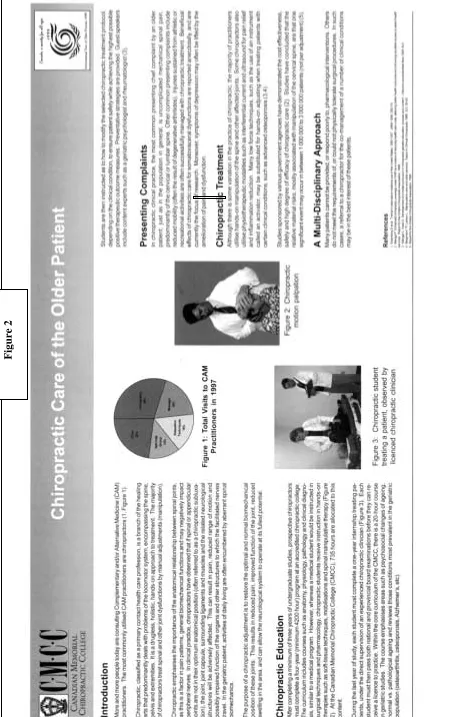
It was decided by the project supervisor and the in-volved interns that the optimal manner of communicating the information to the target audience would be by a pres-entation that consisted of slides, anatomical models and hand-outs, followed by a question-and-answer period. Two posters, which captured the more relevant concepts from the presentations, were developed and donated to each presentation site. (Figures 1 and 2)
Survey results
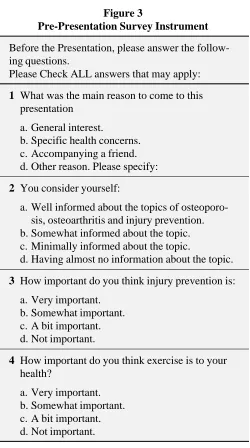
A pre- and post-survey was given to each person who attended a presentation (Figures 3 and 4). Even though the number of questionnaires completed and returned were low (N = 16), the survey results suggested that the primary objectives of the presentations were successfully met.
When asked, 15 of 16 (94%) respondents stated that they attended the presentation for general interest, with only one person indicating it was for specific health concerns. Nine of 16 respondents (56%) considered them-selves somewhat informed about the topics to be dis-cussed, with only 3 respondents stating they felt they were
well informed. All 16 respondents indicated that they felt
injury prevention was very important, and all but one re-spondent felt that exercise was very important.
Figure
Figure
that the presentation was either very informative (N = 10) or somewhat informative (N = 5). Only one person felt that the presentation was only a bit informative. None of the respondents indicated that they felt the presentation was
not at all informative. Of particular relevance to the
pre-senters, 13 of 16 (81%) respondents indicated that the presentation was very understandable, with the remaining respondents reporting that the presentation was somewhat understandable.
When asked if they would try to utilize any of the sug-gestions to safety-proof their homes, 13 of 16 respondents
indicated they would try to use all or most of the sugges-tions. One respondent indicated that he or she would use some of the suggestions. Two persons did not respond to
Figure 3
Pre-Presentation Survey Instrument
Before the Presentation, please answer the follow-ing questions.
Please Check ALL answers that may apply:
1 What was the main reason to come to this
presentation
a. General interest.
b. Specific health concerns. c. Accompanying a friend. d. Other reason. Please specify:
2 You consider yourself:
a. Well informed about the topics of osteoporo-sis, osteoarthritis and injury prevention. b. Somewhat informed about the topic. c. Minimally informed about the topic.
d. Having almost no information about the topic.
3 How important do you think injury prevention is:
a. Very important. b. Somewhat important. c. A bit important. d. Not important.
4 How important do you think exercise is to your
health?
a. Very important. b. Somewhat important. c. A bit important. d. Not important.
Figure 4
Post-Presentation Survey Instrument
After the presentation, please answer the following questions.
1 Did you find the presentation:
a. Very informative. b. Somewhat informative. c. A bit informative. d. Not at all informative.
2 Were the concepts understandable?
a. Very understandable. b. Somewhat understandable. c. A bit confusing.
d. Very confusing.
3 There were many suggestions made for injury
prevention. Do you think you will try to:
a. Use all or most of the suggestions. b. Use only some of the suggestions. c. Use very few of the suggestions. d. Use none of the suggestions.
4 On the topics of osteoporosis and osteoarthritis,
do you feel that:
a. You know a lot about the topics because of the presentations.
b. You learned very little at the presentation. c. You knew a lot before the presentation and
learned very little today.
d. You knew a lot before the presentation and learned a lot more.
5 How important do you think exercise is to your
health:
the question. Lastly, 14 of 16 respondents indicated that they either knew a lot about the topic because of the
pres-entation (N = 9) or knew a lot before the prespres-entation and learned a lot more during it (N = 5).
Discussion
Mootz and Haldeman recently wrote that “for health pro-fessions students to understand the natural history of health-related events over time and to achieve the goal of collaborative practice, curricula must be community ori-ented”.1 This approach may enable chiropractic students to develop important clinical skills that they may not other-wise have had an opportunity to develop during their internships. Moreover, because patients may not seek out guidance for the management of specific health care con-cerns, a community-based presentation may be better able to bring to a target audience information on these areas of concern.
The importance of chiropractic geriatric education is becoming more and more apparent.2 Demographic studies indicate that this group of individuals are the fastest grow-ing segment of the population,2,3 and they are expected to comprise a disproportionately larger percentage of a prac-titioner’s portfolio.4 Currently, about 12% of the American population is over the age of 65, and this number is ex-pected to climb to 22% by the year 2030.2,3 The fastest growing segment of the population is comprised of those over the age of 80 (the old old), with the number of Ameri-can centenarians expected to increase 11-fold by the year 2050, when they are predicted to number over 800,000.5,6 As Killinger et al. opined; “Our nation must recognize that health care is becoming primarily geriatric health care and will remain so for quite some time”.7
Injury prevention and wellness promotion
The emerging focus in health care away from what Coul-ter8 described as a compartmental, disease-based approach towards a model advocating prevention, health promotion, and wellness, parallels the tenets traditionally embraced by chiropractic philosophy.9
Injury prevention is of vital concern for health care pro-viders. Falls and fractures are a leading cause of morbidity and mortality among older patients.10 Death due to falls is the sixth leading cause of death in older patients, and the leading cause of death due to injury.10,11 About one-third of community-dwelling seniors fall once a year, and this
rises to 50% for those over the age of 80 years.10–13 The fall rate is even higher in nursing homes,12 suggesting that these institutions may best benefit from presentations on injury prevention.
In the United States, falls accounted for 14,000 deaths and 22 million visits to hospitals and physician’s offices in 1996.14 The death rate attributable to falls increases with age,14 and falls account for 90% percent of wrist, forearm and pelvic fractures.11 Falls account for 250,000 hip frac-tures annually, and demographic projections indicate that this number may exceed 650,000 by the year 2050.10,15 In the year following a hip fracture, mortality increases by 12%.11
Even in the absence of a fracture, a fall results in serious injury in 25% of all cases involving older persons.16 The rate of falling increase with age, and the rate of injury is highest among the elderly.13 Among the elderly who fall, the risk of hospitalization is 10 times greater and the risk of dying is 8 times greater as compared to children who fall.13 In the United States, the overall economic burden of caring for older patients who fall and sustain an injury is esti-mated at $12.4 billion.13 Not surprisingly, it is estimated that one half of all older persons limit their activities in some way so as to avoid the risk of falling, thus imposing significant limitations on their pursuit of a higher quality of life.16,17
Education and other preventative programs aimed at re-ducing potential risk factors of falling among older pa-tients has been shown to reduce the risk of falling by 7% to 12%.13 A study from Australia sought to determine the cost-effectiveness of home assessment programs aimed at reducing fall-hazards in older patient’s homes.18 Over a one year period, the researchers estimated the cost of the program to be $172 per person. However, it was estimated that the cost-per-fall prevention was $1,721 per person, and the cost-per-injury prevention was estimated at $17,298. The investigators concluded that injury preven-tion programs aimed at “safety-proofing” a patient’s home are substantially cost-effective both in terms of health care savings and enhanced quality of life.18
Osteoporosis and osteoarthritis
care. In the United States, the direct and indirect costs of osteoporosis are estimated at $10 billion annually.16,17
The presentations described in this study sought to pro-vide important information about OA and OP. Topics in-cluded risk factors for their development, and preventative strategies such as exercise, strength training19 and nutri-tion, as well as the potential benefits of chiropractic care.
Other benefits of community-based presentations
Combining relevant information about osteoporosis, osteoarthritis and injury prevention can provide an older person with practical strategies to maintain self-suffi-ciency. This follows Killinger’s view who suggested: “Whereas a provider must be desirous of facilitating the patient’s progress in terms of improved score on outcome assessments and return to normal ranges of motion, the patient’s goal may be much more straightforward-inde-pendence”.20
Lastly, exposing more people to chiropractic can further demystify its approach to health care, while simultane-ously informing older persons about chiropractic and how it is uniquely suited to handle many of those clinical condi-tions that preferentially affect them.21
Conclusions
Community-based presentations can help develop impor-tant interdisciplinary and social support networks. Accord-ing to Healthy People 2000, “social support networks are of critical importance in promoting the health and inde-pendence of older adults”.22 Such programs also help “alleviate social isolation of the elderly by encouraging regular interactions with others in a setting that is non-threatening and pleasurable”.22
As Goldzweig summed up “... good medicine means going beyond the walls of the operating room, the emer-gency room, and the examination room. It means going to the people before they end up in any of these “rooms” and helping them to change their lives in a way that will foster their health, their well-being and their happiness”.23
Acknowledgements
The author would like to thank Dr. Dave Waalen, Judy Waalen, PhD, and then interns now Drs. Kim Clackett, Kari Edman, Ryan French, Sasha Green, Natalia Leonard, Enrice Schirru and Lisa Yerex for their participation in this project.
References
1 Mootz RD, Haldeman S. The evolving role of chiropractic within mainstream health care. Topics in Clinical
Chiropractic 1995;2(2):11–21.
2 Hawk C, Killinger L, Zapotocky B, Azad A. Chiropractic training in care of the geriatric patient: an assessment. J Neuromusculoskeletal System 1997;5(1):15–25. 3 US Bureau of the Census.
4 Coulter I, Horowitz E, Aranow H, Cassata D, Beck J. Chiropractic patients in a comprehensive home-based geriatric assessment, follow-up and health promotion program. Topics in Clinical Chiropractic 1996; 3(2):46–55.
5 Elliot G, Hunt M, Hutchison K. Facts on Aging in Canada. The Office of Gerontological Studies, McMaster
University 1996.
6 Brown K. How long have you got? Scientific America 2000; 11(2):9–15.
7 Killinger L, Azad A, Zapotocky B, Morschhauser, E. Development of a model curriculum in chiropractic geriatric education; process and content.
J Neuromusculoskeletal System 1998; 6(4):146–153. 8 Coulter I. Alternative philosophical and investigatory
paradigms in chiropractic. J Manipulative Physiol Thera 1993; 16(6):419–425.
9 Hawk C. Should chiropractic be a “wellness” profession? Topics in Clinical Chiropractic 2000; 7(1):23–26.
10 Bowers L. Clinical assessment of geriatric patients: unique challenges. Topics in Clinical Chiropractic 1996;
3(2):10–21.
11 Abrams W, Beers M, Berkow R. The Merck Manual of Geriatrics. 2nd Edition. Whitehouse Station: Merck and Co., 1995.
12 Cummings RG. Epidemiology of medication-related falls and fractures in the elderly. Drugs and Aging 1998; 12(1):43–53.
13 Tibbits M. Patients who fall: How to predict and prevent injuries. Geriatrics 1996; 51(9):24–31.
14 Hoskins AF. Fatal falls: Trends and characteristics. Statistical Bulletin- Metropolitan Insurance Companies 1998; 79(2):10–15.
15 Brody JA. Prospects for an aging population. Nature 1985; 315:463–466.
16 Lonergan E. Geriatrics. A Lange Clinical Manual. First Edition. Stamford: Appleton and Lange, Simon and Schuster Company, 1996.
17 Ferri F, Fretwell M, Watchel T. Practical Guide to the Care of the Elderly Patient. 2nd Edition. St Louis: Mosby-Year Book, Inc., 1997.
19 Gleberzon BJ, Annis R. The necessity of strength training for the older patient. J Can Chiropr Assoc 2000;
4(2):99–103.
20 Killinger LZ. Trauma in the geriatric patient: a
chiropractic perspective with a focus on prevention. Topics in Clinical Chiropractic 1998; 5(3):10–15.
21 Gleberzon BJ. Chiropractic geriatrics: the challenges of assessing the older patient. J Am Chiropr Assoc 2000; 4:36–37.
22 Healthy People 2000: National Health Promotion and Disease Prevention Objectives. Washington, D.C.: U.S. Dept. of Health and Human Services, 1990.
23 Goldzweig IA. Creating a Community Health Forum. Health Promotion for the Ethnic Minority Elderly. Meharry Consortium Geriatric Education Center, Meharry Medical College, 1996.
Canadian Chiropractic Research Foundation
Dr. David Peterson, DC
Calgary, Alberta
President, CCRF
Dr. Ron Carter, DC
Calgary, Alberta
Chair, Fund Raising Committee
Dr. Martin Gurvey, DC
Winnipeg, Manitoba
Chair, Fund Allocating Committee
Dr. Robert Allaby, DC
Fredericton, New Brunswick
Treasurer
Dr. Benno Nigg, Dr. sc. Nat.
Calgary, Alberta