RVC OPEN ACCESS REPOSITORY – COPYRIGHT NOTICE
This author’s accepted manuscript may be used for non-commercial purposes in accordance with Wiley Terms and Conditions for Self-Archiving.
The full details of the published version of the article are as follows:
TITLE: Lessons from integrating behaviour and resource selection: activity‐specific responses of African wild dogs to roads
AUTHORS: Abrahms, B. Jordan, N. R., Golabek, K. A., McNutt, J. W., Wilson, A. M. and Brashares, J. S.
JOURNAL: Animal Conservation
PUBLISHER: Wiley/ZSL
PUBLICATION DATE: June 2016
Lessons from integrating behaviour and resource selection:
1
activity-specific responses of African wild dogs to roads
2
Short Title: Integrating behaviour and resource selection
3
4
Briana Abrahms
* a, Neil R. Jordan
b,c,d, Krystyna A. Golabek
d,e, John W. McNutt
d,
5
Alan M. Wilson
f, and Justin S. Brashares
a6
a Department of Environmental Science, Policy, and Management, University of
California-7
Berkeley, Berkeley, CA, USA 8
b Centre for Ecosystem Science, School of Biological, Earth and Environmental Sciences,
9
University of New South Wales (UNSW), NSW 2052, Australia 10
c Taronga Conservation Society Australia, Taronga Western Plains Zoo, Wildlife Reproduction
11
Centre, Obley Road, Dubbo, NSW 2830, Australia 12
d Botswana Predator Conservation Trust, Maun, Botswana
13
e Wildlife Conservation Research Unit, University of Oxford, Tubney, United Kingdom
14
f Structure & Motion Lab, Royal Veterinary College, University of London, London, United
15
Kingdom 16
17
*Corresponding author: Briana Abrahms 18
University of California – Berkeley, Dept. of Environmental Science, Policy, and Management
19
130 Mulford Hall #3114, Berkeley, CA 94720
20
Ph: 425-890-5603, Fax: 510-643-5098, Email: [email protected] 21
Abstract
23
Understanding how anthropogenic features affect species’ abilities to move within landscapes is 24
essential to conservation planning and requires accurate assessment of resource selection for 25
movement by focal species. Yet, the extent to which an individual’s behavioural state (e.g. 26
foraging, resting, commuting) influences resource selection has largely been ignored. Recent 27
advances in GPS tracking technology can fill this gap by associating distinct behavioural states 28
with location data. We investigated the role of behaviour in determining responses of an 29
endangered species of carnivore, the African wild dog (Lycaon pictus), to one of the most 30
widespread forms of landscape alteration globally: road systems. We collected high resolution 31
GPS and activity data from 13 wild dogs in northern Botswana over a two-year period. We 32
employed a step selection framework to measure resource selection across three behavioural 33
states identified from activity data (high-speed running, resting, and traveling) and across a 34
gradient of habitats and seasons, and compared these outputs to a full model that did not parse 35
for behaviour. The response of wild dogs to roads varied markedly with both the behavioural and 36
landscape contexts in which roads were encountered. Specifically, wild dogs selected roads when 37
traveling, ignored roads when high-speed running, and avoided roads when resting. This 38
distinction was not evident when all movement data were considered together in the full model. 39
When traveling, selection of roads increased in denser vegetative environments, suggesting that 40
roads may enhance movement for this species. Our findings indicate that including behavioural 41
information in resource selection models is critical to understanding wildlife responses to 42
landscape features and suggest that successful application of resource selection analyses to 43
movement occurs. Thus, behaviour-specific step selection functions offer a powerful tool for 45
identifying resource selection patterns for animal behaviours of conservation significance. 46
47
Key-words
48
resource selection, animal behaviour, linear features, movement ecology, step selection 49
functions, conservation planning, landscape permeability, Lycaon pictus
50
51
Introduction
52
Understanding animal movement is essential to effective in-situ conservation planning. An 53
animal’s ability to move through its landscape has fundamental consequences for both individual 54
fitness (e.g. resource acquisition, survival) and long-term population persistence (e.g. dispersal, 55
gene flow; Swingland & Greenwood 1983; Dingle 1996; Hanski 1999; Clobert et al. 2001). 56
Management efforts aimed at preserving landscape connectivity have thus skyrocketed, and the 57
effect of natural and human-built landscape features on animal movement and resource selection 58
has become a central issue in ecology and conservation (Turner 1989; Nathan et al. 2008). In 59
particular, conservation planners use estimates of resource selection to identify important habitat 60
for wildlife populations, assess how wildlife responds to specific landscape features, and 61
delineate wildlife corridors where animal movement is predicted to occur (Manly et al. 2002; 62
Chetkiewicz & Boyce 2009). 63
64
The extent to which an animal’s behavioural state (e.g. foraging, resting, commuting) influences 65
resource selection has largely been ignored as part of these conservation planning efforts 66
component of habitat selection and space use in multiple taxa including elk (Cervus elaphus) 68
(Fryxell et al. 2008), killer whales (Orcinas orca) (Ashe, Noren & Williams 2010), Bluefin tuna 69
(Thunnus maccoyii) (Pedersen et al. 2011), lions (Panthera leo) (Elliot et al. 2014) and elephants 70
(Loxodonta africana) (Roever et al. 2013).While both behavioural patterns and habitat use vary
71
substantially among these species, these studies are similar in demonstrating that behaviour is an 72
important determinant of how animals use their landscape. Thus, appropriate land management 73
decisions rely on correctly identifying patterns of resource selection for the specific behaviours 74
that are of conservation interest. 75
76
Recent advances in GPS tracking and mapping technology promise to improve efforts to link 77
behavioural traits and patterns of habitat use, thereby providing conservation practitioners with a 78
greater understanding of animal space use (Nams 2014). Animal-attached accelerometers in 79
particular are being increasingly used to collect high-resolution activity data that can be paired 80
with GPS locations (Brown et al. 2013). This collar technology allows not only precise 81
quantification of resource selection, but also assessment of the behavioural contexts in which 82
landscape features are selected for or avoided. Here, we demonstrate the importance of 83
combining location and activity data to determine the role of behavioural state in resource 84
selection and response to human habitat modification. Specifically, we investigate how 85
behavioural state affects responses of African wild dogs (Lycaon pictus; Fig. 1) to one of the 86
most widespread forms of landscape alteration globally: road systems (Bennett 1991; Trombulak 87
& Frissell 2013). Roads have been shown to impede movement and dispersal by small-bodied 88
species, particularly in areas with high human traffic (e.g., Fahrig et al. 1995; Shepard et al.
89
suggests that larger and more vagile species such as carnivores may use low traffic volume roads 91
as movement corridors; roads may therefore increase the permeability of the encompassing 92
landscape for these species (Latham et al. 2011; Whittington et al. 2011). Because of their 93
vagility and sensitivity to human disturbance (Creel & Creel 1998), African wild dogs offer a 94
particularly appropriate system for exploring behavioural variation in responses to road 95
networks. Given that road construction is accelerating throughout Africa, including in areas 96
critical to the remaining African wild dog populations, detailed understanding of interactions 97
between road networks and African wild dog behaviour is necessary for effective management of 98
this endangered species. 99
100
To determine if resource selection patterns by African wild dogs vary with behavioural state, we 101
evaluated fine-scale individual responses to roads using step selection functions. This approach 102
is ideal for estimating resource selection for continuous movement data as it accounts for 103
changes in resource availability as the animal moves through its environment (Fortin et al. 2005; 104
Thurfjell, Ciuti & Boyce 2014). We modeled resource selection across three behavioural states 105
(high-speed running, resting, and traveling) measured across multiple habitats and seasons to test 106
the hypothesis that roads increase landscape permeability for African wild dogs. In addition to 107
providing the first behaviourally explicit analysis of movements by African wild dogs, our 108
analyses demonstrate the importance of including behavioural information in conservation-109
planning efforts. 110
111
Materials and methods
112
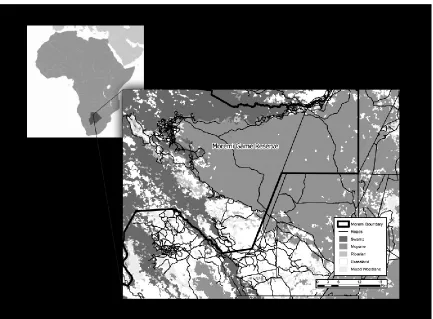
Our study area (Fig. 1) was located in northern Botswana’s Okavango Delta (c. 2700 km2;
114
centered at 19°31’S, 23°37’E; elevation c. 950 m) and included the southeastern portion of 115
Moremi Game Reserve and surrounding Wildlife Management Areas. The region is 116
characterized by highly seasonal fluctuations in precipitation, which correlate with vegetative 117
growth. The dry season extends from April to October, peaking September-November (hereafter, 118
peak dry season). The wet season extends from November to March with annual rainfall of 300-119
600 mm (McNutt 1996), peaking January-March (peak wet season). At our study site, the peak 120
of the Delta’s annual flood pulse typically occurs between August and September, which 121
coincides with the wild dog denning season June-August (flood/denning season). Five major 122
habitat types can be distinguished based on vegetation composition and structure: swamp (open 123
structure), grassland (open structure), mixed woodland (medium structure), mopane (medium-124
dense structure), and riparian (dense structure). Broekhuis et al. (2013) provide detailed 125
descriptions of these habitats and the methods used to distinguish them. An extensive and 126
growing network of unpaved (sand) roads in this area (Fig. 2) is used primarily to support 127
ecotourism. 128
129
DATA COLLECTION 130
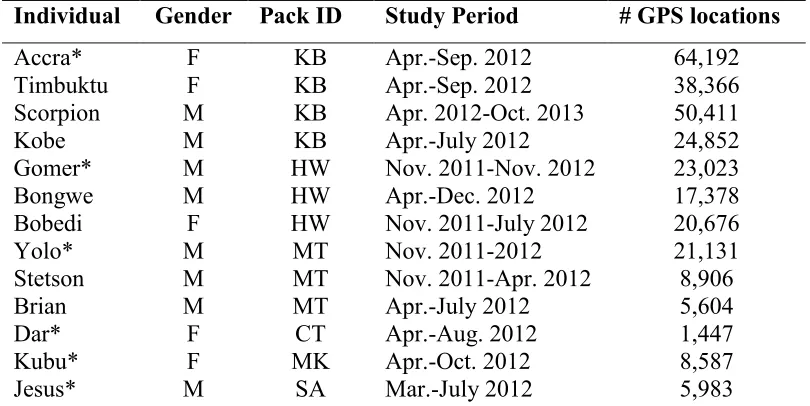
Between November 2011 and 2013, we fitted thirteen adults from six wild dog packs with 131
custom-designed GPS radiocollars (mean fixes per collar = 22350 ± 18676; Table S1). Each 132
collar included a GPS unit and an Inertial Measurement Unit (IMU) consisting of a three-axis 133
accelerometer and gyroscope to record position, velocity, and acceleration data. The GPS units 134
within the collars were programmed to move between different operating states depending on the 135
fixes when the animal was stationary but transitioned into a ‘traveling’ state with five-minute 137
fixes when activity data indicated that the animal was moving consistently. In addition, 10 138
collars included a ‘running’ state of five fixes per second, or 5-Hz intervals, triggered by 139
acceleration equivalent to galloping (38.2 m/s2). Field validation has shown that the number of
140
runs recorded by the collars agree with reported data on average chases of prey per individual per 141
day (Wilson et al. 2013). Wilson et al. (2013) provide additional information regarding the 142
specifications of the collar design. 143
144
MOVEMENT ANALYSES 145
We chose roads as our focal landscape feature for evaluating patterns of resource selection since 146
roads are a ubiquitous form of human landscape alteration and have been shown to influence 147
animal movement patterns (e.g., Whittington, St. Clair & Mercer 2005; Shepard et al. 2008). To 148
determine if responses to roads by African wild dogs vary with behavioural state, we employed a 149
case-control design using step selection functions (SSFs; Fortin et al. 2005). SSFs use 150
conditional logistic regression to estimate the relative probability of selecting a step by 151
comparing the attributes of observed steps with those in a set of random control steps. When 152
analyzing GPS-derived data, a step is typically measured as the straight line segment between 153
two consecutive fix locations, and is described by its step length and turn angle (Turchin 1998). 154
Following Forester et al. (2009), we generated five control steps for each observed step by 155
sampling random step lengths from an exponential distribution and random turn angles from a 156
uniform distribution from 0 to 2𝜋. We chose to create only five control steps per observed step 157
since a low number of control steps has been shown to have no effect on coefficient estimation
158
for large datasets (Thurfjell et al. 2014). The binary response variable of our step selection model
was used (1) and control (0) locations, with predictor variables being step length, turn angle, and 160
distance to nearest road, measured continuously. We checked these predictor variables for 161
collinearity using pairwise Pearson correlation coefficients with a correlation threshold of |r| > 162
0.6 (Latham et al. 2011); based on this threshold, no variables were discarded. 163
164
We estimated a SSF for all movement data without parsing by behaviour (‘combined model’), 165
and then estimated separate SSFs for each of the three behavioural states. Since SSFs rely on 166
constant telemetry fix rates, for the combined model we matched the 5-minute fix intervals for 167
traveling by interpolating the hourly resting data, during which the animal was stationary, and 168
subsampling the 5 Hz running data. We conducted a sensitivity analysis to ensure post-hoc 169
modification of fix rates did not affect parameter estimation; we found no significant difference 170
between estimates for the resting and running data at the modified fix rates. For models 171
partitioned by behaviour, we subsampled the running data to 1 Hz and did not alter the fix rates 172
of the resting or traveling data. To consider the potential role of lack of independence between 173
individuals occurring within the same pack, we repeated this and the following analyses with 174
only one individual from each pack. The results of this more conservative approach were 175
consistent with those presented in this paper (Table S2, Fig. S1 and S2). 176
177
To explore effects of roads on landscape permeability when traveling, we included a distance-to-178
road by habitat type interaction term in the traveling model; data on habitat type were derived 179
from a GIS layer of the five habitat classes (Broekhuis et al. 2013). We performed a Fourier 180
Transform for the traveling data and included an interaction between distance to road and the 181
(Priestley 1981). Finally, we calculated movement speed as displacement divided by time and 183
turn angle as the change in direction of heading for each step in the traveling dataset. We used a 184
linear model to test for relationships between average speed or turn angle as response variables 185
and a binary on-road/off-road predictor variable. To look at variation in these relationships over 186
season, we created separate models with data from the peak wet, flood/denning, and peak dry 187
seasons. All statistical analyses were performed using R 3.1.0 (R Core Team 2014). Conditional 188
logistic regression was performed with R package survival and p-values for coefficient estimates 189
were calculated with Wald tests (Therneau 2014). 190
191
Results
192
BEHAVIOURALLY-MEDIATED VARIATION IN RESPONSES TO ROADS 193
There were no effects of roads on step selection in a full model (“combined”) that included the 194
entire GPS dataset and all behavioural categories (p = 0.54; Table 1). However, when locations 195
were partitioned by behavioural state and run in separate models, we found that patterns of road 196
use varied markedly among the focal behaviours. African wild dogs selected for roads when 197
traveling (p<0.01) but selected locations far from roads when resting (p=0.015). No effect of 198
roads was evident for high-speed running (p = 0.55). The positive and negative effects of roads 199
on step selection for these behavioural categories explain the absence of a road effect in the 200
combined model. 201
202
MOVEMENT RESPONSES TO ROADS ACROSS SPACE AND TIME 203
When an interaction term between distance-to-road and habitat type was included in the model 204
However, the magnitude of the selection coefficient, corresponding to the degree to which roads 206
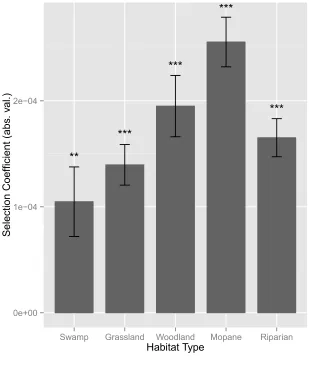
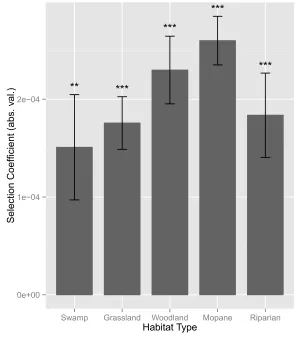
were selected for, varied greatly among habitats. Road selection was lowest in open habitat types 207
(swamp, |β| = 1.05e-04; grassland, |β| = 1.4e-04), and increased with increasing habitat density 208
(woodland, |β| = 1.95e-04; mopane, |β| = 2.56e-04), although road selection was only moderate in 209
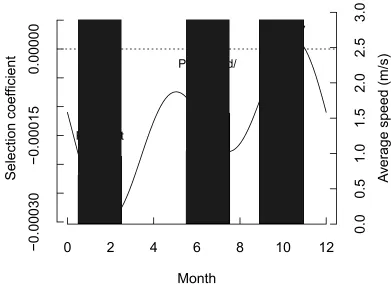
the densest habitat category, riparian (|β| = 1.65e-04). Results from the Fourier Transform 210
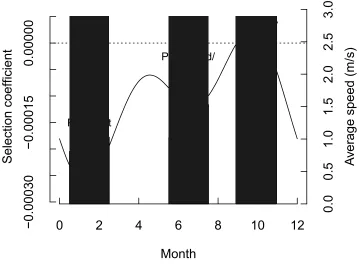
showed similar significant variation in road selection over time (Fig. 4). Road selection was 211
strongest during the peak wet season, January-March (min β = -2.6 e-04), and weakest during the 212
peak dry season, September-November (max β = 2.18e-05). A second peak in road selection 213
occurred in June-August (min β = -1.04e-04), which corresponds with the flood/denning season. 214
215
MOVEMENT STATISTICS OF ROAD TRAVEL 216
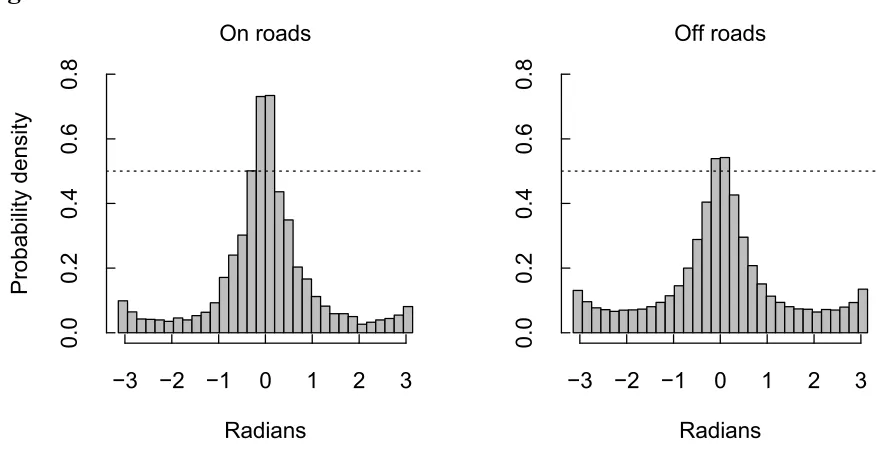
In our traveling data set, comparisons of the distribution of turn angles for observed steps on 217
roads versus observed steps off roads revealed that movement steps on roads had a greater 218
proportion of small or zero magnitude turn angles (Fig. 5). Our linear model showed that turn 219
angles were 25% smaller on roads (intercept = 1.00, slope = -0.25, p < 0.01). Average speeds 220
calculated from the traveling dataset were higher on roads than off-road across all seasons (Fig. 221
4). Average off-road travel speeds were 27% less than on-road speeds in the peak wet season 222
(0.81 vs. 1.03 m/s, SE=0.01, p<0.01), 50% less in the flood season (1.02 vs. 1.53 m/s, SE=0.006, 223
p<0.01), and 23% less in the peak dry season (0.72 vs. 0.17 m/s, SE = 0.006, p=0.04). 224
225
Discussion
226
Conservation and development planning require a comprehensive understanding of how 228
anthropogenic landscape features affect resource selection and landscape connectivity. Our 229
results emphasize the importance of explicitly considering the behavioural, landscape, and 230
climatic contexts in which the landscape features under study are encountered by the study 231
species. Importantly, we show that failure to consider these factors yields notably different and 232
potentially misleading outcomes compared to models that incorporate behaviour. Specifically, 233
while African wild dogs selected for roads when traveling, they avoided roads when resting. This 234
distinction was not evident when all movement data were considered together, thus illustrating 235
the need to consider the specific behavioural context in which movement is measured in order to 236
understand fully how anthropogenic features affect wildlife. In our case, separating patterns of 237
resource selection by behavioural state was required to determine roads effects on landscape 238
permeability for African wild dogs. 239
240
ROAD EFFECTS ON LANDSCAPE PERMEABILITY 241
Understanding the effects of landscape features such as roads on the energetic or survival cost of 242
animal movement is critical for accurately assessing connectivity and for protecting linkages for 243
wildlife movement (Rudnick et al. 2012; Cozzi et al. 2013). Yet, despite the global ubiquity of 244
roads, little research has described their impacts on fine-scale behavioural responses of wide-245
ranging species. While roads increase landscape resistance for many species, our findings 246
indicate that unpaved roads can significantly enhance landscape permeability for a large 247
carnivore of conservation concern. Our finding that African wild dogs selected for movement on 248
roads when traveling is consistent with previous studies on large carnivore use of anthropogenic 249
resolution spatial data partitioned by behavioural state provided a novel opportunity to link road 251
use to enhancement of landscape permeability. 252
253
Results of two analyses supported our hypothesis that roads increase landscape permeability for 254
African wild dogs when traveling. First, African wild dogs selected roads more strongly in 255
habitat types with high vegetation density, suggesting that roads are more preferred for 256
movement as the vegetation surrounding them becomes less permeable (Fig. 3). One exception 257
to this trend occurred in riparian habitat, where road selection was lower than in either mixed 258
woodland or mopane forest habitats. While riparian habitat was the most densely vegetated, the 259
riverbanks and ground cover immediately abutting riparian areas was more open and may have 260
served as movement corridors, a pattern that has been demonstrated for other large carnivore 261
species (Hilty & Merenlender 2004; Dickson et al. 2005). Second, road selection tracked 262
seasonal changes in vegetation, peaking during the peak wet season when vegetative growth is 263
highest, and dropping during the peak dry season when ground cover is relatively sparse (Fig. 4). 264
A second peak in road selection occurred during the Delta flood pulse, which coincides with the 265
denning season for African wild dogs. This peak in road selection may reflect the benefits of 266
efficient travel to and from den sites. Topographically, the study area is extremely flat, with no 267
correlation between road locations and elevation; as a result, we found no evidence that road 268
selection during the wet or flooding seasons is an artifact of animals simply selecting higher 269
ground to avoid flooded areas. A potential alternative hypothesis for road use is that prey species 270
of African wild dogs use roads for travel or foraging and the dogs simply followed their prey. 271
However, our results do not support this explanation as road selection was greatest in mopane 272
(Aepyceros melampus; Bonyongo 2005), and this hypothesis does not explain the seasonal 274
variation in road use exhibited by African wild dogs. 275
276
Roads also significantly influenced the turn angle and speed parameters of African wild dog 277
movement, which may result in energetic benefits. Smaller turn angles (Fig. 5) and greater travel 278
speeds may reflect reduced energetic costs of traveling on this type of open surface. These 279
tendencies were most pronounced during the denning season, a finding that is consistent with 280
work by Zimmermann et al. (2014), who reported that breeding wolves traveled faster than non-281
breeding wolves, especially on roads. Increased travel speeds during the denning season might 282
be explained by two contributing factors: den site habitat characteristics and the nature of central 283
place foraging. Wild dogs frequently choose den sites in relatively prey-poor habitat which has 284
been attributed to comparatively low predator densities (Meer et al. 2013). Commuting relatively 285
long distances through less prey-productive habitats could contribute to direct steady, and 286
therefore faster, travel until reaching comparatively high prey density hunting areas. Secondly, 287
the return trip to provision pups during the denning season represents a direct and purpose-driven 288
commute from wherever they are to a known destination (i.e., central place). Elimination of the 289
need to maintain cohesion as a social group while traveling (because the common destination is 290
predetermined), as well as the relatively direct return trip commute, would contribute to 291
increased average travel speeds during this period. 292
293
In addition to increasing landscape permeability, road use may have other behavioural 294
advantages. One potential advantage of road use is demarcation of pack territories, as has been 295
marking sites since roads may act as transmission corridors for olfactory information (Parker 297
2010). Roads may also confer benefits for hunting behaviour. For example, roads may increase 298
the line-of-sight to prey for African wild dogs (Latham et al. 2011). Indeed, Whittington and 299
colleagues (2011) showed that encounter rates between wolves and caribou increased near linear 300
features such as roads. Finally, while roads may increase the probability of encounters with other 301
carnivore species (e.g., lions), road use may reduce the risk of potentially detrimental outcomes 302
due to increased visibility along roads; this potential consequence of road use by traveling 303
African wild dogs will be investigated as part of future studies of the movement patterns of this 304
species. 305
306
These results suggest that unpaved roads do not reduce, and may in fact enhance, landscape 307
permeability for African wild dogs in wildlife areas of northern Botswana. This can and should 308
be incorporated into landscape-level connectivity assessments for this species, though managers 309
must be careful to align conservation action with the specific behaviour of conservation concern. 310
For example, our results indicate that preservation of suitable habitat for African wild dog rest 311
sites would be markedly different to that for movement pathways. Future research should explore 312
the potential negative impacts of roads on other behaviours such as denning (Meer et al. 2013), 313
and the direct impact of vehicle strikes or other effects of human presence in human-dominated 314
areas (Woodroffe et al. 2007). 315
316
CONCLUSIONS 317
Our findings emphasize the importance of considering the behavioural contexts in which animal 318
features (Beyer et al. 2010; Wilson et al. 2012). Resource selection analyses are commonly used 320
to inform landscape resistance surfaces in order to identify wildlife corridors (Chetkiewicz & 321
Boyce 2009; Zeller, McGarigal & Whiteley 2012). We assert that conservation biologists should 322
limit application of these data to localities identified when members of the target species are in 323
an appropriate behavioural state; failure to do so risks misidentification of movement corridors 324
(Elliot et al. 2014). While behaviour has been used to inform recommendations for conservation
325
planning in marine systems (Ashe et al. 2010), it has yet to be similarly incorporated into land
326
management for terrestrial species, particularly for the preservation of functional landscape
327
connectivity. The use of behaviour-specific step selection functions as implemented here 328
provides a powerful tool for analyzing fine-scale resource selection as part of efforts to conserve 329
habitats critical to endangered wildlife. 330
331
Acknowledgements
332
We thank the Botswana Ministry of Environment, Wildlife, and Tourism for permission to 333
conduct this research under permit number EWT 8/36/4 XXIV. This material is based upon work 334
supported by the National Science Foundation Graduate Research Fellowship under Grant No. 335
DGE1106400 and the Department of Education Foreign Language and Area Studies Fellowship. 336
We thank J. Lowe and S. Amos for fabricating and programming collars and the EPSRC 337
(EP/H013016/1), BBSRC (BB/J018007/1) and ERC for funding the collar work. We thank D. 338
Kedikilwe and other BPCT research assistants for invaluable contributions in the field, B. 339
Reineking, C. Harris, M. Tsalyuk, and P. Marler for assistance with analyses, W. Getz, E. Lacey, 340
A. Merenlender, and K. Gaynor for valuable edits, and the Brashares Lab Group for continuous 341
Literature Cited
343
Ashe, E., Noren, D.P. & Williams, R. (2010) Animal behaviour and marine protected areas: 344
incorporating behavioural data into the selection of marine protected areas for an 345
endangered killer whale population. Anim. Conserv.13, 196–203. 346
Benítez-López, A., Alkemade, R. & Verweij, P.A. (2010) The impacts of roads and other 347
infrastructure on mammal and bird populations : A meta-analysis. Biol. Conserv.143, 348
1307–1316. 349
Bennett, A.F. (1991) Roads, roadsides, and wildlife conservation: a review. Nature conservation
350
2: the role of corridors. (eds D.A. Saunders & R.J. Hobbes), pp. 99–118. Surrey Beatty and
351
Sons, Chipping Norton, New South Wales, Australia. 352
Beyer, H.L., Haydon, D.T., Morales, J.M., Frair, J.L., Hebblewhite, M., Mitchell, M. & 353
Matthiopoulos, J. (2010) The interpretation of habitat preference metrics under use-354
availability designs. Proc. R. Soc. B Biol. Sci.365, 2245–2254. 355
Bonyongo, C.M. (2005) Habitat Utilization by Impala (Aepyceros Melampus) in the Okavango
356
Delta. PhD thesis, University of Botswana.
357
Broekhuis, F., Cozzi, G., Valeix, M., McNutt, J.W. & Macdonald, D.W. (2013) Risk avoidance 358
in sympatric large carnivores: reactive or predictive? (ed J Fryxell). J. Anim. Ecol.82, 359
1097–1105. 360
Brown, D.D., Kays, R., Wikelski, M., Wilson, R. & Klimley, A. (2013) Observing the 361
unwatchable through acceleration logging of animal behavior. Anim. Biotelemetry1, 20. 362
Chetkiewicz, C.-L.B. & Boyce, M.S. (2009) Use of resource selection functions to identify 363
conservation corridors. J. Appl. Ecol.46, 1036–1047. 364
Clobert, J., Danchin, E., Dhondt, A.A. & Nichols, J.D. (eds). (2001) Dispersal. Oxford 365
University Press, Oxford. 366
Cozzi, G., Broekhuis, F., McNutt, J.W. & Schmid, B. (2013) Comparison of the effects of 367
artificial and natural barriers on large African carnivores: Implications for interspecific 368
relationships and connectivity. J. Anim. Ecol.82, 707–715. 369
Creel, S. & Creel, N.M. (1998) Six ecological factors that may limit African wild dogs, Lycaon 370
pictus. Anim. Conserv.1, 1–9. 371
Dickson, B.G., Jenness, J.S. & Beier, P. (2005) Influence of vegetation, topography, and roads 372
Elliot, N.B., Cushman, S.A., Macdonald, D.W. & Loveridge, A.J. (2014) The devil is in the 375
dispersers: predictions of landscape connectivity change with demography. J. Appl. Ecol.
376
51, 1169–1178. 377
Fahrig, L., Pedlar, J.H., Pope, E.S., Taylor, P.D. & Wegner, J.F. (1995) Effect of road traffic on 378
amphibian density. Biol. Conserv.73, 177–182. 379
Forester, J.D., Im, H.K. & Rathouz, P.J. (2009) Accounting for animal movement in estimation 380
of resource selection functions: sampling and data analysis. Ecology90, 3554–65. 381
Fortin, D., Beyer, H.L., Boyce, M.S., Smith, D.W., Duchesne, T. & Mao, J.S. (2005) Wolves 382
influence elk movements: behavior shapes a trophic cascade in Yellowstone National Park. 383
Ecology86, 1320–1330.
384
Fryxell, J.M., Hazell, M., Börger, L., Dalziel, B.D., Haydon, D.T., Morales, J.M., McIntosh, T. 385
& Rosatte, R.C. (2008) Multiple movement modes by large herbivores at multiple 386
spatiotemporal scales. Proc. Natl. Acad. Sci. U. S. A.105, 19114–9. 387
Hanski, I. (1999) Metapopulation Ecology. Oxford University Press, Oxford. 388
Hilty, J.A. & Merenlender, A.M. (2004) Use of Riparian Corridors and Vineyards by 389
Mammalian Predators in Northern California. Conserv. Biol.18, 126–135. 390
Latham, A.D.M., Latham, M.C., Boyce, M.S. & Boutin, S. (2011) Movement responses by 391
wolves to industrial linear features and their effect on woodland caribou in northeastern 392
Alberta. Ecol. Appl.21, 2854–2865. 393
Manly, B.F.J., McDonald, L.L., Thomas, D.L., McDonald, T.L. & Erickson, W.P. (2002) 394
Resource Selection by Animals: Statistical Design and Analysis for Field Studies. Kluwer
395
Academic Publishers, Boston, Massachusetts. 396
McNutt, J.W. (1996) Sex-biased dispersal in African wild dogs, Lycaon pictus. Anim. Behav.52, 397
1067–1077. 398
Meer, E. Van Der, Mpofu, J., Rasmussen, G.S.A. & Fritz, H. (2013) Characteristics of African 399
wild dog natal dens selected under different interspecific predation pressures. Mamm. Biol.
400
78, 336–343. 401
Nams, V.O. (2014) Combining animal movements and behavioural data to detect behavioural 402
states. Ecol. Lett.17, 1228–1237. 403
Nathan, R., Getz, W.M., Revilla, E., Holyoak, M., Kadmon, R., Saltz, D. & Smouse, P.E. (2008) 404
A movement ecology paradigm for unifying organismal movement research. Proc. Natl.
405
Acad. Sci. U. S. A.105, 19052–19059.
Parker, M. (2010) Territoriality and Scent Marking Behavior of African Wild Dogs in Northern
407
Botswana. PhD thesis, University of Montana.
408
Pedersen, M.W., Patterson, T.A., Thygesen, U.H. & Madsen, H. (2011) Estimating animal 409
behavior and residency from movement data. Oikos120, 1281–1290. 410
Priestley, M.B. (1981) Spectral Analysis and Time Series. (Vol. 1): Univariate Series. Academic 411
Press, London, UK. 412
R Core Team. (2014) R: A Language and Environment for Statistical Computing. 413
Roever, C.L., Beyer, H.L., Chase, M.J. & van Aarde, R.J. (2013) The pitfalls of ignoring 414
behaviour when quantifying habitat selection. Divers. Distrib. 1–12. 415
Rudnick, D.A., Ryan, S.J., Beier, P., Cushman, S.A., Dieffenbach, F., Epps, C.W., Gerber, L.R., 416
Hartter, J., Jenness, J.S., Kintsch, J., Merenlender, A.M., Perkl, R.M., Preziosi, D. V & 417
Trombulak, S.C. (2012) The Role of Landscape Connectivity in Planning and Implementing 418
Conservation and Restoration Priorities. Issues Ecol.16, 1–20. 419
Shepard, D.B., Kuhns, A.R., Dreslik, M.J. & Phillips, C.A. (2008) Roads as barriers to animal 420
movement in fragmented landscapes. Anim. Conserv.11, 288–296. 421
Swingland, I.R. & Greenwood, P.J. (1983) The Ecology of Animal Movement. Clarendon Press, 422
Oxford. 423
Therneau, T. (2014) A Package for Survival Analysis in S. R package version 2.37-7. 424
Thurfjell, H., Ciuti, S. & Boyce, M.S. (2014) Applications of step-selection functions in ecology 425
and conservation. Mov. Ecol.2, 4. 426
Trombulak, S.C. & Frissell, C.A. (2013) Review of Ecological Effects of Roads on Terrestrial 427
and Aquatic Communities. Conserv. Biol.14, 18–30. 428
Turchin, P. (1998) Quantitative Analysis of Movement. Sinauer Associates, Sunderland, 429
Massachusetts. 430
Turner, M. (1989) Landscape Ecology: The effect of pattern on process. Annu. Rev. Ecol. Syst.
431
20, 171–197. 432
Whittington, J., St. Clair, C.C. & Mercer, G. (2005) Spatial responses of wolves to roads and 433
trails in mountain valleys. Ecol. Appl.15, 543–553. 434
Whittington, J., Hebblewhite, M., DeCesare, N.J., Neufeld, L., Bradley, M., Wilmshurst, J. & 435
Musiani, M. (2011) Caribou encounters with wolves increase near roads and trails: a time-436
Wilson, R.R., Gilbert-Norton, L. & Gese, E.M. (2012) Beyond use versus availability: 438
behaviour-explicit resource selection. Wildlife Biol.18, 424–430. 439
Wilson, A.M., Lowe, J.C., Roskilly, K., Hudson, P.E., Golabek, K.A. & McNutt, J.W. (2013) 440
Locomotion dynamics of hunting in wild cheetahs. Nature498, 185–9. 441
Woodroffe, R., Davies-Mostert, H., Ginsberg, J., Graf, J., Leigh, K., McCreery, K., Robbins, R., 442
Mills, G., Pole, A., Rasmussen, G., Somers, M. & Szykman, M. (2007) Rates and causes of 443
mortality in Endangered African wild dogs Lycaon pictus: lessons for management and 444
monitoring. Oryx41, 215–223. 445
Zeller, K.A., McGarigal, K. & Whiteley, A.R. (2012) Estimating landscape resistance to 446
movement: a review. Landsc. Ecol.27, 777–797. 447
Zimmermann, B., Nelson, L., Wabakken, P., Sand, H. & Liberg, O. (2014) Behavioral responses 448
of wolves to roads: scale-dependent ambivalence. Behav. Ecol.00, 1–12. 449
450
451
452
453
454
455
456
457
458
459
460
461
462
463
Table 1. Summary of step selection coefficients for “distance to road” by collar-derived 465
behaviour categories (n = 13 individuals). Negative beta values indicate increasing “distance to 466
road” has a negative effect on step selection, therefore negative values correspond to selection 467
for locations nearer roads (road selection); positive values indicate selection for locations farther 468
from roads (road avoidance). All beta and standard error values are multiplied by 10-4. P-values
469
were calculated from Wald tests. 470
Behaviour # observed steps β SE p
Combined 82840 -0.16 0.26 0.54 Traveling 70550 -1.47 0.20 <0.01* Running 5934 -1.63 2.70 0.55 Resting 6356 3.23 0.13 0.015* 471
472
473
474
475
476
477
478
479
Figure 1
481
482
483
484
485
Figure 2
487
488
489
490
491
492
493
494
495
496
497
498
499
500
501
Figure 3
504
505
506
507
508
509
510
511
512
513
**
***
***
***
***
0e+00 1e−04 2e−04
Swamp Grassland Woodland Mopane Riparian
Habitat Type
S
e
le
ct
io
n
C
o
ef
fic
ie
nt
(
ab
s.
v
al
Figure 4
514 515 516 517 518 519 520 521 522 523 0. 0 0 .5 1 .0 1. 5 2. 0 2. 5 3 .0 A ve ra g e sp e ed ( m /s )0 2 4 6 8 10 12
Figure 5
524
525
526
527
528
529
530
531
532
533
534
535
536
537
538
On roads
Radians
P
ro
ba
b
ili
ty
d
en
si
ty
−3 −2 −1 0 1 2 3
0
.0
0.
2
0.
4
0.
6
0
.8
Off roads
Radians
−3 −2 −1 0 1 2 3
0
.0
0.
2
0.
4
0.
6
0
Figure Captions
539
Figure 1. Map of study area (c. 2700 km2; centered at 19°31’S, 23°37’E) and major vegetation
540
types. 541
542
Figure 2. A pack of African wild dogs (Lycaon pictus) on a typical sand road in the study area 543
located in northern Botswana’s Okavango Delta region. 544
545
Figure 3. The strength of road selection as a function of habitat type for African wild dogs 546
moving consistently (“traveling”, n = 70550 steps). Selection coefficients were calculated with 547
step selection functions; larger values indicate stronger road selection. Habitats are listed in 548
increasing order of vegetation density from left: swamp (open structure), grassland (open 549
structure), mixed woodland (medium structure), mopane forest (medium-dense structure), and 550
riparian (dense structure). With the exception of riparian habitat (see Discussion), the strength of 551
road selection increases in denser habitat types. 552
553
Figure 4. Variation in road selection over time of year (black line) when African wild dogs were 554
moving consistently (“traveling”, n = 70550 steps) and corresponding travel speeds averaged 555
within each season (light grey bars = average off-road travel speed; dark grey bars = average on-556
road travel speed). Negative step selection coefficients correspond to selection for locations 557
nearer roads (road selection); positive values indicate selection for locations farther from roads 558
(road avoidance). Three distinct climatic seasons are highlighted: peak wet, peak flood, and peak 559
Figure 5. Probability density of turn angles for steps on roads and off roads when African wild 561
dogs were moving consistently (“traveling”, n = 70550 steps). The dotted line highlights the 50% 562
probability density for comparison between plots. Turn angles were measured as the change in 563
bearing from the previous step. 564
565
566
567
568
569
570
571
572
573
574
575
576
577
578
579
580
581
Supplementary Material
583
The following Supplementary Material is available for this article online. 584
585
Table S1. Pack identities and data collected per collared individual. 586
Individual Gender Pack ID Study Period # GPS locations
Accra* F KB Apr.-Sep. 2012 64,192 Timbuktu F KB Apr.-Sep. 2012 38,366 Scorpion M KB Apr. 2012-Oct. 2013 50,411 Kobe M KB Apr.-July 2012 24,852 Gomer*
Bongwe
M M
HW HW
Nov. 2011-Nov. 2012 Apr.-Dec. 2012
23,023 17,378 Bobedi F HW Nov. 2011-July 2012 20,676 Yolo*
Stetson
M M
MT MT
Nov. 2011-2012 Nov. 2011-Apr. 2012
21,131 8,906 Brian M MT Apr.-July 2012 5,604 Dar* F CT Apr.-Aug. 2012 1,447 Kubu* F MK Apr.-Oct. 2012 8,587 Jesus* M SA Mar.-July 2012 5,983
* Individuals included in the more conservative analyses excluding multiple individuals from the same pack.
587 588
589
Table S2. Summary of step selection coefficients for distance to road by collar-derived 590
behaviour categories excluding multiple individuals from the same pack (n = 6 individuals). 591
Negative beta values correspond to selection for locations nearer roads (road selection); positive 592
values indicate selection for locations farther from roads (road avoidance). All beta and standard 593
error values are multiplied by 10-4. P-values were calculated from Wald tests.
594
Behaviour # observed steps β SE p
Figure S1. The strength of road selection as a function of habitat type for African wild dogs 595
moving consistently, excluding multiple individuals from the same pack (“traveling”; n = 6 596
individuals, 25601 steps). Selection coefficients were calculated with step selection functions; 597
larger values indicate stronger road selection. Habitats are listed in increasing order of vegetation 598
density from left: swamp (open structure), grassland (open structure), mixed woodland (medium 599
structure), mopane forest (medium-dense structure), and riparian (dense structure). With the 600
exception of riparian habitat (see Discussion), the strength of road selection increases in denser 601
habitat types. 602
603
604
605
** ***
***
***
***
0e+00 1e−04 2e−04
Swamp Grassland Woodland Mopane Riparian
Habitat Type
S
e
le
ct
io
n
C
o
ef
fic
ie
nt
(
ab
s.
v
al
Figure S2. Variation in road selection over time of year (black line) when African wild dogs 606
were moving consistently, excluding multiple individuals from the same pack (“traveling”; n = 6 607
individuals, 25601 steps), and corresponding travel speeds averaged within each season (light 608
grey bars = average off-road travel speed; dark grey bars = average on-road travel speed). 609
Negative step selection coefficients correspond to selection for locations nearer roads (road 610
selection); positive values indicate selection for locations farther from roads (road avoidance). 611
Three distinct climatic seasons are highlighted: peak wet, peak flood, and peak dry seasons. 612 613
0.
0
0
.5
1
.0
1.
5
2.
0
2.
5
3
.0
A
ve
ra
g
e
sp
e
ed
(
m
/s
)
0
2
4
6
8
10
12