Volume-7 Issue-2
International Journal of Intellectual Advancements
and Research in Engineering Computations
Enhancement of power quality using UPQC by ANN controller
M.Rajkumar, M.K Elango*
PG Scholar, Department of Electrical and Electronics Engineering K.S.Rangasamy College of
Technology Tiruchengode, Tamilnadu, India
*Professor and Head, Department of Electrical and Electronics Engineering K.S.Rangasamy College of
Technology Tiruchengode, Tamilnadu, India
ABSTRACT
This paper proposes Design and analysis of ANN based unified power quality controller (UPQC) for power quality improvement. The UPQC is the combination of shunt and series APF. The series APFs are used to compensate voltage related problems and the shunt APFs are used to compensate current related problems. The unified power quality conditioner (UPQC) integrates both shunt and series APFs through a common DC link capacitor. The UPFC is employed in power transmission system, and the primary objective of UPFC is to control the flow of power at, fundamental frequency. Whereas the UPQC is employed in a power transmission system. It controls distortion due to harmonics and unbalance in voltage in addition to control of flow of power at the fundamental frequency. In this work, the conventional controller has been replaced by an ANN (Artifical Nural Network). The ANN has been used in APFs in place of conventional controller for improving the dynamic performance. The results obtained through the ANN are good in terms of dynamic response. Simulations are verified by using of MATLAB/Simulink.
Index Terms
: Artificial neural network (ANN), Current Source Inverter (CSI), Proportional integral (PI), Unified power- quality conditioner (UPQC), Voltage Source Inverter (VSI).INTRODUCTION
The term electric power quality (PQ)is generally used to assess and to maintain the good quality of power at the level of generation, transmission, distribution, and utilization of AC electrical puissance[1][2]. Since the pollution of electric power supply systems is much astringent at the utilization level, it is paramount to study at the terminals of end users in distribution systems. There are a number of reasons for the pollution of the AC supply systems, including natural ones such as lightening, flashover, equipment failure,
unbalanced currents, and an extortionate neutral current in polyphase systems due to unbalancing and harmonic currents engendered by some nonlinear loads. These power quality quandaries cause failure of capacitor banks, incremented losses in the distribution system and electric machines, noise .Nowadays more number of non linear are utilizing in distribution system.[2] It requires more flexible and high speed of operation. For this situation, power quality amelioration contrivances are utilized. The main custom power contrivance which are utilized in distribution systems for power quality amelioration are D-STATCOM, AF, UPQC etc. Electrical equipment susceptible to power quality or more congruously to lack of potency quality would fall within a ostensibly abysmal domain. Mundane issues cognate to power quality are such as voltage sag, voltage swell, voltage unbalance, harmonics, voltage fluctuations. In this paper, the ANN(Artificial Neural Network )has been presented, and its emolument strategy is applied to a three phase three-wire power system
UNIFIED POWER QUALITY
CONDITIONER
UPQC (unified power quality conditioner) is a equipment which is utilized for compensate for voltage distortion and voltage unbalance in a puissance system so that the voltage at load side is thoroughly balance and sinusoidal and impeccably regulated and additionally it is utilized to compensate for load current harmonics so that the current at the source side is impeccably sinusoidal and liberate from distortions and harmonics. [4] UPQC is a coalescence of a shunt active power filter and series active power filter. here shunt active power filter (APF) is utilized to compensate for load current harmonics and make the source current thoroughly sinusoidal and liberate from harmonics and distortions. shunt APF is connected parallel to transmission line. here series APF is
utilized to mitigate for voltage distortions and unbalance which is present in supply side and make the voltage at load side impeccably balanced, regulated and sinusoidal. series APF is connected in series with transmission line.
Principle
Figure 1 Basic Configuration of UPQC
ARTIFICIAL NEURAL NETWORK
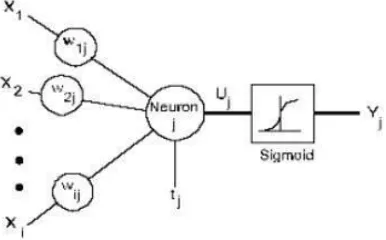
The detection of the disturbance signal in a rapid way with high accuracy, fast processing of the reference signal, and high dynamic response of the controller are the prime requirements for desired compensation in case of UPQC. The traditional controller neglects to perform agreeably under parameter varieties nonlinearity load aggravation, and so forth. An ongoing report demonstrates that NN-based controllers give quick unique reaction while keeping up steadiness of the converter framework over wide working reach . [10][11]The ANN is comprised of interconnecting fake neurons. It is basically a mix of appropriately interconnected nonlinear components of extremely straightforward structure that have the capacity to learn and adjust. It identifies with cerebrum dependent on two angles pursue by the information is gained by the system through the learning procedure and interneuron association qualities are utilized to store the learning .These systems are portrayed by their topology, the manner by which they speak with their condition, the way in which they are prepared, and their capacity to process data. ANN has gain a great deal of enthusiasm in the course of the most
recent couple of years as an incredible strategy to take care of numerous genuine issues. Contrasted with customary programming, they possess the capacity of taking care of issues that don't have algorithmic arrangement and are in this way discovered appropriate to handle issues that individuals are a great idea to comprehend, for example, design acknowledgment. ANNs are being utilized to take care of AI issues without essentially making a model of a genuine powerful framework. For improving the execution of an UPQC, a feed forward-type ANN- based controller is structured
Structure of ANN
Fig 3. Basic structure of ANN While there is a reasonable comprehension of
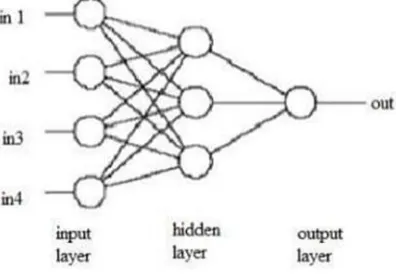
how an individual neuron functions, there is still a lot of research and generally guess with respect to the manner in which neurons arrange themselves and the systems used by varieties of neurons to adapt their comportment to outer upgrades. There are a sizably voluminous number of trial neural system structures as of now in use mirroring this condition of sustaining research. For our situation, we will just portray the structure, science and comportment of that structure kenned as the back propagation system. This is the most common and summed up neural system right now in use. To assemble a back propagation system, continue in the accompanying style [12]. To begin with, take various neurons and cluster them to make a layer. A layer has every one of its sources of info associated with either a previous layer or the contributions from the outside world, however not both inside a similar layer. A layer has every one of its outputs associated with either a thriving layer or the outputs to the outside world, however not both inside a similar layer. Next, various layers are then
exhibited one succeeding the other so that there is an info layer, different transitional layers and determinately a output layer, as in Figure 4. Middle of the road layers, that are those that have no sources of info or outputs to the outside world, are called concealed layers. Back propagation neural systems are generally completely associated. This implies every neuron is associated with each output from the former layer or one contribution from the outside world if the neuron is in the main layer and, correspondingly, every neuron has its output associated with each neuron in the succeeding layer.
In General, the information layer is viewed as a wholesaler of the signs from the outer world. Concealed layers are viewed as categorizers or highlight locators of such signals. The output layer is viewed as an authority of the highlights identified and maker of the reaction. While this perspective on the neural system might be useful in conceptualizing the elements of the layers, you ought not take this model too truly as the capacities portrayed may not be so explicit or confined.
Fig.4. Back propagation Network
SIMULATION WORK AND RESULT
MATLAB is an interactive system for numerical computation. The simulation diagram of
unified Power Quality Conditioner is shown below in fig 4
Table 1 System Parameters
Inductor 4e-3H Series transformer 250e-6KVA Non liner RL load --
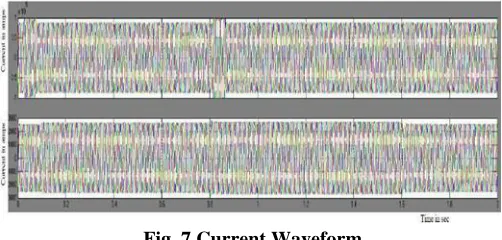
The UPQC has simulated by Artificial Neural Network. The source voltage and current waveform afore and after connecting the UPQC are analysed. It has descried that the source voltage is distorted afore connecting the UPQC and the distorted is reduce after connecting the UPQC.
The UPQC has simulated utilizing by the ANN controller. The source voltage and current waveform before and after connecting the UPQC are analysed. It has descried that the source voltage is distorted afore connecting the UPQC and the distorted is reduce after connecting the UPQC.
Fig.5 Simulink Model of UPQC with ANN
Voltage Waveform
The system is simulated at the intervals of 0.8 to 1.6 during this sag is crated and after connecting
UPQC the distoration is reduced from 1.6 to 0.87 and the voltage wave is shown in Figure 6
Fig. 6 Voltage Waveform
Fig. 7 Current Waveform
Harmonic Distortion
The system is simulated and harmonic analysis are taken it has been seen that from figure 8 before connecting UPQC harmonic distortion is 3.18% at
the time of 0.82 sec after connecting conditioner the harmonic distortion is reduced to 0.40% at the time of 0.91 sec as shown in figure 9
Fig. 8 THD before connecting UPQC
Fig .9 THD after connecting UPQC. V CONCLUSION AND FEATURE SCOPE
In this paper the incrementation in commercial and industrial load has results in rigorous power quality quandary in the transmission and distribution side. The major perturbance in the
Genetic algorithm. These control techniques which reduce the uncompensated part and improve the
power quality.
REFERENCES
[1]. Abdlfettah Boussaid, Ahmed Lokmane Nemmour, Lamri Louze, Abdelmalek Khezzar “A novel strategy for shunt active filter control” Electric Power Systems Research 123, 2015, 154–163.
[2]. Ashish Patel, H.D. Mathur, Surekha Bhanot, “An Improved Control Method for Unified Power Quality Conditioner with unbalanced load” Electrical Power and Energy Systems 100, 2018, 129–138.
[3]. Allan A. Montanari, Aniruddha M. Gole “Enhanced Instantaneous Power Theory for Control of Grid Connected Voltage Sourced Converters under Unbalanced Conditions” IEEE Transactions on Power Electronics, 32(8), 2017.
[4]. Anup Kumar Panda, Nishant Patnaik “Management of reactive power sharing & power quality improvement with SRF- PAC based UPQC under unbalanced source voltage condition” Electrical Power and Energy Systems, 84, 2015, 182–194.
[5]. Esmaeil Rezaei, Mohammad Ebrahimi, and Ahmadreza Tabesh “Control of DFIG Wind Power Generators in Unbalanced Microgrids Based on Instantaneous Power Theory” IEEE Transactions on Smart Grid, 8(5), 2017, 2278-2286
[6]. Farnaz Harirchi, Marcelo G. Simões, “Enhanced Instantaneous Power Theory Decomposition for Power Quality Smart Converter Applications” IEEE Transactions on Power Electronics, 99, 2018.
[7]. Jeraldine .A Viji ,T. Aruldoss Albert Victoire “Enhanced PLL based SRF control method for UPQC with fault protection under unbalanced load conditions” Electrical Power and Energy Systems, 58, 2014, 319–328.
[8]. Metin Kesler,Engin Ozdemir “A Novel Control Method for Unified Power Quality Conditioner (UPQC) Under Non-Ideal Mains Voltage and Unbalanced Load Conditions” IEEE Transactions on Power Electronics, 10(1), 374-379.
[9]. Quoc-Nam Trinh, Hong-Hee Lee “Improvement of unified power quality conditioner performance with enhanced resonant control strategy” IET Generation, Transmission & Distribution, 8(12), 2014, 2114-2123.
[10].Sudheer Vinnakoti and Venkata Reddy Kota “Implementation of artificial neural network based controller for a five-level converter based UPQC” Alexandria Engineering Journal, 57(8), 2014, 1475-1488
[11].Sudheer Vinnakoti and Venkata Reddy Kota “ANN based control scheme for a three-level converter based unified power quality conditioner” Journal of Electrical System and Information Technology, 5(3), 526-541.
[12].Vadirajacharya ,G. Kinhal, Promod Agarwal and Hari Oam Gupta “ Performance Investigation of Neural- Network- Based Unified Power Quality Conditioner” IEEE Transactions on Power Delivery, 26(1), 431-437.
[13].Vinod Khadkikar and Ambrish Chandra “UPQC-S: A Novel Concept of Simultaneous Voltage Sag / Swell and Load Reactive Power Compensations Utilizing Series Inverter of UPQC” IEEE Transactions on Power Electronics, 26(9), 2011, 2414- 2425.