119 Advised by Tamar Taliashvili, Ilia State University, Tbilisi, Georgia
received: February 02, 2011 accepted: March 10, 2011
Nino Sharvashidze MA, Researcher at Ilia Sate University, School of Graduate Studies, Educational Research, Kakutsa Cholokashvili Ave 3/5 Tbilisi, 0162 Georgia.
E-mail: [email protected]; [email protected] Website: www.iliauni.edu.ge
Miles Bryant Professor and Fulbright Scholar, Chair, Joint UNL/UNO Doctoral Program, Department of Educational Administration, University of Nebraska, Lincoln, NE 68588-0630, USA. E-mail: [email protected]
Website: http://www.unl.edu
THE CONCEPT OF SYSTEMRELATED
STRESS REDUCTION (SYSRED) IN
EDUCATIONAL FIELDS
Marcus Stueck
University Leipzig, Germany E-mail: [email protected]
Abstract
Existing analysis about teachers’ and student´s experience of stress, related health risk factors, and consequences for the profession represent the basis of this integrated stress-management concept designed for educational fields, e.g. schools. It has been developed by the author of this article since 1994. The SYSRED-Concept (SYStemrelated Stress REDuction) follows three level of stress management, which are used integratively with both teachers and children. First (Level of children), it offers strategies for stress preventive work with children (e.g. EMYK: training of relaxation with elements of yoga for children). Secondly (Level of adults), courses for stress-management for teachers were developed and evaluated (e.g. STRAIMY: Stress-management training with elements of yoga; BIODANZA: dance and motion oriented psychological intervention method for stress-management). Finally, seminars for the broadening of teachers’ pedagogic-psychological competences are carried out (e.g. employment of relaxation methods in class; method-training seminars for the reduction of exam anxieties and for a better handling of behavioural disorders and discipline problems). Thirdly (level of conditions), the conditions which cause stress are analyzed and changed. Within the framework of accompanying evaluations we examined around 600 subjects with regard to the short and long term effects of the measures taken concerning personnel development and intervention on certain psychological, psycho-social, and immunological parameters. We were able to prove the stress reducing effects of the trainings methods for both students and teachers as well as the improvement of the teachers’ pedagogical-psychological competences caused by participating in the training seminars. Until now we were sucessfully working with 1000 teachers and pupils applying the components of the SYSRED-Concept. This article further explains an MasterplanMasterplan to secure the Balance between Intuitive-emotional vs. Rationbal Education. This Plan helps to get an overview where the stressreduction methods from SYSRED are integrated. Within it, it is discussed thethe role of the Body-Orientation, Stressreduction, Empathy and ability to Love in educational fields as human basic behaviour in educational fields, which has to be developed within the Education of the 21st
century.
Key words: stress, stress and teacher, stress coping in school. Introduction
Volume 29, 2011
120 programme, into first results of evaluation and an theoretical introduction to stress.
What is Stress and How Can it be Mastered?
there exists a variety of different theories and definitions of stress, depending on the standpoint of the observer. yet, despite these differences all existing definitions have one understanding in common: stress is a necessary psychological and physiological, additional performance in order to cope with alarming problematic situations.
a stress-triggering alarming situation exists for the individual when a certain demand can no longer be handled with conventional routines of action. the individual sees for himself a danger to the following basic needs on a physical and psychological level (schröder, 1996):
• need for control of the environment (situations can no longer be controlled by the individual),
• need for self-control (individual can no longer control himself), • need for self-development (individual can no longer develop himself), • need for social integration (individual can not count on help).
With the help of this identification of an alarming situation one tries to activate optimal mental, emotional, behavioural, social, and physical aids and recourses to be able to fulfil the demands. this mobilization or additional regulation is also called acute stress reaction – an natural survival reaction, which releases additional energies. the following psychological and physiological reactions and stress signals indicate that someone is under this pressure (schröder and reschke, 2000) (see table 1).
Table 1. Stress signals in the stage of acute stress.
a) in one’s thoughts (stress cognitions and problem thoughts like ‘I should not make a mistake’, ‘I must …’, ‘this will
go wrong’, ‘nothing will work out alright’),
b) in one’s feelings (inner unrest, anger, insecurities, anxieties),
c) in one’s behaviour (I walk faster, I talk louder, I explode easily, I try to do many things at the same time),
d) in one’s body (release of the stress hormones adrenaline and noradrenaline: causing an increase of pulse, blood
pressure, respiration frequency, increase of the amount of oxygen in the blood and better perfusion of the perform-ing organs like the musculature, preparation of sugar and fat reserves to provide extra energy for the muscles).
Volume 29, 2011 121
Table 2. Stress signals in the incipient stage of chronic stress.
Psychological symptoms:
Lacking control of the demand, feelings of anxiety, harassment, depression, helplessness, lower self-esteem, loss of perspective, exhaustion of reserves, loss of the ability to recreate, disturbance of social relations, increase of unhealthy behaviour, destruction of action (impracticability of action plans), reduced effectiveness of action (low quantity and quality of a performance).
Physical symptoms:
e.g. Dysregulation in Heart-Circulation, Stomache malfunctions, depressive states, sleeping disorders
disturbances of the cardiovascular and digestive systems, headaches, insomnia, distur-bances of the motor coordination and mimic.
the symptoms of disturbances listed in table 2 are not yet comparable to a disease. in order to reduce chronic stress conditions the effected person needs, however, management help from his or her personal environment. should there be no such help, psychologically and/or organically manifested diseases can develop (stomach ulcers, allergies, heart attack, depression, phobias, psychotic developments) (see table 3).
Table 3. Psychological risk factors for stress diseases.
Whether a person diseases because of chronic stress conditions or not does not only depend on the physical peculiari-ties of this person’s constitution, but especially on the following personality-psychological coping peculiaripeculiari-ties:
a) subjective interpretation of the stress situation (cognitive risk factors): Less favourable for long term pressure
(although justifiable for short term pressure) are mental defence or ignorance of stress. Favourable is an assess-ment of the situation as being a challenge.
b) emotional experience of the situation (emotional risk factors): Unfavourable is a hostile defence against the
demands with strong negative feelings1: depressiveness, anxiety/fear, anger, repeated changes between hope and resignation, feelings of helplessness and hopelessness.
c) behaviour in situations of pressure (behavioural risk factors): Hyperactivity in stressful situations as well as
lacking or delayed phases of relaxation can cause illness.
Possible Stress Management Strategies
teachers as well as students are looking for offers and concepts which can help them deal adequately with pressure. possible influences for the management of stress situations for children can basically start at two points1:
1. alteration of the conditions of the demands (e.g. school, home). 2. Qualification of students and teachers to become capable of:
a) Regulating the environment
students and teachers can be taught how to master demands or problematic situations concerning their achievements and the social and organisational sphere by applying appropriate problem solving methods (e.g. by acquiring 1 schröder (1996) also calls these negative feelings ‘patogenetic transformational links between illness and health’.
Volume 29, 2011
122 knowledge, teaching of learning techniques and problem solving strategies, improvement of time management, communication training).
b) Self-regulation
students and teachers can learn to regain their lost inner balance with the help of different self-regulation methods (relaxation programmes) for a short or longer period of time (see table 4). the thus gained stability is the requirement for acting successfully in stress situations.
Table 4. Intervention possibilities to encourage the self-regulation of children and adults.
Passive methods, not exercise-oriented:
1. relaxation through self-hypnosis 2. travels of the imagination 3. meditative exercises
4. self-instruction to stop momentary stress situations 5. lowering of the level of demands
6. short sleep
Active methods, exercise-oriented:
7. progressive muscle relaxation (PMR)
8. yoga
9. simple stretching exercises 10. breathing exercises
11. massages
12. sensory exercises (euthyme sensory experience) 13. dance elements
14. mandala drawing
With the help of these self-regulation methods a balance of emotions is achieved as well as an improvement of the general state of mind, a reduction of tenseness and further effects of the relaxation response, which acts as an antagonist towards the stress reaction. another proven effect (ebert, 1986) is an optimization of the vegetative working point with far-reaching psy-chological consequences: less impulsivity, aggression, and anxiety, better ability to concentrate (stueck, 2000).
Why Body-Oriented Stress Reduction Methods with Teachers and Children?
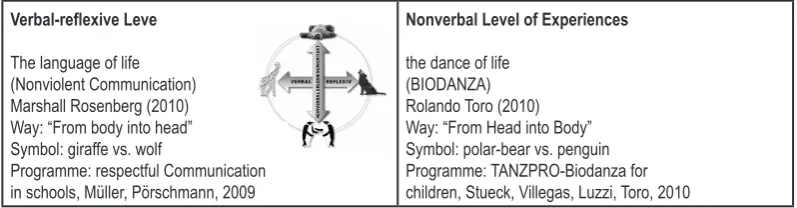
the perception of the body means to feel. the feelings and emotions are the connection with the own needs. this nonverbal expression is the basic for our verbal reflection. for a child the body is the most important “thinking organ”. that means also the teacher has to have an access to his own body-perception, without rational processing, only the ability to experience. that’s why we propose the intervention method biodanZa (toro, 2010) as well for children as for teachers. Without this body-access the development of self-conscious within children and teachers is not possible (maturana & Verden Zöller, 2005). stueck (2010) developed a master plan to secure the balance between intuitive-emotional vs. rational education. this plan helps to get an overview where the stress reduction methods from sysred are integrated:
1. The body as an organ for experience and thinking (presence between child and teacher).
2. Stress reduction and relaxation as basis for empathy and the ability to love. 3. Emphatic and respectful communication: stueck (2010) developed a school of
Volume 29, 2011 123 pörschmann, 2009) and nonverbal aspects (biodanZa, r. toro). the integrative model
of empathy is shown in figure 1.
Education is Only Possible with Ability of Empathy and Love?
stressreduction and relaxation is the basic for emphaty and the ability to love1. Without this human basic skills children can not learn and teacher can not teach. the concept of love and its important meaning for therapy and healthy education was announced as a scientific construct and as basic ability for all human disciplines by stueck (20112). rolando toro (2010) developed with biodanza a system of affective integration to develop a “behaviour of love and empathy” on a nonverbal-experiencial level (“the dance of life”). marshal rosenberg developed the verbal-reflexive basics as a “language of life”. stueck (2010) integrated this verbal and nonverbal basic-concepts to a “school of empathy”. the “concept of love” as a scientific construct is investigated at this moment by a research group at leipzig university3.
Verbal-reflexive Leve
The language of life (Nonviolent Communication) Marshall Rosenberg (2010) Way: “From body into head” Symbol: giraffe vs. wolf
Programme: respectful Communication in schools, Müller, Pörschmann, 2009
Nonverbal Level of Experiences
the dance of life (BIODANZA) Rolando Toro (2010) Way: “From Head into Body” Symbol: polar-bear vs. penguin Programme: TANZPRO-Biodanza for children, Stueck, Villegas, Luzzi, Toro, 2010
Figure 1: School of Empathy + Integrative Model of Human Empathy (Stueck, 2010).
this first 3 steps are named as the forgotten basics of humanity (maturana, Verden & Zöller, 2005). Without a body access, relaxation, empathy and ability of love there is no possibility to develop education (steps 4-7):
4. supervision of teachers, 5. educational skills/content, 6. educational concept, 7. frame conditions.
the master plan to secure the balance between intuitive-emotional vs. rational educa-tion was successfully implemented in a project in Germany named“strong roots - healthy life styles in Kindergartens” (ministry of health, technical university dresden, university of leipzig and Government of health north saxonia4).
Introduction to the Components of the SYSRED-Concept
since 1994, we are developing a stress preventive concept based on the above described theoretical background which is applied to students as well as to teachers. this integrative method is necessary because students and teachers are two components that influence and teach one another. in order to secure this integrative method we suggest four possibilities of
1 in studies at leipzig university (stueck, sonntag, balzer, et al., 2005) could be shown the negative correlation between chronic stress states and the ability to love.
2 at his key note speech at the international interdisciplinary conference “crisis and intervention” at riga marcch at his key note speech at the international interdisciplinary conference “crisis and intervention” at riga marcch 2011
3 stueck, m.; schaumberg, r. (2011). love - a open source of cognition. unpublished edition: center of educa- stueck, m.; schaumberg, r. (2011). love - a open source of cognition. unpublished edition: center of educa-tional health, leipzig.
Volume 29, 2011
124 intervention: 1) level children:
a) Implementation of preventive interventions for stress management for pupils/ students
focus: preventive work with children
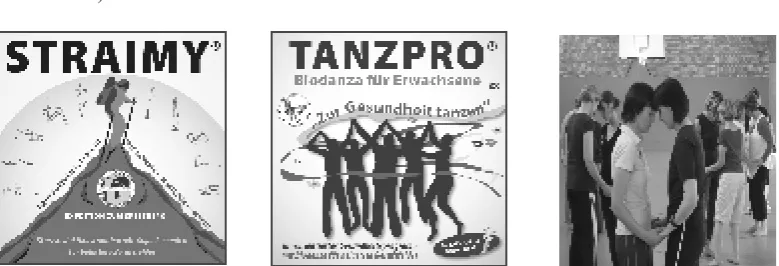
e.g. EMYK: training of relaxation with elements of yoga for children (stueck, 2000, 2009)
TANZPRO-Biodanza: dance-oriented programme with biodanza for children (stueck, Villegas, luzzi, toro, 2010)
Figure 2: Evidence-based Stressreduction Programmes for children.
2) level adults/teacher:
a) Implementation of interventions for stress managements for adults (e.g.teachers) focus: preventive work with teachers
e.g. STRAIMY: stress training with elements of yoga for adults (stueck, 2009). BIODANZA: intervention oriented on music, emotions, dance to reduce stress (toro, 2010).
Figure 3: Evidence-based stress reduction programmes for adults/teachers.
b) Schoolbased Abilities: Qualification of teachers to use stress and conflict management techniques during lessons (focus: teacher as mediator; teacher-student-relation (stueck, 2007, 2008)
• relaxation procedures in schools
• handling behaviourally difficult of students • how to motivate students
• reduction of exam anxieties in children
Volume 29, 2011 125 3) level conditions:
a) Awareness and Analysis of Stress-Conditions (focus: stress reductive conditions, stueck, 2008)
the education of course instructors to the sysred components (emyK, straimy, tanZpro-biodanza for children) are leaded through at the center of educational health at leipzig and Graz. the education for biodanZa-teachers is organized at biodanzaschool leipzig and riga1. the scientific evaluations take place at university of leipzig and riga teacher and management academy in riga (latvia).
Description of the SYSRED Components
Level 1: Implementation of preventive interventions for stress management for children
a) EMYK: Training of Relaxation with Elements of Yoga for Children
during several years of development, praxis transfer, and evaluation (1994-2001) the indian method of yoga was integrated into a structured training programme and combined with further tried and tested methods of stress management suitable for children. this programme was tested with students of different types of school. the training consists of 15 sessions (two exercises per week), one session lasting 60 minutes and being structured as follows:
• First Relaxation (10 minutes):
it is the aim of this first part to switch from the outer orientation of every day life to the inner orientation, which is necessary as a preparation for the following yoga part. at the end of this first relaxation breathing techniques for self-regulation are taught and exercised (rhythmical breathing, exhaling techniques, among others).
• Yoga Part (30 minutes):
the yoga part is the core of the training where different asana and yoga rows are taught and exercised. it is the aim of these exercises (besides the immediate effects of yoga) to enable the students to practise asana for self-relaxation independently at home.
• Final Part(10 minutes):
in the final part interactive, sensory, and meditation exercises, and travels of the imagination are carried out in combination with self-instruction and massages.
the instruction of this training follows a structured programme which is described in a handbook (stueck, 2000).
Evaluation Results
the effects of this programme called training of relaxation with elements of yoga were proven within a test-control-group-design (n=48 subjects) with psychological and physi-ological measuring methods (stueck, 1998, 2000). the results showed that the students ac-cepted the training and that its contents were attractive to them. We were able to prove with psychological and psycho-physiological methods the relaxation effects of the training as well as the stabilization of those parts of one’s personality relevant for coping with stress situations. this stabilization is a requirement for reacting successfully (significant positive effects p≤5%, e.g. emotional
Volume 29, 2011
126 stability, well-being, ability to take stress, ability to concentrate). furthermore, students also applied the acquired exercises independently for self-regulation (transfer effects).
Education of Instructors
since 1998, around 500 instructors are trained to work with emyK in schools but also in the clinical context. here as well, positive effects with regard to a decrease of exam anxiety and of the momentary experience of stress as well as an improvement of the ability to relax became visible (significant effects, p≤5%). thus, the successful transfer of the training from its developmental phase into praxis was verified (hartwig, 2000; stueck & Glöckner, 2005).
b) TANZPRO-Biodanza: Dance-oriented Programme with BIODANZA for children
tanZpro-biodanza for children is an evidence-based and scientifically evaluated dance-oriented program for children which was developed and scientificly investigated between 2008 and 2010 by marcus stueck, alejandra Villegas, cecilia luzzi, rolando toro at leipzig university. biodanza is a movement based method which uses especially the dance as a form of expression. the method was created by the chilean psychologist and anthropologist rolando toro in the 1960s and is performed in europe since the 1970s with growing popularity. in this type of movement the life (“bios”) is danced with integrative moves (danza) under the guidance of a biodanza teacher. in the process so-called “Vivencias” (spanish for experience) are used which influences children´s vitality, affectivity and creativity. the program tanZpro biodanza for children is designed for 10 sessions. each session consists of three partseach session consists of three parts1:
1. story „journey to a country“ or „to a theme“, 2. biodanza (issue-specific dances),
3. final part (processing of the experiences in images, imaginary journeys).
Evaluation Results
the effects of this programme were proven within a first investigation (n=15 subjects) with psychological, physiological and immunological, endocrinological measuring methods (stueck, 1998, 2000). the results showed that the contents of tanZpro-biodanza were attractive to them. We were able to prove the stress reductive effects of tanZpro-biodanza sessions.
Education of Instructors
since 2010, 40 instructors are trained to work with tanZpro-biodanza in schools but also in the clinical context.
level 2: intervention programmes for stress management applied to adults (e.g. teach-ers)
a) STRAIMY: Stress Training with Elements of Yoga for adults (e.g. teachers)
between 1999 and 2007, the stress training with elements of yoga for adults (straimy) was developed and evaluated. it can be carried out in two different ways with an
Volume 29, 2011 127 ensuing refreshing-seminar:
a) 10-weeks-course: one meeting (two hours) per week. b) 3-days- compact-course.
Theoretic and Thematic Frame Concept
the training and the compact course are thematically planned and carried out as an expedition to a mountain with the title: ‘It’s easy to come up, how will I come down again?’ Expedition to the stress mountain. it has been proven that this travel to the stress mountain is worthwhile since it offers a new, highly imaginative approach to the application of training pro-grammes for stress management. a climbing expedition can easily be compared to the life of a teacher because in both cases the breakdown of energy recourses due to an inappropriate stress management can lead to a far-reaching state of exhaustion along with a weakening of the im-mune system, vegetative and/or psychological instability, and psychosomatic reactions (stueck et al., 2006). the numerous early retirements of teachers are an indicator for this development (sieland, 2000). the concept of this training aims at enabling the participating teachers to ac-quire the following abilities:
• internal stability during or after the stress situation along with a growing psychological stability being a prerequisite for successful external reactions. the teacher is to acquire techniques that will help him to regulate emotions in order to reach a psycho-vegeta-tive balance e.g. after stress conditions (breathing and walking meditation, relaxation through self-hypnosis, self-reflections, self-instructions, among others).
• furthermore, teachers will learn how to better cope with external demands in their everyday lives with the help of stress-relevant strategies (e.g. with regard to teacher-student-interaction, time management, communication behaviour).
contents of the 10-weeks-course (straimy)
each session of the 10-weeks-course offer lasts two hours. based on earlier personal experiences in the development of training programmes (stueck, 1998, 2000) the structure of the sessions is organized in such a way that in the first part psycho-educative contents related to stress-relevant problems are taught and different short- and long-term stress management tech-niques are exercised. for this approach, the effective components of intervention programmes, developed by schröder and reschke (2000) and Wagner-link (2010), as well as newly devel-oped training modules are used. in the second part of the sessions the self-regulation methods yoga and meditation are used to train presence, composure, carefulness, and the ability to relax. this element of the training was successfully tested within the scope of another course offer (training of relaxation with elements of yoga for adults, torwey-a) between may and June 1999 and later modified to fit the needs of this training. regular exercises of the self-regula-tion-methods (yoga, meditation, relaxation through self-hypnosis) for 45 minutes each session are an important distinctive feature compared to other programmes.
Table 6. Structure of a session of the teacher training.
Psycho-educative part concerning the following topics:
Theory of stress, stress diagnosis, short- and long-term stress management techniques, conflict management and communicative behaviour specifically for teachers, social net, naming of personal desires and objectives.
Self-regulative part:
Volume 29, 2011
128 scientific research ascribes very efficient psychotherapeutic effects to yoga and meditation methods (Grawe, donati, bernauer, 1998). this self-regulative aspect was demanded by the teachers in a preliminary examination (stueck, 2007).
in addition to the 10-weeks-course, a 3-day seminar is offered. in this course the same content is taught in a compromised form with psycho-educative contents functioning as self-regulative exercises (small yoga programme; breathing and walking meditation). in the psycho-educative part the following aspects are covered: theory of stress, stress diagnosis, short- and long-term stress management techniques, social net, naming of personal desires and objectives.
six months after the end of both courses an analysis of progresses and problems that occurred when the acquired knowledge was transferred into practice is covered in a refreshing seminar.
Evaluation Results
the effects of this training were determined with the accompanying effect and process evaluation study (n=90) with a tG-cG-design (pre, post 1, and post 2). We were able to ascertain significant positive effects on different psychological behavioural and experience patterns (self-effectiveness, optimism, contentedness, job-related behavioural and experience patterns) as well as physiological parameters (blood pressure, skin resistance) and an immunological parameter (immune globulin a in the saliva).
Education of Instructors
since 2003 we educated and evaluated around 160 instructors to work with this method in schools and other institutions. an evaluation of course instructors in schools can be find in stueck (2007).
b) BIODANZA: Music-Emotion-Dance oriented Intervention
in addition to the traditional and successful stress management possibilities, which aim especially at changes through the cognitive-behavioural level, the sysred-concept works with a non-verbal and self-regulative emotion-dance- and contact-oriented intervention to improve emotional and social competences. in 1967, the chilean psychologist prof. rolando toro developed ‘biodanza’ – the dance of life – a method which received international acknowledgement and was introduced in europe in the 1980s. no previous knowledge is necessary in order to be able to practice this method. under the instruction of experienced teachers life (bios) is danced with integrated movements (danza). thus, motor-affective mechanisms for the reactivation of instincts and the non-verbal expression of one’s own identity are initiated. most importantly, this method achieves an integral, integrating emotional experience of music, singing, and dancing as well as the individual experience of being part of the group. these experiences and the exercises of the biodanza sessions are related to the following areas: vitality, affectivity, creativity, sexuality, and transcendence.
Evaluation Results
(Vil-Volume 29, 2011 129 legas, a.; stueck, m.; terren, r.; toro, V.; balzer, h-u.; hecht, K.; mazzarella, l., 1999, 2000, Villegas, 2006, stueck, 2007; stueck, Villegas et. al., 2008, stueck, Villegas et al. 2009). there-fore, according to the health policy of the World health organisation (Who), biodanza gains special notice due to the progressive development of health and a primary prevention. biodanza demands psycho-physical self-orientation and increases the ability to act and the effectiveness of these actions. a special effect is the modulation and balancing of different emotions (im-proved regulation of anger, optimism, and reduction of depressions, among others).
education of instructors
since 2005 we educated 20 instructors at the biodanza-school leipzig to work with this method1.
instruction of teachers to use stress- and conflict-management techniques in class in this third sysred intervention approach teachers shall be instructed to work as me-diators for the application of stress- and conflict-management techniques in schools. therefore, special emphasis lies on the fact that teachers are to enable their students to use management strategies (teacher-student-relation). the following instruction concepts are being practiced:
c) Method-Training-Seminar:Relaxation Methods in Schools
this seminar is conceived for teachers who shall be instructed to use relaxation exer-cises regularly during lessons. a pilot-study with school teachers in saxony (Germany) show (n=35), that only 17% of the teacher apply these self-regulation methods on a regular basis. this number is higher (46.4%) with consultation teachers2 (n=68). one reason for not using relaxation methods, often named by teachers, is the lack of time. We believe that a lack of knowledge about the advantages and effects of relaxation exercises as well as personal fears also account for this fact. the benefits of relaxation exercises – inner balance, improved ability to concentrate, and a better learning environment – are proven by our tests. the teacher prof-its as well, because he can also relax and work better with his students, since he reaches their physiological level of arousal and is able to attract many students through group intervention. in our opinion, this is a very effective and practicable method. the instruction of the teachers takes place as a one-day seminar where different elements of relaxation are introduced and a theoretic basis is worked out. furthermore, the teachers are taught how to instruct these exercises (trav-els of the imagination, meditative exercises, short sleep, progressive muscle relaxation, simple stretching exercises, breathing exercises, massages, sensory exercises, mandala drawing). the listed exercises were compiled from the results of interviews with teachers who already use these methods successfully.
Evaluation Results
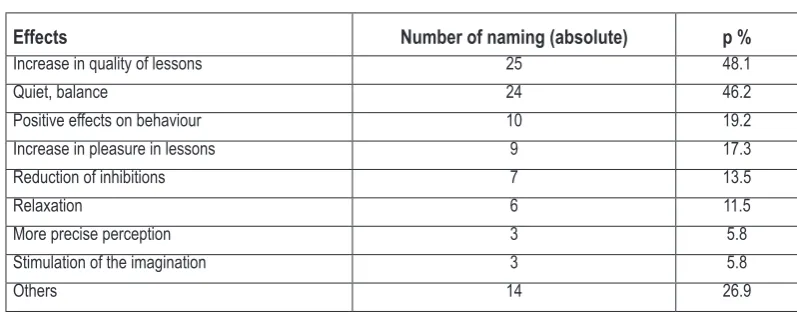
since 1998, 68 teachers of different school types and age groups were interviewed. the questions concerned the favourite and most successful relaxation methods as well as their ef-fects. With the help of a praxis hand-book, which was based on this information, further educa-tion for teachers is organized. the results listed below are given as examples (stueck, 2007).
1 www.biodanzaschule-leipzig.de www.biodanzaschule-leipzig.de
Volume 29, 2011
130 Table 9. What are the results of those relaxation exercises regarding
perform-ance, experience, and behaviour of the children? (n=68).
Effects Number of naming (absolute) p %
Increase in quality of lessons 25 48.1
Quiet, balance 24 46.2
Positive effects on behaviour 10 19.2
Increase in pleasure in lessons 9 17.3
Reduction of inhibitions 7 13.5
Relaxation 6 11.5
More precise perception 3 5.8
Stimulation of the imagination 3 5.8
Others 14 26.9
d) Method-Training-Seminar: dealing with behaviourally difficult students
during this two-day seminar teachers learn how to deal with behaviourally difficult students. With the help of exemplary cases the participants develop behaviour analyses with derived alternatives and try their practicability. it is the aim of this seminar to enable teachers to analyse and solve problem situations in self-supervision (within a small group).
e) Method-Training-Seminar: How to motivate children to learn
in the first part of this seminar teachers acquire basic motivation techniques (use of reinforcement, partner-oriented working, determination of mutual objectives, rhetoric). in the second part these techniques are trained with role plays taken from everyday school life.
f) Method-Training-Seminar: Reduction of Exam anxieties with Students
this two-days seminar explains the theoretic basis of the causes for anxieties and of the diagnosis of exam nerves. With the help of praxis-oriented exercises and group discussions possibilities of coping with exam anxieties are being worked out.
Level 3: Condition Analysis of the system
Volume 29, 2011 131
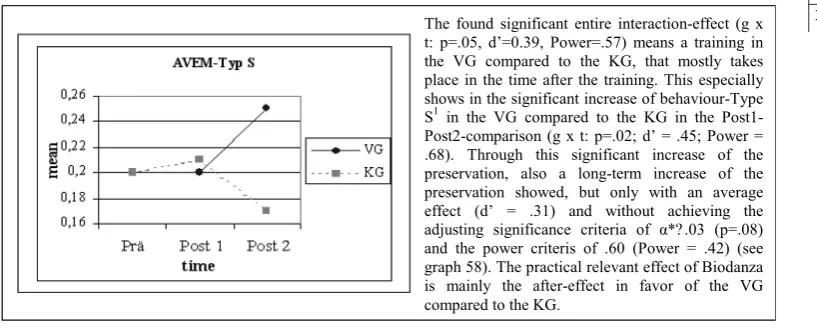
the found significant entire interaction-effect (g x t: p=.05, d’=0.39, power=.57) means a training in the VG compared to the KG, that mostly takes place in the time after the training. this especially shows in the significant increase of behaviour-type s1 in the VG compared to the KG in the
post1-post2-comparison (g x t: p=.02; d’ = .45; power = .68). through this significant increase of the preservation, also a long-term increase of the preservation showed, but only with an average effect (d’ = .31) and without achieving the
adjusting significance criteria of α*?.03 (p=.08)
and the power criteris of .60 (power = .42) (see graph 58). the practical relevant effect of biodanza is mainly the after-effect in favor of the VG compared to the KG.
Figure 4: The type “preservation”.
the increased preservation-behaviour lead to a positive attitude to life and a relatively good life-satisfaction (schaarschmidt & fischer, 1996), but its origin is mainly found outside work. in this coping pattern motivational aspects, which are e.g. connected to bad working conditions and work-coordination, are most important. it shows that behaviour-preventive actions serve the preservation if no relation-preventive interventions are taking place at the same time. hereto belong e.g. changing of the organization structure school. here also the limits of behaviour-preventing interventions show if there is no parallel behaviour prevention taking place.
We propose to use a diagnostic instrument at the beginning of the interventions and change of conditions which causes stress. (e.g. ista, Questionnaire, semmer, Zapf and dunckel 1998).
Conclusion
the evaluations of the sysred-components show that the afore mentioned interventions are valuable instruments for coping with pressure in everyday school life. all three sysred-interventions were evaluated positively and can therefore be put in praxis successfully. especially the systematic approach to stress management enables both teachers and students to better cope with their pressures. this integrative stress-management concept also improves the student-teacher relationship. enabling teachers and students to deal with stress prevents them from unburdening themselves to the others. since teachers did not acquire stress management strategies during their studies, this training helps them to use specific psychological knowledge and techniques in school. moreover, it gives them a tool to simplify their work and competently solve psychological problems by themselves. the initiated training of instructors (training of relaxation with elements of yoga for children; stress management with elements of yoga for teachers) and the proven acceptance of the intervention approaches secures the transfer of the sysred-concept and its components into praxis. more information:more information: stueck@ bildungsgesundheit.de or www.bildungsgesundheit.de
References
ebert, d. (1986). Physiologische Aspekte des Yoga. leipzig: Georg thieme Verlag.
Volume 29, 2011
132 Grawe, K., donati, r., bernauer, f. (1994). Psychotherapie im Wandel: von der Konfession zur Profession. Göttingen: hogrefe.
hartwig, K. (2000). Politstudie zu Untersuchungen von Praktischen Einsatzfelder des Entspannungstrainings mit Yogaelementen für Kinder (emy-K). unpublished dissertation. leipzig university.
maturana, h., Verden-Zöller, G. (2005). Liebe und Spiel – Die vergessenen Grundlagen des Menschseins.
heidelberg: carl-auer Verlag.
müller, m., pörschmann, n. (2009). Verbale aspekte Wertschätzender Kommunikation im Kindergarten: auf der basis der Gewaltfreien Kommunikation nach marshall rosenberg (empathieschule für pädagogen). in: m. stueck (hrsg.), Beiträge zur Bildungsgesundheit. bd. 7. strasburg: schibri-Verlag.
semmer, n. K., Zapf, d., dunckel, h. (1998). assessing stress at work: a framework and an instrument. in o. svane & c. Johansen (eds.), Work and health - scientific basis of progress in the working environment
(pp. 105-113). luxembourg: office for official publications of the european communities.
schaarschmidt, u., fischer, a. (1996). Arbeitsbezogenes Verhaltens- und Erlebensmuster (AVEM).
frankfurt: swets & Zeitlinger.
schröder, h. (1996). psychologische interventionsmöglichkeiten bei stressbelastungen. in: K. reschke,
Intervention zur Gesundheitsförderung für Klinik und Alltag. regensburg: roderer-Verlag. (s. 7 – 26).
schröder, h., reschke, K. (2000). Optimistisch den Stress meistern. Kursleiterhandbuch–Handbuch und Material für die Kursführung. tübingen: deutsche Gesellschaft für Verhaltenstherapie Verlag.
sieland, b., tacke, m. (2000). Ansätze zur Förderung der Gesundheit und Leistungsfähigkeit dienstälterer Lehrer in Niedersachsen. unpublished final report. university of lüneburg.
stueck, m. (1998). Relaxation training at the school using elements of Yoga. How to dismantle stress.
donauwörth: auer Verlag (german language).
stueck, m. (2000). Manual on relaxation training at the school using elements of Yoga. donauwörth: auer Verlag (german language).
stueck, m., reschke, K., tanjour, i., hartwig, K., enke, J., Kühn, J., breitner, K. (2002). children’s relaxation training program using elements of yoga and imagery: practical application and first evaluation of a curriculum – a train the trainer study. Journal of Meditation and Meditation-Research, 1 (1), 19-29.
stueck, m., hecht, K., schröder, h. (2001). emotional - vegetative regulation under high-altitude hypoxia and extreme living conditions prevailing in high-mountain areas (cho oyu 8205m). in hecht K., scherf, h.-p., König o.: Emotional stress by excessive stress and demands that are below the test persons’ abilities. berlin, milow, strasburg: schibri-Verlag, p.421- 442. (German language).
stueck, m., horn, K., rigotti, th., bauer, K., Villegas, a., terren, r., toro, V., mazzarrella, l., pauw, a., toro, r., sack, u. (2004). Psycho-Immunological evaluation of stress prevention with a new psychological intervention method Biodanza (submitted; south african medical Journal).
stueck, m., sonntag, a., balzer, h. u., Glöckner, n., rigotti, th., schönichen, c., hecht K. (2005). states of hypersensibility of elektrodermal activity und experiencing burdens in teacher profession.
Volume 29, 2011 133 stueck, m., Glöckner, n. (2005). yoga for children in the mirror of science: Working spectrum and practice fields of a training of relaxation with elements of yoga for children (torwey-c). Journal Early child development and care, 175 (4), 371-377.
stueck, m., balzer, h. u., hecht, K., schröder, h., rigotti, th. (2006). psychological and psychophysiological effects of a high mountains expedition to tibet. Journal of Human Performance in Extreme Environments, 8 (1), 11-20.
stueck, m. (2007). „Development and empiric examination of an intervention programme under the use of Yoga and Biodanza for teachers’ occupational stress” habilitation. faculty of biomedical sciences, university of leipzig.
Stueck, M., Villegas, A., Terren, R., Toro, V., Mazzarella, L., Schröder, H. (2008).Dancing the Burden?
biodanza as a new body-orientated, psychological intervention method for coping with burdens for teachers. Ergo-Med, 02/2008, 34-43.
Stueck, M., Villegas, A. (2008). Dancing towards Health? Empiric research on Biodanza. In: M. Stueck &
a.Villegas (hrsg.), Biodanza im Spiegel der Wissenschaften. bd. 1. strasburg: schibri-Verlag.
stueck, m. (2009). bilingual support of movement and relaxation in day-care centres: the relaxation training with elements of yoga for three- to six-year-old children (emyK-arbeitsbuch für die Kita). in: m. stueck (hrsg.), Beiträge zur Bildungsgesundheit. bd.2. strasburg: schibri-Verlag.
stueck, m. (2009). the stress reduction training for educators and other burdened professions (straimy-Workbook). in: m. stueck (hrsg.), Beiträge zur Bildungsgesundheit. bd. 4. strasburg: schibri-Verlag.
stueck, m. (2010). „Kinder, forscher, pädagogen - frühe bildung auf dem prüfstand. Beiträge zur Bildungsgesundheit. bd. 14 strasburg: schibri-Verlag.
stueck, m., Villegas, a., luzzi, c., toro, r. (2010). TANZPRO-children: Dance-oriented Programme with Biodanza for children. unpublished edition. center of educational health.
schwarzer, r. (1993). Stress, Angst und Handlungsregulation. stuttgart: Kohlhammer.
toro, r. (2010). Das System Biodanza. hannover: tinto-Verlag.
Villegas, a., stueck, m., terren, r., toro, V., schröder, h., balzer, h. u., hecht, K., mazzarella, l. (1999). psychological and physiological effects of biodanza. in: Conexión Abierta uai b. aires no: 2, p. 15-18 (spanish language).
Villegas, a., stueck, m., terren, r., toro, V., schröder, h., balzer, h. u., hecht, K., mazzarella, l. (2000). investigations into the psychological and physiological effects of biodanza. in: Biodanza: Annual journal, year 2000 aeib, p. 37-42. (german language).
in the 21 century Volume 29, 2011 134 Advised by Laima Railienė, University of Siauliai, Lithuania
received: February 28, 2011 accepted: April 16, 2011
Marcus Stueck PhD, University Leipzig, Department of Psychology, Germany. Seeburgstr. 14-20, D-04103 Leipzig.
Phone: +49 341 97 35 950. E-mail: [email protected] Website: http://www.uni-leipzig.de/english/
Wagner-link, a. (2010). Verhaltenstraining zur stressbewältigung Arbeitsbuch für Therapeuten und Trainer. Leben lernen.
Advised by Laima Railienė, University of Siauliai, Lithuania
received: February 28, 2011 accepted: April 16, 2011
Marcus Stueck PhD, University Leipzig, Department of Psychology, Germany. Seeburgstr. 14-20, D-04103 Leipzig.