APR-2015
International Journal of Intellectual Advancements
and Research in Engineering Computations
PRICING ADJUSTMENT COMBINATORIAL DOUBLE AUCTION
RESOURCE ALLOCATION MODEL IN CLOUD COMPUTING
1
C
.John Wesley,
2P.Karthikeyan
ABSTRACT
Users and providers have different requirements and objectives in an investment market. Users will pay the lowest price possible with certain guaranteed levels of service at a minimum and providers would follow the strategy of achieving the highest return on their investment. Designing an optimal market-based resource allocation that considers the benefits for both the users and providers is a fundamental criterion of resource management in distributed systems, especially in cloud computing services. Most of the current market-based resource allocation models are biased in favour of the provider over the buyer in an unregulated trading environment. In this study, the problem was addressed by proposing a new market model called the Combinatorial Double Auction Resource Allocation (CDARA), which is applicable in cloud computing environments. The CDARA was prototyped and simulated using CloudSim, a Java-based simulator for simulating cloud computing environments, to evaluate its efficiency from an economic perspective. The results proved that the combinatorial double auction-based resource allocation model is an appropriate market-based model for cloud computing because it allows double-sided competition and bidding on an unrestricted number of items.
Keywords
- double auction, cloud computing, resource allocationINTRODUCTION
Cloud computing is an advanced
technology in which it uses high speed internet-based computing by which user can access their resource from the remote site .It is based on sharing
on resources through virtualization. Cloud
computing emerged in early 1996 but it become popular when Amazon developed Elastic Compute Cloud in 2006. Cloud computing is the delivery of computing as a service rather than a product,
whereby shared resources, software, and
information are provided to computers and other
devices as a utility over a network. Cloud
computing is the result of evolution and adoption of existing technologies and paradigms.
In the cloud environment auction plays an important role in resource allocation. Auction is a sale in which the commodity is sold to the highest bidder. Cloud auction have three different areas and they are buyer, seller and an auctioneer. Virtualization technique helps to share single
physical instance of an application or resource among different customers. Data will be in the form of virtualized pools in the data center and these resources are allocated based on the needs of the customer. There are two types of auctions primary and secondary actions. The following figure illustrates it. The goal of cloud computing is to allow users to take benefit from all of these technologies, without the need for deep knowledge about or expertise with each one of them.
This paper is organized as follows section II Related Works, section III Proposed Architecture section IV Algorithm Description section V Result Analysis section VI conclusion
RELATED WORKS
this issue by introducing microeconomic methods into the resource management and allocation in the cloud environment. With the combination of batch matching and reverse auction, a reverse batch matching auction mechanism is proposed for resource allocation. On that basis, we further introduce the strategy of twice punishment and the pursuit of QoS (Quality of Service) for the purpose of trading fraud prevention. The winner of the auction is then determined by solving an optimization problem that maximizes a weighted sum of three evaluation criteria, i.e., the market efficiency, user satisfaction and QoS.
StefaniaCostache (2012) proposed
Themis, a system that uses an economic-based approach to automatically allocate resources to the applications that need them the most. Themis provides generic scaling policies based on feedback control loops. Themis can effectively meet
application performance objectives while
optimizing infrastructure’s utilization. Shin-ichi Kuribayashi (2013) proposes to enhance the existing joint multiple resource allocation method, so that it can handle multiple heterogeneous resource-attributes. It can reduce the total amount of resources up to 30%.Ching-Hsien Hsu(2014) presented an energy-aware task consolidation
(ETC) technique that minimizes energy
consumption. ETC achieves this by restricting CPU use below a specified peak threshold. The simulation results show that ETC can significantly reduce power consumption in a cloud system, with 17% improvement over MaxUtil.
Marian Mihailescu (2010) proposes a dynamic pricing mechanism for the allocation of shared resources, and evaluates its performance. In the work the author formally prove the economic properties of our pricing scheme using the mechanism design framework.
machine resource Allocation is the process of assigning available resources to the needed cloud applications over the internet. Resource allocation starves services if the allocation is not managed precisely.
COMBINATORIAL DOUBLE AUCTION
An auction is a process of buying and selling of commodities by providing a bid and then selling the item to the highest bidder .It is used in cloud and grid environment. It can be closed or open. Auction can be classified as single side auction and double side auction. In a double auction, both buyers and sellers select bids. Most often, these auctions are continuous. Combinatorial double auction-based resource allocation model is an appropriate market-based model for cloud
computing because it allows double-sided
competition and bidding on an unrestricted number of items, which causes it to be economically efficient.
FLOWCHART
In existing combinatorial auction-based
mechanism for dynamic provisioning and
allocation of VM instances in clouds is used [2]. The problem defined in this method is that providers are not maximized their revenue by attracting users and improving the resource utilization. However, it is hard for users to determine which providers that they should trade with, and vice versa, to meet their objectives under dynamic and unpredictable resource demands, supplies, prices, and budgets. So we use grouping auction for improving the revenue for users and to improve the resource utilization in cloud auction environment To Adjust the price between cloud user and provider using combinatorial double
Fig.1 flowchart
The present work which results in the improvement of revenue generation respectively. The present work proposes auction system in the cloud instance market, and the simulation studies have verified its applicability and effectiveness in terms of resource efficiency and monetary benefits to a participant. The proposed system outperforms existing cloud service. And the architecture for the proposed system is more efficient for resource utilization and the profit for the providers and users. In particular, combinatorial Double auction-based mechanisms are best suited for resource allocation in clouds because of the nature of the allocation requests. However, we have to overcome certain challenges while using combinatorial auction-based mechanisms.
ALGORITHM DESCRIPTION
1. Input the buyer submit their and the same time provider submit their ask.
2. Auctioneer announces start of the auction to the participants of the auction.
to the auctioneer.
4. Winner determination using pricing
adjustment algorithm.
5. buyer and provider agree the beneficial value and allocated the virtual machine
6. Price adjustment will be calculated.
PRICING ADJUSTMENT METHOD
Implementation includes all those
activities that take place to convert from the old system to proposed system. The old system is operated in different manner from the new system. A proper implementation is essential to provide to meet requirements.
provisioning test environment. Flexibility and applicability, developers can model and test the performance of their application services in heterogeneous cloud environments.
WINNER DETERMINATION
Auctioneer is responsible for determining the winners in an auction. Auctioneer first sorts requests and offers of users and cloud providers in the increasing order of their attributes. To determine the winners, the users and cloud providers lists had to be sorted. The reason for sorting is to prioritize the requests from users, whose bid amounts were higher, and to those cloud providers who offered cheaper amounts.
Pricing adjustment is used to decide a payable price by a user for an allocation. The final trade price from users to cloud providers was the sum of the price adjustment then adjusts the price using the threshold limit value
Pricing adjustment algorithm (buyer, provider, bid value)
Step 1: {phase 1: collect bids}
Step 2: for
j=1….n do
Step 3: collect bid Bj= (r1….rm,vj) from user Uj
Step 4: {phase 2: submit ask to provider}
Step 5: VM instances characteristics W=
K// where k is a no of users
Step 7: if Uj compute price<Uj bid price allocate the VM instances to Uj
Step 8: end for
Average of History ()
{
for j = 1,…,n do
sum = sum + THj
Avg = sum/n
return avg;
}
RESULT ANALYSIS
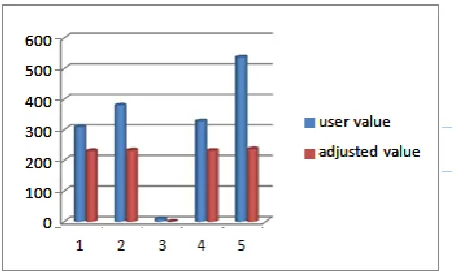
We investigate the performance of the new mechanisms. In terms of resource generation, profit and number of users served. Discount is provided to the group based on the number of users in each group the performance can be shown. This section investigates the adjustment of pricing between user and provider by using our pricing adjustment algorithm the revenue generation of the user would become higher and benefit. The metrics calculated are
Resource utilization
Fig 2: Performance of revenue generation
RESOURCE UTILIZATION
The resource utilization defined as the percentage of the adjustment price a resource is busy executing jobs. In order for the resources to be efficiently used, the user level should increases.
REVENUE GENERATION
The provider value adjusted by using our pricing adjustment algorithm and the number of users increase more. When the number of user increases revenue generation will became higher for the users
CONCLUSION
The present work proposes combinatorial double auction in the cloud instance market, and the simulation studies have verified its applicability and effectiveness in terms of resource efficiency and monetary benefits to auction participants. The proposed system outperforms existing cloud service. And the flowchart for the proposed system is more efficient for revenue generation.
REFERENCES
[1] A combinatorial double auction resource
allocation modelin cloud computing,
ParniaSamimi, YounessTeimouri, MuriatiMukhtar -2013.
[2] The Combinatorial Seller’s Bid Double Auction: An Asymptotically Efficient Market Mechanism, Rahul Jain andPravin Varaiya-2006.
[3] MDCSim: A Multi-tier Data Center
Simulation Platform, Seung-Hwan Lim, Bikash Sharma, Gunwoo Nam, EunKyoung Kim, and Chita R. Das.
Mechanism in the Cloud Computing Environment, Xingwei Wang1, Jiajia Sun1, Hongxing Li2, Chuan Wu2 and Min Huang1 Received: 3 Oct. 2012, Revised: 20 Nov. 2012, Accepted: 1 Dec. 2012Published online: 1 Feb. 2013.
[5] A Strategy-proof Pricing Scheme for
Multiple Resource Type Allocations, Yong MengTeo and Marian Mihailescu.
[6] An Auction Mechanism for Resource Allocation in Mobile Cloud Computing Systems, Yang Zhang, DusitNiyato, and Ping Wang.
[7] An Online Mechanism for Dynamic VM
Provisioning and Allocation in Clouds,
SharrukhZaman, Daniel Grosu.
[8] Configurable Services in the Cloud:
Supporting Variability While Enabling Cross-Organizational Process Mining, Wil M.P. van der Aalst.
[9] Economy-Based Automatic Resource Scaling for Cloud Systems, StefaniaCostache y, Nikos Parlavantzas z, Christine Morin y, Samuel Kortas EDF R&D, Clamart, France Author manuscript, published in "14th IEEE International Conference
on High Performance Computing and
Communications (HPCC2012) (2012)".
[10] Green and Fair Workload Distribution in Geographically Distributed Datacenters, Rawan Y. Alawnah, Imtiaz Ahmad and Ebrahim A. Alrashed.
[11] Joint Multiple Resource Allocation Method for Cloud Computing Services with Different QOS
to users at Multiple Locations,
Shin-ichiKuribayashi International Journal of Computer Networks & Communications (IJCNC) Vol.5, No.5, September 2013.