Volume 36: April 2018
ISSN 2414-6633
https://doi.org/10.22151/politikon.36
Editorial Board
Editor-in-Chief: Jaroslava Barbieri (Italy & Ukraine)
Justinas Lingevičus
(Lithuania)
Andrés Lopez Rivera
(Ecuador)
Rafael Plancarte (Mexico)
Ana Magdalena Figueroa (Brazil)
Table of Contents
Editorial Note ... 4
Articles
I Always Feel Like Somebody’s Watching Me. Understanding the Authoritarian
Tendencies of the U.S. National Security State / Elizabeth Wright ... 5
The International Win-Set: Boundaries for Influence / Shayna Servillas ... 25
Trust and the Rule of Law. A Multilevel Analysis / Frederik Gremler ... 36
The debate on shared parenting in Germany / Johannes Carl Busse ... 66
Uprising’s Dialectic Pedagogy: Gramsci, Scott and Mandela against the 2013 Hefazat
-e-Islam Movement in Bangladesh / Helal Mohammed Khan ... 82
Editorial Note
Dear Reader,
We proudly present Vol. 36 of Politikon, the flagship academic journal of the International Association for Political Science Students.
Politikon is open to talented junior scholars regardless of their formal academic status. This is evident from the diversity of backgrounds of our authors, whose papers successfully passed our peer-review process.
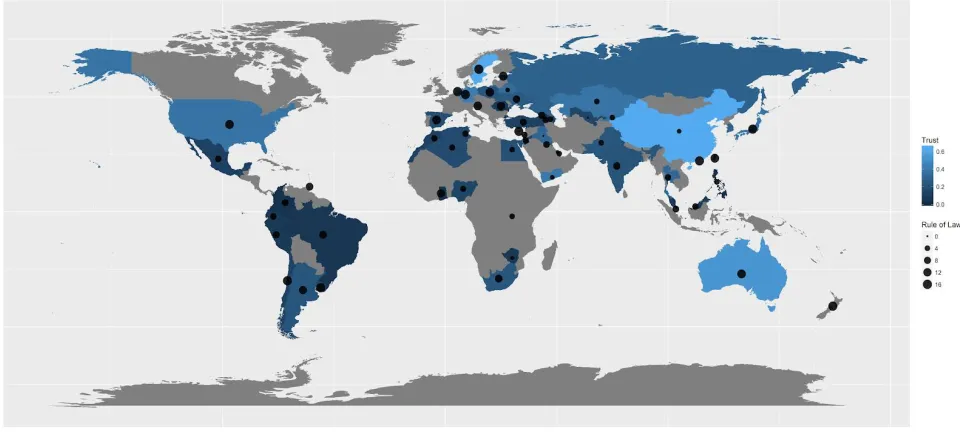
Our first paper reinterprets George Orwell’s 1984 dystopia to analyse surveillance policies under the Bush and Obama administration, while pointing out the latter’s authoritarian tendencies. Although from a different perspective, the second paper also addresses the U.S. domestic context. In particular, it adopts a structural realist view to contend that the power of domestic actors in shaping foreign policy is bounded by international constraints. This argument is illustrated through two case studies: the Kennedy Administration’s response to the Cuban Missile Crisis and the Bush Administration’s response to the Israeli Operation Defensive Shield. Our third paper uses multilevel modeling with cross-sectional data from the World Values Survey, Freedom House and other sources to examine the relationship between generalized trust and rule of law on a national level. In so doing, it captures an important gap in the literature, which has focused rather on related issues of property rights, economic freedom and corruption. Our fourth paper adopts discourse theory to address a niche yet fascinating topic, namely the domestic debate on shared parenting in Germany, and offers us tools to spot science and advocacy approaches. Our final paper revisits the 2013 Hefazat-e-Islam protests in Bangladesh, a religion-based social movement, through the philosophical lenses on popular resistance by Antonio Gramsci (Prison Notebooks, 1948) and James Scott (Weapons of the Weak, 1985) as well as Nelson Mandela’s autobiographical piece (Long Walk to Freedom, 1994).
If you also want to publish an article with us, please visit our website for further information: https://www.iapss.org/wp/academics/journals/politikon/call-for-papers/
We look forward to reviewing your work!
I Always Feel Like Somebody’s Watching Me. Understanding the
Authoritarian Tendencies of the U.S. National Security State
Elizabeth Wright
https://doi.org/10.22151/politikon.36.1
Elizabeth Wright, 22, has a Bachelor of Arts in Political Science from Southwestern University and is a Masters in Security Policy Studies Candidate at George Washington University. He research centers on the intersection of Constitutional law and surveillance, specifically examining privacy and civil liberties in the public sphere. Outside of academics, she is part time contributor for the online initiative, Middle East Collective, providing monthly commentary on national security and foreign policy.
Abstract
George Orwell’s novel 1984 defined authoritarianism as a consequence of overarching surveillance in the modern state. Nearly 70 years later, the threat of tyranny reemerges in the present surveillance state—the U.S. Beyond the Orwellian concept of Big Brother to examine the U.S. national security state, this research examines the expansion of domestic surveillance in the post-9/11 age. Using a within-case comparative analysis of the presidencies of George W. Bush and Barack Obama, it argues that institutional manipulation has forged the U.S. national security state into a surveillance heavy Banopticon (Bigo 2006). Though the latter operates to maintain state and citizen security, it undermines citizens’ freedoms through invasive surveillance policies which embolden state repression, despotism, and unconstitutional policy. Such authoritarian tendencies can be seen in the creation of surveillance under Bush and the expansive development of surveillant assemblages, surveillant culture, and surveillance capitalism (Zuboff 2015) during the Obama era.
Keywords
Introduction
“Do not confuse sécurité, the feeling of having nothing to fear and sûreté, the state of having nothing to fear.” — Marguerite-Marie Dubois
“Modern tyranny is terror management. When the terrorist attack comes, remember that authoritarians exploit such events in order to consolidate power.”
— Timothy Snyder
In a speech to the Muslim Public Affairs Council, Brookings Senior Fellow and Hoover Institute Task Force on National Security, Technology, and Law co-chair, Benjamin Wittes spoke of the role of national security amidst the growing global trend toward authoritarianism. While very understanding of the fear that United States’ surveillance and security techniques are susceptible to the corruption of demagoguery, Wittes ensured the audience that it is the duty of every public servant to protect institutions and individuals from political processes that would seek to abuse them and undermine democracy.
True national security [is] the security of a liberal society that protects individuals and minority groups in the exercise of their freedoms… in the security of a liberal democracy, the security you’re defending is the security of liberalism itself (Wittes 2017).
Here is the primary contradiction that plagues the national security state — if national security is meant to secure liberalism itself, can it ever truly protect the people?
the national security state that are antithetical to liberal democracy, this research will establish the sequence of U.S. authoritarianization, or the “slow and incremental dismantling of democratic systems by democratically-elected leaders” (Kendall-Taylor et al. 2017: 9). In an age of emerging new authoritarianism, this is essential to reforming the relationship between the national security state and liberal democracy, before it is too late.
In order to appropriately consider the ways in which the national security state “both exploits and presupposes the dominance of certain subjectivities,” this research design will feature three theoretical frameworks: structuralism, liberalism, and institutionalism (Belletto 2009: 334-335). According to Blackburn, structuralism encompasses, “interlocking combinations of political, economic, ideological, and theoretical structure and practices [that] form objective determinants of resulting social forces” (Blackburn 2008: 16). In order to grasp the means in which the national security state develops surveillance subcultures within society (Lyon 2007), it is importance to review how political structure can influence public opinion, ideology, and social inequality, potentially resulting in authoritarianism. For the purpose of this research, liberalism will be defined through Freeden’s perspective of modern U.S. liberalism. He defines this theory as “a plastic, changing thing, shaped and reshaped by the thought-practices of individuals and groups… Liberalism is the vehicle best encompassing the dynamic of individual and social life” (Freeden 2005: 20-25). Since this analysis will review national security and surveillance within the context of the United States liberal democracy, it’s necessary to consider how liberalism (and it’s alter-ego, illiberalism) functions within the national security state. Institutionalism, defined by Peters as how “the institution represents more of the individuals themselves — or at least their ideas and discourses — and their patterns of interactions,” offers insight into the relationship between states and constituents within the national security state (Peters 2012: 116). This is essential to understanding how certain bodies, specifically legislative and economic, can redefine democracy through surveillance and security. By analyzing the nature of structuralism, liberalism, and institutionalism in relation to specific administrative actions regarding surveillance, this research intends to develop a course for the United States democracy’s path to a “new” authoritarian national security apparatus.
Conceptualizing Authoritarianism, Democracy, the National Security State,
and Surveillance
2015). Surveillance will be understood here as modes of systematic monitoring “in which special note is taken of certain human behaviors that go beyond human idle curiosity” (Lyon 2007: 13). Though this definition of surveillance may appear broad or vague, it is meant to reflect the observation, classification, and enforcement techniques used by the state that deviate from perceptions of surveillance that are strictly militaristic entity or rooted in artificial intelligence (Allen and Chan 2017). Systems of surveillance birthed the national security state, a system that he defines as a state that “emerges from war, from fear of revolution and change, from the instability of capitalism, and from the nuclear weapons and military technology” (Raskin 1976: 189). The national security apparatus as it is conceived today originated from the National Security Act of 1947, a statute that would go on to shape the future of the National Security Council (NSC), Central Intelligence Agency (CIA) and various systems within the Department of Defense. A distinct perspective of both domestic surveillance and the national security state, in regards to United States politics, is imperative to understanding shifts from liberal democracy to authoritarianism.
But what is democracy? Schmitter and Karl define democracy as “a system of governance in which rulers are held accountable for their actions in the public realm by citizens… [Even though] no single set of actual institutions, practices, or values embodies democracy” (Schmitter and Karl 1991: 4 & 11). In the case of the United States, which operates within a “liberal” democracy, this term could be further understood as “governments and other democratic institutions [which are] responsive to the majority of the people, rather than only a narrow elite, or markets, unelected bureaucrats, or corporate interests” (Berman 2017: 38). One could argue that these prescriptions for democracy are the foundation for understanding the potential trajectory from democracy to authoritarianism. De Tocqueville noted, “I see clearly two tendencies in equality; one turns each man’s attention to new thoughts, while the other would induce him freely to give up thinking at all...the human spirit might bind itself in tight fetters to the general will of the greatest number” (De Tocqueville 1966: 436). Unlike the authoritarianism of old, which operates under typical totalitarian tropes (terror, indoctrination, social control and movement of the masses) mentioned in Arendt’s Origins of Totalitarianism (1979), the “new” digital age of authoritarianism instead functions on the mere threat of terror replicated within the state of surveillance. Hence, new authoritarianism could be branded as a pseudo-Panopticon, a “mechanism, for it automatizes and individualizes power, [and] also a laboratory; used to carry out experiments, to alter behavior, to train or correct individuals” (Foucault 1977: 7 & 8). Using constant visibility, new authoritarianism seduces individuals to modify actions to fit within the confines of surveillance culture.
To understand the relationship between authoritarianism and the post-9/11 national security state, this paper will compare surveillance techniques used within the years of George W. Bush’s presidency (2001 to 2009) and the era of President Barack Obama (2009 to 2017). Taking a qualitative approach, this research will operate using Mill’s method of difference, a system which is essential to, “eliminat[ing] potential sufficient causes to conclude that a given factor is not (by itself) necessary or sufficient for the outcome of interest” (Mahoney and Villegas 2007: 75). While numerous democratic inconsistencies and intelligence infractions exhibited by Presidents Bush and Obama ranged from defensive to preemptive, respectively, both endangered United States’ democracy, exploiting institutions and citizens to bolster a tyrannical national security apparatus. Given the most different system determines varying factors which implicitly and explicitly shape outcomes in a case analysis, this research assumes that the presence of Mill’s method will reflect how the increase of surveillance within the national security state, through institutional means, has contributed to the authoritarianization of the United States. This paper does acknowledge certain research constraints that stem from the clandestine nature of the topic. It is difficult to operationalize levels of surveillance when the majority of the information regarding covert counterterrorism operations and surveilled citizens is classified. By further examining the processes of domestic surveillance through evaluation of legislation, emergency status, and national security rhetoric within the Bush and Obama administrations, this paper will assess the validity of the causality between the surveillance-heavy national security state and new authoritarianism.
Shifts in Democratic Structure
personalized in nature (Kendall-Taylor et al. 2017: 9). Citizens are socialized into a regime of security through willing surveillance, eventually succumbing to “regime suppression” through “the most cherished notions of [online] agency” (Giroux 2015: 111-112). Rather than fully adhering to the authoritarian elements presented within the digital age, United States citizens are coerced into conformity, often ignorant to the debilitating effects of online culture and advanced observation.
Several scholars believe that increased technology is essential to the future of democracy (Bryan et al. 1998: 5; Rheingold 1993: 14). These arguments make the case that online culture is more participatory and accessible, effectively streamlining ideas and providing transparency. Monahan argues for modes of dataveillance which assist democracy in universalizing power across varying demographies by providing equal access to information and policing legitimate threats without the assumption of danger based on socioeconomic, ethnic, or gendered means (Monahan 2010: 103). This is faulty logic, however, for it fails to consider the algorithmic disparities riddled within surveillance systems. As Eubanks notes, machine technology can in fact be biased. There are detrimental effects of assuming the objectivity of high-tech programming, especially in the United States where these “impartial” systems replicate current societal cleavages which contribute to democratic instability by “automating inequality”(Eubanks 2018). The modern age of surveillance is structured to encourage various online monitoring techniques which are wholly antithetical to U.S. values. Systems which breed discrimination, encourage censorship, and undermine privacy are weaponized against the general populace, causing many to weigh imperative First and Fourth Amendment rights against the need for national security. It is this “algorithmic authoritarianism” which undermines the political and begins to highlight the threat that surveillance systems pose to the future of U.S. democracy.
Illiberalism & The Decline of U.S. Democracy
initiative, the modern Muslim Ban — formally known as Executive Order 13769 or Protecting the Nation from Foreign Terrorist Entry, this attempted to suspend entry of Syrian refugees and travelers Iran, Iraq, Libya, Somalia, Sudan, Syria, and Yemen — have exemplified the many ways in which democracy is exploited and undermined through the juxtaposition of surveillance and identity liberalism.Though the politics of identity are central to notions of democracy, personal and national identity can become too radicalized, often inspiring authoritarianization.
In the post-9/11 era, this has been most glaringly represented through the normalization of exclusionary and nativist national security processes. Following the onslaught of online vetting initiatives, facial recognition programming, and heightened biometric screening, ”comfort with increased surveillance [has created] an internalized acceptance of a totalitarian tendency. This normalizing of the totalitarian is one of the more frightening features of willed and willing development of a surveillance society” (Fiske 1998: 86).Still, academics argue that illiberalism is not a direct sign of authoritarianism.
Berman provides an apt analysis for the liberalism and illiberalism presented by democracy, arguing that liberal democracy (as in the case of the United States) is not the model manifestation of democracy (Berman 2017: 30). Therefore, illiberal democratic practices are often the sign of flourishing democracy rather than democracy in decline. The problem with this perspective is that it fails to consider the illiberal to liberal trajectory within United States history. Given that U.S. democracy became “fully democratic” in the 1970s (Mickey et al. 2017), present shifts toward authoritarianism prove regressive, resembling the early illiberal struggles over civil liberties and power dynamics. Oliker writes that illiberalism itself cannot be employed to demolish democracy. Historically, illiberalism uses “democratic institutions to centralize power and limit civil liberties” (Oliker 2017: 7). In harnessing the divisions brought on by illiberal democracy, the national security state assumes a mild authoritarian agenda, prioritizing the repression and surveillance of the few in order to protect the many.
systems has created deep inequalities for decades. Specifically around the treatment of black and brown folks who have often been either overrepresented in the more punitive systems or diverted from the more helpful systems” (Eubanks, qtd, in Edes and Bowman 2018). While the centralization of internet data may appear harmless and necessary to some, to others it manifests as a virtual stop and frisk or iJimCrow. The expansive and invasive surveillance machine that is the modern national security state, though said to be used as a means to “maintain” the economy, education, healthcare, and beyond, has simultaneously created a a pipeline from surveillance to incarceration, deportation, and authoritarianization.
Demolishing “Ironclad” Institutions
Though several scholars maintain that the national security state and democracy are always in opposition (Shetterly 2013, Belletto 2009), there is an assumption that institutions are incapable of corruption, effectively able to restrain abuses and shield democracy from tyrannical leaders. Though it “may be tempting to assume that the United States’ centuries-old democracy is impervious to democratic erosion, such confidence is misplaced. Those pinning their hopes on pushback from the bureaucracy are also likely to be disappointed (Mickey et al. 2017).” Specifically, the intersection of surveillance and national security, citizen and state, and democracy and authoritarianism in the United States is one that often features institutional manipulation within executive, legislative, and judiciary. Though security and surveillance seek to maintain order in the name of public safety, they often operate within political means that are vague, allowing for unmonitored imperialism, secrecy, and illegality (Raskin 1976, 198). Just as foreign policy and intelligence seek to combat external threats, so does the domestic formation of the national security state in relation to internal threats. Using surveillance techniques within the framework of “maximum flexibility,” security measures are justified as a means to diffuse supposed chaos and terror, even if preemptively screening non-threatening actors such as lower class individuals, dark bodies, females, non-gender conforming citizens, immigrants, and opposing political operatives (Raskin 1976: 199). This form of risk-averse surveillance, known as the Banopticon (Bigo 2006), exemplifies the tension between democracy and the national security state.
of individuals.” Hence, “those who govern can non-longer rely on the rhetoric of sovereignty [and] citizenship” (Bigo 2006: 8 & 11). The relationship between the state and surveillance poses a direct threat to democracy by actively exploiting the citizenry, subverting Constitutional rights, and minimizing of authoritarian tendencies, all at the institutional level.
Other research argues against the correlation of surveillance-heavy security states and authoritarianism. Weiss rejects the “dichotomy” presented by many critiques of the national security state, contending assumptions that technology, neoliberalism, and capitalism threaten the stability and rationale of the national security state. Her argument arguing is that security and surveillance can transcend democratic inconsistency to remain a strong force of United States democracy (Weiss 2014: 19-21). In contrast, Potter finds that though pervasive surveillance cultures are rarely studied within authoritarian regimes, current authoritarian states are much more vulnerable to the threats of repressive security than democracy (Potter 2016: 2). Both arguments are ignorant to the very real threat of abusive power within democratic states of surveillance. As Jablonsky notes, “the new threat [of 9/11] assures the continued existence if not growth of the national security state and will certainly cause increased centralization and intrusiveness of the US government” (Jablonsky 2002: 18). Lyon agrees, finding that “surveillance enhances the position of those ‘in power.’ Power, in this view, is not a possession, but a strategy” (Lyon 2007: 18). The results from present examinations of the national security apparatus therefore present a significant case for the correlation between surveillance, security, and democratic shifts toward authoritarianism in the United States.
CASE STUDY:
The Birth of American Authoritarianization
valuing secrecy over deliberation [while undermining the Congressional] ability to identify—let alone stop—serious investigative abuses” committed in the name of national security (Bendix and Quirk 2013: 2 & 13).
The legislature and judiciary’s endorsement of a culture of lawlessness and urgency allowed for the creation of various invasive means of protection such as the Defense Advanced Research Projects Agency (DARPA) Information Awareness Office and the Total Information Awareness Program (TIA). Through a centralized system of information collection and sharing, The Patriot Act served as an extension of FISA, empowering the state to lower legal standards and increase abilities to wiretap, trace, and register citizens. Beyond legislation, the Bush years also emboldened the executive on an international arena, contributing to a mentality of U.S. exceptionalism domestically and abroad. After September 11, the United States embraced the role of a “lone hegemonic superpower” shifting “the mode of political regulation” (Steinmetz 2003: 330). The Bush administration resisted international law abroad while simultaneously enacting invasive and reactionary surveillance programming at home, an early signifier of authoritarianization.
Moving beyond Bush’s DARPA and TIA programs, data mining under President Obama could obtain information of a financial, medical, and biometric nature without a warrant. Using PRISM, an extension of the Protect America Act of 2007, surveillance also began to take on a new, non-militaristic purpose in the form of surveillance capitalism. The U.S. National Security Agency (NSA) developed PRISM in accordance with several technology conglomerates, namely Google Inc., in order to expand upon its internet monitoring and acquisition of “confidential” information. By July of 2013, the general populace began to learn of the reality of Obama era surveillance. Everything from private communications to facial recognition could be utilized and if deemed necessary to national security, all data could be compiled, shared, and deployed throughout the intelligence community. The global surveillance leaks from Edward Snowden were the first efforts to apply pressure on the Obama administration, eventually shaping the USA FREEDOM Act. The Freedom Act was supposedly unique in that it protected civil liberties by ending bulk collection of data, improved transparency by requiring the publication of FISA decisions, and advanced national security objectives by increasing various means of surveillance and enforcement (Judiciary Committee 2015). However, this bipartisan effort to restrict the NSA and reform domestic surveillance still failed to remedy the tension between the state and citizen (Cohn and Reitman 2015). Though the intelligence community was finally being held accountable for their various unlawful actions, the Act failed to completely eradicate Section 702 of FISA altogether—a reform effort that would symbolize the prioritization of the rights of citizens over the security of liberal democracy.
Building the Banopticon
within structures [while] reproduce[ing] sovereign power rather than resist[ing] its mechanisms” (Ritchie 2015: 181 & 182). But just as Foucault writes of discipline and power, the regulation of U.S. society, even by subtle means, created a disciplinary national security state which was easily susceptible to manipulation.
In building this U.S. Banopticon, rhetoric has also stimulated an ideology of American nationalism that borders on tribalism. Department of Homeland Security (DHS) initiatives contributed to U.S. authoritarianization by making the fight against terror a personal, visceral, and daily pursuit by means of profiling and affective assumption. The “terrorist” became coded not only as an omnipresent entity, but an invisible enemy hiding in plain sight. Bodies were characterized as either transparent or opaque—transparent bodies were perceived as less threatening due to their visible conformity to the national security state’s aesthetics and values while opacity became synonymous with dissent and darkness (Hall 2015). Much like the Anglo-American model that defined early American surveillance systems, the present national security state is inherently gendered and racialized to determine threat level by subjective means. Hall writes,
The capacity to risk and to have one’s risky ventures securitized is a marker of the privilege of transparency…white people are presumed innocent and people of color are presumed guilty…Some enjoy the privilege of being presumed capable of demonstrating (the absence of) the threat of terrorism. Others are presumed incapable, unwilling, or non- compliant (Hall 2015: 75-76).
In this way, rhetoric perpetuates American authoritarianization at various levels of U.S. society. From federally mandated wiretapping of assumed jihadists to the school-to-prison pipeline that often criminalizes black and brown bodies before an actual offense has occurred, the Banopticon encourage unity through division, openly securing a subset of the population in an effort to once again prioritize state before citizen.
This rhetorical nature of security and surveillance is a a primary sign of the tension between democracy and authoritarianism. “The national security state’s apparatus needs arbitrary power. Such power has its own code, which is meant to govern or justify the behavior of the initiated—after the fact. It operates to protect the state apparatus from the citizenry” (Raskin, Qtd in Shetterly 2013).Directly following September 11, the reconceptualization of perceptions of security, intelligence, and surveillance occurred in the form of subliminal messaging. Bush often spoke in coded language, or rhetoric disseminated through a reproduction of discourse influenced by institutional power relations in order to justify undemocratic and illiberal actions taken in the name of security and defense. The rhetoric of security and terrorism serves as “the dissolution of the civil relations obtaining within and among nations, particularly liberal nations, and thus portends the dissolution of civilization itself” (Noorani 2005: 13).
PATRIOTIC Act and USA FREEDOM Act as “Uniting and Strengthening America by Providing Appropriate Tools Required to Intercept and Obstruct Terrorism” and “Uniting and Strengthening America by Fulfilling Rights and Ending Eavesdropping, Dragnet-collection and Online Monitoring,” respectively, the state has found a means to advertise repression and invasion of privacy as genuine U.S. Americanism. Hall writes, “In this manner, the aesthetics of transparency lend a democratic veneer to sites where radically undemocratic practices thrive” (Hall 2015: 66). The ability to reframe the narrative of national security by propagating the notion that a legislative defense of liberty and democracy is incapable of defying the Constitution is a primary example of the minimization of American authoritarianism.
Beyond rhetoric, states of emergency sustain the constant culture of urgency and chaos needed to foster anxiety and terror within the national security state, an essential element of authoritarianism. The modern fear state is unique in that the mere threat of terror to be continuously replicated, even when no genuine threat exists. Presently, the United States is in twenty-eight states of emergency, but it isn’t new—“this month marks the start of our 39th year in a continuous emergency state” (Padhi 2017). Since their conception, emergency powers have presented a threat to democracy and the rule of law. Upon investigating President Truman’s actions following the 1950 declaration of emergency (a mandate that would eventually lead to the war in Vietnam), a committee report found that emergency powers to the executive “conferred enough authority to rule the country without reference to normal constitutional process” (Padhi 2017). Today, this committee warning is almost altogether ignored. As of 2014, fifty-two states of emergency have been placed into effect and thirty are still “active,” with a majority of them stemming from the Bush era. The immediate reactivation of emergency status is detrimental to democracy, especially given the institutional tendency towards widespread surveillance in the postmodern age. Through emergency status, the national security state weaponizes fear, producing “privatized citizens whose paramount concern is personal welfare, [therefore] rendering individuals particularly vulnerable to the crushing strength of institutions “(Lyon 2007: 19). Through the convergence of states of emergency and surveillant society, paranoia serves as a primary tool of panoptic control.
of the twentieth century, liberal societies such as the United States are much more susceptible to its subtle anti-democratization.
Still, the national security state is not a new enemy of democracy. Since it’s conception, the United States security apparatus has plagued society, promoting “lies and self-deception [that] have broken faith with the essential precondition for constitutional government in democracy" (Raskin, Qtd in Shetterly 2013). However, security policies and surveillance practices alone cannot breed tyranny. Lyon writes, “to detect totalitarian tendencies in specific practices is a far cry from declaring that the ‘ surveillance society has finally arrived” (Lyon 2007: 87). In fact, state observance and management is necessary in that it ensures democratic capabilities — specifically by ensuring equal distribution of rights (Lyon 1994: 31). The relevance of the September 11th attacks in shaping U.S. authoritarianization is also contested. For while, “The events of September 11 catalyzed a break with the established regulatory model [of United States democracy]… the response to September 11 has been a solution with significant precedents in post-1945 U.S. state history…” (Steinmetz 2003: 325 & 335). Research of Bigo (2006), Giroux (2015; 2016), Lyon (2007), Noorani (2005), and others contends this notion, finding that the institutional manipulation of the relationship between citizen and state, surveillant and surveilled, and the rule of law and public safety have heightened tensions in a post-9/11 era. Regardless of twentieth century origins of American authoritarianism, the illiberalism and undemocratic manifestations of the national security state following the attacks of September 11 depict a unique shift toward “new” authoritarianism.
The United States presently operates through “security in the disciplinary” modeled as
Conclusion
The legacy left behind by actions taken within the Bush and Obama eras has brought the United States to its present predicament. In an era when the authoritarianism of old appears to be reinvigorated by demagoguery in the face of globalization and violent extremism, the revisionism, perpetual anxiety, and nationalism encouraged by national security rhetoric and states of emergency represents a distinct tendency towards authoritarianism. The blatant threats to U.S. Constitutional values exhibited by legislative loopholes, also indicates this legacy of American authoritarianism. Not only has the national security state enabled a culture of U.S. exceptionalism, giving intelligence agencies and Presidential administrations too much power, it has also created a culture of surveillance, replicated throughout society, which trades heightened citizen visibility for decreased state repression. Bush and Obama’s jurisdictive misapplications of surveillance serve as a testament to the underlying United States security narrative that Benjamin Wittes (2017) referenced in his speech.
The national security apparatus is continuously bolstered as the premier defense of liberalism, encouraging the convergence of security, surveillance, and democracy across partisan lines, while asserting that the security of liberalism and the security of U.S. citizens are mutually exclusive. This is the most glaring representation of the legacy of U.S. authoritarianism, for “people who assure you that you can only gain security at the price of liberty usually want to deny you both. You can certainly concede freedom without becoming more secure” (Snyder 2017: 100). Following the attacks on September 11, 2001, the administrations of Presidents George W. Bush and Barack Obama committed many oversights and abuses in the name of national security. In attempting to secure the fate of liberalism through legislative directives, recurrent emergency status, and the overall rhetoric of the War of Terror, institutional manipulation within the national security state has fostered authoritarianization within United States—potentially signaling the end of liberal democracy, as we know it.
References
Allen, Greg and Taniel Chan (2017): ‘Artificial Intelligence and National Security.’ Belfer Center for Science and International Affairs. Accessed October 20, 2017. http://www.belfercenter.org/
Andrejevic, Mark (2007): iSpy: Surveillance and Power in the Interactive Era. Kansas: University Press of Kansas.
Bamford, James (2016): ‘Every Move You Make.’ Foreign Policy. http://foreignpolicy.com/2016/09/07/every-move-you-make-obama-nsa-security-surveillance-spying-intelligence-snowden/ Accessed September 25, 2017.
Belletto, Steven (2009): ‘The Game Theory Narrative and the Myth of the National Security State.’ American Quarterly. Vol. 61 (2): 333-357. https://doi.org/10.1353/aq.0.0074
Bendix, William and Paul J. Quirk (2013): ‘Institutional Failure in Surveillance Policymaking: Deliberating the Patriot Act.’ Issues in Governance Studies at Brookings. (60): 1-15.
https://www.brookings.edu/research/institutional-failure-in-surveillance-policymaking-deliberating-the-patriot-act/ Accessed October 20, 2017.
Berman, Sheri (2017): ‘The Pipe Dream of Undemocratic Liberalism.’ Journal of Democracy. Vol. 28 (3): 29-38. Project MUSE. https://muse.jhu.edu/article/664163 Accessed September 25, 2017.
Bigo, Didier (2006): lliberal Practices of Liberal Regimes: The (in)security Games.West Africa: L’Harmattan.
Blackburn, Simon (2008): Oxford Dictionary of Philosophy. Second Edition Revised. Oxford: Oxford University Press.
Browne, Simone (2015): Dark Matters: On the Surveillance of Blackness. North Carolina: Duke University Press. https://doi.org/10.1215/9780822375302
Bryan, Cathy et al. (1998): ‘Electronic Democracy and the Civic Networking Movement in Context,’ in Cyberdemocracy: Technology, Cities, and Civic Networks. Edited by Rosa Tsagarousianou, Damian Tambini, and Cathy Bryan. London: Routledge.
Case, Holly (2017): ‘The New Authoritarians.’ Aeon. https://aeon.co/essays/the-new-dictators-speak-for-the-complainer-not-the-idealist Accessed September 6, 2017.
Cohn, Cindy and Rainey Reitman (2015): ‘USA Freedom Act Passes: What We Celebrate, What We Mourn, and Where We Go From Here’ Electronic Frontier Foundation. https://www.eff.org/deeplinks/2015/05/usa-freedom-act-passes-what-we-celebrate-what-we-mourn-and-where-we-go-here Accessed November 25, 2017.
Cooley, Alexander (2015): ‘Authoritarianism Goes Global.’ Journal of Democracy. Vol. 26 (3): 49-63. http://www.journalofdemocracy.org/sites/default/files/Cooley-26-3.pdf Accessed September 25, 2017. https://doi.org/10.1353/jod.2015.0049
Couldry, Nick. 2018. “The Price of Connection: ‘Surveillance Capitalism.” The Conversation. https://theconversation.com/the-price-of-connection-surveillance-capitalism-64124 Accessed March 10, 2018.
Davis, Robert N. (2003): ‘Striking the Balance: National Security vs. Civil Liberties.’ Brooklyn Journal
http://brooklynworks.brooklaw.edu/bjil/vol29/iss1/4?utm_source=brooklynworks.brooklaw.edu %2Fbjil%2Fvol29%2Fiss1%2F4&utm_medium=PDF&utm_campaign=PDFCoverPages
Accessed October 18, 2017.
De Tocqueville, Alexis (1966): Democracy in America. Vol. 1 & 2. New York: Harper Row.
Eoyang, Mieke, et al. (2017): ‘The Public is Not that Fussed About the Surveillance State: Confidence in the Intelligence Community and its Authorities.’ Lawfare. https://www.lawfareblog.com/public-not-fussed-about-surveillance-state-confidence-intelligence-community-and-its-authorities#
Accessed November 15, 2017.
Edes, Alyssa and Emma Bowman (2018): “Automating Inequality': Algorithms In Public Services
Often Fail The Most Vulnerable.” NPR.
https://www.npr.org/sections/alltechconsidered/2018/02/19/586387119/automating-inequality-algorithms-in-public-services-often-fail-the-most-vulnerab Accessed March 13, 2018.
Eubanks, Virginia (2018): Automating Inequality: How High-Tech Tools Profile, Police, and Punish the Poor. New York: St. Martin’s Press.
Fiske, John (1998): ‘Surveilling the City: Whiteness, the Black Man and Democratic Totalitarianism.’ Theory, Culture & Society. Vol. 15 (2): 67-88. SAGE Publications. http://journals.sagepub.com/doi/10.1177/026327698015002003 Accessed October 1, 2017.
Foucault, Michel (2008): ‘’Panopticism’ from Discipline & Punish: The Birth of the Prison.’ Race/Ethnicity: Multidisciplinary Global Contexts. Vol. 2 (1): 1-12. JSTOR. http://www.jstor.org/stable/25594995 Accessed August 31, 2017.
Freeden, Michael (2005): Liberal Languages. Princeton: Princeton University Press.
Gerring, John (2007): ‘The Case Study: What it is and What it Does,’ in The Handbook of Comparative Politics. Edited by Charles Boix and Susan C. Stokes. United Kingdom: Oxford University Press.
Giroux, Henry A. (2015): ‘Totalitarian Paranoia in the Post Orwellian Surveillance State.’ Cultural Studies. Vol. 29 (2): 108-140. https://doi.org/10.1080/09502386.2014.917118
Giroux, Henry A. (2016): Dangerous Thinking in the Age of the New Authoritarianism. New York: Routledge.
Hall, Rebecca (2015): The Transparent Traveler: The Performance and Culture of Airport Security. North Carolina: Duke University Press. https://doi.org/10.1215/9780822375296
“Highlights of the USA PATRIOT Act” (2001): The Department of Justice. https://www.justice.gov/archive/ll/highlights.htm Accessed November 19, 2017.
Jablonsky, David (2002): ‘The State of the National Security State.’ Parameters. Pennsylvania: Army War College. http://ssi.armywarcollege.edu/pubs/parameters/articles/02winter/jablonsk.pdf Accessed September 26, 2017.
Kendall-Taylor, Andrea et al. (2017): ‘The Global Rise of Personalized Politics: It’s Not Just Dictators Anymore.’ The Washington Quarterly. Vol. 40 (1): 7-19. https://doi.org/10.1080/0163660X.2017.1302735
Lohr, Steve (2018): “Facial Recognition Is Accurate, if You’re a White Guy.’ The New York Times.
https://www.nytimes.com/2018/02/09/technology/facial-recognition-race-artificial-intelligence.html Accessed March 19, 2018.
Lyon, David (1994): Electronic Eye: The Rise of Surveillance Society. Minnesota: University of Minnesota
Press. 24-26. Ebook Central.
http://ebookcentral.proquest.com/lib/utxa/detail.action?docID=310274 Accessed September 6, 2017.
Lyon, David (2007): Surveillance Studies: An Overview. Cambridge: Polity Press.
Mahoney, James and Celso M. Villegas (2007): ‘Historical Enquiry and Comparative Politics.’ The Handbook of Comparative Politics. Edited by Charles Boix and Susan C. Stokes. United Kingdom: Oxford University Press.
Mickey, Robert et al. (2017): ‘Is America Still Safe for Democracy? Why the United States Is in Danger of Backsliding?’ Foreign Affairs. https://www.foreignaffairs.com/articles/united-states/2017-04-17/america-still-safe-democracy Accessed September 25, 2017.
Monahan, Torin (2010): ‘Surveillance as Governance: Social Inequality and the Pursuit of Democratic Surveillance.’ In Surveillance and Democracy. 91-110. Edited by K.D. Haggerty and M. Samatas. New York: Routledge.
Moore, Lisa Jean and Paisley Currah (2015): ‘Legally Sexed: Birth Certificates and Transgender Citizens,” in Feminist Surveillance Studies. Rachel E. Dubrofsky. North Carolina: Duke University Press. https://doi.org/10.1215/9780822375463-004
Morozov, Evgeny (2012): The Net Delusion: The Dark Side of Internet Freedom. New York: Public Affairs.
Oliker, Olga (2017): ‘Putinism, Populism and the Defence of Liberal Democracy.’ Survival: Global Politics and Strategy. Vol. 59 (1): 7-24. https://doi.org/10.1080/00396338.2017.1282669
Orwell, George (1949): Nineteen Eighty-Four. London: Secker & Warburg.
Padhi, Catherine (2017): ‘Emergencies Without End: A Primer on Federal States of Emergency.’ Lawfare. https://www.lawfareblog.com/emergencies-without-end-primer-federal-states-emergency Accessed December 8, 2017.
Peters, B. Guy (2012): Institutional Theory in Political Science: The New Institutionalism. Ed. 3. New York: The Continuum International Publishing Group.
Plato (1955): The Republic. Trans. Desmond Lee. London: Penguin Books.
Potter, Robert (2016): ‘Cyberwarfare a Double-Edged Sword For Authoritarian States.’ Modern War Institute. New York: West Point. https://mwi.usma.edu/cyberwarfare-double-edged-sword-authoritarian-states/ Accessed September 14, 2017.
Raskin, Marcus G. (1976): Law and Contemporary Problems. Vol. 40 (3): 189-220. North Carolina: Duke University Press. http://scholarship.law.duke.edu/lcp/vol40/iss3/7 Accessed September 20, 2017.
Rheingold, Howard (1993): Virtual Community: Homesteading the Electronic Frontier. Massachusetts: Addison-Wesley.
Ritchie, Marnie (2015): ‘Feeling for the State: Affective Labor and Anti- Terrorism Training in US Hotels.’ Communication and Critical/Cultural Studies. Vol. 12 (2): 179-197. Taylor & Francis Online. http://www.tandfonline.com/doi/full/10.1080/14791420.2015.1023816 Accessed October 31, 2017.
Rockwell (1984): "Somebody's Watching Me." Somebody's Watching Me. Motown 6052ML, Spotify Version.
Schmitter, Philippe C. and Terry Lynn Karl (1991): ‘What Democracy is and is Not.’ Journal of Democracy. Vol. 2 (3): 75-88.
http://www.ned.org/docs/Philippe-C-Schmitter-and-Terry-Lynn-Karl-What-Democracy-is-and-Is-Not.pdf Accessed October 20, 2017.
https://doi.org/10.1353/jod.1991.0033
Shetterly, Robert (2013): ‘Meditations While Painting Edward Snowden: The artist ruminates on his newly unveiled portrait of the NSA whistleblower.’ Common Dreams.
https://www.commondreams.org/views/2013/07/18/meditations-while-painting-edward-snowden Accessed October 20, 2017.
Steinmetz, George (2003): ‘The State of Emergency and the Revival of American Imperialism: Toward an Authoritarian Post-Fordism.’ Public Culture. Vol. 15 (2): 323-345. Project MUSE. https://muse.jhu.edu/article/42974 - FOOT14 Accessed November 11, 2017.
Tebble, Adam J. (2006):“Exclusion for democracy. Political Theory. Vol 34. (4): 463-487. ttps://doi.org/10.1177/0090591706288519
“USA FREEDOM Act” (2015): Judiciary Committee: House of Representatives. https://judiciary.house.gov/issue/usa-freedom-act/ Accessed November 19, 2017.
Weiss, Linda (2014): America Inc.? Innovation and Enterprise in the National Security State. New York: Cornell University Press.
Wittes, Benjamin (2017): ‘National Security and Demagoguery: Remarks to the Muslim Public Affairs Council.’ Lawfare. https://www.lawfareblog.com/national-security-and-demagoguery-remarks-muslim-public-affairs-council Accessed September 28, 2017.
The International Win-Set: Boundaries for Influence
Shayna Servillas
https://doi.org/10.22151/politikon.36.2
Shayna Servillas, 20, is a third-year undergraduate pursuing her Bachelor of Arts in Economics and Political Science at Northwestern University, and currently studying Philosophy, Politics, and Economics (PPE) at St. Catherine’s College in Oxford University. She has spent two years on foreign policy research for the London-based Human Security Centre and her most recent summer on human rights research for the Tehran-based Tavaana Institute. Her research interests include domestic and international Iranian politics, strategic applications of game theory, and international political economy.
Abstract
In line with the structural realist school in international relations, this paper argues that while being considerable, the power domestic actors have in the foreign policy sphere is bounded by international constraints. The argument proceeds by extrapolating the concept of a ‘win-set’ constraint from the Robert Putnam’s 1988 two-level model on negotiation onto a decision structure of foreign policy actors. Hence it explains the unusual strength of domestic influence in the U.S., relative to other states. Through the use of applied game theory and the case studies of the Kennedy Administration’s response to the Cuban Missile Crisis and the Bush Administration’s response to the Israeli ‘Operation Defensive Shield’, this research attempts to demonstrate how domestic groups exercise influence within the boundaries created by the international power structure.
Keywords
Introduction
There is no doubt that domestic actors influence American foreign policy. Domestic actors, in this sense, refer to organized groups of people within the United States who seek some personal interest in a change of U.S. foreign policy. While some heads of state are more or less isolated from electoral pressures of congress, diplomatic actors within democracies are almost always either elected by the public or appointed by elected officials. This exposure subjects foreign policy decisions made by those heads of state to the ebb and flow of both majority opinion and the financial leverage of strong domestic actors. Even autocratic leaders are still dependent on the financial backing of powerful domestic interest groups (Hill, 2010: 224). However, the extent to which domestic actors have control over foreign policy is contested. It is a radical proposition to say that the strength of a favorable domestic group is the primary determinant of a policy outcome. While domestic groups have considerable, and sometimes concerning, levels of influence, their preferences must still be balanced with those of the state in an international incentive structure. This paper will attempt to investigate this balance by first explaining the calculus of an international win-set, then by discussing the means by which domestic groups operate within this constraint. It will accomplish this by examining unique U.S. privileges and delving into two cases: the Kennedy Administration’s response to the Cuban Missile Crisis and the Bush Administration’s response to the Israeli ‘Operation Defensive Shield’. Overall, I hope to argue that domestic groups exert influence proportional to their economic strength within the boundaries created by an international structure.
Review of the Literature
At the core of international relations is the economic assumption of state rationality. Mearsheimer describes a rational state as:
One of the most popular critiques of the Rational Actor Model came from Herbert Simon, who argued that the translation of theory to reality came with restrictions on the capacity of actors to make ‘theoretically’ rational choices. Because it is almost never possible for an individual to know the full series of consequences created by their decision, they may only act rationally within the boundaries of their limited foresight. A modification of Rationality, Simon’s Bounded Rationality sought to find the most rational outcomes within the boundary of limited information (Simon, 1955). Modern critics, such as Jonathan Kirshner in TheEconomic Sins of Rationalist IR Theory, notice that actors ‘bring’ their cultural backgrounds and individual experiences into their respective models. Contrary to homogenous consumer groups in economics, individual actors in foreign policy dilemmas use different economic models from each other (Kirshner, 2014: 169). While Kirshner refers to historical timelines that construct value structures, this complexity can also take place between individuals within the same state. For example, one administration in the U.S. might prioritize preponderance, while another chooses peace. Such a heterogeneity would allocate utility differently. For the preponderance actor, ensured hegemony might increase utility by 100, but for the pro-peace actor, only by 50. Taking these differences into account changes a cost-benefit analysis based on the preferences of the actor, and allow for a range of optimal outcomes. Of course, one might extrapolate these values to be rational and irrational decisions themselves. For example, preponderance might be more effective than peace in the satisfaction of U.S. interests. However, the limited capacity of individuals to foresee outcomes, argued by Simon, often causes actors to substitute individual values for the foresight they lack. This paper follows the rationale of Kirshner, assuming that values can allot for diversity between actor choices and that those choices can be influenced by domestic actors, but that those choices will still fall within the structural constraints initially suggested by Kenneth Waltz. However, because this paper evaluates real-world cases with the restriction of limited information, it relaxes the assumption that actors have, as Mearsheimer described, long-term foresight and certainty of actor responses.
the domestic influence. Therefore, domestic groups exert strong influence contingent on their chosen policy falling within the constraints of a foreign policy ‘win-set’. Within these boundaries, there exist plausible arguments that each of the policy options encompassed best advances state interest.
Considering this bounded constraint, it appears implausible that domestic groups in the U.S. would have as much influence as they do, as their policy choices still must fall within these boundaries. However, U.S. privileges allot it a ‘larger’ range of plausible policy choices than other states. Consequently, proportionally more of U.S. foreign policy is subject to the push and pull of domestic interest than the policy of its international counterparts.
Figure 1. Model 1 of International Win-Set
The top half of the model presents a series of decisions available to an actor in a foreign policy dilemma. Rational options are presented in green, irrational options in red. The second model presents a similar set of options, this time with the assumption that utility is variable, based on pre-existing value differences both of individual belief and cultural background. The volatility of actor preference causes prior ‘suboptimal’ choices to merit utility not before offered by the ‘optimal’ choice, and therefore opens up more than one rational option. The set of all rational options is the international win-set.
crisis to store reserves of the currency in its national bank. The constant demand for dollars allowed the United States to borrow without concern, passing its adjustment burdens onto allied states in its security apparatus (Mastanduno, 2009: 134). Such exorbitant borrowing privileges allow policymakers to bypass the political cost of austerity, pushing those costs onward to future generations. While future costs already are subject to a discount factor in cost-benefit decisions, the current administration also understands it will likely not be the actor undertaking those costs. This dramatically reduces the disincentive of fiscal cost on the decision-maker.
In addition to economic resources, the cost of policy choices in terms of diplomacy is relatively more crippling for a state which does not enjoy military supremacy. For example, South Africa struggled to negotiate with international partners on the continent during apartheid, the racism underlying the policy not lost on African heads of state (Hill, 2010: 227). The consequences for South Africa of such loss in international opinion, especially from a continent which hosts so many of its trading partners, were of such magnitude to pressure a change in domestic policy, regardless of domestic interests. A similar circumstance for the United States, the loss of international support in response to its 2003 intervention in Iraq, was costly, but relatively less crippling. The U.S. was able to sacrifice international opinion without concern for loss of security and even undertake large economic costs by invading Iraq unilaterally (Schmidt and Williams, 2008: 193). The U.S. is much less dependent on its relationship with Middle Eastern states than South Africa on its African peers. U.S. military supremacy also provides it leverage in many of its alliances because so many states are dependent on its security (Mastanduno, 2009: 133). The decreased cost of many policy endeavors expands the number of ‘contestable’ policy options for the U.S., and increases the size of its international win-set. Therefore, the job of determining which of the now many policy options in this constraint will be implemented often falls in the hands of domestic interest groups.
The Cuban Missile Crisis exemplifies the pull of domestic interests within the constraint of the international win-set. In October 1962, President Kennedy made a public statement that the United States would not tolerate the presence of ‘offensive weapons’ in Cuba. Weeks later, intelligence discovered IL-28 bombers on the island, and the president was forced to take action (Graham, 2010: 120).
for President Kennedy, who was under political pressure from Republicans to be more assertive, and whose decision to not follow his previous statement would undermine confidence in both him and the democrats who pledged him their loyalty. An upcoming election made this a politically precarious situation (Allison and Zelikow, 2010: 119). However, the assertive options — invasion and surgical airstrike — ran the risk of prompting a response from the Soviet Union in Berlin, and a forced reactionary response of nuclear engagement.
Graph 2. Model 2 of International Win-Set and Aggressive Policy
The Cuban Missile Crisis is an ideal case of U.S. constraint by concrete international interests. Military supremacy and borrowing privileges could not excuse the state from the consequences of a nuclear war — the interest in avoiding escalation was absolute. Yet, there was still debate about whether to perform an airstrike. Why was this the case? The decision about whether to engage assertively was a game of risk in which the worse outcome involved escalation, whereas the better income would mean the ‘backing down’ of the Soviet Union and a grand display of power for President Kennedy. If, alternatively, the case had been that EXCOMM was sure the Soviet Union would escalate the crisis, there would be no room for discussion. An escalation toward nuclear war is against U.S. interests, and no sane leader would prioritize political capital at the expense of nuclear conflict. It was the ambiguity about whether this outcome would play out that encouraged debate. The extent to which the decision was encompassed within the international win-set could be said to have increased as the likelihood that aggressive action would cause escalation decreased.
in political utility on a low-risk wager. The ‘% chance policy is chosen’ is therefore slightly higher than in the latter model, in which risk of escalation is higher. In this case, the incentives to pursue the policy decrease. An interpretation is that the percentage risk of escalation pushes the policy choice out of the international-win set. The percentage risk of non-escalation remains safely within the win-set. The actor, without information about whether the outcome will or will not remain in the win-set, gambles accordingly.
However, EXCOMM soon decided that the threat of nuclear escalation was too great to perform a surgical airstrike or invasion. The ‘domestic’ interests therefore played within the confines of the three remaining options — do nothing, exert diplomatic pressure, or construct a naval blockade. The domestic incentives for President Kennedy pushed him toward the third option, a naval blockade. Therefore, while domestic pressure certainly guided the president’s actions, he still had to operate within the confines of the international structure.
Another example of a situation in which domestic interest groups had questionable influence to guide policy away from U.S. interests was the push and tug between the American Israel Public Affairs Committee (AIPAC) and the Bush Administration during Operation Defensive Shield (ODS) in 2002. AIPAC’s domestic influence is multifaceted. Its strategic campaign donations make its support a necessity in order to win an election, both for a majority of congressmen and the president. Candidates often compete for AIPAC’s resources, attempting to outdo each other’s enthusiasm for pro-Israel policy. The absolute necessity for politicians to frame their rhetoric in support of Israel also directs the national conversation away from potential criticism (Mearsheimer, 2007: 152). Operation Defensive Shield was a response to a Palestinian suicide bombing on Passover Seder which killed 30 Israelis (Mearsheimer and Walt, 2007: 208). The attack, although condemned by Arafat, undermined any trust Israel had in the Palestinian Authority as a negotiating partner. ODS involved an attempt to create ‘facts on the ground’ and assert ownership of populous territories in the West Bank, including the largest military occupation since the 1967 Six-Day War and the construction of a wall within the territories.
Bush reluctantly vocalized support for ODS, and, three months later, allotted Israel $200 million to aid in the effort against terrorism (Mearsheimer and Walt, 2007: 210).
It first appears as though domestic politics won against U.S. interests. While the U.S. certainly cares about Israel, the sacrifice of international rapport and the goodwill of the entire Muslim faith seem a heavy cost at which to support its ally unconditionally. Within the policy community, there was near-consensus that support for ODS was against U.S. interests (Quandt, 2005: 398). However, there are plausible arguments that such unconditional support for Israel is in line with U.S. interests. This possibility, combined with the relatively small costs the U.S. endures from unpopularity, mean that radical pro-Israel policy falls within the state’s international win-set. In the Rational Actor Model, this outcome would likely have been ‘suboptimal’, attesting to the failure of the model to account for the complexities that make up real-world decisions. The contestability of a claim that a policy is against U.S. interests ought to contribute to its place within the range of policy choices, even if there is more evidence to the contrary.
Eisenstadt and Pollock argue that there are several ways our alliance with Israel actually upholds U.S. interests, in addition to value-based ideas of supporting a fellow democracy. The primary argument is that a close trade relationship with Israel stimulates innovation in the U.S. because of the relationship between both states’ prosperous technology sectors (Eisenstadt and Pollock, 2012: xii). While there is a forced equivalency here between securing a trading partner and unconditional support for an ally, the relative economic benefits of Israel’s support relative to that of other Arab allies is still worth taking into consideration. Eisenstadt and Pollock’s stronger argument is that many U.S. allies — i.e. Egypt, Saudi Arabia, and Jordan — did not alter their relationship with the U.S. in response to ODS, or to past pro-Israel maneuvers (Eisenstadt and Pollock, 2012: 5). The persistence of U.S. allegiances with Jordan and Saudi Arabia factor into the ‘low-cost calculus’ of U.S. decision-making. Saudi Arabia and Jordan are both on the lower hand of leverage in their U.S. relationships — Saudi Arabia in terms of economic aid, and Jordan in terms of access to trade agreements. The predicted ‘costs’ of U.S. controversial support for Israel are therefore, as demonstrated earlier, lower than they would be for a less powerful state. Eisenstadt and Pollock also attribute unfavorable opinion of the U.S. to other policy choices. For example, Anti-American sentiment arises in Iran from the placement of the corrupt and extraordinarily unpopular Shah in 1941, and in other states from support of autocratic rulers and the invasion of Iraq (Eisenstadt and Pollock, 2012: 7). Taking this into account, the consequences of unconditional support are not so drastic.
Secretary Powell were both described as ‘reluctant’ to support ODS. Would the U.S. have been able to resist AIPAC influence in a ‘less contested’ case where the calculus of international interests were more absolute? To answer this hypothetical, we can look to the Cuban Missile Crisis — it was not in Kennedy’s domestic interest to pursue a diplomatic solution, and outside the boundary of viable international policy to escalate the conflict with an airstrike. In such a case, Kennedy was pushed into a median position, a reconciliation between structural international interests and domestic influence. Therefore, if the benefits of supporting ODS had not been contestable, as was the case in the Cuban Missile Crisis, Powell would likely have been guided to a similar compromised position, perhaps a vocal condemnation of Palestinian terrorism without a $200 million financial contribution.
It is worth addressing a question which arises from a conclusion that the U.S. win-set is so large — that is, if the international structure has so weak a hold on U.S. policy choice, why even mention international structure at all? There are two reasons why acknowledging the existence of an intact U.S. incentive structure is necessary. The first is that not all cases fall within its boundaries. A choice in absolute conflict with U.S. interests will be unavailable to domestic groups. The second reason is that just because the U.S. is currently so loosely constrained, does not mean it will be so in the future. Privileges the U.S. enjoys are not guaranteed. Eventually, the U.S. will have to make reasonable spending decisions and undergo austerity. It also will not always be facing actors in a relationship of absolute military supremacy. Acknowledging the existence of such restraints is therefore a useful means to evaluate the importance of maintaining such U.S. privileges.
In general, the pressure on President Kennedy to take military action during the Cuban Missile Crisis, and AIPAC’s influence on our foreign policy are some of the most extreme cases of domestic influence. Even such radical examples, while challenging the boundaries of the U.S. international win-set, still remain within it. The ease with which domestic interest groups can dip their toes in policy is a consequence of the U.S. position of power and privileges in the world. However, just because we can pursue a policy, doesn’t mean we should. The notion that domestic groups have as much decision-making power as they do means that other parties, such as academic specialists, do not. The conclusion that policy is within the interests of the state should not be the only prerequisite for a policy to be enacted. Other secondary concerns such as whether the policy contributes to a better world, or the values prioritized, should be considered before the satisfaction of powerful minority groups.
Within the Academic Framework
The research here presented therefore directs attention to a boundary on rational choice theory’s applicability. The array of rational choices that lie within the framework of the U.S. win-set is now vast, including outcomes which provide disproportionate benefits to a single domestic group, even at an overall cost deficit to the state. As such, domestic political theory is necessary to fill the explanatory role which international relations theory cannot. The economic politics of domestic political influence, an economic question in terms of capital, and a sociological question in terms of social appeal, is perhaps now, under hegemonic leadership, a more useful predictor of foreign policy.
In the Trump Era, this trend is even more apparent. The administration’s foreign policy, its trade policy in particular, appears to follow little rational choice. The Trump Administration is a vessel which expresses the interests of a key domestic group within the boundaries of a privileged, hegemonic international win-set – the pursuit of protectionist policy for the disproportionate interests of displaced industrial workers. Anyone who wished to predict foreign policy outcomes in the 2010s would have been better suited to look at patterns of structural unemployment and sociological distrust of authority than in the rational choice models of large states. If such variations exist within the rational actor model, what does this now say about Mearsheimer’s claim that states “consider the preferences of other states and how their own behavior is likely to affect the behavior of those others states” when the U.S. is not subjectable enough to the actions of its consequences to, in many cases, even other state preferences into consideration? Is the U.S. even a ‘rational actor’ in the structural realist sense? The U.S. is still acting rationally, but within constraints so flexible that the concerns that typify structural realism no longer predict its policy outcomes. Therefore, while these seemingly irrational U.S. foreign policy choices are in fact rational, the growing number of rational outcomes decreases the usefulness of structural realism to predict outcomes. The integration of other means of predicting policy must be used to evaluate the most likely outcome within a state’s international win-set.
References
Allison, Graham T., and Zelikow, Philip (2010): Essence of Decision: Explaining the Cuban Missile Crisis. New York: Longman. https://doi.org/10.1093/oxfordhb/9780199646135.013.38
Eisenstadt and Pollock (2012): ‘How the United States Benefits from its Alliance with Israel’, Strategic Report 7, Washington, D.C.. Washington Institute for Near East Policy. Accessible at https://www.washingtoninstitute.org/uploads/Documents/pubs/StrategicReport07.pdf
Hill, Christopher (2010): The Changing Politics of Foreign Policy. Basingstoke: Palgrave Macmillan. https://doi.org/10.1017/S1537592704970697