2
Volume 29: March 2016
Editorial Board
Vit Simral (Czech Republic)
Cait Bagby (USA)
3
Table of Contents
Editorial Note 5
Articles
National Interest Groups and Transnational Governance:
Brazilian Sugarcane Producers and Biofuel Standards
Guilherme Arbache, Danilo Freire & Pietro Rodrigues 6
Implications and Consequences of the Arms Trade Treaty (ATT)
Laura Crovetto and Dario Caponigro 25
Migration from Central America and Mexico to the US:
Does the Movement of People Affect the Economies of the Sending Countries?
Ana Magdalena Figueroa 38
Human Rights Activism and the (De-)securitization of the ‘Other’
Richard Georgi 55
Female Jihad – Women in the ISIS
Katharina Kneip 88
Transnational Terrorism and International Relations:
Exploring Postcolonial Interventions in the Case of Boko Haram
Johannes Korak 107
A new era for global energy governance?
The environmental imperatives and the EU perspective
Maria Kottari 124
UN’s Use of Private Military and Security Companies in Peacekeeping Operations: Is There a Legal Basis?
Tina Linti 295 140
Why Western Law Theories Do Not Settle Religious Issues?
Daniel Nunes Pereira 153
Can serious Human Rights Violations Justify a Breach of State Immunity?: The current legal provisions of international law on why serious human rights violations cannot be brought to domestic courts.
4 Development and Disease: A Study of Cancer Villages in China
Sharma Shagun 189
Securitization as a nation-building instrument
Marta Silva 201
Power of Words: When Terrorism Goes Viral
Markéta Šonková 215
Borders to Borderless:
An Analysis of the Social Construction of the US Securitization Agenda (2006-2010)
Dané Smith 229
How Does an “Envisioned” European Identity Correspond to a “Realized” European Identity?
A Critical Analysis of the Efficacy, Effectiveness, and Outcomes of European Union Policy-Based Construction of a European Identity
Kelly Soderstrom 247
The Council of Europe and Democratic Security: Reconciling the Irreconcilable?
Max Steuer 267
De Facto Sovereignty and Population Displacement as Tools of Conflict
Hilmi Ulas 280
Brazil´s cyberspace politics:
Combining emerging threats with old intentions
Tiago Pedro Vales 295
Research Note
Methodological framework of the electoral integrity model
Alberto Velez Valdes 310
Call for Papers 316
5
Editorial Note
Dear Reader,
Our Editorial Board is proud to present Volume 29 of Politikon, the flagship academic journal of the International Association for Political Science Students.
The current issue, coming just in time to be read at the 2016 IAPSS World Congress in Berlin, is full of interesting articles; some of them were presented at the 2016 IAPSS Convention in Prague. From a study of cancer villages in China, through the question of population displacement to Brazil’s cyberspace politics, we compiled 18 articles and one research note, or more than three hundred pages of valuable academic work from young scholars across the globe.
We believe that with such a wide variation of topics, all our readers may find something that will catch their attention and maybe also something that will inspire them to submit their own article to one of our IAPSS academic journals.
We are looking forward to reviewing your work!
6
National Interest Groups and Transnational Governance:
Brazilian Sugarcane Producers and Biofuel Standards
Guilherme Arbache, Danilo Freire & Pietro Rodrigues
Guilherme Arbache, 31, born in São Paulo, Brazil, has a BA and a MA from the Department of Political Science, University of São Paulo. Guilherme’s research is focused on political participation, political culture, voting patterns, and private governance. Danilo Freire, 32, also a Brazilian national, is a PhD candidate in Political Economy at King’s College London. Freire holds a BA and a MA in Political Science from the University of São Paulo and a MA in International Relations at the Graduate Institute of International and Development Studies, Geneva. His main topics of interest are civil wars, political violence, prison gangs, and research methods, particularly Bayesian inference and agent-based modelling. Pietro Rodrigues, 28, born in Sorocaba (Brazil), is a PhD candidate in the Institute of International Relations at the University of São Paulo. Pietro hold a BA in Social Sciences and a MA in Political Science from the same institution. He is interested in the intersection between business and politics, especially international political economy and international private governance.
Abstract
How does the Brazilian sugarcane sector act towards transnational private governance initiatives on biofuels? Brazil is one of the world’s largest biofuel producers, and since the 1970s sugarcane ethanol production has expanded with the help of the federal government. The developed nations' rising demands for higher social and environmental standards have fostered the emergence of new governance mechanisms that affect biofuel-producing countries, which in turn have started to engage in private initiatives to regulate their economic activities through transnational certificates. This article aims to analyse the strategic interaction amongst Brazilian actors involved in biofuel production. Our goal is to explain: a) what are the conditions that have based the agents' ability to act in the international arena, and b) how they have influenced the international standards for biofuels. Building upon Büthe e Mattli's (2011) Institutional Complementarity Theory, as well as Caffagi e Pistor's (2013) normative concept of regulatory capability, we argue that a trend of geographical and economic concentration and homogeneity in Brazilian sugarcane production helped to create the conditions for Brazilian producers to adhere and influence the standards of Bonsucro (the most important private international regulation for sugarcane ethanol). Then, we suggest paths for further research on that issue, so that we can confirm these claims.
Keywords
7
Introduction
Brazil is one of the world’s largest biofuel producers. Since the 1970's, sugarcane ethanol production has expanded with the help of the Brazilian government. The rising demands for higher social and environmental standards by the developed nations (such as the USA and the EU members) have fostered the emergence of new governance mechanisms that affect biofuel producing countries, which in turn have started to regulate their economic activities through transnational certificates. Bonsucro (sugarcane), RSPO (palm oil) and RTRS (soybeans) are prominent examples. The embodiment of socioambiental responsibility attributes to demanding consuming markets rang the bell of producers in developing countries, who follow carefully the regulatory dynamics of importing countries, especially the European Union, which established compromises and goals through the European Directive on Renewable Energy (EU-RED) in 2009. The Directive sets a goal of 20% of all the energy of EU to be renewable until 2020, and it is faced by some developing countries as a non-tariff barrier to trade, once its exigencies can considerably increase the costs of production and trading of biofuels like sugarcane ethanol made in Brazil.
Every private or public regulation has the potential of creating distributive impacts over the stakeholders1. Particularly interesting is the fact that the Directive was not bounded to one only standard. Thus, state-driven and voluntary standards previously approved by the European Comission allow the entrance of biofuels in EU. Among the voluntary certification schemes, Bonsucro (Better Sugarcane Initiative) stands out as the main responsible for the prescription of environmental and social criteria of production and processing of sugarcane.
Brazil, as the major sugarcane producer in the world, is also an example of one of the most successful attempts to influence environmental and social standards. It is important to note that not always big producers are capable of directly interfering on the criteria defined by voluntary systems of certification. The soybean industry in Brazil, for example, is one of the world biggest producers, but its influence on the Round Table on Responsible Soy (a multistakeholder institution that creates global standards for sustainable production of soy) is almost null2. That is precisely the reason why we believe it is necessary to understand the conditions that allowed the sugar industry to influence and comply with Bonsucro standards. Our main hypothesis is that political centralization of interests and productive, technical and territorial homogeneity of Brazilian sugarcane industry have created the o criaram the roots for an effective action by UNICA (Sugarcane Industry Association) towards Bonsucro standards, in order to attend some specifities of the Brazilian sugarcane production (reducing, therefore, the transaction costs for adequacy to the international standards).
1Every regulatory regime exerts differential effects on regulators, the direct targets of regulation (i.e. the regulated), its
beneficiaries, as well as others who are indirectly affected by it. Regulation restricts the choices of some while enabling others to realize their preferences. As such, every regulatory regime has distributional effects. (Cafaggi 2013: 2). A similar argument can be seen in Büthe (2010).
2RTRS: www.responsiblesoy.org. The hardship of Brazilian producers and industrialists to adhere RTRS can be
8 Büthe and Mattli's (2011) Institutional Complementarity Theory aims to find the conditions in which a productive segment is able to influence international private standards. According to these authors, the more hierarchically arranged an industry is inside a country (i.e., the less disperse), higher the capacity of representing its interests on the international arena. If the sugarcane industry is more vertically organized (having sugar mills that are owners of the lands where they grow sugar or linked to the producers through rigid contractual schemes) higher are the possibilities of finding an environment conducive to a unified positioning towards international demands. We argue that this is precisely the case of Brazilian ethanol: its increasingly concentrated production and UNICA's role as the spokesman of the segment favoured the strengthening of Brazilian producers inside Bonsucro, enabling them to influence the standard in order to attend their interests.
Our argument also builds upon the normative concept of regulatory capability, as developed by Cafaggi and Pistor (2014). Regulatory capability, for these authors, is the power of agents submitted to regulatory pressures to influence or create alternatives to regulatory regimes. In that sense, the case of Brazilian ethanol producers is a successful example of regulatory capability.
To sustain our main argument, we will proceed to the analysis of the reasons through which we believe the Brazilian sugar ethanol industry was able to uphold its main interests through UNICA. As in other studies in the field of private governance, the shortage of empirical analysis creates a gap that must be fulfilled. Therefore, we proceed to an initial attempt of determining the capacity of influence of organized segments over the regulatory supply stablished through private regulation schemes. For that goal, we employ as our main explanatory variables measures of economic and political centralization of the industry. Those variables might explain a great deal of the adherence of Brazilian producers to Bonsucro, as well as the legitimacy given by EU to this standard for ethanol international trade.
We aim to develop a theoretical argument to search for the foundations of the power of influence of a specific segment over private regulatory initiatives, in that case, the determinants of the capacity of action of UNICA inside Bonsucro. After exposing some key concepts to drive our dependent variable (regulatory capability), we proceed to an analysis of explanatory variables through public data and information obtained through interviews. Finally, we discuss the limitations found in the constitution of the analytical model aimed in the present article and some possible directions for future research.
International Organizations and International Institutional Environment
Practices internationally established from an economic agent decision-making perspective provide the basis with which strategies of action are defined. To international governance institutions, the evaluation of the setting of international rules of commerce is the starting point of strategy drawing up for private actors. It is from the perception of the flaws in the international institutional arrangement that many of the explanations about the creation and design of private regulation are anchored (Mayer and Gereffi 2010; Cashore 2002). The international institutional environment is important to define the role of these organizations.
9 However, its scope of action is constrained by decisions made inside multilateral International Organizations from importing countries and political/economic blocks like EU, with whom it maintain an intense interaction.
As a general rule, the regulatory frameworks that affect global trade are designed under the influence of economic factors (Thorstensen, Ramos, and Muller 2013: 75). They could be subsumed in three categories: the most comprehensive framework brought by the multilateral trade system, begun with the GATT and with WTO as a contemporary reference; regional, bilateral and not always reciprocal regulatory frameworks that spread mainly after the 1990’s. Finally, major international partners also define regulatory frameworks over the international trade when they develop their own public policies, following and broadening multilateral and preferential frameworks, under the pressure of main political and economic players (Thorstensen, Ramos, and Muller 2013: 76).
The hardships faced by the multilateral trade system under World Trade Organization in order to answer to international regulatory demands over new issues provide an important obstacle to the definition of global rules. WTO, given its complex structure (159 members)3 and decision-making rules based on consensus, cannot conclude the Doha Round of Trade Agreements, started in 2001. One of the main reasons for Doha’s hindrance regards the demands of developing countries such as Brazil and other countries involved in the G77 for the reduction of agricultural subsides to developed countries and regions, like USA and EU.
Many discussions over the proliferation of private regulation have taken place inside formal International Organizations. In WTO case, since 2005 there is a concern with the impact of private regulation over the multilateral trade system. In that case, private standards are a matter of discussion by the Committee on Sanitary and Phytosanitary Measures (SPS Committee). The main discussions are about 3 issues: market access, development and multilateral legislation (Mbengue 2011).
These issues, beyond the demand for sustainability and labour rules, have a direct impact in the competitivity of agro exporting countries, since they define an increase in production costs while introducing patterns and conditionants that make the productive process more expensive. Thus, the access to markets like UE and USA wcan exclude many potential suppliers when they stablish rigorous domestic legislations (in particular, suppliers from developing countries, for whom is usually more difficult to adapt to such standards).
The agricultural field is in the core of the quarrels inside WTO and the insatisfaction of developing countries in relation to more demanding markets like Europe and US. No wonder that, in the absence of satisfactory answers to the pressures for environmental and social rules that, for many agribusiness segments, private regulation initiatives have emerged, aiming to fit to the specifities of different countries and regions. This plurality of private initiatives helps to build a new scenario for the international trade, where legitimacy disputes, adherence and aception of these mechanisms in the multilateral, preferential and national levels take place.
10
The European Directive of Renewable Energy
The European Directive of Renewable Energy (EU-RED) is an initiative by the European Union to reduce greenhouse emissions (GEEs) in the economic activities of member countries. Founded in 2009, the Directive "details what each country needs to do in order to help achieving the global goal: 20% off all energy consumption inside EU must come from renewable sources until 2020, being 10% of that in the transportation sector" (SGS 2011: 6). To achieve these goals, the EU has set sustainability criteria that must be followed by all its potential energy suppliers. What is new in the model adopted by the EU, however, is the fact that, simultaneously, to the establishment of sustainability criteria, there was a struggle to explain how “member States and biofuel industry organizations could implement and evaluate biofuels in accordance to the criteria” that were defined by the initiative (SGS 2011: 6).
While crediting the role of bondsman of the criteria to voluntary certification initiatives, EU has included private regulation institutions into its legal internal arrangement. As a supplier of rules that testify the compliance of biofuels with the Directive, the European decision strengthens private regulation, which in turn gains a unique role as a “third party” deliberative organ of the rules to be followed by energy suppliers.
Bonsucro, as a representative of the sugar cane industry, was included in the list of voluntary certificates accepted by the EU-RED. The acceptance of Bonsucro was interpreted by Brazilian participants of this multistakeholder initiative as an encouragement for an increase on the production of certified ethanol. On the other hand, the demands stabilished by the regulation might be faced as non-tariff trade barriers (Levy and Newell 2005), since many potential suppliers (including many Brazilian producers) are excluded on the basis of requirements that are not regulamented by WTO.
Distributive Effects of Private Regulation
11
Figure 1: Biofuel Sustainability Initiatives in the European Union. Source: SGS, 2011.
Büthe's proposition claims attention to the specificities of the actors involved in the private governance process and highlights that the interests and interpretations of such actors over the regulation impact their positions on the creation, maintenance, monitoring, compliance and enforcement of private institutions. Since changing rules is costly, why would private actors handle these costs, and what would be the best way to distribute them? What would lead market actors to cooperate for the creation of rules? For Büthe (2010), despite quarrels over the cost and benefit distribution among stakeholders, the main perceptions of benefits are based in assumptions like the following: 1. Cost-efficiency of private regulation; 2. Capacity to adjust to interest conflits and asymmetric distributive impacts; 3. Less transactional costs and higher trust among stakeholders; 4. Broadened participation of other stakeholders; 5. Favouring of cooperation for unimpeditive, unegotiable rules, which remove costs from the government.
Büthe's analysis struggles to interpret incentives that explain the creation of private regulation arena. The author combines, in his propositions, political and economic arguments, mainly the ones that are related to a perception of smaller transactional costs of private regulation in comparison to public regulation4. For such reason, his point-of-view implies an understanding that the limitations of collective action and the incentives of private regulation institutions are constrained by transaction costs. Therefore, the limitations to action provided by private initiatives can be considered only when the benefit of the collective action is smaller than the costs of creation, maintenance and adherence to the rules. In the absence of mandatory rules and given the
12 "voluntary" character of the private regulation, the adhesion and compliance of suppliers will be limited by the costs in relation to the benefits of such adhesion and compliance.
Regulatory capacities
Literature on private regulation is broad and heterogeneous regarding explanations to success/failure of private institutions created in order to regulate market flaws. In general, explanations are divided by the disciplinary filiations of authors5. Therefore, sociological/constructivist approaches tend to focus the negotiation arenas the different world-views of players regarding social pressures in the incentives for the creation of private initiatives and its negotiations (Keck and Sikkink 1998; Chasek, Downie and Brown 2013; Gereffi, Humphrey and Sturgeon 2005). On the other hand, this subject has gained relevance in the business and political economy field, especially when it comes to economic interests and hindrances that underlie demand and supply for regulation and specific characteristics of the segments subject to regulation (Bruszt and McDermott 2012). In turn, political scientists and internationalists are concerned with questions of legitimacy and authority, as well as the relationship between private authorities inside each state and international organizations (Slaughter 2004; Hale and Held 2011; Hall and Biersteker 2002; Rosenau and Czempiel 1992).
Among this great variety of perspectives, scholars such as Büthe (2010), Büthe and Mattli (2011), Cafaggi (2011), Van Waarden (2011), Levi-Faur (2011), and Prakash and Potoski (2012), while proposing an approach of the phenomena not constrained to a single train of thought, have made an effort to build a more organized debate, providing significant contributions for the developing of questions that can be addressed with empirical analyses. Our struggle to create empirical indicators is mainly based on these authors' works.
The Idea of Regulatory Capabilities
"The regulatory capabilities approach draws attention to the impact TPR (Transnational Private Regulation) has on the ability of individuals and collectives to determine the rules that shall govern them" (Cafaggi and Pistor 2014). Caffagi e Pistor's definition of regulatory capacity raises an important question: the capacity of stakeholders to choose or influence the rules to which they will be submitted. According to the authors, the concept of capacity is influenced by many factors, such as the material conditions of the agents, personal abilities, social constraints, and other features of the social, political, and economic context. What is most important here is the idea that internal and external conditionants to the agent have a considerable impact on its capacity to influence, adhere or reject rules.
The synergy between public policies and the domestic coordination of productive sectors might be related to the capacity of this sector to influence the setting of rules in transnational private arenas (Büthe and Mattli 2011). At the one hand, that means the type of productive chain and the institutional environment in which they are inserted make possible the adhesion and influence of the segment in private multistakeholder initiatives. On the other, it means that the differences
13 between domestic regulation among the countries could encourage or discourage consensus building among national industry organized representation.
Based on that argument, the behavior of productive chains and the adequacy of public policies to the characteristics of an industry will tell the capacity of this industry to influence international standards. The higher the capacity of influence, higher the level of compliance to the standard(s). In that sense, sectorial adhesion to private rules is not seen only a consequence of incentives (prizes) on the market. Before that, adherence and success of private governance initiatives will depend on the acclimation of the rules created to the specific characteristics of the productive chains of big players. Therefore, one of the main consequences of the differences among domestic regulation standards, considering that private regulation might work as a club, once the major players define the rules of international trade, is that less competitive and/or influential actors will have to fit themselves, otherwise they will stay out of the main world trade channels.
The obstacles faced by the coordination of the productive chain, the reputation of Brazilian ethanol, and the threats of creation of non-tariff barriers to commodity exports are strategic issues in Brazilian political and commercial agenda (Barral 2003). Frequently, public policies are pointed out as bottlenecks for the development of Brazilian agribusiness and, consequently, taken as essential to the development of competitive and internationally representative productive segments.
Büthe and Mattli, in "The New Global Rulers" (2011), develop a theory about "Who wins, who loses and why, when the standard-setting is made by private focal institutions" (pp. 43)6. The institutional complementarity theory states that:
A concern with distributive conflicts inherent to private regulation underlies the theory developed by the authors. Adaptive costs for the convergence of production chains, "even when the benefits of convergence are clearly higher than [those] adaptive costs for each country or player" (Büthe and Mattli 2011: 42) are faced by stakeholders as a fundamental element for their positioning in the negotiations. On the other hand, according to these authors, understanding how the interests are balanced when private rules are put under negotiation requires an understanding of how the stakeholders themselves are domestically articulated. Once the resources for influence that lie on private arenas are distinct from traditional resources that exist on the Intergovernmental Organizations, the ability to organize in a country basis is very important. While highlighting the role of resources such as technical expertise, socioeconomic resources, information speed and effective representation of interests, the capacity of influence of national segments on private arrangements will depend on the level of coordination of the domestic productive chain.
In order to support their main argument, Büthe and Mattli (2011: 48) claim that domestic institutions are crucial in the interaction with international institutions. The institutional complementarity between domestic institutions and standard-setting International Organizations affects the ability of stakeholders to influence the content of international standards and their consequent cost and benefit distribution. The way that these authors analyze the capacity of influence is driven by an analysis of the domestic organization of the relevant industry. Comparing
14 domestic sectorial regulatory models, these authors state that the higher the complementarity between domestic and international institutions, higher the power domestic stakeholders to make their interests relevant inside the private international institutions. At the same time, it increases the capacity of pervasiveness and influence of international rules at the national level.
In Büthe and Mattli’s framework, the type of institutional domestic structure is the most important element to determine the capacity of influence of national stakeholders in transnational arrangements7. Countries that present hierarchical domestic structures, that is, centralized regulatory public institutions (by technical field or segment), would have an advantage in the representation of the interests of domestic agents, given that they would find themselves in a higher level of organization and harmonization. Therefore, they can project their interests with a single voice, strengthened by the legitimacy that their practices already find in the domestic level8, once they are already translated into public policies. On the opposite side, countries with a decentralized, non-hierarchical internal structure, the ability of sectorial coordination is diffuse and, consequently, could make impossible for the segment to have a legitimate, single voiced, representation in the international level. That is only possible because, even inside a single productive sector, stakeholders would be more prone to have different interests, besides having different adaptation costs (Büthe and Mattli 2011, 54).
Private regulation, according to Cafaggi and Renda (2012), emphasizes the division of responsibility among the many agents in a productive chain for the provision of guarantees that the rules will be respected. That responsibility distribution implies in costs that need to be distributed. For these authors, players with a higher power of influence on the market would be leaned to force other players of the productive chain to comply with the rules through contractual agreements. Big buyers, for example, could demand by contract that their suppliers respect the rules (stablished by the company itself, through self-regulatory standards). The same way, vertical integration or disintegration processes acquire a very interesting consequence for the capacity of incorporation of international private standards in this approach (Williamson 1996). Cafaggi and Renda (2012), argue that more vertically integrated productive chains have a higher capacity of coordination of activities for the certification of the whole process of production (a guarantee chain) in comparison to less integrated chains. They should resort to other mechanisms of governance so that the information and guarantees of the certification process can be adequately transferred through the stages of production. Therefore, productive chains in which we verify a high level of vertical integration would be more inclined to the adoption of common rules. Under this conception, the type of productive chain and the characteristics of transactions inside such productive chains determine, to a large extent, the capacity of rules harmonization in the international level through private schemes.
Empirical Analysis
So far, we have stated that the capacity of influence of organized segments on the private regulation schemes depends on many political and economic variables. The main explanatory variables here
7Büthe (2013) develops a similar argument.
8The capacity of information exchange in this type of daomestic institutional structure would also be higher than in
15 are: 1) the overlapping between geographic location of the regulatory demand and the destination of exports, which encourage exporting companies to comply; 2) The structure of the plants and the governance mechanism of the market9; 3) public pressure and the institutional domestic environment of the agents submitted to the pressure to engage in private regulation and; 4) Diffusion or concentration of legitimacy and authority of class entities. In the following sections, we perform a preliminary analysis of the impact of these explanatory variables in the case of Brazilian ethanol industry, aiming to find evidences of the capacity of influence of the organized sector in Bonsucro standard.
Importance of Sugar Ethanol Segment to Brazil and the International Market
Our statements about regulatory capacity depends, of course, on the importance of Brazilian exports of ethanol to the EU. Since the region is the main target of international demands for sustainability certification, the overlapping of these demands with the economic relevance of the European market to Brazilian exporters provides a significant incentive for the adequacy of the production chain to EU-RED standards. Similarly, these data provide strong indications that this relevance might be related to the capacity of Brazilian producers to adapt easily (i.e., with lower costs) to these standards, since many of these criteria were already being attended in the Brazilian industry.
First, it is worth to note the external importance of Brazilian sugar in the entire world has risen up abruptly lately. The share of Brazil went from 3.1% in 1989 to 51% of the total amount of sugar exported in 2010 (DATAGRO). Being a major player helps the country's producers gain power to influence international standards.
On the demand side, EU is a major player in ethanol exports, especially if we consider only the product made in Brazil. In 2008, USA was still the biggest importer with 30% of the total volume, but if we consider the European Union as a whole, it was very close to US with 29% of the total volume of Brazilian ethanol (Moraes et al. 2010). The particular relevance of the European market to Brazilian producers (and vice-versa) is shown in figure 2 below: the share of Brazil was 40% in 2009 and 45% in 2010.
Figure 2: Country/Region of Origin of EU Bioethanol Imports (2009/2010). Source: Johnson et al (2013).
16 Thus, considering that both USA and most particularly the European Union are major destinations of Brazilian ethanol, the fact that these are very demanding markets in terms of sustainability of their energy grid is a significant reason for Brazilian producers to organize themselves in order to influence the sustainability standards that are linked to these markets.
Evidence of Concentration in the Brazilian Sugarcane Industry
One of the particularities of Brazilian sugar and alcohol production is that it is highly concentrated in comparison to other countries. Most sugar mills owners are also owners of the lands where the sugarcane is grown. This verticalization facilitates the coordination and homogeneity of interests vis-à-vis national and international regulators. Moreover, it decreases the costs of spreading the new procedures brought by such regulations to the first levels of the supply chain. According to CONAB, "one of the main distinctive features of Brazilian sugar industry is precisely the concentration of production and processing of the sugar in the same plant. Only one third of the processed sugarcane is bought from third party producers" (Abastecimento 2008).
Table 1 shows the trend of concentration in sugarcane industry along almost two decades. From 1992/93 to 2010/2011, the number of sugar mills went from 147 to 190. The average milling rate almost tripled, going from 1199 to 2931 thousand tons, as well as the total milling, that went from 176.218 to 556.880 thousand tons.
1992–1993 2000–2001 2010–2011
Number of units
Total milling (1000 tons) Average milling (1000 tons)
147 176,218
1,199
133 207,099
1,557
190 556,880
2,931
Table 1: Number of Sugar Mills in Operation and Average Milling per Unit in São Paulo State. Source: DATAGRO (2013).
Figure 3 shows the territorial concentration in Brazilian sugarcane, with a predominance of producers of the Center-South region of the country over the North and Northeast (it also suggests that this geographic concentration is slowly increasing - it went from 90.45% in 2005/2006 to 96.09% in 2010/2011).
17 This trend of a geographic concentration in sugar cane and ethanol production is not new. Cordonnier (2008) shows that since the 1940’s the production started to get concentrated in Center-South (whereas the Northeast was known for its sugar cane production for centuries). This author also points out that "industrial growers who also controlled sugar Mills" became more frequent as independent growers started to disappear.
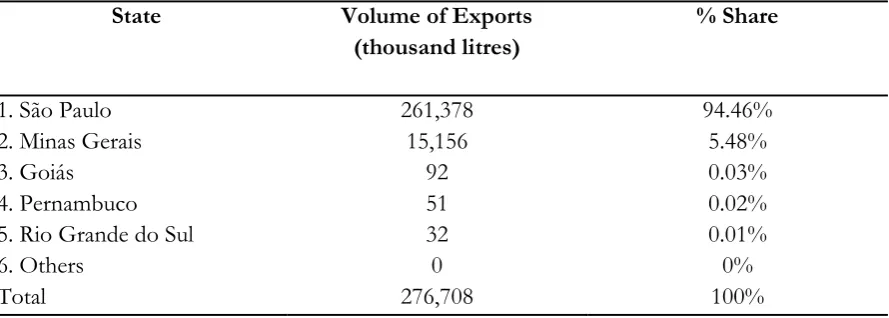
In table 2, it is evident that the prominence of Center-South, mainly São Paulo State, is not only in the production, but also in ethanol exports (São Paulo State is responsible for almost 95% of the total exported by the country)10.
State Volume of Exports
(thousand litres)
% Share
1. São Paulo 2. Minas Gerais 3. Goiás
4. Pernambuco 5. Rio Grande do Sul 6. Others
Total
261,378 15,156
92 51 32 0 276,708
94.46% 5.48% 0.03% 0.02% 0.01% 0% 100%
Table 2: Ethanol Exports by State. Source: UNICA/SECEX (2013).
For sugarcane in particular, the main international requirements are related to managing complexity and environmental pressure: the bottleneck on the coordination for increase in sustainability remains in the production and processing of the commodity. Other players that stand further on the sugarcane production chain have been pushing the producers to engage on a common goal of certified production(Moura and Chaddad 2012).
As Sauer and Leite (2011) point out, the production and processing of sugarcane is made by short trade circuits, as shown by the territorial concentration of the production and trade of sugarcane. According to Shikida, Azevedo, and Vian (2011), this territorial concentration can be used as an indicator of homogeneity on the use of technology in the sugar ethanol industry of the Center-South region. Geographical concentration of production, processing verticalization (given that few plants respond for most of the processing, and they are also spatially concentrated) as well as homogeneity on the technological standard are, thus, true indicators of the balance on the profile of production units. Therefore, those material conditions create a basis for an efficient positioning of Brazilian sugar industry in the international arena, with a relatively easy and low-cost achieving of consensus.
10If we look at data on production by state or, inversely, exports by region (Center-south VS North and Northeast)
18
Public Policies and Regulation in Brazil
As pointed out by Zezza and others (2012), some of the most prominent authors in private governance theory, like Cashore et al. (2007), see an important role for the government in creating conditions for compliance with private regulation.
Zezza and others (2012) shows then how the compliance of Brazilian ethanol producers with international standards and certifications is such an example was made more feasible by public policies designated for the ethanol market.
Brazilian government helped ethanol production not only increase but also adapt easily to international standards and regulation, for two reasons: first, through public policies that support both the supply and demand of ethanol in the country. Second, through public regulation, in some cases coordinated with private actors, which turned Brazilian ethanol chain of production already close to the requirements of international certification, in comparison to other producing countries.
First, the Proalcool program, started in 1975, brought many incentives for the production and transport of ethanol (Cordonnier 2008). Second, policies that helped a vigorous internal market for ethanol emerge, like a 1979 Protocol: "One of the most innovative governmental programs to emerge from the late 1970s in Brazil was the agreement brokered between the Brazilian government and large automobile manufacturers to produce cars that ran on ethanol alone, rather than simply a blend of ethanol and gasoline" (Cordonnier 2008).
These policies, which continued with financial supports to "flex fuel" cars (cars that run on both ethanol and petroleum) and sugar/ethanol production throughout the decades, made possible a vigorous ethanol industry.
Besides that, by the time that certifications linked to the EU Directive such as Bonsucro were starting to develop, Brazil had already public regulations that were strict in comparison to other biofuel producers, making adaptation to these international standards less costly. For example, the country had already “implemented its own protected areas” under the CDB (Convention for Biological Diversity), although different criteria than the one used by the EU Directive (@ Zezza and others 2012, 8).
More than that, sugar cane producers in São Paulo state (where most of the production is concentrated and well-articulated under UNICA’s representation) signed the Green Protocol, an agreement with São Paulo State Environmental Agency (Zezza, 2012:14). In fact, UNICA itself was the responsible for signing, in the name of producers, the Green Protocol. This shows how organized and prepared for adequacy to environmental and social restrictions those producers were even before international standards started gain importance11.
11Beyond those incentives,Brazilian sugarcane was easier to fit water requirements of Bonsucro, since 95% of the
19
Concentration and Interest Representation
Not only the relationships inside the chain of production, but also the representational profile of sugar and ethanol producers in Brazil is relevant in the way that national actors organize to support their interests. Private interests representation also depends on the capacity to coordinate collective action. Notwithstanding, the characteristics of the productive chains and the relationships developed among its many agents are essential to identify the obstacles for the establishment of interest representation organizations and for the efficiency of compliance to international rules.
Together with the concentration and verticalization of Brazilian ethanol production it came an institution that could represent Southern producers effectively. UNICA has today more than 130 associates, which correspond to 50% of the ethanol and 60% of the sugar produced in the country (UNICA website, 12 June 2014)12.
UNICA was founded in 1997, as a result of the merger of several São Paulo State setorial organizations (which, as we have seen before, is responsible for the majority of production and export of Brazilian ethanol). It is run by a Council formed by representatives of the associate producers and technical experts in sugarcane13.
As a consequence of the centralization of important players around UNICA, the association could become not only the main representative of the sugarcane segment inside the country, but it also gained power in the international level, particularly in Bonsucro negotiations. UNICA’s worldwide projection can be felt by the opening of an office in USA, in 2007, and Europe, one year later. More than that, the organization has a member in the board of directors of Bonsucro.,Therefore, UNICA’s performance was crucial in the strengthening of the position of Brazilian exporters and the avoidance of dissonant voices in the segment inside the country.
Analytical Considerations
Cafaggi and Pistor (2014), Cafaggi and Renda (2012) and Büthe and Mattli (2011) became reference in private transnational regulation studies because their contributions have exceeded their initial goals. Most of the literature in the field have relied on case studies, mainly because of a lack of theoretical foundations that allow the development of research questions that could be addressed with data analysis and replicable explanatory models.
At the one hand, Büthe e Mattli's (2011) institutional complementarity theory. solidify the argument that some specific features of an (namely, the level of verticalization of the productive chain, the centralization in the interest representation, and the adequacy to standards and legitimation of the sectorial positioning through public policies) are strong indicators of the capacity of producers to make their interest worth in the international regulatory arena. On the other, regulatory capability theory of Cafaggi and Pistor (2014) complement Büthe and Mattli’s statement, while building arguments that, in the field of private regulation, provide a normative foundation to the idea of the capacity of influence of players in the regulation to which they are
12There are other associations which represent the interests of producers, such as Alcopar (in Paraná State, close to
São Paulo), but they only represent a few producers and have much less international power of influence than UNICA.
20 submitted. The present article main goal is to find convergence between these two theoretical perspectives which, when applied to our case (Brazilian ethanol industry influence on Bonsucro standard), suggest interesting paths to a research agenda.
Therefore, the study of the determinants of the coordinated action and regulatory capacity of players that represent the sugar ethanol segment in brazil, testified by the level of adherence of Brazilian producers to Bonsucro14, show us that the theoretical framework of these authors can be suitable to an explanation of 1) the level of adherence and compliance to private regulation (certification) 2) the necessary conditions for country sectorial interests could be balanced in private transnational regulatory arenas.
First, the case shows that the sources of demand for ethanol regulation (EU) converge with a privileged destination of Brazilian exports of sugar and ethanol. The pressures for compliance that come mainly from Europe through EU-RED have strongly impacted producers and industrials that act in Brazil. Such pressures gave a kick-start to the constitution of Bonsucro, the private initiative for sustainability standards of the sugarcane chain of production.
Secondly, a concentration of the production and processing of sugarcane in Brazil enable a relative homogenization of the production. The data on that matter suggest that the concentration, mainly in the sugar processing, has as a consequence the strengthening of this stage of the productive chain in relation to producers (who are more disperse), increasing verticalization of the productive chain in the first stages of the value chain. When we overlap data on production with territorial dispersion of production and processing of sugarcane, we find out that the industry is concentrated in the Center-South, a very homogeneous region in terms of property size (mainly large), technology (Shikida, Azevedo, and Vian 2011), and labor and environmental standards (fueled by previous public policies, as pointed out by Zezza and others (2012). As Büthe and Mattli (2011) suggest, the homogenization of the industry favored an increased capacity of being represented in transnational arenas.
Third, public policies that favour or legitimate the practices of a sector also provide legitimacy to the position of agents in the international arenas (Büthe 2013). In the Brazilian case, a very demanding institutional environment regarding environmental standards made many producers of sugar and ethanol already adapted to international standards as the ones required by EU-RED, even before they seek for certification. Therefore, the Brazilian industry gained, from the beginning, a comparative advantage in relation to other competitors whose initial patterns were less demanding. As it follows, the efforts made by the Brazilian government to stimulate the production of ethanol in the 1970’s were essential to impel the growing and productivity of the segment.
Finally, we state that the geographic concentration and verticalization of the production and processing in a small number of sugar mill plants favored, in the case of sugarcane industry, the unification of interests under UNICA. It is important to highlight the role of UNICA, since the
14The large majority of plants certified by Bonsucro are Brazilian (26 out of 28). Source:
21 beginning, as a privileged member of Bonsucro negotiations. That role was only possible because of the domestic legitimacy and power that UNICA gained among Brazilian producers.
Conclusions and Directions for Future Research
Scholar literature on private transnational regulation is still taking its first steps in the use of metrics, statistical data and analytical frameworks. In the present article, which intends to set a further research agenda, we have combined some information and data that could sustain the development of indicators or analytical models, which could be anchored on theoretical grounds in a process of systematization of research questions, fundamental concepts and analysis dimensions. Therefore, we believe the development of an indicator for further research is of the greatest importance for private governance studies and, for that reason, we proceed to the systematization of theoretical statements which could be supported by quantitative indicators and available statistical data.
The study of the fundaments that characterize the capacity of collective action of Brazilian ethanol industry in Bonsucro is an interesting exercise which could, on subsequent works, help us to create indicators that provide an adequate measure of the regulatory capacity (influence) of organized domestic segments to influence and adhere to private regulation standards. Therefore, the question “Who wins and who loses under private regulation- and why?” could gain a clearer outline, as the indicators of regulatory capacity could be used to evaluate and measure the distributive effects of private regulation from the agents capacity to involve themselves effectively in private regulation processes.
22
References
Abastecimento, Companhia Nacional de (2008): Perfil Do Setor Do Açúcar E Do Álcool No Brasil. Brasília: Governo Gederal.
Barral, Welber Oliveira (2003). Negociações Comerciais Multilaterais: a Trade Promotion Authority E Os Interesses Brasileiros. São Paulo: Fundação Boiteux.
Bruszt, Laszlo, and Gerald A McDermott (2012). “Integrating Rule Takers: Transnational Integration Regimes Shaping Institutional Change in Emerging Market Democracies.” Review of International Political Economy, 19(5): 742–778.
Büthe, Tim (2010). “Private Regulation in the Global Economy: A (P)Review.” Business and Politics, 12(3). Büthe, Tim (2013). “Distributional Consequences of Transnational Private Regulation: Institutional Complementarity as a Structural Source of Power in Global Product and Financial Markets.” Duke University Rethinking Regulation Working Paper, 6.
Büthe, Tim, and Walter Mattli (2011). The New Global Rulers: the Privatization of Regulation in the World Economy. Princeton: Princeton University Press.
Cafaggi, Fabrizio (2011). “New Foundations of Transnational Private Regulation.” Journal of Law and Society, 38(1): 20–49.
Cafaggi, Fabrizio (2013). “The Regulatory Functions of Transnational Commercial Contracts: New Architectures.” Fordham International Law Journal, 36:1557.
Cafaggi, Fabrizio, and Katharina Pistor (2014). “Regulatory Capabilities: a Normative Framework for Assessing the Distributional Effects of Regulation.” Regulation & Governance (early view).
Cafaggi, Fabrizio, and Andrea Renda (2012). “Public and Private Regulation: Mapping the Labyrinth.” CEPS Working Document, 370.
Cashore, Benjamin (2002). “Legitimacy and the Privatization of Environmental Governance: How Non– State Market–Driven (NSMD) Governance Systems Gain Rule–Making Authority.” Governance, 15(4): 503–529.
Cashore, Benjamin, Graeme Auld, Steven Bernstein, and Constance McDermott (2007). “Can Non-State Governance ‘Ratchet up’ Global Environmental Standards? Lessons from the Forest Sector.” Review of European Community & International Environmental Law, 16(2): 158–172.
Chasek, Pamela S, David L Downie, and Janet Brown (2013). Global Environmental Politics. Boulder: Westview Press.
Cordonnier, Vanessa M. (2008). “Ethanol’s Roots: How Brazilian Legislation Created the International Ethanol Boom.” William & Mary Environmental Law & Policyy Review. 33:287.
Gereffi, Gary, John Humphrey, and Timothy Sturgeon (2005). “The Governance of Global Value Chains.” Review of International Political Economy, 12(1): 78–104.
23
Hall, Rodney Bruce, and Thomas J Biersteker (2002). The Emergence of Private Authority in Global Governance. Cambridge: Cambridge University Press.
Keck, Margaret E, and Kathryn Sikkink (1998). Activists Beyond Borders: Advocacy Networks in International Politics. Cambridge: Cambridge University Press.
Kersbergen, Kees van, and Frans van Waarden (2004). “Governance as a Bridge Between Disciplines: Cross-Disciplinary Inspiration Regarding Shifts in Governance and Problems of Governability, Accountability and Legitimacy.” European Journal of Political Research, 43(2): 143–171.
Levi-Faur, David (2011). “Regulation and Regulatory Governance.” In: Levi-Faur, David (ed.). Handbook on the Politics of Regulation. Northampton: Edward Elgar Publishing. pp. 1–25.
Levy, David L, and Peter John Newell (2005). The Business of Global Environmental Governance. Cambridge: MIT press.
Mayer, Frederick, and Gary Gereffi (2010). “Regulation and Economic Globalization: Prospects and Limits of Private Governance.” Business and Politics, 12(3): 1--25.
Mbengue, M. 2011. “Private Standards and WTO Law.” International Centre for Trade and Sustainable Development (ICTSD) Bridges Trade BioRes Review, 5(1).
Moraes, Bruna, Heidy Ramos, Marina Soares, and Mi Almeida. 2010. “Fatores Determinantes Para a Entrada de Investimento Estrangeiro Direto No Setor Sucroalcooleiro Do Brasil.” In Congreso Internacional de Estratégia SLADE, Guayaquil, 1: 1–23.
Moura, Paula T, and Fabio R Chaddad (2012). “Collective Action and the Governance of Multistakeholder Initiatives: a Case Study of Bonsucro.” Journal on Chain and Network Science, 12(1): 13–24.
Prakash, Aseem, and Matthew Potoski (2012). “Voluntary Environmental Programs: a Comparative Perspective.” Journal of Policy Analysis and Management, 31(1): 123–138.
Rodrigues, Pietro. 2014. “Governança E Regulação Transnacional Privada: Os Limites Do Sistema Agroindustrial Da Soja.” Master’s thesis, Department of Political Science, University of São Paulo. São Paulo.
Rosenau, James N, and Ernst-Otto Czempiel (eds.) (1992). Governance Without Government: Order and Change in World Politics. Cambridge: Cambridge University Press.
Sauer, Sérgio, and S Pereira Leite (2011). “Agrarian Structure, Foreign Land Ownership, and Land Value in Brazil.” In: International Conference on Global Land Grabbing, Cornell University, pp. 6–8.
Selfa, Theresa, Carmen Bain, and Renata Moreno. 2014. “Depoliticizing Land and Water ‘Grabs’ in Colombia: the Limits of Bonsucro Certification for Enhancing Sustainable Biofuel Practices.” Agriculture and Human Values, 31(3): 455–468.
24
Shikida, Pery Francisco Assis, Paulo Furquim de Azevedo, and Carlos Eduardo de Freitas Vian. (2011). “Desafios Da Agroindústria Canavieira No Brasil Pós-Desregulamentação: Uma análise Das Capacidades Tecnológicas.” Revista de Economia E Sociologia Rural, 49(3): 599–628.
Slaughter, Anne-Marie (2004). “Sovereignty and Power in a Networked World Order.” Stanford Journal of International Law, 40:283.
Spiller, Pablo (2011). “Transaction Cost Regulation.” NBER Working Papers, 16735.
Thorstensen, Vera, Daniel Ramos, and Adriane N. Muller Carolina e Baptista (2013). “Sistemas de Regulação Do Comércio Internacional Em Confronto: O Marco Dos Estados E O Marco Das Transnacionais.” Política Externa, 21(4). Online.
Van Waarden, Frans (2011). “Varieties of Private Market Regulation: Problems and Prospects.” In: Levi-Faur, David (ed.). Handbook on the Politics of Regulation. Northampton: Edward Elgar Publishing , pp. 469--486.
Williamson, Oliver E. (1996). The Mechanisms of Governance. Oxford: Oxford University Press.
25
Implications and Consequences of the Arms Trade Treaty (ATT)
Laura Crovetto and Dario Caponigro
Université libre de Bruxelles, International Relations
[email protected]; Avenue Général Médecin Derache 127, Brussels, Belgium
Università degli Studi di Milano, International Science and European Institutions [email protected]; via Sant’Orsola 12, 20123 Milan, Italy
Laura Crovetto, 22, from Milan (Italy), is a graduate who received her Bachelor’s degree in “International Science and European Institutions” at the Università degli Studi di Milano in July 2015. In December 2014, she participated and obtained a final certificate in “Winter School on Disarmament and Armament Proliferation Control: International Law, Engagement of Governments and Role of Civil Society”. She wrote her Bachelor’s thesis on “International arms trade: prospective of the Arms Trade Treaty (ATT)”. She helped in founding ASSP Unimi in Milan and currently holds its Secretary. She is doing a Master in International Relations at the Université libre de Bruxelles.
Dario Caponigro, 26, was born in Tehran (Iran). Currently living in Milan (Italy) and studying for the Bachelor’s degree in “International Science and European Institutions” at the Università degli Studi di Milano. An IAPSS and ASSP Italia member, he helped in founding ASSP Unimi in Milan along like-minded colleagues and currently holds its Presidency. His interests include strategic studies, conflict resolution, human behaviour and associationism.
Abstract
The international sales volume of conventional arms has been considerably increasing, making it necessary to create an international normative framework of regulations: the adoption of the ATT by the United Nations (U.N.) General Assembly (2013) represents a historical achievement to establish global standards for the arms trade, with the purpose of supporting international peace and security and curbing human-rights abuses. This paper describes the process aimed at regulating the legal arms trade and strengthening the fight against the illicit trafficking. Through the data of the U.N. Disarmament Affairs, the Stockholm International Peace Research Institute and the International Institute for Strategic Studies, the amount of conventional arms transfers worldwide has been analyzed. The articles of the ATT are illustrated focusing on the most innovative and critical dispositions. In conclusion, the Conference of the State Parties will face the turbulent developments and the different international perspectives for the future of the ATT.
Keywords
26
Introduction
The Arms Trade Treaty establishes common international standards for the regulation of the international trade in conventional arms, ammunition, parts and components for the purpose of contributing to peace and security, reducing human suffering, and promoting cooperation and transparency. The global volume of trade linked to these arms is progressively increasing and it represents a potential menace to international peace and security (SIPRI Yearbook 2015). The international community is aware of the strong and intense scale of conventional arms trade worldwide and the member States of U.N. expressed their will and need to regulate it in the most efficient and appropriate way: the treaty aims to establish a certain number of criteria by which States will assess arms transfers applications; a ban on transfers likely to contribute to war crimes, to acts of genocide or to violations of international commitments and Security Council embargos; consideration of risks associated with violations of human rights or international humanitarian law; consideration of the risk of corruption in transactions and the risk of diversion into the illicit market. This treaty – which covers the seven categories of the UN Register on Conventional Arms as well as the SALW, ammunition, parts and components – entered into force on 31st December 2014 and its implementation is now essential in the fight against illicit trafficking and in the general regulation of this global trade, especially in the geographical areas most effected by trafficking of SALW.
“The need for the ATT remains abundantly clear. Deadly weaponry continues to find its way into irresponsible hands. Unscrupulous arms brokers defy UN arms embargoes. Ammunition depots are poorly guarded. End-use certificates are not standardized and can be easily forged […] In adopting the Arms Trade Treaty, Member States came together to support a robust, legally binding
commitment to provide a measure of hope to millions of people around the world15”.
Literature Review
Before describing the global volume of the trade linked to these specific arms, it is fundamental to identify what does the notion of “conventional arms” mean. A conventional arm is an arm which is neither nuclear, biological, nor chemical because these latter arms have stronger magnitudo and they are classified as “mass destruction arms” for this reason (Christian Ponti, 2013: p. 643).
The U.N. Register of Conventional Arms (hereafter Register) covers seven categories of arms, which are deemed the most offensive ones: battle tanks, armored combat vehicles, large-caliber artillery systems, combat aircraft, attack helicopters, warships, missiles and missiles launchers. The Register is a voluntary arrangement established on 1st January 1992 under General Assembly resolution16; this resolution called upon all member States to provide annually by 31st May of each year, to the Secretary General, relevant data on imports and exports of conventional arms to be included in the Register. In the same resolution of December 1991, the General Assembly declared its determination to prevent the excessive and destabilizing accumulation of arms in order to
15 Remarks delivered by Angela Kane, 25 September, on behalf of the Secretary General to the 2014 Treaty Event,
annually devoted to multilateral treaty advancement at the margins of the UNGA (United Nations General Assembly) in New York.
27 promote stability and strengthen international peace and security, taking into account the legitimate security needs of States and the principle of undiminished security at the lowest possible level of armaments.
Recently, member States decided that the SALW could be added to the seven arms of the Register, under the formula “7+1”. The U.N. General Assembly gave a definition of the SALW17: “small arms” are weapons designed for personal use and they consist of: light machine guns, sub-machine guns, including machine pistols, fully automatic rifles and assault rifles, and semi-automatic rifles; “light weapons” instead include the following portable weapons designed for use by several persons serving as a crew, such as heavy machine guns, automatic cannons, howitzers, mortars of less than 100 mm caliber, grenade launchers, anti-tank weapons and launchers, recoilless guns, shoulder-fired rockets, antiaircraft weapons and launchers, and air defense weapons.
The SALW, unlike heavy weapons, circulate everywhere in both the military and civilian markets. These categories of arms are cheap, light, easy to handle, transport and use by civilians, so that there are different possible ways in which SALW find their way to fall into hands of civilians and into the illegal market: arms captured from enemies during fighting, soldiers defecting from armed groups, stolen or captured peacekeeping stocks, arms supplied by the armed forces, purchases through the open market, supply from government stockpiles of neighbouring States, inheritance from family or relatives or friends.
Before the adoption of the ATT, efforts to improve controls on international arms transfers have primarily been driven and directed by U.N. member States. At the international level there are three existing international instruments: the Protocol against the Illicit Manufacturing of and Trafficking in Firearms, their Parts and Components and Ammunition (the Firearms Protocol)18, the UN Programme of Action to Prevent, Combat and Eradicate the Illicit Trade in Small Arms and Light Weapons in All Its Aspects (PoA)19 and the International Instrument to Enable States to Identify and Trace, in a Timely and Reliable Manner, Illicit Small Arms and Light Weapons (ITI)20. These have all contributed to the development of a normative framework on small arms control (Sarah Parker, 2013: page 4), but they have some critical limits: no one of them cover all together the SALW, ammunition, parts and components in their activities and control measures, and the Firearms Protocol is the only legally binding instrument.
Before the adoption of the ATT, U.N. Security Council’s arms embargoes were the only real international legally binding measures that aim to partly regulate but mostly to prohibit specific arms transfers: arms embargos are one type of sanctions that can be used to coerce States and
17 UNGA(United Nations General Assembly), Doc. A/52/298 on 27th August 1997, Annex, Report of the Panel of
Governmental Experts on Small Arms.
18 UNGA (United Nations General Assembly), Protocol against the Illicit Manufacturing of and Trafficking in Firearms, Their
Parts and Components and Ammunition, Supplementing the
United Nations Convention against Transnational Organized Crime (‘Firearms Protocol’). Resolution 55/255, adopted on 31st May 2001. A/RES/55/255 of 8th June 2001.
19 UNGA (United Nations General Assembly), Programme of Action to Prevent, Combat and Eradicate the Illicit
Trade in Small Arms and Light Weapons in All Its Aspects (‘UN Programme of Action’). Adopted on 21st July 2001. A/CONF.192/15 of 20th July 2001.
20 UNGA (United Nations General Assembly), International Instrument to Enable States to Identify and Trace, in a
Timely and Reliable Manner, Illicit Small Arms and Light Weapons
28 non-governmental actors to improve their behaviour in the interests of international peace and security (SIPRI Arms Embargoes Database). Under Chapter VII of the U.N. Charter, the Security Council can take enforcement measures to maintain or restore international peace and security. Such measures range from economic and/or other sanctions not involving the use of armed force to international military action. Based on article 41 of the U.N. Chapter, since the 1945-2006 the United Nations has imposed 27 arms embargoes (SIPRI, 2007, Table A.1).
Nevertheless, it is important to specify that arms embargos present some significant limits: States have not always applied with respected the embargoes measures, which can’t prevent the supply of arms but can just limit or can just end illicit trades. In general, it is not the goal of arms embargos to regulate the international and national arms trade (Christian Ponti, 2013, p. 646).
Theoretical framework
The ATT is the culmination of numerous dedicated initiatives conducted over recent decades. The idea of an arms trade treaty first came from Nobel Peace Laureates, supported by civil society organisations worldwide: in May 1997 they launched the International Code of Conduct on Arms Transfers (Nobel Laureate Code, 1997): Costa Rican President and Nobel Prize laureate Oscar Arias led other notables in summoning international community support for ethical standards and transparency in arms trade (Sarah Parker, 2014: p. 78). This was to better protect human rights and promote government accountability. In 1998, the European Union concluded the EU Code of Conduct on Arms Exports (EU, 1998), a political measure designed to block member-state arms exports to locations provoking or prolonging armed conflict, risking human rights repression or fomenting state aggression.
In 2003, the Control Arms21 campaign was launched and has since gathered support for the ATT from over a million people worldwide. Indeed, in 2006 Control Arms handed over a global petition called “Million Faces” to the U.N. Secretary General Kofi Annan. In December 2006, a group of States led by the United Kingdom began investigating the feasibility of an arms trade treaty with common international standards for the export, import, and transfer of conventional arms. The U.N. General Assembly then requested the U.N. Secretary General to canvass member States over the feasibility, scope and draft parameters of a comprehensive, legally binding instrument establishing common international standards for the import, export and transfer of conventional arms22. Following reports by a Group of Government Experts (GGE) in 2008, and a U.N. Open-Ended Working Group of government representatives in 2009, differences over a future treaty were narrowed to four main headings. They included goals and objectives (treaty application at its broadest level); feasibility (requirements for a universal, objective, non-discriminatory and clearly defined instrument); scope (intended weapons coverage and range of transactions, transfers and sales); and, most importantly, parameters (principles and criteria providing presumptions of denial of transfer and operational mechanisms). The U.N. General Assembly resolved to establish a
21 Control Arms is a global civil society movement Non-Governmental Organisations (NGOs) campaigning for tough
controls on the international arms trade. Control Arms represents organisations working in over 120 countries. It includes major international NGOs such as Oxfam, Amnesty International and Saferworld, as well as many regional and national level organisations.
22 UNGA (United Nations General Assembly), Res 61/89 (6th December 2006), passed by 153 votes in favor, one