753 Village Green Ave London N6K1H3, Ontario, Canada
email:[email protected]
Abstract. An agent wishing to delegate some of its tasks to others needs to use the services of a match-making agent. The quality of the matchmatch-making process represents a key success factor in the effective-ness of the delegation process. As more services are exposing descriptions based on languages devel-oped in the framework of Semantic Web, there is no doubt that Descriptions Logics (DLs) on which Web Ontology Language (OWL-DL) is based will be playing a major role in this context. This work contributes to the field in three ways. First, the DLALCN was used in a matchmaking process that yields a justified ranking of results. Second, the matchmaking process provides useful information to the requester/provider in order to modify or refine the original request/capability description for a better result. Third, the requester agents should be able to further filter the results based on other criteria that we call “service goodness” that are based on some Quality of Service (QoS) criteria as well as attributes such as trust and cost.
Keywords: Semantic matchmaking, description logics, software agents, semantic web, delegation, qual-ity of service.
(Received November 01, 2009 / Accepted September 15, 2010)
1 Introduction
The Semantic Web was introduced to extend the Web in such a way that its content can expressed in a for-mat that can be understood by machines through the creation of domain ontologies. This has increased both openness and interoperability in the web environment.
The widespread availability of resources and ser-vices has led to the complexity of finding the best matches for a given request. The need for an effective matchmaking process has become a key factor in many e-marketplaces in which supply and demand have to be matched and services need to be discovered.
In this context, we define an agent as an entity that acts on behalf of a user or another program. Agents need to delegate some tasks to others either because they don’t have the capabilities or resources to per-form them or that they want to optimize the
execu-tion of their tasks. Before the delegaexecu-tion process hap-pens a requester agent (or a broker acting on its be-half if a full-mediation service is used) needs to use the services of a resource discovery agent (matchmaker) which matches requests with available offers. The pur-pose of the matchmaking process is to find, for a given request, the best matches available among the list of of-fers. The Semantic Web paradigm requires that descrip-tions of requests and offers should be in a structured form based on ontologies. We assume in what follows that the descriptions of requests and offers pertain to a common ontology.
on the open-world assumption in which the absence of information is distinguished from negative information. Usually, DL-based approaches exploit standard rea-soning services of a DL system (satisfiability and sub-sumption) to match requests with offers. If an offer (supply) is described by a conceptSup and a request (demand) is described by a concept Dem, unsatisfi-ability is denoted by the empty conjunction of Sup andDem, while satisfiability is denoted by its non-emptiness. Hence, unsatisfiability identifies incompat-ibility between requests and offers, while satisfiability identifies a potential match between them (compatibil-ity). DemsubsumesSup(every individual of concept Supis also of conceptDem) means that requirements onDemare completely fulfilled bySup.
The matchmaking process needs to go beyond com-patible and incomcom-patible matches by providing an ex-plained ranking of the most prominent matches. More-over, when an exact match is not found (which is the case most of the time), the matchmaking process should identify what needs to be changed inSupand/orDem in order to get a better result. The automation of such process is still a widely accepted challenge.
This work goes beyond providing a list of ranked matches by allowing the requester to further filter the re-sults based on other criteria that we call “service good-ness” that are based on some Quality of Service (QoS) criteria as well as attributes such as trust, and cost that are embedded into a common capability description language called Requester Provider Capability Descrip-tion Language (RPCDL).
The rest of the paper is organized as follows. Sec-tion 2 provides an overview of DLs, while secSec-tion 3 presents how matchmaking is performed using DLs. Section 4 defines the extra filtering process performed by a requester after receiving a ranked list of offers. Section 5 presents a case study applying our approach to matchmaking. Section 6 presents related work, while section 7 concludes the paper.
2 Description Logics
DLs are a family of logic formalisms for Knowledge Representation [7]. This section is intented to present the core principles of DLs. In DLs, the basic syntax elements are:
• Concepts, such as Person, Female, Parent,
WomenandMother.
• Roles, such ashas child.
• Individuals, such asElizabethandCharles.
Intuitively, concepts represent sets of individuals and roles link individuals in different concepts, as the rolehas childlinks aParentwith aPerson. Ba-sic elements can be combined using constructors to form concept and role expressions, and each DL has its distinguished set of constructors. In this paper we use Attributive Language with Complements and un-quantified Number restrictionsALCN. Although hav-ing more constructors makes a DL more expressive, this comes with a cost which is the explosion in computa-tional complexity of inference services [6]. Hence a trade-off is necessary. ALCN meets the trade-off be-cause it is both sufficiently expressive and yet offers PSpace-complete complexity of inference services [20]. Moreover, ALCN can be mapped into a subset of OWL-DL [2]. The following lists the constructs of
ALCN:
• �universal concept represents all individuals in the domain.
• ⊥bottom concept represents the empty set.
• A atomic concept represents all individuals be-longing to the set represented byA.
• ¬Cnegation represents all individuals not belong-ing to the set represented byC.
• C�D intersection represents the individuals be-longing to both toCandD.
• C�Dunion represents the individuals belonging to eitherCorD.
• ∀R.Cuniversal restriction represents all individu-als participating in relationRwhose range are all individuals belonging toC.
• ∃R.C existential restriction represents some indi-viduals participating in relationRwhose range are all individuals belonging toC.
• (≥ nR),(≤ nR) unquantified number restriction represents the minimum and the maximum indi-viduals participating in relationR. We write (=
nR) for (≥nR)�(≤nR).
A DL knowledge base typically comprises two com-ponents, a “TBox” and an “ABox”. The TBox contains terminological knowledge (hence the term “TBox”) and is built through declarations (axioms) that de-scribe general properties of concepts. The ABox con-tains assertional knowledge (hence the term ABox)– knowledge that is specific to the individuals of a do-main. Terminological knowledge is usually thought not to change (timeless), while assertional knowledge is usually thought to be subject to occasional or even constant change. For example, a TBox could in-clude the following axioms: Parent ≡ Person
�∃ has child.Person and Women � Person,
while an ABox could include the following assertions:
mother(Elizabeth),
person(Charles)and
has child(Elizabeth,Charles).
Let’s turn our attention now to the semantics of ALCN. A model provides a set of domain elements and a way to interpret each piece of syntax. For example, we can interpret mother(Elizabeth)
and
has child(Elizabeth,Charles) only when
we are told whoElizabeth is and who Charles
is and whatMothermeans (a set of individuals) and what has child means (a role, a binary relation). Whether or not the statements are true depends on whether
Elizabeth is a Mother and on whether
Elizabeth’s child is Charles in our domain.
In model theory, formulas are fixed and interpretations are varied (as to tackle different domains). When a set of formulas is true in some domain, the formulas are said to represent a model of that domain. They say something accurate about it, but don’t tell us everything. What makes this useful is that when we do some syntactic manipulation to generate new formulas from the model, we expect that the new thing we found is also true in the domain.
DLs semantic can be defined by the standard Tarski-style interpretations. A semantic interpretation is a pair I = (Δ,.I), which consists of the domainΔand the
interpretation function.I, which maps every concept to
a subset ofΔ, every role to a subset of ofΔ×Δ, and
every individual to an element ofΔ. We assume that
different individuals are mapped to different elements ofΔ, i.e.,aI �=bIfor individualsa�=b. Table 1 and Table 2 define both the syntax and semantics ofALCN constructs and its TBox axioms respectively. A model of a TBoxT is an interpretation satisfying all axioms ofT.
Table 1: Syntax and Semantics ofALCN constructs
Name Syntax Semantics
Top � ΔI
Bottom ⊥ ∅
Intersection C�D CI∩DI
Union C�D CI∪DI
Negation ¬C ΔI\CI
Universal quantification ∀R.C {x∈ΔI|
∀y: (x, y)∈RI→y∈CI}
Existential quantification ∃R.C {x∈ΔI|
∃y: (x, y)∈RI∧y∈CI}
Number restrictions (≥nR) {x∈ΔI|
�{y∈ΔI|(x, y)∈RI} ≥n}
(≤nR) {x∈ΔI|
�{y∈ΔI|(x, y)∈RI} ≤n}
Table 2: Syntax and Semantics ofALCN TBox asser-tions
Name Syntax Semantics Definition C≡D CI=DI Inclusion C�D CI⊆DI
DL-based systems usually provide two basic rea-soning services [17]:
• Concept Satisfiability: given a TBox T and a concept C, does there exist at least one model of T assigning a non-empty extension to C? Satisfia-bility is defined as follows:C��T ⊥.
• Subsumption: given a TBoxT and two concepts C andD, is CI always contained inDI for ev-ery modelI ofT? Subsumption betweenCand Dis defined as follows: C �T D. Subsumption
can be expressed using concept unsatisfiability as follows:C� ¬D�T ⊥.
Intuitively, unsatisfiability means that a concept does not belong to a given ontology, whereas D subsumes C (or C is subsumed by D) ,means that D is more general than C and C is more specific than D. This means that C inherits all properties of D in addition to having its own properties. For example if in a certain domain the conceptsPerson
and Parent are made of the following individuals:
Person={Elizabeth, Charles, William},
and Parent={Elizabeth,Charles}. The
in-dividuals Elizabeth and Charles are in the set
Parentbecause they participate in rolehas child, whileWilliamdoes not.
3 Semantic Matchmaking
a certain request from a requester. Requests and ad-vertisements are expressed with reference to a shared ontology (having TBoxT). A study of the latest ad-vances in the field reveals the following classification of matches [17]:
• Exact match: Sup ≡T Dem.This means that
SupandDemare equivalent.
• Full match: Sup �T Dem. This means that
DemsubsumesSup.Suphas at least all features required byDem.
• Plug-in match: Dem�T Sup. This means that
SupsubsumesDem.Demmay have features not fulfilled bySup.
• Intersection match: Dem�Sup ��T ⊥. This
means thatSupandDemhave something in com-mon and no conflicting features.
• Disjoint match:Dem�Sup�T ⊥. This means
that there is a conflict betweenDemandSup.
The above degrees of matches are organized in an ascending order of preference. We now introduce the process of matchmaking a request with advertisements. A DL reasoner [1] is used to compute a hierarchy of all advertised services. For an incoming requestR, a DL reasoner is used to classifyRi.e. computeR’s sub-sumption relationships with all advertised services. Ad-vertisements equivalent toRare considered to be “ex-act matches”, those subsumed by, but not equivalent to Rare considered to be “full matches”, those subsum-ing but not equivalent toRare considered to be “plug-in” matches. The DL reasoner is then used to classify ¬R. Advertisements subsuming but not equivalent to ¬Rare considered to be “intersection matches”, while those subsumed by¬Rare considered to be “disjoint matches”.
Getting a ranked list of advertisements matching its request is not enough for a requester. The requester (provider) should be given extra-information as to allow it to refine/modify its request (advertisement). In order to do so, we need first to normalize the way in which concepts are defined. Every satisfiable conceptC can be divided into three components:C≡T Cc�Cr�Cn. Cc ≡T A1�. . .�Ahrepresents the conjunction ofh atomic concepts.Cr≡T QRl.Cl�. . .�QRp.Cp. Here l < pandQ represents either∃ or ∀. Cr represents the conjunction of (p−l) concepts of the form∀R.D or∃R.D, where D is a normalized concept. Finally, Cn ≡T (ORs)�. . .�(ORt)represents the
conjunc-tion of all number restricconjunc-tions. O is an operator that
could be either≥or≤. Each role can have at most two conjuncts of number restrictions of either≥or≤.
Now, we are ready to define the refinement tech-niques for each of the of non-exact matches defined above.
• Case of Full match: SinceSup �T Dem, then
Sup≡T Dem�Cl�. . .�Cp, wherel < p. The matchmaker sends the partCl�. . .�Cp to the requester in order to let it know the extra features provided by the provider of the service in order to put it into consideration (if required) in future requests.
• Case of plug-in match: Since Dem �T Sup,
thenDem≡T Sup�Cl�. . .�Cp, wherel < p.
The matchmaker sends the partCl�. . .�Cp to both requester and provider in order to improve the request or advertisement. The requester will know the requested features that are not supported by the provider of the service, while the provider can pro-vide extra features to meet the demands of the re-quester. This leads to the following two cases.
– request refinement: If we remove the part Cl �. . . �Cp from Demwe get an exact match (Dem≡T Sup).
– advertisement refinement: We can use con-cept abduction [9] by finding aALCN for-mula H satisfiable with respect to T such thatSup�H �T Dem.
• Case of intersection match: Since, Dem � Sup��T ⊥, thenDem≡T C�Cl1 �. . .�Cp1 andSup ≡T C�Cl2 �. . .�Cp2. l1 < p1and l2< p2.Crepresents, the “common” features
be-tweenSupandDem. There are two alternatives to consider in this case, each is based on whether the requester or provider takes the initiative of refining its request or advertisement.
– request refinement: The requester keeps the common part (C) and remove the part which is different. We get,Sup �T C, whereC
represents the refinedDem. So we get a full match.
– advertisement refinement: The provider keeps the common part (C) and removes the part which is difference. We getDem �T
• Case of disjoint match: In this case concept con-traction [9] can be used to refine the request in oder to get an “intersection” match. We need to find two ALCN formulasG(for give-up) andK(for keep) such thatDem≡T G�KandK�Sup��T ⊥.
4 Filtering Matchmaking Results Using “Ser-vice Goodness”Attributes
Our approach goes beyond providing a list of ranked matches by allowing the requester to further filter the re-sults based on other criteria that we call “service good-ness” that are based on some Quality of Service (QoS) criteria as well as attributes such as trust, and cost. To achieve this requests and advertisements should be written using a common capability description language named Requester Provider Capability Description Lan-guage
(RPCDL). Table 3 describes the high-level EBNF grammar ofRPCDL.
Table 3: EBNF Grammar ofRPCDL < Request Capability >::=< Context > < Description > < Service Goodness >
< Context >::=< Domain of the ontology > < Description >::=< AnALCNf ormula def ining a request or capability >
< Service Goodness >::=< QoS > < Other Attributes > < QoS >::=< Availability > < Accessibility > < Integrity > < P erf ormance > < Reliability >
< Other Attributes >::=< T rust > < Cost >
As mentioned earlier requests and advertisements should use the same context (ontology describing the domain). If they have different contexts then an inte-gration process need to be performed as defined for ex-ample in [21].
The filtering process starts at the requester imme-diately after it receives a ranked list of advertisements that match its request as described in the previous sec-tion. The “service goodness” attributes used are defined below:
• Availability: Availability reflects if the service is ready for immediate use. It represents the proba-bility that a service is available. Mean Time To Re-pair (M T T R), usually associated with availability represents the mean time it takes to repair a service that has failed. Smaller values ofM T T Rare de-sirable.
• Accessibility: Accessibility represents the degree in which a service is capable of serving a request. It represents the probability of service initiation at a point in time. There could be situations when a
service is available but not accessible. High ac-cessibility of services can be achieved by building highly scalable systems. Scalability refers to the ability to consistently serve the requests despite variations in the volume of requests. Again, accessibility can be calculated as:
the time the service was actually accessible time elapsed since the service started af ter being advertised
• Integrity: Integrity represents how the service
main-tains the correctness of the interaction in respect to the requester. Proper execution of service transactions will provide the correctness of interaction. A transaction refers to a sequence of tasks that make-up a service which needs to be treated as a single unit of work. All the tasks have to be completed to make the transaction successful, otherwise all changes made should be rolled back. Integrity can be calculated as:
the number of transactions successf ully completed total number of handled transactions
Here by “successfully” we mean that the provider has given a correct service result to the requester.
• Performance: Performance is defined as made-up of
two attributes: throughput and latency. Throughput rep-resents the number of service requests served per unit of time. Latency is the round-trip time between sending a request and receiving the response. Higher throughput and lower latency values represent good performance of a service.
• Reliability: Reliability represents the degree of being
capable of maintaining a service and its associated qual-ity. The Mean-Time Between Failures (M T BF) repre-sents a measure of reliability of a service.
• Trust: Trust can be defined as the degree of confidence
that an entity is capable of acting reliably and securely in a particular transaction. Trust management thus in-volves the collection of information necessary for defin-ing trust values of entities and continuously monitordefin-ing and adjusting such values. Reputation mechanisms rep-resent an attractive way of handling trust [22]. In these mechanisms, a requester will have an aggregated trust value (between0and1) for each provider.
• Cost: This represent the amount of money the provider
is charging for providing the service.
The filtering technique uses a weighting strategy in which the requester assigns a weighting factor (∈[0,1])
�7
i=1Wi = 1. The requester also defines the
rela-tive difference between its requested value of each at-tribute and the value offered by the provider. IfAd is the value requested by a requester andAs is a value offered by a provider then the percentage in difference (P D ∈ [0,1])(from the viewpoint of the requested) is
calculated asP D = Ad−As
Ad . A negative value ofP D
means that what is offered is more than what is expected and a positive value means the opposite. A final value of preferences (calledP ref ∈ [0,1]) is calculated as
follows:
P ref = 8 �
i=1
Wi∗P Di
P ref combines weights and percentages in differ-ence of all eight attributes. The final result is com-pared with a threshold value that the requester has. If P ref≤thresholdthen the requester will consider us-ing the service of the provider, otherwise it will move to calculateP reffor the next ranked provider.
The final result of the entire filtering process should be a set of providers instead of only one to cater for the dynamism of the system. If only one provider is gener-ated, there is a possibility that by the time the requester wants to call its related service, the provider has either unadvertised for its service or has left the system.
5 Case Study
In this section, we use a modified version of the sample ontology that appeared in [17] to illustrate our match-making process. The ontology is related to the buy-ing/selling of computers and their variants. Table 4 represents a TBox of the ontology.
Table 4: TBox of Computers Ontology Monitor≡CRTmonitor�LCDmonitor
CRTmonitor�LCDmonitor≡ ⊥
StorageDevice≡HardDisk�FlashDisk OperatingSystem≡Linux�Windows Device≡Monitor�StorageDevice
Software≡OperatingSystem�Browser�WordProcessor Computer≡PC�Laptop
Computer�(≥1hasStorageDevice) � ∀hasStorageDevice.StorageDevice
� ∀hasSoftware.Software�(≥1hasRAM)
HomePC�PC�(≥1hasSoftware)�(= 1hasOS) �(≥1hasMonitor)� ∀hasMonitor.Monitor
Server�Computer�(≥2hasCPU)� ∀hasRAM.(≥512hasMB) � ∀hasStorageDevice.(≥20000hasMB)
Based on the above TBox, let’s take now examples of each of the four cases of matches.
• Case of full match:Sup≡HomePC�
∀hasMonitor.LCDMonitorand
Dem ≡ HomePC. This is a full match because Sup�Dem. In such a case the matchmaker send the part
∀hasMonitor.LCDMonitor to the requester
in order to let it know that all providedHomePCs
come with an LCD monitor. In such a case it is up to it to accept this or not.
• Case of plug-in match:Sup≡HomePC�
∀hasMonitor.LCDMonitorand
Dem≡HomePC�
∀hasMonitor.LCDMonitor�
∀hasRAM.(≥ 1024 hasMB). This is plug-in match becauseDem �Sup. If the requester re-moves the part∀hasMonitor.LCDMonitor� ∀hasRAM.(≥ 1024hasMB) fromDemthen we get full-match as Sup � Dem. If the provider adds∀hasRAM.(≥1024hasMB) toSupthen we get an exact match (although we can add a more specific conjunct and we get a full match). How-ever, in most cases it is easier for a requester to re-move features from its request than for a provider to add features because sometimes it does not have the capability to offer them.
• Case of intersection match:Sup ≡HomePC � ∀hasRAM.(≥1024hasMB�
∃hasSoftware.WordProcessor) and
Dem ≡ HomePC �
∀hasMonitor.CRTMonitor. HomePC
≡ Dem�Sup. If the requester keepsHomePC
and removes the rest thenSup � Demand we have a full match. If the provider keepsHomePC
and removes the rest we get a plug-in match which can be refined as per the previous point.
• Case of disjoint match:Sup≡HomePC�
∀hasMonitor.LCDMonitorand
Dem ≡ Server �
∀hasMonitor.CRTMonitor. Clearly
Dem � Sup ≡ ⊥. In this case we need to use concept contraction by finding two ALCN formulasG (for give-up) andK (for keep) such thatDem≡G�KandK�Sup��T ⊥. In our
caseK≡HomePCand
G≡ ∀hasMonitor.LCDMonitor.
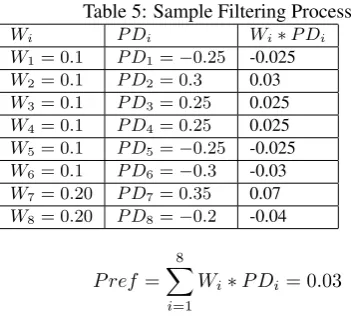
Table 5: Sample Filtering Process Wi P Di Wi∗P Di W1= 0.1 P D1=−0.25 -0.025
W2= 0.1 P D2= 0.3 0.03
W3= 0.1 P D3= 0.25 0.025
W4= 0.1 P D4= 0.25 0.025
W5= 0.1 P D5=−0.25 -0.025
W6= 0.1 P D6=−0.3 -0.03
W7= 0.20 P D7= 0.35 0.07
W8= 0.20 P D8=−0.2 -0.04
P ref = 8 �
i=1
Wi∗P Di= 0.03
6 Related Work
With the growing information overload on the Web, matchmaking has been increasingly investigated in re-cent years under a number of perspectives and for dif-ferent purposes. In this section, we will summarize work done on matchmaking in general (for the sake of completeness), with a focus on DL-based approaches. However, at the end of the section we compare our work with only those using DLs for matchmaking.
In [11],KQML was proposed as an agent com-munication language that can facilitate the matchmak-ing process. In [15], two developed matchmakers were described, the SHADE matchmaker, which op-erates over logic-based and structured text languages, and the COINS matchmaker, which operates over free text. These matchmakers have been used for a variety of applications, most significantly, in the domains of engineering and electronic commerce. Similar meth-ods were later re-considered in the GRAPPA system [26]. Classified ads matchmaking, at a syntactic level, was proposed in [19] to matchmake semi-structured descriptions advertising computational resources in a fashion anticipating grid resources brokering. Match-making was used in SIMS [3] to dynamically inte-grate queries using KQML, and LOOM as description languages. LOOM was also used in the subsumption matching addressed in [12]. InfoSleuth [14], a sys-tem for discovery and integration of information, in-cluded an agent matchmaker, which adopted KIF as a description language and the deductive database lan-guage LDL++.
Matchmaking using satisfiability in DLs was first proposed in [13], [10] and [25]. In [23], the authors introduced a specific language (LARKS) for agent ad-vertisement in the framework of the RETSINA Multi-agent infrastructure. Moreover, a matchmaking engine
was developed which carries out the process using five filters. Such levels exploit both classical text-retrieval techniques and semantic match usingθ-subsumption. However, standard features of a semantic-based system, such as satisfiability check were not used. Nonethe-less, the authors introduced the notion of plug-in match in order to overcome the limitations of exact match. This was further extended in [18]. In [16], the au-thors extended the approach defined in [23] by adding two new levels of matching classification (subsumes and intersection). In [5], the authors proposed an ap-proach to semantic matchmaking that uses concept dif-ference [24], followed by a covering operation opti-mized using hypergraph techniques, in the framework of web services discovery. An initial DL-based ap-proach, adopting penalty functions ranking, has been proposed by [8] in the framework of dating systems. An extended matchmaking approach based on concept contraction and concept abduction was presented in [9] and further extended in [17].
Our work can be seen as an extension to [16] and [9]. However, besides the similarities, there are major differences in the approach taken. Both similarities and differences can be summarized as follows:
• Our approach has similar classification of match-making levels found in [16], although different naming conventions were used. It is worth not-ing that [16] did not tackle request refinements. Our approach, uses techniques to refine a request which is somehow similar to what is defined in [9]. However, there are many differences between the two approaches (see below).
• The work in [9] uses concept contraction to improve the match from “disjoint” to “intersec-tion”. It also uses concept abduction to improve the match from “intersection” to “full”. In con-trast, our approach tackles all cases (besides ex-act match) and proposes ways to refine the match. In the case of “full” match the requester is in-formed of the “extra” features of the provided ser-vice so that it can use them in the future. “Plug-in”,“intersection” and “disjoint” matches can be improved to “full” matches by either making changes to the request or the advertisement.
7 Conclusion
We have addressed the matchmaking problem between requests and advertisements from a DL perspective. We cannot overemphasize the importance of efficient and effective matchmaking in the Semantic Web.
The problem of matchmaking has been tackled from different aspects. First, we organized the degrees of matches by order of importance then defined ways to improve the request or advertisement in order to reach either an exact or full match. Then, we went beyond the matchmaking done at resource discovery level and de-fined a filtering process of the results based on attributes that we call “goodness of service”. These attributes combine both QoS attributes and other attributes such as trust, and cost. To this end, we definedRPCDLas a language in which requests and advertisements can be written and “goodness of service” attributes can be conveyed by the providers. The outcome of the fil-tering process can trim-down tremendously the list of matching advertisements and provides the most accu-rate matches that the requester needs. To our knowl-edge, our refinement mechanism and the filtering using “service goodness” represent new contribution to the matchmaking field.
References
[1] Dl reasoners. available from
http://www.cs.man.ac.uk/ sattler/reasoners.html.
[2] Owl. available from http://www.w3.org/tr/owl-features/.
[3] Arens, Y., Knoblock, C. A., and Shen, W. Query reformulation for dynamic information integra-tion. Journal of Intelligent Information Systems, 6:99–13, 1996.
[4] Baader, F., Calvanese, D., D.and Mc Guinness, Nardi, D., and Patel-Schneider, P., editors. The Description Logic Handbook. Cambridge Univer-sity Press, 2003.
[5] Benatallah, B., Hacid, M., Rey, C., and Toumani, F. Request rewriting-based web service discov-ery. In Proceedings of International Semantic Web Conference, volume 2870 of Lecture Notes in Computer Science, pages 242–257. Springer, 2003.
[6] Brachman, R. and Levesque, H. The tractability of subsumption in frame-based description lan-guages. In Proceedings of the Fourth National Conference on Artificial Intelligence (AAAI-84),
pages 34–37. Morgan Kaufmann, Los Altos, 1984.
[7] Brachman, R. and Levesque, H. Knowledge Rep-resentation and Reasoning. Morgan Kaufmann Publishers Inc., San Francisco, CA, USA, 2004. [8] Cali, A., Calvanese, D., Colucci, S., Di Noia, T.,
and Donini, F. M. A description logic based ap-proach for matching user profiles. In In Proceed-ings of the 17th International Workshop on De-scription Logics (DL04), volume 104, 2004. [9] Colucci, S., Di Noia, T., Di Sciascio, E., Donini,
F., and Mongiello, M. Concept abduction and con-traction for semantic-based discovery of matches and negotiation spaces in an e-marketplace. Elec-tronic Commerce Research and Applications, 4(4):345–361, 2005.
[10] Di Sciascio, E., Donini, F., Mongiello, M., and Piscitelli, G. A knowledge-based system for person-to-person e-commerce. In In Proceedings of the KI-2001 Workshop on Applications of De-scription Logics (ADL-2001), volume 44, 2001. [11] Finin, T., Fritzson, R., McKay, D., and McEntire,
R. Kqml as an agent communication language. In Proceedings of the Third International Confer-ence on Information and Knowledge Management (CIKM94), pages 456–463. ACM Press, 1994. [12] Gil, Y. and Ramachandran, S. Phosphorus: a task
based agent matchmaker. In Proceedings of In-ternational Conference on Autonomous Agents 01, pages 110–111. ACM Press, 2001.
[13] Gonzales-Castillo, J., Trastour, D., and Bartolini, C. Description logics for matchmaking of ser-vices. In Proceedings of the KI-2001 Workshop on Applications of Description Logics (ADL-2001), volume 44, 2001.
[14] Jacobs, N. and Shea, R. Carnot and infosleuth database technology and the web. In Proceedings of the ACM SIGMOD International Conference on Management of Data, pages 443–444. ACM Press, 1995.
[15] Kuokka, D. and Harada, L. Integrating informa-tion via matchmaking. Journal of Intelligent In-formation Systems, 6:261–279, 1996.
[17] Noia, T. D., Sciascio, E. D., and Donini, F. M. Semantic matchmaking as non-monotonic reason-ing: A description logic approach. Journal of Ar-tificial Intelligence Research, 29:269–307, 2007.
[18] Paolucci, M., Kawamura, T., Payne, T., and Sycara, K. Semantic matching of web services capabilities. In proceedings The Semantic Web - ISWC 2002, volume 2342 of Lecture Notes in Computer Science, pages 333–347. Springer-Verlag, 2002.
[19] Raman, R., Livny, M., and Solomon, M. Match-making: distributed resource management for high throughput computing. In Proceedings of IEEE High Performance Distributed Computing Conference, pages 140–146, 1998.
[20] Schmidt-Schaub, M. and Smolka, G. Attributive concept descriptions with complements. Artificial Intelligence, 48(1):1–26, 1991.
[21] Shvaiko, P. and Euzenat, J. A survey of schema-based matching approaches. Journal on Data Se-mantics, 4:146–171, 2005.
[22] Singh, A. and Liu, L. Trustme: Anonymous man-agement of trust relationships in decentralized p2p systems. In Proceedings of IEEE Peer-to-Peer Computing (P2P) 2003, pages 142–149, 2003.
[23] Sycara, K., Widoff, S., Klusch, M., and Lu, J. Larks: Dynamic matchmaking among het-erogeneus software agents in cyberspace. Au-tonomous agents and multi-agent systems, 5:173– 203, 2002.
[24] Teege, G. Making the difference: A subtraction operation for description logics. In Proceedings of the Fourth International Conference on the Prin-ciples of Knowledge Representation and Reason-ing (KR94), pages 540–550.
[25] Trastour, D., Bartolini, C., and Priest, C. Se-mantic web support for the business-to-business e-commerce lifecycle. In Proceedings of Inter-national World Wide Web Conference (WWW) 02, pages 89–98, 2002.