Open Access
Research
Induction of endogenous
γ
-globin gene expression with decoy
oligonucleotide targeting Oct-1 transcription factor consensus
sequence
Xiaoxin S Xu*, Xin Hong and Gan Wang*
Address: Institute of Environmental Health Sciences, Wayne State University, 2727 Second Avenue, Detroit, MI 48201, USA Email: Xiaoxin S Xu* - [email protected]; Xin Hong - [email protected]; Gan Wang* - [email protected]
* Corresponding authors
Abstract
Human globin disorders are relatively common genetic diseases cause by mutations in the β-globin gene. Increasing the expression of the γ-globin gene has great benefits in reducing complications associated with these diseases. The Oct-1 transcription factor is involved in the transcriptional regulation of the γ-globin gene. The human γ-globin genes (both Aγand Gγ-globin genes) carry three Oct-1 transcription factor consensus sequences within their promoter regions. We have studied the possibility of inducing γ-globin gene expression using decoy oligonucleotides that target the Oct-1 transcription factor consensus sequence. A double-stranded 22 bp decoy oligonucleotide containing the Oct-1 consensus sequence was synthesized. The results obtained from our in vitro binding assay revealed a strong competitive binding of the decoy oligonucleotide for the Oct-1 transcription factor. When K562 human erythroleukemia cells were treated with the Oct-1 decoy oligonucleotide, significant increases in the level of the γ-globin mRNA were observed. The results of our western blots further demonstrated significant increases of the fetal hemoglobin (HbF, α2γ2) in the Oct-1 decoy oligonucleotide-treated K562 cells. The results of our immunoprecipitation (IP) studies revealed that the treatment of K562 cells with the Oct-1 decoy oligonucleotide significantly reduced the level of the endogenous γ-globin gene promoter region DNA co-precipitated with the Oct-1 transcription factor. These results suggest that the decoy oligonucleotide designed for the Oct-1 transcription factor consensus sequence could induce expression of the endogenous γ-globin gene through competitive binding of the Oct-1 transcription factor, resulting in activation of the γ-globin genes. Therefore, disrupting the bindings of the Oct-1 transcriptional factors with the decoy oligonucleotide provides a novel approach for inducing expression of the γ-globin genes. It also provides an innovative strategy for the treatment of many disease conditions, including sickle cell anemia and β-thalassemia.
Introduction
Human β-hemoglobin disorders, such as sickle cell ane-mia and β-thalassemia, are relatively common genetic dis-eases that affect millions of people worldwide. The diseases cause severe clinical symptoms including heart
disease, stroke, kidney failure, infection, and other com-plications. It is well documented that these diseases are caused by mutations in the β-globin gene: a T-to-A muta-tion at the sixth amino acid codons of the β-globin gene causes sickle cell anemia and various deletions that occur Published: 27 March 2009
Journal of Hematology & Oncology 2009, 2:15 doi:10.1186/1756-8722-2-15
Received: 18 December 2008 Accepted: 27 March 2009
This article is available from: http://www.jhoonline.org/content/2/1/15
© 2009 Xu et al; licensee BioMed Central Ltd.
at the β-globin gene lead to β-thalassemia [1]. When γ -globin genes are highly expressed, the presence of high levels of fetal hemoglobin (HbF, α2γ2) in erythrocytes (~20–30%) can compensate for the defective β-globin product and significantly reduce disease symptoms [1]. Therefore, increased expression of the γ-globin genes has important clinical relevance in the treatment of β-globin disorders. However, the γ-globin genes are developmen-tally regulated and normally expressed at high levels only during the fetal stage of human development [2-5]. In adults, the β-globin gene is predominantly expressed and the adult hemoglobin (HbA, α2β2) consists of over 98% of total hemoglobin whereas the γ-globin genes are expressed at very low levels and the HbF consists of less than 1% of the total hemoglobin. Several strategies have been developed to induce expression of γ-globin genes for the treatment of sickle cell anemia and β-thalassemia [6-9]. However, new strategies still need to be developed so that more effective treatments can be provided for these patients.
Oct-1 is a member of the POU family of transcription fac-tors that specifically interacts with the octamer motif ATGCAAAT, a regulatory element that is important for tis-sue- and cell-specific transcription as well as for the tran-scription of a number of housekeeping genes [10]. Studies reveal that the promoter region of each of the human γ -globin genes carries three Oct-1 transcription factor con-sensus sequences, which are located at the -280, -220, and -175 regions, respectively [1]. Clinical studies reveal that mutations occurring at the -175 Oct-1 consensus sequence of the γ-globin gene lead to elevated levels of γ -globin transcription and increased levels of HbF in indi-viduals with a hereditary persistence of fetal hemoglobin (HPFH) condition [11-13]. In our previous studies, muta-tions generated at the -280 Oct-1 consensus sequence of the γ-globin genes also resulted in increased transcription of the genes [14]. All of these observations suggest that the Oct-1 transcription factor negatively regulates transcrip-tion of the γ-globin genes, and therefore, disrupting the binding of the Oct-1 transcription factor at these consen-sus sequences may lead to increased expressions of the γ -globin genes.
Decoy oligonucleotides provide an attractive approach to manipulating transcription factors and regulating the expression of the desired target genes [15-19]. Theoreti-cally, when a decoy oligonucleotide containing the con-sensus sequence of a specific transcription factor is introduced into the cells, the presence of high levels of the decoy oligonucleotide will compete with the endogenous gene targets for binding to the transcription factor, which will lead to the removal of the transcription factor from the endogenous gene targets and cause alteration in tran-scription of the target genes. Most published studies
uti-lize the decoy oligonucleotides to down regulate transcription of target genes [20-29]. If decoy oligonucle-otides can also be used to up regulate expression of the desired target genes, it will significantly extend its poten-tial applications. Induced transcription of target genes with decoy oligonucleotides will also have important clin-ical implications in the treatments of many disease condi-tions.
We have studied the possibility of using decoy oligonucle-otides targeting an Oct-1 transcription factor consensus sequence to induce expression of the endogenous γ -globin gene. Using a double-stranded decoy oligonucle-otide containing the Oct-1 consensus sequence, the results obtained from our in vitro protein binding study revealed a strong competitive binding of the decoy oligo-nucleotide for the Oct-1 transcription factor. When K562 human erythroleukemia cells were treated with the decoy oligonucleotide, significant increases in the level of γ -globin mRNA and HbF protein were detected. The results obtained from our immunoprecipitation (IP) study fur-ther demonstrated that the treatment of the K562 cells with the decoy oligonucleotide caused a significant decrease in the binding of the Oct-1 transcription factor to the endogenous γ-globin gene promoter region DNA. All of these results suggest that the decoy oligonucleotide designed to target the Oct-1 transcription factor consensus sequence can effectively induce expression of the endog-enous γ-globin genes by competing with the Oct-1 con-sensus sequences of the endogenous γ-globin gene for the Oct-1 binding, resulting in activation of the endogenous
γ-globin gene and increased accumulation of the HbF pro-tein.
Materials and methods
Cell line and oligonucleotides
The K562 Human erythroleukemia cells were purchased from the American Type Culture Collection (ATCC, Rock-ville, MD) and maintained in RPMI 1640 medium supple-mented with 10% heat-inactivated fetal bovine serum.
In vitro Oct-1 binding assay
A pair of complementary 24-mer oligonucleotides con-taining the Oct-1 consensus with a sequence of
5'ACGTCAGTATGCAAATCGTATCAG3' was synthesized.
The complementary oligonucleotides were annealed to form a 24 bp Oct-1 consensus DNA fragment. The DNA fragment was radioactively labeled with [γ-32P]-ATP by T4
polynucleotide kinase. The radioactively labeled Oct-1 consensus DNA fragment (1 × 10-11 mole or ~20,000 cpm
radioactively labeled Oct-1 DNA fragment) was incubated with a HeLa nuclear extract (5 μg) in a volume of 20 μl containing 1× Protein Binding buffer (20 mM HEPES, pH 7.9, 100 mM KCl, 0.2 mM EDTA, 0.5 mM DTT, and 20% glycerol) at room temperature for one hour. To reduce unspecific binding, denatured salmon sperm DNA (4 μg) was also supplemented in each binding reaction. The unlabeled 24 bp scrambled or Oct-1 decoy oligonucle-otide was added into some reactions for competitive bind-ing of the Oct-1 transcription factor. The reactants were analyzed by polyacrylamide gel electrophoresis using a 6% gel and visualized by autoradiography.
The Oct-1 decoy oligonucleotide treatment and preparation of total RNA
The K562 cells were seeded at a density of 4 × 10⁴ cells/ml
and treated with the Oct-1 decoy oligonucleotide at vari-ous concentrations by adding the 24 bp Oct-1 decoy oli-gonucleotide directly into the cell growth medium. As controls, some K562 cells were treated with either 10 μM scrambled oligonucleotide or 75 μM hemin, an effective γ -globin gene inducer, in parallel experiments. At various time points, the cells were harvested and total RNA was
isolated using an RNeasy mini kit (Qiagen, Santa Clarita, CA). Total RNA was also isolated from the untreated K562 cells at the same time points in parallel experiments.
Real time PCR assay
A two-step real time PCR assay was performed to measure the level of the γ-globin mRNA. The reverse transcription (RT) reaction was carried out in 2 μg of total RNA using the Taqman Reverse Transcription Master Mix (Applied Biosystems, Foster City, CA). A primer optimization step was then tested to determine the optimal primer concen-trations. Once the optimal primer concentrations were determined, the cDNA sample (10 ng) was used for a quantitative PCR reaction to determine the value of cycle threshold (Ct) of the γ-globin gene from each RNA sample using a Sybr Green Master Mix with ABI 7500 Fast Real Time PCR System (Applied Biosystems). The Ct value of the GADPH gene was also determined for each RNA sam-ple. The real time PCR data was then analyzed to deter-mine the levels of the γ-globin mRNA in each RNA sample. The level of the γ-globin mRNA in the untreated K562 cells of each time point was counted as 100% and the level of the γ-globin mRNA in the treated K562 cells of the same time point was then calculated as a percentage in comparison to that of the untreated K562 cells. The
GAPDH gene was used as an internal control for normali-zation. Relative expression of the γ-globin mRNA was expressed as 2-ΔΔCt where ΔC
t was calculated by subtracting
the average normalization gene Ct (GAPDH) from the average target gene (γ-globin gene) Ct value in the same cell line and the ΔΔCt was obtained by subtracting the ΔCt
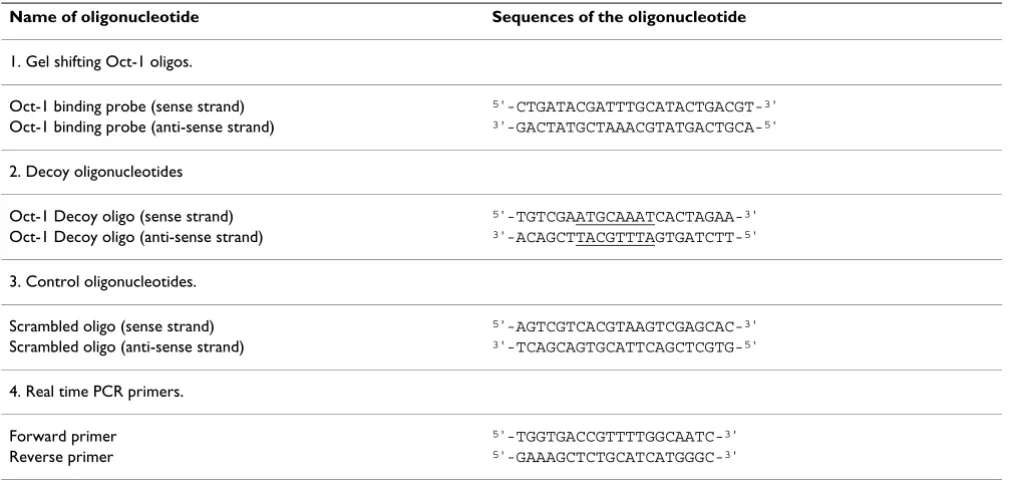
of the untreated cells from the ΔCt of the treated cells. Table 1: Oligonucleotides used in the study.
Name of oligonucleotide Sequences of the oligonucleotide
1. Gel shifting Oct-1 oligos.
Oct-1 binding probe (sense strand) 5'-CTGATACGATTTGCATACTGACGT-3'
Oct-1 binding probe (anti-sense strand) 3'-GACTATGCTAAACGTATGACTGCA-5'
2. Decoy oligonucleotides
Oct-1 Decoy oligo (sense strand) 5'-TGTCGAATGCAAATCACTAGAA-3'
Oct-1 Decoy oligo (anti-sense strand) 3'-ACAGCTTACGTTTAGTGATCTT-5'
3. Control oligonucleotides.
Scrambled oligo (sense strand) 5'-AGTCGTCACGTAAGTCGAGCAC-3'
Scrambled oligo (anti-sense strand) 3'-TCAGCAGTGCATTCAGCTCGTG-5'
4. Real time PCR primers.
Forward primer 5'-TGGTGACCGTTTTGGCAATC-3'
Western blot hybridization assay
The mouse anti-human fetal hemoglobin (HbF) mono-clonal antibody (MHFH00) was purchased from Caltag Laboratories (Burlingame, CA). Both the untreated and the treated K562 cells were harvested and lysed in RIPA cell lysis buffer (1 × PBS, 1% NP-40 (v/v), 0.5% Deoxy-cholic acid (w/v), 0.1% SDS (w/v)). The cell lysates (30 μg total protein) were analyzed by PAGE using a 10% gel. The proteins were transferred to a PVDF membrane and the level of HbF protein was determined by western blots using the mouse anti-human HbF antibody. The same membrane was then stripped in a stripping solution (62.5 mM Tris, pH6.8, 2% SDS (v/v), 0.7% 2-mercaptoethanol (v/v)) and hybridized with an actin antibody (Oncogene Research Products, San Diego, CA) to determine the level of actin in each sample. The level of the HbF was calcu-lated as a level relative to that of the actin in each sample to minimize the experimental variations.
Immunoprecipitation (IP) assay
The K562 cells were seeded at a density of 6 × 10⁴ cells/ml.
The cells were treated with either the 24 bp Oct-1 decoy oligonucleotide (2 μM and 10 μM) or the 24 bp scram-bled oligonucleotide (10 μM) for four days and then har-vested. Approximately 6 × 10⁶ cells were harvested for
each study in the experiment. As a control, the same number of cells was also harvested from the untreated K562 cells. The cells were fixed in 1% formaldehyde for 20 minutes at room temperature and washed in 1 × PBS three times. The cells were resuspended in the SDS cell lysis buffer at a density of 1 × 10⁶ cells/200 μl and incubated on
ice for 10 minutes. The cells were then sonicated (four cycles of 10 second sonications with a 30 second pulse) to lyse the cells. The cell lysates were centrifuged at 4°C for 10 minutes at 14,000 rpm to remove any insoluble cell debris and the supernatants were used in the IP study. The cell lysates (100 μl) were diluted with 900 μl of ChIP dilu-tion buffer (0.01% SDS, 1.1% Triton X-100, 1.2 mM EDTA, 16.7 mM Tris-HCl, pH8.1, 167 mM NaCl) and then incubated with 20 μl of Oct-1 antibody (Santa Cruz Biotechnology, Inc., Santa Cruz, CA) at 4°C overnight. Protein A-conjugated agarose beads (40 μl beads) (Sigma Inc., St. Louise, MO) were then added and the reactants were incubated at 4°C for two hours. The beads were col-lected from the reactants by centrifugation and washed three times with low salt washing buffer (0.1%SDS, 1.1% Triton X-100, 2 mM EDTA, 20 mM Tris-HCl, pH8.1, 150 mM NaCl) and three times with high salt washing buffer (0.1% SDS, 1% Triton X-100, 0.5 mM EDTA, 20 mM Tris-HCl, pH8.1, 500 mM NaCl) to remove any unspecific binding proteins. Half of the beads were analyzed by west-ern blot to determine the level of the Oct-1 protein precip-itated with the beads in each reaction. The rest of the beads were resuspended in 100 μl of 50 mM NaCl and incubated at 65°C for 5 hours to reverse the DNA-protein
crosslinks. The proteins were removed by phenol chloro-form extraction and the DNA was recovered by ethanol precipitation. The DNA was dissolved in 10 μl of TE buffer and a quantitative PCR assay was performed to determine the amount of the γ-globin gene promoter region DNA contained in each reaction using a pair of primers that bind to the γ-globin gene at the positions of -350 to -330 and +50 to +30 respectively with the ABI 7500 Fast Real Time PCR System. The Ct value was determined for each reaction. The amount of γ-globin gene promoter DNA pre-cipitated from the untreated K562 cells by the IP was cal-culated as 100% and the amount of γ-globin gene promoter DNA precipitated from the treated K562 cells by the IP was calculated as a percentage in comparison to that of the untreated K562 cells.
Statistical analysis
Results are expressed as the mean + S.D. Statistically sig-nificant differences were determined using a one-factor analysis of variance with p < 0.01. The quantification of the γ-globin mRNA in these studies was obtained from at least three independent experiments.
Results
The Oct-1 decoy oligonucleotides effectively competed with the Oct-1 consensus probe for an Oct-1 binding in vitro
We first tested whether the decoy oligonucleotide designed for the Oct-1 transcription factor can effectively compete with the Oct-1 consensus probe in vitro. For this study, a 24 bp DNA fragment containing the Oct-1 con-sensus sequence was radioactively labeled with [γ-32
P]-ATP and used as a probe for the in vitro DNA-protein bind-ing study. The DNA probe was incubated with HeLa nuclear extracts at room temperature for one hour to allow for the Oct-1 transcription factor to bind to the DNA probe. For a competitive binding, the HeLa nuclear extracts were incubated with both the radioactively labeled Oct-1 DNA probe and the unlabeled Oct-1 decoy oligonucleotide at room temperature for one hour. The reactants were then analyzed by polyacrylamide gel elec-trophoresis using a 6% gel (Fig. 1). The binding of the Oct-1 transcription factor caused a mobility shift of the Oct-1 DNA probe in the gel (Fig. 1, lane 2 vs lane 1). When the HeLa nuclear extracts were incubated with both the radioactively labeled Oct-1 DNA probe and the unla-beled Oct-1 decoy oligonucleotide, however, a dose-dependent reduction in the level of the shifted Oct-1 DNA probe was observed (Fig. 1, lanes 9–11). The Oct-1 tran-scription factor binding-caused gel mobility shift of the Oct-1 DNA probe was completely diminished when 1 × 10⁻⁶ M of the Oct-1 decoy oligonucleotide was
concentra-tions of the scrambled oligonucleotide were supple-mented into the binding reactions (Fig. 1, lanes 6–8). This result suggests that the Oct-1 decoy oligonucleotide effec-tively competes with the Oct-1 consensus DNA probe for the binding of the Oct-1 transcription factor.
The Oct-1 decoy oligonucleotide treatment did not affect cell viability
To determine if the Oct-1 decoy oligonucleotide treat-ment could result in reduced cell viability, we studied the cell viability of the K562 human erythroleukemia cells under the Oct-1 decoy oligonucleotide treatment. The K562 cells were seeded at a density of 4 × 10³ cells/ml and
treated with the Oct-1 decoy oligonucleotide at various concentrations (0, 2, 5, and 10 μM). As controls, some K562 cells were either untreated or treated with the scram-bled oligonucleotide (10 μM). The cell density was deter-mined at various time points (1, 2, 3, 4, and 5 days) and the cell growth curve was determined for each treatment (Fig. 2). The cell growth was not significantly affected by the Oct-1 decoy oligonucleotide treatment even with the oligonucleotide at concentrations as high as 10 μM (Fig. 2).
The Oct-1 decoy oligonucleotide treatment caused an increase in expression of the γ-globin gene in K562 cells
The results obtained from our in vitro protein binding assays revealed a strong competitive binding of the Oct-1 decoy oligonucleotide for the Oct-1 transcription factor. To determine if the Oct-1 decoy oligonucleotide can induce expression of endogenous γ-globin genes, the K562 cells were treated with the Oct-1 decoy oligonucle-otide and the effect of the decoy oligonucleoligonucle-otide treat-ment on γ-globin expression was determined.
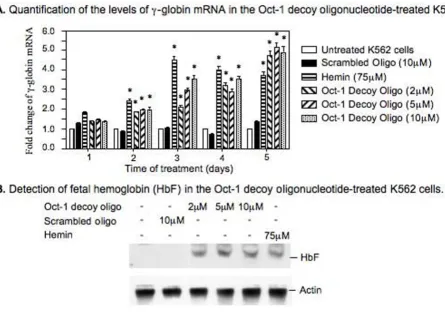
We first determined the Oct-1 decoy oligonucleotide treat-ment-induced transcription of the γ-globin gene. The K562 cells were either untreated or treated with the Oct-1 decoy oligonucleotide at various concentrations (0, 2, 5, and 10 μM). As controls, some K562 cells were treated with the scrambled oligonucleotide (10 μM) or hemin (75 μM), an effective hemoglobin inducer [30-32]. At var-ious time points, the cells were harvested and total RNA was isolated. A real time PCR assay was then performed to determine the level of the γ-globin mRNA in each RNA sample (Fig. 3A). When treated with the scrambled oligo-nucleotide at 10 μM, no significant increase in the level of
γ-globin mRNA was observed in the K562 cells (Fig. 3A). When treated with the Oct-1 decoy oligonucleotide, how-ever, significant increases in the level of the γ-globin mRNA were detected in the K562 cells even with the Oct-1 decoy oligonucleotide at concentrations as low as 2 μM. For example, when the K562 cells were treated with 5 μ MOct-1 decoy oligonucleotide for two, three, four and five days, the level of the γ-globin mRNA increased 1.92, 2.93, 2.85, and 5.13 fold respectively. As a positive con-trol, when the K562 cells were treated with 75 μM hemin
Determination of the competitive binding of the Oct-1 decoy oligonucleotide in vitro
Figure 1
Determination of the competitive binding of the Oct-1 decoy oligonucleotide in vitro. The radioactively labeled Oct-1 consensus DNA probe was incubated with HeLa nuclear extracts at room temperature for one hour and then analyzed by polyacrylamide gel electrophoresis using a 6% gel. Some reactions also contained the unlabeled Oct-1 decoy oligonucleotide or the scrambled oligonucle-otide for competitive binding. The Oct-1 binding-caused gel mobility shift was confirmed by a western blot hybridization assay using an Oct-1 antibody (data not shown).
The cell viability of K562 cells under the Oct-1 decoy oligo-nucleotide treatment
Figure 2
The cell viability of K562 cells under the Oct-1 decoy oligonucleotide treatment. The K562 cells were seeded at a density of 2 × 10⁴ cells/ml and treated with either the
for two, three, four, and five days, the levels of the γ-globin mRNA increased 2.41, 4.47, 4.00, and 3.71 fold respec-tively (Fig. 3A). This result suggests that the Oct-1 decoy oligonucleotide treatment increases the transcription of the γ-globin genes in the K562 cells as effectively as that of hemin, a well-known γ-globin inducer.
Although the results obtained from our real time PCR study demonstrated increases in transcription of the γ -globin genes in the Oct-1 decoy oligonucleotide-treated K562 cells, whether these increases in transcription led to increases in the protein level of fetal hemoglobin (HbF,
α2γ2) was unknown. Therefore, we further performed an
immuno-blotting study to determine the level of HbF in the Oct-1 decoy oligonucleotide-treated K562 cells (Fig. 3B). Indeed, the results obtained from our immuno-blot-ting studies revealed that the treatment of the Oct-1 decoy oligonucleotide (2, 5, or 10 μM) resulted in increases in the level of HbF in the K562 cells (Fig. 3B). As a negative control, the treatment of the K562 cells with 10 μM scram-bled oligonucleotide did not cause a significant increase in the level of HbF (Fig. 3B). As a positive control, the treatment with 75 μM hemin also resulted in an increase in the level of HbF in the K562 cells (Fig. 3B).
The Oct-1 decoy oligonucleotide-induced expression of the endogenous γ-globin genes in K562 cells
Figure 3
These results suggest that the treatment of K562 human erythroleukemia cells with the Oct-1 decoy oligonucle-otide caused an increased expression of the endogenous γ -globin genes in the K562 cells.
The Oct-1 decoy oligonucleotide treatment caused a reduction in binding of the Oct-1 transcription factor to the promoter region sequence of the endogenous γ-globin gene
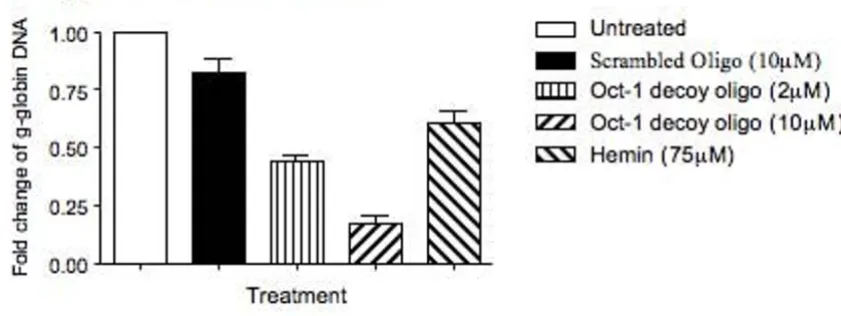
To determine whether the increased γ-globin gene tran-scription in the Oct-1 decoy oligonucleotide-treated K562 cells was caused by the competitive binding of the Oct-1 decoy oligonucleotide to the Oct-1 transcription factor, we further performed an immunoprecipitation (IP) study [33,34] to determine the binding status of the Oct-1 bind-ing sites within the promoter region of the endogenous γ -globin gene under the Oct-1 decoy oligonucleotide treat-ment. Both untreated and the Oct-1 decoy oligonucle-otide-treated K562 cells were fixed in 1% formaldehyde and sonicated to shear the chromosomal DNA into small fragments. The Oct-1 transcription factor was then immu-noprecipitated from both the untreated and the decoy oli-gonucleotide-treated K562 cells by the IP protocol using an Oct-1 antibody and Protein A-conjugated agarose beads. As controls, the Oct-1 transcription factor was also immunoprecipitated from the scrambled oligonucleotide and hemin-treated K562 cells. Half of the beads were ana-lyzed by western blot to determine the level of Oct-1 pro-tein precipitated from each cell lysate (Fig. 4A) and rest of the beads were analyzed by a quantitative PCR assay to determine the level of the γ-globin gene promoter region DNA co-precipitated with the Oct-1 transcription factor from each cell lysate (Fig. 4B). The results of our western blots revealed that similar amounts of Oct-1 transcription factor were precipitated from individual cell lysates, sug-gesting a very successful IP of the study. The results of our quantitative PCR studies indicated that the Oct-1 decoy oligonucleotide treatment caused significant decreases in the level of the endogenous γ-globin gene promoter region DNA co-precipitated with the Oct-1 transcription factor by the IP protocol. In comparison to the amount of
γ-globin gene promoter region DNA co-precipitated with the Oct-1 transcription factor in the untreated K562 cells, only 44% and 17% of the γ-globin gene promoter region DNA was co-precipitated with the Oct-1 transcription fac-tor when the K562 cells were treated with 2 μM and 10 μM Oct-1 decoy oligonucleotide, respectively. When the K562 cells were treated with 10 μM scrambled oligonucleotide, however, more than 83% of the γ-globin gene promoter region DNA was still co-precipitated with the Oct-1 tran-scription factor. The treatment of K562 cells with 75 μM hemin also resulted in a decrease in the level of the co-pre-cipitated γ-globin gene promoter region DNA to 61% of the untreated K562 cells. This result revealed that the treatment of K562 cells with the Oct-1 decoy
oligonucle-otide caused a dose-dependent decrease in the binding of Oct-1 transcription factor to the endogenous γ-globin gene promoter region DNA sequence, suggesting that the Oct-1 decoy oligonucleotide effectively competed with the endogenous γ-globin gene promoter region Oct-1 con-sensus sequences for binding with the Oct-1 transcription factor, which resulted in activation of the endogenous γ -globin gene and increases in the level of γ-globin mRNA and HbF in the K562 cells.
Discussion
In this work, we have studied the possibility of using a decoy oligonucleotide targeting the Oct-1 transcription factor to induce expression of the endogenous γ-globin gene. The results obtained from our in vitro protein bind-ing study indicate that the Oct-1 decoy oligonucleotide effectively competes with the Oct-1 consensus DNA probe for binding to the Oct-1 transcription factor. The results obtained from our Oct-1 decoy oligonucleotide treatment studies demonstrate that the treatment of the K562 cells with the Oct-1 decoy oligonucleotide results in an increase in transcriptions of the γ-globin genes and an increase in accumulation of the HbF in the K562 cells. These results provide strong evidence to suggest that the decoy oligonucleotide targeting the Oct-1 transcription factor consensus sequence can be used to induce expres-sion of the endogenous γ-globin gene. Since increased expression of the γ-globin gene has already shown its clin-ical benefit in the treatment of β-globin disorders such as sickle cell anemia and β-thalassemia, this work provides a novel approach for the treatment of these diseases. In addition, the knowledge obtained from this study may also lead to innovative strategies for the treatment of many other disease conditions via manipulating expres-sion of the desired target genes through the decoy oligo-nucleotides.
transcription factor negatively regulates the transcription of the endogenous γ-globin gene expression. Therefore, these results provide important insight into the mecha-nism of γ-globin gene regulation and a possible mecha-nism regarding the γ-globin gene silencing.
Many studies have demonstrated the down-regulation of the target genes' expression using decoy oligonucleotides [15,16,20-29,35-38]. In comparison, much less work has
been conducted in the exploration of up-regulation of gene expression for the desired target genes using the decoy oligonucleotide strategy although the clinical rele-vance of up-regulation of target genes for the treatment of many disease conditions clearly exists. One of the obsta-cles for this up-regulation is to identify the transcription factors that negatively regulate transcription of the target genes. It is also a great challenge to develop a methodol-ogy that can sequence-specifically disrupt the interactions
The effect of Oct-1 decoy oligonucleotide treatment on binding of Oct-1 transcription factor to the endogenous γ-globin gene promoter region DNA in K562 cells
Figure 4
between the transcription factors and their consensus sequences. The work described here takes advantage of the well-studied human γ-globin gene by disrupting the bind-ing of Oct-1 transcription factor to the endogenous γ -globin gene promoter region Oct-1 consensus sequences using a decoy oligonucleotide, and therefore, achieving activation of the endogenous γ-globin genes in the treated cells. A similar strategy can also be applied to other target genes by targeting different transcription factor consensus sequences. Therefore, the work described in this study has broad implications in the treatment of many disease con-ditions.
The results obtained from our K562 cell study revealed that the transcription of the γ-globin genes was signifi-cantly increased when the K562 cells were treated with the Oct-1 decoy oligonucleotide at concentrations as low as 2
μM, which is the lowest concentration of the decoy oligo-nucleotide used in the study. Therefore, it is likely that the transcription of the γ-globin genes can be achieved at even lower concentrations of the decoy oligonucleotide. This result suggests that the concentration of the Oct-1 decoy oligonucleotide required to induce transcription of the γ -globin genes is much lower than the concentrations of antisense oligonucleotides used in most studies [39-42]. One possible explanation for this difference is the target choice in the strategies: when the antisense strategy is used to regulate expression of target genes, high levels of anti-sense oligonucleotides need to be maintained inside the cells in order to effectively inhibit translation from the mRNA, which is continuously transcribed throughout the treatment; when the decoy oligonucleotide strategy is used, however, the limited copy numbers of the target genes result in the requirement of much fewer molecules of decoy oligonucleotide for efficient regulation of tran-scription of the target genes. Therefore, the decoy oligonu-cleotides strategy may provide a better approach in regulating expression of the target genes than that of the antisense strategy.
The results obtained from our real time PCR analysis indi-cated that the transcription of the γ-globin genes was maintained at high levels for a relatively long period of time following a single Oct-1 decoy oligonucleotide treat-ment. The mechanism that leads to this long duration of transcription is unknown. One possibility is that the dou-ble-stranded phosphorothioate-modified decoy oligonu-cleotide is more stable than that of the single-stranded phosphorothioate-modified oligonucleotides inside cells and the requirement of fewer molecules of the decoy oli-gonucleotide leads to this relatively long period of tran-scription for the γ-globin gene. It is also possible that the disruption of the Oct-1 transcription factor binding to its endogenous gene targets due to the decoy oligonucleotide has a prolonged effect on transcription of the genes,
which can also lead to the long duration of transcription of the γ-globin gene following the Oct-1 decoy oligonucle-otide treatment. Further studies are needed in order to determine the mechanism that causes this extended tran-scription duration of the γ-globin gene following the Oct-1 decoy oligonucleotide treatment.
The results obtained from our IP studies revealed that the Oct-1 decoy oligonucleotide treatment led to reduced Oct-1 transcription factor binding at the γ-globin pro-moter. This provides strong evidence to suggest that the Oct-1 decoy oligonucleotide induces expression of the γ -globin genes through its competitive binding with the Oct-1 transcription factor, resulting in activation of the γ -globin genes. The hemin treatment also led to reduced Oct-1 binding at the γ-globin promoter. Although the mechanism underlying this effect is not known, it is pos-sible that the induced transcription of the γ-globin genes by the hemin reduces the binding of the Oct-1 to the γ -globin promoter.
The decoy oligonucleotides used in this study are phos-phorothioate-modified oligonucleotides. The results obtained from our cell viability study indicate that the cells are relatively tolerant towards the decoy oligonucle-otide treatment even with the decoy oligonucleoligonucle-otide at concentrations as high as 10 μM. The in vitro protein-DNA binding results also suggest that the Oct-1 transcription factor has a strong binding affinity towards the decoy oli-gonucleotide. The gene expression studies also demon-strate the cell permeability for the decoy oligonucleotide. Therefore, this modified decoy oligonucleotide is effective in inducing expression of the endogenous γ-globin genes. However, other modifications (e.g. peptide nucleic acids (PNA)) are also available in the oligonucleotide synthesis. Although some studies have already used these modifica-tions in the decoy oligonucleotide synthesis [15,27,37], whether or not these modifications can be used to induce expression of endogenous gene targets is still largely unclear. Further studies are needed to evaluate the effect of these modifications on decoy oligonucleotide-induced endogenous gene expression.
Competing interests
The authors declare that they have no competing interests.
Authors' contributions
Acknowledgements
We thank L. Chuang, X. Zhang, and S. Lomonaco for their experimental assistance. We also thank Dr. T. Kocarek and L. Wang for their critical readings of this manuscript. Performance of this work was facilitated by the Cell Culture Facility Core and the Imaging and Cytometry Facility Core of the Environmental Health Sciences Center in Molecular and Cellular Toxi-cology with Human Applications at Wayne State University (P30 ES06639). This work is supported by the grant R01HL62551 from the National Heart, Lung, and Blood Institute (NHLBI), NIH to G. W. and Wayne State Univer-sity new faculty start-up fund to X.S.X.
References
1. Stamatoyannopoulos G, Nienhuis A, Majerus X, Varmus X: The molecular Basis of Blood diseases. Second edition. W.B. Saun-ders Company, Philadelphia, PA; 1994.
2. Stamatoyannopoulos G: Control of globin gene expression dur-ing development and erythroid differentiation. Exp Hematol 2005, 33:259-271.
3. Chakalova L, Carter D, Debrand E, Goyenechea B, Horton A, Miles J, Osborne C, Fraser P: Developmental regulation of the beta-globin gene locus. Prog Mol Subcell Biol 2006, 38:183-206. 4. Pace BS, Zein S: Understanding mechanisms of gamma-globin
gene regulation to develop strategies for pharmacological fetal hemoglobin induction. Dev Dyn 2006, 235:1727-1737. 5. Mahajan MC, Karmakar S, Weissman SM: Control of beta globin
genes. J Cell Biochem 2007, 102:801-810.
6. Yang YM, Pace B: Pharmacologic induction of fetal hemoglobin synthesis: cellular and molecular mechanisms. Pediatr Pathol Mol Med 2001, 20:87-106.
7. Wang G, Xu X, Pace B, Glazer PM, Chan P, Goodman SR, Shokolenko I: Induction of human gamma-globin gene expression via peptide nucleic acids (PNAs). Nucleic Acids Res 1999, 27:2806-2813.
8. Quek L, Thein SL: Molecular therapies in beta-thalassaemia. Br J Haematol 2007, 136:353-365.
9. Lisowski L, Sadelain M: Current status of globin gene therapy for the treatment of beta-thalassaemia. Br J Haematol 2008, 141:335-345.
10. Phillips K, Luisi B: The virtuoso of versatility: POU proteins that flex to fit. J Mol Biol 2000, 302:1023-1039.
11. Surrey S, Delgrosso K, Malladi P, Schwartz E: A single base change at position -175 in the 5'-flanking region of the Gγ-globin gene from a black with Gγβ+-HPFH. Blood 1988, 71:807-810. 12. Ottolenghi S, Nicolis S, Taramelli R, Malgaretti N, Mantovani R, Comi
P, Giglioni B, Longinotti M, Dore F, Oggiano LEA: Sardinian G gamma-HPFH: a T-C substitution in a conserved "octamer" sequence in the G gamma-globin promoter. Blood 1988, 71:815-817.
13. Stoming TA, Stoming GS, Lanclos KD, Fei YI, Altay C, Kutlar F, Huis-man THJ: An Aγ type of nondeletional hereditary persistence of fetal hemoglobin with a T->C mutation at position -175 to the cap site of the Aγ globin gene. Blood 1989, 73:329-333. 14. Xu X, Glazer PM, Wang G: Activation of human γ-globin gene
expression via triplex-forming oligonucleotide (TFO)-directed mutations in the γ-globin gene 5' flanking region. Gene 2000, 242:219-228.
15. Gambari R: New trends in the development of transcription factor decoy (TFD) pharmacotherapy. Curr Drug Targets 2004, 5:419-430.
16. Cutroneo KR, White SL, Chiu JF, Ehrlich HP: Tissue fibrosis and carcinogenesis: divergent or successive pathways dictate multiple molecular therapeutic targets for oligo decoy ther-apies. J Cell Biochem 2006, 97:1161-1174.
17. Isomura I, Morita A: Regulation of NF-kappaB signaling by decoy oligodeoxynucleotides. Microbiol Immunol 2006, 50:559-563.
18. Tomita N, Kashihara N, Morishita R: Transcription factor decoy oligonucleotide-based therapeutic strategy for renal disease. Clin Exp Nephrol 2007, 11:7-17.
19. Edwards MR, Bartlett NW, Clarke D, Birrell M, Belvisi M, Johnston SL: (2009) Targeting the NF-kappaB pathway in asthma and chronic obstructive pulmonary disease. Pharmacol Ther 2009, 121:1-13.
20. Eller MS, Yaar M, Ostrom K, Harkness DD, Gilchrest BA: A role for interleukin-1 in epidermal differentiation: regulation by expression of functional versus decoy receptors. J Cell Sci 1995, 108:2741-2746.
21. Sharma HW, Perez JR, Higgins-Sochaski K, Hsiao R, Narayanan R: Transcription factor decoy approach to decipher the role of NF-kappa B in oncogenesis. Anticancer Res 1996, 16:61-69. 22. Tomita N, Horiuchi M, Tomita S, Gibbons GH, Kim JY, Baran D, Dzau
VJ: An oligonucleotide decoy for transcription factor E2F inhibits mesangial cell proliferation in vitro. Am J Physiol 1998, 275:278-284.
23. Shiratsuchi T, Ishibashi H, Shirasuna K: Inhibition of epidermal growth factor-induced invasion by dexamethasone and AP-1 decoy in human squamous cell carcinoma cell lines. J Cell Phys-iol 2002, 193:340-348.
24. Wang LH, Yang XY, Zhang X, Mihalic K, Xiao W, Farrar WL: The cis decoy against the estrogen response element suppresses breast cancer cells via target disrupting c-fos not mitogen-activated protein kinase activity. Cancer Res 2003, 63:2046-2051.
25. Novak EM, Metzger M, Chammas R, da Costa M, Dantas K, Manabe C, Pires J, de Oliveira AC, Bydlowski SP: Downregulation of TNF-alpha and VEGF expression by Sp1 decoy oligodeoxynucle-otides in mouse melanoma tumor. Gene Ther 2003, 10:1992-1997.
26. Penolazzi L, Borgatti M, Lambertini E, Mischiati C, Finotti A, Romanelli A, Saviano M, Pedone C, Piva R, Gambari R: Peptide nucleic acid-DNA decoy chimeras targeting NF-kappaB transcription factors: Induction of apoptosis in human primary osteo-clasts. Int J Mol Med 2004, 14:145-152.
27. Borgatti M, Boyd DD, Lampronti I, Bianchi N, Fabbri E, Saviano M, Romanelli A, Pedone C, Gambari R: Decoy molecules based on PNA-DNA chimeras and targeting Sp1 transcription factors inhibit the activity of urokinase-type plasminogen activator receptor (uPAR) promoter. Oncol Res 2005, 15:373-383. 28. Fabian RH, Perez-Polo JR, Kent TA: A decoy oligonucleotide
inhibiting nuclear factor-kappaB binding to the IgGkappaB consensus site reduces cerebral injury and apoptosis in neo-natal hypoxic-ischemic encephalopathy. J Neurosci Res 2007, 85:1420-1426.
29. Osako MK, Tomita N, Nakagami H, Kunugiza Y, Yoshino M, Yuyama K, Tomita T, Yoshikawa H, Ogihara T, Morishita R: Increase in nuclease resistance and incorporation of NF-kappaB decoy oligodeoxynucleotides by modification of the 3'-terminus. J Gene Med 2007, 9:812-819.
30. Tsiftsoglou AS, Wong W, Robinson SH, Hensold J: Hemin increase production of beta-like globin RNA transcripts in human erythroleukemia K-562 cells. Dev Genet 1989, 10:311-317. 31. Fibach E, Kollia P, Schechter AN, Noguchi CT, Rodgers GP:
Hemin-induced acceleration of hemoglobin production in immature cultured erythroid cells: preferential enhancement of fetal hemoglobin. Blood 1995, 85:2967-2974.
32. Tahara T, Sun J, Nakanishi K, Yamamoto M, Mori H, Saito T, Fujita H, Igarashi K, Taketani S: Heme positively regulates the expression of beta-globin at the locus control region via the transcrip-tional factor Bach1 in erythroid cells. J Biol Chem 2004, 279:5480-5487.
33. Bigler J, Eisenman RN: Isolation of a thyroid hormone-respon-sive gene by immunoprecipitation of thyroid hormone receptor-DNA complexes. Mol Cell Biol 1994, 14:7621-7632. 34. Weinmann AS, Farnhamm PJ: Identification of unknown target
genes of human transcription factors using chromatin immunoprecipitation. Methods 2002, 26:37-47.
35. Morishita R, Gibbons GH, Horiuchi M, Kaneda Y, Ogihara T, Dzau VJ: Role of AP-1 complex in angiotensin II-mediated transform-ing growth factor-beta expression and growth of smooth muscle cells: using decoy approach against AP-1 binding site. Biochem Biophys Res Commun 1998, 243:361-367.
36. Lee YN, Park YG, Choi YH, Cho YS, Cho-Chung YS: CRE-tran-scription factor decoy oligonucleotide inhibition of MCF-7 breast cancer cells: cross-talk with p53 signaling pathway. Biochemistry 2000, 39:4863-4868.
tar-Publish with BioMed Central and every scientist can read your work free of charge "BioMed Central will be the most significant development for disseminating the results of biomedical researc h in our lifetime."
Sir Paul Nurse, Cancer Research UK
Your research papers will be:
available free of charge to the entire biomedical community
peer reviewed and published immediately upon acceptance
cited in PubMed and archived on PubMed Central
yours — you keep the copyright
Submit your manuscript here:
http://www.biomedcentral.com/info/publishing_adv.asp
BioMedcentral geting transcription factors as a tool to modify gene
expres-sion. Curr Drug Targets 2004, 5:735-744.
38. Cho JW, Kim JY, Kim CW, Lee KS: Down-regulation of TGF-beta1-induced type I collagen synthesis by AP-1 transcrip-tion factor decoy in scleroderma fibroblasts. J Dermatol Sci 2006, 43:207-209.
39. Bitko V, Barik S: Intranasal antisense therapy: preclinical mod-els with a clinical future? Curr Opin Mol Ther 2007, 9:119-125. 40. Eckstein F: The versatility of oligonucleotides as potential
therapeutics. Expert Opin Biol Ther 2007, 7:1021-1034.
41. Spurgers KB, Sharkey CM, Warfield KL, Bavari S: Oligonucleotide antiviral therapeutics: antisense and RNA interference for highly pathogenic RNA viruses. Antiviral Res 2008, 78:26-36. 42. Rayburn ER, Zhang R: Antisense, RNAi, and gene silencing