R E S E A R C H
Open Access
Job preferences of undergraduate nursing
students in eastern China: a discrete choice
experiment
Tongtong Liu
1,2,3, Shunping Li
2,3*, Renyong Yang
4, Shimeng Liu
2,3and Gang Chen
5Abstract
Background:Shortage and mal-distribution of nursing human resources is an intractable problem in China. There is an urgent need to explore the job preferences of undergraduate nursing students. The main aim of this study is to investigate the stated preferences of nursing students when choosing a job.
Methods:A discrete choice experiment (DCE) was conducted to assess job preferences of the final year undergraduate nursing students from four medical universities/colleges in Shandong Province, China. Job attributes include location, monthly income,bianzhi(which refers to the established posts and can be loosely regarded as state administrative staffing), career development and training opportunity, work environment and working strength. Mixed logit models were used to analyze the DCE data.
Results:A total of 445 undergraduate nursing students were included in the main DCE analysis. They demonstrated higher preference for a job with higher monthly income, and the probability of choosing a rural job would increase to 92.8% if monthly income increased from RMB 2000 (US$ 296) to RMB 8000 (US$ 1183). They expressed higher stated preferences for a job which required light working strength and with excellent work environment over other non-economic attributes. Among all attributes, location was the least important attribute. Subgroup analysis showed that students who came from city or county and whose family income was more than RMB 50 000 (US$ 7396) were significantly willing to pay more monthly income for a job in city.
Conclusions: This study confirmed that economic and non-economic factors both affected the job choices of the students. These results may be more effective for policymakers to perfect the employment policies and design strategies to attract more nursing students taking jobs in rural areas.
Keywords: Discrete choice experiments, Job preferences, Undergraduate nursing students, China
Background
In 2006, the World Health Organization issued the World Health Report, with the theme of “working together for health,” to indicate the negative impact of human re-sources shortages in global health care [1]. Currently, the scarcity of skilled nurses is being highlighted as one of the biggest obstacles to achieving health system effectiveness both in developed and developing countries [2–4]. China also faces the severe challenges of nursing shortages [3].
In 2013, there was 2.05 nurses per 1000 population, which was much lower than the world average of 2.86 [5]. It was estimated that there were 3.51 million registered nurses in China in 2016, and the ratio of doctors to nurses was only 1:1.10 [6], lower than the targeting ratio of 1:1.25, which is documented in the Outline of National Medical and Health Service System (2015–2020).
Mal-distribution of nursing human resources and other healthcare providers is also a challenging issue in both developed and developing countries [7,8]. Globally, 50% of the population live in rural areas and served by 38% of the total nursing workforce [9]. Similarly, in China, the density of nurses in urban areas is much higher than in rural areas, and the gap between urban * Correspondence:[email protected]
2
School of Health Care Management, Shandong University, Jinan 250012, China
3NHC Key Laboratory of Health Economics and Policy Research (Shandong
University), Jinan 250012, China
Full list of author information is available at the end of the article
© The Author(s). 2019Open AccessThis article is distributed under the terms of the Creative Commons Attribution 4.0 International License (http://creativecommons.org/licenses/by/4.0/), which permits unrestricted use, distribution, and reproduction in any medium, provided you give appropriate credit to the original author(s) and the source, provide a link to the Creative Commons license, and indicate if changes were made. The Creative Commons Public Domain Dedication waiver
and rural areas is enlarging. From 2010 to 2015, regis-tered nurses per 1000 population have increased from 3.09 to 4.75 in urban areas and only increased from 0.89 to 1.50 in rural areas [6]. It should also be noted that within the hierarchical medical system, the number of registered nurses in basic medical and health institutions (including community health service centers in urban areas, and township hospitals and village clinics in rural areas) is much lower than the secondary and tertiary hospitals (0.70 million versus 2.81 million) [6]. In addition, the job transfer rate of Chinese nurses in basic medical and health institutions is high, and some of them move to other positions, such as administration and logistics [10].
Nursing staff is an important guarantee for improving healthy China and providing quality, efficient, and con-venient health services. The shortage and mal-distribution of nursing staff are partly responsible for the increasing workload of existing nurses, which may decrease the qual-ity of health services and patient’s satisfaction, even cause conflict between nurses and patients [11].
Both existing nurses and final year nursing students who will soon be on the job market are important hu-man resources for health in the long term. There has been a greater demand from health institutions for nurses, especially for nurses with higher educational levels [12]. Although medical universities/colleges have expanded enrollment levels to meet their demands, the shortage of nurses is still a severe problem in China [12]. This might be explained by the fact that the major-ity of medical universities/colleges graduates compete for tertiary hospitals, in which their salaries, career de-velopment, and work environment are superior to those offered by basic medical and health institutions [13]. How to attract and retain undergraduate nursing stu-dents in basic medical and health institutions especially in rural areas is an extremely important problem for policymakers.
Discrete choice experiment (DCE) is a quantitative ap-proach that combines random utility theory [14], con-sumer theory [15], experimental design theory [16], and econometric analysis [17]. DCEs have been more widely applied to health care areas, primarily to value patient experiences or assess trade-offs between health out-comes and patient experiences [18]. In recent years, the number of studies that used DCEs to explore the job preferences of health care providers, including nurses and nursing students, has been increasing [7, 19–27], and most of them are set in developing countries. All studies demonstrate the influence of economic and non-economic factors for the job choices of the stu-dents. However, different studies include different job at-tributes, and the findings from these studies are unlikely to represent China’s special national conditions. So far,
there is one DCE study which investigated the job pref-erences of nursing students in China; however, the study was based on 164 nursing students who took internship in a tertiary hospital [28]. This study showed that the as-pects prioritized by nursing students when choosing a position in basic medical and health institutions were as follows in descending order: monthly income, children’s educational conditions,bianzhi, location, working condi-tions, career development, and training opportunity.
By using randomly selected nursing students, this study aims to identify what job characteristics affect job choices of final year undergraduate nursing students by using a DCE in eastern China. The findings of the study will provide valuable information for policymakers to de-sign effective strategies to attract more nursing students taking jobs in rural areas, to consolidate, stabilize, en-rich, and develop construction of nursing teams.
Methods
Setting and sample
This study was conducted in Shandong Province, which is located in eastern China, with a population of about 100 million [29]. In 2016, the gross regional product of Shandong Province amounted to RMB 6802 billion (US$ 1024 billion), ranking it as the third largest economy within China [29]. However, there are only 0.27 million registered nurses in Shandong Province, and the ratio of doctors and nurses is 1:1.10 which is ranked the 16th in China [6].
There are eight medical universities/colleges in Shan-dong Province [30], and five are provincial independent medical universities/colleges. Considering the different education system, we excluded Shandong University of Traditional Chinese Medicine. Four medical universities/ colleges, namely Weifang Medical University, Binzhou Medical University, Jining Medical University, and Taishan Medical College were included. The final year undergraduate nursing students were selected in this study because they were considering various employ-ment choices but had not yet made final decisions [31]. A cluster random sampling method was used, and we aimed to recruit a minimum of 100 respondents from each medical university/college [32]. Accordingly, two or three classes in each university/medical college were randomly selected depending on the number of final year undergraduate nursing students in each class.
Discrete choice experiment design
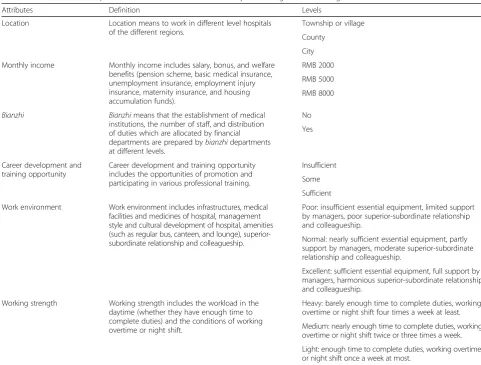
quality, workload, management style, and organizational culture have been commonly adopted and suitable for the Chinese health care system [7, 21–23, 26, 28, 31, 34–36]. Then, in-depth interviews were conducted with five professional nurses from different hospital levels. As a result, the condition of working night shift was added as the potential attributes. Two focus groups (seven par-ticipants per group) were then conducted among the final year undergraduate nursing students from Weifang Medical University. They were asked to discuss which attributes were considered the relative important factors in their job selection until they reached a consensus for the final attributes and their levels. In this process, we used the new attribute of a job which required light working strength to replace both the workload and the condition of working night shift. Meanwhile, facility quality, management style, and organizational culture were generalized into the attribute of work environment. Based on literature reviews, in-depth interview, focus group discussions, and the final review with two
specialists on DCEs, six attributes and their levels were finally included within the DCE (Table 1). The final six attributes include a monetary attribute (monthly in-come) and five non-monetary attributes: location,
bianzhi, career development and training opportunity, work environment, and work strength.
A full factorial design will produce 35× 2 = 486 hypothetical job scenarios. A total of (486 × 485)/2 choice sets will be generated, and those are not feas-ible for a single individual to choose. Accordingly,
24 choice sets were constructed by using a
D-efficient design (assuming zero priors for all attri-butes) with Ngene DCE design software [37]. In order to lessen the burden of participants, Ngene software was also employed to divide 24 choice sets into two versions. One of the choice sets in each version was included twice as a consistency test but
the data of the repeated choice sets were
not included in the final analysis. The two versions
of questionnaires were randomly allocated to
Table 1Discrete choice experiment attributes and levels for final year undergraduate nursing students
Attributes Definition Levels
Location Location means to work in different level hospitals
of the different regions.
Township or village
County
City
Monthly income Monthly income includes salary, bonus, and welfare
benefits (pension scheme, basic medical insurance, unemployment insurance, employment injury insurance, maternity insurance, and housing accumulation funds).
RMB 2000
RMB 5000
RMB 8000
Bianzhi Bianzhimeans that the establishment of medical institutions, the number of staff, and distribution of duties which are allocated by financial departments are prepared bybianzhidepartments at different levels.
No
Yes
Career development and training opportunity
Career development and training opportunity includes the opportunities of promotion and participating in various professional training.
Insufficient
Some
Sufficient
Work environment Work environment includes infrastructures, medical
facilities and medicines of hospital, management style and cultural development of hospital, amenities (such as regular bus, canteen, and lounge), superior-subordinate relationship and colleagueship.
Poor: insufficient essential equipment, limited support by managers, poor superior-subordinate relationship and colleagueship.
Normal: nearly sufficient essential equipment, partly support by managers, moderate superior-subordinate relationship and colleagueship.
Excellent: sufficient essential equipment, full support by managers, harmonious superior-subordinate relationship and colleagueship.
Working strength Working strength includes the workload in the
daytime (whether they have enough time to complete duties) and the conditions of working overtime or night shift.
Heavy: barely enough time to complete duties, working overtime or night shift four times a week at least.
Medium: nearly enough time to complete duties, working overtime or night shift twice or three times a week.
Light: enough time to complete duties, working overtime or night shift once a week at most.
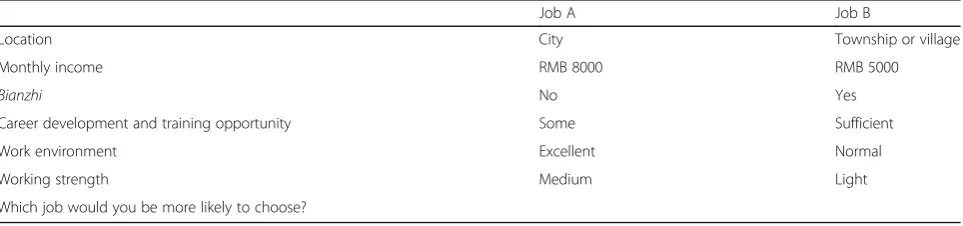
participants. An example of the choice sets was demonstrated in Table 2.
Data collection
A pilot investigation (n= 15) was carried out among final year undergraduate nursing students from Weifang Medical University in March 2017 to examine intelligi-bility, acceptaintelligi-bility, and face validity of the question-naire, and minor modifications were made to attribute definitions and levels. The formal investigation was con-ducted in the classroom setting between April and June 2017. The questionnaire consisted of two sections. The first section included general characteristics of partici-pants. Furthermore, they were also asked to rank the job attributes from most important to least important. The second section contained 13 choice sets of hypothetical job scenarios. The DCE questionnaires were explained in detailed by one of the three trained researchers from Shandong University. Then, students finished the struc-tured questionnaires by themselves. If they had any questions, researchers would help them. On average, participants took approximately 20 min to complete the survey.
The study has been approved by the Ethics Review Board of the School of Preventive Medicine, Shandong University (Reference No. 20170301). Informed consent was obtained from all participants prior to questionnaire administration.
Data analysis
Responses were coded and double-entered into an elec-tronic database using EpiData version 3.1 (EpiData Asso-ciation, Odense, Denmark). Statistical analyses were performed using Stata version 13.1 (StataCorp LP, Col-lege Station, TX, USA). The general characteristics of the undergraduate nursing students were summarized as means and standard deviations or frequencies and percentages.
The theoretical basis for statistical analysis of DCE data is the random utility model. In this framework, it is assumed that individualn will opt for the option that is
associated with the highest utility level. In this study, we analyzed the data using a mixed logit model which has the convenient properties of allowing for the preference heterogeneity and violation of the independence of ir-relevant alternative assumption [18, 38]. All attributes were specified as having a random component. Monthly income was coded as a continuous variable, and other attributes were coded as dummy variables. Mixed logit models were used to analyze the variables using mixlogit command [39] and were specified with 500 Halton draws. The utility that individualnobtains from alterna-tiveiin choice settis depicted as:
Unit¼ β1þη1n
monthly income
þ β2þη2n
location county
þ β3þη3n
location city
þ β4þη4n
bianzhi yes
þ β5þη5n
opportunity some
þ β6þη6n
opportunity sufficient
þ β7þη7n
environment normal
þ β8þη8n
environment excellent
þ β9þη9n
strength medium
þ β10þη10n
strength lightþεnit
where βi is a vector of coefficients representing the relative preference weights for each attribute level on average, ηi reflects the degree of heterogeneity among
respondents, and εnit is unobservable random
component.
Willingness to pay (WTP) represents a monetary measure of participants’valuation for a certain attribute. WTP was the ratio of the coefficient between each attri-bute level and the monthly income attriattri-bute. The posi-tive or negaposi-tive WTP results indicated the portion of monthly income that participants would be willing to pay or to be compensated for an attribute level. We also conducted a simulation study to predict that the uptake rates of undergraduate nursing students for rural versus city jobs change as the levels of job attributes are chan-ged (policy interventions).
Table 2An example of a discrete choice experiment question for assessing job preferences of the final year undergraduate nursing students
Job A Job B
Location City Township or village
Monthly income RMB 8000 RMB 5000
Bianzhi No Yes
Career development and training opportunity Some Sufficient
Work environment Excellent Normal
Working strength Medium Light
Results
A total of 554 final year undergraduate nursing stu-dents were recruited in the survey, 507 completed the majority of the questionnaire. The number of partici-pants from four medical universities/colleges were 141 (Weifang), 107 (Binzhou), 139 (Jining), and 120 (Taishan), respectively. Participants who gave incon-sistent answers to repeated choice sets were excluded from the main analysis (n= 62, 12.2%), and detailed results reported below were based on the remaining 445 undergraduate nursing students. Meanwhile, a sensitivity analysis including all 507 participants was conducted, and the results were not substantially sig-nificantly different (Additional file 1: Table S1).
General characteristics
The general characteristics of respondents are presented in Table3. There were no significant differences between participants who passed or failed the consistency test. The mean age of the analytical sample (n= 445) was 22.3 ± 1.2 years, and 410 (92.1%) students were between ages 21 and 24. Female (91.5%) were overwhelmingly predominant in the participants. Most of the students (69.4%) came from townships or villages, and 327 (73.5%) students had brothers or sisters. More than 90% of participants spent less than RMB 1500 per month, and approximately 60% participants indicated their an-nual family income as less than RMB 50 000. With re-gard to future plans, the majority of the students (n= 361) said they wanted to engage in nursing work after graduation.
Results from the standalone ranking of importance of job attributes (which was asked prior to the DCE tasks) is showed in Fig. 1. On average, monthly income was regarded as the most important job attribute, followed by location.
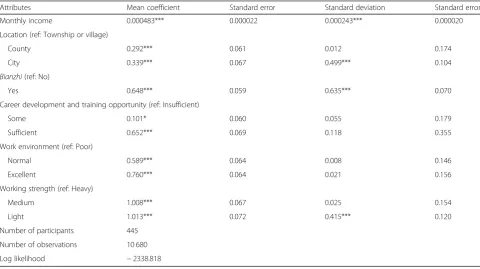
Job preferences among undergraduate nursing students Table 4 shows the main results from the mixed logit model. The mean coefficients of all attributes were sta-tistically significant and were of the expected sign. Among non-monetary attributes, the final year under-graduate nursing students expressed highest stated pref-erences for a job with light working strength (β= 1.013,
P< 0.01), followed by an excellent work environment (β = 0.760,P< 0.01). Although a city location had a positive effect for the respondents (β= 0.339,P< 0.01), it did not appear to be as important as the other attributes.
The standard deviations of monthly income, city loca-tion, having bianzhi, and having light working strength were statistically significant, indicated the existence of preference heterogeneity among the final year under-graduate nursing students.
Estimated willingness to pay for job attributes
The results of WTP are shown in Table5 and are used for relative comparisons. They were willing to pay RMB 2096.2 (US$ 310.1) monthly income for a job with light working strength than a job with heavy working strength. If the work environment improved from poor to excellent, they were willing to forego RMB 1572.4 (US$ 232.6) per month. In addition, they put a value of only RMB 702.4 (US$ 103.9) per month on a work loca-tion in the city, as compared to work in a township or village.
Subgroup analysis
The results of mixed logit models and WTP among dif-ferent subgroups are showed in Table6. Apart from the attribute of location, the preferences for other job attri-butes between different subgroups were relatively simi-lar. Students who came from the county or city valued a city location very highly with a willingness to pay of RMB 1594.2 (US$ 235.8) (95% CI, 1037.2–2 185.9), com-pared to students who came from townships or villages with a willingness to pay of only RMB 366.6 (US$ 54.2) (95% CI, 63.3–662.2). Compared to students whose fam-ily income was less than RMB 50 000 (US$ 7396), stu-dents with a family income of more than RMB 50 000 (US$ 7396) were willing to pay RMB 611.3 (US$ 90.4) (95% CI, 530.7–709.2) extra monthly income for a job in the city.
Changes in uptake rates for a rural job versus a city job under different policy interventions
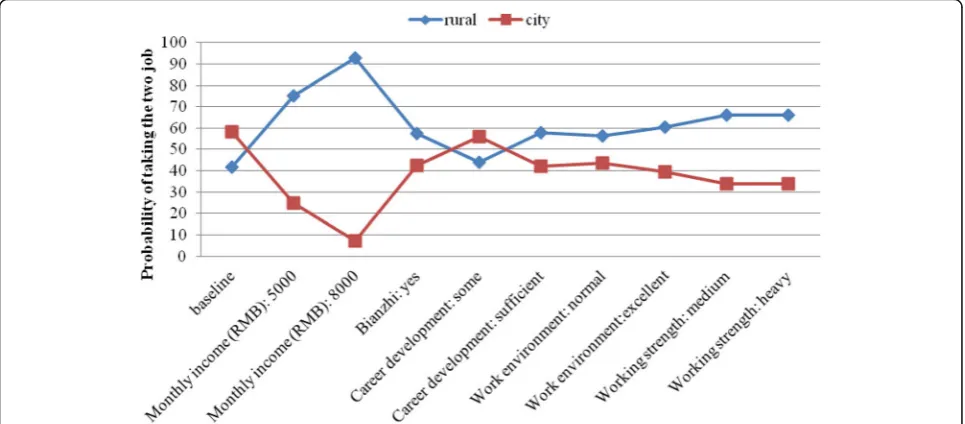
Figure2 shows the varying probabilities of taking a rural (township or village) job versus a city job, with various job conditions; the county job was omitted here but can be calculated based on the regression coefficients reported in the paper. It shows that the baseline probability of taking the rural job is 41.6%, and the probability of taking the city job is 58.4% (all else been equal). If monthly income in-creased from RMB 2000 (US$ 296) to RMB 5000 (US$ 740), the probability of choosing a rural job would in-crease to 75.2%. However, raising monthly income by an-other RMB 3000 (US$ 444) to RMB 8000 (US$ 1183), the probability would increase to 92.8%. The model predicted that a job with light working strength rather than heavy would increase the proportion of students opting a rural job to 66.2%. Improving the work environment from poor to excellent, career development and training opportunity from insufficient to sufficient and offering bianzhiwould increase the probability of taking a rural job to 60.4%, 57.8%, and 57.7%, respectively.
Discussion
using a DCE. All six attributes (including both economic and non-economic factors) significantly affected the job choices of the students. They preferred a job with higher monthly income, light working strength, excellent work environment, sufficient opportunity for career develop-ment and training,bianzhi, and city location. The mixed logit model estimates further suggest the existence of preference heterogeneity in all six attributes. Comparing our results with what have been reported in the litera-ture, all studies have included both monetary and non-monetary attributes in the nursing job choice DCEs; in addition, consistent findings suggest that monetary at-tribute (e.g., income) had significantly positive impact on the nursing job preference. On the other hand, the non-monetary attributes included in DCE studies varied in the literature (e.g.,bianzhiattribute has been included in all studies focusing China, while housing attribute has been commonly included in studies focusing on African countries), partially highlighting the importance of tak-ing into account of the country-specific context. For the same attribute been investigated in different DCEs (e.g.,
working strength), results are also mixed regarding to the significance and the relative importance.
Similar with other studies [28, 34], our findings con-firmed that monthly income had a significant impact on the job choices of undergraduate nursing students. Wu et al. conducted a survey among 164 eligible nursing un-dergraduates who took internship in a tertiary hospital in Tangshan, and the monthly income was regarded as the most important attribute [28]. Apart from this, non-economic factors were also important. In particular, the work environment and working strength were the most important two non-economic job attributes for students. This result differs from what has been reported by Vujicica et al. [25], in which the authors found that the workload was valued the least important. One pos-sible reason is that newly employed nurses suffer occu-pational stress from a heavy workload and they also more likely to work night shift in China [40]. It should also be noted that in the ranking exercise, these two tributes were not rated as more important than other at-tributes. This difference can be partially caused by the Table 3The general characteristics for final year undergraduate nursing students from four medical universities/colleges, n (%)
Characteristics All (n= 507) Participants who passed the
consistency test (n= 445)
Participants who failed the
consistency test (n= 62) χ
2
Pvalue
Gender
Male 41 (8.1%) 38 (8.5%) 3 (4.8%) 1.003 0.317
Female 466 (91.9%) 407 (91.5%) 59 (95.2%)
Hometown
City 69 (13.6%) 61 (13.7%) 8 (12.9%) 3.400 0.183
County 80 (15.8%) 75 (16.9%) 5 (8.1%)
Township or village 358 (70.6%) 309 (69.4%) 49 (79.0%)
Only child
Yes 132 (26.0%) 118 (26.5%) 14 (22.6%) 0.438 0.508
No 375 (74.0%) 327 (73.5%) 48 (77.4%)
Consumption level (RMB per month)
< 800 139 (27.4%) 120 (27.0%) 19 (30.7%) 1.573 0.455
800–1500 323 (63.7%) 283 (63.6%) 40 (64.5%)
> 1500 45 (8.9%) 42 (9.4%) 3 (4.8%)
Family income (RMB per year)
< 30 000 157 (31.0%) 143 (32.1%) 14 (22.6%) 3.652 0.455
30 000–50 000 181 (35.7%) 154 (34.6%) 27 (43.5%)
50 000–70 000 88 (17.3%) 76 (17.1%) 12 (19.4%)
70 000–90 000 37 (7.3%) 34 (7.7%) 3 (4.8%)
> 90 000 44 (8.7%) 38 (8.5%) 6 (9.7%)
Your future plan after graduation
Engage in nursing work 406 (80.1%) 361 (81.1%) 45 (72.6%) 2.588 0.274
Continue education 87 (17.1%) 72 (16.2%) 15 (24.2%)
Others 14 (2.8%) 12 (2.7%) 2 (3.2%)
methodological differences between two approaches, in which respondents focused on one attribute at a time whereas in the DCE, respondents focused on whole sce-narios which consisted of different attributes and more close to real world scenarios [41]. Further qualitative study is required to understand the difference in more detail.
According to the DCE result, policy interventions fo-cusing on providing a better work environment will be an effective approach to attract nursing students. Previ-ous studies conducted in Indonesia [34] and Uganda [22] found that nursing students preferred supportive management and an advanced quality facility over other non-economic attributes. In this study the attribute of
Fig. 1Figure that demonstrates the importance of job attributes
Table 4Results of a mixed logit model of DCE data from final year undergraduate nursing students
Attributes Mean coefficient Standard error Standard deviation Standard error
Monthly income 0.000483*** 0.000022 0.000243*** 0.000020
Location (ref: Township or village)
County 0.292*** 0.061 0.012 0.174
City 0.339*** 0.067 0.499*** 0.104
Bianzhi(ref: No)
Yes 0.648*** 0.059 0.635*** 0.070
Career development and training opportunity (ref: Insufficient)
Some 0.101* 0.060 0.055 0.179
Sufficient 0.652*** 0.069 0.118 0.355
Work environment (ref: Poor)
Normal 0.589*** 0.064 0.008 0.146
Excellent 0.760*** 0.064 0.021 0.156
Working strength (ref: Heavy)
Medium 1.008*** 0.067 0.025 0.154
Light 1.013*** 0.072 0.415*** 0.120
Number of participants 445
Number of observations 10 680
Log likelihood −2338.818
work environment also included superior-subordinate relationship and colleagueship. A previous study has found that good relations with peers played a positive in-fluence on recruiting and retaining registered nurses in rural areas [42]. The importance of healthy relationships at work is also supported by focus group discussions.
Thebianzhi was found to have relatively minor effect, which seems contrary to other Chinese studies [26, 28]. This result may be partly explained by Maslow’s hier-archy of needs [43]. At present, the final year under-graduate nursing students are seeking a good job, and fundamental needs are not satisfied. Furthermore, lim-ited students can find a job with bianzhi at present. Apart from this, all of the nursing students were born after 1990, and they have vitality and self-confidence. For this younger generation, a job withbianzhi may not be important for them. Therefore, economic incentives and providing a work with lighter working strength and better work conditions may more easily attract nursing students.
Interestingly, the preference of nursing students for lo-cation was the least important and was contrary to what was expected. The subgroup analysis suggested substan-tial heterogeneity among nursing students for the valu-ation of locvalu-ation, students who came from the city or county and with a family income of more than RMB 50 000 (US$ 7396) were willing to pay more monthly in-come for a job in city. Former DCE studies in Liberia and Vietnam also found that nurses and physicians born in rural areas were willing to pay less to work in urban areas [25, 44]. Nursing students had different family background and job expectation; students who lived in
rural areas probably have planned to take up jobs close to their home. Furthermore, as the family income of most students was less than RMB 50 000 (US$ 7396), they urgently needed to find a steady job to earn more money. A follow-up in-depth qualitative study would be helpful to explain the reasons behind the observations.
It is crucial to recruit and retain health workers in rural areas [45]. Providing economic incentive to nursing students should be a priority of the Chinese government. This study found that raising monthly income from RMB 2000 (US$ 296) to RMB 5000 (US$ 740) would increase the probability of choosing a rural job to 75.2%. Unsatisfied remuneration among nurses in China could be the underlying reason that caused the above phenomenon [46, 47]. However, in-creasing monthly income alone may not be the most efficient way to attract more nursing students to rural areas. A similar study conducted in Tanzania also reached the result [35]. It may be wise for the gov-ernment to focus on other policy interventions after raising the monthly income to a certain level. For ex-ample, recruiting nursing students from rural areas may be an effective way. Review papers for health workers’ attraction and retention also mentioned that rural upbringing increases chances of health workers returning to practice in rural areas [48, 49].
It is worth mentioning that any single intervention attracting health workers to take jobs in rural areas is unlikely to be sufficient or successful. Effective interventions need to combine different packages of policy interventions, and these interventions need to be matched with health workers’ preferences and Table 5Estimated willingness to pay (WTP) for job attributes among final year undergraduate nursing students (based on mixed logit estimates)
Attributes WTP (RMB) Lower level of 95% confidence interval Upper level of 95% confidence interval
Location (ref: Township or village)
County 605.0 362.1 845.6
City 702.4 433.9 968.5
Bianzhi(ref: No)
Yes 1341.5 1118.6 1570.9
Career development and training opportunity (ref: Insufficient)
Some 208.8 −33.2 461.9
Sufficient 1350.0 1075.0 1626.6
Work environment (ref: Poor)
Normal 1219.7 962.4 1475.6
Excellent 1572.4 1311.0 1847.5
Working strength (ref: Heavy)
Medium 2085.8 1815.0 2365.8
Light 2096.2 1819.3 2 389.3
expectations [45]. Different countries require com-pletely different combinations of human resources pol-icies so standard strategies which can be applied in any context are not realistic [21].
This study has three limitations. Firstly, it was conducted in medical colleges in Shandong Province which is located in eastern China; thus, these find-ings cannot be generalized to the whole country. Secondly, this study focused only on the job prefer-ences of undergraduate nursing students. Their job preferences may differ from the current registered nurses. Thirdly, similar to other DCEs studies, we only have investigated the stated preferences of the students. Further research should compare these re-sults with the revealed preferences based on actual behavior.
Conclusion
This study empirically estimated job preferences of the final year undergraduate nursing students in China using a DCE and found that not only the economic factor but also non-economic factors significantly affected the job choices of nursing students. These results can provide useful information for policymakers to gain insight into their job preferences, and refine the employment pol-icies. Apart from raising the monthly income to a certain level, prioritizing strategies which can reduce the work-ing strength and improve the work environment may be more effective in China.
Additional file
Additional file 1:Table S1.Table that demonstrates the results from a mixed logit model of discrete choice experiment data from all final year undergraduate nursing students. (DOCX 15 kb)
Abbreviations
DCE:Discrete choice experiment; SD: Standard deviation; SE: Standard error;
WTP: Willingness to pay
Acknowledgements
The authors thank all the participants for their time and effort. Responsibility for any remaining errors lies solely with the authors.
Funding
All meetings, time invested, travel, etc. was funded by the individuals. The project had no financial support.
Availability of data and materials
The data used and/or analyzed during the study are available from the corresponding author on reasonable request.
Authors’contributions
SPL, TTL, and GC designed the study. TTL, SPL, RYY, and SML collected the data. TTL and GC completed the data analyses. TTL wrote the manuscript. SPL, RYY, SML, and GC edited the manuscript. All authors have read and approved the final manuscript.
Ethics approval and consent to participate
The study has been approved by the Ethics Review Board of the School of Preventive Medicine, Shandong University (Reference No. 20170301). Informed consent was obtained from all participants prior to questionnaire administration.
Consent for publication Not applicable.
Competing interests
The authors declare that they have no competing interests.
Fig. 2Figure that demonstrates the change in probabilities of taking the two job, as condition in rural job improve (In this baseline, both jobs
have a monthly income of RMB 2000, nobianzhi, insufficient career development and training opportunity, poor work environment and heavy
Publisher’s Note
Springer Nature remains neutral with regard to jurisdictional claims in published maps and institutional affiliations.
Author details
1The Affiliated Hospital of Qingdao University, Qingdao 266000, China. 2School of Health Care Management, Shandong University, Jinan 250012,
China.3NHC Key Laboratory of Health Economics and Policy Research (Shandong University), Jinan 250012, China.4Jining Medical University, Jining 272067, China.5College of Medicine and Public Health, Flinders University, Adelaide 5042, Australia.
Received: 18 July 2018 Accepted: 3 December 2018
References
1. World Health Organization. The World Health Report 2006 - working
together for health. Geneva: World Health Organization; 2006.
2. Buchan J, Aiken L. Solving nursing shortages: a common priority. J Clin
Nurs. 2008;17(24):3262–8.
3. Yun H, Jie S, Anli J. Nursing shortage in China: state, causes, and strategy.
Nurs Outlook. 2010;58(3):122–8.
4. Kinfu Y. The health worker shortage in Africa: are enough physicians and
nurses being trained? Bull World Health Organ. 2009;87(3):225–30.
5. Wu Q, Zhao L, Ye XC. Shortage of healthcare professionals in China. BMJ.
2016;354:i4860.
6. National Health and Family Planning Commission. China Health and Family
Planning Statistical Yearbook 2017 [in Chinese]. Peking: Peking Union Medical College Press; 2017.
7. Park BH, Ko Y. Hospital preferences of nursing students in Korea: a discrete
choice experiment approach. Hum Resour Health. 2016;14(1):58.
8. Wilson NW, Couper ID, Vries ED, Reid S, Fish T, Marais BJ. A critical review of
interventions to redress the inequitable distribution of healthcare professionals to rural and remote areas. Rural Remote Health. 2009;9(2):1060.
9. Grobler L, Marais BJ, Mabunda S. Interventions for increasing the proportion
of health professionals practising in rural and other underserved areas. Cochrane Database Syst Rev. 2015;6:CD005314.
10. Fang HZ, Qi W, Yan L, Li CX, Fu H, Ding TC. Nursing human resources in
grassroot medical institutions: status quo and countermeasures [in Chinese].
Chinese Rural Health Service Administration. 2017;37(6):641–3.
11. Zhang H. A review of nursing human resources shortage in China [in
Chinese]. J Nurs Adm. 2009;9(9):15–7.
12. You LM, Ke YY, Zheng J, Wan LH. The development and issues of
nursing education in China: a national data analysis. Nurse Educ Today.
2015;35(2):310–4.
13. Wang H, Gusmano MK, Cao Q. An evaluation of the policy on community
health organizations in China: will the priority of new healthcare reform in
China be a success? Health Policy. 2011;99(1):37–43.
14. McFadden D. Conditional logit analysis of qualitative choice behavior. In Frontiers
in econometrics, Zarembka P (ed). New York: Academic Press; 1974.
15. Lancaster KJ. A new approach to consumer theory. J Polit Econ. 1966;74(2):132–57.
16. Reed Johnson F, Lancsar E, Marshall D, Kilambi V, Muhlbacher A, Regier DA,
Bresnahan BW, Kanninen B, Bridges JF. Constructing experimental designs for discrete-choice experiments: report of the ISPOR Conjoint Analysis Experimental Design Good Research Practices Task Force. Value Health.
2013;16(1):3–13.
17. de Bekker-Grob EW. Discrete choice experiments in health care: theory and
applications. Rotterdam: Erasmus University Rotterdam; 2009.
18. de Bekker-Grob EW, Ryan M, Gerard K. Discrete choice experiments in
health economics: a review of the literature. Health Econ. 2012;21(2):145–72.
19. Song KM, Meng QY, Scott A, Sivey P. Analyzing health care providers’job
preferences by discrete choice experiments: a literature review [in Chinese].
Chinese Health Econ. 2012;31(10):91–3.
20. Lagarde M, Blaauw D. A review of the application and contribution of
discrete choice experiments to inform human resources policy interventions. Hum Resour Health. 2009;7(1):62.
21. Blaauw D, Erasmus E, Pagaiya N, Tangcharoensathein V, Mullei K, Mudhune
S, Goodman C, English M, Lagarde M. Policy interventions that attract nurses to rural areas: a multicountry discrete choice experiment. Bull World
Health Organ. 2010;88(5):350–6.
22. Rockers PC, Jaskiewicz W, Wurts L, Kruk ME, Mgomella GS, Ntalazi F,
Tulenko K. Preferences for working in rural clinics among trainee health professionals in Uganda: a discrete choice experiment. BMC Health Serv Res. 2012;12(1):212.
23. Rao KD, Ryan M, Shroff Z, Vujicic M, Ramani S, Berman P. Rural clinician
scarcity and job preferences of doctors and nurses in India: a discrete choice experiment. PLoS One. 2013;8(12):e82984.
24. Doiron D, Hall J, Kenny P, Street DJ. Job preferences of students and new
graduates in nursing. Appl Econ. 2014;46(9):924–39.
25. Vujicica M, Alfanob M, Ryanc M, Wessehd CS, Brown-Annan J. Policy options
to attract nurses to rural Liberia: evidence from a discrete choice experiment. Washington DC: Health, Nutrition and Population (HNP) Discussion Paper, World Bank; 2010.
26. Zhang H, Pan W, Yan D, Hu D, Liu XY. Job preferences of nurses at
township health centers: based on a discrete choice experiment [in
Chinese]. Chinese Health Res. 2015;18(5):338–41.
27. Song KM, Scott A, Sivey P, Meng QY. Improving Chinese primary care
providers’recruitment and retention: a discrete choice experiment. Health
Policy Plan. 2015;30(1):68–77.
28. Wu D, Shi Y, Wu S. Aspects prioritized by nursing undergraduates during choosing
a position in grassroots medical institutions analyzed based on the discrete choice
experiment [in Chinese]. Chinese General Practice. 2017;20(30):3759–62.
29. National Bureau of Statistics of China. China Statistical Yearbook 2017 [in
Chinese]. Peking: China Statistics Press; 2017.
30. Cai SF, Shen SS, Zhang NL, Zeng JJ, Zhao J. Analysis on distribution of higher
medical education resources in China [in Chinese]. Med Philosophy. 2015;36(12A):
68–71.
31. Kruk ME, Johnson JC, Gyakobo M, Agyei-Baffour P, Asabir K, Kotha SR,
Kwansah J, Nakua E, Snow RC, Dzodzomenyo M. Rural practice preferences among medical students in Ghana: a discrete choice experiment. Bull World
Health Organ. 2010;88(5):333–41.
32. de Bekker-Grob EW, Donkers B, Jonker MF, Stolk EA. Sample size
requirements for discrete-choice experiments in healthcare: a practical
guide. Patient. 2015;8(5):373–84.
33. Brødsgaard KE. Institutional reform and the Bianzhi system in China. China
Quarterly. 2002;170:361–86.
34. Efendi F, Chen CM, Nursalam N, Andriyani NW, Kurniati A, Nancarrow SA. How to
attract health students to remote areas in Indonesia: a discrete choice experiment.
Int J Health Plann Manag. 2016;31(4):430–45.
35. Kolstad JR. How to make rural jobs more attractive to health workers.
Findings from a discrete choice experiment in Tanzania. Health Econ. 2011;
20(2):196–211.
36. Mangham LJ, Hanson K. Employment preferences of public sector nurses in
Malawi: results from a discrete choice experiment. Tropical Med Int Health.
2008;13(12):1433–41.
37. Choice Metrics. Ngene Software. Available from:http://www.choice-metrics.
com/index.html. (Accessed 13 Oct 2017).
38. Vujicic M, Alfano M, Shengelia B, Witter S. Attracting doctors and medical
students to rural Vietnam: insights from a discrete choice experiment. Washington DC: Health, Nutrition and Population (HNP) Discussion paper, World Bank; 2010.
39. Hole AR. Fitting mixed logit models by using maximum simulated
likelihood. Stata J. 2007;7(3):388–401.
40. Zhang RX, Zhang LF, Chen MX, Qin XQ. Occupational stressors in newly
employed nurses and the coping strategies [in Chinese]. Modern Clin Nurs.
2015;14(2):9–12.
41. Lancsar E, Louviere J. Conducting discrete choice experiments to inform
healthcare decision making. PharmacoEconomics. 2008;26(8):661–77.
42. Huntley B. Factors influencing recruitment and retention: why RNs work in
rural and remote area hospitals. Aust J Adv Nurs. 1994;12(2):14–9.
43. Maslow AH. A theory of human motivation. Psychol Rev. 1943;50(4):370.
44. Vujicic M, Shengelia B, Alfano M, Thu HB. Physician shortages in rural
Vietnam: using a labor market approach to inform policy. Soc Sci Med.
2011;73(7):970–7.
45. Araújo E, Maeda A. How to recruit and retain health workers in rural and
remote areas in developing countries: a guidance note. Washington DC: Health, Nutrition and Population (HNP) Discussion Paper, World Bank; 2013.
46. Yu XH, Wu N, Li T, Yang YL, Wan LT, Gu WT. Study on job satisfaction of
grassroots medical staff in Jilin city [in Chinese]. Med Soc. 2017;30(3):35–41.
47. Xu YM, Yu F, Yang P. Investigation and analysis on degree of job
the perspective of new health care reform [in Chinese]. Chinese Med
Ethics. 2015;28(3):374–7.
48. Lehmann U, Dieleman M, Martineau T. Staffing remote rural areas in
middle- and low-income countries: a literature review of attraction and retention. BMC Health Serv Res. 2008;8(1):19.
49. Liu XY. International experiences and implications of attraction and
retention of health workers in rural areas [in Chinese]. Chinese J Health