Open Access
Research
Internal consistency reliability is a poor predictor of responsiveness
Milo A Puhan*
1, Dianne Bryant
2, Gordon H Guyatt
2,3, Diane Heels-Ansdell
2and Holger J Schünemann
2Address: 1Horten Centre, University Hospital, Postfach Nord, 8091 Zurich, Switzerland, 2Department of Clinical Epidemiology and Biostatistics,
McMaster University, 1200 Main St. W., Health Sciences Centre, Room 2C12, Hamilton, Ontario, L8N 3Z5 Canada and 3Department of Medicine,
McMaster University, Health Sciences Centre, Hamilton, Ontario, L8N 3Z5 Canada
Email: Milo A Puhan* - [email protected]; Dianne Bryant - [email protected]; Gordon H Guyatt - [email protected]; Diane Heels-Ansdell - [email protected]; Holger J Schünemann - [email protected]
* Corresponding author
Abstract
Background: Whether responsiveness represents a measurement property of health-related quality of life (HRQL) instruments that is distinct from reliability and validity is an issue of debate. We addressed the claims of a recent study, which suggested that investigators could rely on internal consistency to reflect instrument responsiveness.
Methods: 516 patients with chronic obstructive pulmonary disease or knee injury participating in four longitudinal studies completed generic and disease-specific HRQL questionnaires before and after an intervention that impacted on HRQL. We used Pearson correlation coefficients and linear regression to assess the relationship between internal consistency reliability (expressed as Cronbach's alpha), instrument type (generic and disease-specific) and responsiveness (expressed as the standardised response mean, SRM).
Results: Mean Cronbach's alpha was 0.83 (SD 0.08) and mean SRM was 0.59 (SD 0.33). The correlation between Cronbach's alpha and SRMs was 0.10 (95% CI -0.12 to 0.32) across all studies. Cronbach's alpha alone did not explain variability in SRMs (p = 0.59, r2 = 0.01) whereas the type of
instrument was a strong predictor of the SRM (p = 0.012, r2 = 0.37). In multivariable models applied
to individual studies Cronbach's alpha consistently failed to predict SRMs (regression coefficients between -0.45 and 1.58, p-values between 0.15 and 0.98) whereas the type of instrument did predict SRMs (regression coefficients between -0.25 to -0.59, p-values between <0.01 and 0.05).
Conclusion: Investigators must look to data other than internal consistency reliability to select a responsive instrument for use as an outcome in clinical trials.
Background
Health-related quality of life (HRQL) instruments should demonstrate adequate test-retest reliability, cross-sec-tional and longitudinal validity before investigators use them to assess outcomes in research studies. Whether responsiveness, the ability of an instrument to detect
change in HRQL when change occurs, is a measurement property distinct from reliability and validity remains, however, controversial [1-4].
Lindeboom et al. purportedly tested the assumption that responsiveness is not a distinct measurement property, Published: 09 May 2005
Health and Quality of Life Outcomes 2005, 3:33 doi:10.1186/1477-7525-3-33
Received: 07 April 2005 Accepted: 09 May 2005
This article is available from: http://www.hqlo.com/content/3/1/33
© 2005 Puhan et al; licensee BioMed Central Ltd.
but is embodied in internal consistency reliability [5]. To investigate their hypothesis, the authors removed the item contributing most to internal consistency (as determined using Cronbach's alpha) in a step-wise fashion from the physical component of the Sickness Impact profile, the Barthel activities of daily living scale and the psychosocial domain of the Graves' ophthalmology quality of life instrument using data from three previous studies. Fol-lowing each step-wise removal, they recalculated Cron-bach's alpha and the standardised response means (SRM, change score divided by standard deviation of change score) of the remaining items. They then assessed the cor-relation of these new Cronbach's alphas with the new SRMs and observed strong associations (Spearman rank correlation coefficients between 0.90 and 1.00). They con-cluded that internal consistency reliability adequately reflects an instrument's responsiveness and that investiga-tors can use the two entities interchangeably.
The first conceptual problem with the approach Linde-boom et al. chose is that they looked at the correlation of internal consistency reliability and responsiveness within single studies and instruments only. However, this approach does not take into account that responsiveness depends on the type of an intervention while internal con-sistency reliability does not. Most HRQL measures may be very reliable, but internal consistency reliability has noth-ing to do with the therapy that is producnoth-ing the change. In contrast, if an intervention targets aspects of HRQL that are specifically covered by a disease-specific instrument, for example, responsiveness is likely to be high. If the effect of another intervention targeting aspects other than those covered by the instrument, responsiveness will be lower. Thus the within study approach does not take into account that responsiveness is not a fixed measurement property.
Another important issue to consider is the influence of other determinants of an instrument's responsiveness such as the type of instrument, generic or disease-specific. There is ample evidence that responsiveness depends on the type of instrument. [6-9] Lindeboom's within instru-ment approach does not take into account this issue.
Finally, if the within instrument approach with step-wise deconstruction of domains is used, one would expect step-wise decreases of internal consistency reliability, responsiveness and other measurement properties such as cross-sectional validity for the following reasons. Internal consistency reliability is reduced when the items contrib-uting most to internal consistency reliability are removed because the error term in the denominator increases. For the same reason, responsiveness deteriorates if the number of items is decreased[10]. Thus it is likely to see a parallel decline of internal consistency reliability and
responsiveness even if there is no relationship between these two measurement properties. Indeed using Linde-boom's approach one would expect high correlations between internal consistency reliability and other meas-urement properties such as cross-sectional validity and could consequently conclude that they are all embodied in internal consistency reliability. The assessment of the relationship between internal consistency reliability and responsiveness should include entire domains, as they were developed, validated and used in research.
Having considered the methodological challenges and constraints above, we analysed the relationship between internal consistency reliability and responsiveness of entire domains across different instruments and studies using data from several of our previous studies.
Methods
StudiesA priori we defined the following eligibility criteria to ensure an unbiased selection of datasets as possible and to ensure that it was theoretically possible to detect a corre-lation between internal consistency reliability and respon-siveness if one existed. We applied the following criteria:
1. Studies must have longitudinal follow-up with a base-line assessment and at least one follow-up assessment completed by the CLARITY research group (McMaster University, Hamilton, Ontario, Canada) within the last five years.
2. Studies must have investigated an intervention of estab-lished effectiveness that induces changes in HRQL.
3. Studies must include ≥ 2 multi-item HRQL instruments that allow calculation of Cronbach's alpha and instru-ments within a study must have different degrees of responsiveness (e.g. generic versus disease-specific) to ensure variability in responsiveness. We expected variabil-ity in Cronbach's alpha to be limited to values ≥ 0.60 because only those are generally accepted to represent suf-ficient internal consistency reliability [3].
Statistical analysis
We calculated Cronbach's alpha using baseline scores for each domain of each HRQL instrument or for the total instrument if domains did not exist. Similarly, for each domain or for a total score we calculated SRMs (change score divided by standard deviation of change score).
the independent variable. Since the type of instrument (generic or disease-specific) affects the SRM [6-9], we introduced the type of instrument as a covariate into the regression models. For all regression models, we adjusted for possible clustering for data originating from the same
group of patients (for example, patients from one study providing data for eight domains of the Short-Form Sur-vey 36) by using the cluster function of STATA. We per-formed all statistical analysis with STATA for Windows version 8.2 (StataCorp, College Station, Texas, USA).
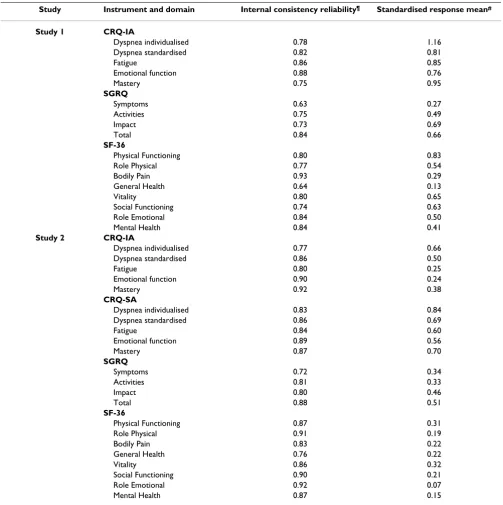
Table 1: Internal consistency reliability and responsiveness. Studies 1 and 2
Study Instrument and domain Internal consistency reliability¶ Standardised response mean#
Study 1 CRQ-IA
Dyspnea individualised 0.78 1.16
Dyspnea standardised 0.82 0.81
Fatigue 0.86 0.85
Emotional function 0.88 0.76
Mastery 0.75 0.95
SGRQ
Symptoms 0.63 0.27
Activities 0.75 0.49
Impact 0.73 0.69
Total 0.84 0.66
SF-36
Physical Functioning 0.80 0.83
Role Physical 0.77 0.54
Bodily Pain 0.93 0.29
General Health 0.64 0.13
Vitality 0.80 0.65
Social Functioning 0.74 0.63
Role Emotional 0.84 0.50
Mental Health 0.84 0.41
Study 2 CRQ-IA
Dyspnea individualised 0.77 0.66
Dyspnea standardised 0.86 0.50
Fatigue 0.80 0.25
Emotional function 0.90 0.24
Mastery 0.92 0.38
CRQ-SA
Dyspnea individualised 0.83 0.84
Dyspnea standardised 0.86 0.69
Fatigue 0.84 0.60
Emotional function 0.89 0.56
Mastery 0.87 0.70
SGRQ
Symptoms 0.72 0.34
Activities 0.81 0.33
Impact 0.80 0.46
Total 0.88 0.51
SF-36
Physical Functioning 0.87 0.31
Role Physical 0.91 0.19
Bodily Pain 0.83 0.22
General Health 0.76 0.22
Vitality 0.86 0.32
Social Functioning 0.90 0.21
Role Emotional 0.92 0.07
Mental Health 0.87 0.15
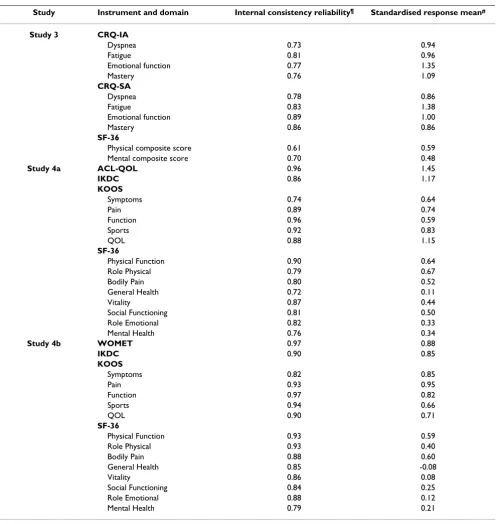
Table 2: Internal consistency reliability and responsiveness. Studies 3 and 4
Study Instrument and domain Internal consistency reliability¶ Standardised response mean#
Study 3 CRQ-IA
Dyspnea 0.73 0.94
Fatigue 0.81 0.96
Emotional function 0.77 1.35
Mastery 0.76 1.09
CRQ-SA
Dyspnea 0.78 0.86
Fatigue 0.83 1.38
Emotional function 0.89 1.00
Mastery 0.86 0.86
SF-36
Physical composite score 0.61 0.59
Mental composite score 0.70 0.48
Study 4a ACL-QOL 0.96 1.45
IKDC 0.86 1.17
KOOS
Symptoms 0.74 0.64
Pain 0.89 0.74
Function 0.96 0.59
Sports 0.92 0.83
QOL 0.88 1.15
SF-36
Physical Function 0.90 0.64
Role Physical 0.79 0.67
Bodily Pain 0.80 0.52
General Health 0.72 0.11
Vitality 0.87 0.44
Social Functioning 0.81 0.50
Role Emotional 0.82 0.33
Mental Health 0.76 0.34
Study 4b WOMET 0.97 0.88
IKDC 0.90 0.85
KOOS
Symptoms 0.82 0.85
Pain 0.93 0.95
Function 0.97 0.82
Sports 0.94 0.66
QOL 0.90 0.71
SF-36
Physical Function 0.93 0.59
Role Physical 0.93 0.40
Bodily Pain 0.88 0.60
General Health 0.85 -0.08
Vitality 0.86 0.08
Social Functioning 0.84 0.25
Role Emotional 0.88 0.12
Mental Health 0.79 0.21
¶Cronbach's alpha
Results
Eligible StudiesThe following four studies met the eligibility criteria:
Study 1 [11]
This prospective study measured HRQL in 85 patients with chronic obstructive pulmonary disease (COPD) before and after participation in Canadian inpatient respi-ratory rehabilitation programs similar to many inpatient programs worldwide [12]. All patients completed the interviewer-administered Chronic Respiratory Question-naire (CRQ) including individualised and standardised dyspnea questions. In addition, patients completed the St. Georges Respiratory Questionnaire (SGRQ) and the Short-From Survey 36 (SF-36) [13] at the beginning and end of the rehabilitation program.
Study 2 [14]
This was a prospective randomised study of 177 patients with COPD before and after respiratory rehabilitation in Canada and the United States. We randomised patients to complete either the interviewer or self-administered CRQ [11,15]. All patients answered the individualised and standardised dyspnea questions of the CRQ. Patients also completed the SGRQ and the SF-36 at the beginning and end of the rehabilitation program.
Study 3 [16,17]
This prospective study enrolled 71 patients with COPD following a respiratory rehabilitation program at four cites in Switzerland, Germany and Austria. We also ran-domised patients to complete either the interviewer or self-administered CRQ as in study 2 [11,15] and all
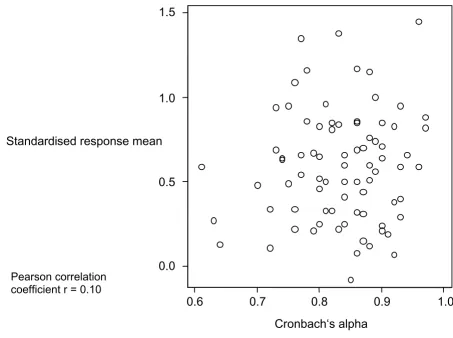
Relationship between internal consistency reliability and responsiveness, all studies Figure 1
Relationship between internal consistency reliability and responsiveness, all studies Relationship between Cron-bach's alpha and standardised response mean for 79 domains or total scores of health-related quality of life instruments and symptoms scales. The data come from four studies including 333 patients with chronic obstructive pulmonary disease following a pulmonary rehabilitation and 183 patients with knee injury undergoing anterior crucial ligament reconstruction or knee arthroscopy.
ean
0.5
0.0
1.0
0.9
0.8
Cronbach‘s alpha
0.7
0.6
1.5
1.0
Standardised response m
patients answered the individualised and standardised dyspnea questions of the CRQ. Patients also completed the SF-36 [18] at the beginning and end of the rehabilita-tion program.
Study 4 [19]
This prospective study enrolled patients undergoing ante-rior crucial ligament reconstruction (study 4a, n = 66) and knee arthroscopy (study 4b, n = 117) to determine their ability to recall pre-operative quality of life and functional status. Patients completed the disease-specific Anterior Crucial Ligament Quality Of Life questionnaire (ACL-QOL) [20] (study 4a) or the Western Ontario Meniscal Evaluation Tool (WOMET) [21] (study 4b) as well as the International Knee Documentation Committee (IKDC) Subjective Form [22], the Knee Injury and Osteoarthritis Outcome Score (KOOS) [23] and the SF-36 pre- and one year post-operatively.
Relationship between internal consistency reliability and responsiveness
Tables 1 and 2 show the reliability coefficients and stand-ardised response mean for each study and instrument. The mean Cronbach's alpha across all studies was 0.83 (SD 0.08, range 0.61 to 0.97) and the mean standardised response mean was 0.59 (SD 0.33, range -0.08 to 1.45).
Figure 1 shows the relationship between Cronbach's alpha and SRM across all studies. The correlation coeffi-cient was 0.10 (95% CI -0.12 to 0.32). When we analysed each study separately, correlation coefficients ranged from -0.17 to 0.62 (Figure 2).
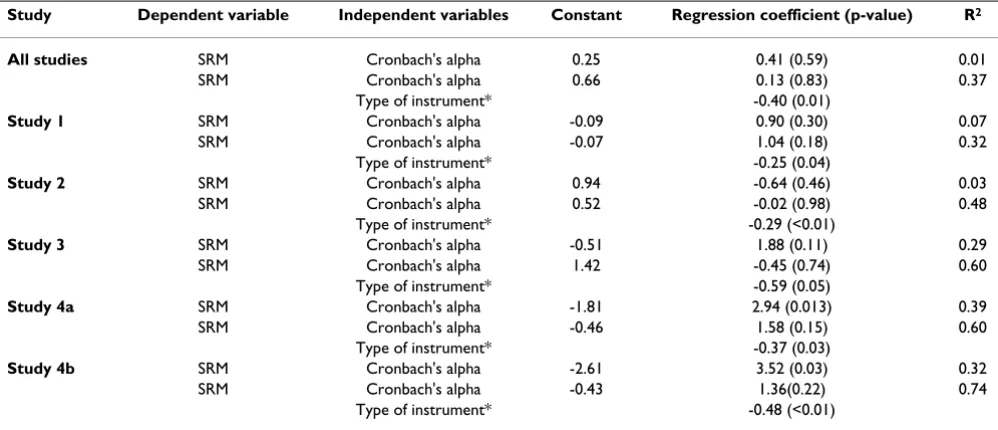
Table 3 shows the regression equations to predict the SRM from Cronbach's alpha. In an analysis of all studies including internal consistency reliability as the sole inde-pendent variable did not predict responsiveness (p = 0.59, r2 = 0.01). In contrast, an analysis that included the type of instrument showed that the generic versus specific cat-egorisation predicted responsiveness (p = 0.01, r2 = 0.37). Relationship between internal consistency reliability and responsiveness, per study
Figure 2
Relationship between internal consistency reliability and responsiveness, per study.
r: Pearson correlation coefficient
r = 0.27
0
.5
1
1.
5
1
1.5
Study 1 Study 2
Study 4a Study 4b
Standardised response mean
r = -0.17
r = 0.62 r = 0.56
r = 0.27
0
.5
1
1.
5
1
1.5
Study 1 Study 2
Study 4a Study 4b
Standardised response mean
r = -0.17
r = 0.62 r = 0.56
0
.5
.5 .6 .7 .8 .9 1
.5 .6 .7 .8 .9 1 .5 .6 .7 .8 .9 1
Study 3
Cronbach alpha
r = 0.54
r: Pearson correlation coefficient
0
.5
Study 3
.5 .6 .7 .8 .9 1
.5 .6 .7 .8 .9 1 .5 .6 .7 .8 .9 1
Cronbach alpha
Analysing the studies separately showed similar results (Figure 2). Only in study 4 was Cronbach's alpha a signif-icant predictor in unadjusted analyses. Even in this case, when we introduced the type of instrument into the model, Cronbach's alpha was no longer a significant predictor.
Discussion
We assessed the relationship between internal consistency reliability and responsiveness and found no evidence to support the claim that investigators can use them interchangeably. In general, internal consistency reliabil-ity is a poor predictor of responsiveness. Consistent with previous findings [6], we showed that in contrast to Cron-bach's alpha, a significant predictor of responsiveness is whether the instrument is a generic or a disease-specific HRQL instrument.
Our findings contradict those presented by Lindeboom et al. We suspect that these differences are largely due to dif-ferences in conceptual and, thus, statistical approaches. In particular, Lindeboom's within instrument and within study approach fails to take into account that responsive-ness depends on the type of instrument and on the inter-vention that produces change in HRQL. In our analyses, we evaluated the relationship between internal consist-ency reliability and responsiveness across instruments and studies.
One might argue that our failure to demonstrate a rela-tionship between Cronbach's alpha and the SRM results
from the limited variability in Cronbach's alpha across the instruments and their domains. Indeed, this limited variability in part explains the lack of relationship. Never-theless, when choosing instruments for clinical trials, investigators will face Cronbach's alpha coefficients such as those shown in Table 1 and 2. If they rely on these results to predict responsiveness, they will be misled. In particular, some domains with very high Cronbach's alpha coefficients (SF-36 bodily pain, 0.93; CRQ IA emo-tional function 0.90) had low responsiveness (SRMs of 0.29 and 0.24, respectively).
Strengths of our study include the definition of a priori criteria to ensure an unbiased selection of studies that ensure large variability responsiveness creating the great-est potential to detect a relationship if one existed. Fur-thermore, the inclusion of very different patient populations (chronic lung disease and knee pathology) and the consistency of results across these studies and populations enhances the generalizability of our study. Replication in other populations would further strengthen our conclusions.
Conclusion
Our study demonstrates that internal consistency reliabil-ity is a poor predictor of responsiveness and that both conceptual and statistical evidence exists to support the argument that they are distinct measurement properties of evaluative instruments.
Table 3: Prediction of responsiveness from internal consistency reliability
Study Dependent variable Independent variables Constant Regression coefficient (p-value) R2
All studies SRM Cronbach's alpha 0.25 0.41 (0.59) 0.01
SRM Cronbach's alpha 0.66 0.13 (0.83) 0.37
Type of instrument* -0.40 (0.01)
Study 1 SRM Cronbach's alpha -0.09 0.90 (0.30) 0.07
SRM Cronbach's alpha -0.07 1.04 (0.18) 0.32
Type of instrument* -0.25 (0.04)
Study 2 SRM Cronbach's alpha 0.94 -0.64 (0.46) 0.03
SRM Cronbach's alpha 0.52 -0.02 (0.98) 0.48
Type of instrument* -0.29 (<0.01)
Study 3 SRM Cronbach's alpha -0.51 1.88 (0.11) 0.29
SRM Cronbach's alpha 1.42 -0.45 (0.74) 0.60
Type of instrument* -0.59 (0.05)
Study 4a SRM Cronbach's alpha -1.81 2.94 (0.013) 0.39
SRM Cronbach's alpha -0.46 1.58 (0.15) 0.60
Type of instrument* -0.37 (0.03)
Study 4b SRM Cronbach's alpha -2.61 3.52 (0.03) 0.32
SRM Cronbach's alpha -0.43 1.36(0.22) 0.74
Type of instrument* -0.48 (<0.01)
Publish with BioMed Central and every scientist can read your work free of charge
"BioMed Central will be the most significant development for disseminating the results of biomedical researc h in our lifetime."
Sir Paul Nurse, Cancer Research UK
Your research papers will be:
available free of charge to the entire biomedical community
peer reviewed and published immediately upon acceptance
cited in PubMed and archived on PubMed Central
yours — you keep the copyright
Submit your manuscript here:
http://www.biomedcentral.com/info/publishing_adv.asp
BioMedcentral
Authors' contributions
MAP, DB, GHG and HJS designed the study and wrote the study protocol. MAP, GHG, HJS and DB collected the data. MAP, DB and DHA performed the statistical analysis. MAP drafted and DB, GHG, DHA and HJS criti-cally revised the manuscript. All authors read and approved the final manuscript.
References
1. Guyatt GH, Feeny DH, Patrick DL: Measuring health-related quality of life.Ann Intern Med 1993, 118:622-629.
2. Hays RD, Hadorn D: Responsiveness to change: an aspect of validity, not a separate dimension.Qual Life Res 1992, 1:73-75. 3. Streiner D, Norman G: Health measurement scales Third edition.
Oxford, Oxford University Press; 2003.
4. Terwee CB, Dekker FW, Wiersinga WM, Prummel MF, Bossuyt PM:
On assessing responsiveness of health-related quality of life instruments: guidelines for instrument evaluation.Qual Life Res 2003, 12:349-362.
5. Lindeboom R, Sprangers MA, Zwinderman AH: Responsiveness: a reinvention of the wheel?Health Qual Life Outcomes 2005, 3:8. 6. Wiebe S, Guyatt G, Weaver B, Matijevic S, Sidwell C: Comparative
responsiveness of generic and specific quality-of-life instruments.J Clin Epidemiol 2003, 56:52-60.
7. de Torres JP, Pinto-Plata V, Ingenito E, Bagley P, Gray A, Berger R, Celli B: Power of Outcome Measurements to Detect Clini-cally Significant Changes in Pulmonary Rehabilitation of Patients With COPD(*).Chest 2002, 121:1092-1098.
8. Guyatt GH, King DR, Feeny DH, Stubbing D, Goldstein RS: Generic and specific measurement of health-related quality of life in a clinical trial of respiratory rehabilitation.J Clin Epidemiol 1999,
52:187-192.
9. Singh SJ, Sodergren SC, Hyland ME, Williams J, Morgan MD: A com-parison of three disease-specific and two generic health-sta-tus measures to evaluate the outcome of pulmonary rehabilitation in COPD.Respir Med 2001, 95:71-77.
10. Moran LA, Guyatt GH, Norman GR: Establishing the minimal number of items for a responsive, valid, health-related qual-ity of life instrument.J Clin Epidemiol 2001, 54:571-579.
11. Schunemann HJ, Griffith L, Jaeschke R, Goldstein R, Stubbing D, Aus-tin P, Guyatt GH: A Comparison of the Original Chronic Res-piratory Questionnaire With a Standardized Version.Chest 2003, 124:1421-1429.
12. Lacasse Y, Brosseau L, Milne S, Martin S, Wong E, Guyatt GH, Gold-stein RS: Pulmonary rehabilitation for chronic obstructive pulmonary disease.Cochrane Database Syst Rev 2004:CD003793. 13. Ware JEJ, Sherbourne CD: The MOS 36-item short-form health
survey (SF-36). I. Conceptual framework and item selection 1.Med Care 1992, 30:473-483.
14. Schunemann HJ, R G, Mador MJ, D. MK, E S, M.A. P, L G, B. G, P A, R. C, G.H. G: A Randomized Trial to Evaluate the Self-Admin-istered Standardized CRQ.Europ Respir J 2005, 25:31-40. 15. Guyatt GH, Berman LB, Townsend M, Pugsley SO, Chambers LW: A
measure of quality of life for clinical trials in chronic lung disease.Thorax 1987, 42:773-778.
16. Puhan MA, Behnke M, Frey M, Grueter T, Brandli O, Lichtenschopf A, Guyatt GH, Schunemann HJ: Self-administration and inter-viewer-administration of the German Chronic Respiratory Questionnaire: instrument development and assessment of validity and reliability in two randomised studies 1.Health Qual Life Outcomes 2004, 2:1.
17. Puhan MA, Behnke M, Laschke M, Lilhtenschopf A, Brandli O, Guyatt GH, Schunemann HJ: Self-administration and standardisation of the chronic respiratory questionnaire: A randomised trial in three German-speaking countries.Respiratory Medicine 2004,
98:342-350.
18. Bullinger M: German translation and psychometric testing of the SF-36 Health Survey: preliminary results from the IQOLA Project. International Quality of Life Assessment.
Soc Sci Med 1995, 41:1359-1366.
19. Bryant D, Norman G, Stratford P, Marx R, Walter S, al KA: Can patients undergoing knee surgery provide an accurate rating of pre-operative quality of life, functional status and general
health at 2 weeks post-operatively? A matter of efficiency.
Manuscript in progress 2005.
20. Mohtadi N: Development and validation of the quality of life outcome measure (questionnaire) for chronic anterior cru-ciate ligament deficiency.Am J Sports Med 1998, 26:350-359. 21. Griffin S, Huffman H, Bryant D, Kirkley A: The development and
validation of a quality of life measurement tool for patients with meniscal pathology: the Western Ontario Meniscal Evaluation Tool (WOMET).Manuscript in progress 2005. 22. Irrgang JJ, Anderson AF, Boland AL, Harner CD, Kurosaka M, Neyret
P, Richmond JC, Shelborne KD: Development and validation of the international knee documentation committee subjective knee form.Am J Sports Med 2001, 29:600-613.