R E S E A R C H A R T I C L E
Open Access
The effect of mirabegron, used for
overactive bladder treatment, on female
sexual function: a prospective controlled
study
A. Zachariou
1,5*, C. Mamoulakis
2, M. Filiponi
3, F. Dimitriadis
1, J. Giannakis
1, S. Skouros
1, P. Tsounapi
4,
A. Takenaka
4and N. Sofikitis
1Abstract
Background:Αim of the study was to determine the effect of mirabegron, used for overactive bladder (OAB) treatment, on female sexual function.
Methods:Eighty five sexually active women suffering from overactive bladder were prospectively enrolled in this study. Females were divided into two groups. In Group A (control), 48 patients received no treatment and in Group B, 37 patients received mirabegron 50 mg/daily for 3 months. Patients were evaluated with FSFI-Gr at the beginning of the study and again after a period of 3 months.
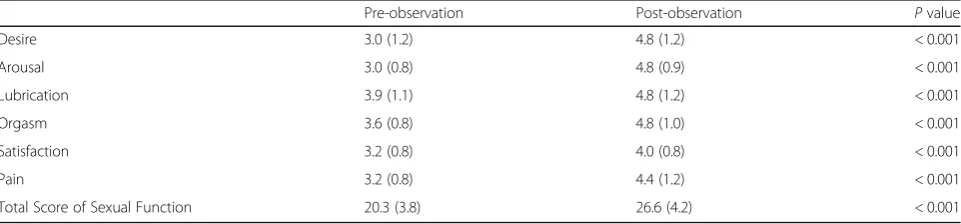
Results:In Group B, there was a significant increase post-treatment compared to baseline (p< 0.001) in total FSFI (20.3 (3. 8) to 26.6 (4.2)) and all domains (desire: 3.0 (1.2) to 4.8 (1.2)), arousal: 3.0 (0.8) to 4.8 (0.9), lubrication: 3.9 (1.1) to 4.8 (1.2), orgasm: 3.6 (0.8) to 4.8 (1.0), satisfaction: 3.2 (0.4) to 4.0 (0.8) and pain: 3.2 (0.8) to 4.4 (1.2)). In Group A, there were no statistically significant changes in pre- and post-observation values.
Conclusions:This study is one of the few demonstrating that management of OAB with mirabegron improves female sexual function.
Trial registration:TRNISRCTN17199301, 20/10/2017, retrospectively registered.
Keywords:Female sexual dysfunction, Mirabegron, Overactive bladder
Background
Overactive bladder (OAB) is defined by the International Continence Society (ICS) as urinary urgency in the absence of any known infection or other obvious path-ology. OAB is usually characterized by frequency and nocturia, but may or may not cause urinary incontinence [1]. It has been shown to affect up to 36% of adult women in Europe and US [2,3].
Although not life threatening, OAB is a debilitating disease which can substantially impede the quality of life,
resulting in low self-esteem, anxiety, depression, impair-ment of work productivity and increase in the number of falls and fractures [4]. Women with OAB experience increased incidence of sexual problems, sometimes with consequent personal distress and sexual partner com-patibility issues. [5]. The impact of OAB symptoms on sexual function in women has been evaluated in a few studies [6–9]. Patel et al. [6] reported that 25% of their female OAB population had some degree of sexual dysfunction, meaning that OAB has a greater effect on female sexual health than it does urinary incontinence.
Female sexual dysfunction (FSD) is traditionally classi-fied into disorders of desire, arousal, lubrication, orgasm and pain. In the absence of detailed epidemiological data, current estimates have up to 43% of women com-plaining of at least one sexual issue [10]. Women are at
* Correspondence:[email protected]
Presented at the 19thCongress of the European Society of Sexual Medicine 2017 in Nice, France, February 1-3, 2017
1Department of Urology, School of Medicine, Ioannina University, Ioannina, Greece
53 Spyridi Street, 38221 Volos, Greece
Full list of author information is available at the end of the article
risk of developing FSD due to physiologic, iatrogenic and psychological factors. Lower tract urinary tract in-fections are a further, independent FSD cause [10, 11]. To identify FSD, appropriate assessment guidelines should be applied. So as to ascertain sexual history and enable assessment, there are a number of self-reporting questionnaires available. The Female Sexual Function Index (FSFI) is a concise, multidimensional“gold stand-ard”tool which is regarded in high-esteem [12].
Recently introduced as an oral treatment for OAB, mirabegron (a β3-adrenergic agonist compound) im-proves storage capacity of bladder without inducing anticholinergic adverse events [13]. In four, large–scale 12-week phase III studies [14–17], a pooled analysis [18] and 12-month study [19], mirabegron consistently demonstrated superiority over placebo with respect to reductions in incontinence episodes and micturition frequency, with a similar incidence of adverse effects as the placebo.
The objective of the current study is to evaluate the effect of the β3-adrenoceptor agonist, mirabegron, as used for OAB treatment on the sexual function of women (employing FSFI-Gr, a validated questionnaire translated into the Greek language).
Methods
Between January 2016 and December 2016, 85 sexually active women with confirmed OAB, had referred to the Urogynecology outpatient clinic and were prospectively enrolled in this study. OAB was determined using the International Continence Society definition [1]. The urination frequency of all women was 8 or more times a day, with urge symptoms independent of incontinence. OAB was present in all women for a minimum of 3 months and none of the women had undergone prior treatment for the condition. Other inclusion criteria were the willing of women to comply with the protocol and the capability to complete the voiding diaries and the questionnaires without assistance.
Subjects were excluded from inclusion if they had clin-ically significant stress urinary incontinence, neurogenic bladder and urinary retention or were at risk of these conditions. Women with a history of pelvic muscle training programs were excluded because it is accepted that pelvic floor muscle exercises improve female sexual function [20]. The protocol for the research project was approved by ELPIS HOSPITAL Ethics Committee and informed consent was taken from all the women.
The inclusion criteria also integrated women over the age of 18 being in a sexually active relationship. Women who stated that they were not sexually active were asked to indicate the reason and were excluded from further analysis. Women who considered that there was no need
for long-term treatment for OAB or were afraid of regi-men’s adverse effects were included in control group.
Patients were assessed using a comprehensive history, a detailed general and neurological physical examination, as well FSFI. According to the latest report of the Inter-national Consultation on Sexual Medicine, the FSFI re-mains the“gold standard”assessment tool, has a level of evidence 1 and recommendation grade A, for evaluating female sexual dysfunction [21]. Item selection and cat-egories were based on the American Foundation for Urological Diseases classification system of female sexual dysfunction. Furthermore, FSFI has been translated and validated in the Greek language [22]. All women were asked to complete the Greek version of the FSFI, which evaluates the four phases of female sexual function and categorizes sexual dysfunction in the domains of (a) de-sire (b) arousal (c) lubrication (d) orgasm (e) satisfaction and (f ) pain. The development of a scoring system, whereby higher scores indicate a healthier condition allowed the attainment of individual domain scores. Wiegel et al. [23] found that a total FSFI score of 26.5 is the optimal cut-off score for differentiating women with and without sexual dysfunction. We used the same cut-off scores in order to have comparable results with matching papers.
To determine the eligible women all females were asked to answer the question: “Do you have sexual distress associated with sexual dysfunction?” and only women who gave a negative answer were finally re-cruited for analysis, since sexual distress needs special questionnaires to be evaluated. Patients were divided into two groups. Group A, which is defined as a control group, consisted of 48 women. None of these females with OAB wished to receive any therapy. On the other hand, in Group B, 37 patients with OAB were treated with mirabegron 50 mg daily for 3 months.
patients completed the FSFI questionnaire at the begin-ning and after the completion of the 3 month study.
All outcome variables were tested for normality using the Shapiro-Wilk W test. Concretely, the following continues/ordinal variables were tested per group: age, body weight, symptom duration, parity; pre- and post-observation/treatment FSFI domains (desire, arousal, lubrication, orgasm, satisfaction, pain), total score of sex-ual function and percentage (%) improvement in total score of sexual function; pre- and post-observation/treat-ment episodes of frequency, urgency, nocturia, incontin-ence; number of pads needed; and voided volumes. The potential presence of any correlation was investigated be-tween the % of improvement in LUTS/incontinence and in sexual function (separately for each parameter) in order to evaluate the effect of OAB improvement on sexual function. Finally, % improvement in total score of sexual function was compared between groups and a multivariate linear regression analysis was performed in order to inves-tigate the effect of several independent parameters on sex-ual function. The % improvement in total score of sexsex-ual function was used as dependent variable. The % improve-ments in frequency, urgency, nocturia, incontinence epi-sodes, number of pads needed and voided volume were considered as independent variables. Data were analyzed using IBM Corp. Released 2016. IBM SPSS Statistics for Windows, Version 24.0. Armonk, NY: IBM Corp. Two-tailedp< 0.050 was considered significant.
Results
All tested variables showed significant departures from the normal distribution. The only exceptions were the pre- and post-observation/treatment total scores of sex-ual function and the voided volumes. Consequently, non-parametric tests (Mann Whitney U test and Wil-coxon signed-rank test, respectively) were performed for all comparisons (for uniformity purposes) between and within groups, respectively; all data are presented as me-dians (interquartile ranges; IQRs).
Among the 48 women who reported sexual activity in the last 4 weeks from Group A, 11 women reported dur-ing the monthly visits that they had decided to follow pharmacotherapy/behavioral therapy for OAB and were therefore excluded from the study. Furthermore, 2 women from Group A and 2 women from Group B re-fused to complete the FSFI questionnaire at the end of 3 month period and were also excluded. There were no adverse reactions from mirabegron administration dur-ing the study.
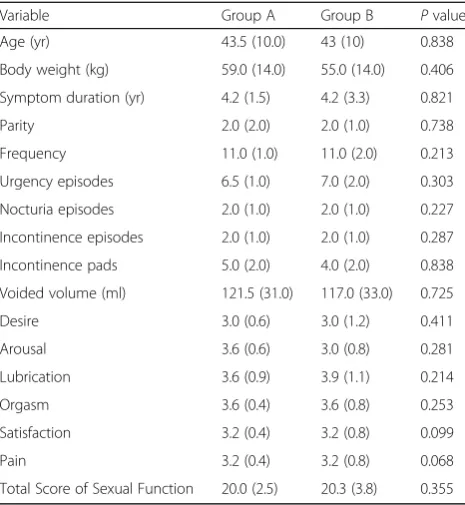
Demographic characteristics and baseline OAB/sexual scores did not differ significantly between groups (Table1). Sixty-five percent of patients in Group B who were incontinent at baseline became continent by the study-endpoint. Furthermore, all urinary outcomes, all
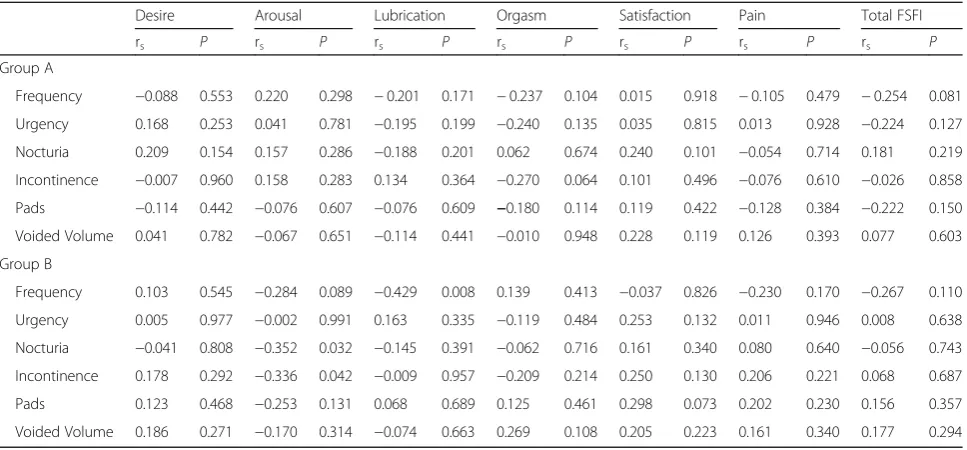
FSFI domain scores and the total score of sexual func-tion improved significantly in Group B at 3 months, in contrast to Group A (Tables 2, 3 and 4). Spearman’s rank-order correlation test yielded statistically significant (negative) correlations between % improvement in LUTS/incontinence and % improvement in sexual func-tion were detected exclusively in Group B (frequency-lu-brication, nocturia-arousal, incontinence-sexual satisfaction; Table5).
Total score of sexual function improvement (%) dif-fered significantly between groups (Group A vs. Group
Table 1Demographic characteristics and baseline OAB/sexual scores of participants
Variable Group A Group B Pvalue
Age (yr) 43.5 (10.0) 43 (10) 0.838
Body weight (kg) 59.0 (14.0) 55.0 (14.0) 0.406
Symptom duration (yr) 4.2 (1.5) 4.2 (3.3) 0.821
Parity 2.0 (2.0) 2.0 (1.0) 0.738
Frequency 11.0 (1.0) 11.0 (2.0) 0.213
Urgency episodes 6.5 (1.0) 7.0 (2.0) 0.303
Nocturia episodes 2.0 (1.0) 2.0 (1.0) 0.227
Incontinence episodes 2.0 (1.0) 2.0 (1.0) 0.287
Incontinence pads 5.0 (2.0) 4.0 (2.0) 0.838
Voided volume (ml) 121.5 (31.0) 117.0 (33.0) 0.725
Desire 3.0 (0.6) 3.0 (1.2) 0.411
Arousal 3.6 (0.6) 3.0 (0.8) 0.281
Lubrication 3.6 (0.9) 3.9 (1.1) 0.214
Orgasm 3.6 (0.4) 3.6 (0.8) 0.253
Satisfaction 3.2 (0.4) 3.2 (0.8) 0.099
Pain 3.2 (0.4) 3.2 (0.8) 0.068
Total Score of Sexual Function 20.0 (2.5) 20.3 (3.8) 0.355
Table 2Urinary evaluation of the participants
Group A Pre-observation Post-observation Pvalue
Frequency 11.0 (1.0) 11.0 (1.0) 0.200
Urgency episodes 6.5 (1.0) 7.0 (1.0) 0.093
Nocturia episodes 2.0 (1.0) 1.0 (1.0) 0.231
Incontinence episodes 2.0 (1.0) 2.0 (2.0) 0.332
Incontinence pads 5.0 (2.0) 5.0 (2.0) 0.231
Voided volume (ml) 121.5 (31.0) 114.5 (27.0) 0.001
Group B Pre-treatment Post-treatment Pvalue
Frequency 11.0 (2.0) 9.0 (2.0) < 0.001
Urgency episodes 7.0 (2.0) 4.0 (2.0) < 0.001
Nocturia 2.0 (1.0) 1.0 (1.0) < 0.001
Incontinence episodes 2.0 (1.0) 1.0 (1.0) < 0.001
Incontinence pads 4.0 (2.0) 2.0 (2.0) < 0.001
B: 1.0 (3.7) vs. 32.6 (7.9); p< 0.001). Multivariate linear regression analysis run to predict % improvement in total score of sexual function from group, as well as % improvements in frequency, urgency, nocturia, incontin-ence episodes, number of pads needed and voided vol-ume revealed that Group and % improvements in frequency statistically significantly predicted % improve-ment in total score of sexual function, F(7, 77) = 141.970,
p< .001, R2= 0.928. All seven variables added statistically significantly to the prediction, p< 0.001. The multivari-ate linear regression model is presented in Table6.
Discussion
This study is one of the few, to our knowledge, to dem-onstrate the effect of mirabegron, the first β-3 adreno-ceptor agonist, on sexual function of women suffering from OAB. Our data has indicated that after 3 months evaluation, females with OAB receiving mirabegron 50 mg revealed statistically significant changes in FSFI total score and all subscales.
OAB symptoms, urinary incontinence and sexual health in general are topics many find difficult to dis-cuss. Not only may stigma make sufferers reluctant to approach a health professional, but it may also make health professionals embarrassed to confront patients. Self-reporting rather than interview-administered ques-tionnaires greatly reduce this barrier. As FSFI allows a quantitative evaluation and can be used to study sexual-ity changes after therapeutic intervention, it has a dis-tinct advantage over other assessment tools like diaries
or calendars [24]. This tool is a reliable self-reporting measure of FSD which only requires 15 min to complete. Although it excludes issues involving personal stress, it measures outcomes of therapeutic response by design.
Female sexual dysfunctions can interfere with intim-acy, affect a marital relationship and ultimately erode well-being and overall health. Although sexual dysfunc-tion is more likely in women than men, clinical FSD tri-als are rare compared to the available burgeoning data on men. Furthermore, the amount of data related to the effect of treatment agents used for OAB on the sexual function of women is insufficient in the literature while study comparisons should be made with caution because of differences in study designs and population.
The use of anticholinergics as a first-line treatment for OAB is well documented. However, many large trials ex-clude sexual function change assessment after their ad-ministration. Tolterodine and oxybutynin are two anticholinergic medications with high quality evidence supporting improvement in sexual function with use. According to Hajebrahimi et al. [7], tolterodine IR sig-nificantly improved all domains of sexual function of women with OAB. The FSD was evaluated with the Arizona Sexual Experience Scale (ASEX), a five-topic questionnaire. Rogers et al. [25] evaluated the effect of short term treatment with tolterodine ER on FSD using the Pelvic Organ Prolapse/Urinary Incontinence Sexual Function Questionnaire (PISQ) and Sexual Quality of Life–Female (SQOL-F). OAB symptoms improved with tolterodine ER, as did the scores of sexual health and
Table 3Comparison of pre-observation and post-observation FSFI in Group A
Pre-observation Post-observation Pvalue
Desire 3.0 (0.6) 3.0 (0.6) 0.524
Arousal 3.6 (0.6) 3.6 (0.6) 0.628
Lubrication 3.6 (0.9) 3.9 (0.6) 0.713
Orgasm 3.6 (0.4) 3.6 (0.4) 0.505
Satisfaction 3.2 (0.4) 2.8 (0.4) 0.109
Pain 3.2 (0.4) 3.2 (0.8) 0.424
Total Score of Sexual Function 20.0 (2.5) 19.8 (2.0) 0.609
Table 4Comparison of pre-treatment and post-treatment FSFI in GroupΒ
Pre-observation Post-observation Pvalue
Desire 3.0 (1.2) 4.8 (1.2) < 0.001
Arousal 3.0 (0.8) 4.8 (0.9) < 0.001
Lubrication 3.9 (1.1) 4.8 (1.2) < 0.001
Orgasm 3.6 (0.8) 4.8 (1.0) < 0.001
Satisfaction 3.2 (0.8) 4.0 (0.8) < 0.001
Pain 3.2 (0.8) 4.4 (1.2) < 0.001
anxiety measures in sexually active women with OAB. Rogers et al. [26] revealed that in a population of racially diverse, sexually active women, long term tolterodine ER treatment for OAB resulted in a relief of symptoms as ascertained in bladder diaries. Their study also validated improved sexual health. Using three items from the King’s Health Questionnaire and one item from the Beck Depression Inventory, Sand et al. [27] showed that trans-dermal oxybutynin treatment for OAB improved sexual function. Young et al. [28], in a prospective study using the FSFI questionnaire, demonstrated that OAB symp-tom management using solifenacin had a positive out-come on female sexual function, especially on the domains of arousal, desire and satisfaction. On the other hand, according to Jha [29] treatment of OAB symptoms with anticholinergics, in female patients evaluated with the PISQ questionnaire, does not guarantee improve-ment in sexual health. The small sample size and the uncontrolled design of the studies may not permit the
demonstration of a causal relationship between the regi-men used for OAB treatregi-ment and FSD.
Other factors can have a greater effect on sexual life than urinary incontinence associated with intercourse. However, the enjoyment of intercourse can be adversely effected by urgency and frequency issues, along with the fear of leakage during stimulation and intercourse [30]. After 3 months of mirabegron treatment, results indicated statistically significant improvements in sexual function. These improvements may have played a critical role in overall women’s sexual health wellness, as revealed by total FSFI scores and individual sexual domain scores, in Group B. Thus, the improvement of FSFI scores, in the current study, may at least partly be attributable to the established improvements in urgency and frequency.
Numerous studies have demonstrated that sexual function is negatively affected in women with bladder dysfunction [6, 30]. It is obvious that the improvement in lower urinary tract symptoms results in improvement of women’s sexual life [7,25–28]. These previous studies are consistent with our findings, demonstrating a posi-tive influence of OAB symptom treatment with mirabe-gron on sexual health and quality of life. The fact that the number of incontinence pads used by patients was significantly reduced after treatment, might help women feel more desirable and willing to experience sexual relationships and may represent another mechanism to explain the improvement of FSFI demonstrated in the current study after mirabegron administration.
Extensive data exists on the β3-adrenergic receptor
subtype of the sympathetic nervous system [31, 32]. In a recent study,β3-receptor stimulation caused rat aorta
vasorelaxation via the activation of NO synthase and
Table 5Correlation between improvements (%) in lower urinary tract symptoms & female sexual function
Desire Arousal Lubrication Orgasm Satisfaction Pain Total FSFI
rs P rs P rs P rs P rs P rs P rs P
Group A
Frequency −0.088 0.553 0.220 0.298 −0.201 0.171 −0.237 0.104 0.015 0.918 −0.105 0.479 −0.254 0.081
Urgency 0.168 0.253 0.041 0.781 −0.195 0.199 −0.240 0.135 0.035 0.815 0.013 0.928 −0.224 0.127
Nocturia 0.209 0.154 0.157 0.286 −0.188 0.201 0.062 0.674 0.240 0.101 −0.054 0.714 0.181 0.219
Incontinence −0.007 0.960 0.158 0.283 0.134 0.364 −0.270 0.064 0.101 0.496 −0.076 0.610 −0.026 0.858
Pads −0.114 0.442 −0.076 0.607 −0.076 0.609 −0.180 0.114 0.119 0.422 −0.128 0.384 −0.222 0.150
Voided Volume 0.041 0.782 −0.067 0.651 −0.114 0.441 −0.010 0.948 0.228 0.119 0.126 0.393 0.077 0.603
Group B
Frequency 0.103 0.545 −0.284 0.089 −0.429 0.008 0.139 0.413 −0.037 0.826 −0.230 0.170 −0.267 0.110
Urgency 0.005 0.977 −0.002 0.991 0.163 0.335 −0.119 0.484 0.253 0.132 0.011 0.946 0.008 0.638
Nocturia −0.041 0.808 −0.352 0.032 −0.145 0.391 −0.062 0.716 0.161 0.340 0.080 0.640 −0.056 0.743
Incontinence 0.178 0.292 −0.336 0.042 −0.009 0.957 −0.209 0.214 0.250 0.130 0.206 0.221 0.068 0.687
Pads 0.123 0.468 −0.253 0.131 0.068 0.689 0.125 0.461 0.298 0.073 0.202 0.230 0.156 0.357
Voided Volume 0.186 0.271 −0.170 0.314 −0.074 0.663 0.269 0.108 0.205 0.223 0.161 0.340 0.177 0.294
Table 6Multivariate linear regression analysis model
Variable B SE B β Pvalue 95.0% CI
Constant 1.162 0.752 0.126 −0.336 2.660
Group 24.193 3.688 0.741 < 0.001 16.849 31.538
Frequency −0.155 0.079 −0.107 0.050 −0.312 −0.001
Urgency 0.003 0.049 0.005 0.951 −0.095 0.101
Nocturia −0.001 0.012 −0.003 0.931 −0.025 0.023
Incontinence 0.004 0.018 0.009 0.843 −0.032 0.039
Number of pads −0.015 0.031 −0.036 0.629 −0.077 0.047
the associated increase of tissue levels of cGMP [33]. Gur et al. [34] demonstrated that mirabegron markedly relaxed isolated human corpus cavernosum (HCC) and rat corpora cavernosa by activating β3-adrenoceptors
independently of the NO-cGMP pathway. Moreover, Cirino et al. [35] showed that the activation of the
β3-receptors present in human corpus cavernosum
elicits a cGMP dependent but NO-independent vasore-laxation which involves the inhibition of the RhoΑ/ Rho-kinase pathway and facilitates erectile function.
An up-regulation of Rho kinase-β protein in alloxan-induced diabetic rabbit corporal tissue [36] and in the human corpus cavernosum [37] has recently been shown
to control corporal smooth muscle contraction induced by endothelin-1. This suggests that the RhoA/Rho kinase pathway plays a mediatory role in increased sensitivity and force generation of corporal smooth muscle. Add-itionally, β3 receptor-mediated corporal smooth muscle relaxation involves the inhibition of RhoA/Rho-kinase [35]. Smooth muscle relaxation associated with phos-phorylation and the resulting inhibition of RhoA is caused by the NO–cGMP signaling pathway mediated by the activation of the cGMP-dependent protein kinase [35, 38, 39]. As the cGMP-dependent protein kinase is found in human corpora cavernosa, this second mechan-ism is likely to occur in humans too. It seems, therefore,
Fig. 1Possible mechanism of mirabegron’s effect, used for overactive bladder treatment, on female sexual function.β3- adrenergic receptor activation by mirabegron agonist is coupled to the generation of the second messenger cGMP, which causes human corporal cavernosum smooth muscle relaxation by lowering intracellular levels of free calcium.β3 receptor-mediated corporal smooth muscle relaxation involves inhibition of RhoA/Rho-kinase [34]. The Rho pathway is initiated by ET-1 agonist binding in the GPCR receptor, which activates RhoGEF, facilitating RhoA–GDP conversion to RhoA–GTP. RhoA– GTP binds to ROCK, facilitating autophosphorylation of ROCK that enhances its ability to phosphorylate and deactivate MLCP, promoting vasoconstriction. Relaxation is largely mediated by cGMP, which causes phosphorylation of RhoA, preventing interaction with ROCK and thereby inhibiting vasoconstriction.
Endothelin-1-induced contraction of corporal smooth is mediated by an up-regulation of Rho kinase-βprotein in alloxan-induced diabetic human corpus
that the state of human corpus cavernosum tumescence may be regulated by the physiological function of these two pathways.
The clitoris is a complex structure that simulates the structure of penis, which is composed of two erectile bodies known as the corpora cavernosa. During sexual arousal, both the clitoris and the labia minora become engorged with blood. In addition, both vaginal and clit-oral length and diameter increase. To date, the vascular contributions in FSD remain to be elucidated. The main blood supply to female genital tissue is via the internal pudendal artery (IPA) and clitoral artery (CA). A better understanding of female sexual arousal would be made possible if more was known about both these arteries. Allahdadi et al. [40] demonstrated that internal pudendal artery and clitoral artery are sensitive to the potent vaso-constrictor peptide, endothelin-1. Rho-kinase, however is a key component in endothelin-1 signaling. Further-more, the inhibition of Rho-kinase in the internal pu-dendal artery and clitoral artery reduces ET-1-mediated constriction [40].
We may hypothesize that mirabegron, as aβ3
-adrenor-eceptor agonist, induces relaxation of the corpus cavern-osum that may enhance blood flow in the female region-clitoris which might be accompanied by increased stimulation. This proposed mechanism of mirabegron explains our results, in which mirabegron treatment caused statistically significant improvements in arousal, desire, orgasm and satisfaction female sexual function domains, as well as in total FSFI score (Fig.1).
However, the present study has some limitations. Our study had a control group with women not taking mira-begron treatment but there is no placebo group. Thus, there is no evaluation about the effect of placebo on sex-ual function. It was not possible to use a randomization method since the decision of female patients to receive mirabegron or not, was the reason for being in certain group. Someone could claim that it is a random process of selection although that can by chance lead to dispar-ities. In spite of these limitations, significant results have been obtained, which are of value for clinicians working in this field.
Conclusions
Females with OAB should be assessed for their sexual function to provide better quality of life. According to the aforementioned data, OAB treatment with mirabegron improves female sexual function. The above documented improvement in female sexual function might be due to the improvement in the consequences of OAB patho-physiology. However an alternative mechanism may be raised attributing these beneficial effects in the women who received mirabegron treatment to mirabegron action per se. Our study is adherent to CONSORT guidelines.
Abbreviations
ASEX:Arizona Sexual Experience Scale; BDI: Beck depression inventory; CA: Clitoral artery; cGMP: Cyclic Guanosine Monophosphate; ET-1: Endothelin-1; FSD: Female sexual dysfunction; FSFI: Female sexual function index; FSFI-Gr: Female sexual function index–greek; HCC: Human corpus cavernosum; ICS: International Continence Society; IPA: Internal pudendal artery; KHQ: King’s Health Questionnaire; NO: Nitric oxide; OAB: Overactive bladder; PISQ: Pelvic Organ Prolapse/Urinary Incontinence Sexual Function Questionnaire; SPSS: Statistical Package for the Social Sciences; SQOL-F: Sexual quality of life– female; Tolterodine ER: Tolterodine extended release; Tolterodine IR: Tolterodine immediate release
Acknowledgements
The authors would like to thank Mrs. D. Pantartzi, Scientific Secretary of the Clinical Trial Office, Department of Urology, University of Crete Medical School for the administrative and technical support.
Funding ELPIS HOSPITAL.
Availability of data and materials
The data of the current study are available from the corresponding author on reasonable request.
Authors’contributions
ZA contributed to conception and design, collected data, contributed to the analysis and interpretation of data, drafted the manuscript and revised it critically for important intellectual content. CM led the analysis, made substantial contribution to the interpretation of data, has been involved in drafting the manuscript and revising it critically for important intellectual content. FM contributed to conception and design, collected data, contributed to the analysis and interpretation of data, drafted the manuscript and revised it critically for important intellectual content. DF, FJ, SS contributed to collection of data, contributed to the analysis and interpretation of data. TP, TA, SN contributed to conception and design, analysis and interpretation of data and helped revise the manuscript critically for important intellectual content. All authors read, approved and agree to be accountable for the final manuscript.
Ethics approval and consent to participate
The study was approved by ELPIS HOSPITAL Ethics Committee 01/2016. Written informed consent was obtained from all study participants prior to commencement of the study.
Consent for publication Not applicable.
Competing interests
The authors declare that they have no competing interests.
Publisher’s Note
Springer Nature remains neutral with regard to jurisdictional claims in published maps and institutional affiliations.
Author details
1Department of Urology, School of Medicine, Ioannina University, Ioannina, Greece.2Department of Urology, University General Hospital of Heraklion, University of Crete, Medical School, Heraklion, Greece.3Department of Urology, ELPIS Hospital, Volos, Greece.4Department of Urology, School of Medicine, Tottori University, Yonago, Japan.53 Spyridi Street, 38221 Volos, Greece.
Received: 11 July 2017 Accepted: 20 June 2018
References
2. Stewart WF, Van Rooyen JB, Cundiff GW, Abrams P, Herzog AR, Corey R, Hunt TL, Wein AJ. Prevalence and burden of overactive bladder in the United States. World J Urol. 2003;20(6):327–36.
3. Coyne KS, Sexton CC, Thompson CL, Milsom I, Irwin D, Kopp ZS, Chapple
CR, Kaplan S, Tubaro A, Aiyer LP, et al. The prevalence of lower urinary tract symptoms (LUTS) in the USA, the UK and Sweden: results from the epidemiology of LUTS (EpiLUTS) study. BJU Int. 2009;104(3):352–60. 4. Coyne KS, Sexton CC, Irwin DE, Kopp ZS, Kelleher CJ, Milsom I. The impact of
overactive bladder, incontinence and other lower urinary tract symptoms on quality of life, work productivity, sexuality and emotional well-being in men and women: results from the EPIC study. BJU Int. 2008;101(11):1388–95. 5. Cohen BL, Barboglio P, Gousse A. The impact of lower urinary tract
symptoms and urinary incontinence on female sexual dysfunction using a validated instrument. J Sex Med. 2008;5(6):1418–23.
6. Patel AS, O’Leary ML, Stein RJ, Leng WW, Chancellor MB, Patel SG, Borello-France D. The relationship between overactive bladder and sexual activity in women. Int Braz J Urol. 2006;32(1):77–87.
7. Hajebrahimi S, Azaripour A, Sadeghi-Bazargani H. Tolterodine immediate release improves sexual function in women with overactive bladder. J Sex Med. 2008;5(12):2880–5.
8. Kim YH, Seo JT, Yoon H. The effect of overactive bladder syndrome on the sexual quality of life in Korean young and middle aged women. Int J Impot Res. 2005;17(2):158–63.
9. Zahariou A, Karamouti M, Tyligada E, Papaioannou P. Sexual function in women with overactive bladder. Female Pelvic Med Reconstr Surg. 2010; 16(1):31–6.
10. Laumann EO, Paik A, Rosen RC. Sexual dysfunction in the United States: prevalence and predictors. JAMA. 1999;281(6):537–44.
11. Hayes RD, Dennerstein L, Bennett CM, Fairley CK. What is the“true” prevalence of female sexual dysfunctions and does the way we assess these conditions have an impact? J Sex Med. 2008;5(4):777–87.
12. Rosen R, Brown C, Heiman J, Leiblum S, Meston C, Shabsigh R, Ferguson D, D’Agostino R Jr. The Female Sexual Function Index (FSFI): a
multidimensional self-report instrument for the assessment of female sexual function. J Sex Marital Ther. 2000;26(2):191–208.
13. Yamaguchi O. Beta3-adrenoceptors in human detrusor muscle. Urology.
2002;59(5 Suppl 1):25–9.
14. Nitti VW, Auerbach S, Martin N, Calhoun A, Lee M, Herschorn S. Results of a randomized phase III trial of mirabegron in patients with overactive bladder. J Urol. 2013;189(4):1388–95.
15. Khullar V, Amarenco G, Angulo JC, Cambronero J, Hoye K, Milsom I, Radziszewski P, Rechberger T, Boerrigter P, Drogendijk T, et al. Efficacy and tolerability of mirabegron, a beta(3)-adrenoceptor agonist, in patients with overactive bladder: results from a randomised European-Australian phase 3 trial. Eur Urol. 2013;63(2):283–95.
16. Herschorn S, Barkin J, Castro-Diaz D, Frankel JM, Espuna-Pons M, Gousse AE, Stolzel M, Martin N, Gunther A, Van Kerrebroeck P. A phase III, randomized, double-blind, parallel-group, placebo-controlled, multicentre study to assess the efficacy and safety of the beta(3) adrenoceptor agonist, mirabegron, in patients with symptoms of overactive bladder. Urology. 2013;82(2):313–20. 17. Yamaguchi O, Marui E, Kakizaki H, Homma Y, Igawa Y, Takeda M, Nishizawa
O, Gotoh M, Yoshida M, Yokoyama O, et al. Phase III, randomised, double-blind, placebo-controlled study of the beta3-adrenoceptor agonist mirabegron, 50 mg once daily, in Japanese patients with overactive bladder. BJU Int. 2014;113(6):951–60.
18. Nitti VW, Khullar V, van Kerrebroeck P, Herschorn S, Cambronero J, Angulo JC, Blauwet MB, Dorrepaal C, Siddiqui E, Martin NE. Mirabegron for the treatment of overactive bladder: a prespecified pooled efficacy analysis and pooled safety analysis of three randomised, double-blind, placebo-controlled, phase III studies. Int J Clin Pract. 2013;67(7):619–32.
19. Chapple CR, Kaplan SA, Mitcheson D, Klecka J, Cummings J, Drogendijk T, Dorrepaal C, Martin N. Randomized double-blind, active-controlled phase 3 study to assess 12-month safety and efficacy of mirabegron, a beta(3)-adrenoceptor agonist, in overactive bladder. Eur Urol. 2013;63(2):296–305. 20. Zahariou AG, Karamouti MV, Papaioannou PD. Pelvic floor muscle training improves sexual function of women with stress urinary incontinence. Int Urogynecol J Pelvic Floor Dysfunct. 2008;19(3):401–6.
21. Hatzichristou D, Kirana PS, Banner L, Althof SE, Lonnee-Hoffmann RA, Dennerstein L, Rosen RC. Diagnosing sexual dysfunction in men and women: sexual history taking and the role of symptom scales and questionnaires. J Sex Med. 2016;13(8):1166–82.
22. Zachariou A, Filiponi M, Kirana PS. Translation and validation of the Greek version of the female sexual function index questionnaire. Int J Impot Res. 2017;29(4):171–4.
23. Wiegel M, Meston C, Rosen R. The female sexual function index (FSFI): cross-validation and development of clinical cutoff scores. J Sex Marital Ther. 2005;31(1):1–20.
24. Chedraui P, Perez-Lopez FR, San Miguel G, Avila C. Assessment of sexuality among middle-aged women using the Female Sexual Function Index. Climacteric. 2009;12(3):213–21.
25. Rogers R, Bachmann G, Jumadilova Z, Sun F, Morrow JD, Guan Z, Bavendam
T. Efficacy of tolterodine on overactive bladder symptoms and sexual and emotional quality of life in sexually active women. Int Urogynecol J Pelvic Floor Dysfunct. 2008;19(11):1551–7.
26. Rogers RG, Omotosho T, Bachmann G, Sun F, Morrow JD. Continued
symptom improvement in sexually active women with overactive bladder and urgency urinary incontinence treated with tolterodine ER for 6 months. Int Urogynecol J Pelvic Floor Dysfunct. 2009;20(4):381–5.
27. Sand PK, Goldberg RP, Dmochowski RR, McIlwain M, Dahl NV. The impact of
the overactive bladder syndrome on sexual function: a preliminary report from the Multicenter Assessment of Transdermal Therapy in Overactive Bladder with Oxybutynin trial. Am J Obstet Gynecol. 2006;195(6):1730–5. 28. Young O, Hyo K, Won H, Jin B, Changhee Y, Goo L, Seon C. Clinical efficacy
of solifenacin on female sexual dysfunction in patients with overactive bladder (SOS trial; Solifenacin on Overactive bladder and Sexual dysfunction). J Urol. 2013;189:e618–9.
29. Jha S. Impact of treatment of overactive bladder with anticholinergics on sexual function. Arch Gynecol Obstet. 2016;293(2):403–6.
30. Coyne KS, Margolis MK, Jumadilova Z, Bavendam T, Mueller E, Rogers R. Overactive bladder and women’s sexual health: what is the impact? J Sex Med. 2007;4(3):656–66.
31. Strosberg AD. Structure and function of the beta 3-adrenergic receptor. Annu Rev Pharmacol Toxicol. 1997;37:421–50.
32. Guimaraes S, Moura D. Vascular adrenoceptors: an update. Pharmacol Rev. 2001;53(2):319–56.
33. Trochu JN, Leblais V, Rautureau Y, Beverelli F, Le Marec H, Berdeaux A, Gauthier C. Beta 3-adrenoceptor stimulation induces vasorelaxation mediated essentially by endothelium-derived nitric oxide in rat thoracic aorta. Br J Pharmacol. 1999;128(1):69–76.
34. Gur S, Peak T, Yafi FA, Kadowitz PJ, Sikka SC, Hellstrom WJ. Mirabegron causes relaxation of human and rat corpus cavernosum: could it be a potential therapy for erectile dysfunction? BJU Int. 2016;118(3):464–74. 35. Cirino G, Sorrentino R, di Villa Bianca R, Popolo A, Palmieri A, Imbimbo
C, Fusco F, Longo N, Tajana G, Ignarro LJ, et al. Involvement of beta 3-adrenergic receptor activation via cyclic GMP- but not NO-dependent mechanisms in human corpus cavernosum function. Proc Natl Acad Sci U S A. 2003;100(9):5531–6.
36. Chang S, Hypolite JA, Changolkar A, Wein AJ, Chacko S, DiSanto ME. Increased contractility of diabetic rabbit corpora smooth muscle in response to endothelin is mediated via Rho-kinase beta. Int J Impot Res. 2003;15(1):53–62.
37. Wang H, Eto M, Steers WD, Somlyo AP, Somlyo AV. RhoA-mediated Ca2+
sensitization in erectile function. J Biol Chem. 2002;277(34):30614–21.
38. Sawada N, Itoh H, Yamashita J, Doi K, Inoue M, Masatsugu K, Fukunaga
Y, Sakaguchi S, Sone M, Yamahara K, et al. cGMP-dependent protein kinase phosphorylates and inactivates RhoA. Biochem Biophys Res Commun. 2001;280(3):798–805.
39. Sauzeau V, Le Jeune H, Cario-Toumaniantz C, Smolenski A, Lohmann SM,
Bertoglio J, Chardin P, Pacaud P, Loirand G. Cyclic GMP-dependent protein kinase signaling pathway inhibits RhoA-induced Ca2+ sensitization of contraction in vascular smooth muscle. J Biol Chem. 2000;275(28):21722–9. 40. Allahdadi KJ, Hannan JL, Tostes RC, Webb RC. Endothelin-1 induces