R E S E A R C H A R T I C L E
Open Access
Comparison of 10-day sequential therapy
with 7-day standard triple therapy for
Helicobacter pylori
eradication in inactive
peptic ulcer disease and the efficiency of
sequential therapy in inactive peptic ulcer
disease and non-ulcer dyspepsia
Chung-Chuan Chan
1,5†, Nai-Hsuan Chien
3,4†, Chia-Long Lee
3,5*, Yi-Chen Yang
2, Chih-Sheng Hung
3,
Tien-Chien Tu
3,5and Chi-Hwa Wu
3Abstract
Background:Eradication rates of standard triple therapy forHelicobacter pyloriinfections have decreased in recent years due to a worldwide increase in bacterial resistance. Sequential therapy has the advantage of a two-phase treatment regimen and achieves a superior result forH. pylorieradication in peptic ulcer disease. However, no study has yet compared the efficacy of sequential therapy forH. pylorieradication exclusively in inactive duodenal ulcer (iDU) or non-ulcer dyspepsia (NUD).
Method:We retrospectively recruited 408 patients with endoscopic proven iDU (170 patients) or NUD (238 patients) infected withH. pylori. Patients with iDU were assigned into two groups: iDU triple therapy group, 44 patients treated with 40 mg pantoprazole, 1000 mg amoxicillin and 500 mg clarithromycin, twice daily for 7 days; iDU sequential therapy group, 126 patients treated with 40 mg pantoprazole and 1000 mg amoxicillin, twice daily for the first 5 days, followed by 40 mg pantoprazole, 500 mg clarithromycin and 500 mg tinidazole, twice daily for the next 5 days. All patients with NUD were treated with sequential therapy and assigned as the NUD sequential group. Post-treatment
H. pyloristatus was confirmed by a13C-urea breath test.
(Continued on next page)
* Correspondence:[email protected] †Equal contributors
3Division of Gastroenterology, Department of Internal Medicine, Cathay
General Hospital, 280, Section 4, Jen-Ai Road, Taipei 10650, Taiwan 5
Department of Internal Medicine, School of Medicine, College of Medicine, Taipei Medical University, Taipei, Taiwan
Full list of author information is available at the end of the article
(Continued from previous page)
Result:The eradication rates of intention-to-treat (ITT) and per-protocol (PP) analysis were 77.3 % (95 % CI 64.9–89.7 %) and 85.0 % (95 % CI 73.9–96.1 %) in the iDU triple therapy group and 87.3 % (95 % CI 81.5–93.1 %) and 92.4 % (95 % CI 87.6–97.2 %) in the iDU sequential therapy group. The overall eradication efficacy was superior in the sequential group than in the triple group, both with ITT analysis (83.5 %vs.77.3 %,P= 0.29) and PP analysis (88.1 %vs.85.0 %, P = 0.57). Eradication rates for ITT and PP analysis were 81.5 % (95 % CI 76.6–86.4 %) and 85.8 % (95 % CI 83.5–88.2 %) in the NUD sequential therapy group. Eradication rate was statistically better in the iDU sequential therapy group than the NUD sequential therapy group according to per protocol analysis (P= 0.04). Eradication rate was not significantly different between the iDU sequential- and iDU triple therapy groups according to protocol analysis (P= 0.14).
Conclusion:The sequential regimen has a better eradiation rate in the iDU group than in the NUD group. There is no statistically difference between 10-day sequential therapy and 7-day standard triple in iDU group.
Keywords:Helicobacter pylori, Inactive Duodenal ulcer, Non-ulcer dyspepsia, Sequential therapy, Triple therapy
Background
Helicobacter pylori (H. pylori) has been proved to be a major cause of chronic gastritis, and peptic ulcer disease [1, 2]. Furthermore, H. pylori infection is also a crucial cause of gastric cancer [3, 4] and is associated with an increased risk of gastric mucosa-associated lymphoid
tis-sue (MALT) lymphoma [5]. WHO has categorized H.
pylori as a class I carcinogenic agent in humans; there-fore, its eradication has been an important step in the treatment of peptic ulcer disease and prevention of gas-tric malignancy [6–8].
Treatment ofH. pylorihas been evolving rapidly over the past two decades and several regimens have been proposed to maintain or even increase eradication rates. When first introduced, the now standard triple therapy using proton pump inhibitors, amoxicillin, and clarithro-mycin, was popular and recommended as first-line ther-apy forH. pylori in Asia and other regions of the world [7–9]. The eradication rates of this regimen, however, have declined below 80 % as observed in many of the latest studies because of increasing drug resistance, mostly to clarithromycin [10–12]. Several approaches have been proposed to overcome the low eradication rates. Sequential therapy was first proposed by Zullo
et al, in Italy [13]. This two-phase treatment regimen, which involves a proton pump inhibitor plus amoxi-cillin for the first 5 days followed by a proton pump inhibitor plus clarithromycin and tinidazole or metro-nidazole for a further 5 days, achieved better results than standard triple therapy [14–16].
Many studies have proved that successful eradication of H. pylori substantially reduces the recurrent rate of duodenal ulcers [17, 18] and its recommendation has a worldwide consensus [7–9]. However, no study has yet demonstrated the efficacy of sequential therapy for
H. pylorieradication exclusively in an inactive duodenal ulcer (iDU). On the other hand, a significant portion of non-ulcer dyspepsia (NUD) patients are infected with
H. pylori [19] and its eradication improved dyspeptic
symptoms. [20] An early study, which compared triple therapy with ranitidine bismuth citrate based quadruple therapy in treatments between peptic ulcer disease (PUD) and NUD patients, revealed better eradication re-sults in PUD [21]. With a similar regimen in another study, there was no convincing evidence to imply that NUD patients responded to H. pylori eradication treat-ments differently from those with PUD [22].
The aim of our study was to compare the efficacy of currently used two-phase sequential therapy with stand-ard triple therapy for H. pylori eradication in patients with iDU and the efficiency of sequential therapy in iDU and NUD in the Taiwanese population.
Methods
Study population and intervention
We enrolled consecutive patients with endoscopically proven iDU or NUD who were infected with H. pylori, which is defined as a positive rapid urease test (CLOtest; Kimbery-Clark, Roswell, GA 30076 USA) from the gastroenterology clinic in one medical center in Taipei, Taiwan. All patients were >18 years of age and had never received treatment for H. pylori. Additional exclusion criteria included: (i) consumption of antibiotics, non-steroid anti-inflammatory drugs, proton pump inhibitors (PPI), H2-receptor antagonists, or bismuth salt during the previous four weeks; (ii) allergy or contraindications to antibiotics or PPI; (iii) previous gastric surgery; (iv) severe concomitant cardiopulmonary disease or serious hepatic/renal dysfunction or malignancy; and (v) preg-nancy or lactation.
Patient selection andH. pyloridetection
An inactive duodenal ulcer was defined as an endo-scopic inspection of a white scar longer than 3 mm with converging folds, located over the duodenal bulb region. Patients with findings of coexisting active ulcers were excluded. Non-ulcer dyspepsia patients were de-fined as having clinical symptoms of persistent pain or discomfort focused over the epigastric region for at least one month and no abnormality could be detected during endoscopic inspection or during a normal ab-dominal ultrasound examination. One biopsy specimen was obtained from at least 2 cm away from the pylorus along the greater curvature side of the antrum for a rapid urea test. H. pyloriinfection was diagnosed if the rapid urea test was positive.
Therapy protocol
Patients with iDU were assigned into 2 groups accord-ing to a physician’s discretion: the iDU triple therapy group (hereafter, the iDU triple group) contained 44 pa-tients who received a triple therapy regimen: 40 mg pantoprazole, 1000 mg amoxicillin, and 500 mg clari-thromycin, twice daily for 7 days. The iDU sequential therapy group (hereafter, the iDU sequential group) contained 126 patients and they received a sequential therapy regimen: 40 mg pantoprazole and 1000 mg amoxicillin, twice daily for the first 5 days, followed by 40 mg pantoprazole, 500 mg clarithromycin and 500 mg tinidazole, twice daily for the next 5 days. All 238 patients with NUD were treated with a sequential therapy regimen and assigned to the NUD sequential group.
Post treatment measurement
Results of H. pylori status after eradication therapy were determined using a13C-urea breath test (13C-UBT). When patients had persistent epigastric symptoms, follow-up endoscopy was performed to make sure there were no newly developed lesions. Assessment of
H. pylori status again used a rapid urease test (CLO).
The 13C-UBTs were performed at least 2 months
apart and from the date at the end of therapy. The UBT was performed after an overnight fast. A base-line breath sample was obtained and then 75 mg of
13
C urea with 1.5 g of citric acid was administered as an aqueous solution. The second breath sample was collected 30 min after the intake of test solution. The result was defined positive if the difference between the baseline sample and the 30-min sample exceeded 4.5 per mil of 13CO2. The sensitivity and specificity
values of the UBT were reported as 94.7 % and 95.7 %, respectively [23]. Therapy compliance and drug adverse effects were assessed by personal inter-view after the end of treatment.
Statistical analysis
We used intention-to-treat (ITT) and per-protocol (PP) analysis in assessment of the eradication efficacy. En-rolled eligible patients who started medication were all included in the ITT analysis regardless of the correct protocol or compliance. Patients who did not take at least 80 % of the medication or who had incomplete treatment were excluded from PP analysis.
We compared continuous variables with the Student’s test and presented an arithmetic mean and standard de-viations. Qualitative variables were analyzed with the chi-square test and presented as percentage and 95 % confidence intervals (95 % CI). All statistical tests were two-sided and all P values <0.05 were considered statis-tically significant. The analyses were performed using SPSS for Microsoft Window (version 18; SPSS Inc., Chicago, IL, USA).
Results
Patients
From September 2007 to June 2010, we recruited 408 patients with endoscopic proven iDU or NUD and who were infected with H. pylori. Figure 1 shows the flow diagram of patients during the protocol. A total of 170 patients were diagnosed as iDU patients and 238 pa-tients were diagnosed as NUD papa-tients. Of the 170 iDU patients, 126 were assigned to the iDU sequential group and the remaining 44 patients were assigned to the iDU triple group. All 238 NUD patients were assigned to the NUD sequential group. Patients of these 3 groups all went through the complete protocol and 7 patients (5.6 %), 4 patients (9.1 %), and 12 patients (5.0 %) of the iDU sequential group, iDU triple group, and NUD se-quential group, respectively, did not take the complete regimen of medication. Comparison of clinical character-istics and eradication rates between the iDU sequential group vs. the iDU triple group and the iDU sequential groupvs.the NUD sequential group were performed with both ITT and PP analysis.
Eradication rates ofH. pylori
Demographic characteristics and eradication rate of the iDU sequential group vs. the iDU triple group are summarized in Table 2. Females were more dominant in the iDU triple group than in the iDU sequential group. Age was similar between these two groups. The eradica-tion rate of ITT and PP analyses were 77.3 % (95 % CI 64.9–89.7 %) and 85.0 % (95 % CI 73.9–96.1 %) in the iDU triple group and 87.3 % (95 % CI 81.5–93.1 %) and
92.4 % (95 % CI 87.6–97.2 %) in the iDU sequential group. The eradication rate of H. pylori in the iDU se-quential group was better than in the iDU triple group both with ITT and PP analyses. However, the differences were not significant and P values were 0.22 and 0.14, respectively.
Demographic characteristics and eradication rate of the iDU sequential group vs. the NUD sequential group are Fig. 1Trial flowchart scheme
Table 1Baseline demographic and clinical characteristics of the patients
ITT PP
Triple therapy Sequential therapy Triple therapy Sequential therapy
Number of patients 44 364 40 345
Age (Mean ± SD) 52.6 ± 9.5 51.0 ± 11.2 53.7 ± 9.0 51.1 ± 11.2
Gender (%)
Male 9 (20.5 %) 135 (37.1 %) 7 (17.5 %) 127 (36.8 %)
Female 35 (79.5 %) 229 (62.9 %) 33 (82.5 %) 218 (63.2 %)
Endoscopic finding
iDU 44 (100 %) 126 (34.6 %)
NUD 238 (65.4 %)
Eradication success 34 304 34 304
Eradication rate 77.3 % 83.5 % 85.0 % 88.1 %
95 % CI 64.9–89.7 % 79.9–87.3 % 73.9–96.1 % 84.7–91.5 %
P-value 0.29 0.57
summarized in Table 3. Females were more dominant in the NUD sequential group than in the iDU sequential group. Age was similar between these two groups. The eradication rate of ITT and PP analyses were 87.3 % (95 % CI 81.5–93.1 %) and 92.4 % (95 % CI 88.4–96.4 %) in the iDU sequential group and 81.5 % (95 % CI 76.6–86.4 %) and 85.8 % (95 % CI 83.5–88.2 %) in the NUD sequential group. The eradication rate of H. pylori in the iDU se-quential group was better than in the NUD sese-quential group both for ITT and PP analyses. Difference was sig-nificant in PP analysis but not so marked in ITT analysis; P values were 0.04 and 0.11 respectively.
Adverse events and compliance
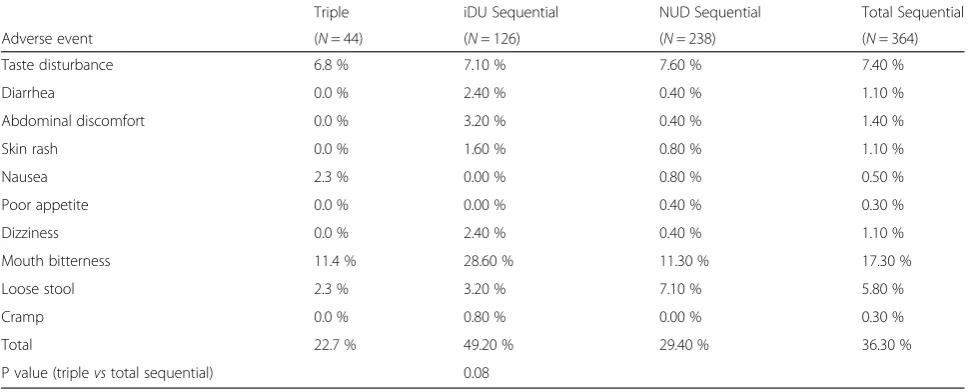
Table 4 shows the adverse events and their incidences in conventional triple and sequential therapy groups. The overall adverse event rate was higher in the se-quential group than in the triple group (36.3 % vs. 22.7 %, P= 0.08). The highest incidence of adverse events was mouth bitterness in both groups. Patients
reported compliances were similar in both the triple and sequential groups (90.9 % vs. 94.8 %, P= 0.29).
Discussion
Standard triple therapy, when first proposed, was dem-onstrated to have a high eradication efficacy with a suc-cess rate over 85 % [24]. Therefore, most therapeutic guidelines from major academic committees worldwide recommended a proton pump inhibitor based triple therapy plus clarithromycin and amoxicillin or metro-nidazole as the first-line regimen for eradication of H.
pylori[7–9]. Unfortunately, the eradication rate of this gold standard therapy declined rapidly during the fol-lowing 10 years toward unacceptable levels [25]. The frustrating outcome of the poor eradication rate led to several new strategies aimed to raise eradication effi-cacy. Innovative therapeutic approaches included ex-tending therapy duration, the altering of conventionally used antibiotics to novel ones, and the addition of multi-drug regimens.
Table 2Characteristics of subjects in ITT and PP and a comparison of the eradication rate between iDU triple and iDU sequential groups
ITT PP
iDU triple iDU sequential iDU triple iDU sequential
Number of patients 44 126 40 119
Gender (%)
Male 9 (20.5 %) 57 (45.2 %) 7 (17.5 %) 52 (43.7 %)
Female 35 (79.5 %) 69 (54.8 %) 33 (82.5 %) 67 (56.3 %)
Age (Mean ± SD) 52.6 ± 9.5 52.4 ± 12.3 53.7 ± 9.0 52.4 ± 12.3
Eradication success 34 110 34 110
Eradication rate 77.3 % 87.3 % 85.0 % 92.4 %
95 % CI 64.9–89.7 % 81.5–93.1 % 73.9–96.1 % 87.6–97.2 %
P-value 0.22 0.14
ITTintention to treat,PPper protocol,iDUinactive duodenal ulcer
Table 3Characteristics of subjects in ITT and PP and a comparison of the eradication rate between iDU sequential and NUD sequential groups
ITT PP
iDU Sequential NUD Sequential iD U Sequential NUD Sequential
Number of patients 126 238 119 226
Gender (%)
Male 57 (45.2 %) 78 (32.8 %) 52 (43.7 %) 75 (33.2 %)
Female 69 (54.8 %) 160 (67.2 %) 67 (56.3 %) 151 (66.8 %)
Age (Mean ± SD) 52.4 ± 12.3 50.3 ± 10.7 52.4 ± 12.3 50.4 ± 10.6
Eradication success 110 194 110 194
Eradication rate 87.3 % 81.5 % 92.4 % 85.80 %
95 % CI 81.5–93.1 % 76.6–86.4 % 88.4–96.4 % 83.5–88.2 %
P-value 0.11 0.04
A two-phase sequential regimen, by adding a fourth drug, has been shown to have promising eradication re-sults in many studies worldwide. However, most of these trials were conducted in patients diagnosed withH.
pyl-oriinfection and without separately analyzed eradication rates in either ulcer related or non-ulcer related groups. Our current work was a trial to compare the eradication efficacy of sequential therapy and conventional triple therapy exclusively in inactive duodenal ulcer and non-ulcer dyspepsia patients. The results demonstrated that a 10-day sequential regimen was superior to conventional triple therapy for eradication of H. pylori in treatment naïve patients. Overall, the eradication rate of sequential therapy was 88.1 % with PP analysis and 83.5 % with ITT analysis, which were higher than those of triple therapy (85.0 % with PP analysis and 77.3 % with ITT analysis). The result is similar to that shown in other studies in Western and Asian countries [26–31]. How-ever, in our trial, the eradication rate of sequential ther-apy did not reach the good category according to the Graham’s report card for gradingH. pylori therapy [32] (90–95 % intention-to-treat) as with most other studies [15, 33, 34] and did not demonstrate a significant differ-ence compared to triple therapy. One randomized con-trolled trial in southern Taiwan reported a high eradication rate (92.9 % with PP and 93.2 % with ITT analysis) of sequential therapy [35]. Patients they en-rolled had either gastric ulcers or duodenal ulcers (94.3 % of total patients). We suggest the reason why our results did not yield a higher eradication efficacy may be due to the type of gastroduodenal diseases in our patients. Our patient pool only consisted of either inactive duodenal ulcer or non-ulcer dyspepsia patients.
Previous studies found that the eradication rate of standard triple therapy in non-ulcer dyspepsia tends to
be lower than that in peptic-ulcer patients [21, 36]. Con-trary results are observed in sequential therapy and the success rates are not significantly affected by patho-logical findings (peptic-ulcer vs. non-ulcer dyspepsia) [37, 38]. Our study’s result was different, in that the eradication rate of sequential therapy (Table 3) was bet-ter in duodenal ulcer scar patients than in non-ulcer dyspepsia with ITT analysis (87.3 %vs.81.5 %) and with PP analysis (92.4 % vs. 85.8 %), which reached a signifi-cant difference. Two large studies (DU-MACH [39] and GU-MACH [40]) have therefore looked at the impact of inflammation on H. pylori eradication. Polymorph infil-tration in the antrum of patients with inflammation of grades 2/3 was associated with a significantly higher eradication rate when compared with inflammation of grades 0/1. Previous ulcer diseases may induce inflam-mation processes that cause degradation of the mucus and epithelial layers and altered epithelial permeability. That may allow better penetration of antibiotics from the gastric lumen and better systemic delivery of drugs. Besides, the subtype of H. Pylori that cause ulcer may be more aggressive which has a better response to the anti-biotics. Therefore, we speculate that the low eradication rate of sequential therapy in non-ulcer dyspepsia pa-tients tarnished the overall eradication rate of sequen-tial therapy in our 364 patients with either duodenal ulcer scar or non-ulcer dyspepsia. Although eradication of Helicobacter Pyloriis both suggested in patient with duodenal ulcer scar or non-ulcer dyspepsia, the differ-ence in eradication rate could provide us a better out-come predication to discuss with the patient.
Although the difference was not statistically signifi-cant, subgroup analysis revealed a superior eradication rate of sequential therapy in duodenal ulcer scar patients (Table 2; ITT, 87.3 %vs. 77.3 %; PP, 92.4 % vs. 85.0 %).
Table 4Adverse events in sequential therapy
Triple iDU Sequential NUD Sequential Total Sequential
Adverse event (N= 44) (N= 126) (N= 238) (N= 364)
Taste disturbance 6.8 % 7.10 % 7.60 % 7.40 %
Diarrhea 0.0 % 2.40 % 0.40 % 1.10 %
Abdominal discomfort 0.0 % 3.20 % 0.40 % 1.40 %
Skin rash 0.0 % 1.60 % 0.80 % 1.10 %
Nausea 2.3 % 0.00 % 0.80 % 0.50 %
Poor appetite 0.0 % 0.00 % 0.40 % 0.30 %
Dizziness 0.0 % 2.40 % 0.40 % 1.10 %
Mouth bitterness 11.4 % 28.60 % 11.30 % 17.30 %
Loose stool 2.3 % 3.20 % 7.10 % 5.80 %
Cramp 0.0 % 0.80 % 0.00 % 0.30 %
Total 22.7 % 49.20 % 29.40 % 36.30 %
P value (triplevstotal sequential) 0.08
Sequential therapy also achieved the acceptable ef-fectiveness category (86–89 %, ITT) and was better than triple therapy (unacceptable category: <80 %, ITT) according to Graham’s category [32]. Since many studies have proved that successful eradication of H. pylori substantially reduces the recurrent rate of duodenal ulcers, it is recommended by a world-wide consensus. We believe that a 10-day sequential regimen could be a valid alternative therapy in initial treatment for the eradication of H. pylori in duodenal ulcer scar patients.
Our data showed that the overall adverse event rate was higher in the sequential group than that in the triple group (Table 4; 36.3 %vs.22.7 %). The highest in-cidence of adverse events was mouth bitterness in both groups. The sequential group had an even higher fre-quency of mouth bitterness. Nonetheless, patient-reported
compliance was similar in both the triple and sequential therapy groups (90.9 %vs.94.8 %).
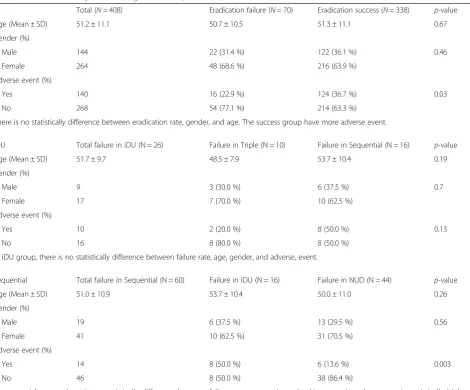
We also performed the multivariate analysis to inves-tigate the independent factors predicting eradication failure in this study. Table 5 showed the eradication ef-ficiency has no relationship with age and gender. Besides, the successful eradication group has a significantly higher adverse reaction rate then the failure group. It seemed that the eradication rate was associated independently with the different protocol and presence of ulcer scar.
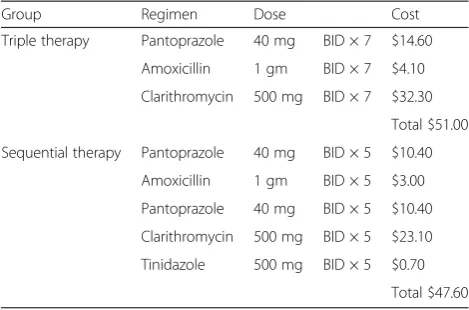
Furthermore, Table 6 shows the cost of each individual regimen. Clarithromycin was the most expensive drug and cost $32.30 in the standard triple therapy regimen, out of a total cost of $51.00. The sequential therapy regi-men cost only $47.6. Due to the comparative expense of standard therapy, replacement of it with the less costly sequential regimen would greatly reduce total treatment
Table 5Multivariate analysis to investigate the independent factors
Total (N= 408) Eradication failure (N= 70) Eradication success (N= 338) p-value
Age (Mean ± SD) 51.2 ± 11.1 50.7 ± 10.5 51.3 ± 11.1 0.67
Gender (%)
Male 144 22 (31.4 %) 122 (36.1 %) 0.46
Female 264 48 (68.6 %) 216 (63.9 %)
Adverse event (%)
Yes 140 16 (22.9 %) 124 (36.7 %) 0.03
No 268 54 (77.1 %) 214 (63.3 %)
There is no statistically difference between eradication rate, gender, and age. The success group have more adverse event.
iDU Total failure in iDU (N = 26) Failure in Triple (N = 10) Failure in Sequential (N = 16) p-value
Age (Mean ± SD) 51.7 ± 9.7 48.5 ± 7.9 53.7 ± 10.4 0.19
Gender (%)
Male 9 3 (30.0 %) 6 (37.5 %) 0.7
Female 17 7 (70.0 %) 10 (62.5 %)
Adverse event (%)
Yes 10 2 (20.0 %) 8 (50.0 %) 0.13
No 16 8 (80.0 %) 8 (50.0 %)
In iDU group, there is no statistically difference between failure rate, age, gender, and adverse, event.
Sequential Total failure in Sequential (N = 60) Failure in iDU (N = 16) Failure in NUD (N = 44) p-value
Age (Mean ± SD) 51.0 ± 10.9 53.7 ± 10.4 50.0 ± 11.0 0.26
Gender (%)
Male 19 6 (37.5 %) 13 (29.5 %) 0.56
Female 41 10 (62.5 %) 31 (70.5 %)
Adverse event (%)
Yes 14 8 (50.0 %) 6 (13.6 %) 0.003
No 46 8 (50.0 %) 38 (86.4 %)
costs. This economical consideration also favors the use of the latter treatment regimen.
The present study had a couple of limitations. Firstly, that patients were not randomized to receive either standard triple therapy or 10-day sequential therapy. Pa-tients with iDU were assigned into 2 groups according to a physician’s discretion, which may have introduced selection bias. Therefore, the number in the iDU triple group was too small. However, all patients were pro-spectively followed up with a standard protocol and were well informed about adverse problems and compliance. Secondly, bacterial culture was not performed in our protocol, and therefore the effect of antibiotic resistance was not able to be assessed. However, the resistance rates of Amoxicillin, Clarithromycin, Metronidazole, and Tetracycline in Cathy General Hospital are 13.9, 27.8, 19.4, and 0 % respectively.
Conclusion
Despite no statistically significant difference in ITT patients, 10-day sequential therapy for the eradication of H. pylori was superior in iDU patients than NUD patients and it reached a significant eradication effect-iveness in PP patients. The sequential regimen has a better eradication rate in the iDU group than in the NUD group.
Abbreviations
H. pylori:Helicobacter pylori; iDU: inactive duodenal ulcer; NUD: non-ulcer dyspepsia; ITT: intention-to-treat; PP: per-protocol; PUD: peptic ulcer disease; EGD: esophagogastroduodenoscopy; C-UBT:13C-urea breath test; CLOtest: rapid urease test.
Competing interests
The authors declare that they have no competing interests.
Authors’contributions
CCC and CNH contributed equally to this work. CCC drafted the manuscript. CNH proposed the study protocol. YYC performed data analysis. HCS, TTC, and WCH recruited all clinical cases. LCL audited all the study details and results. All authors read and approved the final manuscript.
Acknowledgment
The author declares that this research did not receive any grant from funding agency in the public, commercial, or not-for-profit sectors.
Author details 1
Division of Gastroenterology, Department of Internal Medicine, Hsinchu Cathay General Hospital, Hsinchu, Taiwan.2Committee of Medical Research and Education, Hsinchu Cathay General Hospital, Hsinchu, Taiwan.3Division of Gastroenterology, Department of Internal Medicine, Cathay General Hospital, 280, Section 4, Jen-Ai Road, Taipei 10650, Taiwan.4School of Medicine, Fu Jen Catholic University, New Taipei, Taiwan.5Department of Internal Medicine, School of Medicine, College of Medicine, Taipei Medical University, Taipei, Taiwan.
Received: 1 October 2015 Accepted: 27 November 2015
References
1. Suerbaum S, Michetti P.Helicobacter pyloriinfection. N Engl J Med. 2002;347: 1175–86.
2. Hsu PI, Lai KH, Lo GH, Tseng HH, Lo CC, Chen HC, et al. Risk factors for ulcer development in patients with non-ulcer dyspepsia: a prospective two year follow up study of 209 patients. Gut. 2002;51:15–20.
3. Helicobacter and Cancer Collaborative Group. Gastric cancer and
Helicobacter pylori: a combined analysis of 12 case control studies nested within prospective cohorts. Gut. 2001;49:347–53.
4. Uemura N, Okamoto S, Yamamoto S, Matsumura N, Yamaguchi S, Yamakido M, et al.Helicobacterinfection and the development of gastric cancer. N Engl J Med. 2001;345:784–9.
5. Parsonnet J, Hansen S, Rodriguez L, Gelb AB, Warnke RA, Jellum E, et al.
Helicobacter pyloriinfection and gastric lumphoma. N Engl J Med. 1994;330: 1267–71.
6. Fuccio L, Zagari RM, Eusebi LH, Laterza L, Cennamo V, Ceroni L, et al. Meta-analysis: canHelicobacter pylorieradication treatment reduce the risk for gastric cancer? Ann Intern Med. 2009;151:121–8.
7. Fock KM, Katelaris P, Sugano K, Ang TL, Hunt R, Talley NJ, et al. Second Asia-Pacific Consensus Guidelines forHelicobacter pyloriinfection. J Gastroenterol Hepatol. 2009;24:1587–600.
8. Chey WD, Wong BC. Practice Parameters Committee of the American College of Gastroenterology. American College of Gastroenterology guideline on the management of Helicobacter pylori infection. Am J Gastroenterol. 2007;102:1808–25.
9. Malfertheiner P, Megraud F, O’Morain CA, Atherton J, Axon ATR, Bazzoli F, et al. The European Helicobacter Study Group (EHSG). Management ofHelicobacter pylori infection–the Maastricht IV/ Florence consensus report. Gut. 2012;61:646–64. 10. Graham DY, Fischbach LA.Helicobacter pyloritreatment in the era of
increasing antibiotic resistance. Gut. 2010;59:1143–53.
11. Rimbara E, Fischbach LA, Graham DY. Optimal therapy forHelicobacter pylori infection. Nat Rev Gastroenterol Hepatol. 2011;8:79–88.
12. Megraud F, Coenen S, Versporten A, Kist M, Lopez-Brea M, Hirschl AM, et al.
Helicobacter pyloriresistance to antibiotics in Europe and its relationship to antibiotic consumption. Gut. 2013;62:34–42.
13. Zullo A, Vaira D, Vakil N, Hassan C, Gatta L, Ricci C, et al. High eradication rates ofHelicobacter pyloriwith a new sequential treatment. Aliment Pharmacol Ther. 2003;17:719–26.
14. Vaira D, Zullo A, Vakil N, Gatta L, Ricci C, Perna F, et al. Sequential therapyversus standard triple-drug therapy for Helicobacter pylori eradication: a randomized trial. Ann Intern Med. 2007;146:556–63.
15. Jafri NS, Hornung CA, Howden CW. Meta-analysis: sequential therapy appears superior to standard therapy for helicobacter pylori infection in patients naïve to treatment. Ann Intern Med. 2008;148:923–31.
16. Gatta L, Vakil N, Leandro G, Di Mario F, Vaira D. Sequential therapy or triple therapy forHelicobacter pyloriinfection: systematic review and meta-analysis of randomized controlled trials in adults and children. Am J Gastroenterol. 2009; 104:3069–79.
17. Neil GA, Suchower LJ, Johnson E, Ronca PD, Skoglund ML.Helicobacter pylori eradication as a surrogate marker for the reduction of duodenal ulcer recurrence. Aliment Pharmacol Ther. 1998;12:619–33.
18. Kim JS, Kim SG, Choi IJ, Park MJ, Kim BG, Jung HC, et al. Effect of
Helicobacter pylorieradication on duodenal ulcer scar in patient with no clinical history of duodenal ulcer. Aliment Pharmacol Ther. 2002;16:275–80.
Table 6The therapy dose and cost for triple and sequential therapy
Group Regimen Dose Cost
Triple therapy Pantoprazole 40 mg BID × 7 $14.60
Amoxicillin 1 gm BID × 7 $4.10
Clarithromycin 500 mg BID × 7 $32.30
Total $51.00
Sequential therapy Pantoprazole 40 mg BID × 5 $10.40
Amoxicillin 1 gm BID × 5 $3.00
Pantoprazole 40 mg BID × 5 $10.40
Clarithromycin 500 mg BID × 5 $23.10
Tinidazole 500 mg BID × 5 $0.70
19. Bruley des Varannes S, Flejou JF, Colin R, Zaïm M, Meunier A, Bidaut-Mazel C. There are some benefits for eradicatingHelicobacter pyloriin patients with non-ulcer dyspepsia. Aliment Pharmacol Ther. 2001;15:1177–85. 20. Jaakkimainen RL, Boyle E, Tudiver F. Is Helicobacter pylori associated with
non-ulcer dyspepsia and will eradication improve symptoms? A meta-analysis. BMJ. 1999;319:1040–4.
21. Gisbert JP, Marcos S, Gisbert JL, Pajares M.Helicobacter pylorieradication therapy is more effect in peptic ulcer than in non-ulcer dyspepsia. Eur J Gastroenterol Hepatol. 2001;13:1303–7.
22. Huang JQ, Zheng GF, Hunt RH, Wong WM, Lam SK, Karlberg J, et al. Do patients with non-ulcer dyspepsia respond differently toHelicobacter pylori eradication treatments from those with peptic ulcer disease? A systematic review. World J Gastroenterol. 2005;11:2726–32.
23. Vaira D, Vakil N. Blood, urine, stool, breath, money, andHelicobacter pylori. Gut. 2001;48:287–9.
24. Bazzoli F, Pozzato P, Zagari M, Fossi S, Ricciardiello L, Nicolini G, et al. Efficacy of lansopraole in eradicatingHelicobacter pylori: a meta-analysis. Helicobacter. 1998;3:195–201.
25. Laheij RJ, Rossum LG, Jansen JB, Straatman H, Verbeek AL. Evaluation of treatment regimens to cureHelicobacter pyloriinfection- a meta-analysis. Aliment Pharmacol Ther. 1999;13:857–64.
26. Sirimontaporn N, Thong-Ngam D, Tumwasorn S, Mahachai V. Ten-day sequential therapy ofHelicobacter pyloriinfection in Thailand. Am J Gastroenterol. 2010;105:1071–5.
27. Park HG, Jung MK, Jung JT, Kwon JG, Kim EY, Seo HE, et al. Randomised clinical trial: a comparative study of 10-day sequential therapy with 7-day standard triple therapy forHelicobacter pyloriinfection in naïve patients. Aliment Pharmacol Ther. 2012;35:56–65.
28. Chung JW, Jung YK, Kim YJ, Kwon KA, Kim JH, Lee JJ, et al. Ten-day sequentialversustriple therapy forHelicobacter pylorieradications: a prospective, open-label, randomized trial. J Gastroenterol Hepatol. 2012;27: 1675–80.
29. Liou JM, Chen CC, Chen MJ, Chen CC, Chan CY, Fang YJ, et al. Sequential
versustriple therapy for the first-line treatment ofHelicobacter pylori: a multicentre, open-label, randomised trial. Lancet. 2013;381:205–13. 30. Zhou L, Zhang J, Chen M, Hou X, Li Z, Song Z, et al. A comparative study of
sequential therapy and standard triple therapy forHelicobacter pyloriinfection: a randomized multicenter trial. Am J Gastroenterol. 2014;109:535–41. 31. Gatta L, Vakil N, Vaira D, Scarpignato C. Global eradication rates for
Helicobacter pyloriinfection: systematic review and meta-analysis of sequential therapy. BMJ. 2013;347:f4587.
32. Graham DY, Lu H, Yamaoka Y. A report card to gradeHelicobacter pylori therapy. Helicobacter. 2007;12:275–8.
33. Tong JL, Ran ZH, Shen J, Xiao SD. Sequential therapyvs.standard triple therapies forHelicobacter pyloriinfection: a meta-analysis. J Clin Pharm Ther. 2009;34:41–53.
34. Gisber JP, Calvet X, O’Connor A, Mégraud F, O’Morain CA. Sequential therapy forHelicobacter pylorieradication : a critical review. J Clin Gastroenterol. 2010;44:313–25.
35. Tsay FW, Tseng HH, Hsu PI, Wang KM, Lee CC, Chang SN, et al. Sequential therapy achieves a higher eradication rate than standard triple therapy in Taiwan. J Gastroenterol Hepatol. 2012;27:498–503.
36. de Boer WA, Tytgat GN. Should anti-Helicobacter therapy be different in patients with dyspepsia compared with patients with peptic ulcer diathesis? Eur J Gastroenterol Hepatol. 2001;13:1281–4.
37. De Francesco V, Zullo A, Hassan C, Faleo D, Ierardi E, Panella C, et al. Two new treatment regiments forHelicobacter pyloridoes not allow reaching therapeutic outcome of sequential scheme: a prospective randomized study. Dig Liver Dis. 2001;33:676–9.
38. Zullo A, De Francesco V, Hassan C, Morini S, Vaira D. The sequential therapy regimen forHelicobacter pylorieradication: a pooled-data analysis. Gut. 2007; 56:1353–7.
39. Zanten SJ, Bradette M, Farley A, Leddin D, Lind T, Unge P, et al. The DU-MACH study: eradication ofHelicobacter pyloriand ulcer healing in patients with acute duodenal ulcer using omeprazole based triple therapy. Aliment Pharmacol Ther. 1999;13:289–95.
40. Malfertheiner P, Bayerdörffer E, Diete U, Gil J, Lind T, Misiuna P. The GU-MACH study: the effect of 1-week omeprazole triple therapy onHelicobacter pylori infection in patients with gastric ulcer. Aliment Pharmacol Ther. 1999;13(6): 703–12.
• We accept pre-submission inquiries
• Our selector tool helps you to find the most relevant journal
• We provide round the clock customer support
• Convenient online submission
• Thorough peer review
• Inclusion in PubMed and all major indexing services
• Maximum visibility for your research
Submit your manuscript at www.biomedcentral.com/submit