R E S E A R C H A R T I C L E
Open Access
A pre-post study testing a lung cancer
screening decision aid in primary care
Daniel S. Reuland
1*, Laura Cubillos
2, Alison T. Brenner
2, Russell P. Harris
1, Bailey Minish
3and Michael P. Pignone
4Abstract
Background:The United States Preventive Services Task Force (USPSTF) issued recommendations for older, heavy lifetime smokers to complete annual low-dose computed tomography (LDCT) scans of the chest as screening for lung cancer. The USPSTF recommends and the Centers for Medicare and Medicaid Services require shared decision making using a decision aid for lung cancer screening with annual LDCT. Little is known about how decision aids affect screening knowledge, preferences, and behavior. Thus, we tested a lung cancer screening decision aid video in screening-eligible primary care patients.
Methods:We conducted a single-group study with surveys before and after decision aid viewing and medical record review at 3 months. Participants were active patients of a large US academic primary care practice who were current or former smokers, ages 55–80 years, and eligible for screening based on current screening guidelines. Outcomes assessed pre-post decision aid viewing were screening-related knowledge score (9 items about screening-related harms of false positives and overdiagnosis, likelihood of benefit; score range = 0–9) and preference (preferred screening vs. not). Screening behavior measures, assessed via chart review, included provider visits, screening discussion, LDCT ordering, and LDCT completion within 3 months.
Results: Among 50 participants, knowledge increased from pre- to post-decision aid viewing (mean = 2.6 vs. 5.5, difference = 2.8; 95% CI 2.1, 3.6, p< 0.001). Preferences across the overall sample remained similar such that 54% preferred screening at baseline and 50% after viewing; however, 28% of participants changed their preference (to or away from screening) from baseline to after viewing. We assessed screening behavior for 36 participants who had a primary care visit during the 3-month period following enrollment. Eighteen of 36 preferred screening after decision aid viewing. Of these 18, 10 discussed screening, 8 had a test ordered, and 6 completed LDCT. Among the 18 who preferred no screening, 7 discussed screening, 5 had a test ordered, and 4 completed LDCT.
Conclusions: In primary care patients, a lung cancer screening decision aid improved knowledge regarding screening-related benefits and harms. Screening preferences and behavior were heterogeneous.
Trial registration: This study is registered at www.clinicaltrials.gov. NCT03077230 (registered retrospectively,November 22, 2016).
Keywords:Cancer screening, Shared decision making, Primary care, Medicare, Pulmonary diseases
* Correspondence:[email protected]
1Department of General Medicine and Clinical Epidemiology, University of
North Carolina School of Medicine, Cecil G Sheps Center for Health Services Research, University of North Carolina at Chapel Hill, 725 Martin Luther King Jr. Blvd, CB 7590, Chapel Hill, NC 27599, USA
Full list of author information is available at the end of the article
Background
Lung cancer is the leading cause of cancer death in the United States (US) [1]. The National Lung Screening Trial (NLST) showed that annual low-dose computed tomography (LDCT) can reduce mortality from lung cancer in a high-risk population [2]. However, despite evidence for mortality reduction, LDCT screening can also lead to harms. For example, more than 95% of screen-detected nodules are ultimately determined to be benign (i.e. false positives) after follow-up evaluation, which can be costly and invasive [2]. Further, screening can also lead to the detection and unnecessary treatment of cancers that would not have affected the patient clin-ically in his/her lifetime (overdiagnosis) [3, 4].
Based on NLST findings and other evidence [5, 6], the US Preventive Services Task Force (USPSTF) found that there was sufficient support for the net benefit of screen-ing to recommend annual screenscreen-ing with LDCT for patients ages 55–80 with 30 or more pack-years smoking history who have smoked in the past 15 years [4]. Because of the tradeoffs between benefits and harms involved, guidelines recommend a thorough process of informed and shared decision-making occur prior to commencing annual screening. [4, 7] However, experts remain con-cerned that widespread implementation of screening could happen without patients being appropriately informed [8]. These concerns are supported by accumu-lating evidence that US patients generally overestimate the benefits and are poorly informed about the potential harms of cancer screening [9–14]. These concerns in-formed a 2015 Centers for Medicare & Medicaid Services (CMS) coverage decision requiring that a “shared decision-making visit”involving the use of a patient deci-sion aid be conducted before screening would be covered for CMS beneficiaries [15, 16].
Decision aids are evidence-based tools designed to fa-cilitate informed and shared decision-making about complex treatments or screening choices [17]. A lung cancer screening decision aid may be a helpful adjunct in conveying the complex information about benefits and harms of screening. However, few lung cancer screening decision aids have been tested and, to our knowledge, none have been studied in a primary care setting, where cancer screening decisions typically take place [18–20]. Moreover, little is known about whether decision aids help screening-eligible patients develop a realistic understanding of the likelihood of benefitting from screening or improve their understanding of im-portant but difficult to understand screening-related harms, such as false positives and overdiagnosis [18, 19].
Methods
We report the findings from a single-group primary care clinic-based study of a video decision aid on lung cancer
screening in a cohort of screening-eligible primary care patients. We had three main study aims: first, to assess the effect of the decision aid on knowledge of the bene-fits and harms of screening and on screening prefer-ences; second, to describe screening behavior within 3 months of viewing a screening decision aid; and third, to examine relationships between screening knowledge, preferences, and screening test ordering during subse-quent primary care encounters.
Setting and participants
The study setting was an academic internal medicine practice serving approximately 13,000 patients. We identi-fied active patients who were current or former smokers ages 55–80. We excluded patients with lung cancer, can-cer treatment with chemotherapy or radiation within 18 months, recent hemoptysis or unexplained weight loss, or any chest CT within 18 months. Study staff reviewed electronic health records (EHR) and further excluded those who clearly did not meet USPSTF smoking history requirements (i.e. fewer than 30 pack-years or quit more than 15 years ago). Primary providers reviewed lists of their potentially eligible patients and excluded those deemed inappropriate for screening based on comorbidi-ties. Approved patients were mailed a recruitment packet containing a study invitation letter and an opt-out card.
Patients then received a recruitment telephone call where an eligibility survey was administered to confirm screening eligibility based on USPSTF guidelines. Eligible patients who agreed to participate were scheduled for a study visit at the clinic. Upon arrival and consent, partic-ipants completed a baseline survey, viewed the video decision aid, and completed a follow-up survey. Screen-ing behaviors were assessed via EHR review at 3 months. Participants received a $40 gift card. Data were collected from October 2015–October 2016 and analyzed from October 2016–February 2017.
Intervention
We previously developed and refined the decision aid based on feedback from screening-eligible patients from the community (n= 11) and providers from the academic medical center (n = 11) [21]. The decision aid was designed to meet requirements specified by CMS and relevant standards set by the International Patient Decision Aid Standards Collaboration, and to be accessible to those with low literacy [15, 22]. Writ-ten text was read aloud, and technical terms and con-cepts were explained using narration, graphics, and animations. We pre-tested the decision aid and mea-sures with 10 screening-eligible participants before beginning the pre-post phase of the study.
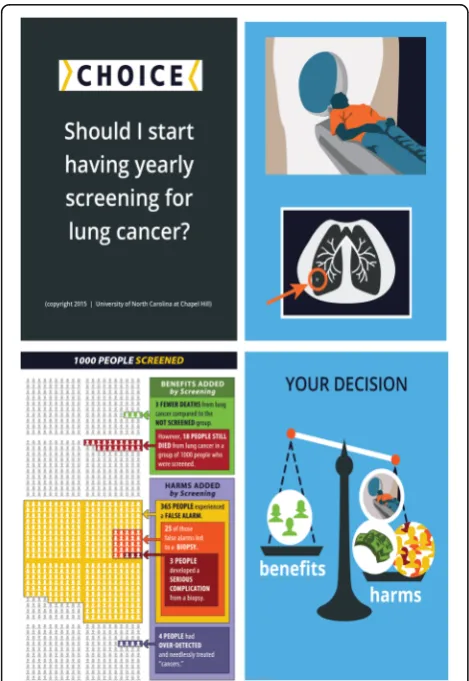
and a dynamic icon array (pictogram) that sequen-tially depicted estimates for benefits and harms of screening among 1000 individuals screened annually for 3 years (Fig. 1). Estimates were based on NLST trial data as presented in materials developed by the National Cancer Institute and the Veterans Health Administration (VHA) [2, 20, 23, 24]. Benefits pre-sented in the pictogram were lung cancer deaths averted (3 per 1000 screened). Harms presented in-cluded false positives, need for biopsy that did not find cancer, serious complications from biopsies, and overdiagnosis. Other potential screening harms, pre-sented qualitatively (not in the pictogram) included radiation exposure, anxiety and distress, and costs re-lated to follow-up tests and procedures. The video concluded with an implicit values clarification exercise prompting the viewer to weigh the potential benefits and harms of screening and discuss them with his/her doctor. Participants viewed the 6-min video at the clinic on a tablet computer (available online https:// goo.gl/1f7XIY).
Measures
Knowledge
We measured screening-related knowledge before and after decision aid viewing (items shown in Results, Table 2). Knowledge of benefit was assessed using a sin-gle item asking about the number of lung cancer deaths averted per 1000 individuals screened. Response options including contiguous estimates ranging from 0 up to 1000. Because our primary goal was to convey the“gist” concept that the number of individuals who benefit is small relative to the number of individuals screened, we treated responses that were within an order of magni-tude of the value presented in the decision aid, i.e. up to 30 per 1000, as correct. Knowledge of harms was assessed using seven items adapted from a previously-published overdiagnosis knowledge scale [25] and one item about false positives. Knowledge items were catego-rized as either correct or incorrect, with “don’t know” responses treated as incorrect. A knowledge score was calculated (0–9 points) by summing the correct answers.
Preference
Screening preference was assessed through a single 5-point Likert item adapted from a previous study asking participants how much they agreed with the statement
“I plan to have a lung cancer screening test in the near future”(strongly agree to strongly disagree) [26].
Clinical screening behavior and LDCT findings
For patients who had a primary care visit, we assessed whether there was EHR documentation of each of the following: screening-related discussion, LDCT order, and LDCT completion. For completed CTs, we also recorded the LungRADS nodule classification based on the radiol-ogist’s report [27].
Decision aid acceptability
We assessed decision aid acceptability using a published scale measuring perception of decision aid length, bal-ance, and suitability for decision-making [28].
Statistical analyses
We characterized the study population with descriptive statistics. We tested for pre-post changes in knowledge using a paired t-test for total score and McNemar’s chi-squared tests for individual items. We dichotomized the preference item, defining “preference for screening” as
“agree” or“strongly agree” responses. We calculated the proportions who changed their preference before and after decision aid viewing. We calculated proportions for screening behavior measures and LDCT findings among participants who had a provider visit after viewing the decision aid (and thus an opportunity for screening dis-cussion and test ordering). We examined the relationship
between (post-decision aid) knowledge and screening preference using logistic regression controlling for baseline preference. We also calculated the proportion of visits with a “preference concordant” decision, de-fined as either: preferring screening and having LDCT ordered, OR not preferring screening and not having an LDCT ordered. Analyses were conducted using STATA (Release-13, College Station, TX).
Results
Enrollment (see Fig. 2): We mailed 716 recruitment let-ters and reached 378 patients by telephone. Among 215 patients who completed the initial eligibility assessment, 135 were found ineligible. Common reasons for declin-ing to complete the eligibility assessment included poor
health, lack of time, and transportation challenges. Among the 80 patients initially found eligible for the study, 18 either declined participation or did not attend the study visit. Of the 62 (78%) eligible patients who participated, 10 completed the pre-test phase and thus were ineligible to participate in the main pre-post phase. Two additional participants were later found to be ineligible during the follow-up chart review phase of the study (because of re-cent chest CTs) and were excluded from analysis. The final analytic sample included 50 participants.
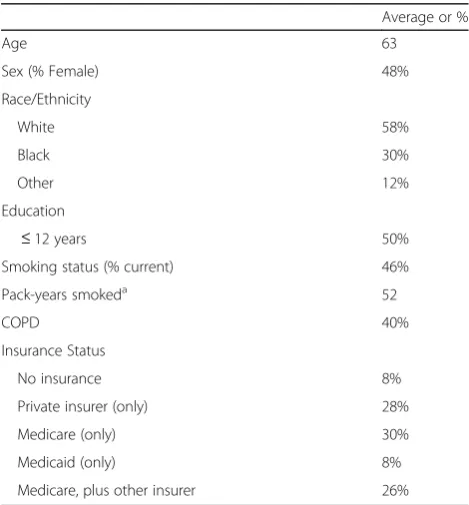
Sample characteristics (Table 1) include: mean age of 63 years; 48% female; 58% White; 30% Black; 12% other race; 50% high school education or less; 46% current smokers; average of 52 pack-years smoked; 40% COPD; and 56% had Medicare (alone or with another insurance).
Screening knowledge and preferences
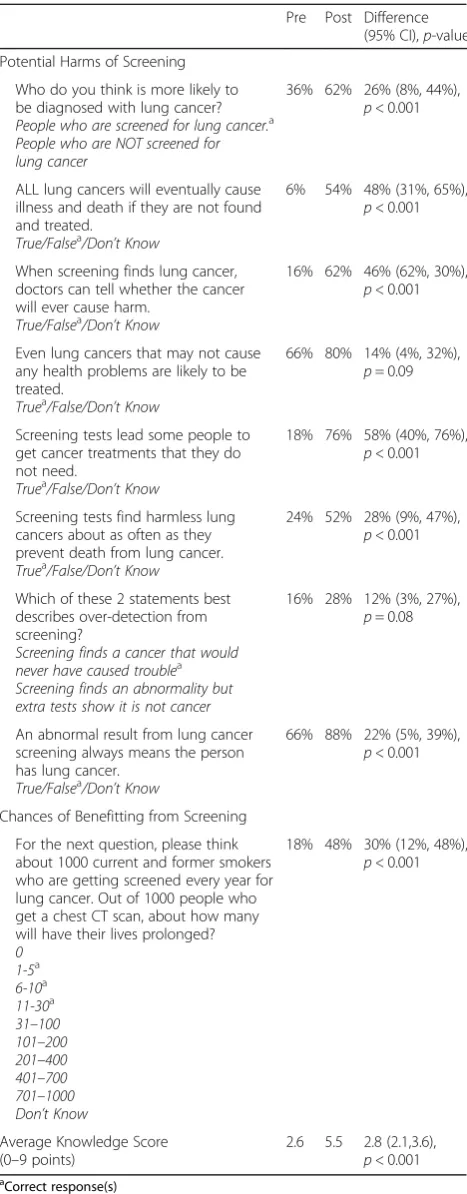
Knowledge score (9-point scale) increased after viewing the decision aid from 2.6 to 5.5 (difference = 2.8; 95% confidence interval [CI] 2.1, 3.6,p< 0.001) (Table 2). Be-fore decision aid viewing, the most common response was that 401–700 individuals benefit per 1000 screened. After decision aid viewing, the most common response category was 1–5 per 1000. In the overall sample, 27 (54%) participants preferred screening at baseline and 25 (50%) preferred screening after viewing.
Of the 27 participants who preferred screening pre-decision aid viewing, 8 (30%) changed and did not prefer screening after viewing. Of the 23 participants who did
716 Current/
Former Smokers
378 Reached
by Phone
338 Not
Reached
163 Declined
Eligibility
Assessment
135 Ineligible
215 Assessed
for Eligibility
9 Declined to
Participate
9 No Show
10 Pre-test
Participants
2 Excluded*
80 Eligible
62
Participated
50 Included in
Analysis
*found to be ineligible during follow-up chart review
Fig. 2Flowchart of enrollment
Table 1Participant Characteristics (n= 50)
Average or %
Age 63
Sex (% Female) 48%
Race/Ethnicity
White 58%
Black 30%
Other 12%
Education
≤12 years 50%
Smoking status (% current) 46%
Pack-years smokeda 52
COPD 40%
Insurance Status
No insurance 8%
Private insurer (only) 28%
Medicare (only) 30%
Medicaid (only) 8%
Medicare, plus other insurer 26%
a
not prefer screening pre-decision aid, 6 (26%) preferred screening post-decision aid.
We observed an inverse relationship between post-decision aid knowledge and screening preference (odds ratio = 0.73; 95% CI 0.54, 0.98;p= 0.03). For each point in-crease in post-decision aid knowledge score there was an estimated 27% reduction in the odds of preferring screening.
Decision aid acceptability
Most participants (n= 48, 96%) reported that the deci-sion aid was “useful in making a decision about getting screened for lung cancer.” Most participants (n= 29, 58%) felt that the decision aid was balanced, 16 (32%) in-dicated that it was slanted toward getting screened, and 5 (10%) indicated that it was slanted toward no screening.
Screening behavior
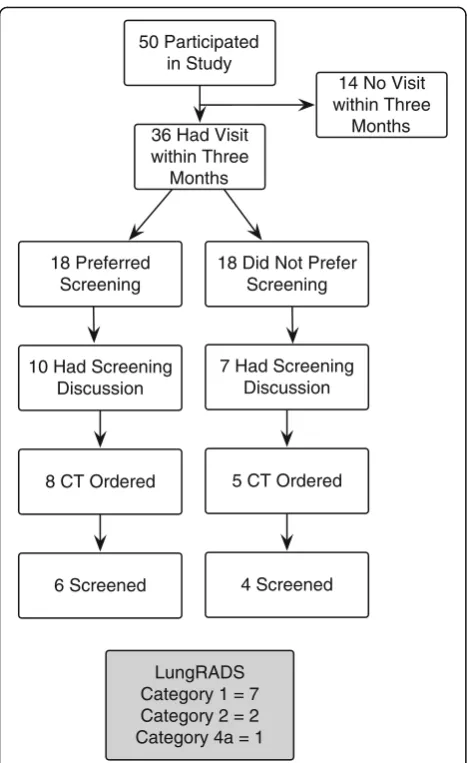
Thirty-six participants had a clinic visit in the 3 months following study enrollment (Fig. 3), among whom 21 (58%) had concordance between test preference and test ordering. Among 18 participants preferring screening after decision aid viewing, 10 (56%) discussed screening, 8 (44%) had a test ordered, and 6 (33%) completed LDCT. Among the 18 not preferring screening, 7 (39%) discussed screening, 5 (28%) had a test ordered, and 4 (22%) completed LDCT. Discordance was greatest for the 18 participants who indicated they preferred screen-ing, of whom 10 did not subsequently have an LDCT ordered. Notably, in 8 of these 10 cases, there was no apparent screening discussion with the provider.
LDCT findings
Among the 10 completed LDCTs, 7 were LungRADS cat-egory 1 (normal result) and 2 were catcat-egory 2 (small nod-ules, benign appearance). One was category 4a (suspicious findings); this participant preferred screening in the study and the recommended 3-month follow-up scan showed resolution of the nodule.
Discussion
We report findings from testing a lung cancer screening decision aid in 50 primary care patients. We found that decision aid viewing was associated with greater know-ledge of the benefits and harms of screening. At baseline, we found that participants tended to greatly overesti-mate the chances of benefitting from screening. After viewing, participants tended to have a more realistic understanding of the chances of benefitting. We also found that decision aid viewing led to improved under-standing of two important but conceptually complex screening-related harms: false positives and overdiagno-sis. To our knowledge, this study is the first to Table 2Changes in knowledge and intent to initiate lung cancer
screening before and after viewing the decision aid (n= 50)
Pre Post Difference (95% CI),p-value Potential Harms of Screening
Who do you think is more likely to be diagnosed with lung cancer?
People who are screened for lung cancer.a People who are NOT screened for lung cancer
36% 62% 26% (8%, 44%),
p< 0.001
ALL lung cancers will eventually cause illness and death if they are not found and treated.
True/Falsea/Don’t Know
6% 54% 48% (31%, 65%),
p< 0.001
When screening finds lung cancer, doctors can tell whether the cancer will ever cause harm.
True/Falsea/Don’t Know
16% 62% 46% (62%, 30%),
p< 0.001
Even lung cancers that may not cause any health problems are likely to be treated.
Truea/False/Don’t Know
66% 80% 14% (4%, 32%),
p= 0.09
Screening tests lead some people to get cancer treatments that they do not need.
Truea/False/Don’t Know
18% 76% 58% (40%, 76%),
p< 0.001
Screening tests find harmless lung cancers about as often as they prevent death from lung cancer.
Truea/False/Don’t Know
24% 52% 28% (9%, 47%),
p< 0.001
Which of these 2 statements best describes over-detection from screening?
Screening finds a cancer that would never have caused troublea Screening finds an abnormality but extra tests show it is not cancer
16% 28% 12% (3%, 27%),
p= 0.08
An abnormal result from lung cancer screening always means the person has lung cancer.
True/Falsea/Don’t Know
66% 88% 22% (5%, 39%),
p< 0.001
Chances of Benefitting from Screening For the next question, please think about 1000 current and former smokers who are getting screened every year for lung cancer. Out of 1000 people who get a chest CT scan, about how many will have their lives prolonged?
0 1-5a 6-10a 11-30a 31–100 101–200 201–400 401–700 701–1000 Don’t Know
18% 48% 30% (12%, 48%),
p< 0.001
Average Knowledge Score (0–9 points)
2.6 5.5 2.8 (2.1,3.6),
p< 0.001
a
demonstrate that viewing a decision aid can help attenu-ate biased perceptions about the benefits and harms of lung cancer screening.
Our study complements and extends a limited body of empiric evidence about lung cancer screening deci-sion aids. Previous studies were conducted in popula-tions recruited from the community [19], or referral settings such as a tobacco cessation clinic [18] or a dedicated, sub-specialty screening program [20]. Our study was conducted in a primary care setting and allowed providers to exclude patients they believed to be poor screening candidates based on co-morbidity concerns. Thus, despite being relatively small, our study mimicked a systematic, practice-based approach to screening. Furthermore, two of three prior studies tested lung cancer screening decision aids in mixed populations that included relatively small numbers of screening eligible patients (n= 14 and n= 11,
respectively) [18, 19]. All participants in our study were eligible for screening based on current USPSTF guidelines.
We found that baseline (pre-decision aid) screening preferences were heterogeneous, with roughly half of participants falling into each of our two preference groups (preferring screening vs. not). Although decision aid viewing was not associated with net changes in the proportions in each of these preference groups in the overall study sample, about one-quarter of participants in each group actually changed their screening prefer-ence after decision aid viewing (in opposite directions). Our findings suggest that we cannot assume screening-eligible primary care patients will be uniformly inclined toward or away from screening. Moreover, our results also suggest that a non-trivial proportion of primary care patients may change their preferences as they become more informed about screening.
Our results are consistent with the findings of Kinsinger et al.’s VHA pragmatic screening demonstra-tion pilot [29] in that we observed heterogeneity in screening behavior. Among participants who preferred screening and saw a provider within 3 months of deci-sion aid viewing, about half discussed LDCT scanning with their provider and about a third completed an LDCT. We also found that some participants who did not prefer screening after decision aid viewing ended up completing an LDCT. Kinsinger et al. similarly found that 50% of eligible patients completed screening [29]. While the VHA demonstration program developed and utilized paper-based decision support materials (from which we adapted our video decision aid), no data are available regarding the manner and extent to which they were used.
Our findings that 50% of patients preferred screen-ing post-decision aid and 28% completed screenscreen-ing (among patients with post-decision aid primary care encounters), contrasts with findings from what is, to our knowledge, the only other study to assess screening completion in individ-uals receiving a lung cancer screening decision aid. That study, conducted by Mazzone et al. in patients attending a tertiary screening program, found that 95% of participants completed screening after undergoing a shared decision making visit [20]. We hypothesize that the overwhelming majority of patients who attend a dedicated lung cancer screening program assume that the purpose of referral to such a program is to complete screening, rather than to de-cide about screening. When considering Mazzone’s findings alongside our results, it suggests that the time frame during which screening-eligible patients actually make decisions about screening is before they attend a dedicated screening program. Tertiary lung cancer screening programs are now being implemented in the US, and many claim to be able to conduct shared decision making. Our findings add to the 50 Participated
in Study
36 Had Visit within Three
Months
14 No Visit within Three
Months
18 Preferred Screening
10 Had Screening Discussion
8 CT Ordered
6 Screened
18 Did Not Prefer Screening
7 Had Screening Discussion
5 CT Ordered
4 Screened
LungRADS Category 1 = 7 Category 2 = 2 Category 4a = 1
discourse regarding the appropriate implementation context for medical decision making about lung cancer screening.
We found that the more knowledge participants had about benefits and harms of screening, the less likely they were to prefer screening. The fact that we did not observe differences in screening behavior sug-gests the need for additional research aimed at under-standing how we can help ensure that patients receive care that is consistent with their preferences. This will likely require interventions beyond providing patient decision aids.
Our study examined decision aid effects on knowledge about two important harms of screening: overdiagnosis and false positives. We chose these outcomes because: 1) overdiagnosis and false positive tests can cause sub-stantial harms in screened populations; 2) CMS explicitly requires that information about overdiagnosis and false positives be included in lung cancer screening decision aids; and 3) these harms may not be recognized or understood by patients making medical decisions about cancer screening [9, 15, 25]. Other knowledge domains are also probably relevant to decisions about lung cancer screening [8]. Further research is needed to assess the validity of measures of decision-relevant knowledge and to better understand knowledge thresholds at which pa-tients may be considered adequately informed to make medical decisions about cancer screening.
We found relatively low concordance (58%) between (post-decision aid) preferences and LDCT ordering during subsequent provider visits. It appears that a major driver of discordance was that many patients who preferred screening and did not have an LDCT ordered did not actually have an opportunity to dis-cuss screening with their provider. This finding points to an important problem in implementation of patient decision support in health care. Decision aids are intended not to replace but to inform discussions be-tween patients and providers about medical decisions [30, 31]. However, competing demands and lack of adequate provider time to deliver preventive services are important barriers to effective communication and decision-making [16]. Further, lung cancer screening is especially complex given both the risk for lung cancer in this population and the chances of serious complications as a consequence of screening. Thus, further research is needed to understand how best to structure lung cancer screening decision support in-terventions in the primary care medical home to en-sure that there is adequate time for patients and providers to discuss and deliberate. Moreover, more research is needed to understand the role that do-mains other than knowledge and stated preferences play in the complex picture of lung cancer screening behavior.
Limitations
Our study has limitations. First, because of the one-group, pre-post study design we were unable to compare the effects of the decision aid with usual care. Second, this was a single site study and many patients declined initial eligibility assessment. Additionally, patients re-ceived an incentive to participate and were required to attend a separate study visit, both of which can affect participant behavior and sample representativeness. Thus, the degree to which the findings are generalizable to other screening-eligible populations is unclear. Never-theless, our participants were similar to NLST partici-pants in terms of average age (63 in our study, 62 in NLST), pack-years smoked (52 vs. 56, respectively), per-cent current smokers (46% vs. 48%, respectively), and percent female (48% vs 41%, respectively) [32]. Our sam-ple reflects a more disadvantaged population than was studied in the NLST in that they were less likely to be white (58% vs 91%, respectively) and less likely to have received education beyond high school (50% vs 70%, re-spectively) [33]. Third, knowledge was assessed immedi-ately following completion of the decision aid and may not reflect long-term retention of lung cancer screening information. Finally, our behavior assessments were rela-tively crude in that we did not differentiate between chest CT scans discussed and ordered for diagnostic rea-sons (i.e. to evaluate symptoms) vs. for true screening.
Another consideration is that the decision aid we tested was not targeted to lung cancer risk. Ideally, infor-mation about benefits and harms of screening would be tailored to the patient’s individual lung cancer risk, as occurs in the decision aid produced at the University of Michigan [33]. However, brief video decision aids such as ours or the one developed by Volk and colleagues [18] do not require high-level reading capability, entry of patient-specific data, or other interaction by the patient. Such a format offers potential advantages in terms of implementation, and may be better suited for low-literacy populations. Studies are needed to examine tradeoffs associated with using simpler versus more complex, tailored decision aids for lung cancer screen-ing, particularly given the prevalence of low education and low literacy in the US screening-eligible population.
Conclusions
preferences after decision aid viewing. In contrast to findings in a referral population at a tertiary, sub-specialty screening program, screening preferences and behaviors among screening-eligible patients in a primary care population appear to be heterogeneous.
Abbreviations
CI:Confidence Interval; CMS: Center for Medicare and Medicaid Services; EHR: Electronic Health Record; LDCT or CT: Low-Dose Computed Tomography or Computed Tomography; NLST: National Lung Screening Trial; US: United States; USPSTF: United States Preventive Services Task Force; VHA: Veterans Health Administration
Acknowledgements
The authors would like to acknowledge Adrian Compean García for his contributions in the field, as well as Carolina Health Assessment and Resource Tool (CHART) and the CHART team for their assistance in delivering the intervention and instruments through CHART’s online platform. These findings were previously presented at the Preventing Overdiagnosis 2016 Conference on September 20-22, 2016 and the 38th Annual Meeting of the Society for Medical Decision Making on October 23, 2016.
Funding
This study was supported in part by a grant from NCI (P30-CA16086) to the Lineberger Comprehensive Cancer Center, and the Cancer Prevention and Control Intervention Research, an initiative of the University Cancer Research Fund and the UNC Lineberger Comprehensive Cancer Center, at the University of North Carolina at Chapel Hill (UNC). Other support for this study came from the North Carolina Translational and Clinical Sciences Institute at the University of North Carolina (Grant No. 1UL1TR001111; UNC IRB#s 14– 1813 and 14–2012).
Availability of data and materials
The datasets analyzed during the current study are available from the corresponding author on reasonable request.
Authors’contributions
DR conceived of the study, interpreted the results, and composed the manuscript. LC collected participant data, interpreted results, and contributed substantially to writing the manuscript. AB provide input on study design, analyzed and interpreted data and contributed substantially to writing the manuscript. RH provided input on study design, interpreted results, and contributed to writing the manuscript. BM collected participant data and reviewed the manuscript. MP provided input on study design, interpreted results, and contributed to writing the manuscript. All authors read and approved the final version of the manuscript.
Ethics approval and consent to participate
The University of North Carolina IRB approved the study (#14–2948). All participants were informed and completed a signed consent form.
Consent for publication
Not applicable.
Competing interests
Michael Pignone is a member of the US Preventive Services Task Force. The views presented here are not necessarily those of the Task Force.
Publisher’s Note
Springer Nature remains neutral with regard to jurisdictional claims in published maps and institutional affiliations.
Author details
1Department of General Medicine and Clinical Epidemiology, University of
North Carolina School of Medicine, Cecil G Sheps Center for Health Services Research, University of North Carolina at Chapel Hill, 725 Martin Luther King Jr. Blvd, CB 7590, Chapel Hill, NC 27599, USA.2Lineberger Comprehensive
Cancer Center, Cecil G Sheps Center for Health Services Research, University of North Carolina at Chapel Hill, 725 Martin Luther King Jr. Blvd, CB 7590,
Chapel Hill, NC 27599, USA.3Department of General Medicine and Clinical
Epidemiology, University of North Carolina, School of Medicine, Ambulatory Care Center, University of North Carolina at Chapel Hill, 101 Mason Farm Road, Chapel Hill, NC 27599-7745, USA.4Department of Medicine, Dell Medical School, The University of Texas at Austin, 1912 Speedway, Campus Mail Code D2000, Austin, TX 78712, USA.
Received: 8 June 2017 Accepted: 2 January 2018
References
1. American Cancer Society. Cancer Facts & Figures 2017. Atlanta: American Cancer Society; 2017.
2. National Lung Screening Trial Research Team, Aberle DR, Adams AM, et al. Reduced lung-cancer mortality with low-dose computed tomographic screening. N Engl J Med. 2011;365(5):395–409.
3. Patz EF Jr, Pinsky P, Gatsonis C, et al. Overdiagnosis in low-dose computed tomography screening for lung cancer. JAMA Int Med. 2014;174(2):269–74. 4. Moyer VA. U. S. Preventive Services Task Force. Screening for lung cancer: U.
S. Preventive Services Task Force recommendation statement. Ann Intern Med. 2014;160(5):330–8.
5. de Koning HJ, Meza R, Plevritis SK, et al. Benefits and harms of computed tomography lung cancer screening strategies: a comparative modeling study for the U.S. Preventive Services Task Force. Ann Intern Med. 2014; 160(5):311–20.
6. Humphrey L, Deffebach M, Pappas M, et al. Screening for lung cancer: systematic review to update the US Preventive Services Task Force recommendation. MD: Rockville; 2013.
7. Wender R, Fontham ET, Barrera E Jr, et al. American Cancer Society lung cancer screening guidelines. CA Cancer J Clin. 2013;63(2):107–17. 8. Harris RP, Sheridan SL, Lewis CL, et al. The harms of screening: a proposed
taxonomy and application to lung cancer screening. JAMA Int Med. 2014; 174(2):281–5.
9. Hoffman RM, Lewis CL, Pignone MP, et al. Decision-making processes for breast, colorectal, and prostate cancer screening: the DECISIONS survey. Med Decis Mak. 2010;30(5 Suppl):53S–64S.
10. Schwartz LM, Woloshin S, Fowler FJ Jr, Welch HG. Enthusiasm for cancer screening in the United States. JAMA. 2004;291(1):71–8.
11. Hoffman RM, Elmore JG, Fairfield KM, Gerstein BS, Levin CA, Pignone MP. Lack of shared decision making in cancer screening discussions: results from a national survey. Am J Prev Med. 2014;47(3):251–9.
12. Hoffman RM, Couper MP, Zikmund-Fisher BJ, et al. Prostate cancer screening decisions: results from the National Survey of medical DECISIONS (DECISIONS study). Arch Intern Med. 2009;169(17):1611–8.
13. Lafata JE, Divine G, Moon C, Williams LK. Patient-physician colorectal cancer screening discussions and screening use. Am J Prev Med. 2006;31(3):202–9. 14. Wunderlich T, Cooper G, Divine G, Flocke S, Oja-Tebbe N, Stange K, Lafata JE.
Inconsistencies in patient perceptions and observer ratings of shared decision making: the case of colorectal cancer screening. Patient Educ Couns. 2010; 80(3):358–63.
15. Decision Memo for Screening for Lung Cancer with Low Dose Computed Tomography (LDCT) (CAG-00439N). https://www.cms.gov/medicare-coverage-database/details/nca-decision-memo.aspx?NCAId=274. Accessed 5 Feb 2015. 16. Crothers K, Kross EK, Reisch LM, et al. Patients’attitudes regarding lung
cancer screening and decision aids. A survey and focus group study. Ann Am Thorac Soc. 2016;13(11):1992–2001.
17. Brenner A, Howard K, Lewis C, et al. Comparing 3 values clarification methods for colorectal cancer screening decision-making: a randomized trial in the US and Australia. J Gen Intern Med. 2014;29(3):507–13. 18. Volk RJ, Linder SK, Leal VB, et al. Feasibility of a patient decision aid about
lung cancer screening with low-dose computed tomography. Prev Med. 2014;62:60–3.
19. Lau YK, Caverly TJ, Cao P, et al. Evaluation of a personalized, web-based decision aid for lung cancer screening. Am J Prev Med. 2015;49(6):e125–9. 20. Mazzone PJ, Tenenbaum A, Seeley M, Petersen H, Lyon C, Han X, Wang XF.
Impact of a lung cancer screening counseling and shared-decision-making visit. Chest. 2017;151(3):572–8.
In: 3rd annual preventive Overdiagnosis conference: September 1–3, 2015; Bethesda, MD; 2015.
22. Elwyn G, O'Connor A, Stacey D, et al. Developing a quality criteria framework for patient decision aids: online international Delphi consensus process. BMJ. 2006;333(7565):417.
23. Screening for Lung Cancer. http://www.prevention.va.gov/docs/ LungCancerScreeningHandout.pdf. Accessed 1 Sept 2014.
24. Patient and Physician NLST Study Guide. https://www.cancer.gov/types/ lung/research/NLSTstudyGuidePatientsPhysicians.pdf. Accessed 1 Sept 2014. 25. Hersch J, Barratt A, Jansen J, et al. Use of a decision aid including
information on overdetection to support informed choice about breast cancer screening: a randomised controlled trial. Lancet. 2015;385:1642–52. 26. Brenner AT, Hoffman R, McWilliams A, et al. Colorectal cancer screening in vulnerable patients: promoting informed and shared decisions. Am J Prev Med. 2016;51(4):454–62.
27. Lung-RADS Version 1.0 Assessment Categories. https://www.acr.org/-/ media/ACR/Files/RADS/LungRADS/Lung-RADS_AssessmentCategories.pdf. Accessed 23 Aug 2016.
28. O'Connor A, Cranney A. User manual-acceptability. Ottawa: Ottawa Hospital Research Institute; 2002.
29. Kinsinger LS, Anderson C, Kim J, et al. Implementation of lung cancer screening in the veterans health administration. JAMA Intern Med. 2017;177: 399–406.
30. Elwyn G, Frosch D, Thomson R, et al. Shared decision making: a model for clinical practice. J Gen Intern Med. 2012;27(10):1361–7.
31. O'Connor AM, Stacey D, Entwistle V, et al. Decision aids for people facing health treatment or screening decisions. Cochrane Database Syst Rev. 2003; 2:CD001431.
32. Aberle DR, Adams AM, Berg CD, Clapp JD, Clingan KL, Gareen IF, Lynch DA, Marcus PM, Pinsky PF. Baseline Characteristics of Participants in the Randomized National Lung Screening Trial. JNCI J Natl Cancer Inst. 2010; 102(23):1771–1779.
33. Lau YK, Caverly TJ, Cherng ST, Cao P, West M, Arenberg D, Meza R. Development and validation of a personalized, web-based decision aid for lung cancer screening using mixed methods: a study protocol. JMIR Res Protoc. 2014;3(4):e78.
• We accept pre-submission inquiries
• Our selector tool helps you to find the most relevant journal • We provide round the clock customer support
• Convenient online submission • Thorough peer review
• Inclusion in PubMed and all major indexing services • Maximum visibility for your research
Submit your manuscript at www.biomedcentral.com/submit