S Y S T E M A T I C R E V I E W
Open Access
The effect of spinal manipulative therapy on
experimentally induced pain: a systematic
literature review
Mario Millan
1,2*, Charlotte Leboeuf-Yde
2,3,4, Brian Budgell
5and Michel-Ange Amorim
1,6Abstract
Background:Although there is evidence that spinal manipulative therapy (SMT) can reduce pain, the mechanisms involved are not well established. There is a need to review the scientific literature to establish the evidence-base for the reduction of pain following SMT.
Objectives:To determine if SMT can reduce experimentally induced pain, and if so, if the effect is i) only at the level of the treated spinal segment, ii) broader but in the same general region as SMT is performed, or iii) systemic. Design:A systematic critical literature review.
Methods:A systematic search was performed for experimental studies on healthy volunteers and people without chronic syndromes, in which the immediate effect of SMT was tested. Articles selected were reviewed blindly by two authors. A summary quality score was calculated to indicate level of manuscript quality. Outcome was considered positive if the pain-reducing effect was statistically significant. Separate evidence tables were
constructed with information relevant to each research question. Results were interpreted taking into account their manuscript quality.
Results:Twenty-two articles were included, describing 43 experiments, primarily on pain produced by pressure (n = 27) or temperature (n = 9). Their quality was generally moderate. A hypoalgesic effect was shown in 19/27 experiments on pressure pain, produced by pressure in 3/9 on pain produced by temperature and in 6/7 tests on pain induced by other measures. Second pain provoked by temperature seems to respond to SMT but not first pain. Most studies revealed a local or regional hypoalgesic effect whereas a systematic effect was unclear. Manipulation of a“restricted motion segment”(“manipulable lesion”) seemed not to be essential to analgesia. In relation to outcome, there was no discernible difference between studies with higher vs. lower quality scores. Conclusions:These results indicate that SMT has a direct local/regional hypoalgesic effect on experimental pain for some types of stimuli. Further research is needed to determine i) if there is also a systemic effect, ii) the exact mechanisms by which SMT attenuates pain, and iii) whether this response is clinically significant.
Background Pain
Pain is defined as an unpleasant sensory and emotional experience associated with actual or potential tissue dam-age [1]. It originates in specific receptors, named nocicep-tors, which are classified according to the type of damage
to which they respond; thus, mechanosensitive, thermo-sensitive, chemosensitive and polymodal nociceptors.
From the peripheral nociceptors, noxious stimuli are transmitted to the dorsal horn of the spinal cord [2]. There, afferent fibers synapse in the superficial laminae of the dorsal gray matter of the spinal cord [3]. Cells in the superficial laminae serve as an integration centre and relay system for many sensations. Most cells of the grey matter involved in nociception send axons across the midline of the spinal cord to ascend to the thalamus. From there, they project upwards, eventually to the
* Correspondence:[email protected]
1EA 4532 CIAMS, UFR STAPS, University Paris-Sud, Paris, France
2
The Research Department, The Spine Centre of Southern Denmark Hospital Lillebælt, Lillebælt, Denmark
Full list of author information is available at the end of the article
CHIROPRACTIC & MANUAL THERAPIES
© 2012 Millan et al.; licensee BioMed Central Ltd. This is an Open Access article distributed under the terms of the Creative Commons Attribution License (http://creativecommons.org/licenses/by/2.0), which permits unrestricted use, distribution, and reproduction in any medium, provided the original work is properly cited.
cortex of the brain. However, impulses are not only transmitted to the cerebral cortex. There are also other pathways and mechanisms that may participate in anal-gesic influences at the spinal and supraspinal levels.
When a noxious stimulus occurs, there may be a“first pain”, conducted by Aδ fibers, and a“second pain”, due to temporal sensory summation (TSS) and conducted by nociceptive C-fibers. “First pain” is described as sharp and "pricking". The propagation of this stimulus is rela-tively quick and it is felt in a well-defined part of the body surface [2]. “Second pain”, which is transmitted more slowly, is often described as dull and aching, and it is poorly localized. This pain tends to last beyond the ter-mination of an acute noxious stimulus. Sources, path-ways, perception of and treatment of the two types of pain are very different [4].
Modulating pain
The infliction of pain is not always experienced in a lin-ear manner according to the strength and nature of the stimulus. Pain sensations can be very different from one individual to another, and also intra-individual variations can occur, so that identical types of damage do not ne-cessarily result in an identical amount and type of pain. One reason for this is that pain can be modulated, both to increase and decrease.
One modulating system, central sensitization, tends to increase pain sensation [5], particularly in people who have more long-lasting pain, making them more sensi-tive to “new” pain impulses than they would have been under normal circumstances.
Another endogenous modulating system is afferent or segmental inhibition, meaning that one external stimulus can block an ongoing pain sensation by having higher priority in reaching the brain [4].
Descending antinociceptive systems provide yet an-other modulating mechanism. These originate largely in the mesencephalon and have synaptic connections with neurons in the medulla and the spinal cord. This means that nociceptive information may be blocked or attenu-ated before it reaches higher centers [6]. This system is also tightly connected to a descending pain facilitating pathway that has the same general sites of origin (mes-encephalon and medulla) but with the opposite effect.
Finally, there are also other intrinsic mechanisms for physiological modulation of pain, such as subjective as-sessment and motivational-affective modulation [7], which act by raising pain thresholds via endogenous opioids and other substances. These mechanisms, at times, preferen-tially alter sensory and/or affective aspects of pain percep-tion, and the associated modulation of pain-evoked neural activity occurs in limbic and/or sensory brain regions, suggesting multiple endogenous pain-modulating systems [8]. Thus, pain can be increased or decreased by mere
expectations or, even, abolished by feelings of, for example, fear.
Treating back pain with spinal manipulative therapy Although back pain is common and frequently distressing, and many therapies have arisen to treat it, musculoskeletal pain remains difficult to diagnose and treat. Spinal ma-nipulative therapy (SMT) is one common treatment for musculoskeletal pain. One class of SMT involves a high-velocity, low-amplitude (HVLA) manipulation frequently used by chiropractors. HVLA treatments are mechanical events. They cause slight momentary deformations of the spine and surrounding soft tissues, and often elicit a cracking sound thought to be brought about by cavitation of spinal facet joints [9-11]. It is common to differentiate manipulation from mobilization. In the latter case, the joint is not taken beyond its passive limit. Rather mobilization can be described as a passive and perhaps re-petitive stretch. Manipulation, on the other hand, carries the vertebrae beyond the normal physiological range of movement without exceeding the boundaries of anatomic integrity [11]. However, the distinction between manipula-tion and mobilizamanipula-tion is probably not that clear, and it has been shown that cavitation is not necessary for SMT to exert a clinical effect [12-16]. The term SMT can therefore be used to describe various types of manual therapy (MT).
The possible mechanisms of spinal manipulative therapy in back pain
Clinical experience indicates that both HVLA and mobilization, and also other types of manual therapy (MT), can have an immediate effect on pain. The litera-ture also suggests that SMT has a direct neurological pain-reducing effect, by evoking one or possibly several of the physiologic pain-modulating mechanisms described briefly above. Indeed, there could be a combination of mechanisms or a number of these acting on different causes of pain. In this article we shall concentrate on the possible direct effect of SMT on pain. There are three possible levels of this hypothesized direct effect of SMT on pain, i.e. local, regional or central.
Local pain reducing effect
One theory is that SMT would have a pain-reducing ef-fect primarily at the level of the manipulation, i.e. at a specific spinal level. In all, this phenomenon would probably be the result of a mix of different mechanisms. For example, SMT may mechanistically act to decrease the sensitivity of the muscle spindles and/or the various segmental sites of a reflex pathway [17].
Regional pain reducing effect
Another possibility is that SMT could have a regional ef-fect, although still at the spinal level of the manipulative
Millanet al. Chiropractic & Manual Therapies2012,20:26 Page 2 of 22
input. Some authors suggest an effect on the dorsal horn of the spinal cord [18] or on the periaqueductal grey area [19-21]. SMT is also thought to affect reflex neural outputs to both muscle and visceral organs by affecting both paraspinal muscle reflexes and motoneuron excit-ability [22].
Central pain reducing effect
Recently, it has been hypothesized that SMT reduces the potential for central sensitization by inhibiting TSS (“sec-ond pain”) [23]. One mechanism underlying the effects of SMT may be the ability of manipulation to alter central sensory processing by removing subthreshold mechanical or chemical stimuli from paraspinal tissues [22].
Conflicting literature
Also a comprehensive model of mechanisms of manual therapy in the treatment of musculoskeletal pain has been suggested [24] consisting of a cascade of neurophysio-logical responses from the peripheral and central nervous systems which are then responsible for the clinical out-comes. In other words, the literature offers many possible mechanisms and combinations of mechanisms to explain the pain-reducing effect of SMT. In fact, there is a lot of information available in the literature on this topic. How-ever, the literature is difficult to grasp and conflicting be-cause it consists of a mixture of discussions, hypotheses, and studies employing different designs, methods and outcome variables. Therefore, there is a need for system-atic and critical literature reviews in order to establish the evidence-base for various theories relating to the direct or indirect reduction of pain following SMT. A first step might be to establish the weight of evidence in relation to whether pain is indeed dampened by the application of SMT to the spinal structures.
Aims and objectives
Therefore, in this systematic critical literature review we shall examine the effect of spinal manipulation on ex-perimentally induced pain in healthy study subjects con-centrating on the possible direct effects of SMT on pain at three levels, i.e. local, regional or systemic. Because different types of pain may travel through different path-ways, these were studied separately.
The specific research questions were:
1- Does SMT reduce pain provoked by pressure? 2- Does SMT reduce pain provoked by temperature? 3- Does SMT reduce pain provoked by methods other
than pressure and temperature?
4- Does SMT reduce experimentally induced pain at the spinal segment where it is performed? 5- Does SMT reduce experimentally induced pain in
the spinal region where it is performed?
6- Does SMT have a systemic (global) effect on experimentally induced pain?
Methods
In order to obtain answers to the questions above, we undertook a systematic critical literature review, which commenced with a systematic literature search of PubMed, Mantis, and the Cochrane Library using spe-cific search terms. These search terms were: Spinal manipulation pain: ("manipulation, spinal"[MeSH Terms] OR
("manipulation"[All Fields] AND "spinal"[All Fields]) OR "spinal
manip-ulation"[All Fields] OR ("spinal"[All Fields] AND "manipulation"[All
Fields])) AND ("pain"[MeSH Terms] OR "pain"[All Fields]) ; Chiro-practic manipulation pain: ("manipulation, chiropractic"[MeSH Terms] OR ("manipulation"[All Fields] AND "chiropractic"[All Fields]) OR
"chiropractic manipulation"[All Fields] OR ("chiropractic"[All Fields] AND
"manipulation"[All Fields])) AND ("pain"[MeSH Terms] OR "pain"[All
Fields]) ;Spinal manipulation experimental pain:
("manipula-tion, spinal"[MeSH Terms] OR ("manipulation"[All Fields] AND
"spina-l"[All Fields]) OR "spinal manipulation"[All Fields] OR ("spina"spina-l"[All Fields]
AND "manipulation"[All Fields])) AND experimental[All Fields] AND
("pain"[MeSH Terms] OR "pain"[All Fields]) ;and Chiropractic ma-nipulation experimental pain:("manipulation, chiropractic"[MeSH
Terms] OR ("manipulation"[All Fields] AND "chiropractic"[All Fields])
OR "chiropractic manipulation"[All Fields] OR ("chiropractic"[All Fields]
AND "manipulation"[All Fields])) AND experimental[All Fields] AND
("pain"[MeSH Terms] OR "pain"[All Fields]).
Inclusion and exclusion criteria (see Additional file 1) were applied by the first author to the titles and abstracts of the studies identified in the search. Once most selected articles were retrieved, a citation search was made based on the retrieved articles’reference lists. All articles selected were reviewed separately by two dif-ferent authors blinded to each other’s evaluations. Each author separately extracted data from every article according to a checklist. Data were later compared in order to minimize extraction errors. The fourth author would arbitrate any disagreement between the two reviewers. An ongoing search was performed until De-cember 31, 2011 and the review process was repeated when new articles were found.
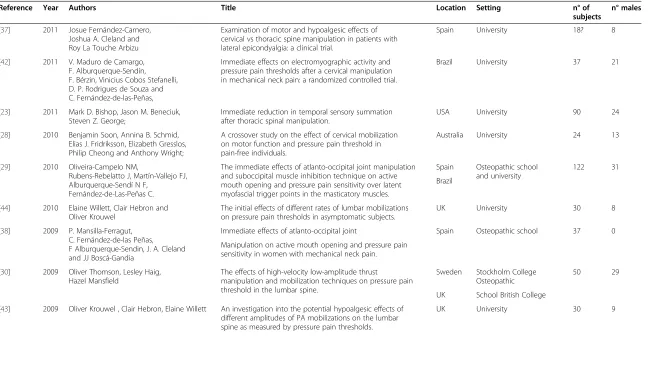
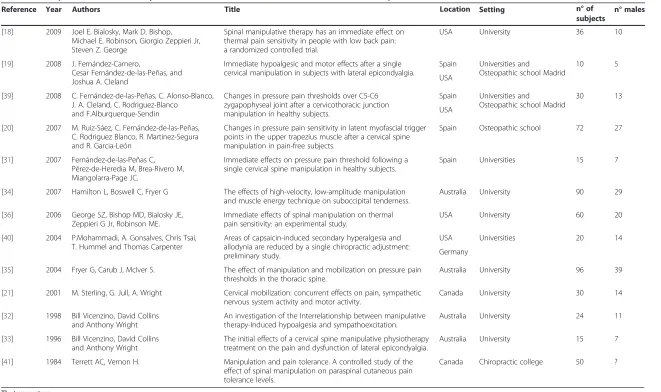
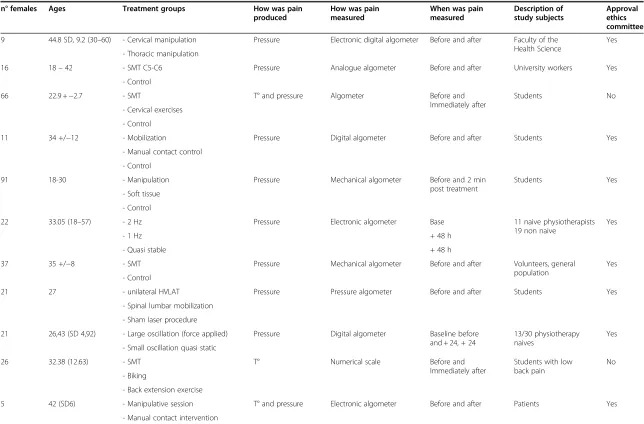
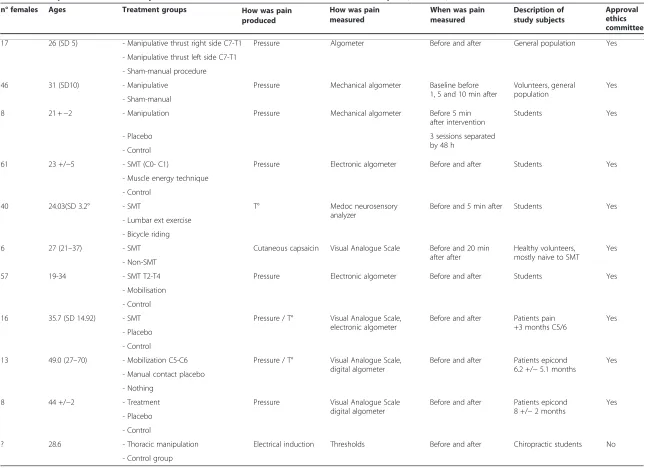
A table was constructed in order to describe the selected articles, as shown in Table 1.
Articles are presented consecutively by year of publica-tion and identified by a number corresponding to its reference in the first column of each table. As we were unable to locate a suitable quality check-list for this type of research, a second set of criteria was developed in order to evaluate the quality and risk of bias in this type of research. We designed this checklist based on con-cepts presented in the PRISMA statement [25], the CONSORT statement [26] and Cochrane guidelines [27] bearing in mind that there can be no general recipe for such work, as review procedures have to be topic
Millanet al. Chiropractic & Manual Therapies2012,20:26 Page 3 of 22
Table 1 Descriptive items used in a systematic critical literature review on the effect of SMT on pain
Reference Year Authors Title Location Setting n° of
subjects
n° males
[37] 2011 Josue Fernández-Carnero, Joshua A. Cleland and Roy La Touche Arbizu
Examination of motor and hypoalgesic effects of cervical vs thoracic spine manipulation in patients with lateral epicondyalgia: a clinical trial.
Spain University 18? 8
[42] 2011 V. Maduro de Camargo, F. Alburquerque-Sendín, F. Bérzin, Vinicius Cobos Stefanelli, D. P. Rodrigues de Souza and C. Fernández-de-las-Peñas,
Immediate effects on electromyographic activity and pressure pain thresholds after a cervical manipulation in mechanical neck pain: a randomized controlled trial.
Brazil University 37 21
[23] 2011 Mark D. Bishop, Jason M. Beneciuk, Steven Z. George;
Immediate reduction in temporal sensory summation after thoracic spinal manipulation.
USA University 90 24 [28] 2010 Benjamin Soon, Annina B. Schmid,
Elias J. Fridriksson, Elizabeth Gresslos, Philip Cheong and Anthony Wright;
A crossover study on the effect of cervical mobilization on motor function and pressure pain threshold in pain-free individuals.
Australia University 24 13
[29] 2010 Oliveira-Campelo NM,
Rubens-Rebelatto J, Martín-Vallejo FJ, Alburquerque-Sendí N F,
Fernández-de-Las-Peñas C.
The immediate effects of atlanto-occipital joint manipulation and suboccipital muscle inhibition technique on active mouth opening and pressure pain sensitivity over latent myofascial trigger points in the masticatory muscles.
Spain Osteopathic school and university
122 31 Brazil
[44] 2010 Elaine Willett, Clair Hebron and Oliver Krouwel
The initial effects of different rates of lumbar mobilizations on pressure pain thresholds in asymptomatic subjects.
UK University 30 8 [38] 2009 P. Mansilla-Ferragut,
C. Fernández-de-las Peñas, F Alburquerque-Sendin, J. A. Cleland and JJ Boscá-Gandia
Immediate effects of atlanto-occipital joint Spain Osteopathic school 37 0 Manipulation on active mouth opening and pressure pain
sensitivity in women with mechanical neck pain. [30] 2009 Oliver Thomson, Lesley Haig,
Hazel Mansfield
The effects of high-velocity low-amplitude thrust
manipulation and mobilization techniques on pressure pain threshold in the lumbar spine.
Sweden Stockholm College Osteopathic
50 29 UK School British College
[43] 2009 Oliver Krouwel , Clair Hebron, Elaine Willett An investigation into the potential hypoalgesic effects of different amplitudes of PA mobilizations on the lumbar spine as measured by pressure pain thresholds.
UK University 30 9
Millan
et
al.
Chiroprac
tic
&
Manual
Therapies
2012,
20
:26
Page
4
o
f
2
2
http://chirom
t.com/con
Table 1 Descriptive items used in a systematic critical literature review on the effect of SMT on pain(Continued)
[18] 2009 Joel E. Bialosky, Mark D. Bishop, Michael E. Robinson, Giorgio Zeppieri Jr, Steven Z. George
Spinal manipulative therapy has an immediate effect on thermal pain sensitivity in people with low back pain: a randomized controlled trial.
USA University 36 10
[19] 2008 J. Fernández-Carnero,
Cesar Fernández-de-las-Peñas, and Joshua A. Cleland
Immediate hypoalgesic and motor effects after a single cervical manipulation in subjects with lateral epicondyalgia.
Spain Universities and
Osteopathic school Madrid
10 5 USA
[39] 2008 C. Fernández-de-las-Peñas, C. Alonso-Blanco, J. A. Cleland, C. Rodriguez-Blanco
and F.Alburquerque-Sendin
Changes in pressure pain thresholds over C5-C6 zygapophyseal joint after a cervicothoracic junction manipulation in healthy subjects.
Spain Universities and
Osteopathic school Madrid
30 13 USA
[20] 2007 M. Ruiz-Sáez, C. Fernández-de-las-Peñas, C. Rodriguez Blanco, R. Martinez-Segura and R. Garcia-León
Changes in pressure pain sensitivity in latent myofascial trigger points in the upper trapezius muscle after a cervical spine manipulation in pain-free subjects.
Spain Osteopathic school 72 27
[31] 2007 Fernández-de-las-Peñas C, Pérez-de-Heredia M, Brea-Rivero M, Miangolarra-Page JC.
Immediate effects on pressure pain threshold following a single cervical spine manipulation in healthy subjects.
Spain Universities 15 7
[34] 2007 Hamilton L, Boswell C, Fryer G The effects of high-velocity, low-amplitude manipulation and muscle energy technique on suboccipital tenderness.
Australia University 90 29 [36] 2006 George SZ, Bishop MD, Bialosky JE,
Zeppieri G Jr, Robinson ME.
Immediate effects of spinal manipulation on thermal pain sensitivity: an experimental study.
USA University 60 20 [40] 2004 P.Mohammadi, A. Gonsalves, Chris Tsai,
T. Hummel and Thomas Carpenter
Areas of capsaicin-induced secondary hyperalgesia and allodynia are reduced by a single chiropractic adjustment: preliminary study.
USA Universities 20 14 Germany
[35] 2004 Fryer G, Carub J, McIver S. The effect of manipulation and mobilization on pressure pain thresholds in the thoracic spine.
Australia University 96 39 [21] 2001 M. Sterling, G. Jull, A. Wright Cervical mobilization: concurrent effects on pain, sympathetic
nervous system activity and motor activity.
Canada University 30 14 [32] 1998 Bill Vicenzino, David Collins
and Anthony Wright
An investigation of the Interrelationship between manipulative therapy-Induced hypoalgesia and sympathoexcitation.
Australia University 24 11 [33] 1996 Bill Vicenzino, David Collins
and Anthony Wright
The initial effects of a cervical spine manipulative physiotherapy treatment on the pain and dysfunction of lateral epicondyalgia.
Australia University 15 7 [41] 1984 Terrett AC, Vernon H. Manipulation and pain tolerance. A controlled study of the
effect of spinal manipulation on paraspinal cutaneous pain tolerance levels.
Canada Chiropractic college 50 ?
T° = temperature.
Table 1 Descriptive items used in a systematic critical literature review on the effect of SMT on pain
Reference Year Authors Title Location Setting n° of
subjects
n° males
(Continued)
n° of subjects Setting
Location
Millan
et
al.
Chiroprac
tic
&
Manual
Therapies
2012,
20
:26
Page
5
o
f
2
2
http://chirom
t.com/con
Table 1 Descriptive items used in a systematic critical literature review on the effect of SMT on pain(Continued)
n° females Ages Treatment groups How was pain
produced
How was pain measured
When was pain measured
Description of study subjects
Approval ethics committee
9 44.8 SD, 9.2 (30–60) - Cervical manipulation Pressure Electronic digital algometer Before and after Faculty of the Health Science
Yes - Thoracic manipulation
16 18–42 - SMT C5-C6 Pressure Analogue algometer Before and after University workers Yes - Control
66 22.9 +−2.7 - SMT T° and pressure Algometer Before and Immediately after
Students No - Cervical exercises
- Control
11 34 +/−12 - Mobilization Pressure Digital algometer Before and after Students Yes - Manual contact control
- Control
91 18-30 - Manipulation Pressure Mechanical algometer Before and 2 min post treatment
Students Yes - Soft tissue
- Control
22 33.05 (18–57) - 2 Hz Pressure Electronic algometer Base 11 naive physiotherapists 19 non naive
Yes
- 1 Hz + 48 h
- Quasi stable + 48 h
37 35 +/−8 - SMT Pressure Mechanical algometer Before and after Volunteers, general population
Yes - Control
21 27 - unilateral HVLAT Pressure Pressure algometer Before and after Students Yes - Spinal lumbar mobilization
- Sham laser procedure
21 26,43 (SD 4,92) - Large oscillation (force applied) Pressure Digital algometer Baseline before and + 24, + 24
13/30 physiotherapy naives
Yes - Small oscillation quasi static
26 32.38 (12.63) - SMT T° Numerical scale Before and Immediately after
Students with low back pain
No - Biking
- Back extension exercise
5 42 (SD6) - Manipulative session T° and pressure Electronic algometer Before and after Patients Yes - Manual contact intervention
Millan
et
al.
Chiroprac
tic
&
Manual
Therapies
2012,
20
:26
Page
6
o
f
2
2
http://chirom
t.com/con
Table 1 Descriptive items used in a systematic critical literature review on the effect of SMT on pain(Continued)
17 26 (SD 5) - Manipulative thrust right side C7-T1 Pressure Algometer Before and after General population Yes - Manipulative thrust left side C7-T1
- Sham-manual procedure
46 31 (SD10) - Manipulative Pressure Mechanical algometer Baseline before 1, 5 and 10 min after
Volunteers, general population
Yes - Sham-manual
8 21 +−2 - Manipulation Pressure Mechanical algometer Before 5 min after intervention
Students Yes - Placebo 3 sessions separated
by 48 h - Control
61 23 +/−5 - SMT (C0- C1) Pressure Electronic algometer Before and after Students Yes - Muscle energy technique
- Control
40 24.03(SD 3.2° - SMT T° Medoc neurosensory analyzer
Before and 5 min after Students Yes - Lumbar ext exercise
- Bicycle riding
6 27 (21–37) - SMT Cutaneous capsaicin Visual Analogue Scale Before and 20 min after after
Healthy volunteers, mostly naive to SMT
Yes - Non-SMT
57 19-34 - SMT T2-T4 Pressure Electronic algometer Before and after Students Yes - Mobilisation
- Control
16 35.7 (SD 14.92) - SMT Pressure / T° Visual Analogue Scale, electronic algometer
Before and after Patients pain +3 months C5/6
Yes - Placebo
- Control
13 49.0 (27–70) - Mobilization C5-C6 Pressure / T° Visual Analogue Scale, digital algometer
Before and after Patients epicond 6.2 +/−5.1 months
Yes - Manual contact placebo
- Nothing
8 44 +/−2 - Treatment Pressure Visual Analogue Scale digital algometer
Before and after Patients epicond 8 +/−2 months
Yes - Placebo
- Control
? 28.6 - Thoracic manipulation Electrical induction Thresholds Before and after Chiropractic students No - Control group
Table 1 Descriptive items used in a systematic critical literature review on the effect of SMT on pain
n° females Ages Treatment groups How was pain produced
How was pain measured
When was pain measured
Description of study subjects
Approval ethics committee
(Continued)
When was pain measured How was pain
produced
How was pain measured
Description of study subjects
Millan
et
al.
Chiroprac
tic
&
Manual
Therapies
2012,
20
:26
Page
7
o
f
2
2
http://chirom
t.com/con
specific. The items selected for the quality checklist and their rationale have been described in Additional file 2. The risk of bias was assessed following the criteria sug-gested by the method guidelines for systematic reviews of trials of treatments for neck and back pain by Furlan et al [27] (see items 1, 2, 4, 6, 9, and 11 in Additional file 2). Additional items were mainly adapted from PRISMA [25] (see items 3, 5, 7, 8, 10, 12, and 13). Finally, the outcomes were noted for each experiment as a positive effect, nega-tive effect, or no effect.
Classifying articles by their quality
Each article selected was checked for each quality item. By consensus, we decided to give one point for every criter-ion, except for the 4 items that we considered as most im-portant: a- unbiased/blind/naïve study subjects (item 1), b- random allocation (item 3), c- blinded assessment (item 9), and d- losses and exclusions (item 11). Each of these was assigned two points.
A summary quality score was calculated but no cutoff-point was defined for acceptable or unacceptable level of quality. This allowed us (and the readers) to use the quality scores and the information on each individual quality item as a guide for whether articles would be considered more or less credible. In other words, the quality assessment was meant to be flexible.
A post hoc comparison was made between results of the two quality scores (the total score and the score for the most important criteria). Using thresholds set at 12/ 18 and 4/8 points, respectively, the distributions of stud-ies with positive and non-positive outcomes were com-pared for the two scales and in relation to whether the studies were of higher or lower quality.
Data synthesis
The data tables were used, in a systematic fashion, to obtain answers to our research questions. This was done by highlighting relevant information to facilitate a visual representation (green = positive outcome, red = non-positive outcome) to make interpretation easier. Finally, studies were sorted in descending order starting with those with the highest total quality score out of 18. Results were thereafter interpreted and reported in a nar-rative fashion. If high and low quality studies generally obtained similar outcomes, we assumed that the poorer quality studies provided supporting evidence for the bet-ter studies. If, however, it was mainly the poorer quality studies which obtained positive findings, particularly if the assessors were not blinded or the study subjects could have been biased, then we would be more cautious in our interpretation of the results.
Because we decided not to use a scoring system to es-tablish level of quality, we have not defined discrete levels of evidence.
Results
In all, 1279 titles satisfying the inclusion criteria were identified in the initial PubMed search. Other database search results were as follows: a- Spinal manipulation pain: 1276 results in Pubmed, 10 in Mantis and 9 Cochrane Reviews. b- Chiropractic manipulation pain: 806 results in Pubmed, 2 in Mantis and 5 Cochrane Reviews. c- Spinal manipulation experimental pain: 63 results in Pubmed, 0 in Mantis and 13 Cochrane Reviews. d- Chiropractic manipulation experimental pain: 28 results in Pubmed, 0 in Mantis and 0 Cochrane Reviews. Only 5 articles were added after an additional search of reference lists.
All articles found in the Mantis and Cochrane data-bases were already identified via the Pubmed searches. Of the 1279 references, 116 were retrieved in full text for further scrutiny.
Description of studies
Upon scrutinizing the full texts, 22 articles were found to fulfill the inclusion criteria. They described 43 experiments: 27 with pain produced by pressure, 9 by temperature, 3 by capsaicin, 2 examined spontaneous pain, 1 used a stretch test to produce pain and 1 used electrically induced pain. All were controlled trials published in English. Detailed information is presented in Table 1 and briefly summarized below.
Three research groups were responsible for 13 publi-cations. They did not seem to have repeatedly used the same study samples but appeared to have reported on different study populations for the various studies. In most cases (n = 18), experiments were carried out totally or partially in universities. The number of subjects ran-ged from 10 to 122. Six articles used patients as study subjects; most of the others included non-clinical popu-lations, often students. There were no studies with ani-mals fulfilling our inclusion criteria.
Most of experiments (n = 20) used external control groups. Twelve of them used three groups: a treat-ment, a placebo and a control group in which no ac-tion was taken - noted in tables as “nothing” (studies [21,23,28-35]). Studies [18,36] used bicycle exercise as their control activity. Seven studies ([19,20,37-41]) used a sham procedure as their control treatment, whereas study [42] compared the treatment group to a control group without a sham procedure. Two studies used only internal control groups; [43] and [44] compared three different types of mobilization.
Data synthesis: Quality of studies
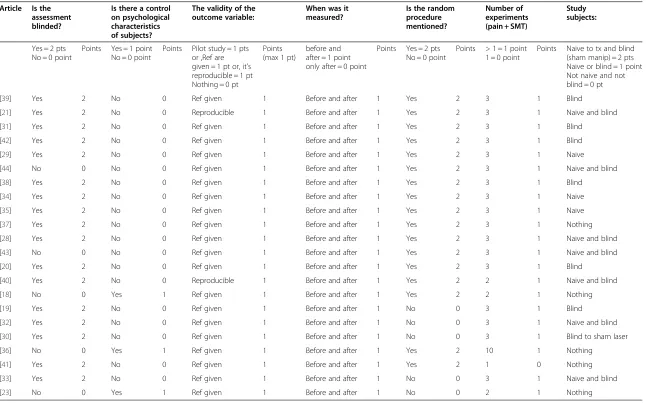
There were no disagreements between reviewers on the scoring of the manuscripts based on the checklists. Table 2 summarizes the quality items for each article. The quality and risk of bias assessment of studies
Millanet al. Chiropractic & Manual Therapies2012,20:26 Page 8 of 22
reviewed revealed them to be relatively homogeneous, with the summary scores ranging between 8 and 16 out of 18 points, with mean and median summary scores of 12.2 and 13, respectively.
Of the various quality items that we scrutinized, all studies fulfilled the criteria on the validity of the out-come variable, all had measured the pain before and after the intervention, all had provided some estimate of the results in tables, graphs or text, and all had tested their results for statistical significance. The ANOVA was used for factorial designs in all studies in order to test how variables interacted or combined.
Other checklist items were not always fulfilled. Of the four quality criteria that we considered particularly im-portant, namely unbiased/blind/naïve study subjects (item 1), random allocation (item 3), blinded assessment (item 9), and losses and exclusions (item 11), the first two were commonly satisfied (in 15 and 17 papers, re-spectively), whereas using unbiased/blind/naïve study subjects and accounting for losses and exclusions were ignored in many studies (present in 7 and 5, respect-ively). Five of the reviewed articles ([18,23,36,43,44]) should be considered with care since their assessments of outcomes were not blinded.
Seven articles did not mention if the allocation of study subjects to each group was randomized. As it was not our intention to penalize unfairly articles that used a randomized allocation without mentioning it, we identi-fied the numbers of individuals in each group in these reports (see Table 3). Articles [19,32,33] did not provide the number of subjects in each experimental group. The others (except [30]) showed a more even distribution than one could expect with a proper randomization pro-cedure. We therefore assumed that the fact that authors did not discuss the randomization procedure, in most cases, reflected the fact that it had not occurred.
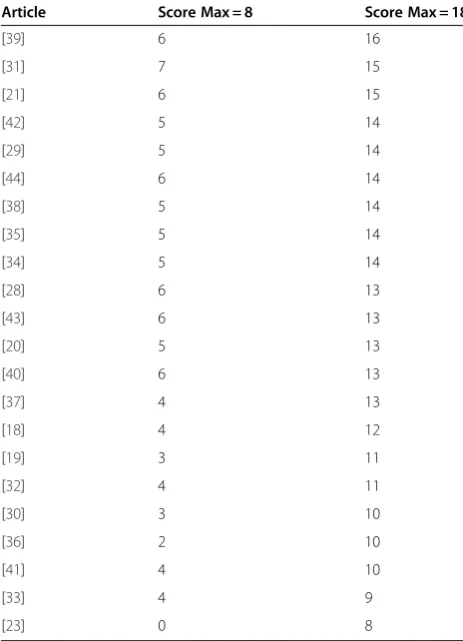
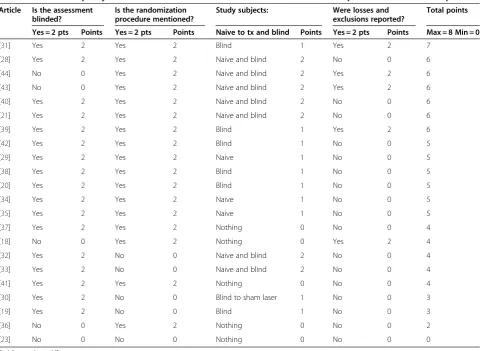
In our review, we did not set a threshold for acceptable/ unacceptable quality but displayed the articles in descend-ing order from the highest to the lowest score. Neverthe-less, in Table 2a, we compared the spread of articles when using the total score (18 point scale, see Table 2) and the scale based on four high-priority items (8 point scale, see Table 2b). With levels of“acceptance” provisionally set at 12/18 and 4/8, respectively, all articles, with one excep-tion, obtained the same classification of acceptable or not, regardless of the system used. We interpreted this con-cordance as a confirmation of the robustness of the qual-ity and risk of bias assessment.
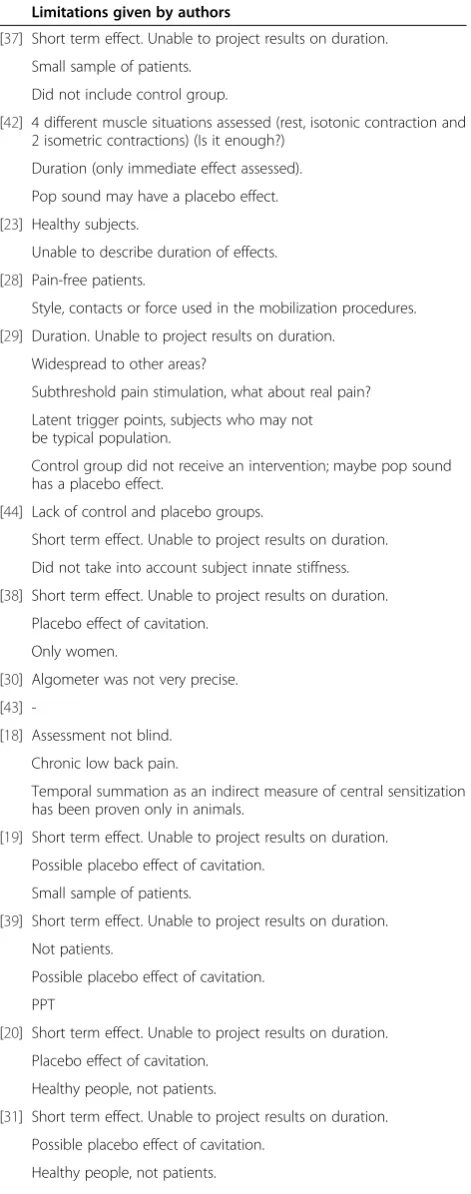
In addition to the quality issues identified in this re-view, the authors themselves have in some instances dis-cussed the limitations of their own studies (see Table 4).
A meta-analysis was not attempted because the het-erogeneity of studies on pain provoking methods, units of measurements, areas of the body where experiments
were performed, and local, regional of systemic assess-ments of the effects of SMT.
Data synthesis: Answers to research questions
Herein, each research question is dealt with one at a time, and for each, we refer to a table summarizing the results in order of quality of the study. If one study contains sev-eral experiments, they have all been reported individually in the appropriate section of the review. Table 5 presents studies grouped by their results, showing in the upper panels those that presented a hypoalgesic action and, in the lower panels, those that did not. Papers are also sepa-rated by the research question, i.e. local, regional or sys-temic effect. Table 6 summarizes for each article the effect of SMT on pain, the site where SMT was per-formed and the location of the pain. This table also shows values reported, whether the effect was local, regional or systemic, whether the effects were ipsilateral or contralat-eral, whether an effect occurred above or below the site of manipulation, and the type of pain induced.
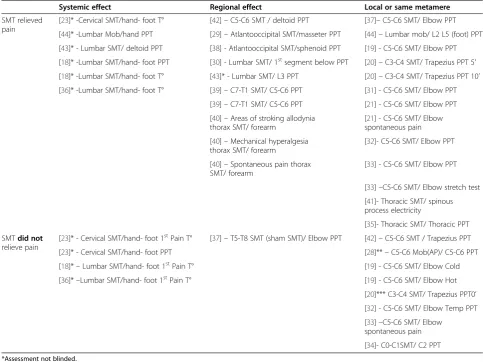
In the majority of experiments (28/43), SMT reduced pain. Outcomes were not dependent on whether quality scores were high or low. These studies demonstrate a clear hypoalgesic effect of SMT (see Table 5a). For spe-cific results, see below.
1. Does SMT reduce experimentally induced pain provoked by pressure? There were 27 experiments performed on pressure pain. Nineteen of these showed manipulation to increase pressure pain thresholds (PPT). There was no obvious link between the reported polarity of the effect and the quality of the studies. Changes produced by SMT were in general statistically significant. Differences in PPT values (before/after SMT), when reported as percentages ranged between 4.8% (in [28]) and 44.2% (in [19]). Other units of measurement were also used making it difficult to summarize with a single parameter the size of the effect. For detailed information, see Tables6and Additional file3. 2. Does SMT reduce experimentally induced pain
provoked by temperature? There were 9 experiments on pain induced by temperature, only 3 of which showed a hypoalgesic action for SMT: studies [18,23,36] found that SMT relieves pain provoked by temperature and therefore transmitted by C-fibers. The other experiments (n = 6) did not show significant differences in relation to SMT. Three of these tested first pain (Aδfiber system) and the other three tested TSS (C-fiber system). There was no obvious link with the quality of studies. For values and detailed information, see Table6and Additional file4. 3. Does SMT reduce experimentally induced pain
provoked by methods other than pressure and
Millanet al. Chiropractic & Manual Therapies2012,20:26 Page 9 of 22
Table 2 Quality criteria of articles selected for a systematic critical literature review on the effect of SMT on pain
Article Is the assessment blinded?
Is there a control on psychological characteristics of subjects?
The validity of the outcome variable:
When was it measured?
Is the random procedure mentioned?
Number of experiments (pain + SMT)
Study subjects:
Yes = 2 pts No = 0 point
Points Yes = 1 point No = 0 point
Points Pilot study = 1 pts or ,Ref are given = 1 pt or, it's reproducible = 1 pt Nothing = 0 pt
Points (max 1 pt)
before and after = 1 point only after = 0 point
Points Yes = 2 pts No = 0 point
Points > 1 = 1 point 1 = 0 point
Points Naive to tx and blind (sham manip) = 2 pts Naive or blind = 1 point Not naive and not blind = 0 pt [39] Yes 2 No 0 Ref given 1 Before and after 1 Yes 2 3 1 Blind
[21] Yes 2 No 0 Reproducible 1 Before and after 1 Yes 2 3 1 Naive and blind [31] Yes 2 No 0 Ref given 1 Before and after 1 Yes 2 3 1 Blind
[42] Yes 2 No 0 Ref given 1 Before and after 1 Yes 2 3 1 Blind [29] Yes 2 No 0 Ref given 1 Before and after 1 Yes 2 3 1 Naive [44] No 0 No 0 Ref given 1 Before and after 1 Yes 2 3 1 Naive and blind [38] Yes 2 No 0 Ref given 1 Before and after 1 Yes 2 3 1 Blind
[34] Yes 2 No 0 Ref given 1 Before and after 1 Yes 2 3 1 Naive [35] Yes 2 No 0 Ref given 1 Before and after 1 Yes 2 3 1 Naive [37] Yes 2 No 0 Ref given 1 Before and after 1 Yes 2 3 1 Nothing [28] Yes 2 No 0 Ref given 1 Before and after 1 Yes 2 3 1 Naive and blind [43] No 0 No 0 Ref given 1 Before and after 1 Yes 2 3 1 Naive and blind [20] Yes 2 No 0 Ref given 1 Before and after 1 Yes 2 3 1 Blind
[40] Yes 2 No 0 Reproducible 1 Before and after 1 Yes 2 2 1 Naive and blind [18] No 0 Yes 1 Ref given 1 Before and after 1 Yes 2 2 1 Nothing [19] Yes 2 No 0 Ref given 1 Before and after 1 No 0 3 1 Blind
[32] Yes 2 No 0 Ref given 1 Before and after 1 No 0 3 1 Naive and blind [30] Yes 2 No 0 Ref given 1 Before and after 1 No 0 3 1 Blind to sham laser [36] No 0 Yes 1 Ref given 1 Before and after 1 Yes 2 10 1 Nothing
[41] Yes 2 No 0 Ref given 1 Before and after 1 Yes 2 1 0 Nothing [33] Yes 2 No 0 Ref given 1 Before and after 1 No 0 3 1 Naive and blind [23] No 0 Yes 1 Ref given 1 Before and after 1 No 0 2 1 Nothing
T° = temperature.
Millan
et
al.
Chiroprac
tic
&
Manual
Therapies
2012,
20
:26
Page
10
of
22
http://chirom
t.com/con
Table 2 Quality criteria of articles selected for a systematic critical literature review on the effect of SMT on pain(Continued)
Study subjects:
SMT performed by: Is the SMT well
described?
Are losses and exclusions reported?
Experimental conditions
Estimates given Are differences tested for statistical significance?
Total of points
Points Same person = 1 point Experienced person (> 5 years) = 1 point
Points (max 2 pts)
Yes = 1 point No = 0 point
Points Yes = 2 pts No = 0 point
Points same day or T° controlled or same time = 1 point different day and T° or time not controlled = 0 point
Points Yes = 1 point No = 0 point
Points Yes = 1 point No = 0 point
Points Min = 0 Max = 18
1 Same and experienced 2 Yes 1 Yes 2 Same day 1 Yes 1 Yes 1 16 2 Same and experienced 2 Yes 1 No 0 Same day 1 Yes 1 Yes 1 15 1 Experienced 1 Yes 1 Yes 2 T controlled 1 Yes 1 Yes 1 15 1 Same and experienced 2 Yes 1 No 0 Same day 1 Yes 1 Yes 1 14 1 Same and experienced 2 Yes 1 No 0 Same day 1 Yes 1 Yes 1 14 2 Same and experienced 2 Yes 1 Yes 2 More 48 H, no control T° 0 Yes 1 Yes 1 14 1 Same and experienced 2 Yes 1 No 0 Same day 1 Yes 1 Yes 1 14 1 Same and experienced 2 Yes 1 No 0 Same day? 1 Yes 1 Yes 1 14 1 Same and experienced 2 Yes 1 No 0 Same day? 1 Yes 1 Yes 1 14 0 Same and experienced 2 Yes 1 No 0 Same day 1 Yes 1 Yes 1 13 2 Experienced 1 Yes 1 No 0 More 48 H, no control T° 0 Yes 1 Yes 1 13 2 Same 1 Yes 1 Yes 2 More 3 days, no control T° 0 Yes 1 Yes 1 13 1 Experienced 1 Yes 1 No 0 Same day 1 Yes 1 Yes 1 13 2 Experienced 1 Yes 1 No 0 More 7 days, no control T° 0 Yes 1 Yes 1 13 0 Nothing 0 Yes 1 Yes 2 Same day 1 Yes 1 Yes 1 12 1 Same and experienced 2 Yes 1 No 0 More 48 H, no control T° 0 Yes 1 Yes 1 11 2 Nothing 0 Yes 1 No 0 More 3 days, control T° 1 Yes 1 Yes 1 11 1 Nothing 0 Yes 1 No 0 Same day 1 Yes 1 Yes 1 10 0 Nothing 0 Yes 1 No 0 Same day 1 Yes 1 Yes 1 10 0 Nothing 0 Yes 1 No 0 Same day 1 Yes 1 Yes 1 10 2 Nothing 0 No 0 No 0 More 3 days, no control T° 0 Yes 1 Yes 1 9 0 Nothing 0 yes 1 No 0 Highly controlled 1 Yes 1 Yes 1 8
Millan
et
al.
Chiroprac
tic
&
Manual
Therapies
2012,
20
:26
Page
11
of
22
http://chirom
t.com/con
temperature? Only 7 tests were performed using methods other than pressure and temperature to induce pain. Six of these revealed a statistically significant hypoalgesic effect induced by SMT. There did not seem to be a link with the quality of studies. For values and detailed information, see Tables6and Additional file5.
4. Does SMT reduce experimentally induced pain in the spinal segment where it is performed? Twenty experiments investigated whether SMT reduces experimentally induced pain in the spinal segment where it is performed. Twelve of them showed a hypoalgesic effect. The other eight presented no significant effects. Of these, study [28] tested the hypoalgesic action of an anterior-posterior
mobilization and not a lateral maneuver, as is usually the case in SMT. In study [20], there was no effect immediately after SMT, but an effect was
demonstrable five and ten minutes later. In studies [19,31] differences between sides were studied, but no difference was found. Outcomes did not relate to the quality score. For detailed information, see Tables5and6.
5. Does SMT reduce experimentally induced pain in the same region where it is performed? Nine experiments reported a regional effect of SMT on pain. Only one study failed to obtain a hypoalgesic effect. In this, thoracic manipulation was used as a sham treatment versus cervical manipulation to evaluate the action on elbow PPT. There did not seem to be a link between treatment effects reported and the quality of studies. For detailed information, see Table5and6.
6. Does SMT have a systemic effect on experimentally induced pain? Nine experiments evaluated this hypothesis. None of them had blinded assessors, which makes the results uncertain. Five of them demonstrated a systemic action of SMT on pain, but four of them did not show significant differences between treatment groups. Three of these four (studies [18,23,36]) evaluated first pain transmitted by Aδfibers. There did not seem to be a link between treatment effects reported and the quality of studies. For detailed information, see Tables5and6.
Additional observations
1. No article presented any data on the duration of the pain reduction. Studies [43,44] concluded that the hypoal-gesic effect was unrelated to the amplitude of the manual procedure, whereas [30] concluded that mobilization had a stronger effect than manipulation.
2. Four studies ([29,35,36,40]) applied the SMT to a point on the spine thought to be in need of treatment, i.e. at what was considered to be a dysfunctional spinal seg-ment (manipulable lesion/fixation/subluxation), whereas in all other studies the exact location of SMT was prede-termined without reference to local signs or symptoms. However, hypoalgesic results were observed regardless of whether the treatment was provided in a “clinical” fash-ion, i.e. where the patient would have what the clinician considered a dysfunctional segment, or if the manipula-tion was given in a predetermined area.
3. In two studies ([20,29]) the investigators searched for so-called trigger points.
4. Five articles ([19,31,37,39,42]) assessed whether the effect of SMT was only on the ipsilateral side of the im-pulse or if it was also noted on the contra-lateral side. None of the trials found a side-specific effect.
5. Several reports (N = 9) made reference to the“crack” ([18-20,23,29,37-39,42]), which is thought to occur when a joint is cavitated [14]. If no cavitation was obtained, a second manipulation would be given. There was no ob-vious difference in results between studies that concen-trated on the crack and those that did not. However, none studied that issue specifically, making it impossible to know whether all study subjects were “cracked” or not.
Table 2a A comparison between total scores obtained from two different scales (8 point scale and 18 point scale)
Article Score Max = 8 Score Max = 18
[39] 6 16
[31] 7 15
[21] 6 15
[42] 5 14
[29] 5 14
[44] 6 14
[38] 5 14
[35] 5 14
[34] 5 14
[28] 6 13
[43] 6 13
[20] 5 13
[40] 6 13
[37] 4 13
[18] 4 12
[19] 3 11
[32] 4 11
[30] 3 10
[36] 2 10
[41] 4 10
[33] 4 9
[23] 0 8
Articles scoring < 4/8 or < 12/18 are shown in red.
Millanet al. Chiropractic & Manual Therapies2012,20:26 Page 12 of 22
6. Regarding whether the effect could be noticed above or below the segment where the SMT was performed, results lacked consistency. In two of the studies ([23,39]), an effect was noted below the area of treat-ment. Studies [39,44] showed an effect above the area of treatment, whereas two of the studies ([36,37]) did not detect an effect above or below the relevant segment.
7. Outcomes were not affected by whether the control group received a sham treatment or no treatment at all.
8. In 10 of the experiments (5 articles), patients with current pain were included ([18,19,21,32,33]). Three of these experiments ([19,21,32]) found increased PPT values after SMT. Article [33] showed relief of pain on stretching painful muscles after SMT but not relief of spontaneous pain, whereas article [21] reported that spontaneous pain was diminished by SMT. Articles [18,19] evaluated temperature-induced pain with similar results, that is to say there was a hypoalgesic action on second pain [18], no action on first pain [18] and no ac-tion in 2 trials on TSS.
Discussion Summary of results
At the time of conducting this review, only one earlier systematic review was available on this subject. It exam-ined 11 articles but was unable to draw conclusions regarding treatment effects [45]. For the present review, however, it was possible to identify 22 relevant articles, which made it possible to draw several conclusions in relation to the possible pain-reducing effect of SMT.
Table 2b Four main quality criteria of articles from literature review on effect of SMT on pain–maximum score 8 points
Article Is the assessment blinded?
Is the randomization procedure mentioned?
Study subjects: Were losses and exclusions reported?
Total points
Yes = 2 pts Points Yes = 2 pts Points Naive to tx and blind Points Yes = 2 pts Points Max = 8 Min = 0
[31] Yes 2 Yes 2 Blind 1 Yes 2 7
[28] Yes 2 Yes 2 Naive and blind 2 No 0 6
[44] No 0 Yes 2 Naive and blind 2 Yes 2 6
[43] No 0 Yes 2 Naive and blind 2 Yes 2 6
[40] Yes 2 Yes 2 Naive and blind 2 No 0 6
[21] Yes 2 Yes 2 Naive and blind 2 No 0 6
[39] Yes 2 Yes 2 Blind 1 Yes 2 6
[42] Yes 2 Yes 2 Blind 1 No 0 5
[29] Yes 2 Yes 2 Naive 1 No 0 5
[38] Yes 2 Yes 2 Blind 1 No 0 5
[20] Yes 2 Yes 2 Blind 1 No 0 5
[34] Yes 2 Yes 2 Naive 1 No 0 5
[35] Yes 2 Yes 2 Naive 1 No 0 5
[37] Yes 2 Yes 2 Nothing 0 No 0 4
[18] No 0 Yes 2 Nothing 0 Yes 2 4
[32] Yes 2 No 0 Naive and blind 2 No 0 4
[33] Yes 2 No 0 Naive and blind 2 No 0 4
[41] Yes 2 Yes 2 Nothing 0 No 0 4
[30] Yes 2 No 0 Blind to sham laser 1 No 0 3
[19] Yes 2 No 0 Blind 1 No 0 3
[36] No 0 Yes 2 Nothing 0 No 0 2
[23] No 0 No 0 Nothing 0 No 0 0
Articles scoring≤4/8 pts.
Table 3 Distribution of subjects in study groups in articles where allocation procedure was not specified
Article Total of subjects
SMT groups Control group
No treatment
[23] 60 30 30 30
[39] 30 10 10 10
[19] 10 ? ? ?
[31] 15 7 8
-[33] 18 ? ? ?
[30] 50 19 18 13
[32] 24 ? ? ?
Millanet al. Chiropractic & Manual Therapies2012,20:26 Page 13 of 22
Thus our results indicate clearly that such an effect is achievable.
However, differences in effect exist according to whether the outcome is tested locally, regionally or sys-temically. An effect was clearly shown locally and re-gionally, whereas an effect is less clear in more distant parts of the body. Also the outcome differs according to the method of pain induction; pain induced by pressure, electricity, stretching of painful tissue, dermal irritation, and spontaneous pain all respond to SMT, whereas temperature-induced pain does not always respond.
Methodological considerations of our own review
One limitation of this review is that there is no generally accepted and validated quality check list for the type of ex-perimental studies which we examined and so we had to select our own quality criteria, based on some basic meth-odological concepts important to our research questions. Such a check list can be modified, which could affect the overall quality assessment. According to our quality scor-ing system, studies scored between 8 and 16 points out of a possible 18. However, in order to discriminate better be-tween studies, a more detailed scale could have resulted in different scores, which could perhaps have separated stud-ies into more obviously “good” and “bad”. However, the relevance, if any, of these quality items in relation to out-come, is not known and, in fact, the quality scores were not clearly associated with outcomes.
The strengths of this review are that the search for relevant articles was free of language bias, that the con-stituent articles were reviewed independently by two reviewers, that the results can be considered in relation to the quality of studies, that there was no arbitrary threshold for acceptable quality [46], that the check list tables are sufficiently detailed to allow readers to per-form their own analysis of the inper-formation provided, and that there was a relatively large number of studies, mak-ing it possible to examine several research questions.
Table 4 Limitations to own studies given by authors of articles reviewed for the effect of SMT on pain
Limitations given by authors
[37] Short term effect. Unable to project results on duration.
Small sample of patients.
Did not include control group.
[42] 4 different muscle situations assessed (rest, isotonic contraction and
2 isometric contractions) (Is it enough?)
Duration (only immediate effect assessed).
Pop sound may have a placebo effect.
[23] Healthy subjects.
Unable to describe duration of effects.
[28] Pain-free patients.
Style, contacts or force used in the mobilization procedures.
[29] Duration. Unable to project results on duration.
Widespread to other areas?
Subthreshold pain stimulation, what about real pain?
Latent trigger points, subjects who may not be typical population.
Control group did not receive an intervention; maybe pop sound has a placebo effect.
[44] Lack of control and placebo groups.
Short term effect. Unable to project results on duration.
Did not take into account subject innate stiffness.
[38] Short term effect. Unable to project results on duration.
Placebo effect of cavitation.
Only women.
[30] Algometer was not very precise.
[43]
-[18] Assessment not blind.
Chronic low back pain.
Temporal summation as an indirect measure of central sensitization has been proven only in animals.
[19] Short term effect. Unable to project results on duration.
Possible placebo effect of cavitation.
Small sample of patients.
[39] Short term effect. Unable to project results on duration.
Not patients.
Possible placebo effect of cavitation.
PPT
[20] Short term effect. Unable to project results on duration.
Placebo effect of cavitation.
Healthy people, not patients.
[31] Short term effect. Unable to project results on duration.
Possible placebo effect of cavitation.
Healthy people, not patients.
Table 4 Limitations to own studies given by authors of articles reviewed for the effect of SMT on pain(Continued)
[36] Short term effect. Unable to project results on duration.
Possible placebo effect of cavitation.
Healthy people, not patients.
No control, no sham group.
[40]
-[21]
-[32]
-[33]
-[41]
-[35]
-[34]
-Millanet al. Chiropractic & Manual Therapies2012,20:26 Page 14 of 22
Methodological considerations for the studies under review
This review identified some common methodological problems, such as lack of blinded assessment that could weaken the evidence in these experimental studies. We considered one of the most important points to be that the assessor was blinded, to avoid expectation bias. Some studies ignored this issue. This aspect affected our interpretation of the systemic effect of SMT, as all five articles (10 trials) dealing with the systemic effects of SMT lacked a blinded assessor.
It is also important that the results be truthfully pre-sented, and not exaggerated in some way, meaning that any subjects or data excluded from analysis should be accounted for. This was often ignored.
Another challenge was that of the control group. Ideally, the SMT should be matched against a suitable sham treatment and control procedure, and this was done in 12 studies. This is difficult with physical
procedures, but several of the other 10 studies tried to make the best of the situation by selecting naive study subjects, and in some cases different types of treatment were compared (such as treatment in two areas of the spine), in which case no sham treatment would be ne-cessary. However, whether a proper sham treatment was used or not, there were no obvious differences in the results, possibly indicating that the effect is very obvious and not affected to a large extent by expectations.
Potential confounders of these effects would be anxiety in general and fear of pain, known moderators of treat-ment outcomes in clinical practice. However, according to the three articles in which anxiety and fear of pain were studied, there were no statistically significant corre-lations between pain-related cognition, pain thresholds and the hypoalgesic response to SMT, indicating that the psychological aspect, considered to be so important in the perception of pain, perhaps does not come into play during experimental studies of this type.
Table 5 Effect of SMT on experimentally induced pain by localization of pain reduction
Systemic effect Regional effect Local or same metamere
SMT relieved pain
[23]* -Cervical SMT/hand- foot T° [42]–C5-C6 SMT / deltoid PPT [37]–C5-C6 SMT/ Elbow PPT
[44]* -Lumbar Mob/hand PPT [29]–Atlantooccipital SMT/masseter PPT [44]–Lumbar mob/ L2 L5 (foot) PPT
[43]* - Lumbar SMT/ deltoid PPT [38] - Atlantooccipital SMT/sphenoid PPT [19] - C5-C6 SMT/ Elbow PPT
[18]* -Lumbar SMT/hand- foot PPT [30] - Lumbar SMT/ 1stsegment below PPT [20]–C3-C4 SMT/ Trapezius PPT 5’
[18]* -Lumbar SMT/hand- foot T° [43]* - Lumbar SMT/ L3 PPT [20]–C3-C4 SMT/ Trapezius PPT 10’
[36]* -Lumbar SMT/hand- foot T° [39]–C7-T1 SMT/ C5-C6 PPT [31] - C5-C6 SMT/ Elbow PPT
[39]–C7-T1 SMT/ C5-C6 PPT [21] - C5-C6 SMT/ Elbow PPT
[40]–Areas of stroking allodynia
thorax SMT/ forearm
[21] - C5-C6 SMT/ Elbow
spontaneous pain
[40]–Mechanical hyperalgesia
thorax SMT/ forearm
[32]- C5-C6 SMT/ Elbow PPT
[40]–Spontaneous pain thorax
SMT/ forearm
[33] - C5-C6 SMT/ Elbow PPT
[33]–C5-C6 SMT/ Elbow stretch test
[41]- Thoracic SMT/ spinous
process electricity
[35]- Thoracic SMT/ Thoracic PPT
SMTdid not relieve pain
[23]* - Cervical SMT/hand- foot 1stPain T° [37]–T5-T8 SMT (sham SMT)/ Elbow PPT [42]–C5-C6 SMT / Trapezius PPT
[23]* - Cervical SMT/hand- foot PPT [28]**–C5-C6 Mob(AP)/ C5-C6 PPT
[18]*–Lumbar SMT/hand- foot 1stPain T° [19] - C5-C6 SMT/ Elbow Cold
[36]*–Lumbar SMT/hand- foot 1stPain T° [19] - C5-C6 SMT/ Elbow Hot
[20]*** C3-C4 SMT/ Trapezius PPT0’
[32] - C5-C6 SMT/ Elbow Temp PPT
[33]–C5-C6 SMT/ Elbow
spontaneous pain
[34]- C0-C1SMT/ C2 PPT
*Assessment not blinded.
**This was an anterior-posterior mobilization, not lateral as SMT.
***PPT measured just after SMT, but there was a hypoalgesic effect at 5’and 10’. T° = temperature.
PPT = pressure pain thresholds.
Millanet al. Chiropractic & Manual Therapies2012,20:26 Page 15 of 22
Comparison with another systematic review
Some of our results were corroborated by a newly pub-lished high quality review on this very topic [47]. This other review included 15 of our articles but, as they did not put a restriction on duration of symptoms in symp-tomatic people, they also incorporated 5 articles not included in our review. They defined effects as occur-ring “locally” or in “remote” areas, and pooled the results in all studies for the effects of PPT. They found the effects on PPT to be small in both areas but never-theless statistically significant. When the data were sepa-rated for local and remote effect significance was only noted for the remote effect. They did not study any other pain–inducing method nor did they take into con-sideration the quality of studies, although they did per-form a quality assessment.
Discussion of findings
Pain provoked by pressure, electricity, stretching of pain-ful tissue, dermal irritation, or spontaneous pain all re-spond to SMT.
Experimental pain provoked by pressure was the most common method used to assess the effect of manipula-tion (27 out of 43 experiments). Unfortunately, the reports did not use the same units for reporting increased tolerance to pressure, making it difficult to compare outcomes, but SMT was shown to increase PPT values between 4.8% and 44.6%. That the algometer, used for this purpose, is a highly reliable method to measure pain [48] suggests that these results are robust. However, they cannot necessary be compared between studies because of different experimental situations.
Table 5a Effect of SMT on experimentally induced pain by localization of pain reduction in relation to the quality of studies
Systemic effect Regional effect Local or same metamere
SMT relieved pain
[23]* -Cervical SMT/hand- foot T° [42]–C5-C6 SMT / deltoid PPT [37]–C5-C6 SMT/ Elbow PPT
[44]* -Lumbar Mob/hand PPT [29]–Atlantooccipital SMT/masseter PPT [44]–Lumbar mob/ L2 L5 (foot) PPT
[43]* - Lumbar SMT/ deltoid PPT [38] - Atlantooccipital SMT/sphenoid PPT K - C5-C6 SMT/ Elbow PPT
[18]* -Lumbar SMT/hand- foot PPT [30] - Lumbar SMT/ 1stsegment below PPT [20]–C3-C4 SMT/ Trapezius PPT 5’
[18]* -Lumbar SMT/hand- foot T° [43]* - Lumbar SMT/ L3 PPT [20]–C3-C4 SMT/ Trapezius PPT 10’
[36]* -Lumbar SMT/hand- foot T° [39]–C7-T1 SMT/ C5-C6 PPT [31] - C5-C6 SMT/ Elbow PPT
[39]–C7-T1 SMT/ C5-C6 PPT [21] - C5-C6 SMT/ Elbow PPT
[40]–Areas of stroking allodynia thorax SMT/ forearm
[21]- C5-C6 SMT/ Elbow
spontaneous pain
[40]–Mechanical hyperalgesia
thorax SMT/ forearm
[32]- C5-C6 SMT/ Elbow PPT
[40]–Spontaneous pain thorax
SMT/ forearm
[33] - C5-C6 SMT/ Elbow PPT
[33]–C5-C6 SMT/ Elbow stretch test
[41]- Thoracic SMT/ spinous
process electricity
[35]- Thoracic SMT/ Thoracic PPT
SMTdid not relieve pain
[23]* - Cervical SMT/hand- foot 1stPain T° [37]–T5-T8 SMT (sham SMT)/ Elbow PPT [42]–C5-C6 SMT / Trapezius PPT
[23]* - Cervical SMT/hand- foot PPT [28]**–C5-C6 Mob(AP)/ C5-C6 PPT
[18]*–Lumbar SMT/hand- foot 1stPain T° [19]- C5-C6 SMT/ Elbow Cold
[36]*–Lumbar SMT/hand- foot 1stPain T° [19] - C5-C6 SMT/ Elbow Hot
[20]***–C3-C4 SMT/ Trapezius PPT0’
[32] - C5-C6 SMT/ Elbow Temp PPT
[33]–C5-C6 SMT/ Elbow
spontaneous pain
[34]- C0-C1SMT/ C2 PPT
X- : Studies scoring≤12 points on 18 point scaleand≤4 points on 8 point scale. X- : Study scoring≤4 points on 8 point scale and more than 12 points on 18 point scale. X *: Studies where the assessor was not blinded.
** This was an anterior-posterior mobilization, not lateral as is usually the case in SMT.
*** Pressure pain thresholds measured just after spinal manipulation, but there was a hypoalgesic effect at 5’and 10’. T° = temperature.
PPT = pressure pain thresholds.
Millanet al. Chiropractic & Manual Therapies2012,20:26 Page 16 of 22
Table 6 Detailed findings from literature review on effect of SMT on pain
Art Effect of SMT on pain Site of SMT/pain Values Local/regional/
systemic effect
Same/opposite side
Above/below Pain form
[37] The application of a cervical SMT, but not thoracic SMT, resulted in immediate bilateral hypoalgesic effect in patients with lateral epicondylitis.
SMT C5-C6 and T5-T8 /PPT both epicondyles
Changes PPT in KiloPascals (differences)PPT Cervical Thoracic affected side 88.6 (35.1%) 18.6 (0.8%) unaffected side 95.6 (25.4%) -40.5 (−0.9%)
Effect within the same segment..
Used SMT caudal level as placebo with no effect.
No significant differences between L and R side
Effect within the same segment. Used SMT caudal level as placebo with no effect.
Pressure
[42] On deltoid, small effect at the same segment. Didn't work on trapezius and C5
SMT C5-C6 right / PPT upper
trapezius, deltoid and C5 spinous process
Changes PPT in Kg/cm² (differences)PPT SMT Control Trapezius ipsilateral 0.2 0.3 Trapezius contralateral 0.4 0.1 Deltoid ipsilateral 0.3 -0.2 Deltoid contralateral 0.2 -0.2 C5 spinous process 0.1 -0.1
Small effect within the same segment
Comparison of sides baseline in table2, but no differences p>.523 Bilateral increases of PPT
- Pressure
[23] SMT reduced TSS (temporal sensory summation) but not PPT
Lower cervical and upper thoracic region / T° on hand + popliteal fossa
PPT increased for all groups (not only SMT) from pre to post SMT (F=9.6, partial N²=0.10)= SMT produced a significant reduction in TSS (p=.003)
Averages of lower extremity values were higher than upper extremity values
- SMT worked at the same level or below
Pressure and Temperature (T°)
[28] No effect Cervical mobilization left C5-C6 / PPT left and right articular pillar of C5-C6
Differences PPT pre/post treatmentKpa F=0.168 p=0.168 Treatment 15.98 (+/−4.8%) Manual contact 4.61 (+/−0.2%) No contact 12.29 (+/−3.5%)
No effect at same segment
- - Pressure
[29] Small immediate increase of PPT
SMT atlantooccipital/ PPT on trigger points in the masseter and temporalis muscles
Differences before/after SMT in Kg/cm²: SMT = 0.29 (10%) Soft mobilization = 0.00 control= 0.019
Regional effect of atlantooccipital SMT and effect on trigeminal area
- - Pressure
[44] Hypoaglesia significant at test site and without differences between the rates of mobilization
Lumbar mobilization/L2 dermatome(thigh), L5 (foot), hand and L5 paraspinal
Mean of changes: 19,6% paraspinal muscles 14,2% L2 dermatome 13,4% L5 dermatom 12% hand (this suggest that changes are systemic)
lumbar hypoalgesia was greater than distal (P=0.0028)
- SMT more effective on lumbar dermatomes than more cephalad dermatomes
Pressure
[38] Small effect regionally SMT atlantooccipital/ PPT over both sides of sphenoid bone (V)
PPT effect on group and time F=14.4 (p<0.001) SMT = 3.5 kg/cm² control =−0.1 kg/cm²
Regional level. - - Pressure
[30] Mobilization had a stronger effect on pain than SMT
SMT 1 segment below marked PPT (lumbar)
Mobilization = small increase (0.434 kg/cm² d= 0.78)
SMT = decrease (−0.173 d= 0.36) Control = small decrease (−0.105 d= 0.25) but ANOVA further revealed non signification between groups.
Local and systemic effect but PPT values increase in a caudal direction
- - Pressure
Table 6 Detailed findings from literature review on effect of SMT on pain(Continued)
[43] No differences between amplitudes (p= 0.864)
lumbar mobilization/ 1- right erector spinae (L3) 2- left patella
(L3 dermatome) 3- proximal lateral sruface of left 5th metatarsal (S1 dermatome) 4- deltoid
PPT A B C 1 18.73% 14.57% 15.48% 2 17.93% 9.93% 10.67% 3 10.53% 15.57% 8.81% 4 19.06% 18.60% 11.69%
Local and systemic effect - - Pressure
[18] Significant changes in temporal summation, only for SMT
Lumbar SMT/ temporal summation on plantar surface (non dominant) and palmar surface (non dominant). Aδfibers mediated pain sensitivity in non dominant forearm and calf
Lumbar (local response): A- Aδfibers sensibility: no differences between groups at 47°C(p= .73), or 49°C (p= . 96) No effect of time at 47°C (p= .31) or 49°C (p= . 94) No changes in Aδfibers B- temporal summation: F= 3,41 (p= . 05), different by group assignment = Changes in temporal summationCervical (general response): A- No changes in Aδ fibers B- temporal summation: SMT group F= 6,78 (p= . 40), all groups had a decrease in temporal summation = Changes in temporal summation
Systemic effect, except for first pain.
- - T°differences Numeric Rating Scale (0–100) Before/after: Bike =−3,7 LE Exercise = 2,5 SMT= 19,9
[19] Effect demonstrated for PPT but not for T°
SMT C5-C6 dominant side (right) / PPT , thermal pain thresholds (HPT - CPT) on lateral epicondyles (both sides)
Differences SMT Control
PPT ipsilateral 121.5 (44.2%) 13.3 ( 4.4%) PPT contralateral 74.4 (17.7%) 6.1(1.7%) HPT ipsilateral (°C) 1.2 (2.9%) 0.7 (2.2%) HPT contralateral 1.5 (4.1%) -0.9 (1.9%) CPT ipsilateral
−0.25(9.2%) -1.5 (9.6%) CPT contralateral 0.9 ( 18.1%)-1.0 (17.4%)
Same segment Bilateral increase of PPT. No significant changes for T°
- Pressure and T°
[39] SMT changes PPT in both R and L C5-C6 zygapophyseal joints in healthy subjects
SMT C7-T1 / PPT C5-C6 zygapophyseal joints
Differences on PPT before/after:
Right sideSMT dominant: 53.1 SMT non-dominant: 80.7 Placebo: -2.7
Left sideSMT dominant: 45.9 SMT non-dominant: 48.0 Placebo: -3.9
Effect at regional level SMT changes PPT in both R and L C5-C6 zygapophyseal. joints in healthy subjects
SMT is also effective above and below of segment treated
Pressure
[20] SMT changes pressure pain sensitivity in triggers points in the upper trapezius
SMT C3-C4 / PPT upper trapezius trigger points (TrPs)
Differences pre/post SMT in Kg/cm² Difference Placebo SMT Pre post−0.06 d=0.35 0.08 d=0.4 Pre - 5' -0.2 d=1.1 0.1 d=0.5 Pre - 10' -0.22 d=1.1 0.12 d=0.44
Regional level - - Pressure
[31] SMT changes pressure pain sensitivity in epicondyles
SMT C5-C6 both sides / PPT on lateral
epicondyles (both sides)
Differences in Kg/cm²SMT ipsilateral 0.8 ( 35.5%) SMT contralateral 0.5 (24.8%) Placebo Ipsilateral 0.003(0.5%) Placebo contralateral 0.006 (0.4%) Control ipsilateral 0.003(0.5%) Control contralateral 0.006 (2.1%)
Same segment No differences between L and R sides
- Pressure
Millan
et
al.
Chiroprac
tic
&
Manual
Therapies
2012,
20
:26
Page
18
of
22
http://chirom
t.com/con
Table 6 Detailed findings from literature review on effect of SMT on pain(Continued)
[36] SMT produces hypoalgesia in lumbar area but not in cervical (control) but no effect on 1st pain
Lumbar SMT/ TSS in plantar surface (non dominant) and palmar surface
(non dominant). Aδfibers mediated pain sensitivity in non dominant forearm and calf
Lumbar Innervated NRS Change 47°C 13.2 (17.2) 12.9 (17.9) 23.5 (17.3) NRS Change 49°C 1.2 (20.2) 6.3 (22.4) 12.1 (19.7) Cervical Innervated NRS Change 47°C−3.0 (13.7) 0.3 (11.6) 0.3 (10.2) NRS Change 49°C 1.9 (9.0) -0.4 (10.1) 1.7 (10.8) NRS= Numeric rating scale
Effect at regional level but not at systemic level
- Effect at the same level, but not above
T°
[40] Allodynia and hyperalgesia decrease with SMT
Non specific thoracic SMT / left and right forearm (capsaicin)
Pre-SMT Post-SMT Pre-sham Post-Sham Hyperalgesia(cm²) 53 31 39 56 Allodynia (cm²) 40 18 28 40 Spontaneous pain (ratings) 4.9 3.3 3.9 4.2
SMT decreases allodynia at regional level
- - Capsaicin
[21] Effect on PPT SMT C5-C6 / PPT over symptomatic segment, T°PT
PPT increases p: < 0.05 +/−0.? % control +/−2.?% placebo +/−22.55 SMT VAS didn't work
Regional level - - Pressure
[32] Mobilization has an effect on pressure pain, not on temperature
Mobilization C5-C6 / PPT both elbows
PPT increases p: < 0.05 +/− −4.? % control +/− −7.?% placebo +/−29 % SMT TPT didn't work
Regional level. - - Pressure and T°
[33] Increase of PPT SMT cervical C5-C6 / PPT both elbows
Changes pre/post treatment
SMT +/−26% Placebo +/− −12% Control +/−0.2%
Regional level. - - Pressure
[41] Elevation of pain tolerance in manipulated group
Thoracic manipulation/ Electric thresholds left and right articular pillar
Intensity of current in mAmp
SMT Control Baseline 1.37 1.62 30'' 2.05 1.46 2 min 2.43 1.46 5 min 2.70 1.56 10 min 3.30 1.86
Local level. - - Electrical induction
[34] No significant differences
SMT C0-C1/ PPT C2 preHVLA-HVLA -5’-39.37 (76.07) Kpa (SD) preHVLA-HVLA-30’ -15.89 (87.50) preMET-MET-5’ -42.03 (62.37) preMET-MET-30’ -30.00 (69.53) preControl-Control-5’ -15.88 (83.62) preControl-Control-30’ -16.12 (62.49)
Local level. - - Pressure
[35] Mobilization and manipulation both produced a statistically significant increase in PPT in the thoracic spines of asymptomatic subjects. Mobilization more than SMT.
Thoracic manipulation T1-T4/ PPT on most tender thoracic vertebra
Differences PPT pre/post treatmentKpa (SD) Manipulation Mobilisation Control Pre-intervention 243.70 (95.22) 204.6 (85.52) 218.71 (82.91) Post-intervention 244.64 (91.59) 216.51 (90.50) 47.13 (96.87) Difference 0.94 (35.07) 11.88 (31.83) 28.42 (39.68)
Local level. - - Pressure
T° = temperature.
PPT = pressure pain thresholds. HPT = hot pain threshold. CPT = cold pain threshold.
Millan
et
al.
Chiroprac
tic
&
Manual
Therapies
2012,
20
:26
Page
19
of
22
http://chirom
t.com/con