R E S E A R C H
Open Access
A replication of the study
‘
Adverse effects of
spinal manipulation: a systematic review
’
Peter Tuchin
*Abstract
Objective:To assess the significance of adverse events after spinal manipulation therapy (SMT) by replicating and critically reviewing a paper commonly cited when reviewing adverse events of SMT as reported by Ernst (J Roy Soc Med 100:330–338, 2007).
Method:Replication of a 2007 Ernst paper to compare the details recorded in this paper to the original source material. Specific items that were assessed included the time lapse between treatment and the adverse event, and the recording of other significant risk factors such as diabetes, hyperhomocysteinemia, use of oral contraceptive pill, any history of hypertension, atherosclerosis and migraine.
Results:The review of the 32 papers discussed by Ernst found numerous errors or inconsistencies from the original case reports and case series. These errors included alteration of the age or sex of the patient, and omission or misrepresentation of the long term response of the patient to the adverse event. Other errors included incorrectly assigning spinal manipulation therapy (SMT) as chiropractic treatment when it had been reported in the original paper as delivered by a non-chiropractic provider (e.g. Physician).
The original case reports often omitted to record the time lapse between treatment and the adverse event, and other significant clinical or risk factors. The country of origin of the original paper was also overlooked, which is significant as chiropractic is not legislated in many countries. In 21 of the cases reported by Ernst to be chiropractic treatment, 11 were from countries where chiropractic is not legislated.
Conclusion:The number of errors or omissions in the 2007 Ernst paper, reduce the validity of the study and the reported conclusions. The omissions of potential risk factors and the timeline between the adverse event and SMT could be significant confounding factors. Greater care is also needed to distinguish between chiropractors and other health practitioners when reviewing the application of SMT and related adverse effects.
Keywords:MeSH, Chiropractic, Spinal manipulative therapy, Adverse effects
Introduction
The use of a treatment by health care providers requires examination of the evidence of effectiveness and assess-ment of the evidence for risks or adverse events (AE) caused by the treatment [1]. Spinal manipulation therapy (SMT) has strong evidence for treatment of low back pain, neck pain, headache and migraine [2-6]. This is supported by numerous systematic reviews of a large number of randomized controlled trials [7-10].
Adverse events following SMT are common but usually result in minor, short term problems [11-14]. The most
commonly expressed area of concern regarding these ad-verse effects of spinal manipulation includes conditions such as vertebral artery dissection (VAD) or carotid artery dissection (CAD), which results in cerebrovascular acci-dents (CVA) [15]. These serious AE can occur immedi-ately following SMT but are reported as rare and unpredictable consequence of all neck movements [16]. However, there appears to be conflict over the frequency or severity of serious events which may follow SMT. A paper written by Ernst“Adverse effects of spinal manipu-lation: a systematic review” was published in the Journal of the Royal Society of Medicine in July 2007 [17]. In the paper, 28 articles reporting a total of 32 case reports were identified with 22 cases involving chiropractors. The Correspondence:[email protected]
Macquarie University, Bld E5A Rm 355, Waterloo Rd, North Ryde, Sydney, NSW 2109, Australia
majority of cases involved complications from cervical manipulation, the most notable problem being VAD. According to the 2007 Ernst paper, “the symptoms were frequently life-threatening”, and in the majority of cases “spinal manipulation was deemed to be the probable cause of the adverse effect” [17]. In addition, SMT applied by chiropractors was specified by a separation of the papers noting chiropractic as the cause of the AE.
It is important that all the clinical features for these AE are clearly identified and recorded, with any poten-tial predisposing risk factors described [14]. As the 2007 Ernst paper is commonly cited when assessing any risk with cervical spine SMT, it may be regarded as a signifi-cant paper [18]. This paper is a replication of the 2007 Ernst paper, and a critical review of the initial results reported in the 2007 paper.
Methods
The case reports in the reference list from the 2007 Ernst paper were retrieved and reviewed in detail. The clinical details of each case were then cross-checked with Ernst’s paper for accuracy and relevance towards assessing adverse events. Particular interest was paid to-wards papers that involved chiropractic SMT and its subsequent effects.
Each paper was reviewed to assess significant risk fac-tors for CVA that had been identified in the literature [18,19]. These include factors such as use of oral contra-ceptive pill (OCP), any history of hypertension, athero-sclerosis, family history of cardiac conditions, smoking, previous headaches or migraine, and genetic factors [19-24]. Also, each paper was reviewed to assess the likelihood that the provider that rendered the treat-ment was a qualified chiropractor. This was deter-mined by a review of the details provided describing the SMT procedure, and by reviewing the country of origin for the case report. Any description of the SMT was assessed to determine if this was a commonly performed chiroprac-tic procedure or if it described SMT commonly performed by other practitioners.
In addition, other items that were assessed included the description of the presenting symptom(s), the time lapse between treatment and the type of adverse event. This included examining any diagnosis of the presenting symp-tom to the SMT practitioner, the onset of sympsymp-toms relat-ing to the adverse event, and assessrelat-ing any other events that could be a confounding factor for assessment of the relationship between SMT and the adverse event.
Papers from the 2007 Ernst study were excluded if the abstract or full text could not be obtained.
Results
In the 2007 Ernst paper, 28 articles reporting a total of 32 case reports were identified with 22 cases involving
chiropractors. Case reports where the paper was not published in English often had only an abstract which could be reviewed. The outcome of these papers is pre-sented as separate issues.
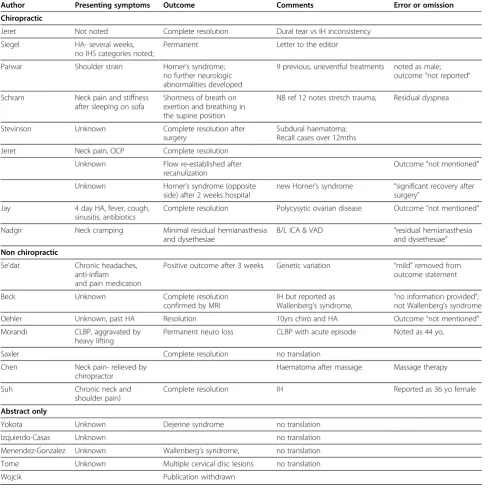
The review of the original case reports and case series papers described by Ernst found numerous errors or in-consistencies (See Table 1- Errors Or Inin-consistencies In The 2007 Ernst Paper). These errors included alteration of the age or sex of the patient, and omission or misrep-resentation of the long term response of the patient to the adverse event.
More serious concerns involved the interpretation of clinical features for each case and the subsequent con-clusions regarding the safety of chiropractic SMT. For example, Table 1 in the 2007 Ernst paper summarizes case reports of AE after SMT administered by chiroprac-tors. However, two case reports clearly state the SMT
was administered by non-chiropractors. Morandi
reported a 49 year old female that developed caudal spinal cord ischaemia after a lumbar SMT [25]. The paper state’s “Three weeks into the episode, a physician performed lumbar vertebral manipulation”. Also, Chen reported a 72 year old male that developed a haematoma in the ligamentum flavum [26]. The paper states “. . .. following traditional massage therapy”.
Nine cases originated from countries where there is no legislation governing chiropractic, which therefore allows non-qualified people to administer SMT, and this may be incorrectly termed “chiropractic” [27-35]. In four of these cases only the abstract was available in English, so a less detailed review could be performed for these papers. However, in the seven cases with full English papers, a detailed review is discussed later in this paper.
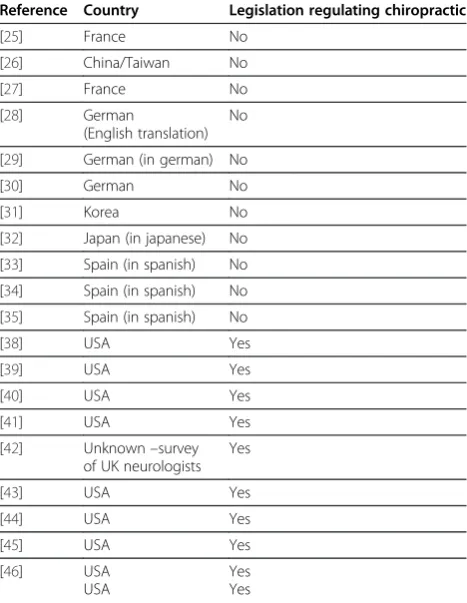
Therefore, in 11 cases of the 21 (one paper has been withdrawn from circulation) that Ernst reported as SMT administered by chiropractors, it is unlikely that the per-son was a qualified chiropractor. Whilst most cases did not describe the SMT procedure, the three cases which did, describe SMT procedures not commonly used by chiropractors [25,28,30]. For example, facet joint infiltra-tion after the SMT and SMT with axial tracinfiltra-tion, which was initially described by Cyriax (a medical practitioner) [36]. This supports the theory that these 11 cases had SMT from a non-chiropractor, which has previously been reported [37]. (See Table 2: Countries With Legisla-tion For Chiropractic).
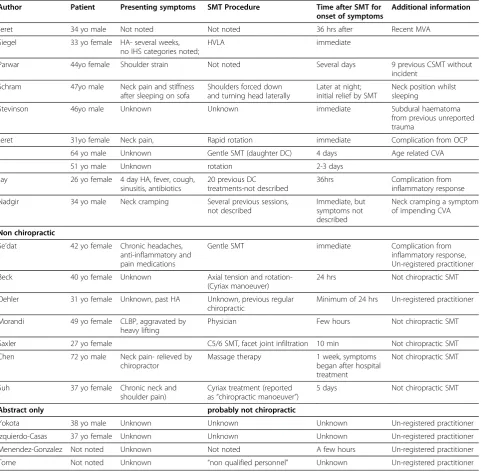
In the remaining 10 cases it is more likely that the per-son was a qualified chiropractor [38-44]. However, as most of these cases (n = six) did not describe the SMT procedure, it cannot be determined if the SMT proced-ure was a type commonly used by chiropractors. In addition, there is the possibility of poor execution of the SMT procedure or inappropriate use of the proced-ure (i.e. professional negligence).
Many of these 10 cases also had a plausible alternative explanation as to why the AE may have occurred (See Table 3: Features And Outcomes Of Cases). For example,
Jeret described a case of a 51-year-old man who presented to the hospital five days after rotatory chiropractic ma-nipulation of his neck [38]. For 2–3 days prior to admis-sion, the patient was reported to have had intermittent slurred speech, left facial droop, and mild left hand weak-ness. The case had no description of the presenting symp-tom and no description of any risk factors for CVA. Interestingly, the initial symptoms were all related to a left side infarct and 2 weeks after admission to hospital the pa-tient had a right side infarct. It is plausible this man had CVA due to risk factors other than chiropractic SMT.
Table 1 Errors or Omissions to 2007 Ernst paper
Author Presenting symptoms Outcome Comments Error or omission
Chiropractic
Jeret Not noted Complete resolution Dural tear vs IH inconsistency
Siegel HA- several weeks,
no IHS categories noted;
Permanent Letter to the editor
Parwar Shoulder strain Horner’s syndrome;
no further neurologic abnormalities developed
9 previous, uneventful treatments noted as male; outcome“not reported“
Schram Neck pain and stiffness after sleeping on sofa
Shortness of breath on exertion and breathing in the supine position
NB ref 12 notes stretch trauma; Residual dyspnea
Stevinson Unknown Complete resolution after
surgery
Subdural haematoma; Recall cases over 12mths
Jeret Neck pain, OCP Complete resolution
Unknown Flow re-established after recanulization
Outcome“not mentioned”
Unknown Horner’s syndrome (opposite side) after 2 weeks hospital
new Horner’s syndrome “significant recovery after surgery”
Jay 4 day HA, fever, cough,
sinusitis, antibiotics
Complete resolution Polycysytic ovarian disease Outcome“not mentioned”
Nadgir Neck cramping Minimal residual hemianasthesia
and dysethesiae
B/L ICA & VAD “residual hemianasthesia and dysethesiae”
Non chiropractic
Se’dat Chronic headaches, anti-inflam and pain medication
Positive outcome after 3 weeks Genetic variation “mild”removed from outcome statement
Beck Unknown Complete resolution
confirmed by MRI
IH but reported as Wallenberg’s syndrome,
“no information provided”; not Wallenberg’s syndrome
Oehler Unknown, past HA Resolution 10yrs chiro and HA Outcome“not mentioned”
Morandi CLBP, aggravated by
heavy lifting
Permanent neuro loss CLBP with acute episode Noted as 44 yo,
Saxler Complete resolution no translation
Chen Neck pain- relieved by
chiropractor
Haematoma after massage Massage therapy
Suh Chronic neck and
shoulder pain)
Complete resolution IH Reported as 36 yo female
Abstract only
Yokota Unknown Dejerine syndrome no translation
Izquierdo-Casas Unknown no translation
Menendez-Gonzalez Unknown Wallenberg’s syndrome, no translation
Tome Unknown Multiple cervical disc lesions no translation
Parwar (2001) reported a case of a 44-year-old woman who presented to an emergency room with severe head-ache, right-sided neck pain, ptosis, and miosis [40]. It was reported that this happened several days after her ninth chiropractic session for her presenting symptom of “a strained right shoulder muscle”. The patient was diagnosed with Horner’s Syndrome due to a right in-ternal carotid artery dissection. None of the risk factors for CVA were reported, for example, migraine, which
has been reported to cause Horner’s Syndrome [19].
The case report also stated that no further neurological
abnormalities occurred, which Ernst reported as
“not reported”.
Schram reported a case of a 41-year-old male who sought chiropractic care for pain and stiffness in his neck and shoulders [41]. The pain developed after the patient had slept on a sofa while on vacation, one week previous to the treatment. The case report stated the “chiropractor did a number of manipulations that the patient described as forcing his shoulders downward and turning his head laterally” (not a common chiropractic technique). There was no record that the patient experi-enced increased neck pain or any alteration in breathing pattern. He returned to his chiropractor the next
day with this complaint, and was subsequently
transferred to an emergency department for evaluation of his orthopnea.
Stevinson (2001) described a case of a 46 year old male that was reported to suffer a subdural haematoma after a chiropractic treatment [42]. The case was obtained from a survey to UK neurologists, who were asked to recall patients that had a neurological complication within a 12 month period. The entire case history is reproduced below:
A man aged 46 was diagnosed with acute subdural haematoma occurring immediately after chiropractic treatment. A burrhole was required. There was no neurological deficit at one month or six month follow up.
Apart from the obvious weakness of recall bias with the survey, the case details could at best only be described as scant. It is more likely this is a case of negli-gence, with the chiropractor failing to adequately investi-gate any previous trauma that would have caused the subdural haematoma. This would then become a contra-indication for SMT and require immediate referral for emergency medical treatment.
Jeret reported a case of a 34 year old male who had a whiplash injury in a motor vehicle accident (MVA), for which chiropractic treatment gave some relief [43]. One month after the MVA, the chiropractor performed a SMT and approximately 36 hours after this the patient reported a severe, throbbing, positional headache. The clinical diagnosis was intracranial hypotension, which is commonly reported as spontaneous.
Jay et al (2003) described a case of bilateral occipital-parietal hemorrhagic infarctions following chiropractic cervical manipulation [44]. A 26-year-old woman pre-sented to a chiropractor with mild headache, cough, and low-grade fever for four days (for which she had been prescribed antibiotics). The patient had received over 20 chiropractic manipulations over the previous two years without event. CT scan and MRI were reported to show bilateral, symmetric occipital-parietal hemorrhagic infarctions. The patient was taking the OCP (for poly-cystic ovarian disease), however, other risk factors for stroke were not recorded. In addition, the time between onset of visual changes and SMT was over 36 hours. It is plausible this woman had CVA due to risk factors other than chiropractic SMT. The patient also made a full recovery.
Discussion
The general quality of the original case information used by Ernst was poor, which should have called into ques-tion the conclusions published in the 2007 Ernst paper. The lack of clinical detail in the original cases does not
Table 2 Reference papers and their country of origin and relevant legislation for chiropractic licensing
Reference Country Legislation regulating chiropractic
[25] France No
[26] China/Taiwan No
[27] France No
[28] German
(English translation) No
[29] German (in german) No
[30] German No
[31] Korea No
[32] Japan (in japanese) No
[33] Spain (in spanish) No
[34] Spain (in spanish) No
[35] Spain (in spanish) No
[38] USA Yes
[39] USA Yes
[40] USA Yes
[41] USA Yes
[42] Unknown–survey of UK neurologists
Yes
[43] USA Yes
[44] USA Yes
[45] USA Yes
[46] USA Yes
allow adequate conclusions to be drawn from these cases. For example, the vast majority of the original cases did not contain information about well-established confounding variables for these types of cases. Subse-quently, no conclusions can be correctly derived about the impact of SMT on the development of VAD. The au-thor of the 2007 paper should have concluded previous cases material was inadequate for any relationship be-tween SMT and VAD to be assessed.
The terms chiropractic treatment, chiropractic ma-nipulation, chirotherapy and/or chiropractic procedure
were used repeatedly, without identification of the prac-titioners’ qualifications. A study by Terrett found that “the words chiropractic and chiropractor have been in-correctly used in numerous publications dealing with SMT injury by medical authors, respected medical jour-nals and medical organisations. In many cases, this is not accidental; the authors had access to original reports that identified the practitioner involved as a non-chiropractor” [36]. Wenban also suggests that the words ‘chiropractor’ and ‘chiropractic manipulation’ are used inappropriately by European biomedical researchers
Table 3 Features And Outcomes Of Cases
Author Patient Presenting symptoms SMT Procedure Time after SMT for
onset of symptoms
Additional information
Jeret 34 yo male Not noted Not noted 36 hrs after Recent MVA
Siegel 33 yo female HA- several weeks, no IHS categories noted;
HVLA immediate
Parwar 44yo female Shoulder strain Not noted Several days 9 previous CSMT without
incident
Schram 47yo male Neck pain and stiffness after sleeping on sofa
Shoulders forced down and turning head laterally
Later at night; initial relief by SMT
Neck position whilst sleeping
Stevinson 46yo male Unknown Unknown immediate Subdural haematoma
from previous unreported trauma
Jeret 31yo female Neck pain, Rapid rotation immediate Complication from OCP
64 yo male Unknown Gentle SMT (daughter DC) 4 days Age related CVA
51 yo male Unknown rotation 2-3 days
Jay 26 yo female 4 day HA, fever, cough, sinusitis, antibiotics
20 previous DC treatments-not described
36hrs Complication from
inflammatory response
Nadgir 34 yo male Neck cramping Several previous sessions, not described
Immediate, but symptoms not described
Neck cramping a symptom of impending CVA
Non chiropractic
Se’dat 42 yo female Chronic headaches, anti-inflammatory and pain medications
Gentle SMT immediate Complication from
inflammatory response, Un-registered practitioner
Beck 40 yo female Unknown Axial tension and
rotation-(Cyriax manoeuver)
24 hrs Not chiropractic SMT
Oehler 31 yo female Unknown, past HA Unknown, previous regular chiropractic
Minimum of 24 hrs Un-registered practitioner
Morandi 49 yo female CLBP, aggravated by heavy lifting
Physician Few hours Not chiropractic SMT
Saxler 27 yo female C5/6 SMT, facet joint infiltration 10 min Not chiropractic SMT
Chen 72 yo male Neck pain- relieved by
chiropractor
Massage therapy 1 week, symptoms
began after hospital treatment
Not chiropractic SMT
Suh 37 yo female Chronic neck and
shoulder pain)
Cyriax treatment (reported as“chiropractic manoeuver”)
5 days Not chiropractic SMT
Abstract only probably not chiropractic
Yokota 38 yo male Unknown Unknown Unknown Un-registered practitioner
Izquierdo-Casas 37 yo female Unknown Unknown Unknown Un-registered practitioner
Menendez-Gonzalez Not noted Unknown Not noted A few hours Un-registered practitioner
Tome Not noted Unknown “non qualified personnel” Unknown Un-registered practitioner
[45]. This appears to be continuing with the Ernst’s paper giving the impression that most AE after SMT are due to chiropractic procedures “. . ..(SMT) is the hall-mark treatment of chiropractors”.
Another weakness in many of the original case studies involved poor information on the time period between the onset of the AE and the administration of the SMT. Few cases described any events which may have occurred after the SMT that could have had a direct bearing on the subsequent AE occurrence. For example, one person drove home after her treatment and whilst she was reversing the car, the AE occurred. The sus-tained neck rotation could have had more impact than the SMT.
There were also further examples were plausible alter-native processes may have led to the development of a VAD, which was independent to the SMT. For example, Ernst failed to acknowledge the anatomical variance in the patient’s vertebral arteries causing them to originate below the level of the foramen magnum which the au-thor acknowledges to have played a vital role in the patient’s complications following spinal manipulative therapy [27].
There was also no discussion on the relevance of time lapse between SMT and the AE, where, in some cases, periods of greater than 24 hours occurred. This com-bined with many cases not describing the presenting symptom, creates significant weaknesses in establishing a link of the AE to SMT.
Conclusion
It is unwise to make conclusions regarding causality from any case study or multiple case studies. The num-ber of errors or omissions in the 2007 Ernst paper sig-nificantly limit any reported conclusions. Standard risk factors for VAD and the timeline between the VAD and SMT could be significant confounding factors. Whilst SMT may coincide with development of VAD, the qual-ity of the 2007 paper does not add to the understanding of whether there is any link of SMT to VAD. A much more thorough peer review needs to occur regarding papers such as Ernst 2007. Further research is required to assess the relationship between SMT and VAD.
Competing interests
The author declare that they have no competing interests.
Authors’information
Peter Tuchin: Senior Lecturer.
Received: 30 May 2012 Accepted: 12 August 2012 Published: 21 September 2012
References
1. Harlan WR Jr:Research on complementary and alternative medicine using randomized controlled trials.J Altern Complement Med2001,
7(Suppl 1):S45–S52.
2. UK BEAM Trial Team:United Kingdom back pain exercise and
manipulation (UK BEAM) randomised trial: cost effectiveness of physical treatments for back pain in primary care.BMJ2004,329:
doi:10.1136/bmj.38282.607859.AE.
3. Meade TW, Dyer S, Browne W,et al:Randomized comparison of chiropractic and hospital outpatient management for low back pain: Results from an extended follow up.Br Med J1995,311:349–351. 4. Bronfort G, Evans R, Anderson AV, Svendsen MS, Bracha Y, Grimm RH:
Spinal Manipulation, Medication, or Home Exercise With Advice for Acute and Subacute Neck Pain: A Randomized Trial.Ann Intern Med2012,
156:1–10.
5. Jull G, Trott P, Potter H, Zito G, Niere K, Shirley D,et al:A randomized controlled trial of exercise and manipulative therapy for cervicogenic headache.Spine2002,27:1835–1843.
6. Tuchin PJ, Pollard H, Bonello R:A RCT of Chiropractic SMT and migraine.
J Manipulative Physiol Ther2000,23:91–95.
7. Chou R, Qaseem A, Snow V,et al:Diagnosis and treatment of low back pain: a joint clinical practice guideline from the American College of Physicians and the American Pain Society.Ann Intern Med2007,
147:478–491.
8. Bronfort G, Haas M, Evans R, Triano J:Effectiveness of manual therapies: the UK evidence report.Chiropr Osteopat2010,18:3–36.
9. Airaksinen O, Brox JI, Cedraschi C,et al:Chapter 4. European guidelines for the management of chronic nonspecific low back pain.Eur Spine J2006,
15(Suppl 2):S192–S300.
10. Chaibi A, Tuchin PJ, Russell M:Manual Therapies for Migraine A Systematic Review of the Literature.J Headache2011. doi:10.1007/s10194-011-0296-6.
11. Thiel HW, Bolton JE, Docherty S, Portlock JC:Safety of Chiropractic Manipulation of the Cervical Spine. A Prospective National Survey.Spine
2007,32:2375–2378.
12. Hurwitz EL, Morgenstern H, Harber P,et al:A Randomized Trial of Chiropractic Manipulation and Mobilization for Patients with Neck Pain: Clinical Outcomes from the UCLA Neck-Pain Study.Am J Publ Health
2002,92:100.
13. Rubinstein SM,et al:The benefits outweigh the risks for patients undergoing chiropractic care for neck pain: a prospective, multicenter, cohort study.J Manipulative Physiol Ther2007,30(6):408–418.
14. Cagnie B, Vinck E, Beernaert A, Cambier D:How common are side effects of spinal manipulation and can these side effects be predicted?Man Ther2004,9:151–156.
15. Ernst E:Vascular accidents after neck manipulation: cause or coincidence?Int J Clin Pract2010,64:673–677.
16. Haldeman S, Kohlbeck FJ, McGregor M:Unpredictability of cerebrovascular ischaemia associated with cervical spine manipulation therapy.Spine
2002,27:49–55.
17. Ernst E:Adverse effects of spinal manipulation: a systematic review.J Roy Soc Med2007,100:330–338.
18. Debette S, Leys D:Cervical-artery dissections: predisposing factors, diagnosis, and outcome.Lancet Neurol2009,8:668–678.
19. Chatzikonstantinou A, Wolf ME, Hennerici MG:Ischemic stroke in young adults: classification and risk factors.J Neurol,
doi:10.1007/s00415-011-6234-3.
20. Chandra A, Suliman A, Angle N:Spontaneous dissection of the carotid and vertebral arteries: the 10-year UCSD experience.Ann Vasc Surg2007,
21:178–185.
21. Gallai V, Caso V, Paciaroni M,et al:Mild hyperhomocystaeinemia: a possible risk factor for cervical artery dissection.Stroke2001,
32:714–718.
22. Grau AJ, Brandt T, Buggle F,et al:Association of cervical artery dissection with recent infection.Arch Neurol1999,56:851–856.
23. Brandt T, Orberk E, Weber R,et al:Pathogenesis of cervical artery dissections: association with connective tissue abnormalities.Neurology
2001,57:24–30.
24. Campos CR, Evaristo EF, Yamamoto FI,et al:Spontaneous cervical carotid and vertebral arteries dissection: study of 48 patients.Arq Neuropsiquiatr
2004,62:492–498.
25. Morandi X,et al:Caudal spinal cord ischemia after lumbar vertebral manipulation.Joint Bone Spine2004,71:334–337.
27. Se’dat J, Dib M, Mahagne MH, Lonjon M, Paquis P:Stroke after chiropractic manipulation as a result of extracranial postero-inferior cerebellar artery dissection.J Manipulative Physiol Ther2002,25:588–590.
28. Beck J, Raabe A, Seifert V:Intracranial hypotension after chiropractic manipulation of the cervical spine.J Neurol Neurosurg Psychiatry2003,
74:820–826.
29. Oehler J,et al:Vertebralisdissektion nach chiropraktischer behandlung.
Der Orthopade2003,32:911–913.
30. Saxler G, Barden B:Extensive spinal epidural haematoma–an uncommon entity following cervical chiropractic manipulation.Z Orthop Grenzgeb2004,142:79–84.
31. Suh S-I, Koh S-B, Choi E-J,et al:Intracranial hypotension induced by cervical spine chiropractic manipulation.Spine2005,30:E340–E342. 32. Yokota J, Amakusa Y, Tomita Y, Takahashi S:The medial medullary
infarction (Dejerine syndrome) following chiropractic neck manipulation.
No To Shinkei2003,55:121–125.
33. Izquierdo-Casas J,et al:Diseccion vertebral como causa del syndrome de enclaustramiento y opciones terapeuticas con fibrinolisis intraarterial durante la fase aguda.Rev Neurol2004,38:1139–1141.
34. Menendez-Gonzalez M,et al:Sindrome do Wallemberg secundario a diseccion de la arteria vertegral por manipulacion quiropractica.Rev Neurol2003,37:837–839.
35. Tome F, Barriga A, Espejo L:Herniacion discal multiple tras manipulacion quiropractica cervical.Revista de Medicina de la Universidad de Navarra
2004,48:39–41.
36. Terrett AGJ:Misuse of the literature by medical authors in discussing spinal manipulative therapy injury.J Manipulative Physiol Ther1995,
18:203–210.
37. Cyriax J:Textbook of Orthopaedic Medicine. Volume one: Diagnosis of Soft Tissue Lesions. 8th edition. London: Baillière Tindall; 1982. ISBN 0 7020 0935. 38. Jeret JS:More complications of spinal manipulation.Stroke2001,
32:1136–1137.
39. Siegel D, Neiders T:Vertebral artery dissection and pontine infarction after chiropractic manipulation.Am J Emerg Med2001,19:172–173. 40. Parwar BL, Fawzi AA, Arnold AC, Schwartz SD:Horner’s syndrome and
dissection of the internal carotid artery after chiropractic manipulation of the neck.Am J Ophthalmol2001,131:523–524.
41. Schram DJ, Vosik W:Diaphragmatic paralysis following cervical chiropractic manipulation: case report and review.Complementary/ Alternative Medicine for Asthma2001,119:638–640.
42. Stevinson C, Honan W, Cooke B, Ernst E:Neurological complications of cervical spine manipulation.J Roy Soc Med2001,94:107–110. 43. Jeret JS, Bluth M:Stroke following chiropractic manipulation. Report of
three cases and review of the literature.Cerebrovasc Dis2002,13:210–213. 44. Jay WM, Shah MI, Schneck MJ:Bilateral occipital-parietal hemorrhagic
infarctions following chiropractic cervical manipulation.Semin Ophthalmol2003,18:205–209.
45. Nadgir RN, Loevner LA, Ahmed T, Chalela J, Slawek K, Imbesi S:
Simultaneous bilateral internal carotid and vertebral artery dissection following chiropractic manipulation: case report and review of the literature.Neuroradiol2003,45:311–314.
46. Wenban AB:Inappropriate use of the title chiropractor and the term chiropractic manipulation in the peer-reviewed biomedical literature.
Chiropr Osteopat2006,14:1–7.
doi:10.1186/2045-709X-20-30
Cite this article as:Tuchin:A replication of the study‘Adverse effects of spinal manipulation: a systematic review’.Chiropractic & Manual Therapies
201220:30. Submit your next manuscript to BioMed Central
and take full advantage of:
• Convenient online submission
• Thorough peer review
• No space constraints or color figure charges
• Immediate publication on acceptance
• Inclusion in PubMed, CAS, Scopus and Google Scholar
• Research which is freely available for redistribution