MODELLING OF SURFACE OZONE
USING ARTIFICIAL NEURAL
NETWORK IN AN URBAN AREA
S.Stephen Rajkumar Inbanathan
Post Graduate and Research Department of Physics, The American College, Madurai 625 002, India.
O. Mahendran
Saraswati Narayanan College, Madurai – 605022, India
R.Samuel Selvaraj and R. Jayalakshmi
Department of Physics, Presidency College, Chennai – 600 005, India.
Abstract
In this paper a novel approach, based on a neural network structure, is introduced in order to face with the problem of pollutant estimation in an urban area. A neural architecture, based essentially on suitable number of layers devoted to predict alarm situations and to estimate the value of the pollutant, has been implemented. A new method for short term prediction is presented using the neural network technique. Due to increase in industrial and anthropogenic activity, air pollution is a serious subject of concern today. Surface ozone prediction using the technique of adaptive pattern recognition is developed. The model can predict the mean surface ozone based on the parameters like Nitrogen-di-oxide, temperature and % Relative Humidity, wind direction, wind speed. The model can perform well both in training and independent periods. The classical methods of short term modeling are not reliable enough. The method can also be used for short term prediction of other air pollutants.
Key words: Air pollution; neural network; surface ozone; short term prediction.
1. Introduction
Surface ozone is a secondary photochemical pollutant produced from a variety of natural and anthropogenic precursors that include industrial and vehicular emission of volatile organic compounds and oxides of nitrogen. In elevated concentrations, it has detrimental effects on vegetation, human health and various natural materials [Guicherit et al., (1987)]. Ozone is an important constituent of the atmosphere that maintains the thermal structure of the stratosphere and the troposphere. Many studies [Ramaswamy and Bowen, (1994); Rajeevan, (1996); Bojkov, (1983)] suggest that an increase in tropospheric ozone leads to the warming in surface temperature. Ozone is considered to be the cause of eye irritation and may affect the respiratory tract [Amdt, (1980)] even during short term high concentrations.
Neural network techniques have recently become the focus of much attention as they can handle the complex and non-linear problems better than the conventional statistical techniques. Neural network is simple mathematical input output model which learns the relationship (linear or non-linear) between the input and output during the training period. Neural network model brings out the maximum information available within the data during the training period and reflects these in the independent period. Present paper aims to develop a simple model using neural network technique based on the data which are easily available. The performance of the model is satisfactory both in training and independent period.
2. Area of Study and data
Ground level ozone concentration and nitrogen dioxide measurements were carried out in the urban site Thiruvottiyur. It is located 60m above from the sea level. It is an Industrial area. So many industries are located nearby to this location. It is situated in the North – Eastern end of Tamil Nadu on the coast of Bay of Bengal. It lies between 12o 09’and 13o 09’ of the Northern latitude and 80 o 12’and 80o 19’of the eastern longitude. It is 5km from Chennai central.
The following parameters were used to develop the model: (1) Prevailing % Relative Humidity as predictor
(2) Prevailing wind speed as predictor.
(3) Nitrogen dioxide concentration as predictor. (4) Mean temperature as predictor.
(5)Previous ozone data as predictor
3. Method of data measurement
A portable Aeroqual series S200 ozone monitor was used. An Aeroqual series S200 ozone Monitor is constructed to measure low and high ozone levels. Its ultra low concentration ozone head measures the ozone concentration from 0.000 to 0.500 ppm, and a high concentration ozone head measures the ozone Concentration from 0.50 to 20.00 ppm. Accuracy of a low concentration ozone head is ± 0.001 ppm (from 0 to 0.100 ppm); ± 10% (0.100 to 0.500 ppm), while that of a high concentration ozone head is ± 10% (from 0.20 to 2.00 ppm); ± 15% (from 2.00 to 20.00 ppm), the measurement unit being either ppm or μg/m3. The operating Temperature range is from – 5o C to 50o C, relative humidity limits are 5% and 95%. Similar kind of NO2 sensor has been used for nitrogen dioxide measurement. A gas sensitive semiconductor (GSS) type sensor is described in
www.aeroqual.com.
Wind speed is calculated using a wind vane. Wind velocity is measured using AM-4201digital Anemometer. Measurement in range 0.4 – 3 m\s has resolution 0.1 m\s of accuracy ± (2% + 0.2 m\s). The ambient temperature and humidity are measured by Thermo Hydrometer. Temperature accuracy ± 0.1oCand humidity accuracy ± 5%. Sampling was carried out for two days from 13-11-2010 to 14-11-2010 for every ten minutes interval.
Brief review of neural network technique
Neural Networks are signal processing systems that attempt to emulate the behavior of biological nervous systems by providing a mathematical model of combination of numerous basic blocks called neurons connected in a network. It is remotely analogous to living nervous system and hence its name. One can think of neural networks as an extended form of regression which has the properties of
(1) adaptivity (2) robustness (3) ruggedness
(4) speed (via massive parallelism), (5) nonlinearity and
(6) optimality with respect to error.
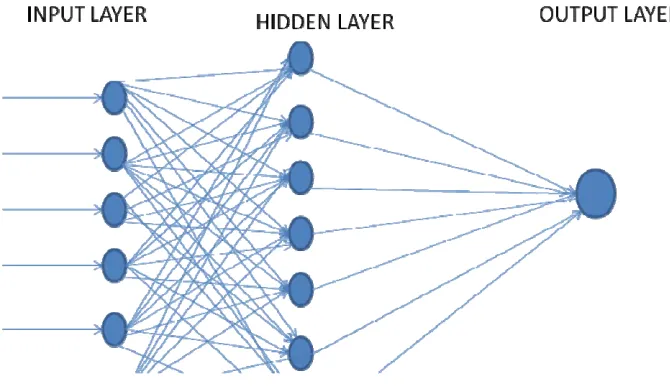
Fig. 1 : Typical configuration of a Three layer perception neural network
The most common neural network is the feed forward mapping network; it consists of a set of nodes and a set of interconnections between them. A node contains a computational element called neuron , taking inputs from incoming interconnections (input links) and providing outputs to outgoing interconnections (output links). The units of the neural network are arranged by layers. A unit on one layer takes inputs from the units on the layers below and feeds its output to the units on the layers above. The bottom layer is called input layer whose units take input from the outside and without processing them distribute to the units on the layer above. The top layer is an output layer whose output is the output of the neural network. The layers between input and output layers are called hidden layers. A pattern is defined as a set of input values with the related output values. A typical computational element takes the weighted sum of the input links and passes the result through a transfer function. The structure of a three layer neural network is shown in Fig. 1.
The transfer function used here is the sigmoidal function. The ANN’s are product of the artificial intelligence, which miming the neurons networks, allow expert systems and learning skills. In this respect they are alternative to the expert systems with learning skills. In this respect they are alternative to the expert systems based on choice trees driven by “if…then …” relationships. Actually, in ANN’s high variety, often devoted to specific functions such as pattern recognition and ranking. The most suitable ANN’s to interpret environmental pollution are those known as feed-forward back propagation because they map inputs to outputs non-determininistically by optimizing forecasting of the learning sections [(Benvenuto et al,2000)].
Y = [1 + e (-ax+b)]-1
where ‘a’ determines the slope of the sigmoid and ‘b’ is the threshold. The process of learning the training set of patterns means the determination of the optimum weights which minimize the mean square error between the outputs in the output layer and the desired values. Most commonly used “back-propagation learning algorithm” [Rumbelhart et al., (1986)] is used for the training. Initially random weights between ±0.5 are assigned to each weight as initial guesses. The weights are learned through an iterative process. During learning the weights are updated. When the network learns the training set of patterns well enough it can be used for determining the output values for the pattern with unknown outputs (Test period or prediction period).
5. Results and conclusions
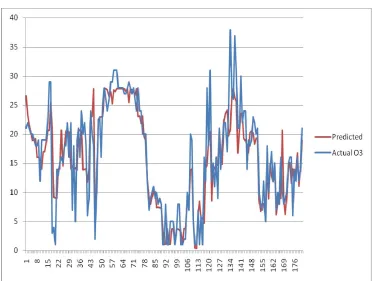
The data is separated for training of the network and the network was trained. The weight values were fixed. Remaining data was used for testing of the network. The result obtained is shown in the Fig. 2.Surface ozone - predicted versus actual values.
Mean Square Error(MSE) 18.109
Root Mean Square Error(RSME) 4.255
Fig 2: Performance of the neural network model
References
[1] Amdt, U. (1980): Wirkungsaspekte im Hindblick auf die Grenzwertziehung von ozone, In photochemische Luftverunreinigungen in der Bundesrepublik Deutschland, Tagung des Umweltbundesamtes, Oct, 1979, VDI – Verlag, Dusseldorf, pp. 229 – 238.
[2] Benvenuto,F. and Marani, A. (2000),Nowcasting of urban air pollutants by neural networks .Nuovo Cimento,23C,567-586.
[3] Bojkov, R.D. (1983): Tropospheric ozone, its changes and possible radiative effects, Proc. WMOTechn. Conf. on Observ. Of Atmosph. Contamin. Vienna, Oct. 1983. WMO Sp. Environm. Report 16.
[4] Bonzar, M.; Lesjak, M .; Mlakar, P. (1993): A neural network based method for short term predictions of ambient SO2 concentration in highly polluted industrial areas of complex terrain. Atmospheric Environment, Part B: Urban Atmosphere, 27B, 2, 221-230. [5] Bravo,J.L.; Diaz, M.T.; Gay, C ; Fajardo, J. (1996):A short term prediction model for surface ozone at southwest part of Mexico
valley, Atmosfera, 9, 33-45.
[6] Guicherit, R. et.al., (1987):The regional ozone problem in Tropospheric ozone – Regional and Global Scale interactions, Nato ASI Series C. 227 (1988), 403-411.
[7] Masters, T., (1993): Practical Neural Network Recipies in C++, Academic Press.
[8] Rajeevan, M. (1996): Climate implications of observed changes in ozone vertical distribution, Int. J. Climatol., 6, 15-22.
[9] Ramaswamy, V.; Bowen, M.M. (1994): Effect of changes in radiatively active species upon lower stratospheric temperatures, J. Geophys. Res., 99, 18909-18921.
[10] Rumbelhart, D.; Hinton, G.E.; Wiliams, R.J. (1986): Learning internal representation by error propagation, In parallel distributed processing Exploration in the Microstructure of Cognition, Vol I, Cambridge.