Name _______________________ Period ___________
Chapter 14: Mendel and the Gene Idea
If you have completed a first-year high school biology course, some of this chapter will serve as a review for the basic concepts of Mendelian genetics. For other students, this may be your first exposure to genetics. In either case, this is a chapter that should be carefully mastered. Spending some time with this chapter, especially working genetics problems, will give you a solid foundation for the extensive genetics unit in the chapters to come. The topics in this chapter correlate with EK 3.A.3.
Overview:
1. In the 1800s the most widely favored explanation of genetics was “blending.” Explain the concept of blending, and then describe how Mendel’s “particulate” (gene) hypothesis was different.
Concept 14.1 Mendel used the scientific approach to identify two laws of inheritance
2. One of the keys to success for Mendel was his selection of pea plants. Explain how using pea plants allowed Mendel to control mating; that is, how did this approach let Mendel be positive about the exact characteristics of each parent?
4. Define the following terms. Then, consider your own family. Which generation would your mother’s grandparents be? Your mother? You?
P generation: F1 generation:
F2 generation:
If your mother’s grandparents represented the P generation, then your mother would be in the F2
generation and you would be in the F3 generation.
5. Explain how Mendel’s simple cross of purple and white flowers did the following:
a. refuted blending:
b. determined dominant and recessive characteristics:
c. demonstrated the merit of experiments that covered multiple generations:
6. Refer to Figure 14.4 in your text to label the allele for both purple and white flower color, a homologous pair, and the locus of the flower color gene What is the difference between the nucleotide sequences of the purple flower allele compared to the white flower allele? Which allele does not produce a functional gene product?
7. In sexually reproducing organisms, why are there exactly two chromosomes in each homologous pair?
8. Mendel’s model consists of four concepts. Describe each concept in the appropriate space below. Indicate which of the concepts can be observed during meiosis by placing an asterisk by the concept.
Mendel’s Four Concepts Description of Concept First concept
Second concept
Third concept
Fourth concept (law of segregation)
9. Using Figure 14.5 in your text as your guide, provide the missing notations for the figure below. (P, F1,
F2). Also indicate the alleles for each individual as well as the gametes it produces, and complete the
Punnett square.
a. What is the F2 phenotypic and genotypic ratio?
b. Which generation is completely heterozygous?
10. In pea plants, T is the allele for tall plants, while t is the allele for dwarf plants. If you have a tall plant, demonstrate with a testcross how it could be determined if the plant is homozygous tall or heterozygous tall.
11. Explain the difference between a monohybrid cross and a dihybrid cross.
12. A you start to work word problems in genetics, two things are critical: the parent’s genotype must be correct, and the gametes must be formed correctly. Using Figure 14.8 as your guide, explain how the gametes are derived for the following cross. (You should have four different gametes).
YyRr × YyRr
13. Complete the cross given in question 12 by placing the gametes in a Punnett square. Then provide the phenotypic ratio of the offspring.
14. Explain Mendel’s law of independent assortment.
Before leaving this concept, it would be helpful to complete the three problems in Concept Check 14.1 on page 274 of your textbook. The problems are worked and explained in the Answer section on page A-13 at the back of the book.
Concept 14.2 Probability laws govern Mendelian inheritance
16. In probability, what is an independent event?
17. State the multiplication rule and give an original example.
18. State the addition rule and give an original example.
19. What is the probability that a couple will have a girl, a boy, a girl, and a boy in this specific order?
Concept 14.3 Inheritance patterns are often more complex than those predicted by simple Mendelian genetics
20. Explain how incomplete dominance is different from complete dominance, and give an example of incomplete dominance.
22. Dominant alleles are not necessarily more common than recessive alleles in the gene pool. Explain why this is true.
23. Explain what is meant when a gene is said to have multiple alleles. Blood groups are an excellent human example of this.
24. Blood groups are so important medically that you should be able to solve genetics problems based on blood types. The first step in accomplishing that is to understand the genotypes of each blood type. Before working any problems, complete this ABO blood type chart.
Genotype Red Blood Cell Appearance Phenotype (blood group)
25. Question 2 in the Concept Check 14.3 is a blood type problem. Complete it here, and show your work.
26. What is pleiotropy? Explain why this is important in diseases like cystic fibrosis and sickle-cell disease.
27. Explain epistasis.
29. Quantitative variation usually indicates polygenic inheritance. What is a good example of this?
30. Using the terms norm of reaction and multifactorial, explain the potential influence of the environment on phenotypic expression.
Concept 14.4 Many human traits follow Mendelian patterns of inheritance
31. Pedigree analysis is often used to determine the mode of inheritance (dominant or recessive, for example). Be sure to read the “Tips for pedigree analysis” in Figure 14.15 in your text; then complete the unlabeled pedigree by indicating the genotypes for all involved.
33. Describe what you think is medically important to know about the behavior of recessive alleles.
34. You are expected to have a general knowledge of the pattern of inheritance and the common symptoms of a number of genetic disorders. Provide this information for the disorders in the following list.
a. cystic fibrosis:
b. sickle-cell disease:
c. achondroplasia:
d. Huntington’s disease:
35. Amniocentesis and chorionic villus sampling (CVS) are the two most widely used methods for testing a fetus for genetic disorders. Use the unlabeled diagram below to explain the three main steps in
amniocentesis and the two main steps of CVS.
37. Just a few years ago, biologist and medical personnel were surprised to learn that fetal cells can escape and enter the mother’s blood. How can these cells be used in fetal testing?
38. What are the symptoms of phenylketonuria (PKU)? How is newborn screening used to identify children with this disorder?
Test Your Understanding Answers
One of the ways to determine your understanding of Mendelian genetics is to work many genetics problems. Complete the questions for the problems at the end of the chapter.
Name _______________________ Period ___________
Chapter 15: The Chromosomal Basis of Inheritance
Overview
1. How does the chromosome theory of inheritance provide a physical explanation for Mendelian inheritance?
Concept 15.1 Mendelian inheritance has its physical basis in the behavior of chromosomes
2. Explain the law of segregation. Use two different colored pencils to illustrate the segregation of alleles.
You may want to consult Figure 15.2 in your text, and model your sketches on this.
3. Explain the law of independent assortment. To demonstrate that you understand this concept, consider a cell with two pairs of chromosomes. Sketch the two different ways these chromosomes might be arranged during metaphase I.
4. Thomas Hunt Morgan selected Drosophila melanogaster as his experimental organism. List at least three reasons the fruit fly is an excellent subject for genetic studies.
5. The notation for wild type and mutant traits follows some accepted conventions. Notate the following genotypes for a female fruit fly:
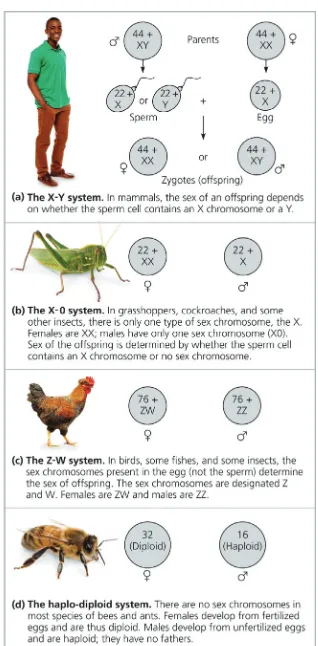
6. When Thomas Hunt Morgan mated a white-eyed male fly with a red-eyed female, he came to the startling conclusion that the trait for eye color was located on the chromosome that determines sex. Show this cross. Begin with the parental generation, and go through the F2.
parental generation:
F1 generation:
F2 generation:
7. What unusual result suggested that the eye-color trait is located on the X chromosome?
Concept 15.2 Sex-linked genes exhibit unique patterns of inheritance
9. What is the SRY gene? Where is it found, and what does it do?
10. What is the definition of a sex-linked gene?
11. In humans, how has the term sex-linked gene been historically modified?
12. Name and describe three human sex-linked disorders.
13. Trythe following problem (Figure 15.7b in your text). A female who carries an allele for color blindness, but who is not color-blind, mates with a male who has normal color vision. What is the probability that they will have a son who is color-blind? How would your answer be different if the question asked the probability of a child who would be color-blind? Pay close attention to the specifics of each genetic problem.
14. Work through problems 15.7a and 15.7c in the Punnett squares provided. Initially try the problems without help from the figure, and then check your work.
16. X inactivation maintains the proper gene dosage. How is the X chromosome inactivated?
17. Why can you say that all calico cats are females?
Concept 15.3 Linked genes tend to be inherited together because they are located near each other on the same chromosome
18. What are linked genes? Do linked genes sort independently?
19. If two genes are linked on the same chromosome, we call this combination the parentalcombination. These genes will be transmitted as a unit and will not sort independently. However, during meiosis, crossing over occurs between homologous chromosomes, and the linked genes can become “unlinked.” In general, the farther two genes are from each other along the chromosome, the more often they will come “unlinked.” Genetic recombination is the process during which linked genes become unlinked. What do geneticists call the offspring that show these new combinations?
20. Review meiosis. When does crossing over occur? Prophase I
21. Alfred H. Sturtevant, a student of Thomas Hunt Morgan, used assumptions from observations of crossovers to map genes. What is a linkage map?
Concept 15.4 Alterations of chromosome number or structure cause some genetic disorders
24. What occurs in nondisjunction?
25. Explain each of the following terms: (note the percentage of aneuploidy human conceptions!)
aneuploidy:
monosomy:
trisomy:
polyploidy:
26. What causes Down syndrome? What are four characteristics of Down syndrome?
27. For each of the following human aneuploidies, give the sex of the individual as well as any physical manifestation of the syndrome.
Sex Physical Traits
XXY
XXX
28. Chromosome structure can be altered in several ways. Place letters in the blocks to represent genes, and
then explain what occurs in each type of alteration.
deletion:
duplication:
inversion:
translocation:
Concept 15.5 Some inheritance patterns are exceptions to the standard Mendelian inheritance
29. A number of genes will cause a variation in phenotype, depending on whether the gene came from the father or the mother. This variation occurs because of genomic imprinting. Explain genomic imprinting.
30. Although you inherited one chromosome of each pair from your mother and your father, you have inherited a group of genes from your mother only. What genes are these?
31. You should have identified mitochondrial DNA as the correct response to question 30 above. What other organelle has its own genes? These are extranuclear genes.
Test Your Understanding Answers