Ch 4: Carbon Chemistry
Ch 5: Macromolecules
Chapter 4 and 5
From Topic 2.1
Essential idea: Living organisms control their composition by a complex web of chemical reactions.
Nature of science: Falsification of theories—the artificial synthesis of urea helped to falsify vitalism. (1.9)
Understandings:
• Molecular biology explains living processes in terms of the chemical substances involved.
• Carbon atoms can form four covalent bonds allowing a diversity of stable compounds to exist.
• Life is based on carbon compounds including carbohydrates, lipids, proteins and nucleic acids.
• Anabolism is the synthesis of complex molecules from simpler molecules including the formation of macromolecules from monomers by condensation
reactions.
• Catabolism is the breakdown of complex molecules into simpler molecules including the hydrolysis of macromolecules into monomers.
Applications and skills:
• Application: Urea as an example of a compound that is produced by living organisms but can also be artificially synthesized.
• Skill: Drawing molecular diagrams of glucose, ribose, a saturated fatty acid and a generalized amino acid.
• Skill: Identification of biochemicals such as sugars, lipids or amino acids from molecular diagrams.
Guidance:
• Only the ring forms of D-ribose, alpha–D-glucose and beta-D-glucose are expected in drawings.
• Sugars include monosaccharides and disaccharides. • Only one saturated fat is expected and its specific name is not necessary.
• The variable radical of amino acids can be shown as R. The structure of individual R-groups does not need to be
memorized.
• Students should be able to recognize from molecular diagrams that triglycerides, phospholipids and steroids are lipids. Drawings of steroids are not expected.
• Proteins or parts of polypeptides should be recognized from molecular diagrams showing amino acids linked by peptide bonds.
Aims:
• Aim 7: ICT can be used for molecular visualization of carbohydrates, lipids and proteins in this sub-topic and in 2.3 and 2.4.
Carbon Chemistry
•
Organic Chemistry – branch of
chemistry dealing with carbon.
•
Organic Molecules- Molecules that
have carbon.
CrashCourse: Carbon Intro*:
Carbon
Understanding: Carbon atoms can form four covalent bonds allowing a diversity of stable compounds to exist.
•
Carbon forms four bonds
–
Why?
•
Can effect three
dimensional shape of
molecules.
•
Variations on carbon
skeletons
–
Length
–
Shape
–
Number and location of
bonds
Carbon Skeletons
Understanding: Carbon atoms can form four covalent bonds allowing a diversity of stable compounds to exist.
•
Carbon’s most useful ability
is being able to bond with
another carbon
•
Carbon will form chains
that other atoms or
molecules will branch from
•
Based on how long the
chain is that chain will have
a certain prefix on its name
•
In organic chemistry both
the prefix and suffix will
give you information about
Isomers
Understanding: Carbon atoms can form four covalent bonds allowing a diversity of stable compounds to exist.
•
Iso = same Mer= Parts
•
Isomers are molecules that
have the same number of
atoms of the same
elements but different
arrangements
Functional Groups
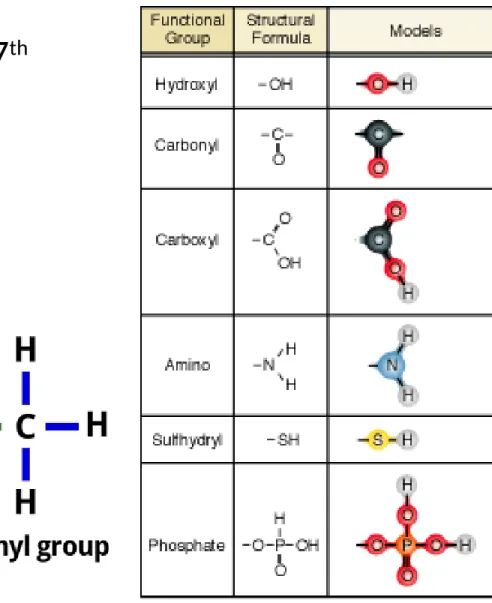
•
See separate notes or
Figure 4.10 of Campbell 7
th
Functional Group Practice
Prefixes
https://wheeldecide.c
om/index.php?c1=M
eth-&c2=Eth-&c3=Pro
p-&c4=But-&c5=Pent-
&c6=Hex-&c7=Hept-&c8=Oct-&c9=Non-&
c10=Dec-&time=5
Suffixes
https://wheeldecide.com/in
dex.php?c1=-ol&c2=-oic+aci
d&c3=-one&c4=-al&c5=-ami
ne&c6=-thiol&c7=-phosphat
e&c8=-ane+&c9=-ene&t=Su
ffixes&time=5
*Note the methyl group does not fit into this naming nomenclature easily,
and will thus be left out of this practice.
Intro to Macromolecules
Understanding:
• Life is based on carbon compounds including carbohydrates, lipids, proteins and nucleic acids.
•
There are four main large organic polymers
1) Carbohydrates
2) Lipids
3) Proteins
4) Nucleic Acids
•
Polymers
are long molecules consisting of many similar or
identical building blocks connected by covalent bonds.
Synthesis and Breakdown of Polymers
• Anabolism is the synthesis of complex molecules from simpler molecules including the formation of macromolecules from monomers by condensation
reactions.
• Catabolism is the breakdown of complex molecules into simpler molecules including the hydrolysis of macromolecules into monomers.
•
Synthesis (making of) polymers from monomers occurs in
dehydration reaction or condensation reaction.
•
Disassembly of polymers into monomers occurs in
hydrolysis.
Dehydration Reaction
•
AKA dehydration synthesis and condensation reactions
-
Linking molecules by the removal of water.
Hydrolysis
•
Hydrolysis: “hydro” means water; “lysis” means to break;
this is the process of breaking polymers with the addition
of water to break the covalent bonds found in a polymer
molecule.
•
Hydrolytic enzymes are enzymes that work by reversing the
condensation reactions, breaking polymers into
monomers.
•
Examples of hydrolytic enzymes are digestive enzymes
Chapter 5: Carbohydrates
From Topic 2.1
Guidance:
• Only the ring forms of D-ribose, alpha–D-glucose and beta-D-glucose are
expected in drawings.
• Sugars include monosaccharides and disaccharides.
From Topic 2.3
Essential idea:
Compounds of carbon, hydrogen and oxygen are used to supply and store energy
Understanding
: Monosaccharide monomers are linked together by condensation reactions to form
disaccharides and polysaccharide polymers.
Application & Skills
:
• Application: Structure and function of cellulose and starch in plants and glycogen in humans.
• Skill
:
Use of molecular visualization software to compare cellulose, starch and glycogen.
Guidance:
• The structure of starch should include amylose and amylopectin.
• Sucrose, lactose and maltose should be included as examples of disaccharides produced by combining
monosaccharides.
Utilization:
Potatoes have been genetically modified to reduce the level of amylose to
produce a more effective
adhesive.
From Topic 6.1
(introduced in HL 1 but reinforced in HL 2)
Utilization:
Chapter 5: Carbohydrates
• Sugars include monosaccharides and disaccharides.
•
Carbohydrates:
Organic molecules made of sugars and their
polymers.
•
Its monomers are simple sugars called
Monosaccharides
• Only the ring forms of D-ribose, alpha–D-glucose and beta-D-glucose areexpected in drawings.
•
Are single sugars
•
Empirical formula is CH
2
O
•
Can be made into more complex structures
•
Ex: Glucose, Galactose, Fructose.
- Glucose can be produced by photosynthesis with the use of CO
2
, light,
and H
2
O
Disaccharides
• Sugars include monosaccharides and disaccharides.
Understanding: Monosaccharide monomers are linked together by condensation reactions to form disaccharides and polysaccharide polymers.
•
Disaccharide:
two monosaccharides linked together by
glycosidic linkage during dehydration reaction
Types of Disaccharides
• Sucrose, lactose and maltose should be included as examples of disaccharides produced by combining monosaccharides.
•
Maltose: Use in brewing
•
Glucose and Glucose
•
Lactose: Transport Sugar in Milk
•
Glucose and Galactose
Polysaccharides
Understanding: Monosaccharide monomers are linked together by condensation reactions to form disaccharides and polysaccharide polymers.
Application & Skills:
• Application: Structure and function of cellulose and starch in plants and glycogen in humans. • Skill: Use of molecular visualization software to compare cellulose, starch and glycogen.
Guidance:
• The structure of starch should include amylose and amylopectin.
Utilization: Potatoes have been genetically modified to reduce the level of amylose toproduce a more effective adhesive.
•
Polysaccharides:
Are macromolecules, made of a few hundred or
thousand monosaccharides.
•
Functions
•
Act as energy storage
•
Ex: Starch, Glycogen
•
Act as structural support
Storage Polysaccharides
Utilization: Potatoes have been genetically modified to reduce the level of amylose toproduce a more effective adhesive.* • Some hydrolytic enzymes have economic importance, for example amylase in production of sugars from starch and in the brewing of beer.**
Starch:
storage polysaccharide of
plants
-
made of only α-glucose monomers
-
Has two components:
amylose
(unbranched) and
amylopectin
(branched with 1-6 glycosidic
linkages)
Glycogen:
storage polysaccharide of
animals
-
made of only α-glucose monomers
-
Similar to amylopectin but more
branched
Structural Support Polysaccharides
Cellulose:
structural support in plants
-
Found in cell walls
-
Made of β-glucose monomers
-
Straight molecule (unbranched)
-
Only certain enzymes can breakdown the
β linkages of cellulose; therefore, not all
organisms can breakdown cellulose
Chitin:
structural support in athropods
-
Made of acetylglucosamine monomers,
amino sugar
-
Forms exoskeleton
-
Also found in fungi
-
Similar to cellulose but contains nitrogen
Starch vs. Cellulose vs. Glycogen
Chapter 5: Lipids
From Topic 2.1
Guidance:
• Only one saturated fat is expected and its specific name is not necessary.
• Students should be able to recognize from molecular diagrams that triglycerides, phospholipids and steroids
are lipids. Drawings of steroids are not expected.
From Topic 2.3
Essential idea:
Compounds of carbon, hydrogen and oxygen are used to supply and store energy.
Nature of science:
Evaluating claims—health claims made about lipids in diets need to be assessed (5.2).
Understandings
:
• Fatty acids can be saturated, monounsaturated or polyunsaturated.
• Unsaturated fatty acids can be cis or trans isomers.
• Triglycerides are formed by condensation from three fatty acids and one glycerol.
Application & Skills
:
• Application: Scientific evidence for health risks of trans fats and saturated fatty acids.
• Application: Lipids are more suitable for long-term energy storage in humans than carbohydrates.
• Application: Evaluation of evidence and the methods used to obtain the evidence for health claims made
about lipids.
• Skill: Determination of body mass index by calculation or use of a monogram.
Guidance:
• Named examples of fatty acids are not required.
International-mindedness:
Variation in the prevalence of different health problems around the world
could be
discussed including obesity, dietary energy deficiency, kwashiorkor,
anorexia nervosa and coronary heart
disease.
• Students should be able to recognize from molecular diagrams that triglycerides, phospholipids and steroids are lipids. Drawings of steroids are not expected.
Essential idea: Compounds of carbon, hydrogen and oxygen are used to supply and store energy.
•
Lipids:
diverse group of organic compounds that
are insoluble in water, but will dissolve in
non-polar solvents.
Examples:
(1) Fats/oils
(2) phospholipids
(3) steroids
• Triglycerides are formed by condensation from three fatty acids and one glycerol. • Named examples of fatty acids are not required.
•
Fats store large amounts of energy (long-term)
•
Made of glycerol backbone and 3 fatty acids chains
•
Connected by ester linkages
•
Forming a
triglyceride
molecule (aka fat molecule,
triacylglycerol)
Characteristics of Fats/Oils
•
Not soluable in water
•
Source of variation is the fatty acids
–
Can all be same
–
Or all three different
–
Vary in length
Saturated vs. Unsaturated Fats
•
No double bonds
•
Carbon has max number of
hydrogens, therefore,
“saturated”
•
Usually solid at room temp
•
Most animal fats, such as
bacon grease, lard, butter
•
One or more double
bond(s) present
•
Double bonds can be
either
cis
or
trans*
•
Tails kink at double bonds;
Can’t pack close enough to
solidify at room temp
•
Usually liquid at room
temp
•
Most plant fats, such as
corn oil, olive oil, peanut
oil
Function of Fats
• Application: Lipids are more suitable for long-term energy storage in humans than carbohydrates.
1) Long-term energy storage
- More energy less weight than other molecules
Phospholipids
•
Glycerol and two fatty acids with a
phosphate on the third. They usually
have a third group as well.
•
Make up the major component of cell
membrane.
•
Show differing interaction with water
due to its polar, hydrophilic head and
nonpolar, hydrophobic tails.
•
Micelle Intro Video:
http:// www.uic.edu/classes/bios/bios100/lectures/membranes01.htmSteroids
•
Steroids:
lipids that have four fused carbon
rings with various functional groups.
•
Cholesterol is an important steroid
•
Precursor to many other steroid
molecules such as…
•
testosterone, estrogen, etc…
•
major component of cell membranes
Fat Transport
Nature of science: Evaluating claims—health claims made about lipids in diets need to be assessed (5.2). • Application: Scientific evidence for health risks of trans fats and saturated fatty acids.
• Application: Evaluation of evidence and the methods used to obtain the evidence for health claims made about lipids. • Skill: Determination of body mass index by calculation or use of a monogram.***
•
Chylomicrons
: A small fat globule composed of protein and lipid; found in the
blood and lymphatic fluid where they serve to transport fat from its port of entry in
the intestine to the liver and to adipose tissue.
•
LDL
(bad) vs
HDL
(good)*: low density lipoprotein vs. high density lipoprotein
LDL cholesterol- contribute to plaque, causing atherosclerosis
HDL cholesterol- removes LDL cholesterol from arteries
Chapter 5: Proteins
From Topic 2.1 Guidance:
• The variable radical of amino acids can be shown as R. The structure of individual R-groups does not need to be memorized.
• Proteins or parts of polypeptides should be recognized from molecular diagrams showing amino acids linked by peptide bonds.
From Topic 2.4
Essential idea: Proteins have a very wide range of functions in living organisms.
Nature of science: Looking for patterns, trends and discrepancies— most but not all organisms assemble proteins from the same amino acids (3.1).
Understandings:
• Amino acids are linked together by condensation to form polypeptides.
• There are 20 different amino acids in polypeptides synthesized on ribosomes.
• Amino acids can be linked together in any sequence giving a huge range of possible polypeptides.
• The amino acid sequence of polypeptides is coded for by genes. • A protein may consist of a single polypeptide or more than one polypeptide linked together.
• The amino acid sequence determines the three-dimensional conformation of a protein.
• Living organisms synthesize many different proteins with a wide range of functions.
• Every individual has a unique proteome.
Applications and skills:
• Application: Rubisco, insulin, immunoglobulins, rhodopsin, collagen and spider silk as examples of the range of protein functions.
• Application: Denaturation of proteins by heat or by deviation of pH from the optimum.
• Skill: Drawing molecular diagrams to show the formation of a peptide bond.
Guidance:
• The detailed structure of the six proteins selected to illustrate the functions of proteins is not needed.
• Egg white or albumin solutions can be used in denaturation experiments.
• Students should know that most organisms use the same 20 amino acids in the same genetic code although there are some exceptions. Specific examples could be used for illustration.
Utilization:
• Proteomics and the production of proteins by cells cultured in fermenters offer many opportunities for the food, pharmaceutical and other industries.
Aims:
• Aim 7: ICT can be used for molecular visualization of the structure of proteins.
From 3.1
Applications and skills:
• Application: The causes of sickle cell anemia, including a base substitution mutation, a change to the base sequence of mRNA transcribed from it and a change to the sequence of a polypeptide in hemoglobin.
Guidance:
• Students should be able to recall one specific base substitution that causes glutamic acid to be substituted by valine as the sixth amino acid in the hemoglobin polypeptide.
From Topic 2.7 (further discussed in Protein Synthesis Unit of HL 1)
Essential idea: Genetic information in DNA can be accurately copied and can be translated to make the proteins needed by the cell. • Aim 8: There are ethical implications in altering the genome of an organism in order to produce proteins for medical use in humans.
From Topic 7.1 (further discussed in Protein Synthesis Unit of HL 1)
Understandings:
• Some regions of DNA do not code for proteins but have other important functions.
From Topic 7.2 (further discussed in Protein Synthesis Unit of HL 1)
Understandings:
• Gene expression is regulated by proteins that bind to specific base sequences in DNA.
From Topic 7.3(further discussed in Protein Synthesis Unit of HL 1)
Understandings:
• Free ribosomes synthesize proteins for use primarily within the cell. • Bound ribosomes synthesize proteins primarily for secretion or for use in lysosomes.
• The sequence and number of amino acids in the polypeptide is the primary structure.
• The secondary structure is the formation of alpha helices and beta pleated sheets stabilized by hydrogen bonding.
• The tertiary structure is the further folding of the polypeptide stabilized by interactions between R groups.
• The quaternary structure exists in proteins with more than one polypeptide chain.
Guidance:
• Polar and non-polar amino acids are relevant to the bonds formed between R groups.
• Quaternary structure may involve the binding of a prosthetic group to form a conjugated protein.
From Topic 11.2 (introduced in HL 1 but reinforced in HL 2)
Guidance:
• Calcium ions and the proteins tropomyosin and troponin control muscle contractions.
Proteins
• Amino acids are linked together by condensation to form polypeptides. • The amino acid sequence of polypeptides is coded for by genes.
• Amino acids can be linked together in any sequence giving a huge range of possible polypeptides.
•
Proteins
are polypeptide chains made of
amino acids
by
condensation reactions.
•
One of the four macromolecules consisting of one or
Nature of science: Looking for patterns, trends and discrepancies—most but not all organisms assemble proteins from the same amino acids (3.1).
• There are 20 different amino acids in polypeptides synthesized on ribosomes. • The amino acid sequence of polypeptides is coded for by genes.
• Polar and non-polar amino acids are relevant to the bonds formed between R groups.
• Students should know that most organisms use the same 20 amino acids in the same genetic code although there are some exceptions. Specific examples could be used for illustration.
•
Amino acids are the monomers of proteins.
•
Are coded by
genes
(DNA).
•
There are 20 common amino acids are grouped by their
properties
–
Hydrophobic, acids, bases…
–
Polar and Non-polar help proteins stay oriented in
membranes, create channels, and active site binding.
Functions of Proteins
Essential idea: Proteins have a very wide range of functions in living organisms. • Living organisms synthesize many different proteins with a wide range of functions.
• Application: Rubisco, insulin, immunoglobulins, rhodopsin, collagen and spider silk as examples of the range of protein functions. • The detailed structure of the six proteins selected to illustrate the functions of proteins is not needed.
•
Functions… there are too many:
•
Structural support (Keratin, collagen)
•
Transport
•
Storage
•
Signaling (insulin, rhodopsin)
•
Movement (Actin, Myosin)
•
Defense (Immunoglobulins)
•
Catalysts (Rubisco, Lactase)
How Peptide Bond Forms
Protein Conformation
•
The shape determines function
•
The native conformation is found
under normal biological
conditions.
•
Four Levels of Protein Structure:
•
Primary, Secondary, Tertiary,
Primary Structure
Change in Primary Structure
• Application: The causes of sickle cell anemia, including a base substitution mutation, a change to the base sequence of mRNA transcribed from it and a change to the sequence of a polypeptide in hemoglobin.
Secondary Structure
• The secondary structure is the formation of alpha helices and beta pleated sheets stabilized by hydrogen bonding.
•
Hydrogen bonds dictate the alpha-helix coils or beta-pleated
Tertiary Structure
• The tertiary structure is the further folding of the polypeptide stabilized by interactions between R groups.
•
Dominant interactions:
•
Hydrophobic interactions
•
Ionic bonds (salt bridges)
•
Disulfide bridges b/w
Quaternary Structure
• A protein may consist of a single polypeptide or more than one polypeptide linked together.
• The quaternary structure exists in proteins with more than one polypeptide chain.
• Quaternary structure may involve the binding of a prosthetic group to form a conjugated protein.
•
When more than one
polypeptide chain (multiple
subunits) combined
•
Subunits can be the same or
different
•
Fibrous:
–
Keratin- hair and feathers
–
Elastin- ligaments and blood vessels
–
Collagen- Most abundant in body. Connective tissue and
cartilage.
•
Globular:
–
Enzymes- Catalyze reactions
–
Hormones- signal (insulin)
–
Antibodies- bind/recognize invaders
Denaturation
• Application: Denaturation of proteins by heat or by deviation of pH from the optimum. • Egg white or albumin solutions can be used in denaturation experiments.
•
Denaturation:
loss of protein confirmation (loss of shape)
•
hydrophobic vs Hydrophilic solvent
•
chemical agents
•
pH
•
heat
•
Ionic strength
Proteome
• Every individual has a unique proteome.
• Proteomics and the production of proteins by cells cultured in fermenters offer many opportunities for the food, pharmaceutical and other industries.
• Aim 7: ICT can be used for molecular visualization of the structure of proteins.
• Aim 8: Obtaining samples of human blood for immunological, pharmaceutical and anthropological studies is an international endeavor with many ethical issues.
•
Proteome:
entire set of proteins coded by the genome
Chapter 5: Nucleic Acids
From Topic 2.6
Essential idea:
The structure of DNA allows efficient storage of genetic information.
Nature of science:
Using models as representation of the real world—Crick and Watson used model making to
discover the structure of DNA (1.10).
Understandings:
• The nucleic acids DNA and RNA are polymers of nucleotides.
• DNA differs from RNA in the number of strands present, the base composition and the type of pentose.
• DNA is a double helix made of two antiparallel strands of nucleotides linked by hydrogen bonding between
complementary base pairs (further discussed in the DNA Unit of HL 1).
Applications and skills:
• Application: Crick and Watson’s elucidation of the structure of DNA using model making.
Nucleic Acids
• Application: Crick and Watson’s elucidation of the structure of DNA using model making.
Nature of science: Using models as representation of the real world—Crick and Watson used model making to discover the structure of DNA (1.10).
•
Nucleic Acids:
transmit hereditary information
DNA vs. RNA
•
Functions in protein synthesis
•
Sites of protein synthesis is on the
ribosomes
(made of RNA and protein)
•
mRNA carries coded info from nucleus
to cytoplasm (in eukaryotes).
•
Flow of genetic information
DNA
RNA
Protein
• The nucleic acids DNA and RNA are polymers of nucleotides.
• DNA differs from RNA in the number of strands present, the base composition and the type of pentose. • DNA is a double helix made of two antiparallel strands of nucleotides linked by hydrogen bonding between complementary base pairs (further discussed in the DNA Unit of HL 1).
•
Contains coded information
•
Directs its own replication
•
Passed on from one
generation to another
•
Found primarily in the nucleus
•
Makes up genes
•
Codes for the production of
proteins with RNA
DNA to Protein
Nucleus
Genetic
message is
transcribed
from DNA
into mRNA.
mRNA
--->
Moves into
cytoplasm.
Cytoplasm
Genetic
message
translated
into a
Nucleotide Structure
• Skill: Drawing simple diagrams of the structure of single nucleotides of DNA and RNA, using circles, pentagons and rectangles to represent phosphates, pentoses and bases.
•
Nucleotide
•
Sugar
•
Phosphate
•
Nitrogenous bases
•
Adenine = Purine
•
Guanine =Purine
•
Cytosine =
Pyrimidine
Pentose Sugar in DNA and RNA
•
DNA contains deoxyribose in its nucleotide while RNA
Biotechnology:A Laboratory Skills Course