
R E S E A R C H A R T I C L E
Open Access
Improving clinical judgment by simulation:
a randomized trial and validation of the
Lasater clinical judgment rubric in Chinese
Fen Yang
1†, Yuncui Wang
1†, Chongming Yang
2, M Huifang Zhou
1, Jing Shu
1, Bei Fu
1and Hui Hu
1*Abstract
Background:The development and assessment of clinical judgment ability are essential in nursing education. The Lasater Clinical Judgment Rubric (LCJR) was shown to be valid in evaluating nursing students’learning outcomes and skills in western cultures but has not been validated in mainland China. This study aimed to compare a simulation-teaching model with a traditional teaching method in enhancing the clinical judgment ability of nursing undergraduate students and to validate the Chinese version of the Lasater Clinical Judgment Rubric (C-LCJR). Methods:Four classes of nursing students (n= 157) at Hubei University of Chinese Medicine, China, were randomly assigned to two control and two experimental classes. The experimental classes were taught using simulation teaching with standardized patients, while the control classes were taught using traditional teaching methods. At the end of the experiment, students in both kinds of classes evaluated their clinical judgment using the C-LCJR. Teachers also rated the students but without knowing who had received the simulation teaching. Confirmatory factor analysis and a Multiple Indicators Multiple Causes (MIMIC) model with Bayesian estimation was fit to the rating data to investigate measurement properties and experimental effects.
Results:Compared to the control classes, students in the experimental classes performed better in all subdomains of C-LCJR (noticing, interpreting, responding, and reflecting). The measurement properties of the C-LCJR were found to be satisfactory with high factor loadings and reliabilities and no bias from age, gender, and raters. Conclusions:The simulation teaching model is more effective than the traditional (non-simulation-based) teaching method in improving clinical judgment of Chinese nursing students. The C-LCJR is a valid and reliable instrument for measuring clinical judgment in nursing students in China.
Keywords:Chinese Lasater clinical judgment rubric, Standardized patients, Simulation education
Background
Clinical judgment is imperative for professional nurses. Tanner defined clinical judgment as“an interpretation or conclusion about a patient’s needs, concerns, or health problems and/or the decision to take action (or not), use or modify standard approaches, or improvise new ones as deemed appropriate by the patient’s response” [1]. The clinical judgment model includes four phases: noticing, interpreting, responding, and reflecting [1]. Effective clin-ical judgment is essential to ensure patient safety and
quality nursing care [2]. On the contrary, its absence in-creases the possibility of adverse events [3–5]. In line with this, acquiring clinical judgment is a key teaching objective of nursing curricula. The challenge for nursing educators is to implement teaching techniques that improve stu-dents’clinical judgment and to effectively navigate how to evaluate such techniques validly and reliably.
The development of clinical judgment in nursing stu-dents entails simulation teaching. As nursing stustu-dents have not yet acquired sufficient judgment and skills, allow-ing them to practice in real clinical settallow-ings can cause tre-mendous concerns from patients [6]. Benner [7] found that it often takes one or 2 years of clinical experience for a novice nurse to become an expert. To help nursing
* Correspondence:[email protected]
†Fen Yang and Yuncui Wang contributed equally to this work. 1School of Nursing, Hubei University of Chinese Medicine, Wuhan, China
Full list of author information is available at the end of the article
students adapt to the clinic as soon as possible, simulation teaching has become a supplemental strategy to improve and assess their clinical judgment [8].
Simulations have been identified as an innovative ap-proach to education that attempts to imitate important as-pects of clinical cases [9]. Kaddoura et al. [10] maintained that simulation is a potent teaching and learning method for developing clinical judgment among nursing students. Furthermore, students can develop critical thinking skills through decision-making and problem-solving and main-tain a safe training without worrying about injuring pa-tients [11]. A recent study showed that simulation safely replaced up to 50% of clinical education without reducing learning or ability and should be used more in nursing education [12]. A simulation with standardized patients (SPs) provides opportunities for students to apply their skills on persons trained to impersonate the characteristics of a real patient in a safe and controlled environment prior to taking care of real patients in clinic [13]. Teaching with SPs has many advantages, including increasing students’ communication skills with patients and with teammates [14], improving clinical reasoning [15], and reducing students’ anxiety and stress and increasing their self-efficacy and study motivation [16]. Therefore, students can develop critical-thinking skills through decision-making and problem-solving so as to maintain a safe training environment without worry-ing about injurworry-ing patients.
The Lasater Clinical Judgment Rubric (LCJR) was de-veloped to evaluate simulation experience based on Ben-ner’s seminal novice-to-expert model [1, 17] and Tanner’s clinical judgment model [1]. The LCJR evalu-ates expected student performance according to Tanner’s four phases of clinical judgment (noticing, interpreting, responding, and reflecting) at various levels. It has been found to be an effective and reliable standard to assess the cognitive and emotional aspects of the clinical judg-ment of nursing students in simulation exercises [18]. The LCJR allows instructors to discover the potential of each student and provide timely feedback. It can promote communication through clear feedback of the results in a clinical or simulation environment [19]. It can also be used by evaluators as an observation tool [19, 20] or by students as a self-assessment exercise [21]. Several studies have used the LCJR to compare nursing students’ self-assessments with teachers’assessments and to evalu-ate the clinical judgment of nursing students through re-peated measurement designs [22, 23]. Some studies have shown high internal consistency (Cronbach alpha = 0.80– 0.97) [24–26], but have provided no information on other essential psychometric properties like dimensionality and factor loadings.
The LCJR has been used in the United States [18,25–28] and has been translated into Sweden [29], Korean [30], Lebanon [31], Spanish [32] and Dutch [33], and validated in
the corresponding countries. To our knowledge, no Chinese version was available at the time this report was prepared. Therefore, one aim of this study was to establish a Chinese culturally adapted and validated version of the LCJR and examine its validity with empirical data of Chinese nursing students receiving simulation teaching. Another aim was to compare simulation teaching with traditional teaching methods of nursing students in the Chinese culture. Our hy-pothesis is that simulation teaching with standardized pa-tients improves clinical judgment more effectively than traditional (non-simulation-based) teaching methods.
Methods Participants
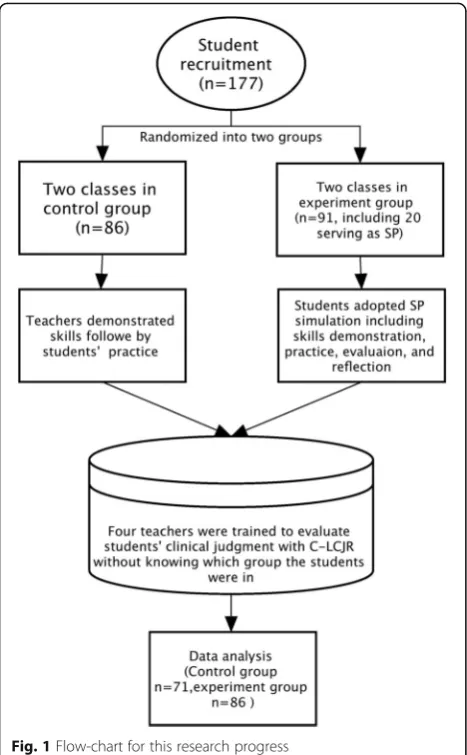
A total of 177 sophomore nursing students (March–June 2015) were recruited from four classes in the college of nursing at Hubei University of Chinese Medicine in Wu-han, China. We used the grasping and smashing method to divide 4 classes into 2 groups. The 4 classes were ran-domized into 2 control (n= 86) and 2 experimental clas-ses (n= 91, including 20 students serving as SPs). The final sample for the statistical modeling had 71 (45.2%) in the experimental group and 86 (54.8%) in the control group. The flowchart for the research is shown in Fig.1. Female students comprised 89.8% and male 10.2% of the sample. The average age of the sample was 19.7 years (SD: 0.88). All the participants had no prior clinical practice or simulation experience.
A priori sample size was not determined for the study because the appropriate sample size depends on many parameters and their sizes, including factor loadings of the measurement model, covariate effects, and the main experimental effects [34]. Inappropriate specifications could lead to different estimates of the desirable sample sizes. Therefore, a power analysis was conducted to esti-mate the power of each parameter of the model at the current sample size.
Measurement
on the four dimensions, readers may refer to Miraglia and Asselin [36].
To construct the Chinese version of the LCJR, the original English edition of the LCJR was translated into Chinese by researchers after obtaining permission from its author. A group of experts with experience in education simulation re-vised the first Chinese translation according to various sug-gestions and enhanced its understandability and acceptability to Chinese nursing teachers and students. The final draft of the Chinese LCJR (C-LCJR) was translated back into English and compared with the original version. After slight modifi-cations for semantic differences, the final version of the C-LCJR was used in this study.
Procedure
Twenty students were selected from the experiment clas-ses to serve as SPs. These students were selected based on their talents, enthusiasm, and commitment to complete the tasks. The simulation teaching was composed of 5 major scenarios, including care for patients with a cold, cervical spine pain, dysmenorrhea, heat stroke, and
insomnia. The SPs were trained for 3 h for each scenario and spent at least 3 h per week practicing until passing the SPs assessment.
The experimental classes adopted SP simulation teach-ing in groups of 5 or 6 students. Each simulation lasted 1 hour and included a demonstration of skills, practice, self-evaluation, teachers’evaluations, and reflection. The simulation course proceeded with a pre-learning activity, simulation and practice, and writing in reflection diaries. Each student participated in 3 simulation sessions of dif-ferent designs. The participating teachers were trained to ensure the consistency of the simulation teaching. In contrast, students in the control classes viewed demon-strations of operations and then practiced them, accord-ing to traditional teachaccord-ing methods.
After the simulation teaching (June 2015), students in both the control and experimental classes participated in one of the simulation scenarios that was recreated with SPs and that they had not practiced before. Students then rated their own clinical judgment using the C-LCJR. The grouping of students for the final assess-ment was carried out by another teacher who was the data analyst and four teachers in the assessment who were blinded and did not know the grouping informa-tion of the students in advance and were trained to use the C-LCJR to rate the students in these recreated sce-narios. When the entire evaluation process was over, data analysts organized and analyzed the data. Other in-formation (age, gender, and class) was collected with questionnaires.
Data analysis
To maximize the use of the rating information from both students and teachers, the measurement properties of the C-LCJR were first examined with a 2-level (indi-vidual rater and two raters) Confirmatory Factor Ana-lysis (CFA), in which the constructs of the original LCJR were specified as latent variables and ratings of the items as categorical indicators. Such treatment specifies a pro-bit modeling of the relations between the latent variables and their observed indicators. This latent variable model-ing partitions out measurement errors and yields more ac-curate estimates of the experimental effects in subsequent modeling than does traditional analysis of variance of sum scores [37]. Bayesian estimation was adopted to accom-modate the small sample size and probabilistic interpret-ation of the estimates. In Bayesian analysis, each parameter has a distribution like a variable with a mean and median instead of a single constant. As the distribu-tion may not be normally distributed, preferred reporting is usually the median, below and above which half of the estimates fall. Model fit was indicated by the posterior predictive p-values (ppp), with ppp> .05 implying an ac-ceptable fit [38]. The 95% credibility interval of an
estimate suggests that the 95% probability for the estimate is within the lower and upper limits, as listed in a bracket in the Results section. Readers interested in more practical applications may refer to Muthén and Asparouhov [39].
Reliability (ω) of each subscale was calculated instead of the traditional reliability measure (Cronbach’s alpha) that assumes equal factor loadings of continuous variables, which made it inappropriate for these measures [40].
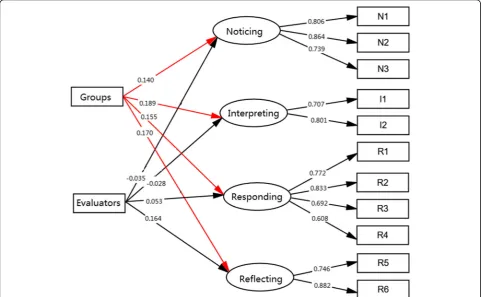
The experimental effects were examined with a 2-level Multiple Indicators Multiple Causes (MIMIC) model, which specified the 4 dimensions of the C- LCJR as the endogenous variables and a dummy-coded grouping variable (experimen-tal = 1, control = 0) as the exogenous, while controlling for other covariates to further balance any differences in the stu-dents between the experiment and control classes. The fol-lowing covariates were initially included in the model: class, gender, age, group, and evaluator. Female gender, students’ self-evaluation, and control group were used as the reference group in analyses. Measurement invariance was also ex-plored by estimating the effects of the covariates on the indicators of the subdomains [41]. Figure 1 de-picts the model simplified to retain only the signifi-cant exogenous effects. All analyses and modeling were carried out with the latent variable modeling program Mplus (v8.1).
Results
Experimental and covariate effects
The final model that estimated the experimental effects (Fig.2) fit the data well, withppp= .36. Students in the ex-perimental group performed better than those in the control group in all subdomains of C-LCJR, as indicated by the sig-nificant experimental effects, respectively, on noticing (γ= 0.14, p< .05, CI [0.02, 0.29]), interpreting (γ= 0.19, p< .05, CI [0.03, 0.36]), responding (γ= 0.16,p< .05, CI [0.01, 0.31]), and reflecting (γ= 0.17,p< .05, CI [0.02, 0.33]). In addition, teachers rated higher than students on the reflecting domain as indicated by the significant rater effect (γ= 0.17,p< .05, CI [0.02, 0.33]). The minimum power for these group differ-ences (as group effect) is .77 but is over .90 for the factor loadings at the sample size of this study.
Gender, class, and age did not have any significant ef-fects on any subdomains or their indicators in the model, implying that the experimental and control classes were well-balanced or the experimental effects were not biased by these variables. These covariates were excluded from the final model for parsimony.
Measurement properties of C-LCJR
The factor structure of the C-LCJR and other influen-cing factors were tested using the MIMIC model of CFA
and Bayesian effects estimation. The CFA showed that the model fit the data well (ppp= 0.37). The posterior median estimates of the standardized factor loadings are listed in Table1. All factor loadings were statistically dif-ferent from zero (p< .01). The inter-correlations of the 4 domains ranged from .45 to .83. Although noticing and interpreting are highly correlated at .83, model compari-sons (3 factors vs. 4 factors) showed that the 4 domains are distinct, as combining noticing and interpreting into one factor significantly worsens the model fit. The reliabil-ities of the C-LCJR subdomains listed in Table 1 are all above .70, the conventional standard for a desirable scale.
Discussion
This study aimed to examine the experimental effect of simulation teaching with SPs on nursing students and to evaluate the measurement properties of the C-LCJR in China. The results showed that simulation teaching with SPs outperformed traditional teaching methods in facilitating the development of clinical judgment in Chinese nursing stu-dents, as is consistent with previous findings [10]. Using SPs in clinical simulation enabled nursing students to employ the theoretical information and skills presented in the classroom and in their clinical practice and specifically enhanced their sense of clinical judgment [23].
Our results also showed no significant effects of age, gen-der, and classes on the subdomains of clinical judgment, implying that randomization at the class level did not result in any bias by these known variables, as opposed to a randomization at the participants’level. The results of other covariates were similar with one study [42]. Another study
by Vreugdenhil and Spek [33] found that the score differ-ences were not significant between students’ self-ratings and nurse educators’ assessments. Lasater [35], however, believed that clinical judgment could be influenced by indi-vidual characteristics. Future studies may collect personality or intelligence data about the instructors, SPs, and students to examine any potential main and moderating effects.
The results also showed that the C-LCJR had satisfactor-ily high factor loadings and reliabilities (ω) and no bias from age, gender, or raters. The high reliabilities are con-sistent with the findings of Victor-Chmil et al. [18] and Luiking et al. [43] that nursing practices in the US and in the Netherlands show more similarities than differences. Reliability from different LCJR studies ranged from .57 to 1.00 [25, 43]. These findings suggest that C-LCJR is ap-plicable to nursing students in China.
There are several limitations of our study. First, the participants of this study were selected from one school, which might limit the generalizability to students of other majors or schools. Second, the participants did not have any prior clinical experience, there is challenge to develop SPs with standardized clinical experience, so the experimental effects may be confounded with a floor ef-fect. Future studies may be designed to control for prior levels of clinical judgment to examine experimental ef-fects of varied simulation teaching. Third, no sample size calculations were made, and no baseline measurements were taken. This may affect the quality and intentional analysis of the article.
Conclusions
In summary, the C-LCJR had satisfactory measurement properties for Chinese nursing students and thus can be used by educators to evaluate nursing students’clinical judgment and can also be used by students to assess themselves. Simulation teaching with SPs is an effective method that outperforms traditional teaching methods in helping nursing students develop clinical judgment.
Abbreviations
C-LCJR:Chinese Lasater Clinical Judgment Rubric; LCJR: Lasater Clinical Judgment Rubric; SP: Standardized patients
Acknowledgements
The study was supported by the 12th 5-year plan educational topic in Hubei province (2012A022). The authors are grateful for the students who partici-pated in this study.
Availability of data and materials
The raw dataset used in this paper is available on request from the first author at [email protected].
Authors’contributions
HH conceived and designed the experiments. FY, YCW, CMY, HFZ, SJ, FB contributed reagents, materials, and analysis tools. FY and YCW contributed to the writing of the manuscript. All authors read and approved the final manuscript.
Table 1Bayesian estimates of reliability and factor loadings [95% credibility intervals]
Items Reliability Factor Loadings
Noticing 0.84 [.72, .92]
N1 Focused observation 0.78 [0.67, 0.88]
N2 Recognizing deviations 0.87 [0.78, 0.94]
N3 Information seeking 0.74 [0.60, 0.84]
Interpreting 0.71 [.56, .82]
I1 Prioritizing data 0.67 [0.54, 0.78]
I2 Making sense of data 0.82 [0.70, 0.90]
Responding 0.81 [.67, .89]
R1 Calm, confident manner 0.75 [0.63, 0.85]
R2 Clear communication 0.82 [0.71, 0.90]
R3 Well-planned intervention 0.68 [0.53, 0.80]
R4 Being skillful 0.60 [0.43, 0.74]
Reflecting 0.79 [.64, 88]
R5 Evaluation 0.73 [0.61, 0.83]
R6 Commitment to improvement 0.88 [0.76, 0.95]
Ethics approval and consent to participate
All individuals provided written consent to participate in this study, which was approved by the Hubei University of Chinese Medicine Research Ethics Committee (2014-IEC-008).
Consent for publication
Not applicable.
Competing interests
The authors declare that they have no competing interests.
Publisher’s Note
Springer Nature remains neutral with regard to jurisdictional claims in published maps and institutional affiliations.
Author details
1School of Nursing, Hubei University of Chinese Medicine, Wuhan, China. 2
Research Support Center, Brigham Young University, Provo, UT, USA.
Received: 3 September 2018 Accepted: 4 January 2019
References
1. Tanner C. Thinking like a nurse: a research-based model of clinical judgment in nursing. J Nurs Educ. 2006;45(6):204–11.
2. Gerdeman JL, Lux K, Jacko J. Using concept mapping to build clinical judgment skills. Nurs Educ Pract. 2013;13(1):11–7.
3. Aiken LH, Sloane DM, Bruyneel L, Van den Heede K, Griffiths P, Busse R, et al. Nurse staffing and education and hospital mortality in nine European countries: a retrospective observational study. Lancet. 2014;383(9931):1824–30. 4. Faisy C, Davagnar C, Ladiray D, Djadi-Prat J, Esvan M, Lenain E, et al. Nurse
workload and inexperienced medical staff members are associated with seasonal peaks in severe adverse events in the adult medical intensive care unit: a seven-year prospective study. Int J Nurs Stud. 2016;62:60–70. 5. Thompson C, Aitken L, Doran D, Dowding D. An agenda for clinical
decision making and judgment in nursing research and education. Int J Nurs Stud. 2013;50(12):1720–6.
6. Manetti W. Evaluating the clinical judgment of prelicensure nursing students in the clinical setting. Nurse Educ. 2018;43(5):272–6. 7. Benner, P. From novice to expert. Menlo Park, CA: Addison-Wesley.1984. 8. McCaughey CS, Traynor MK. The role of simulation in nurse education. Nurs
Educ Today. 2010;30(8):827–32.
9. Buckley T, Gordon C. The effectiveness of high-fidelity simulation on medical-surgical registered nurses’ability to recognize and respond to clinical emergencies. Nurs Educ Today. 2011;31(7):716–21.
10. Kaddoura M, Vandyke O, Smallwood C, Gonzalez KM. Perceived benefits and challenges of repeated exposure to high-fidelity simulation experiences of first degree accelerated bachelor nursing students. Nurs Educ Today. 2016;36:298–303. 11. Hamdenmansour A. Salutogenic wellness promotion scale: validation of the
Arabic version. Am J Health Educ. 2013;44(4):229–34.
12. Hayden JK, Smiley RA, Gross L. Simulation in nursing education: current regulations and practices. J Nurs Regul. 2014;5(2):25–30.
13. Sarmasoglu S, Dinc L, Elcin M. Using standardized patients in nursing education effects on students’psychomotor skill development. Nurse Educ. 2016;41(2):e1–5.
14. Marken PA, Zimmerman C, Kennedy C, Schremmer R, Smith KV. Human simulators and standardized patients to teach difficult conversations to interprofessional health care teams. Am J Pharm Educ. 2010;74(7):120. 15. Ballman K, Garritano N, Beery T. Broadening the reach of standardized patients in nurse practitioner education to include the distance learner. Nurs Educ. 2016;41(5):230–3.
16. Turan S, Uner S, Elcin M. The impact of standardized patient feedback on student motivational levels. Balkan Med J. 2011;28(1):43–8.
17. Benner P, Tanner CA, Chesla CA. Expertise in nursing practice: caring, clinical judgment, and ethics. New York, NY: Springer. 1996.
18. Victor-Chmil J, Larew C. Psychometric properties of the Lasater clinical judgment rubric. Int J Nurs Educ Scholarsh. 2013;10(1):1–8.
19. Lasater K. Clinical judgment: the last frontier for evaluation. Nurs Educ Pract. 2011;11(2):86–92.
20. Johnson EA, Lasater K, Hodson-Carlton K, Siktberg L, Sideras S, Dillard N. Geriatrics in simulation: role modeling and clinical judgment effect. Nurs Educ Perspect. 2012;33(3):176–80.
21. Cato ML, Lasater K, Peeples AI. Nursing students’self-assessment of their simulation experience. Nurs Educ Perspect. 2009;30(2):105–8.
22. Jensen R. Clinical reasoning during simulation: comparison of student and faculty ratings. Nurs Educ Pract. 2013;13(1):23–8.
23. Yuan HB, Williams BA, Man CY. Nursing students’clinical judgment in high fidelity simulation based learning: a quasi-experimental study. J Nurs Educ Pract. 2014;4(5):7–15.
24. Victor-Chmil J. Critical thinking versus clinical reasoning versus clinical judgment: differential diagnosis. Nurs Educ. 2013;38(1):34–6.
25. Adamson KA, Gubrud P, Sideras S, Lasater K. Assessing the reliability, validity, and use of the Lasater clinical judgment rubric: three approaches. J Nurs Educ. 2012;51(2):66–73.
26. Mariani B, Cantrell MA, Meakim C, Prieto P, Dreifuerst KT. Structured debriefing and students’clinical judgment abilities in simulation. Clin Simul Nurs. 2013;9(5):e147–55.
27. Knipe G. Assessment of clinical judgment and decision making in nursing students: what role does human patient stimulation play. In: Master’s Thesis. Chico: California State University; 2013.
28. Strickland HP. Comparing Lasater’s clinical judgment rubric scores across faculty, selfassessment, & outcome scores. Dissertations & Theses -Gradworks 2013.
29. Kristiansen L, Häggström M, Hallin K, Andersson L, Bäckström B. Swedish translation, qualitative relevance evaluation and quantitative reliability test of Lasater clinical judgment rubric. Nordic J Nurs Res. 2015;35(2):113–22. 30. Shin H, Park CG, Shim K. The Korean version of the lasater clinical judgment
rubric: a validation study. Nurs Educ Today. 2015;35(1):68–72.
31. Fawaz MA, Hamdan-Mansour AM. Impact of high-fidelity simulation on the development of clinical judgment and motivation among Lebanese nursing students. Nurs Educ Today. 2016;46:36–42.
32. Román-Cereto M, García-Mayor S, Kaknani-Uttumchandani S, García-Gámez M, León-Campos A, Fernández-Ordóñez E, et al. Cultural adaptation and validation of the Lasater clinical judgment rubric in nursing students in Spain. Nurs Educ Today. 2018;64:71–8.
33. Vreugdenhil J, Spek B. Development and validation of Dutch version of Lasater clinical judgment rubric in hospital practice: an instrument design study. Nurs Educ Today. 2018;62:43–51.
34. Muthén LK, Muthén OB. How to use a Monte Carlo study to decide on sample size and determine power. Struct Equa Modeling: A Multidisciplinary J. 2002;9(4):599–620.
35. Lasater K. Clinical judgment development: using simulation to create an assessment rubric. J Nurs Educ. 2007;46(11):496–503.
36. Miraglia R, Asselin ME. The Laster clinical judgement rubric as a framework to enhance clinical judgement in novice and experience nurses. J Nurs Prof Dev. 2015;31(5):284–91.
37. Cole DA, Maxwell SE, Arvey RS, Salas E. Multivariate group comparisons of variable systems: MANOVA and structural equation modeling. Psych Bull. 1993;114(1):174–84.
38. Muthén B. Latent variable structural equation modeling with categorical data. J Econ. 1983;22(1):48–65.
39. Muthén B, Asparouhov T. Bayesian SEM: A more flexible representation of substantive theory. Psychol Methods. 2012;17(3):313–35.
40. Dunn TJ, Baguley T, Brunsden V. From alpha to omega: a practical solution to the pervasive problem of internal consistency estimation. Br J Psychol. 2014;105(3):399–412.
41. Muthén B. Latent variable modeling in heterogeneous populations. Psychometrika. 1989;54(4):557–85.
42. Luiking ML, Linge RV, Bras L, Grypdonck M, Aarts L. Psychometric properties of the Dutch version of the American nursing activity scale in an intensive care unit. J Adv Nurs. 2012;68(12):2750–5.
![Table 1 Bayesian estimates of reliability and factor loadings[95% credibility intervals]](https://thumb-us.123doks.com/thumbv2/123dok_us/356654.1528230/5.595.56.290.490.714/table-bayesian-estimates-reliability-factor-loadings-credibility-intervals.webp)