Two Process Capability Indices for Half Logistic Distribution
Wararit Panichkitkosolkul
Department of Mathematics and Statistics Faculty of Science and Technology
Thammasat University, Phathum Thani, Thailand [email protected]
Somchit Wattanachayakul
Department of Mathematics and Statistics Faculty of Science and Technology
Thammasat University, Phathum Thani, Thailand [email protected]
Abstract
The process capability indices are important numerical measures in statistical quality control. Well-known process capability indices are constructed under the process distribution is normal. Unfortunately, this situation is rather not realistic. This paper focuses on the half logistic distribution. The bootstrap confidence intervals for the difference between two process capability indices for the mentioned distribution are proposed. The bootstrap confidence intervals considered in this paper consist of the standard bootstrap confidence interval, the percentile bootstrap confidence interval and the bias-corrected percentile bootstrap confidence interval. A Monte Carlo simulation has been used to investigate the estimated coverage probabilities and average widths of the bootstrap confidence intervals. Simulation results showed that the estimated coverage probabilities of the percentile bootstrap confidence interval and the bias-corrected percentile bootstrap confidence interval get closer to the nominal confidence level than those of the standard bootstrap confidence interval.
Keywords: Process capability index, Bootstrap confidence interval, Half logistic distribution.
1. Introduction
The half logistic distribution, which is the distribution of the absolute logistic random variable, was introduced by Balakrishnan (1985). The main references about the half logistic distribution include Balakrishnan and Chan (1992), Balakrishnan and Wong (1994) and Balakrishnan and Aggarwala (1996). If Y is a logistic random variable, then
X Y has a half logistic distribution. The probability density function ( ( ))f x and the cumulative distribution function ( ( ))F x are
22exp ( ) /
( ) ,
1 exp ( ) /
x f x
x
(1.1)
and
1 exp ( ) /
( ) x , 0, 0,
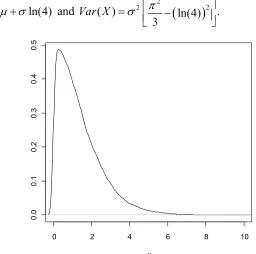
the probability density function for half logistic distribution is shown in Fig. 1.1 The mean and the variance of X are defined as
( ) ln(4)
E X and ( ) 2 2
ln(4)
2 .3
Var X
Figure 1.1 The probability density function for half logistic distribution with 0 and 1.
Several studies have applied the half logistic distribution. For instance, Balakrishnan (1985) has suggested the usage of this distribution as a possible life-time model with an increasing hazard rate. In addition, Balakrishnan and Chan (1992) have shown that the failure times of air conditioning equipment in a Boeing 720 airplane fits the half logistic distribution quite well. This distribution was also applied to environmental and sports records data (Mbah and Tsokos, 2008). In recent papers, many authors have applied the half logistic distribution under progressive Type-II censoring (see Kang et al., 2008, Balakrishnan and Saleh, 2011, Jang et al. 2011). As mentioned above, it is known that the half logistic distribution is an increasing failure rates model with reasonable importance in statistical quality control and reliability studies (see Kantam and Rosaiah 1998,Kantam et al. 2000, Srinivasa, 2004, Satyaprasad, 2007, Rosaiah et al., 2009, Kantam et al., 2010).
One of the statistical quality control tools widely used is the process capability index (PCI). This index uses both process variability and process specification to determine whether the process is capable (Peng, 2010). Even though there are many process capability indices, the two most commonly used indices are Cp and Cpk(Kane, 1986,
Zhang, 2010). In this paper, we focus only on the popular process capability index Cpk
defined as follows
min , ,
3 3
pk USL LSL
C (1.3)
0 2 4 6 8 10
0.
0
0.
1
0.
2
0.
3
0.
4
0.
5
where USL and LSL denote respectively the upper and lower specification limits of the process, is the process mean and is the process standard deviation. As the process standard deviation and the process mean are unknown, they must be estimated from the sample data { ,..., }.X1 Xn Under the normality assumption, the sample mean X;
1 1
n i i X n X
and the sample standard deviation S; 1 21
( 1) n ( i )
i
S n X X
are usedto estimate the unknown parameters and in Eq. (1.3), respectively. Therefore, the natural estimator of the process capability index Cpk can be obtained as
min , .
3 3
pk USL X X LSL
C
S S
However, the underlying process distribution is non-normal in some situations. Hence, it may be a skewed distribution. To deal with these phenomena, Clements (1989) proposed a new method for computing the estimator of the process capability index Cpk when the
process distribution is non-normal. This estimator is defined as
min , ,
pk
p p
USL M M LSL C
U M M L
(1.4)
where U Lp, p and M denote the 99.865th percentile, the 0.135th percentile and the 50th
percentile of the distribution, respectively. The advantage of Cpk
shown in Eq.(1.4) is that it can be applied to any distribution. Kantam et al. (2010) discussed the relationship between Cpk
and the probability that a product falling outside the specification limits when X has a half logistic distribution. This probability is given by
( ) ( ) 1 ( ) ( ),
t
P P X LSL P X USL F LSL F USL
where F( ) is the cumulative distribution function of a half logistic distribution shown in Eq.(1.2). Using the open source statistical package R (Ihaka and Gentleman 1996), some values of L Up, p and M for the half logistic distribution are shown in Table 1.
Table 1: The values of L Up, p and M for the half logistic distribution
Lp Up M
0 1 0.002700002 7.300123 1.098612
0 1.5 0.00405 10.95018 1.647918
0.5 1 0.5027 7.800123 1.598612
0.5 1.5 0.50405 11.45018 2.147918
1 1 1.0027 8.300123 2.098612
The estimator Cpk
in Eq. (1.4) can be applied when the scale parameter of the half logistic distribution is equal to 1. Therefore, if a scale parameter is introduced and known, i.e., 1 in Eq.(1.1), the optimal estimator of Cpk is given by
min , .
( ) ( )
pk
p p
USL M M LSL
C
U M M L
In practice, the scale parameter is unknown. Therefore, we must estimate the unknown
by its estimator. In this paper, we use the moment method for calculating this estimator. The estimator of Cpk for a half logistic distribution is
ˆ ˆ
ˆ min , ,
ˆ( ) ˆ( )
pk
p p
USL M M LSL
C
U M M L
(1.5)
where ˆ is the estimator of . Here, we use the simple estimator which is computed by
the moment method given by ˆ 1 ˆ
ln(4) X
and the maximum likelihood estimator
for is ˆ X(1), the smallest sample order statistics. The moments of the half logistic
distribution were shown in Giles (2012).
In this paper, our focus is on the difference between two process capability indices,
1 2,
pk pk
C C which we will denote by which
1 1 2 2
1 1 2 2
min , min , ,
3 3 3 3
USL LSL USL LSL
where 1, 2 and 1, 2 are the process mean and standard deviation of the first and the
second population, respectively. Similar to Eq.(1.5), we can get the estimator of which is
1 1 1 1 2 2 2 2
1 1 1 1 1 1 2 2 2 2 2 2
ˆ ˆ ˆ ˆ
ˆ min , min , ,
ˆ ( p ) ˆ ( p ) ˆ ( p ) ˆ ( p )
USL M M LSL USL M M LSL
U M M L U M M L
(1.6)
where ˆ1 and ˆ2 are the moment estimator of 1 and 2given by ˆ1 ln(4)1 X1ˆ1
and ˆ2 ln(4)1 X2ˆ ,2 respectively, ˆ1 X1(1) and ˆ2 X2(1).
results and conclusions are presented in the final section. The conclusions are offered in the final section.
2. Bootstrap Confidence Intervals
The bootstrap is a computer-based and resampling method for assigning measures of accuracy to statistical estimates (Efron and Tibshirani, 1993). Many types of bootstrap methods for constructing confidence intervals have been introduced; for example, the standard bootstrap method (SB), the percentile bootstrap method (PB) and the bias-corrected percentile bootstrap method (BCPB).
For a sequence of independent and identically distributed (i.i.d.) random variables, the bootstrap procedure can be defined as follows (Tosasukul et al., 2009). Let the random variables {Xk j, ,1 j m} be the result from sampling m times from the kth population
with replacement from the n observations Xk,1,...,Xk n, . The random variables
,
{Xk j ,1 j m} are called the bootstrap samples from original data
,1,..., , .
k k n
X X In what
follows, we describe the constructions for the confidence interval of the difference between two process capability indices using bootstrap techniques.
2.1 Standard Bootstrap (SB) Confidence Interval
Let Xk b, , where 1 b B, and k1, 2 be the bth bootstrap samples and let Xk,1,...,Xk B,
be the B bootstrap samples. The bth bootstrap estimator of is computed by
( ) ( ) ( ) ( )
( ) 1 1 1 1 2 2 2 2
( ) ( ) ( )
1 1 1 1 1 1 2 2 2 2 2 2
ˆ ˆ ˆ ˆ
ˆ min , min , ,
ˆ ( ) ˆ ( ) ˆ ( ) ˆ ( )
b b b b
b
b b b
p p p p
USL M M LSL USL M M LSL
U M M L U M M L
(2.1)
where ( ) ( )
1 1
ˆ b X b / ln(4),
( ) 1 1
1 1 1,
1 , n b j j X n X
( ) ( )2 2
ˆ b X b / ln(4),
( ) 1 2
2 2 2,
1 , n b j j X n X
Thus,the standard bootstrap (1)100% confidence interval is
1 1
2 2
ˆ , ˆ ,
SB Z S Z S
CI
(2.2)
where Z1/ 2 is a 1/ 2thquantile of the standard normal distribution, 1 ( ) 1
ˆ B ˆ i
i B
and
2( ) ( ) 1
1 ˆ ˆ .
2.2 Percentile Bootstrap (PB) Confidence Interval
The percentile bootstrap (1)100% confidence interval is given by
1
2 2
ˆ , ˆ ,
PB B B
CI
(2.3)
where ˆ( )r is the rth ordered value on the list of the B bootstrap estimator of .
2.3 Bias-Corrected Percentile Bootstrap (BCPB) Confidence Interval
The obtained bootstrap distributions using only a sample of the complete bootstrap distribution may be shifted higher or lower than would be expected. Therefore, this approach has been introduced in order to correct for the potential bias. Firstly, using the ordered distribution of ˆ , compute the probability
0 (ˆ ˆ).
P P Then, 1
0 ( ).0
Z P
Therefore, the percentile of the ordered distribution G*( ),ˆ
0 1 / 2
2
L
P Z Z and
2 0 1 / 2
U
P Z Z are obtained, where ( ) is the standard normal cumulative
function. Finally, the bias-corrected percentile bootstrap (1)100% confidence interval is defined as follows
ˆ( L ), ˆ( U )
,BCPB P B P B
CI (2.4)
whereˆ( )r is the rth ordered value on the list of the B bootstrap estimator of .
To study the different confidence intervals, we consider their estimated coverage probabilities and average widths. For each of the methods considered, the probability that the true value of Cpk is covered by the (1)100% bootstrap confidence interval, which is called the “coverage probability”, can be obtained. In addition, the average width of the bootstrap confidence interval is calculated based on the M 5,000different trials .The estimated coverage probability and the average width are given by
#( )
1 L U ,
M
and
1
( )
,
M
i i i
U L Width
M
where L andU denote the lower and upper bound of the bootstrap confidence interval.
In the following section, a simulation study is presented in order to evaluate the performance of the confidence intervals CISB,CIPB, and CIBCPB based on their estimated
3. Simulation Study
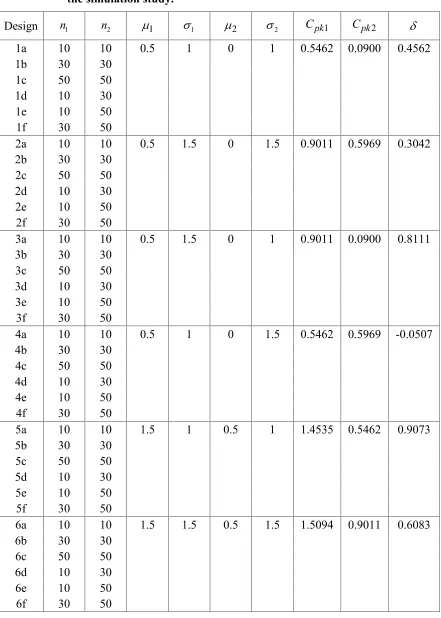
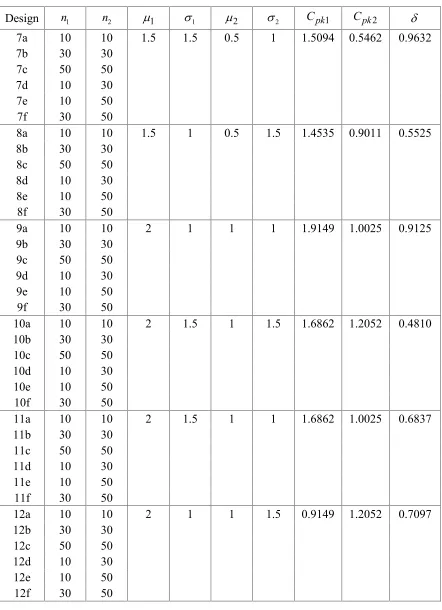
A simulation study on the behavior of three bootstrap confidence intervals of the difference between two process capability indices for half logistic distribution is described. The statistical package R (Ihaka and Gentleman, 1996) is used to carry out the simulation study in this section. In addition, the sample sizes and parameter values of half logistic distribution that we used in this simulation are listed in Table 2. Similar to previous experiments of Kantam et al. (2010), we set the lower and upper specification limits are 1 and 29, respectively. The process capability indices and the difference between the two process capability indices of twelve designs are shown in Table 2. For each design, B1,000 bootstrap samples with each of size n are drawn from the original sample. Additionally, the simulation is replicated 5,000 times. The 90% and 95% bootstrap confidence intervals are constructed by each of the three methods, i.e., SB, PB, and BCPB confidence intervals.
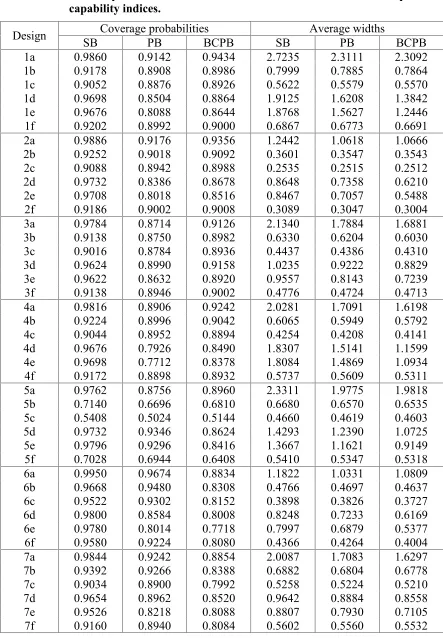
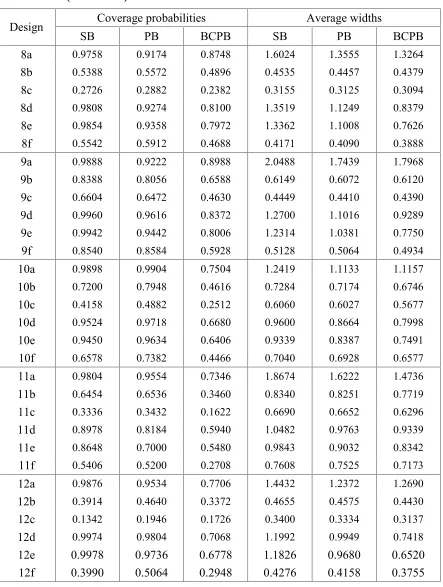
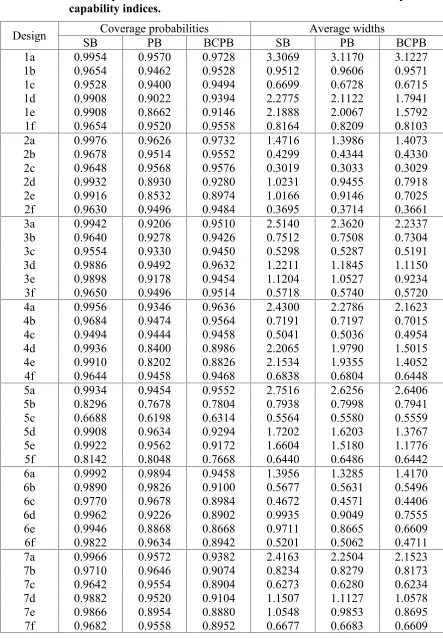
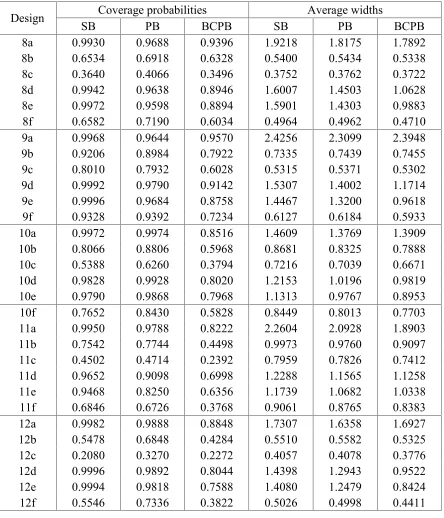
The simulation results are summarized in Tables 3 and 4. These two tables present the results on the estimated coverage probabilities and average widths of 90% and 95% bootstrap confidence intervals, respectively. We begin with the results for Designs 1a-f, 2a-f, 3a-f and 4a-f ( 1 1 and 2 2), the estimated coverage probabilities of CISB
are larger than the nominal confidence level. In addition, the estimated coverage probabilities ofCIBCPBget reasonably closer to the nominal confidence level than those of
SB
CI and CIPB for all sample sizes. When Designs 6a-f and 7a-f ( 1 1 and 2 2)
are considered, the estimated coverage probabilities of CISBare not less than the nominal
confidence level. The CIPB provides the estimated coverage probabilities closer to the
nominal confidence level than those ofCISB and CIBCPB.
As one can see, under Designs 5a-f, 8a-f, 9a-f, 10a-f, 11a-f and 12a-f ( 1 1 and
2 2
), the CISB,CIPB, and CIBCPBgive poor coverage probabilities than the nominal
confidence level for large sample sizes. On the other hand, the estimated coverage probabilities of CISBare significantly above the nominal confidence level for small
sample size (n n1 2 10).
The CIBCPB provides the shortest average width for all situations. Additionally, the
average widths of all the bootstrap confidence intervals get shorter when n1and (or) n2
Table 2: Sample sizes and parameter values of half logistic distribution used in the simulation study.
Design n1 n2 1 1 2 2 Cpk1 Cpk2
1a 10 10 0.5 1 0 1 0.5462 0.0900 0.4562
1b 30 30
1c 50 50
1d 10 30
1e 10 50
1f 30 50
2a 10 10 0.5 1.5 0 1.5 0.9011 0.5969 0.3042
2b 30 30
2c 50 50
2d 10 30
2e 10 50
2f 30 50
3a 10 10 0.5 1.5 0 1 0.9011 0.0900 0.8111
3b 30 30
3c 50 50
3d 10 30
3e 10 50
3f 30 50
4a 10 10 0.5 1 0 1.5 0.5462 0.5969 -0.0507
4b 30 30
4c 50 50
4d 10 30
4e 10 50
4f 30 50
5a 10 10 1.5 1 0.5 1 1.4535 0.5462 0.9073
5b 30 30
5c 50 50
5d 10 30
5e 10 50
5f 30 50
6a 10 10 1.5 1.5 0.5 1.5 1.5094 0.9011 0.6083
6b 30 30
6c 50 50
6d 10 30
6e 10 50
Table 2: (Continued)
Design n1 n2 1 1 2 2 Cpk1 Cpk2
7a 10 10 1.5 1.5 0.5 1 1.5094 0.5462 0.9632
7b 30 30
7c 50 50
7d 10 30
7e 10 50
7f 30 50
8a 10 10 1.5 1 0.5 1.5 1.4535 0.9011 0.5525
8b 30 30
8c 50 50
8d 10 30
8e 10 50
8f 30 50
9a 10 10 2 1 1 1 1.9149 1.0025 0.9125
9b 30 30
9c 50 50
9d 10 30
9e 10 50
9f 30 50
10a 10 10 2 1.5 1 1.5 1.6862 1.2052 0.4810
10b 30 30
10c 50 50
10d 10 30
10e 10 50
10f 30 50
11a 10 10 2 1.5 1 1 1.6862 1.0025 0.6837
11b 30 30
11c 50 50
11d 10 30
11e 10 50
11f 30 50
12a 10 10 2 1 1 1.5 0.9149 1.2052 0.7097
12b 30 30
12c 50 50
12d 10 30
Table 3: The estimated coverage probabilities and average widths of a 90% bootstrap confidence intervals of the difference between two process capability indices.
Design SBCoverage probabilitiesPB BCPB SB Average widthsPB BCPB
1a 0.9860 0.9142 0.9434 2.7235 2.3111 2.3092
1b 0.9178 0.8908 0.8986 0.7999 0.7885 0.7864
1c 0.9052 0.8876 0.8926 0.5622 0.5579 0.5570
1d 0.9698 0.8504 0.8864 1.9125 1.6208 1.3842
1e 0.9676 0.8088 0.8644 1.8768 1.5627 1.2446
1f 0.9202 0.8992 0.9000 0.6867 0.6773 0.6691
2a 0.9886 0.9176 0.9356 1.2442 1.0618 1.0666
2b 0.9252 0.9018 0.9092 0.3601 0.3547 0.3543
2c 0.9088 0.8942 0.8988 0.2535 0.2515 0.2512
2d 0.9732 0.8386 0.8678 0.8648 0.7358 0.6210
2e 0.9708 0.8018 0.8516 0.8467 0.7057 0.5488
2f 0.9186 0.9002 0.9008 0.3089 0.3047 0.3004
3a 0.9784 0.8714 0.9126 2.1340 1.7884 1.6881
3b 0.9138 0.8750 0.8982 0.6330 0.6204 0.6030
3c 0.9016 0.8784 0.8936 0.4437 0.4386 0.4310
3d 0.9624 0.8990 0.9158 1.0235 0.9222 0.8829
3e 0.9622 0.8632 0.8920 0.9557 0.8143 0.7239
3f 0.9138 0.8946 0.9002 0.4776 0.4724 0.4713
4a 0.9816 0.8906 0.9242 2.0281 1.7091 1.6198
4b 0.9224 0.8996 0.9042 0.6065 0.5949 0.5792
4c 0.9044 0.8952 0.8894 0.4254 0.4208 0.4141
4d 0.9676 0.7926 0.8490 1.8307 1.5141 1.1599
4e 0.9698 0.7712 0.8378 1.8084 1.4869 1.0934
4f 0.9172 0.8898 0.8932 0.5737 0.5609 0.5311
5a 0.9762 0.8756 0.8960 2.3311 1.9775 1.9818
5b 0.7140 0.6696 0.6810 0.6680 0.6570 0.6535
5c 0.5408 0.5024 0.5144 0.4660 0.4619 0.4603
5d 0.9732 0.9346 0.8624 1.4293 1.2390 1.0725
5e 0.9796 0.9296 0.8416 1.3667 1.1621 0.9149
5f 0.7028 0.6944 0.6408 0.5410 0.5347 0.5318
6a 0.9950 0.9674 0.8834 1.1822 1.0331 1.0809
6b 0.9668 0.9480 0.8308 0.4766 0.4697 0.4637
6c 0.9522 0.9302 0.8152 0.3898 0.3826 0.3727
6d 0.9800 0.8584 0.8008 0.8248 0.7233 0.6169
6e 0.9780 0.8014 0.7718 0.7997 0.6879 0.5377
6f 0.9580 0.9224 0.8080 0.4366 0.4264 0.4004
7a 0.9844 0.9242 0.8854 2.0087 1.7083 1.6297
7b 0.9392 0.9266 0.8388 0.6882 0.6804 0.6778
7c 0.9034 0.8900 0.7992 0.5258 0.5224 0.5210
7d 0.9654 0.8962 0.8520 0.9642 0.8884 0.8558
Table 3: (Continued)
Design Coverage probabilities Average widths
SB PB BCPB SB PB BCPB
8a 0.9758 0.9174 0.8748 1.6024 1.3555 1.3264
8b 0.5388 0.5572 0.4896 0.4535 0.4457 0.4379
8c 0.2726 0.2882 0.2382 0.3155 0.3125 0.3094
8d 0.9808 0.9274 0.8100 1.3519 1.1249 0.8379
8e 0.9854 0.9358 0.7972 1.3362 1.1008 0.7626
8f 0.5542 0.5912 0.4688 0.4171 0.4090 0.3888
9a 0.9888 0.9222 0.8988 2.0488 1.7439 1.7968
9b 0.8388 0.8056 0.6588 0.6149 0.6072 0.6120
9c 0.6604 0.6472 0.4630 0.4449 0.4410 0.4390
9d 0.9960 0.9616 0.8372 1.2700 1.1016 0.9289
9e 0.9942 0.9442 0.8006 1.2314 1.0381 0.7750
9f 0.8540 0.8584 0.5928 0.5128 0.5064 0.4934
10a 0.9898 0.9904 0.7504 1.2419 1.1133 1.1157
10b 0.7200 0.7948 0.4616 0.7284 0.7174 0.6746
10c 0.4158 0.4882 0.2512 0.6060 0.6027 0.5677
10d 0.9524 0.9718 0.6680 0.9600 0.8664 0.7998
10e 0.9450 0.9634 0.6406 0.9339 0.8387 0.7491
10f 0.6578 0.7382 0.4466 0.7040 0.6928 0.6577
11a 0.9804 0.9554 0.7346 1.8674 1.6222 1.4736
11b 0.6454 0.6536 0.3460 0.8340 0.8251 0.7719
11c 0.3336 0.3432 0.1622 0.6690 0.6652 0.6296
11d 0.8978 0.8184 0.5940 1.0482 0.9763 0.9339
11e 0.8648 0.7000 0.5480 0.9843 0.9032 0.8342
11f 0.5406 0.5200 0.2708 0.7608 0.7525 0.7173
12a 0.9876 0.9534 0.7706 1.4432 1.2372 1.2690
12b 0.3914 0.4640 0.3372 0.4655 0.4575 0.4430
12c 0.1342 0.1946 0.1726 0.3400 0.3334 0.3137
12d 0.9974 0.9804 0.7068 1.1992 0.9949 0.7418
12e 0.9978 0.9736 0.6778 1.1826 0.9680 0.6520
Table 4: The estimated coverage probabilities and average widths of a 95% bootstrap confidence intervals of the difference between two process capability indices.
Design SBCoverage probabilitiesPB BCPB SB Average widthsPB BCPB
1a 0.9954 0.9570 0.9728 3.3069 3.1170 3.1227
1b 0.9654 0.9462 0.9528 0.9512 0.9606 0.9571
1c 0.9528 0.9400 0.9494 0.6699 0.6728 0.6715
1d 0.9908 0.9022 0.9394 2.2775 2.1122 1.7941
1e 0.9908 0.8662 0.9146 2.1888 2.0067 1.5792
1f 0.9654 0.9520 0.9558 0.8164 0.8209 0.8103
2a 0.9976 0.9626 0.9732 1.4716 1.3986 1.4073
2b 0.9678 0.9514 0.9552 0.4299 0.4344 0.4330
2c 0.9648 0.9568 0.9576 0.3019 0.3033 0.3029
2d 0.9932 0.8930 0.9280 1.0231 0.9455 0.7918
2e 0.9916 0.8532 0.8974 1.0166 0.9146 0.7025
2f 0.9630 0.9496 0.9484 0.3695 0.3714 0.3661
3a 0.9942 0.9206 0.9510 2.5140 2.3620 2.2337
3b 0.9640 0.9278 0.9426 0.7512 0.7508 0.7304
3c 0.9554 0.9330 0.9450 0.5298 0.5287 0.5191
3d 0.9886 0.9492 0.9632 1.2211 1.1845 1.1150
3e 0.9898 0.9178 0.9454 1.1204 1.0527 0.9234
3f 0.9650 0.9496 0.9514 0.5718 0.5740 0.5720
4a 0.9956 0.9346 0.9636 2.4300 2.2786 2.1623
4b 0.9684 0.9474 0.9564 0.7191 0.7197 0.7015
4c 0.9494 0.9444 0.9458 0.5041 0.5036 0.4954
4d 0.9936 0.8400 0.8986 2.2065 1.9790 1.5015
4e 0.9910 0.8202 0.8826 2.1534 1.9355 1.4052
4f 0.9644 0.9458 0.9468 0.6838 0.6804 0.6448
5a 0.9934 0.9454 0.9552 2.7516 2.6256 2.6406
5b 0.8296 0.7678 0.7804 0.7938 0.7998 0.7941
5c 0.6688 0.6198 0.6314 0.5564 0.5580 0.5559
5d 0.9908 0.9634 0.9294 1.7202 1.6203 1.3767
5e 0.9922 0.9562 0.9172 1.6604 1.5180 1.1776
5f 0.8142 0.8048 0.7668 0.6440 0.6486 0.6442
6a 0.9992 0.9894 0.9458 1.3956 1.3285 1.4170
6b 0.9890 0.9826 0.9100 0.5677 0.5631 0.5496
6c 0.9770 0.9678 0.8984 0.4672 0.4571 0.4406
6d 0.9962 0.9226 0.8902 0.9935 0.9049 0.7555
6e 0.9946 0.8868 0.8668 0.9711 0.8665 0.6609
6f 0.9822 0.9634 0.8942 0.5201 0.5062 0.4711
7a 0.9966 0.9572 0.9382 2.4163 2.2504 2.1523
7b 0.9710 0.9646 0.9074 0.8234 0.8279 0.8173
7c 0.9642 0.9554 0.8904 0.6273 0.6280 0.6234
7d 0.9882 0.9520 0.9104 1.1507 1.1127 1.0578
Table 4L: (Continued)
Design SBCoverage probabilitiesPB BCPB SB Average widthsPB BCPB
8a 0.9930 0.9688 0.9396 1.9218 1.8175 1.7892
8b 0.6534 0.6918 0.6328 0.5400 0.5434 0.5338
8c 0.3640 0.4066 0.3496 0.3752 0.3762 0.3722
8d 0.9942 0.9638 0.8946 1.6007 1.4503 1.0628
8e 0.9972 0.9598 0.8894 1.5901 1.4303 0.9883
8f 0.6582 0.7190 0.6034 0.4964 0.4962 0.4710
9a 0.9968 0.9644 0.9570 2.4256 2.3099 2.3948
9b 0.9206 0.8984 0.7922 0.7335 0.7439 0.7455
9c 0.8010 0.7932 0.6028 0.5315 0.5371 0.5302
9d 0.9992 0.9790 0.9142 1.5307 1.4002 1.1714
9e 0.9996 0.9684 0.8758 1.4467 1.3200 0.9618
9f 0.9328 0.9392 0.7234 0.6127 0.6184 0.5933
10a 0.9972 0.9974 0.8516 1.4609 1.3769 1.3909
10b 0.8066 0.8806 0.5968 0.8681 0.8325 0.7888
10c 0.5388 0.6260 0.3794 0.7216 0.7039 0.6671
10d 0.9828 0.9928 0.8020 1.2153 1.0196 0.9819
10e 0.9790 0.9868 0.7968 1.1313 0.9767 0.8953
10f 0.7652 0.8430 0.5828 0.8449 0.8013 0.7703
11a 0.9950 0.9788 0.8222 2.2604 2.0928 1.8903
11b 0.7542 0.7744 0.4498 0.9973 0.9760 0.9097
11c 0.4502 0.4714 0.2392 0.7959 0.7826 0.7412
11d 0.9652 0.9098 0.6998 1.2288 1.1565 1.1258
11e 0.9468 0.8250 0.6356 1.1739 1.0682 1.0338
11f 0.6846 0.6726 0.3768 0.9061 0.8765 0.8383
12a 0.9982 0.9888 0.8848 1.7307 1.6358 1.6927
12b 0.5478 0.6848 0.4284 0.5510 0.5582 0.5325
12c 0.2080 0.3270 0.2272 0.4057 0.4078 0.3776
12d 0.9996 0.9892 0.8044 1.4398 1.2943 0.9522
12e 0.9994 0.9818 0.7588 1.4080 1.2479 0.8424
12f 0.5546 0.7336 0.3822 0.5026 0.4998 0.4411
4. Illustrative example
we set LSL1and USL29, the true difference between two process capability indices,
, is 0.8111. The first random sample (x1) generated is
0.02 0.05 0.32 0.44 0.64 0.64 0.67 0.87 1.05 1.05 1.32 1.33 1.40 2.52 2.80 3.21 3.66 4.11 4.12 5.04.
The second random sample (x2) generated is
0.04 0.14 0.19 0.20 0.23 0.44 0.75 0.81 0.88 1.07 1.07 1.09 1.29 1.50 1.62 1.83 1.91 3.56 5.04 5.15.
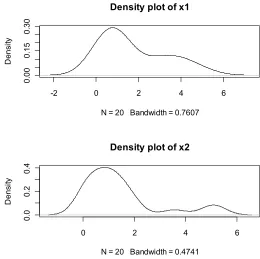
In addition, the density plot of generated samples is displayed in Fig. 4.1. Assuming the half logistic distribution for corresponding random variables X1 and X2,three bootstrap
confidence intervals of the difference between two process capability indices with confidence level 95% are constructed, and they are shown in the following table.
Table 5: Bootstrap confidence intervals and widths of the difference between two process capability indices
Methods Confidence intervals Widths
SB ( 0.2441 , 1.2891 ) 1.0450
PB ( 0.3025 , 1.2891 ) 0.9866
BCPB ( 0.2654 , 1.3003 ) 1.0349
As presented in Table 5, the true difference between Cpk1 and Cpk2 ( 0.8111) lies in
the proposed bootstrap confidence intervals. Additionally, the width of CIPB is shorter
than any other confidence intervals by about 5%.
-2 0 2 4 6
0.
00
0.
15
0.
30
Density plot of x1
N = 20 Bandwidth = 0.7607
D
en
si
ty
0 2 4 6
0.
0
0.
2
0.
4
Density plot of x2
N = 20 Bandwidth = 0.4741
D
en
si
5. Conclusions
In this paper, we have proposed bootstrap confidence intervals of the difference between two process capability indices for half logistic distribution. Three bootstrap confidence intervals are considered: the standard bootstrap confidence interval (CISB), the percentile
bootstrap confidence interval (CIPB) and the bias-corrected percentile bootstrap
confidence interval (CIBCPB).The performances of bootstrap confidence intervals are
compared by considering their coverage probabilities and average widths using Monte Carlo experiments. Based on simulation studies, the CIBCPBachieves better coverage
probability than the other bootstrap confidence intervals when 1 1 and 2 2. In
addition, the CIPB performs well with respect to the coverage criterion when 1 1 and
2 2.
On the other hand, proposed bootstrap confidence intervals are not suitable in terms of coverage probability for other situations ( 1 1 and 2 2).
It would be of interest to propose confidence intervals of the difference between two process capability indices for half logistic distribution when 1 1 and 2 2, and this is left as a topic for future work.
Acknowledgements
The authors acknowledge the excellent suggestions provided by Professor Dr. R.R.L. Kantam and Professor Dr. David E. Giles. The authors are grateful to Mark Zentz for his careful editing of the manuscript, and to two referees for their constructive comments on an earlier version of this paper.
References
1. Balakrishnan, N. (1985). Order statistics from the half logistic distribution.
Journal of Statistical Computation and Simulation, 20(4): 287-309.
2. Balakrishnan, N. and Aggarwala, R. (1996). Relationships for moments of order statistics from the right-truncated generalized half logistic distribution. Annals of the Institute of Statistical Mathematics, 48(3): 519-534.
3. Balakrishnan, N. and Chan, P.S. (1992). Estimation for the scaled half logistic distribution under Type-II censoring. Computational Statistics & Data Analysis, 13(2): 123-141.
4. Balakrishnan, N. and Saleh, H.M. (2011). Relations for moments of progressively Type-II censored order statistics from half logistic distribution with applications to inference.Computational Statistics & Data Analysis, 55(10): 2775-2792. 5. Balakrishnan, N. and Wong K.H.T. (1994). Best linear unbiased estimation of
7. Efron, B. and Tibshirani, R.J. (1993). An introduction to the bootstrap. Chapman & Hall, New York.
8. Giles, D.E. (2012). Bias reduction for the maximum likelihood estimators of the parameters in the half-logistic distribution. Communications in Statistics-Theory and Methods, 41(2): 212-222.
9. Ihaka, R. and Gentleman, R. (1996). R: A language for data analysis and graphics. Journalof Computational and GraphicalStatistics, 5(3): 299-314.
10. Jang, D.H., Park, J. and Kim, C. (2011). Estimation of the scale parameter of the half-logistic distribution with multiply Type II censored sample. Journal of the
KoreanStatisticalSociety, 40(3): 291-301.
11. Kane, V.E. (1986). Process capability indices. Journal of Quality Technology,
18(1): 41-52.
12. Kang, S.B., Cho, Y.S. and Han, J.T. (2008). Estimation for the half logistic distribution under progressive Type-II censoring. Communications of the Korean
Mathematical Society, 15(6): 815-823.
13. Kantam, R.R.L. and Rosaiah, K. (1998). Half logistic distribution in acceptance sampling based on life tests. IAPQR Transactions: Journal of the Indian
Association for Productivity, Quality & Reliability,23(2): 117-125.
14. Kantam, R.R.L., Rosaiah, K. and Anjaneyula, M.S.R. (2000). Estimation of reliability in multicomponent stress-strength model: half logistic distribution.
IAPQR Transactions: Journal of the Indian Association for Productivity, Quality & Reliability, 25(2): 43-52.
15. Kantam, R.R.L., Rosaiah, K. and Subba Rao, R. (2010). Estimation of process capability index for half logistic distribution. International Transactions in
Mathematical Sciences andComputer,3(1): 61-66.
16. Mbah, A.K. and Tsokos, C.P. (2008). Record values from half logistics and inverse weibull probability distribution functions. Neural, Parallel & Scientific Computations, 16(1): 73-92.
17. Olapade, A.K. and Ojo, M.O. (2002). Characterizations of the Logistic Distribution.Nigerian Journal of Mathematics and Applications, 15(1): 30-36. 18. Peng, C. (2010). Estimating and testing quantile-based process capability indices
for processes with skewed distributions.Journal ofData Science, 8(2): 253-268. 19. Rosaiah, K., Kantam, R.R.L. and Srinivasa, R.B. (2009). Reliability test plan for
half logistic distribution.Calcutta Statistical Association Bulletin, 61: 241-244. 20. Satyaprasad, R. (2007). Half logistic software reliability growth model, Ph.D.
Thesis, Acharya Nagarjuna University, India.
21. Srinivasa, R.B. (2004). Control charts and sampling plans in half logistic model, M. Phil Thesis, Acharya Nagarjuna University, India.
22. Tosasukul, J., Budsaba, K. and Volodin, A. (2009). Dependent bootstrap confidence intervals for a population mean.Thailand Statistician, 7(1): 43-51. 23. Zhang, J. (2010). Conditional confidence intervals of process capability indices