https://doi.org/10.5194/amt-13-1-2020
© Author(s) 2020. This work is distributed under the Creative Commons Attribution 4.0 License.
Comparison of the cloud top heights retrieved from MODIS and
AHI satellite data with ground-based Ka-band radar
Juan Huo, Daren Lu, Shu Duan, Yongheng Bi, and Bo Liu
Key Laboratory for Atmosphere and Global Environment Observation, Chinese Academy of Sciences, Bejing, 100029, China Correspondence:Juan Huo ([email protected])
Received: 15 July 2019 – Discussion started: 28 August 2019
Revised: 7 November 2019 – Accepted: 21 November 2019 – Published: 2 January 2020
Abstract. To better understand the accuracy of cloud top heights (CTHs) derived from passive satellite data, ground-based Ka-band radar measurements from 2016 and 2017 in Beijing are compared with CTH data inferred from the Moderate Resolution Imaging Spectroradiometer (MODIS) and the Advanced Himawari Imager (AHI). Relative to the radar CTHs, the MODIS CTHs are found to be underes-timated by−1.10±2.53 km on average and 49 % of CTH differences are within 1.0 km. The AHI CTHs are under-estimated by −1.10±2.27 km and 42 % are within 1.0 km. Both the MODIS and AHI CTH retrieval accuracy depends strongly on the cloud depth (CD). Large differences are mainly due to the retrieval of thin clouds of CD<1 km, es-pecially when the cloud base height is higher than 4 km. For clouds with CD>1 km, the mean CTH difference decreases to −0.48±1.70 km for MODIS and to −0.76±1.63 km for AHI. It is found that MODIS CTHs with higher values (i.e.>6 km) show smaller discrepancy with radar CTH than those MODIS CTHs with lower values (i.e.<4 km). Statis-tical analysis illustrate that the CTH difference between the two satellite instruments is lower than the difference between the satellite instrument and the ground-based Ka-band radar. The monthly accuracy of both CTH retrieval algorithms is investigated and it is found that summer has the smallest re-trieval difference.
1 Introduction
Clouds play important role in the water and energy budgets in the Earth–atmosphere system (Ramanathan et al., 1989; Liou, 1992; Cess et al., 1996; Boucher et al., 2013). They are one of the least understood components, and also one of
the largest uncertainty sources, in general circulation model (GCM) simulations (Wetherald and Manabe, 1988; Arakawa, 2004). Cloud top height (CTH) is one of the important cloud parameters that provide information about the vertical struc-ture of cloud water content (Stubenrauch et al., 1997; Marc-hand et al., 2010). Cloud vertical distributions determine di-abatic heating profiles. Comparisons of stratocumulus CTHs simulated from GCMs with those retrieved from satellites suggested that either satellite retrievals placed stratocumulus clouds too high in the atmosphere or GCM cloud tops were biased too low (Rossow and Schiffer, 1999). Knowledge of CTH is crucial to understanding the Earth’s radiation budget and global climate change.
The Moderate Resolution Imaging Spectroradiometer (MODIS) on board the Aqua and Terra satellites has been in service since 2000 and its cloud products are being widely used by the meteorological community (King et al., 1998; Ackerman, 1998; Rodell and Houser, 2004; Roskovensky and Liou, 2006; Remer et al., 2008; Pincus et al., 2012). Un-certainties in the MODIS CTH products have been assessed using many measurements, i.e. from the ground, aircraft and satellites (Naud et al., 2002; Weisz et al., 2007; Ham et al., 2009; Chang et al., 2010; Marchand et al., 2010; Baum et al., 2012; Marchand, 2013; Xi et al., 2014; Håkansson et al., 2018; Wang et al., 2019). Naud et al. (2002) showed that the two sets of averaged CTHs from the Multi-Angle Imaging Spectroradiometer (MISR) and MODIS were gen-erally within 2 km of each other over the British Isles. Holz et al. (2008) found that MODIS underestimated the CTH rela-tive to the Cloud-Aerosol Lidar with Orthogonal Polarization (CALIOP) by 1.4±2.9 km globally over a 2 month period. Xi et al. (2014) found that daytime CTH of marine bound-ary layer cloud retrieved from MODIS was 0.063 km higher on average than what surface lidar and radar had measured. Håkansson et al. (2018) used global collection 6 MODIS cloud top products to compare with CloudSat cloud profil-ing radar data and reported that the mean difference was −0.61±2.53 km. Previous global evaluation results might be different to the specific regions. This study compares the re-trieved MODIS CTHs with radar measurements in Beijing over a long period and provides further knowledge about the uncertainty of MODIS CTH products.
The Advanced Himawari Imager (AHI) on board the Himawari-8 (HW8) satellite, a geostationary meteorological satellite, has provided CTHs since July 2015 (Bessho et al., 2016). Zhou et al. (2019) reported that the CTHs derived from surface Ka-band radar from December 2016 to Novem-ber 2017 were 0.82 km higher than the retrieved CTH from the AHI radiance data using a Fengyun Geostationary Algo-rithm Testbed-Imager (FYGAT-I) science product algoAlgo-rithm. Mouri et al. (2016) reported that the mean AHI CTH was lower than the MODIS and CALIOP CTH over 2 weeks of measurements. The AHI CTH retrievals are relatively new to the meteorological community and require further evaluation before application in meteorological studies.
MODIS and AHI share some common principles and tech-nologies used for the CTH retrieval. However, the specific retrieval algorithms are different in terms of the radiative transfer model, atmospheric profiles, source measurements and cloud types. A Ka-band (35.075 GHz) radar at the In-stitute of Atmospheric Physics in Beijing, China (39.96◦N, 116.37◦E), has been used for cloud measurements since 2012 (Huo et al., 2019). In this study, we compare and evalu-ate the CTHs retrieved from the passive sevalu-atellite instruments on board a polar-orbiting satellite and a geostationary satel-lite with those measured by a surface active radar in Beijing over a long period. To our knowledge, this study presents the first comparison and evaluation of the CTH datasets for
Bei-jing from MODIS and AHI. This work quantifies the satellite CTH retrieval accuracy and provides a reference and usage guidance for the application of the CTH datasets in mete-orological research, such as climate model simulations for Beijing and northern China.
2 Description of the MODIS, AHI and Ka-band radar CTH retrievals
2.1 MODIS CTH retrieval
MODIS measures radiance in 36 spectral bands from 0.42 to 14.24 µm at three spatial resolutions: 250, 500 and 1000 m. The swath dimensions are 2330 km (cross-track) by 10 km (along-track at nadir). MODIS cloud top pressure (height) is determined by a combination algorithm of CO2-slicing technology (also known as the radiance ratioing technol-ogy) and infrared window technology (IRW, using the 11 µm brightness temperature, Smith and Platt, 1978; Nieman et al., 1993) in conjunction with the National Center for Envi-ronmental Prediction Global Data Assimilation System tem-perature profiles (Menzel et al., 2008; Baum et al., 2012). Equations (1)–(3) below present the basic theory of the CO2 -slicing technology for which Menzel et al. (2008) presented thorough descriptions.
R(v)=(1−NE)Rclr(v)+NE[Rbcd(v, Pc)] (1)
Rbcd(v, Pc)=Rclr(v)
Ps Z
Pc
τ (v, p)dB
v, T (p)
dp dp (2)
R(v1)−Rclr(v1) R(v2)−Rclr(v2)
=NE1 RPc
Psτ (v1, p)
dB[v1,T (p)] dp dp
NE2RPc
Psτ (v2, p)
dB[v2,T (p)] dp dp
(3)
Herevis the frequency,Eis the emissivity of cloud,R(v) is the measured radiance,Rclris the radiance of clear sky and Rbcd is the radiance of black body.N is the cloud coverage of the field of view in the range of 0∼1,τ (v,p) is the frac-tional transmittance of radiation at the wavelengthv from the atmospheric pressure level (p) arriving at the top of the atmosphere (p=0),Pcis the cloud top pressure,B[v,T (p)] is the Planck radiance at the wavelengthvat the temperature
T (p) andPs is the surface pressure. The CO2-slicing tech-nology assumes the emissivity of the cloud to be the same at two close wavelengths, which is nearly correct for ice clouds but less so for water clouds.
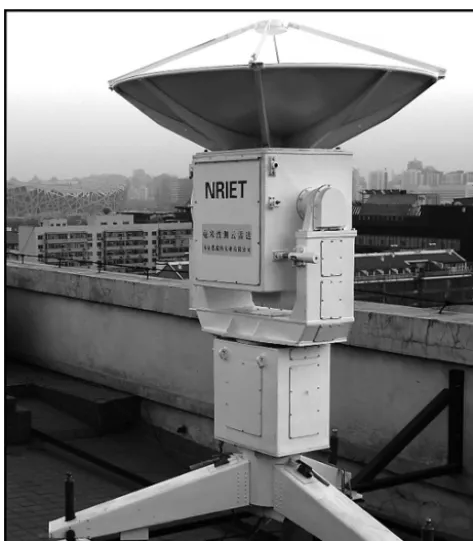
Figure 1.The Ka-band polarization Doppler radar at the Institute of Atmospheric Physics, Chinese Academy of Sciences, Beijing, China (39.967◦N, 116.367◦E).
small that CO2-slicing technology is unsuitable for CTH re-trieval, the IRW is applied. Compared with the collection 5 version algorithm, collection 6 differs in terms of the spa-tial resolution and the radiative transfer model calculation, for example, using ozone profiles provided in the meteoro-logical products rather than from climatometeoro-logical values. Fur-thermore, application of the CO2-slicing method is limited to only ice cloud in collection 6 (Baum et al., 2012). The MODIS cloud products used in this study are the collection 6 version cloud datasets (MYD06/MOD06) from both Aqua and Terra at 1 km spatial resolution.
2.2 AHI CTH retrieval
The HW8 satellite, equipped with the AHI, was launched on 7 October 2014 at the location of 140.7◦E and its op-eration by the Japanese Meteorological Agency commenced on 7 July 2015 (Bessho et al., 2016). The AHI is a visible infrared radiometer that has 16 observation bands, ranging from 0.47 to 13.3 µm (3 for visible, 3 for near-infrared and 10 for infrared). The AHI observes the Japanese area and some other target or landmark areas every 2.5 min and the entire full disk every 10 min with a spatial resolution of 0.5– 2.0 km. The scan ranges for full disk and the Japanese area are preliminarily fixed, while those for the target and land-mark areas are flexible regarding meteorological conditions. Relative to the imagers on board previous Japanese
geosta-Table 1.Main technical specifications of the Ka radar at the IAP.
Parameters Technical
specification
Transmitter Frequency 35.075 GHz
Peak power 29 kW
Pulse width 0.2 µs
Type Magnetron
Pulse repetition frequency 3.5 kHz
Antenna Diameter 1.5 m
Gain 54 dB
Scanning mode Vertically pointing
Beam width 0.4◦
Receiver Noise 5.8 dB
Noise power −103 dBm
Vertical resolution 30 m
tionary satellites, the AHI is improved in terms of its number of bands, spatial resolution, temporal frequency and radio-metric calibration.
2.3 Ka-band radar
The Ka-band polarization Doppler radar using a wave-length of 8.55 mm (Ka radar), situated at the Institute of Atmospheric Physics (IAP, 39.967◦N, 116.367◦E), Beijing, China, was set up in 2010 (Fig. 1). The technical specifica-tions of the Ka-band radar are given in Table 1. The Ka radar works 24 h d−1in a vertically pointing mode, except during special events, such as heavy rain or short-term collabora-tive observations with other instruments, when the mode is changed.
A data quality control approach using a combination of the threshold and median filter methods has been implemented to reduce the effects of clutter and noise on the radar reflectiv-ity (Xiao et al., 2018). It is considered to be cloudy if the reflectivity profile contains more than three bins of radar re-flectivity data higher than−45 dBZ. Zhou et al. (2019) used a threshold of−40 dBZ for cloud determination because their Ka radar was equipped with an all-solid transmitter that was different to our Ka radar. A higher threshold might miss some clouds with weak returns.
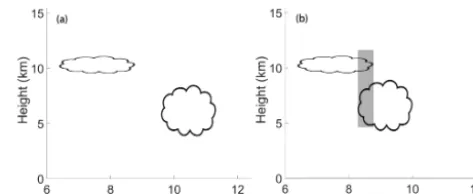
For a cloudy profile, the CTH is determined as the height of the cloudy bin at the highest level. In order to compare with passive satellite data, for clouds detected in a period (i.e. within 10 min), the radar CTH is calculated as the mean CTH of all cloudy profiles but not upper-level cloud if there are multilayer clouds. Note that the radar CTH differs when the upper-level cloud partially but not completely covers low-level cloud (see Fig. 2). For a cloudy profile, the cloud base height (CBH) is determined by the lowest cloudy radar bin. The cloud depth (CD) is equal to the CTH minus the CBH. The final CBH (or CD) is the average value of all CBHs (or CDs).
3 Comparison scheme
A MODIS or AHI CTH pixel covers a larger area than a sin-gle profile of radar. The data repetition frequency also dif-fers. Temporal and spatial collocation of the radar, MODIS and AHI data is critical to facilitate effective comparison and evaluation.
3.1 Collocation of the MODIS and Ka radar
A MODIS CTH pixel at sub-satellite point covers an area of about 1 km2; vertically pointed radar takes about 1.7 min to scan a 1 km path and about 8 min for a 5 km path if the moving speed of cloud is 10 m ×s−1. If the moving speed becomes higher (or lower), the required time scanning the same path will decrease (or increase). To compensate for the temporal and spatial differences in satellite data and ground-based data, Naud and Muller (2002) used MODIS CTH data averaged over a±0.1 latitude–longitude box for comparison with surface radar data. Dong et al. (2008) used the surface data (on the southern Great Plains, SGP, USA, atmospheric
Figure 2.When multilayer clouds exist, the radar CTH is the mean CTH of all cloudy profiles but not upper-level cloud if(a) upper-level cloud and low-upper-level cloud is situated separately or if(b) upper-level cloud covers part of the low-upper-level cloud. The CTH of the grey “covered” part of low-level cloud is not considered.
observatory established by the Atmospheric Radiation Mea-surement, ARM) averaged over a 1 h interval and the satellite data averaged within a 30 km×30 km area for the surface– satellite comparison. In Holz et al. (2008), the 5 km averaged CALIOP data were collocated with the 1 km MODIS data. These collocation methods are designed to satisfy different instrument and observation conditions.
At the IAP site, a collocation scheme is determined ac-cording to the local conditions. The moving speed and direc-tion of cloud is always changing, resulting in variable radar scanning length. The MODIS 1 km spatial resolution is suit-able for pixels around the sub-satellite point, but those pixels around the IAP site have flexible spatial resolutions due to the viewing geometry of the individual satellite overpasses (see Fig. 3).
In this study, the ground-based CTH measurements from radar are averaged within 10 min of the MODIS overpass (MODIS observation time±5 min). All the MODIS CTHs within 5 km to the IAP site are extracted and averaged to compare with surface radar measurements. A detailed description of the investigation of the optimal collocation scheme, including comparison between collocations using 4 years of MODIS and radar data averaged over different times and areas, will take place in an additional analysis but is briefly discussed here. Figure 4 presents the statisti-cal results from four collocation methods: radar data aver-aged within 5 min vs. nearest MODIS (Dm0−r5), radar within 5 min vs. MODIS averaged over a 5 km radius (Dm5−r5), radar within 5 min vs. MODIS within 30 km (Dm5−r30) and radar within 30 min vs. MODIS within 30 km (Dm30−r30). It is found that theDm5−r5is close to the average of four collo-cation methods.
3.2 Collocation of the AHI and Ka radar
Figure 3. Locations of the Terra MODIS CTHs (circles) and the Ka radar (solid black squares). The three panels exhibit three spatial resolutions of MODIS CTH data due to the changing viewing geometry of the individual satellite overpass. Solid grey circles are MODIS pixels within 5 km of the IAP site. The possible path scanned by Ka radar is demonstrated by a dashed black line.
Figure 4.Distributions of the probability density of the CTH dif-ference (MODIS – radar) from four collocation methods.Dm0−r5: radar data averaged within 5 min vs. nearest MODIS; Dm5−r5: radar 5 min vs. MODIS averaged within 5 km; Dm5−r30: radar 5 min vs. MODIS 30 km; andDm30−r30: radar 30 min vs. MODIS 30 km.
10 min of the AHI observation time are extracted and aver-aged (±5 min). The AHI CTHs nearest to the IAP site are used for comparison.
4 Comparison results
In this study, the CTH difference (Dmr) between the radar and MODIS data, the CTH difference (Dar) between the radar and AHI data, and the CTH difference (Dam) between the AHI and MODIS data are defined as follows:
Figure 5.Locations of the AHI CTHs (circles) and the IAP Ka radar (solid black dots). The spatial resolution of the AHI CTH data of the full disk does not change.
Dmr=Hm−Hr, (4)
Dar=Ha−Hr, (5)
Dam=Ha−Hm, (6)
whereHris the radar CTH,Hmis the MODIS CTH andHa is the AHI CTH.
Figure 6. Scatter plot of MODIS CTHs and the Ka radar CTHs from(a)all comparisons,(c)comparisons at daytime and(d) com-parisons at night-time. Panel(b)shows the probability density dis-tribution of theDmr, and the peak, mean and median difference is illustrated with dashed red, green and blue lines, respectively.
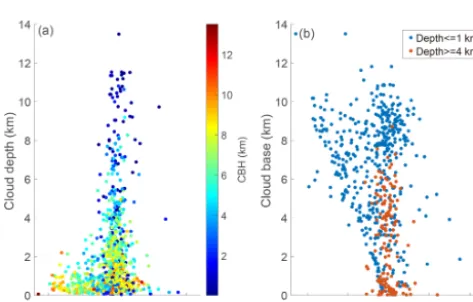
Figure 7.The relationship between(a)theDmrand cloud depth and(b)theDmrand the cloud base height (CBH) in cases of cloud depths<=1 km (blue) and>=4 km.
between MODIS CTHs and radar CTHs is 0.72, which show a good agreement with each other. Relative to the Ka radar, MODIS tends to underestimate the CTHs, by−1.10± 2.53 km (mean±standard deviation, STD, of the Dmr) on average. Among all comparisons, about 14 % of differences are within±0.25 km, 27 % are within±0.5 km and 49 % are within ±1.0 km. The statistical result is very close to the global results reported by Håkansson et al. (2018). Figure 6b presents the probability density distribution of the Dmr but the peak is not centred at zero. Most previous comparison studies used the mean bias to describe the CTH difference (Naud et al., 2002; Holz et al., 2008; Chang et al., 2010; Xi et al., 2014). Håkansson et al. (2018) discussed which statistical method was appropriate for describing a non-Gaussian dis-tribution of CTH difference and found the median was better than the mean to describe the tendency. Here, in Fig. 6b, the peak is at−0.30 km (termed “peak” difference) and the
me-Figure 8.Examples of the Ka radar CTHs (blue dots) and the AHI CTHs (red diamonds) measured on 9 May 2016 from 06:00 to 16:00 (local time: UTC+8).
dian is at−0.57 km with 2.18 km IQR (interquartile range). It is clear that the median difference is closer to the peak differ-ence than the mean differdiffer-ence. In this paper, both mean and median differences are used to describe the CTH difference. From Fig. 6a, it can be seen that most large-underestimated matches have lower MODIS CTHs, i.e. lower than 4 km. Among all MODIS CTHs, 62 % are greater than 6 km, of which the meanDmris 0.0026±1.43 km; yet, the meanDmris−3.55±2.99 km when the MODIS CTHs are less than 4 km. When compared with lower MODIS CTHs, MODIS CTHs greater than 6 km show better agreement with the Ka radar data. That is, a MODIS CTH greater than 6 km is more likely to be close to radar CTH than a MODIS CTH less than 4 km. Comparisons between day and night show that the meanDmrvalues during the day and night are close to each other (Fig. 6c, d). Terra MODIS and Aqua MODIS show similar accuracy in the CTH retrieval over Beijing.
Figure 9.Statistical results of comparisons between Ka radar and AHI. Panel (a)shows the Ka radar CTHs and the AHI CTHs of all comparisons. Panel(b)is the same as Fig. 6b but for theDar.(c)The meanDarand the STD changes with CD.(d)The median ofDarand IQR changes with CD.
Table 2.The median (IQR), mean and standard deviation ofDmrwith different CDs (mean±STD) (unit: km).
CD ∈(0,1) ∈(1,2) ∈(2,3) ∈(3,4) ∈(4,5) >5
Median (IQR) −1.14 (3.79) −0.45 (1.70) −0.45 (1.38) −0.28 (1.23) −0.06 (1.02) −0.24 (1.43) Mean±STD −1.74±3.04 −0.91±2.17 −0.60±1.61 −0.18±1.45 −0.24±1.00 0.01±1.30
Among all 963 comparisons, 753 comparisons have only one cloud layer. For single-layer clouds, the mean Dmr is −1.06±2.39 km and the median (IQR) is−0.55 (1.99) km, while the mean Dmr is −1.23±2.98 km and the median (IQR) is −0.70 (2.72) km for multilayer clouds. Cloud oc-currence frequency (COF) is equal to the number of radar cloudy profiles divided by the total number of radar profiles. It is found that the mean Dmrdeclines to−0.39±1.57 km for the comparisons when the CD was>1 km and the COF is>0.5. Here, the MODIS retrieval algorithm shows higher accuracy for continuous clouds than for broken clouds.
4.2 Comparison between AHI and Ka radar
Figure 8 shows CTHs from the Ka radar and AHI over 10 h on 9 May 2016. Relative to the comparisons between MODIS and Ka radar, the number of comparisons between the Ka radar and AHI increases due to the increase in tem-poral resolution of the data. From 1 January 2016 to 31 De-cember 2017, 6719 valid comparisons are found for the CTH comparison.
It can be seen from Fig. 8 that most AHI CTHs are lower than the radar CTHs. All of the 6719 CTH comparisons are shown in Fig. 9a.
Figure 10.Scatter plot illustrating the relationship of(a)theDar and the COTs and(b)theDarand the CD.
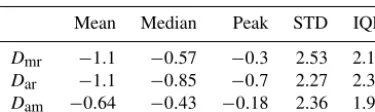
Table 3.Statistical results of the distribution ofDmr,DarandDam (unit: km).
Mean Median Peak STD IQR
Dmr −1.1 −0.57 −0.3 2.53 2.18
Dar −1.1 −0.85 −0.7 2.27 2.32
Dam −0.64 −0.43 −0.18 2.36 1.93
Cloud depth is also a critical factor impacting the accuracy of the AHI retrieval algorithm (Fig. 9c, d). The meanDar de-creases as the CD inde-creases, i.e. the meanDaris−1.52±2.84 for CD<1 km while theDardeclines to−0.76±1.63 km for CD>1 km. The AHI CTHs illustrate great variation for thin clouds (CD<1 km). The mean bias is larger than the median bias when CD<2 km. The relationship between theDarand the cloud optical thickness (COT) is compared with that be-tween the Dar and CD (Fig. 10). All COTs are from AHI cloud products. The range of theDarnarrows as the COT in-creases, but the distribution is much more scattered than that for CD, which might be due to the COT retrieval errors.
Among all comparisons, 79 % have only one cloud layer. For single-layer clouds, the mean Dar is −1.12±2.25 km and the median Dar is−0.88 km with an IQR of 2.25. For multilayer clouds, the meanDaris−0.99±2.40 km and the median Dar is−0.73 km with an IQR of 2.69. The impact of COF on the retrieval accuracy cannot be determined be-cause most of the comparisons with CD>1 km also have COF greater than 0.5.
4.3 Comparison between MODIS and AHI
As just addressed, MODIS and AHI CTH data have different spatial and temporal resolutions. This section compares the MODIS CTHs, averaged using data within 2.5 and 5 km from the IAP site, with the nearest AHI CTHs, respectively. Obser-vation time interval of comparisons is limited within 5 min. More than 600 valid comparisons are matched and are shown in Fig. 11. The meanDamis−0.70±2.49 km for the 2.5 km collocation and −0.64±2.36 km for the 5 km collocation. The median (IQR) Dam is −0.45 (2.18) km for the 2.5 km collocation and −0.43 (1.93) km for the 5 km collocation. The peak Dam is at−0.17 km and−0.18 km, respectively. Statistically, the 5 km collocation method shows larger CTH bias than the 2.5 km collocation. These results are close to the results from Kouki et al. (2016), who reported that the mean AHI CTH was smaller than the MODIS CTH by−0.54 km based on measurements over 13 d in August. Also, the CTH difference shows an obvious relationship with COT.
Based on the analysis in Sect. 4.1–4.3, an overview of the statistical results is presented in Table 3. Statistically, MODIS CTHs and AHI CTHs are lower than radar CTHs; the median differences are closer to the peak differences than the mean differences due to the non-Gaussian distribution of difference. Note that the comparisons between MODIS and
Ka band, between AHI and Ka band, and between MODIS and AHI are based on different comparison samples. There-fore, due to lower median and peakDar, AHI CTHs are lower on average than MODIS CTHs, though the meanDmr and meanDar are close to each other. It also can be found that the CTH difference between the two satellite instruments is smaller than the difference between the satellite instrument and the ground-based radar.
4.4 Seasonal variation
The monthly mean and medianDmrandDarare calculated and presented in Fig. 12 as a reference for the meteorological application of the CTH datasets.
Beijing is in northern China and has a typical continen-tal monsoon climate. It is located in the subtropical mon-soon zone, with southwest and southeast monmon-soons prevail-ing in summer and the northwest monsoon prevailprevail-ing in win-ter. Rainfall is greater in summer, with less rain but more snow occurring in winter. The cloud distribution also shows strong seasonal variations. As shown in Fig. 12, the monthly variation in meanDar is greater than meanDmr and shows seasonal characteristics. It is clear that the AHI CTH retrieval algorithm has lower uncertainty in summer (June–August), while it has the largest uncertainty in winter. The MODIS CTH retrieval algorithm also shows better performance in summer than in the other seasons. It is likely due to the sea-sonal characteristics of cloud distribution that summer has more thick clouds.
5 Summaries and discussions
The accuracy of the CTH retrieval algorithm of MODIS and AHI is associated with the instrument, such as the radiance calibration, signal–noise ratio, the spectral response function, and so on. It is also associated with the calculation accuracy of the radiative transfer model and the uncertainty caused by the theoretical assumptions. In an effort to better under-stand the performance of satellite CTH retrieval algorithms for Beijing, this study evaluates the accuracy of the MODIS and AHI CTH datasets with ground-based radar data based on 2 years of measurements.
Overall, the CTHs retrieved from the two passive sensors on board satellites (Aqua/Terra and HW8) are lower on av-erage than the surface radar data. Furthermore, the retrieval accuracy strongly depends on cloud depth. As the retrieval algorithms determine that the retrieved CTH mostly repre-sents the position of the radiation centre of the clouds, it is reasonable that most CTHs retrieved by MODIS and AHI are lower than the radar CTHs. The CTH difference between two satellite instruments is smaller than the difference between satellite instrument and ground-based radar.
Figure 11.Statistical results of the MODIS CTHs and the nearest AHI CTHs of all comparisons. For the 2.5 km collocation, panel(a)is the scatter plot of all MODIS CTHs and the AHI CTHs. Panel(b)shows the relationship between theDamand the COT. Panel(c)presents the probability density distribution ofDam, same as Fig. 9b. Panels(d–f)are the same as(a–c)but for a 5 km radius.
Figure 12.Monthly variations in(a)the mean and standard devi-ation of theDmrand theDar, and(b)the median and IQR of the
Dmrand theDar.
The large differences are mainly from high and thin clouds (CD<1 km). In particular, retrieval differences are enlarged when the CBH is greater than 4 km. The meanDmrfor clouds with CD>1 km is −0.48±1.70 km and −0.29±1.43 km for clouds with CD>2 km. For the AHI, the mean Dar de-creases as CD inde-creases, i.e. the meanDar is−1.52±2.84 for CD<1 km, while theDar declines to−0.76±1.63 km for CD>1 km. The median differences and IQR are also cal-culated to investigate the CTH difference, and it is found that those median CTH biases are smaller than the mean biases due to the non-Gaussian distribution of difference.
Statistical analysis shows that the mean AHI CTHs are lower than the MODIS CTHs over Beijing. On the basis of
2 years of data, the seasonal changes in the CTH retrieval bias for both sensors is also studied. Both MODIS and AHI retrieval algorithm have the lowest bias in summer.
This study shows the CTH retrieval accuracy of MODIS and AHI and provides a reference for a better understand-ing of the climatological trends of clouds based on satellite datasets and to enhance their application in GCM models. However, this study does not consider the causes of the re-trieval uncertainties. By combining the results of this study with an analysis of the raw radiance data and source retrieval codes, more insights into improvement of the retrieval algo-rithms can be obtained in the future.
Data availability. The MODIS product data were obtained from http://ladsweb.nascom.nasa.gov (last access: 16 December 2019). The AHI data were obtained from https://www.eorc.jaxa.jp/ptree/ index.html (last access: 16 December 2019). The radar data used here are available by special request to the corresponding author ([email protected]).
Author contributions. JH and DL designed the comparisons, and JH carried them out. SD and YB prepared the ground-based radar data. BL prepared some Himawari data and references. JH prepared the manuscript with contributions from all co-authors.
Acknowledgements. Thanks to the MODIS and the AHI team for sharing their product datasets. We also acknowledge our Ka radar team for their maintenance service during the long-term measure-ments that made our research possible.
Financial support. This research has been supported by the Na-tional Natural Science Foundation of China (grant nos. 41775032 and 41275040).
Review statement. This paper was edited by Piet Stammes and re-viewed by Ulrich Hamann and Nina Håkansson.
References
Ackerman, S. A., Strabala, K. I., Menzel, W. P., Frey, R. A., Moeller, C. C., and Gumley, L. E.: Discriminating clear sky from clouds with MODIS, J. Geophys. Res., 103, 32141–32157, 1998. Arakawa, A.: The cumulus parameterization problem: Past, present,
and future, J. Climate, 17, 2493–2525, 2004.
Atlas, D.: The estimation of cloud parameters by radar, J. Meteor., 11, 309–317, 1954.
Baum, B. A., Menzel, W. P., Frey, R. A., Tobin, D. C., Holz, R. E., Ackerman, S. A., Heidinger, A. K., and Yang, P.: MODIS cloud-top property refinements for Collection 6, J. Appl. Meteor., 51, 1145–1163, 2012.
Bessho, K., Date, K., Hayashi, M., Ikeda, A., Imai, T., Inoue, H., Kumagai, Y., Miyakawa, T., Murata, H., Ohno, T., Okuyama, A., Oyama, R., Sasaki, Y., Shimazu, Y., Shimoji, K., Sumida, Y., Suzuki, M., Taniguchi, H., Tsuchiyama, H., Uesawa, D., Yokota, H., and Yoshida, R.: An introduction to Himawari-8/9 – Japan’s new-generation geostationary meteorological satellites, J. Mete-orol. Soc. Jpn., 94, 151–183, 2016.
Boucher, O., Randall, D., Artaxo, P., Bretherton, C., Feingold, G., Forster, P., Kerminen, V., Kondo, Y., Liao, H., Lohmann, U., Rasch, P., Satheesh, S., Sherwood, S., Stevens, B., and Zhang, X. Y.: Clouds and Aerosols, in: Climate Change 2013: The Phys-ical Science Basis, Contribution of Working Group I to the Fifth Assessment Report of the Intergovernmental Panel on Climate Change, edited by: Stocker, T. F., Qin, D., Plattner, G., Tig-nor, M., Allen, S., Boschung, J., Nauels, A., Xia, Y., Bex, V., and Midgley, P.: Cambridge University Press, Cambridge, United Kingdom and New York, NY, USA, 571–657, 2013.
Cess, R. D., Zhang, M. H., Zhou, Y., Jing, X., and Dvortsov, V.: Ab-sorption of solar radiation by clouds: Interpretations of satellite, surface, and aircraft measurements, J. Geophys. Res.-Atmos., 101, 23299–23309, 1996.
Chang, F. L., Minnis, P., Ayers, J. K., McGill, M. J., Palikonda, R., Spangenberg, D. A., Smith Jr., W. L., and Yost, C. R.: Evalua-tion of satellite – upper troposphere cloud top height retrievals in multilayer cloud conditions during TC4, J. Geophys. Res., 115, https://doi.org/10.1029/2009JD013305, 2010.
Dong, X., Minnis, P., Xi, B., Sun-Mack, S., and Chen, Y.: Compari-son of CERES – stratus cloud properties with ground – measure-ments at the DOE ARM Southern Great Plains site, J. Geophys. Res.-Atmos., 113, https://doi.org/10.1029/2007JD008438, 2008.
Eyre J. R.: A fast radiative transfer model for satellite sounding sys-tems. ECMWF Technical Memoranda, available at: https://www. ecmwf.int/node/9329, 176, https://doi.org/10.21957/xsg8d92y3, 1991.
Görsdorf, U., Lehmann, V., Bauer-Pfundstein, M., Peters, G., Vavriv, D., Vinogradov, V., and Volkov, V.: A 35 GHz polarimet-ric Doppler radar for long-term observations of cloud parameters – Description of system and data processing, J. Atmos. Ocean. Tech., 32, 675–690, 2015.
Håkansson, N., Adok, C., Thoss, A., Scheirer, R., and Hörnquist, S.: Neural network cloud top pressure and height for MODIS, At-mos. Meas. Tech., 11, 3177–3196, https://doi.org/10.5194/amt-11-3177-2018, 2018.
Ham, S. H., Sohn, B. J., Yang, P., and Baum, B. A.: Assessment of the quality of MODIS cloud products from radiance simulations, J. Appl. Meteor., 48, 1591–1612, 2009.
Hamada, A. and Nishi, N.: Development of a cloud-top height esti-mation method by geostationary satellite split-window measure-ments trained with CloudSat data, J. Appl. Meteor., 49, 2035– 2049, 2010.
Hamann, U., Walther, A., Baum, B., Bennartz, R., Bugliaro, L., Derrien, M., Francis, P. N., Heidinger, A., Joro, S., Kniffka, A., Le Gléau, H., Lockhoff, M., Lutz, H.-J., Meirink, J. F., Minnis, P., Palikonda, R., Roebeling, R., Thoss, A., Platnick, S., Watts, P., and Wind, G.: Remote sensing of cloud top pressure/height from SEVIRI: analysis of ten current retrieval algorithms, At-mos. Meas. Tech., 7, 2839–2867, https://doi.org/10.5194/amt-7-2839-2014, 2014.
Huo, J. and Lu, D.: Cloud determination of all-sky images un-der low-visibility conditions, J. Atmos. Ocean. Tech., 26, 2172– 2181, 2009.
Huo, J., Bi, Y., Lü, D., and Duan, S.: Cloud Classification and Dis-tribution of Cloud Types in Beijing Using Ka-Band Radar Data, Adv. Atmos. Sci., 36, 793–803, 2019.
King, M., Tsay, S., Platnick, S., Wang, M., and Liou, K.: Cloud Retrieval: Algorithms for MODIS: Optical thickness, effective particle radius, and thermodynamic phase, Algorithm Theoreti-cal Basis Document, ATBD-MOD-05, 83 pp., 1998.
Kouki, M., Hiroshi, S., Ryo, Y., and Toshiharu, I.: Algorithm the-oretical basis document for cloud top height product, Meteorol-gical Satellite Center Technical Note, https://www.data.jma.go. jp/mscweb/technotes/msctechrep61-63.pdf (last access: 19 June 2019), 2016.
Liou, K. N.: Radiation and cloud rrocesses in the atmosphere: the-ory, observation, and modeling, Oxford University Press, 487 pp, 1992.
Marchand, R.: Trends in ISCCP, MISR, and MODIS cloud-top-height and optical-depth histograms, J. Geophys. Res.-Atmos., 118, 1941–1949, 2013.
Marchand, R., Ackerman, T., Smyth, M., and Rossow, W.: A re-view of cloud top height and optical depth histograms from MISR, ISCCP, and MODIS, J. Geophys. Res.-Atmos., 115, https://doi.org/10.1029/2009JD013422, 2010.
Mouri, K., Izumi, T., Suzue, H., and Yoshida, R.: Algorithm The-oritical Basis Document of cloud type/phase product, Meteoro-logical Satellite Center, Technical Note, 61, 19–31, 2016. Naud, C., Muller, J. P., and Clothiaux, E. E.: Comparison of cloud
top heights derived from MISR stereo and MODIS CO2, Geo-phys. Res. Lett., 29, 421–424, 2002.
Nieman, S. J., Schmetz, J., and Menzel, W. P.: A comparison of sev-eral techniques to assign heights to cloud tracers, J. Appl. Mete-orol., 32, 1559–1568, 1993.
Pavolonis, M. J. and Heidinger, A. K.: Daytime cloud overlap detec-tion from AVHRR and VIIRS, J. Appl. Meteorol., 43, 762–778, 2004.
Pincus, R., Platnick, S., Ackerman, S. A., Hemler, R. S., and Patrick Hofmann, R. J.: Reconciling simulated and observed views of clouds: MODIS, ISCCP, and the limits of instrument simulators, J. Climate, 25, 4699–4720, 2012.
Remer, L. A., Kleidman, R. G., Levy, R. C., Kaufman, Y. J., Tanré, D., Mattoo, S., Martins, J. V., Ichoku, C., Koren, I., Yu, H., and Holben, B. N.: Global aerosol climatology from the MODIS satellite sensors, J. Geophys. Res.-Atmos., 113, https://doi.org/10.1029/2007JD009661, 2008.
Ramanathan, V. L. R. D., Cess, R. D., Harrison, E. F., Minnis, P., Barkstrom, B. R., Ahmad, E., and Hartmann, D.: Cloud-radiative forcing and climate: Results from the Earth Radiation Budget Experiment, Science, 243, 57–63, 1989.
Rodell, M. and Houser, P. R.: Updating a land surface model with MODIS-derived snow cover, J. Hydrometeorol., 5, 1064–1075, 2004.
Roskovensky, J. K. and Liou, K. N.: Simultaneous determination of aerosol and thin cirrus optical depths over oceans from MODIS data: Some case studies, J. Atmos. Sci., 63, 2307–2323, 2006. Rossow, W. B. and Schiffer, R. A.: Advances in understanding
clouds from ISCCP, Bound.-Lay. Meteorol., 80, 2261–2288, 1999.
Schmetz, J., Holmlund, K., Hoffman, J., and Strauss, B.: Oper-ational cloud motion winds from Meteosat infrared images, J. Appl. Meteorol., 32, 1207–1225, 1993.
Schiffer, R. A. and Rossow, W. B.: The International Satellite Cloud Climatology Project (ISCCP): The first project of the world cli-mate research programme, Bound.-Lay. Meteorol., 64, 779–784, 1983.
Smith, W. L. and Platt, C. M. R.: Comparison of satellite-deduced cloud heights with indications from radiosonde and ground-based laser measurements, J. Appl. Meteorol., 17, 1796–1802, 1978.
Stephens, G. L. and Kummerow, C. D.: The remote sensing of clouds and precipitation from space: A review, J. Atmos. Sci., 64, 3742–3765, 2007.
Stubenrauch, C. J., Del Genio, A. D., and Rossow, W. B.: Imple-mentation of subgrid cloud vertical structure inside a GCM and its effect on the radiation budget, J. Climate, 10, 273–287, 1997. Wang, T., Luo, J., Liang, J., Wang, B., Tian, W., and Chen, X.: Com-parisons of AGRI/FY-4A cloud fraction and cloud top rressure with MODIS/Terra measurements over East Asia, J. Meteorol. Res., 33, 705–719, 2019.
Weisz, E., Li, J., Menzel, W. P., Heidinger, A. K., Kahn, B. H., and Liu, C. Y.: Comparison of AIRS, MODIS, CloudSat and CALIPSO cloud top height retrievals, Geophys. Res. Lett., 34, https://doi.org/10.1029/2007GL030676, 2007.
Wetherald, R. T. and Manabe, S.: Cloud feedback processes in a general circulation model, J. Atmos. Sci., 45, 1397–1416, 1988. Xi, B., Dong, X., Minnis, P., and Sun-Mack, S.: Com-parison of marine boundary layer cloud properties from CERES – Edition 4 and DOE ARM AMF measurements at the Azores, J. Geophys. Res.-Atmos., 119, 9509–9529, https://doi.org/10.1002/2014JD021813, 2014.
Xiao, P., Huo, J., and Bi, Y.: Ground-based Ka- band cloud radar data quality control. Journal of Chengdu Univer-sity of Information Technology, Journal of Chengdu University of Information Technology, 33, 129–136, https://doi.org/110.16836/j.cnki.jcuit.12018.16802.16005, 2018.