R E S E A R C H
Open Access
Identification of protein complexes from
multi-relationship protein interaction
networks
Xueyong Li
1,2, Jianxin Wang
1*, Bihai Zhao
2*, Fang-Xiang Wu
3and Yi Pan
4Abstract
Background:Protein complexes play an important role in biological processes. Recent developments in experiments have resulted in the publication of many high-quality, large-scale protein-protein interaction (PPI) datasets, which provide abundant data for computational approaches to the prediction of protein complexes. However, the precision of protein complex prediction still needs to be improved due to the incompletion and noise in PPI networks.
Results:There exist complex and diverse relationships among proteins after integrating multiple sources of biological information. Considering that the influences of different types of interactions are not the same weight for protein complex prediction, we construct a multi-relationship protein interaction network (MPIN) by integrating PPI network topology with gene ontology annotation information. Then, we design a novel algorithm named MINE (identifying protein complexes based on Multi-relationship protein Interaction NEtwork) to predict protein complexes with high cohesion and low coupling from MPIN.
Conclusions:The experiments on yeast data show that MINE outperforms the current methods in terms of both accuracy and statistical significance.
Background
With the completion of the sequencing of the human gen-ome, proteomic research becomes one of the most import-ant areas in the life science. One importimport-ant task in proteomics is to detect protein complexes based on protein-protein interaction (PPI) data generated by various experimental technologies, e.g., yeast-two-hybrid [1], tan-dem affinity purification [2], and mass spectrometry [3]. Protein complexes are molecular aggregations of proteins assembled by PPIs, which play critical roles in biological processes. Many proteins are functional only when they are assembled into a protein complex and interact with other proteins in this complex. Protein complexes are key mo-lecular entities to perform cellular functions. Even in the relatively simple model organismSaccharomyces cerevisiae, these complexes are comprised of many subunits that work
in a coherent fashion. Besides applications of PPI networks, such as protein function predictions [4] and essential pro-tein discoveries [5–11], prediction of protein complexes is another active topic. Actually, protein complexes are of great importance for understanding the principles of cellular organization and function.
Many computational methods for predicting protein complexes from PPI networks have been developed. Pair-wise protein interactions can be modelled as a graph or network, where vertices are proteins and edges are PPIs. Since proteins in the same complex are highly interactive with each other, protein complexes generally correspond to dense subgraphs in the PPI network and many previous studies have been proposed based on this observation, such as MCODE (Molecular Complex detection) [12], MCL (Markov Cluster algorithm) [13], R-MCL (Regu-larized MCL) [14], CMC (Maximal Clique algorithm) [15], RRW (Repeated Random Walks) [16], SPICi (Speed and Performance in Clustering algorithm) [17], HC-PIN (Hierarchical Clustering based on Protein-Protein Interaction Network) [18], IPC-MCE (Identifying Protein * Correspondence:[email protected];[email protected]
1
School of Information Science and Engineering, Central South University, Changsha 410083, China
2Department of Information and Computing Science, Changsha University, Changsha 410003, China
Full list of author information is available at the end of the article
Complexes based on Maximal Clique Extension) [19], and IPCA (Identification of Protein Complexes Algorithm) [20]. Nepusz et al. [21] proposed an algorithm to find over-lapping protein complexes from PPI networks, named ClusterONE (Clustering with Overlapping Neighborhood Expansion). For the convenience of researchers, MCODE, ClusterONE, etc. have been designed as plus-in for protein complex prediction and biological network analysis. Clus-terViz [22] is such a Cytoscape APP to complete this work.
However, these abovementioned approaches for extract-ing dense subgraphs fail to take into account the inherent organization. Recent analysis of experimentally detected protein complexes [23] has revealed that a complex consists of a core component and attachments. Core pro-teins are highly co-expressed and share high functional similarity, and each attachment protein binds to a subset of core proteins to form a biological complex. Based on the core-attachment concept, some algorithms have been proposed, including COACH (Core-Attachment-based method) [24], CORE [25], MCL-Caw [26], DCU (Detect-ing Complex based on Uncertain graph model) [27], and WPNCA (a Weighted PageRank-Nibble algorithm with Core-Attachment structure) [28].
In spite of the advances in computational approaches and related fields, accurate identification protein com-plexes are still a bottleneck. One of the most important reasons is that the PPI network contains a lot of false positives which greatly reduce the complex detection accuracy. To address this problem, biological informa-tion other than PPIs has been integrated with network topology to improve the precision of protein complex detection methods. Wu et al. proposed a method called CACHET to discover protein complexes with core-attachment structures from tandem affinity purification (TAP) data [29]. Tang et al. [30] constructed time course PPI networks by incorporating gene expression into PPI networks and applied it successfully to the identification of function modules. Wang et al. [31] proposed a three-sigma method to identify active time points of each pro-tein in a cellular cycle, where three-sigma principle is used to compute an active threshold for each gene ac-cording to the characteristics of its expression curve. A dynamic PPI network (DPIN) is constructed for the de-tection of protein complexes. Li et al. proposed novel al-gorithms, such as TSN-PCD [32] and DPC [33], to identify dynamic protein complexes by integrating PPI data and dynamic gene expression profiles. Zhao et al. [34] reconstructed a weighted PPI network by using dy-namic gene expression data and developed a novel pro-tein complex identification algorithm, named PCIA-GeCo.
There exist complex and diverse relationships among proteins after integrating multiple sources of biological information. However, comparing PPI data is difficult
because they are often diverse and play different roles under different conditions. Current existing approaches failed to take into account and combined the interac-tions with different natures into one interaction effect-ively. Taking into account the influences of different types of interactions are not the same weight for protein complex prediction, we construct a multi-relationship protein interaction network (MPIN) by integrating PPI network topology with gene ontology (GO) annotation information. Then, a new method named MINE (identify protein complexes based on Multi-relationship protein Interaction NEtwork) is proposed. We have conducted an experiment on yeast data. Experimental results show that MINE outperforms the existing methods in terms of both accuracy andpvalue.
Methods
Multi-relationship protein interaction network
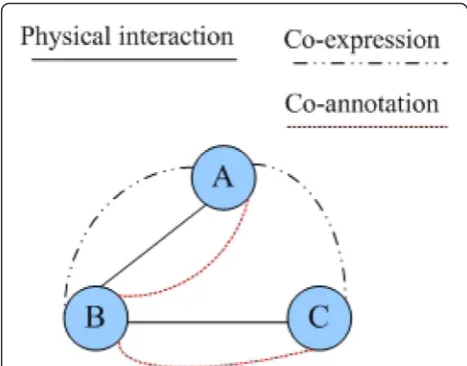
Complex networks have now been a new research focus because of surging networks in various fields such as engineering, social science, and life science. In reality, connections among nodes in complex net-works are diversified. Multi-relationship means that there is more than one connection between two nodes and each of them has its own property. For instance, in social networks [35], persons contact with each other via emails, telephones, MSN, etc. and hence make up a complex multi-relationship network. Si-milarly, in biological networks, there are diverse links among proteins like physical interaction, co-expression, and co-annotation. However, multi-relationship net-works are much more difficult to analyze than single-relationship networks. Multi-relationship net-works are also essential in better reflecting the real world.
Definition 1 Multi-relationship network
Consider a PPI networkG= (V,E), whereV= {v1,v2,…,vn}
represents a set of proteins and E= {e1, e2,…, em}
repre-sents a set of interactions. A multi-relationship network is defined as MG = (V, E∪E’,T), whereT(ei) =ti(i= 1, 2…m)
is the interaction type ofei.E’is the set of new generated
interactions.
Researches [27, 36] show that PPI data obtained through high-throughput biological experiments con-tains relatively high rates of false positives and false negatives. False positives become obstacle to the preci-sion of prediction algorithm. False negatives lead to the loss of interaction data and continue to inhibit the increase of the number of protein complexes correctly matched. To overcome these problems, researches have begun to integrate the PPI network and other biological information, such as gene expression pro-files, essential proteins, and GO annotation infor-mation. Due to the similar biological properties of protein complexes, GO annotation is a valuable addition to PPI data for protein complex prediction. Therefore, in this study we construct a multi-relationship protein inter-action network by integrating PPI network topology and GO annotation information.
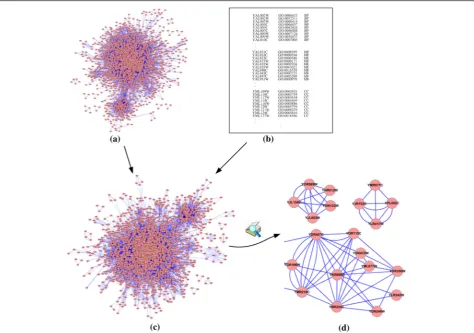
The GO database consists of three separate categories of annotations, namely molecular function (MF), bio-logical process (BP), and cellular component (CC). MF describes activities, such as catalytic or binding activities, at the molecular level. BP describes biological goals accomplished by one or more ordered assemblies of molecular functions. CC describes locations, at the levels of subcellular structures and macromolecular complexes. In this study we integrate the PPI network and three categories of GO annotations to construct a multi-relationship protein interaction network. In our con-structed multi-relationship network, four kinds of interactions at most can be considered between two proteins, namely the interactions of the PPI network and the interactions of sharing molecular functions,
sharing biological processes, and sharing cellular com-ponents. Figure 2 describes the process of a multi-relationship network construction.
In the constructed multi-relationship protein inter-action network, two proteins are connected if they interact with each other in the PPI network or have common functions, including biological processes, molecular functions, and cellular components. After constructing a multi-relationship protein interaction net-work, we do some further processing, such as weighting and filtering. Studies [9, 10, 36] show that the per-formance of prediction algorithms based on weighted networks is generally superior to that based on un-weighted networks. The reason is simple: weight stands for the relative reliability/importance of interactions; thus, weighted networks can be more valuable than un-weighted networks in the representative of PPI networks. For the first type of interaction in our constructed multi-relationship network, interacting with each other in the PPI network, we weight these interactions through the analysis of topological features of PPI networks. Generally speaking, for a pair of interacting proteins, the strength of an interaction can be reflected by the number of its common neighbors. This study uses ECC to calculate the weight of protein pairs, which is defined as
ECCðvi;vjÞ ¼
Ni∩Nj
2
Ni
j j−1
ð Þ Nj−1 ; j jNi >1 andjNjj>1
0 ; Nij ¼1 orjNj¼1 ; 8
> < > :
ð1Þ
where Ni and Nj are the neighborhood sets of vi and vj, respectively. To reduce the negative effect of false
positive on the protein complex prediction, we remove interactions whose ECC values are zero.
For the rest three types of interaction, we weight inter-actions according to the number of common functions (including BP, MF, and CC) between two proteins. For a pair of proteins vi and vj, BPi and BPj are sets of
bio-logical processes of viand vj, respectively. W_BP (vi, vj) represents the strength of sharing biological processes, which is calculated as follows:
W BPðvi;vjÞ ¼
BPi∩BPj
2
BPij jBPj
; jBPij jBPjj>0 0 ; jBPij jBPjj ¼0 8
> < >
: ð2Þ
In Eq. (2), BPi∩BPj denotes the set of common
bio-logical processes of vi and vj. In a similar way, W_MF
(vi,vj) and W_CC (vi,vj) denote the strengths of sharing
molecular functions and cellular components of vi and vj, respectively. They can be calculated as follows: Fig. 1An example of a typical multi-relationship network. There
W MFðvi;vjÞ ¼
MFi∩MFj
2
MFij jMFj
; jMFij jMFjj>0 0 ; jMFij jMFjj ¼0 8
> < >
: ð3Þ
W CCðvi;vjÞ ¼
CCi∩CCj
2
CCij jCCj
; jCCij jCCjj>0 0 ; jCCij jCCjj ¼0 8
> < >
: ð4Þ
For the three types of interactions, we perform more stringent filter operations than the first type because they are newly generated interactions. For a pair of function-shared proteins, if they have only one common function or no common neighbors in the PPI network, interactions between them are removed. After performing the above operations, a weighted multi-relationship protein inter-action network is constructed.
MINE algorithm
Considering the influences of different types of interac-tions in protein complex prediction are not the same, we
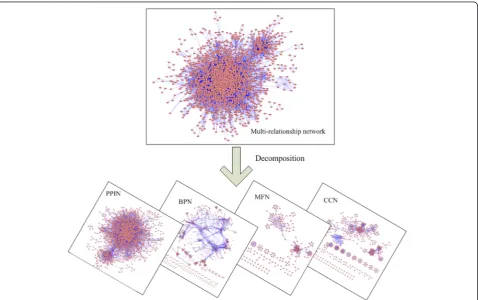
construct a multi-relationship protein interaction net-work by integrating PPI netnet-works and GO annotation information. To test the effectiveness of the multi-relationship network, we design a new method for pre-dicting protein complexes, named MINE (based on relationship protein Interaction NEtwork). Multi-relationship networks have more complex attributes than single networks. Current protein complex predic-tion methods are mainly based on single networks. So, converting a multi-relationship network into single net-works is key to design the MINE algorithm. A simple way for addressing this problem is to combine interac-tions with different natures to one interaction effectively. In reality, it is inappropriate for us to combine multiple interactions between two proteins because they are often derived under different conditions and play different roles in protein complex prediction. Considering that different types of interactions play different roles in detecting protein complexes, we decompose the multi-relationship network into several single networks,
including the PPI network, BPN (sharing biological pro-cesses), MFN (sharing molecular functions) and CCN (sharing cellular components). Figure 3 displays the framework of multi-relationship decomposition.
And then, we identify protein complexes through mining density subgraphs from the four networks. Intuitively, a subgraph representing a protein com-plex should satisfy two simple structural properties: it should contain many reliable interactions between its subunits, and it should be well-separated from the rest of the network [21]. Inspired by the notion, we take into account the density of a subgraph and connections between nodes of the subgraph and nodes out of the subgraph. To describe MINE sim-ply and clearly, we provide the following definitions, firstly.
Definition 2 Weighted Density [27]
Given a weighted network G= (V, E, W). V= {v1, v2, …, vn},E= {e1,e2,…,em},W= {w(e1),w(e2),…,w(em)},w(ei) is
the weight of an edge ei. WD (G) denotes the weighted
density ofGand is defined as
WDð Þ ¼G
Xm
i¼1
p eð Þ i 2
max
1≤i≤jmðp eð ÞiÞðj jV ðj jV−1ÞÞ
ð5Þ
Definition 3 Sub-network Weighted Degree [36]
Given a weighted sub-network G= (V, E, W) and a ver-tex u, u V. V= {v1, v2, …, vn}, E= {e1, e2,…, em}, W=
{w(e1), w(e2),…,w(em)},w(ei) is the weight of an edge ei.
SWD (u,G) denotes the weighted degree ofu withinG and is defined as
SWDðu;GÞ ¼X n
i¼1
w u;ð viÞ;ðu;viÞ∈E ð6Þ
Based on these definitions, we are now ready to de-scribe our proposed MINE algorithm to detect protein complexes. Our method visits the four single networks, respectively, to discover density subgraphs as protein complexes. For a selected network, MINE starts from a randomly chosen protein vertex and add protein vertices via a greedy procedure to form a candidate complex
with high cohesion and low coupling. The growth process is repeated from all vertices to form non-redundant complex sets. Since some vertices have simi-lar neighborhood graphs, the candidate complexes de-tected from their neighborhood graphs may have large overlaps, which result in high redundancy. Hence, a redundancy-filtering procedure is applied to quantify the extent overlap between each pair of complexes and dis-card the complexes with low density or small size.
MINE algorithm (Algorithm 1) describes the overall cedure to identify protein complexes. MINE algorithm pro-cesses four single networks according to the multi-relationship network, such as PPIN, BPN, MFN, and CCN, in line 1. For a selected networkGk, we first generate
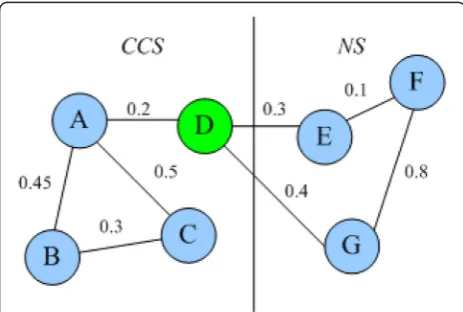
candi-date complexes according to neighbors of all proteins in the network, in lines 3–8. The seed is inserted into the can-didate set CCS, and then all neighbors of the seed are put into CCS one by one. If the weighted density of CCS is less than the threshold WDT, the new added neighbor node is removed from CCS. After this process, a candidate complex with high cohesion is formed. Then, we remove some nodes highly connected with the neighbor subgraph to form a candidate complex with low coupling, in lines 9–12. Figure 4 illustrates an example of removing high-coupling proteins. In Fig. 4, SWD(D, CCS) = 0.2, SWD(D, NS) = 0.3 + 0.4 = 0.7,Dis removed from CCS.
Finally, if CCS is not a subset of complex in the set of protein complex SC, CCS is inserted into SC.
The second stage of our method is redundancy-filtering, in lines 15–20. Complexes overlapping to a very high ex-tent should be discarded. With quantifying the exex-tent of overlap between each pair of complexes, a complex with small weighted density or a small number of proteins is discarded for which overlap score of the pair is above the threshold. In our method, the overlap threshold is
typically set as 0.8 [21, 27], where the matching score of two complexesAandBis defined as follows [15, 24]:
MSðA;BÞ ¼ jA∩Bj
2
Aj jB
j j ð7Þ
Results and discussion
In order to evaluate the performance of our proposed al-gorithm, we compare it with other five competing algo-rithms, including CMC [15], RRW [16], COACH [24], SPICi [17], and ClusterONE [21]. For all those compet-ing algorithms, the parameters are set as recommended by their authors. We have applied our MINE method and other methods on two yeast PPI networks, including DIP [37] and Krogan [38]. These PPI datasets are
available online, which varied from each other a lot. In this section, we will first present in details the results on DIP data. The results using Krogan data will also be briefly presented to demonstrate the effectiveness of our proposed method.
The DIP dataset consists of 5023 proteins and 22,570 interactions. The Krogan dataset contains 3672 proteins and 14,317 interactions. Self-interactions and repeated interactions are filtered out in the three PPI networks. To evaluate the protein complexes predicted by our method, a benchmark set is obtained from the reference [39], which consists of 408 complexes.
To assess the quality of predicted complexes, we employed several evaluation measures, including preci-sion, recall, F-measure, and functional enrichment of GO terms.
Precision, recall, andF-measure
We describe how well the predicted protein complexes match with the benchmark complex set, firstly. A pre-dicted protein complex is considered to match with a benchmark complex, if its matching score MS (see Eq. (7)) is no less than a threshold. Typically, the threshold is set as 0.2 [24, 27]. Precision and recall are the com-monly used measures to evaluate the performance of protein complex prediction algorithms. Precision mea-sures the percentage of predicted protein complexes that match benchmark complexes in all the predicted protein complexes. Recall is the fraction of benchmark com-plexes that are retrieved. Mathematically, precision and recall are defined as follows:
Precision¼Ncp
jPj ð8Þ
Recall¼Ncb
jBj ð9Þ
where Ncp is the number of predicted complexes
matched by benchmark complexes,Ncbis the number of
benchmark complexes that are matched by predicted complexes, P is the set of predicted protein complexes andBis the benchmark complex set.
F-measure, as the harmonic mean of precision and re-call, can be used to evaluate the overall performance of the different techniques [21, 24]. Table 1 shows the basic information about predicted complexes by various methods on DIP data, where the best values are italized.
In Table 1, PC represents the total number of pre-dicted complexes, while Npcp is the number of
com-plexes perfectly matching the benchmark comcom-plexes. In other words, the matching score between a predicted complex and a benchmark complex is 1. From Table 1, we can see that MINE produces the largest number of cor-rectly predicted complexes and the second-largest number
of benchmark complexes after COACH, respectively, while PC of our method (606) is far less than COACH’s (902). The fifth column of Table 1 shows that MINE has the abso-lute advantage to obtain the largest number of perfectly matched complexes. Npcp of MINE is 137.5, 26.67, 375,
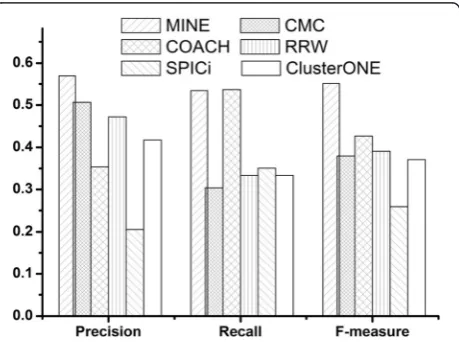
171.43, and 216.67 % higher than that of CMC, COACH, RRW, SPICi, and ClusterONE, respectively. Figure 5 shows the overall comparison in terms of precision, recall, and F-measure.
On DIP data, F-measure of MINE is 0.551, which is 45.05, 29.23, 41.02, 112.62, and 48.59 % higher than that of CMC, COACH, RRW, SPICi, and ClusterONE, respectively. Our MINE method can achieve the highest F-measure by providing the highest precision and the same highest recall as COACH, which shows that our method can predict protein complexes very good.
Functional enrichment analysis
Another evaluation measure is the function enrichment which measures the biological significance of predicted protein complexes by various algorithms. To substanti-ate the biological significance of our predicted com-plexes, we calculate their pvalues, which represent the probability of co-occurrence of proteins with common functions [27]. In this wok, we employ the tool BiNGO
Table 1The matching results of various algorithms
Algorithms PC Ncp Ncb Npcp
MINE 606 345 218 19
CMC 235 119 124 8
COACH 902 319 219 15
RRW 250 118 136 4
SPICi 574 118 143 7
ClusterONE 371 155 136 6
[40] to calculate p values for predicted complexes. BiNGO is a Java-based tool to determine which GO cat-egories are statistically overrepresented in a set of genes or a subgraph of a biological network. BiNGO is imple-mented as a plug-in for Cytoscape [41], which is an open-source bioinformatics software platform for visual-izing and integrating molecular interaction networks. A low pvalue of a predicted complex indicates that those proteins in the complex do not happen merely by chance, so the complex has high statistical significance. Generally, a complex is considered to be significant with pvalue <0.01. In addition, thep-score is also used as an effective evaluation measure, which is defined as
p‐score¼1nXn i¼1
−lgðp valueiÞjp valuei<0:01 ð10Þ
Table 2 lists comparative results of various algorithms based on GO annotation, where the best values are ita-lized. In Table 2, SC is the number of significant pre-dicted complexes. That is, their p values are less than 0.01. Our MINE method achieves the highest proportion of significantly predicted complexes and p-score values among all algorithms. The p-score of MINE is 12.16, 18.41, 32.08, 48.38, and 20.20 % higher than that of CMC, COACH, RRW, SPICi, and ClusterONE, respect-ively. In addition, Table 2 indicates that RRW gets the highest proportion of significant complexes, while achieves a lower p-score values than ClusterONE be-cause the pvalue of significant complexes predicted by ClusterONE are lower than RRW’s. These results suggest that the complexes predicted by MINE had the most biological significance.
Effect of parameters on prediction performance
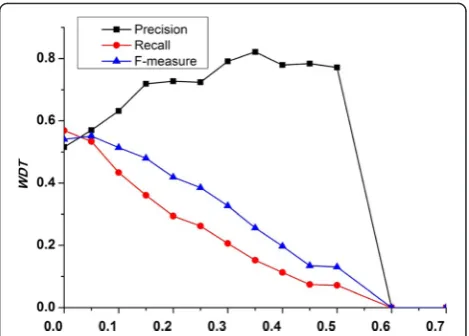
In MINE, we introduce a user-defined parameter WDT (weighted density threshold) to discover density sub-graphs with high cohesion to form candidate complexes. To investigate the effect of parameter WDT on perform-ance of MINE, we evaluate the prediction accuracy in terms of precision, recall, and F-measure by setting dif-ferent values of WDT, ranging from 0 to 1. Figure 6 shows that the performance of our method fluctuates
under various values of WDT. Figure 6 clearly indicates that MINE gets the best performance when WDT is assigned as 0.05.
Results using Krogan data
We also performed MINE method on the Krogan PPI network. The precision, recall, andF-measure of each al-gorithm based on Krogan data are shown in Fig. 7.
Figure 7 indicates that our method gets the best per-formance among all these methods in terms of precision, recall, andF-measure. The F-measure of our method is 0.5, which is 68.63, 33.52, 45.53, 69.71, and 47.73 % higher than that of CMC, COACH, RRW, SPICi, and ClusterONE, respectively.
Table 2The comparison of various methods in terms of
function enrichment
Algorithms PC SC Proportion (%) p-score
MINE 606 499 82.34 11.9
CMC 235 187 79.57 10.61
COACH 902 676 74.94 10.05
RRW 250 191 76.40 9.01
SPICi 574 262 45.64 8.02
ClusterONE 371 235 63.34 9.9
Fig. 6The effect of threshold WDT. It shows that the precision, recall, andF-measure of our method fluctuate under various values of WDT. MINE gets the best overall performance when WDT is assigned as 0.05
Conclusions
In this paper, we have constructed a multi-relationship protein interaction network (MPIN) by integrating PPI network topology with GO annotation information. For a pair of proteins in the MPIN, there exists more than one kind of interactions between them. To test the ef-fectiveness of the MPIN, we have developed a novel method named MINE to predict protein complexes. MINE first decomposes the MPIN into four single rela-tionship networks. Then, MINE visits four networks in turn for predicting protein complexes with high cohe-sion and low coupling. The results of experiments based on yeast PPI networks show that not only MINE achieves higher prediction accuracy than other existing methods but also majority of complexes predicted by MINE possess high biological significance. All results have proved that the constructed MPIN is useful for pre-dicting protein complexes.
Competing interests
The authors declare that they have no competing interests.
Authors’contributions
XYL and BHZ obtained the protein-protein interaction data, gene ontology annotation data, and protein complex data. XYL and BHZ designed the new method MINE and analyzed the results. XYL and BHZ drafted the manuscript together. JW, FXW, and YP participated in revising the draft. All authors have read and approved the manuscript.
Acknowledgements
This work is supported in part by the National Natural Science Foundation of China under Grant No. 61472133, No. 31560317, and No. 61428209 and the Program for New Century Excellent Talents in University under Grant NCET-12-0547.
Declarations
Publication of this article has been funded by the National Natural Science Foundation of China (No. 61472133).
This article has been published as part ofHuman GenomicsVolume 10 Supplement 2, 2016: From genes to systems genomics: human genomics. The full contents of the supplement are available online at http://humgenomics. biomedcentral.com/articles/supplements/volume-10-supplement-2.
Author details
1School of Information Science and Engineering, Central South University, Changsha 410083, China.2Department of Information and Computing Science, Changsha University, Changsha 410003, China.3Department of Mechanical Engineering and Division of Biomedical Engineering, University of Saskatchewan, Saskatoon, SK S7N 5A9, Canada.4Department of Computer Science, Georgia State University, Atlanta, GA 30302-4110, USA.
Published: 25 July 2016
References
1. Ito T, Chiba T, Ozawa R, Yoshida M, Hattori M, Sakaki Y. A comprehensive two-hybrid analysis to explore the yeast protein interactome. Proc Natl Acad Sci. 2001;98:4569–74.
2. Rigaut G, Shevchenko A, Rutz B, Wilm M, Mann M, Séraphin B. A generic protein purification method for protein complex characterization and proteome exploration. Nat Biotechnol. 1999;17:1030–2.
3. Ho Y, Gruhler A, Heilbut A, et al. Systematic identification of protein complexes in Saccharomyces cerevisiae by mass spectrometry. Nature. 2002;415:180–3.
4. Peng W, Li M, Chen L, and Wang L S. Predicting protein functions by using unbalanced random walk algorithm on three biological networks. IEEE/ACM
Transactions on Computational Biology and Bioinformatics. doi 10.1109/ TCBB.2015.2394314.
5. Li M, Lu Y, Niu Z B, Wu F X. United complex centrality for identification of essential proteins from PPI networks. IEEE/ACM Transactions on
Computational Biology and Bioinformatics. doi: 10.1109/TCBB.2015.2394487. 6. Li M, Lu Y, Wang JX, Wu FX, Pan Y. A topology potential-based method for identifying essential proteins from PPI networks. IEEE/ACM Trans Comput Biol Bioinform. 2015;12(2):372–83.
7. Ren J, Wang JX, Li M, Wu FX. Discovering essential proteins based on PPI network and protein complex. Int J Data Min Bioinform. 2015;12(1): 24–43.
8. Li M, Zheng RQ, Zhang HH, Wang JX, Pan Y. Effective identification of essential proteins based on priori knowledge, network topology and gene expressions. Methods. 2014;67(3):325–33.
9. Li M, Wang JX, Wang H, Pan Y. Identification of essential proteins from weighted protein interaction networks. J Bioinform Comput Biol. 2013;11(3): 1341002.
10. Wang JX, Li M, Wang H, Pan Y. Identification of essential proteins based on edge clustering coefficient. IEEE/ACM Trans Comput Biol Bioinform. 2012; 9(4):1070–80.
11. Tang Y, Li M, Wang JX, Pan Y, Wu FX. CytoNCA: a cytoscape plugin for centrality analysis and evaluation of biological networks. BioSystems. 2015;127:67–72.
12. Bader G, Hogue C. An automated method for finding molecular complexes in large protein interaction networks. BMC Bioinformatics. 2003;4:2. 13. Enright AJ, Dongen SV, Ouzounis CA. An efficient algorithm for large-scale
detection of protein families. Nucleic Acids Res. 2002;30:1575–84. 14. Shih YK, Parthasarathy S. Identifying functional modules in interaction
networks through overlapping Markov clustering. Bioinformatics. 2012;28:i473–9.
15. Liu G, Wong L, Chua HN. Complex discovery from weighted PPI networks. Bioinformatics. 2009;25:1891–7.
16. Macropol K, Can T, Singh AK. RRW: repeated random walks on genome-scale protein networks for local cluster discovery. BMC Bioinformatics. 2009;10:283.
17. Jiang P, Singh M. SPICi: a fast clustering algorithm for large biological networks. Bioinformatics. 2010;26:1105–11.
18. Wang JX, Li M, Chen JE, Pan Y. A fast hierarchical clustering algorithm for functional modules discovery in protein interaction networks. IEEE/ACM Trans Comput Biol Bioinform. 2011;8(3):607–20.
19. Li M, Wang JX, Chen JE, Cai Z, Chen G. Identifying the overlapping complexes in protein interaction networks. Int J Data Min Bioinform (IJDMB). 2010;4(1):91–108.
20. Li M, Chen J, Wang J, et al. Modifying the DPClus algorithm for identifying protein complexes based on new topological structures. BMC
Bioinformatics. 2008;9(1):398.
21. Nepusz T, Yu H, Paccanaro A. Detecting overlapping protein complexes in protein-protein interaction networks. Nature Methods. 2012;9:471–5. 22. Wang JX, Zhong JC, Chen G, et al. ClusterViz: a Cytoscape APP for clustering
analysis of biological network. IEEE/ACM Trans Comput Biol Bioinform. 2015; 12(4):815–22.
23. Gavin A, Aloy P, Grandi P, et al. Proteome survey reveals modularity of the yeast cell machinery. Nature. 2006;440:631–6.
24. Wu M, Li X, Kwoh CK, Ng S. A core-attachment based method to detect protein complexes in PPI networks. BMC Bioinformatics. 2009; 10:169.
25. Leung HC, Xiang Q, Yiu SM, Y CF. Predicting protein complexes from PPI data: a core-attachment approach. J Comput Biol.
2009;16:133–44.
26. Srihari S, Ning K, Leong HW. MCL-CAw: a refinement of MCL for detecting yeast complexes from weighted PPI networks by incorporating core-attachment structure. BMC Bioinformatics. 2010;11:504.
27. Zhao B, Wang J, Li M, et al. Detecting protein complexes based on uncertain graph model. IEEE/ACM Trans Comput Biol Bioinform. 2014;11: 486–97.
30. Tang X, Wang J, Liu B, et al. A comparison of the functional modules identified from time course and static PPI network data. BMC Bioinformatics. 2011;12(1):339.
31. Wang J, Peng X, Li M, et al. Construction and application of dynamic protein interaction network based on time course gene expression data. Proteomics. 2013;13:301–12.
32. Li M, Wu X, Wang J, et al. Towards the identification of protein complexes and functional modules by integrating PPI network and gene expression data. BMC Bioinformatics. 2012;13:109.
33. Li M, Chen W, Wang J, et al. Identifying dynamic protein complexes based on gene expression profiles and PPI networks. BioMed Res Int. 2014;2014 (375262):10.
34. Zhao J, Hu X, He T, et al. An edge-based protein complex identification algorithm with gene co-expression data. IEEE Trans Nanobioscience. 2014; 13:80–8.
35. Fan W, Yeung KH. Similarity between community structures of different online social networks and its impact on underlying community detection. Commun Nonlinear Sci Numer Simul. 2015;20:1015–25.
36. Zhao BH, Wang JX, Li M, et al. Prediction of essential proteins based on overlapping essential modules. IEEE Transactions on NanoBioscience. 2014;13:415–24.
37. Xenarios X et al. DIP: the database of interacting proteins. Nucleic Acids Res. 2000;28:289–91.
38. Krogan N et al. Global landscape of protein complexes in the yeast Saccharomyces cerevisiae. Nature. 2006;440:637–43.
39. Pu S, Wong J, Turner B, et al. Up-to-date catalogues of yeast protein complexes. Nucleic Acids Res. 2009;37:825–31.
40. Maere S, Heymans K, Kuiper M. BiNGO: a Cytoscape plugin to assess overrepresentation ontology categories in biological network. Bioinformatics. 2005;21:3448–9.
41. Shannon P et al. Cytoscape: a software environment for integrated models of biomolecular interaction networks. Genome Res. 2003;13:2498–504.
• We accept pre-submission inquiries
• Our selector tool helps you to find the most relevant journal
• We provide round the clock customer support
• Convenient online submission
• Thorough peer review
• Inclusion in PubMed and all major indexing services
• Maximum visibility for your research
Submit your manuscript at www.biomedcentral.com/submit