Abstract
Functional strategies are designed to achieve organizational business strategy and create competitive advantage. In a continuously changing business environment, functional strategies have to be implemented with precision, speed and by maximizing resource productivity.Many researchers argue that, with a simple probability assumption, a strategy may not succeed in 75% of cases. Implementation is the difficult step in the strategy management. Key factors that impact the strategy implementation are leadership, communication, organization structure and culture. Most of the documented tools and methods of strategy management mainly focus on the strategy formulation. This paper explains about the usage of KANBAN boards for strategy implementation at functional level and how it can positively contribute to the key success factors of implementation with an experimental study.
Introduction
Successful execution is a key step in strategy management. Many organizations could not maintain their competitive advantages, in spite of the existing process of drafting a strong strategy, due to lack of achievement in the implementation stage. Leaders and top management of organizations need to pay more attention to strategy implementation due to the higher failure rates that occur at this stage. (Abdullah H. Alharthy et al., 2017) Literature reviews show that the implementation aspects have been overlooked and most of the research had been carried out in the formulation of strategy (Abdullah, Patrick and Hamad 2016).
The implementation of the strategy happens at multiple levels and functional strategy implementation is the lowest level of strategy implementation. While strategy deployment methods may have to be improved in all levels of organization, this paper in particular, details the functional strategy implementation using digitized KANBAN methodology.
Functional Strategy Implementation
-Experimental Study on Agile KANBAN
– Vasu Padmanabhan*
Literature Survey and Discussions
Literature study was done from four aspects: a) The levels of strategy management b) Tools / Methods used for strategy implementation c) Factors affecting strategy implementation d) The success / failure of strategy implementation.
a. Levels of strategy management: The process of strategy formulation, implementation and evaluation is critical to any organization. The steps of strategy management process may vary. However, the environmental appraisal, strategy formulation, strategy implementation and measuring the outcomes are quoted by many authors as key strategy steps (Jofre, Sergio, 2011). While the formal strategic management process is parsimoniously accepted in four sequential steps, the strategies are analyzed in three distinct levels: Corporate Level, Business Level and Functional Level.
At the highest level of function and structure, corporate strategies regard broad decisions about the scope, direction and position of the organization in the long-term. In general, this level of strategy formulation defines the organizational growth objectives and the actions to achieve them. Vertical integration, Horizontal integration, Strategic alliances, mergers and acquisitions are some examples of corporate strategies.
The formulation of strategies at the business level instead, broadly focuses on competition. At this level, the main objective is to develop and sustain competitiveness in all the lines of business the organization has decided to participate in (Reuben Maino Daniel, 2015). The key focus is crafting responses to market circumstances and initiating actions to strengthen market position, building competitive advantage and developing strong competitive capabilities. This level of strategy is for the manager in charge of the business (Julius Tapera, 2014).
The formulation of strategies at the functional level (commonly but erroneously restricted to the term 'operational strategies') focuses on tactical goals & actions (commonly plans) to support the implementation of corporate and business strategies.Although each functional unit commonly have a certain degree of independence over strategic choices, each functional strategy must be aligned with the general long-term strategy of the firm. They will commonly regard functional aspects of strategic relevance such as productivity, pricing, logistics, cost-effectiveness, efficiency, product design, product branding and image, product-life cycle, etc.
Many empirical studies have been conducted to analyze the various tools used for strategy management. According to Darrell Rigby and Bilodeau, 2015, regional variation in tool use is significant. China and India used the highest average number of tools in 2014 (8.0) compared with North America (7.2), Europe (6.6) and Latin America (6.2). In terms of sectors, the industries with the highest tool use are transportation and tourism, manufacturing and technology and telecommunications. According to Tassabehji and Isherwood, 2014, the top 10 tools used are : SWOT analysis, Financial forecasting, Vision and mission statements, Scenario planning, Value chain analysis, Porter's five forces analysis, PEST, BCG matrix, ANSOFF analysis, BOS and Game theory. However Darrell Rigby and Bilodeau (2015), differ with another top 10 list: CRM, Benchmarking, Employee engagement surveys, Strategic planning, Outsourcing, Balanced scorecard, Vision and mission statements, SCM, Change management and Customer segmentation. Most of the tools are analyzing data and developing strategic goals and imperatives. From the strategy implementation point of view, a set of required interventions are identified towards developing the Implementation Plan through value stream map or structured brainstorming. The implementation plan is a collection of Programs that will take a year or more to complete or project that can be completed in typically 1 to 12 months or Kaizen Event (taking 2 to 5 days) or "JDI" (Just Do It) that can be corrected immediately.
Another technique called Hoshin Kanri is animplementation method originally developed in Toyota that aims to integrate the company's strategy work and core activities as manufacturing and product development. Hoshin Kanri is widely adopted in Japanese companies but less spread in Western companies. Even though a few companies in the West that have applied Hoshin Kanri have won many reputable awards, Hoshin Kanri has not gained widespread popularity (Tennant and Roberts (2001), Maschek, Thomas & Thurer, Matthias & Deuse, Jochen (2013), Witcher, Barry & Chau, Vinh (2007)).
The second aspect of the factor influencing strategy implementation is Organizational culture. Functional strategy implementation is positively influenced by organizational culture along the dimensions of learning and development, participative decision making, power sharing, support and collaboration and tolerance for risks and conflicts,which all form part of an organization's cultural environment.
The third aspect of the factors influencing strategy implementation is organizational structure. Many studies have established the link between organizational strategy and structure by pointing out that one of the challenges in strategy implementation is weak coordination of activities.
Table 1: Factors Impacting Strategy Implementation
Factor Impact Factor Impact
Organization culture 28% Leadership 37%
Systems 9% Organizational
structure 26%
d. State of strategy Implementation:The strategy formulation is prone to the wrong identification of internal and external factors. Even if developed correctly, a strategy is not considered effective until it is implemented and creates value for its organization.
Mas Bambang Baroto, Nader Arvand, Fauziah Sh. Ahmad (2014) point out that, with a simple probability assumption, a strategy may not succeed in 75% of cases. The high percentage of strategy failures is contended by others (Cândido, C.J.F. and S.P. Santos 2015) stating this percentage has decreased in the last two decades and the failures are very context specific.
Mas Bambang et al. (2014) further state from reviews that the problem often occurs during the implementation. The challenging nature of the strategy implementation is studied by few researchers
• 66% of corporate strategies are never implemented
• 95% of staff do not realize their organization's strategy
• Only 63% of financial objectives envisioned by companies' strategies are achieved
• Consequences show that 70 to 90 percent of organizations fail to realize the success of implementing their strategies
• Strategies most often fail due to ineffective execution
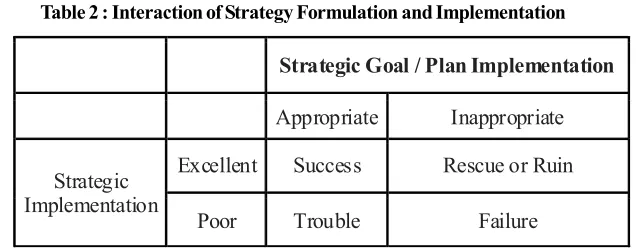
Table 2 : Interaction of Strategy Formulation and Implementation
Strategic Goal / Plan Implementation
Appropriate Inappropriate
Strategic Implementation
Excellent Success Rescue or Ruin
Poor Trouble Failure
It is also important to understand what the typical causes of failure in strategy implementation are. Valentina Ivan?i?, mag.oec. 2013, quotes from the personal work done, many causes of strategy implementation failures in the areas of time management, organizational structure, organizational culture, resources, leadership and uncontrollable external factors. Some of the causes meaningful to this paper's context:
• Took more time than originally allocated; Inconsistencies in translating long range plans into short term objectives
• Lack in communication, coordination, monitoring and incentive systems
• Activities and tasks not sufficiently defined (inefficient operation planning)
• Poor coordination across functions or divisions
• Lack in measuring performance
• Too few people involved in implementation
• Leaders consider their job is done when they finished with the planning
• Implementation tasks and activities not defined thoroughly detailed
Discussion
From the above review, the following aspects were derived:
• In Strategy Management, the implementation is the most difficult stage
• The distinction of Corporate, business and functional aspects of strategy formulation and implementation is prevalent and seen as critical to organizational success, specifically in large scale organizations
• The leadership, organizational culture and structure are the key factors that impact the strategy implementation
• The tools and methods focus mainly on strategy formation. Both for the implementation tools set and methods, the research and literature are limited; typically the project management and balance score cards are used to deploy the strategic actions and monitor the impact of actions on the goals. Hosin Kari is used in Japan and in limited fashion in other geographies
• Significant number of strategies are poorly executed. Since the strategy formulation is continuously improved, it is also important to tune the implementation plans
• For successful implementation of strategies, goal alignment between various levels of strategy management, strategy communication, employee buy-in, learning and development, participative decision making, power sharing, support and collaboration and tolerance for risks and conflicts are some of key success factors
• Research and literature is further required for tools, systems and methods that will increase the success rate of strategy implementation
• Kanban (literally signboard or billboard in Chinese and Japanese) is a scheduling system for lean manufacturing and just-in-time manufacturing (JIT). Kanban is an inventory-control system to control the supply chain. Taiichi Ohno, an industrial engineer at Toyota, developed kanban to improve manufacturing efficiency. Much of research on Kanban is in manufacturing area. (Sumitkumar Singh et al., 2017). Recently Kanban is applied in Software development and services. According to Anderson, David J. et.al, Kanban is a method for defining, managing, and improving services that deliver knowledge work, such as professional services, creative endeavors, and the design of both physical and software products. It may be characterized as a "start from what you do now" method - a catalyst for rapid and focused change within organizations - that reduces resistance to beneficial change in line with the organization's goals. No literature could be found in Kanban's use in strategy implementation.
About Current Study
This paper provides an experimental case study on the functional strategy implementation using a digitized Kanban board. The practices around the Kanban based functional strategy implementation is tuned for addressing the issues such as communication, collaboration, manager buy-in, action privatization, continuous tuning and maximizing efficiency of the teams.
The quality function ensures the project processes are derived from organizational processes for the given project type and provides status visibility to the management. The organization hasdefined strategic goals and corresponding functional goals. One of the goalsis considered for this discussion and given below.
The top priority organizational strategic goals for the given year are
Corporate Goal: Build excellence in delivery by reducing high severity project issues to near zero when the scale of delivery in terms of number of projects, the size, the type and geographical spread is expanded further to meet the revenue targets of the organization.
The aligned strategic goals of the quality function: Bring project status visibility through open and digitally enabled communication & reporting to all levels of management to address the risks and issues on delivery in time.
Key Performance measures at functional level: Eliminate the instances of projects with schedule or cost slippage, poor quality of deliverables (in testing or deployment) and missed service levels that will have an impact for the customers
Experimental Research Setup
The Strategic goal implementation through the Kanban system is set up with the following key steps:
1. The strategic actions are identified through various techniques such as SWOT analysis, business and organizational strategies. Set of yearly business plan meetings are conducted with the functional leadership team both at business units and corporate level to get the buy-in. The communication is kept open through the short messaging system and mails.
2. The business plan is prepared by the corporate functional team at the first instance and the Kanban Board is prepared on that basis.
3. A web based Kanban system is established with the functional team as user set. A customized Kanboard is used for this experimental study. (Kanboard is an open source software running in Apache, PHP and PostgreSQL database, distributed under the permissive MIT License. The software is mainly developed by Frédéric Guillot. The software website is https://kanboard.org/)
4. Each of the strategic goals is developed with a Kanban Board (aka Program) and run-the-function activities (day-to-day to keep the operations running) of the team is created with sub team level Kanban Boards
6. The tasks for a given action and the team specific assignments are elaborated in the tiles by assignees. The actions move across lanes from design through implementation to completion as it progresses and is updated by the assignees
7. Thumb rules are fixed (for example, effort ratio of strategic actions vs run-the-function activities) for balancing activities as well as maximizing the outcomes. The team works with the Kanban boards on a regular basis with the progress percentage and effort spent
8. The weekly team meeting along with the functional head covers the progress, intra team collaboration and addressing of impediments
9. Through continuous strategic analysis, more strategic actions are added to the backlog
10. Through performance measurements, the number of projects having high severityissues, high exposure residual risks are measured, to find the impact of the strategic actions on the achievement of the goal.
Research Design
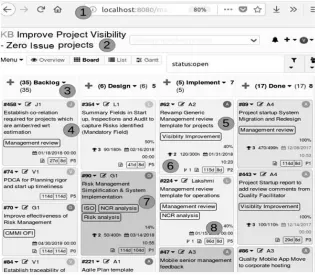
The features of the Kanban Board for functional strategy implementation is illustrated (FIGURE 1) in the following picture with blue circled indicators,
1. ->Web based and hence can be viewed in any browser and used by all the team leads and members.
2. ->Each board is a program. Here the example is for the strategic functional goal
3. -> Tiles are actions and arranged by Lanes; actions move across lanes.
4., 5. -> Each action described in tiles has / expected to have a direct impact on the achievement of goals. These actions are expected to be closed in 3-6 months of time. Actions are further broken down to tasks for assignment and tracking. The Work-in-progress limitations are manually managed by analyzing the number of actions handled by any person. The actions are not expected to have uniform rate of load or progress, as many unknowns hit the way of progress.
6., 7., 8. -> The board provides capability to prioritize actions; date lines can be maintained. The tile color changes automatically if the action slips
Results and Discussions
The Kanban board is implemented with a pilot and full implementation for one year and a survey is done with the functional leads on the effectiveness of the method on strategy implementation. Also the results from the implementation database are analyzed. In general, all factors that contribute to success of strategy is positively influenced by flow based and open management system as Kanban board
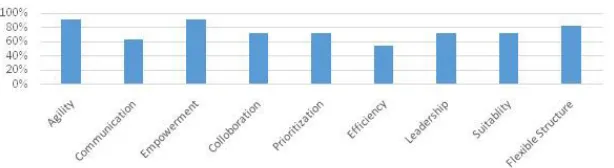
Figure 2: Summary of Survey Results
1. An overwhelming 91% of the participants are seeing that Kanban is one of the best agile mechanisms to track the actions (both strategic and run-the-function) in a seamless way. They also feel empowered due to the full visibility of backlog and the ability to pull the actions to design stage by themselves
2. 38% of the respondents still feel that the goal fulfillment cannot be tracked by simple Kanban Board without bringing the performance measures into the board
4. 72% of the respondents feel that internal team collaboration, ability to prioritize the tasks, leadership support to remove impediments have improved. "No one wants to see a red item in their bucket" drives actions
5. 28% of the respondents feel that there are still improvements to be done such as the ability to see full Gantt for large set of actions and executive dashboards that are essential for using the Kanban for business strategy management
6. 81% of the respondents are in favor of Kanban board's capability to have a flexible team structure that accommodates quick changes to actions and goals. The team structure is also maintained as a Kanban board
7. The impact of the completion of strategic actions on the performance target of the strategic goals is measurable. For example over six months of implementation, a reduction of 20% in the projects having high severity issue(s) was noticed
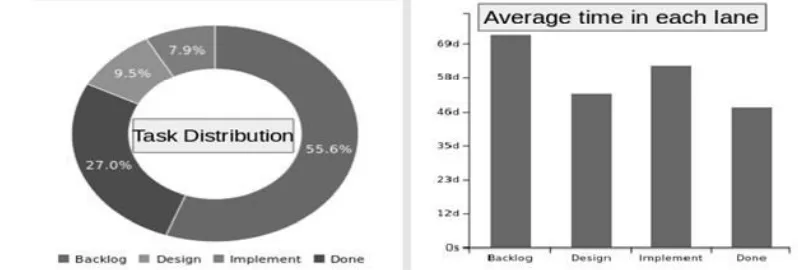
8. The flow of the actions become evident as the time spent on various lanes are more or less uniform as seen in the graph below (FIGURE 3)
9. At least twice the actions which are in design or implementation may be required to keep a good backlog allowing to choose the alternate actions based on the team's capability and priority
Figure 3: Sample Analytics on Ensuring the Effective Implementation of the Kanban
As part of computing the cost of a goal the following formula can be used to compute the ROI and NPV values. The board can be augmented to provide the effort spent on the goals on each day.
Net Present Value = Cumulative Discounted tax adjusted cash flow over time of benefit realization - Cost of effort spent on the goal - Cost of non-human capital spent
Conclusions and Further Study
The literature survey clearly indicates the need to improve implementation methods for a higher success rate of strategy. The functional strategy is aligned to corporate and business strategies and implemented as a set of supporting goals. The experimental set of Kanban boards for functional strategy implementation is aimed at bringing participative leadership to strategic implementation with high level of collaboration.
The Kanban system provides a good visibility to the status of strategic actions through multiple boards, color codes, lanes and resource level reports. It is able to increase the team coordination and collaboration. The waiting times for actions are reduced.
Further study can be done on the applicability of Kanban board for business strategy implementation and in association with tweet like communication systems.The automated feed on the real time performance measures can support continuous measurement to achieve departmental goals or business goals or both.
References
1. Abdullah H. Alharthy,Hamad Rashid,Romano Pagliari, Faisal Khan, (2017), Identification of Strategy Implementation Influencing Factors and Their Effects on the Performance, International Journal of Business and Social Science Vol. 8, No. 1
2. Abdullah H. Alharthy, Patrick McLaughlin, Hamad Rashid, (2016). A comprehensive literature review on the strategy planning, and implementation in large service industry and cultural effects on strategy implementation in Middle East region, The European Business & Management Conference
3. Albana Berisha Qehaja, Enver Kutllovci, Justina Shiroka Pula (2017) Strategic Management Tools and Techniques: A Comparative Analysis of Empirical Studies. Croatian Economic Survey : Vol. 19 : No. 1
4. Cândido, C.J.F. and S.P. Santos, (2015). Strategy implementation: What is the failure rate? Journal of Management & Organization, 21(2), 237-262. DOI: http://dx.doi.org/10.1017/jmo.2014.77
5. Darrell Rigby, Barbara Bilodeau (2015), Management Tools & Trends, Bain & Company
6. Dr. James Rajasekaran, (2014) Factors affecting Effective Strategy Implementation in a Service Industry: A Study of Electricity Distribution Companies in the Sultanate of Oman, International Journal of Business and Social Science Vol. 5, No. 9(1);
7. Julius Tapera, (2014) The Importance of Strategic Management to Business Organizations, www.theinternationaljournal.org > RJSSM: Volume: 03, Number: 11,
8. Jofre, S, 2011 Strategic Management: The theory and practice of strategy in (business) organizations. Kgs. Lyngby: DTU Management
10. Reuben Maino Daniel, (2015). ASIAN JOURNAL OF MANAGEMENT RESEARCH, Revisiting the strategic management process through the levels of strategy analysis Volume 6 Issue 1
11. Stenfors et al., (2007) , Executive views concerning decision support tools, European Journal of Operational Research , 181(2): 929 - 938.
12. Sumitkumar Singh, Ronak Soni. Shriyansh Singh, Swapnil Patil, Manojkumar pal, (2017) A REVIEW ON PRODUCTIVITY IMPROVEMENT OF PROCESS INDUSTRIES BY LEAN MANUFACTURING TOOL, International Journal of Scientific & Engineering Research, Volume 8, Issue 4, ISSN 2229-551)
13. Tassabehji R and Isherwood A (2014) Management Use of Strategic Tools for Innovating During Turbulent Times. Strategic Change. 23(1-2): 63-80.
14. Tennant, C. and P. Roberts (2001). Hoshin Kanri: a tool for strategic policy deployment.Knowledge and Process Management, Vol. 8, No. 4 , pp. 262-269.
15. Valentina Ivan?i?, mag.oec. (2013), 1THE BIGGEST FAILURES IN MANAGING STRATEGY IMPLEMENTATION , Social Science Research Network