e-ISSN: 2278-067X, p-ISSN: 2278-800X, www.ijerd.com
Volume 12, Issue 8 (August 2016), PP.15-21
Influence of Math Comprehension Skills to the Problem Solving
Performance in Solid Mensuration among Freshmen Students of
Naval State University
Analiza Borongan- Calles
College Of Industrial, Information, And Communications Technology Naval State University, Naval, Biliran Province
Abstract:
The study was conducted to determine the influence of math comprehension skills to the problem-solving performance in Solid Mensuration among freshmen students of Naval State University. The study used a researcher-made questionnaire. The questionnaire was administered to 50 student-respondents in their Solid Mensuration class. From the gathered data, frequency count and percentage distribution were used to analyze the students’ profile, their level of performance in Math, their comprehension ability and Solid Mensuration performance. Female students dominated the student population of the Bachelor of Science in Information Management (BSIM) of Naval State University. All of the respondents graduated from the public high schools. The grades in Math 115 and Math 122 of the respondents fell under the grade level of 1.6 to 2.0. The grades of the respondents in English fell under the grade level of 1.6 to 2.0. The time spent by students in studying Solid Mensuration was less than an hour and found to be insufficient to harness the skills desired in the subject. Majority of the respondents spent less than an hour in reading and studying English and found to be very insufficient to improve their comprehension skills in Mathematics. Most of the respondents achieved “fair” performance in Math comprehension test and also “fair” performance in Solid Mensuration. In the test of relationship between the student’s profile and their Math comprehension skill only the time spent by students in reading and studying in English was significant to their Math comprehension skills. The results showed that there was no significant relationship on the student’s profile to their Solid Mensuration performance. There was a significant relationship of the students’ Math comprehensions skill to their Solid Mensuration performance.Keyterms:
Comprehension Skills; Performance in Mathematics; Problem Solving.I.
INTRODUCTION
Mathematics is an essential discipline because of its practical role to individual and society. Through problem solving approach this aspect can be developed.
Problem-solving is the foundation of all mathematical activity (Lambdin, Smith & Suydam, 2001). It is an integral part of Mathematics. Many researchers asserted that problem solving is the main reason in studying Mathematics. It is a skill which enhances logical thinking and stimulates the interest and enthusiasm of students in Mathematics. Moreover, problem-solving approach can provide a vehicle for students to construct their own ideas about Mathematics and to take responsibility of their own learning.
Resnick (1987) stressed that such an approach contributes to the practical use of Mathematics by helping people to develop the facility to be adaptable when technology breaks down. He added that school should focus its efforts on preparing people to be adaptive learners, so that they can perform effectively when situations are unpredictable and task demands change.
The National Council for Teachers of Mathematics (NCTM,1989) recommended that problem-solving be the focus of Mathematics teaching because it encompasses skills and functions which are important part of everyday life. Thus, problem-solving performance is very important to be sharpened because it practically applies to any aspects of individual’s life. The principles of problem solving performance can be applied to everyday life to make a better decision about common problems.
In a large extent, students encounter shortcomings in constructing a mental presentation of the underlying mathematical situation, the use of appropriate solving method and arriving at a correct answer. Likewise, they are slow and, at times, even unable to discriminate between irrelevant and relevant information in word problems.
Language proficiency and mathematical skill must be coupled together to attain a good problem solving performance of the students. Thus, students must have better comprehension skills in mathematical text since this is a vital component in problem-solving and serves as the basis for better acquisition of mathematical knowledge which ensures successful solution to the task.
Talamayan (2000) stressed that reading comprehension has been a perennial problem among teachers for this could affect other academic performance in the other field of discipline. Mathematical ability is vital component also in assessing the problem solving performance of students. It is a skill being able to manipulate the different operations in Mathematics.
Comprehension skills are the ability to use context and prior knowledge to aid reading and to make sense of what one reads and hears. Effective reading comprehension is the culmination of mastering vocabulary, phonics, fluency, and reading comprehension skills. Persons having good comprehension skill are considered as active reader, with an ability to interact with the words by understanding its complete meaning and the concept behind it. In contrast, a passive reader is someone who just read the text without getting its meaning.
The researcher, being a Mathematics teacher at Naval State University, has the first-hand experience through her class that students have poor performance if mathematical concepts are associated with problem-solving in most Mathematics subjects, particularly in Solid Mensuration. Students’ complexity in Mathematics rest mainly on comprehension, construction, and analysis of mathematical text in word problems and using correct mathematical operations.
The learning condition of the students pushed the researcher to pursue this study in order to provide solid and strong bases by generating authentic data and information on whether students’ comprehension skills and abilities had the influence on their performance in Solid Mensuration. Hence, this study would fill-in the gap towards improving and increasing comprehension skills among students.
Objectives Of The Study
The main objective of the study was to investigate the influence of comprehension skills on the problem-solving performance in Solid Mensuration (Math 123) among freshmen students of Naval State University, Naval, Biliran.
Specifically, this sought to address the following objectives:
1. Determine the profile of the BS Information Management students at Naval State University in terms of: gender; High school graduated; Grade in Math subjects taken; Grade in English subject taken; Time spent in studying solid mensuration; and Time spent in reading and studying English
2. Find out the Math comprehension skills of the students;
3. Determine the performance level of the students in Solid Mensuration; 4. Find out whether significant relationships exist between:
4.1 Students’ profile and comprehension ability;
4.2 Students’ profile and Solid Mensuration performance; and 4.3 Students’ Math comprehension skills and Solid Mensuration performance.
Framework Of The Study
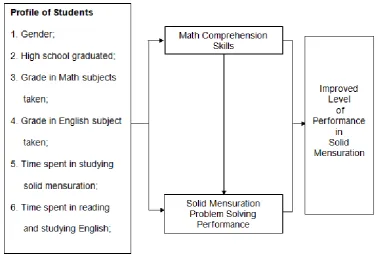
The study focused on determining whether there is an influence of math comprehension skills to the problem solving performance among freshmen students in BS Information Management. The problem-solving performance of students in Solid Mensuration is taken into consideration from students’ personal profile in terms of gender, high school graduated, grade in Math subjects taken, grade in English subject taken, time spent in studying Solid Mensuration and time spent in reading and studying English and math comprehension skills. Proper management of the independent variables should improve students’ strategy in problem-solving performance in Solid Mensuration.
The math comprehension skills and Solid Mensuration problem solving performance of the BS Information Management students were taken from the test conducted through a questionnaire prepared by the researcher. The instrument comprised three parts, namely; the profile of students, math comprehension test and Solid Mensuration problem-solving performance.
Figure 2. Conceptual Framework of the Study
Scope And Delimitation Of The Study
This study was mainly concerned on the problem-solving performance of the freshmen BSIM students of Naval State University in Solid Mensuration. Only one section of the course/program was included. The study focused on the influence of comprehension skills to the problem-solving performance of students. The researcher sought to find answers on the factors influencing the problem-solving performance of the students in the subject and eventually determined the level of difficulty they had encountered in their studies. The parameters measured in the study were limited to the students’ profile, math comprehension skill and the Solid Mensuration performance. There were only fifty (50) students taken as respondents, and the study was conducted for the school year 2009-2010.
II.
METHODOLOGY
This study used the descriptive survey method of research. The researcher used a survey questionnaire for the personal profile of the students. Math comprehension and Solid Mensuration tests were given to students to get the performance scores. The study was conducted at the College of Technology, Naval State University, Naval, Biliran where the fifty (50) freshmen BSIM students taking Solid Mensuration (Math 123) belonged. Purposive sampling was done since all of the students were included in the study. The main instrument used in this study was a researcher-made questionnaire. Statistical Treatment of the Data were percentage, frequency, total number of cases, Chi –Square and Pearson Product-Moment Coefficient of Correlation were employed.
III.
RESULTS AND DISCUSSION
This chapter presents, analyzes and interprets the data gathered from the responses of fifty (50) freshmen BS Information Management students who served as respondents of this study. The first part covered the profile of the respondents. The second part focused on the level of performance of the respondents in math comprehension skill and problem-solving performance in Solid Mensuration. The last part dealt with the relationship between students’ profile and math comprehension skills, students’ profile and Solid Mensuration performance, and math comprehension skills and Solid Mensuration performance.
High school graduated from. This is categorized as private high school and public high school. The preceding table shows that (50) or 100 percent of the respondents are products from different public high schools in the region while no respondent was from private institution. This indicates that all of the respondents took their secondary education in public high school.
Table1. Profile of the Students
Variables f %
Sex Male Female Total 12 38 50 28 76 100
High School Graduated
Private Public Total 0 50 50 0 50 100
Grades in Math 115
1.0 - 1.5 1.6 - 2.0 2.1 - 2.5 2.6 - 3.0 Total 1 26 19 4 50 2 52 38 8 100
Grades Math 122
1.0 - 1.5 1.6 - 2.0 2.1 - 2.5 2.6 - 3.0 Total 1 23 21 5 50 2 46 42 10 100
Grades in English subject taken
1.0 - 1.5 1.6 - 2.0 2.1 - 2.5 2.6 - 3.0 Total 12 36 1 1 50 24 72 2 2 100
Time spent in studying in Solid Mensuration
0.5 1.0 2.0 3.0 Total 21 22 4 3 50 42 44 8 6 100
Time spent in reading and studying English
0.5 1.0 2.0 3.0 Total 24 21 3 2 50 48 42 6 4 100
Grades in math subjects taken. This is categorized as 1.0–1.5, 1.6–2.0, 2.1–2.5, 2.6–3.0. Looking at the table, most of the respondents of 26 or 52 percent taking Math 115 attained a grade level of 1.6 to 2.0. This is followed by 19 or 38 percent of the respondents who attained a grade level of 2.1 to 2.5. Only four (4) or 8 percent of the respondents claimed to have a grade level of 2.6–3.0. One of the respondents or 2 percent got a grade level of 1.0 to 1.5. This implies that majority of the respondents have grades in Math 115 with the grade level of 1.6 to 2.0.
Referring to the same table, most of the respondents, 23 or 46 percent, who took Math 122 claimed to have attained a grade level of 1.6 to 2.0. This was followed by 21 or 42 percent who attained grade level of 2.1 to 2.5. Only five (5) or 10 percent of the respondents got grade level of 2.6–3.0. Only one of the respondents or (2%) got a grade within the range of 1.0 to 1.5. This implies that majority of the respondents have grades in Math 122 with the grade level of 1.6 to 2.0.
Grades in English subject taken. This is categorized as 1.0–1.5, 1.6–2.0, 2.1–2.5, 2.6–3.0. As reflected in the table, (36) or 72 percent of the respondents claimed that their grades in English 111 are in the range of 1.6 to 2.0. Twelve of the respondents (24%) claimed to have a grade level of 1.0 to 1.5. On the grade levels of 2.1 to 2.5 and 2.6 to 3.0, respondents have an identical frequency of 1 or 2 percent. This implies that majority of the respondents have grades in English 111 with the grade level of 1.6 to 2.0.
of the respondents claimed to have spent 3 hours in studying Solid Mensuration. This would mean that the respondents spent less than an hour in studying Solid Mensuration.
Time spent in reading and studying English. This is categorized as 0.50, 1, 2, 3. As observed in the table, 24 or 48 percent of the respondents claimed to have spent half an hour in reading and studying English. Twenty-two or 42 percent of the respondents spent 1 hour in reading and studying English. There were three or 6 percent of the respondents who claimed to have 2 hours spent in reading and studying English. Only two or 4 % of the respondents spent 3 hours in reading and studying English. This implies that majority of the respondents spent only half an hour in reading and studying English.
Level of Performance of Respondents in Math Comprehension skill and Solid Mensuration
Performance in Math comprehension skill. Math comprehension skill is the ability of the student to understand mathematical concepts that are embedded in the problem text. There were 20 items test used to determine the math comprehension skills of the respondents. This is categorized as 20, 15–19, 10–14, 5–9, 0–4 category. This is presented in Table 2.
Table 2. Math Comprehension Skills of the Respondents
It can be gleaned on the table that 24 or 48 percent of the respondents attained a “fair” performance in math comprehension skills. This is followed by 20 or 40 percent of the respondents who got a “good” performance in math comprehension skills test. Five respondents (10%) attained a “fair” performance and only one respondent (2%) got a very “good” performance in math comprehension ability. This finding implies that respondents have a “fair” performance in comprehension ability.
Performancein Solid Mensuration. Solid Mensuration performance of the respondents was determined by giving them a 10 item test which comprised word problems in quadrilaterals. This is categorized as 10, 8–9, 6–7, 3–5, 0–2 category. This is presented in Table 3.
As revealed in the table, 24 or 48 percent of the respondents got a “ fair ” performance in solid mensuration. Seventeen (34%) of the respondents attained a “poor” performance in solid mensuration. Eight of the respondents (16%) attained a “good” performance in Solid Mensuration. Only one got a “very good” performance in the subject. This implies that most of the respondents have a “fair” performance in Solid Mensuration.
Table 3. Solid Mensuration Performance of the Respondents
Relationships Between Variables
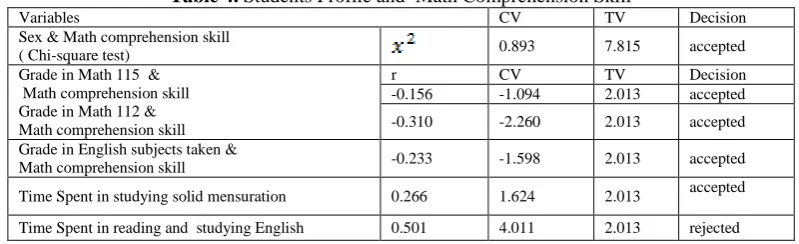
Students’ profile and Math comprehension skill. The profile of the students was correlated to the math comprehension skill using the Pearson moment coefficient of correlation except the gender which was treated with a Chi –square test. To test the significance of each variable in the profile of the respondents to the math comprehension skills, t-test was used. This is presented in Table 4. As reflected in the table, using the determined statistical tool, the variable time spent in reading and studying English to the math comprehension skills indicates a moderate correlation at a significant at 0.05 level of significance. The null hypothesis that “no significant correlation of the time spent in reading and studying English to the math comprehension skills” is rejected. Therefore, there is significant relationship that exists between the student’s time in reading and studying English to the Math comprehension skill. This implies that more time spent in reading and studying English will improve their math comprehension skills.
Score Description f %
20 Excellent 0 0
15 – 19 Very Good 1 2
10 – 14 Good 20 40
5 - 9 Fair 24 48
0 – 4 Poor 5 10
Total 50 100
Score Description f %
10 Excellent 0 0
8 – 9 Very Good 1 2
6 – 7 Good 8 16
3 – 5 Fair 24 48
0 – 2 Poor 17 34
Table 4. Students Profile and Math Comprehension Skill
Variables CV TV Decision
Sex & Math comprehension skill
( Chi-square test) 0.893 7.815 accepted
Grade in Math 115 & Math comprehension skill Grade in Math 112 & Math comprehension skill
r CV TV Decision
-0.156 -1.094 2.013 accepted
-0.310 -2.260 2.013 accepted
Grade in English subjects taken &
Math comprehension skill -0.233 -1.598 2.013 accepted
Time Spent in studying solid mensuration 0.266 1.624 2.013 accepted
Time Spent in reading and studying English 0.501 4.011 2.013 rejected
Students’ profile and Solid Mensuration. The profile of the students was correlated to the Solid Mensuration performance using the Pearson moment coefficient of correlation except the gender which was treated with a Chi –square test. To test the significance of each variable in the profile of the respondents to the Solid Mensuration performance, the t- test was used. This is presented in Table 5. As revealed in the table, using the determined statistical tool, the null hypotheses that “the students’ profile has no significant correlation to the Solid Mensuration performance” is accepted. Therefore, there is no significant relationship that exists between the student’s profile to the solid mensuration performance.
Table 5. Student’s Profile and Solid Mensuration Performance
Relationship between Math comprehension skills and Solid Mensuration performance. Math comprehension skill is correlated to the Solid Mensuration performance. This is presented in Table 6.
Table 6. Relationship between Math Comprehension Skills and Solid Mensuration Performance
Variable r CV TV Decision
Math Comprehension Skill & Solid Mensuration
Performance 0.317 2.316 2.013 rejected
As reflected in the table, r value of 0.317 at 0.05 level of significance indicates a low correlation between math comprehension skills and solid mensuration performance. Computed value of t which is 2.316 is greater than the tabular value of 2.013 .This indicates that there is significant relationship of the math comprehension skills to the student’s performance in Solid Mensuration.
CONCLUSIONS
Based on the findings, the following conclusions were drawn: Majority of the respondents are female since BS Information Management is a female-dominated course. All of the respondents come from public high schools. Grades in Mathematics subjects taken by the respondents are very satisfactory. Grades in English subjects taken by the respondents are very satisfactory, indicating that they have a good performance and also improved their communication and comprehension skills. The time spent by the students in studying Solid Mensuration is less than an hour which is insufficient to master all the mathematical concepts, systematic steps in solving word problem and fundamental operations; thus, showing that majority of them have poor study habits. The time spent by the students in reading and studying in English is less than an hour which is very insufficient to improve their math comprehension skills. The performance in math comprehension skills of the respondents reveals that they have difficulty decoding the meaning of the printed words into appropriate mathematical concepts. The level of performance in Solid Mensuration of the respondents indicates a poor
Variables CV TV Decision
Sex & Math comprehension skill
( Chi-square test) 3.214 7.815 accepted
Grade in Math 115 & Math comprehension skill Grade in Math 112 & Math comprehension skill
r CV TV Decision
-0.070 -0.486 2.013 accepted
-0.278 -1.933 2.013 accepted
Grade in English subjects taken &
Math comprehension skill -0.099 -0.689 2.013 accepted
Time spent in studying Solid mensuration 0.261 1.873 2.013 accepted
performance since they have the difficulty in applying the systematic ways in solving problem and using appropriate formulas. The time spent by the students in reading and studying English is significantly related to their math comprehension skills. The profile of the students is not significantly related to the Solid Mensuration performance. The math comprehension skill strongly influences the Solid Mensuration performance of the students.
RECOMMENDATIONS
Based on the findings and conclusions of the study, the following recommendations were made: Students should take into consideration the usefulness and effectiveness of reading materials for them to develop their comprehension skills since it is a basis to attain a better understanding on the context of what they read, which is the great step in bridging the gap on their ability to solve word problems by decoding text into mathematical language coupled with the strategies and systematic ways of solving word problems. School administrators should encourage the Mathematics teachers and send them to seminars, trainings and workshops that will enhance their teaching techniques and strategies which, in turn, could also develop students in constructing mathematical concepts and analyze word problems involving mathematical situation. Mathematics teachers, especially those handling the subject that presents task or activity that is more on word problems, should help students in decoding problem text into mathematical concepts, being an integral part of the teaching strategies. They should adopt and explore innovative teaching styles that minimize, if not totally eliminate, the mathematical problem-solving difficulties of students to attain high academic performance. Further research and replication of this study should be conducted in order to obtain more valid and highly reliable results and conclusion.
REFERENCES
[1]. Gayrama, Vilma (2006). “Relationship between selected abilities and solving problems in college algebra among students in Biliran National Agricultural College: Basis for improved instruction” Unpublished Master’s Thesis, Naval Institute of Technology, Naval, Biliran
[2]. Lambdin, D.V., Smith, N.L. Suydam, M.N.(2001).Helping children learn mathematics (6th ed.) NewYork: John Wiley.Retrieved on September 2009, from http.www.analyze math_problem/paper_7 html.
[3]. Mangco, Jesus Isaac. (2004). “Effectiveness of small-group instruction in teaching Mathematics to the Second Year Students of Almeria National High School” Unpublished Master Thesis , Naval institute of Technology, Naval ,Biliran.
[4]. Mendoza, Ronnie (2006). “Students scholastic performance in algebra across National High School in Western, Biliran” Naval Institute of Technology. Naval, Biliran.
[5]. Orhun,Nevin (2003). “Effects of properties on grade students on performance of mathematical problem solving”. Anadolu University. Eskişehir,Turkey. Retrieved on August 2009, from http.www.math.unipa.it/grim/…/21_brn003_ Orhun.pdf.
[6]. Tamalayan, A. B. (2000). Graphic organizers enhance reading comprehension. Retrieved on August 2009 from http://www.eisrjc.com/journals/journal_1/isu-cte-2008.pdf