A Comparative Study of Cluster, Grid and
Cloud Computing
Pratima Bhalekar
Asst. Prof., Department of Computer Science,
Ashoka Center For Business and Computer Studies, Nashik, Maharashtra, India
Sonali Ingle
Asst. Prof., Department of Computer Science,
Ashoka Center For Business and Computer Studies, Nashik, Maharashtra, India
Abstract: Cloud computing is defined as a type of computing that relies on sharing computing resources rather than having local servers or personal devices to handle applications. Cloud computing is comparable to Grid Computing, a type of computing where unused processing cycles of all computers in a network are harnesses to solve problems too intensive for any stand-alone machine and Cluster Computing, is a form of computing in which a group of computers are linked together so that they can act like a single entity. All these computing viz. Grid, cluster and utility computing, have actually contributed in the development of cloud computing. In this paper, we are going to compare all the technologies which leads to the emergence of Cloud computing.
Keywords: cluster computing; grid computing; cloud computing; resource balancing; pay-as-you-go.
I .INTRODUCTION
We have experience a tremendous change in computing from older times till today. Previously, large computers were kept behind the glass walls and only the professional are allowed to operate them [1]. Later, came the concept of grid computing which allows the users to have computing on demand according to need [2]. After that, we got such computing which makes resource provisioning easier and on demand of user [3]. Then, finally we got the concept of cloud computing which concentrates on the provisioning and de provisioning of computation, storage, data services to and from the user without user being not aware of the fact that from where he is getting those resources [4]. With the large scale use of internet all over the globe, everything can be delivered over internet using the concept of cloud computing as a utility like gas, water, and electricity etc. [5]. The rest of the paper is organized as follows: Section II describes the cluster computing including its advantages and disadvantages. Section III describes grid computing including its advantages and disadvantages. Section IV describes cloud computing including its advantages and disadvantages. Section V represents comparison between cluster, grid, and cloud computing. In the last section, conclusion is presented.
II. CLUSTER COMPUTING
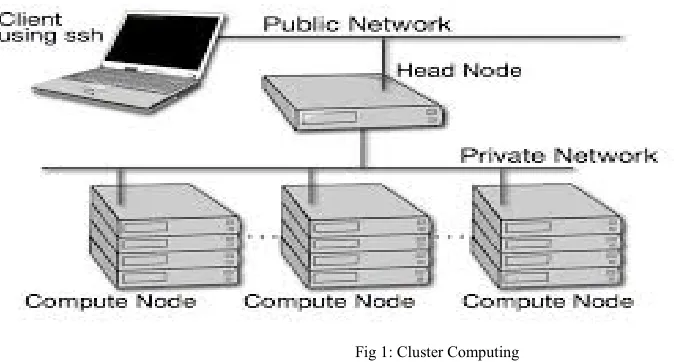
Fig 1: Cluster Computing
Here Fig. 1 shows the general concept of cluster computing according to which several nodes merge together and are presented as a single interface/node to the user.
A. Advantages of Cluster Computing
(1)Manageability: It takes a lot of effort, cost and money to manage a large number of components. But, with cluster, large numbers of components are combined to work as a single entity. So, management becomes easy. (2) Single System Image: Again, with cluster, user just gets the feel that he is working with a single system, but actually he is working with a large number of components. He need not worry about that components, he only needs to manage a single system image.
(3) High Availability: As all the components are replicas of each other, so if one component goes down because of ay technical reason, then some other component can takes its place, and user can continue to work with the system . B. Disadvantages of Cluster Computing
(1) Programmability Issues: This might be the case if the components are different in terms of software from each other, and then there may be issues when combining all of them together as a single entity.
(2) Problem in Finding Fault: Because we are dealing with a single entity, so problem may arise when finding out fault that which of the component has some problem associated with it.
(3) Difficult to handle by a Layman: As cluster computing involves merging different or same components together with different programmability, so a non-professional person may find it difficult to manage
III. GRID COMPUTING
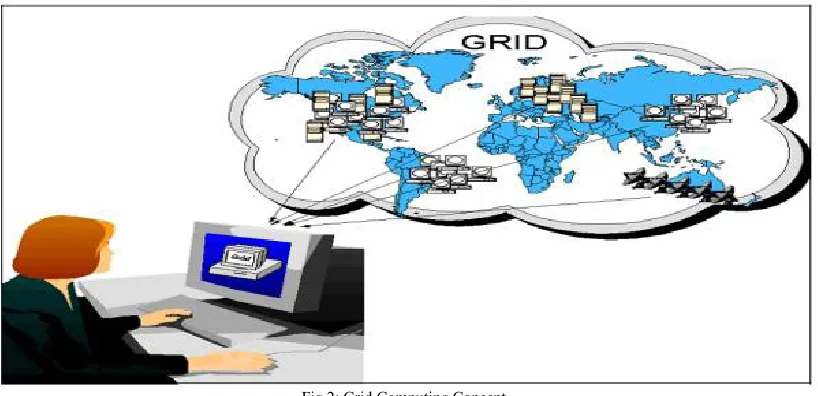
Fig 2: Grid Computing Concept
Here Fig. 2 shows the general concept of grid computing which shows that various resources are segregated from across the globe or geographically dispersed locations towards a central location i.e. the grid system.
A. Advantages of Grid Computing
(1) Access to Additional Resources: In addition to CPU and other storage resources, a grid can also provide other resources as well.
(2) Resource Balancing: A grid incorporates large number of systems into a single system image. For applications that are grid enabled, grid performs the resource balancing by scheduling grid jobs on machines that are showing low utilization.
(3) Reliability: The systems in grid are cheap and geographically dispersed. If, for example, there is power or cooling failure at one site, then that will not affect the other site, thus high reliability will be there specially in case of real time systems [11].
B. Disadvantages of Grid Computing
(1) Not Stable: Grid software and standards are not stable in comparison to other computing. Its standards are still evolving [13].
(2) High Internet Connection Required: Gathering and assembling various resources from geographically dispersed sites require high internet connection which results in high monetary cost.
(3) Different Administrator Domains: Sometimes political issues arise when sharing resources among different domains. Some additional tools are required for having proper syncing and managing among different environments like cfengine, opsware etc[14].
IV. CLOUD COMPUTING
need internet to use these utilities. Buyya et al. (2009) [15] have defined it as follows: “Cloud is a parallel and distributed computing system consisting of a collection of inter-connected and virtualized computers that are dynamically provisioned and presented as one or more unified computing resources based on service-level agreements (SLA) established through negotiation
between the service provider and consumers.”
Here Fig. 3 shows that how users can connect to the cloud services provided by cloud service provider using any device over the internet. Cloud infrastructure includes scalable resources in storage, network, and compute. It also contain virtualized infrastructure and provide these services to the users over internet. Cloud computing cuts the operational and capital costs and allow the IT departments to focus on strategic projects instead of keeping the datacenter running. It provides the services on Infrastructure level, Platform level, and Software level. It provides many features such as speed, scalability of resources, parallel processing, just pay the used resources, choose another technology at any time to further work, 24/7 availability of services, device and location independent, provides reliability and security etc.
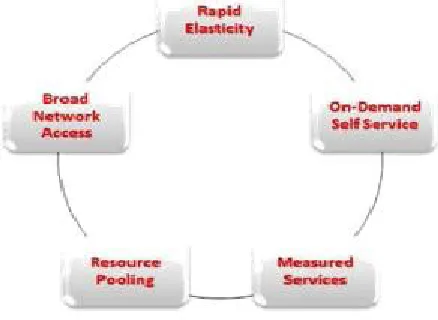
Cloud has five essential features such as rapid elasticity, measured services, on-demand self-service, resource pooling, and board network access as shown in Fig. 4.
Fig 4:Five features of cloud Computing
A. Advantages of Cloud Computing
(1) Shared Resources: Cloud computing share resources to provide the services to multiple users. That’s why it can easily provide the facility like scale up and scale down the resources on demand.
(3) Better Hardware Management: It is easy for cloud service provider to manage the hardware easily because all computers run the same hardware [7].
(4) Save CAPEX and OPEX of Users: New technologies are developing very rapidly. Organizations need to use new technologies to fulfill the requirements of their customers. But changing the technologies is very costly. With the help of cloud computing, users don’t need to purchase the physical infrastructure and spend money on maintaining it. They can use any
technology as per their requirement. B. Disadvantages of Cloud Computing
(1) Less Reliability: Cloud Computing is less reliable because it used to share the resources with multiple users. So there is possibility to steal the data of a user or data of one organization may mix with the data of another organization. For example, In 2007 Microsoft and Yahoo! released some search data to the US Department of Justice as part of a child pornography
case [17]. A disgruntled employee could alter or destroy the data using his or her own access
credentials. If cloud storage system is not reliable, no one wants to save the data on an unreliable system[18]. (2) Internet: The main requirement for users to use the services of cloud computing is internet. Users required high speed of internet connection [16]. Unavailability of internet would cause unavailability of data.
(3) Non-Interoperability: If user stored data in one cloud then later on he/she can’t move it to another cloud service provider because there is non-interoperability between cloud based systems [16].
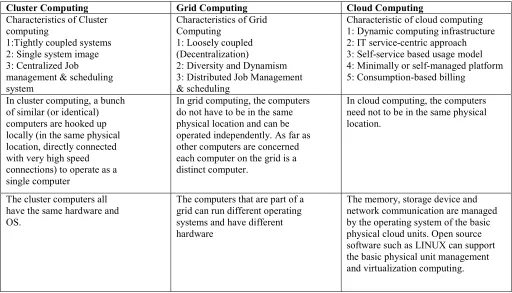
V. COMPARISON BETWEEN GRID, CLUSTER AND CLOUD COMPUTING Table 1 shows the comparison between cluster, grid, and cloud computing.
Cluster Computing Grid Computing Cloud Computing
Characteristics of Cluster computing
1:Tightly coupled systems 2: Single system image 3: Centralized Job
management & scheduling system
Characteristics of Grid Computing
1: Loosely coupled (Decentralization)
2: Diversity and Dynamism 3: Distributed Job Management & scheduling
Characteristic of cloud computing 1: Dynamic computing infrastructure 2: IT service-centric approach 3: Self-service based usage model 4: Minimally or self-managed platform 5: Consumption-based billing
In cluster computing, a bunch of similar (or identical) computers are hooked up locally (in the same physical location, directly connected with very high speed connections) to operate as a single computer
In grid computing, the computers do not have to be in the same physical location and can be operated independently. As far as other computers are concerned each computer on the grid is a distinct computer.
In cloud computing, the computers need not to be in the same physical location.
The cluster computers all have the same hardware and OS.
The computers that are part of a grid can run different operating systems and have different hardware
The whole system (all nodes) behaves like a single system
view and resources are managed by centralized resource manager.
Every node is auton has its own resource manager
and behaves like an independent entityomous i.e. it
Every node acts as an independent entity
The computers in the cluster are normally contained in a single location or complex
Grid are inherently distributed by its nature over a LAN,
metropolitan or WAN
Clouds are mainly distributed over MAN
More than 2 computers are
connected to solve a problem A large project is divided among multiple computers to make use of their resources
It does just the opposite. It allows multiple smaller applications to run at the same time.
Areas of cluster computing 1. Educational resources 2.Commercial sectors for industrial promotion 3.Medical research
Areas of Grid Computing 1.Predictive Modeling and Simulations
2.Engineering Design and Automation
3.Energy Resources Exploration 4.Medical, Military and Basic Research
5.Visualization
Areas of cloud Computing 1.Banking
2.Insurance
3.Weather Forecasting 4.Space Exploration 5.Software as a service 6.PaaS
7.Infrastructure- as -a-Service
Commodity computers High-end computers (servers,
clusters) Commodity computers and high-end servers and network attached storage Size or scalability is 100s Size or scalability is 1000s Size or scalability is 100s to 1000s One of the standard OSs
(Linux, Windows) Any standard OS (dominated by Unix) A hypervisor (VM) on which multiple OSs run
Single Ownership Multiple Ownership Single Ownership
Dedicated, high-end with low latency and high bandwidth Interconnection Network
Mostly Internet with high latency and low Bandwidth
Interconnection Network
Dedicated, high-end with low latency and high Bandwidth Interconnection Network
Traditional login/passwordbased. Medium level of
privacy depends on user privileges.
Public/private key pair based authentication and mapping a user to an account. Limited support for privacy.
Each user/application is provided with a virtual machine. High
security/privacy is guaranteed. Support for setting per-file access control list (ACL).
Membership services
discovery Centralized indexing and decentralized info services discovery
Membership services discovery
Limited service negotiation Yes, SLA based service
negotiation SLA based service negotiation
User management is
centralized User management is decentralized and also virtual organization (VO)-based
User management is centralized or can be delegated to third party
Resource management is centralized
Resource management is distributed
Resource management is centralized/distributed Virtual Interface Architecture
(VIA)-based standards Some Open Grid Forum standards Web Services (SOAP and REST) Standards Multi-clustering within an
Organization for internetworking
Limited adoption for internetworking, but being explored through research efforts such as Gridbus InterGrid
VI. CONCLUSION
Cloud computing is a new technology of computer network, providing the web services at lower cost comparing to normal technique. It contributes to improve the services in other related technologies such as Grid computing, cluster and utility computing. Presently, the
security in clouds is less than the model in grid environment. In this paper we highlight the advantages, disadvantages and compared the features of cluster computing, grid computing, and cloud computing.
REFERENCES
[1] Robert W. Lucky May 2009, Reflections Cloud computing, May 2009, IEEE Spectrum
[2] Mladen A. Vouk, Department of Computer Science, North Carolina State University, Raleigh, North Carolina, USA, Cloud Computing – Issues, Research And Implementations
[3] C Ian Foster, Yong Zhao, Ioan Raicu, Shiyong Lu. Loud “Computing And Grid Computing 360 Degree Compared”
[4] Jadeja Yashpal Singh and Modi Kirit (2012) “Cloud Computing-Concepts, Architecture and Challenges”, InternationalConference on Computing, Electronics and Electrical Technologies [ICCEET], IEEE
[5] Buyya Rajkumar, Yeo Chee Shin, Venugopal Srikumar, Broberg James and Brandic Ivona, “Cloud computing and emerging IT platforms: Vision, hype, and reality for delivering computing as the 5th utility”, Future Generation Computer Systems (2009), pp.599-616
[6] http://www.wisegeek.org/what-is-cluster- computing.htm
[7] Gandotra Indu, Abrol Pawanesh, Gupta Pooja, Uppal Rohit and Singh Sandeep (2011) “Cloud Computing Over Cluster, Grid Computing: a Comparative Analysis”, Journal of Grid and Distributed Computing, pp-01-04
[8] http://etutorials.org/Linux+systems/cluster+computing+with+lin
ux/Chapter+1+So+You+Want+to+Use+a+Cluster/1.2+Why+Use+a+Cluster/ [9] http://www.authorstream.com/Presentation/aS Guest68841-539251-cluster-computing/
[10] Raicu Ion (2008), “Cloud Computing and Grid Computing 360Computing 360--Degree Compared”, Distributed SystemsLaboratory, [11] Computer Science Department, University of Chicago Introduction to Grid Computing, Bart Jacob, Michael Brown, Kentaro Fukui, Nihar
Trivedi; IBM, Red books
[12] http://www.linkedin.com/answers/technology/enterprisesftware/TCH_ENT/552522- 14941035 [13] http://www.slideshare.net/TankBhavin/grid- computing-2007
[14] http://it.toolbox.com/blogs/technews/grid- computingadvantages- and-disadvantages- 23668
[15] Buyya R., Yeo C. S., Venugopal S., Broberg J., and Brandic I.(2009) Cloud computing and emerging IT platforms: Vision, hype, and reality for delivering computing the 5th utility, Future Generation Computer Systems, 25, pp. 599-616.
[16] Maria S. Perez. “Grid and Cloud Computing”, Retrieved from http://laurel.datsi.fi.upm.es/_media/docencia/asignaturas/ccg/gridcloud.pdf [17] A. T. Velte, T. J. Velte, and R. Elsenpeter, Cloud Computing-A Practical Approach, The McGraw-Hill Companies, New York, 2010. [18] K. Kaur, and S. Vashisht. “Data Separation Issues in Cloud Computing”, International Journal for Advance Research in Engineering and
technology, I (10), pp.26-29, November, 2013.
[19] http://www.google.co.in/imgres?sa=G&hl=en&tbm=isch&tbnid=SqF-iD93BvJlM%3A&imgrefurl=http%3A%2F%2Flakjeewa.blogs pot.com%2F2011%2F09%2Fwhat-is-cloudcomputing.
html&docid=blSqlVWBdvfmtM&imgurl=http%3A%2F%2F1.bp.blogspot.com%2F-3Cj5Kxe0UrA%2FTmFEdFuD7-