
Of Radiotherapy Facilities Rooms
Eduardo De Paiva
11
Medical Physics Division, Institute of Radiation Protection and Dosimetry
Corresponding Author:Eduardo De Paiva
Abstract:
High-energy photons produced by electron linear accelerators are widely used in medicine for the treatment of cancer. The wall thickness of facility rooms housing these machines must be calculated in order to prevent their vicinities to receive radiation doses above the permissible level. However, when the radiation beam is oriented vertically up and there is little or no horizontal shielding the radiation can scattered in the air back to the ground. This kind of secondary radiation is termed skyshine and can be a source of hazard to workers as well as members of the public provided that it can reach locations outside the treatment room. In this short work we discuss the origin and some aspects of an empirical expression widely used to estimate the photon skyshine doses in the vicinity of radiotherapy facility rooms housing high-energy medical linearaccelerators.
Keywords:
Photon skyshine, Radiation skyshine, Radiotherapy, Shielding--- --- Date of Submission: 28-04-2018 Date of acceptance: 14-05-2018 ---
---I INTRODUCTION
When a sheltered photon source irradiates in the upward direction, and there is no or little horizontal shielding, the molecules of the air above the ceiling can scatter the radiation back to the ground level reaching points outside the facility room, as shown in Fig. 1. This kind of stray radiation is called skyshine and can be a serious source of hazard for workers as well as members of the public even though at distances far from the source, and for this reason it should be considered for practical design of radiation shielding. In the case of radiotherapy facilities that use large medical electron linear accelerators producing high-energy photon beams, the radiation skyshine may represent the main contribution to total radiation dose at points outside the vertical barriers provided that they are designed to be thick enough to shield against primary, leakage and radiation that scatters at the patient.
Of the variety of methods used to evaluate the photon skyshine dose rates, an empirical expression was stablished in NCRP Report No. 51 [1] to calculate the dose rates at the ground level. It depends on the distance from the source up to a point about 2 meters in the air above the ceiling (point O in Fig. 1); the horizontal distances from the target up to the point of interest (point P); the coefficient of transmission through the roof; the absorbed-dose output rate at isocenter, and the angle formed by the x-ray beam when it is in the upward direction.
In the literature are reported some set of measurements of skyshine photon doses as a function of the distances from the target near clinical accelerators producing 6 MV [2, 3], 10 MV [2], 18 MV [4] and 9, 15 and 21 MV [5] x-ray photons. According to the results reported in these studies it can be seen that in general the calculations obtained by means of the empirical equation underestimate the measurements of skyshine doses. For that reason, a more complete set of measurements encompassing various energies can shed more light on the radiation skyshine phenomenon in the vicinities of radiotherapy facilities rooms. Because of the discrepancies between measurements and estimations, NCRP Report No. 151 [6] recommends that the empirical expression should be used with precaution to calculate the dose rates outside the teletherapy treatment room.
d
0d
s1 sourceIsocenter
P P
d
s2c
a
b
north
south
west
east
O
O
h0
h0
source
P
d
s3Isocenter
d
0Figure 1: A schematic lateral view of a hypothetical radiotherapy facility room with the beam directed upward. The room has area a×b and height h, with the source or target located at the point (c/2, b/2, h0).
North-south and west-east room sections are shown.
II MATERIALSANDMETHODS
A rough evaluation of the skyshine photon doses in the vicinity of a radiotherapy facility room can be obtained by an empirical expression derived as follows. When the x-ray beam is directed vertically up (see Fig. 1) the dose rate Di at a point 2 meters above the top of the roof is given by
(1)
where di is the distance from the source to the point, B is the roof shielding transmission coefficient and D0 is
the x-ray absorbed-dose output rate at 1 m from the source.
According to the NCRP Report No. 51 [1] the skyshine dose rate produced by a source D at a horizontal distance on the ground level is
(2)
where H is the dose rate at the observation point P, ds is the horizontal distance from the source to the point of
interest outside the room, and Ω is the solid angle subtended by the beam. Now, considering Di as the “source”
In the several papers concerning the phenomenon of photon skyshine radiation [2-10] no explanation is given to the fact that the distance di be taken at 2 meters above the ceiling, neither further details about the solid
angle subtended by the x-ray beam and on the multiplicative factor 0.025 are given. In this short note we address a simple discussion about these questions as follows.
III RESULTSANDDISCUSSION
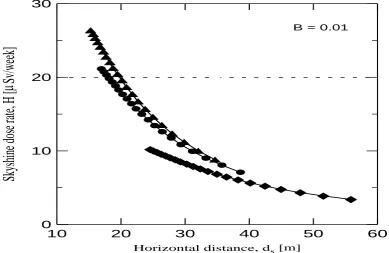
In Fig. 2 are plotted the skyshine dose rates calculated from Equation (3) as a function of the horizontal distances for the hypothetical radiotherapy facility room depicted in Fig. 1. A constant roof shielding transmission of 0.01 and an absorbed-dose output rate of 800 cGy/min are assumed along calculations. It should be noted that, with these assumptions no explicit mention of the beam energy is need.
The solid angle (in steradians) is estimated for a square field of 40 cm × 40 cm according to the formalism described in [9]. The room has area a×b and height h (a = 15, b = 11, h = 5.7 meters); the beam is directed vertically up with the source at h0 = 0.40 m from the ground, and the distance c is 12.3 meters.
In order to verify the effect of changes in the values of distance d0 above the bunker on the results, it is
allowed to vary from 1 to 3 meters in increments of 0.1 m rather than remain constant and equal to 2 m. The distances ds1, ds2 , ds3 represent respectively the horizontal distances from the source to the points of calculation
beyond south wall, north wall, and east (or west) wall. Each point in Fig. 2 represents the dose rate at the nearest horizontal distance, which is determined by the point P that can be seen by an observer located in point O above the roof. For this geometry, the horizontal distances vary in the ranges 24 ≤ ds1 ≤ 56, 17 ≤ ds2 ≤ 39, and 15 ≤ ds3
≤ 35 meters. Results shown in Fig. 2 indicate that the dose rates at the nearest horizontal distance increase about 199% as d0 increases from 1 to 3 m for the sides south, north, and east (or west); these differences increase to
~60% if we consider d0 varying in the rage 1.5-2.5 m, and ~20% for d0 within the range 1.8-2.2 m.
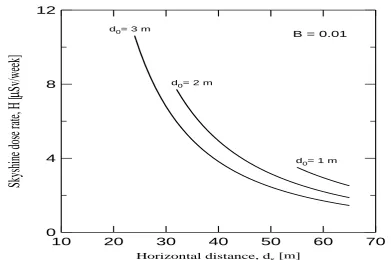
In Fig. 3 is presented the dose rates calculated from Equation (3) for the south side of the room for the nearest horizontal distance up to 65 meters. Results are shown for d0 = 1 m (upper curve), d0 = 2 m (middle
curve) and d0 = 3 m (lower curve). Calculations have indicated an average difference about 34% between results
obtained with d0 = 1 m and d0 = 2 m; and an average difference about -23% between results obtained with d0 = 3
m and d0 = 2 m.
Results shown in Fig. 2 and 3 indicate that the position above the ceiling where is considered as the location of point O strongly affects the results of estimations by means of Equation (3).
10 20 30 40 50 60
Horizontal distance, ds [m]
0 10 20 30
Sk
ys
hi
ne
do
se
ra
te,
H
[
S
v/
we
ek
]
B = 0.01
10
20
30
40
50
60
70
Horizontal distance, ds [m]
0
4
8
12
Sk
ys
hi
ne
d
os
e r
ate
, H
[
S
v/
we
ek
]
B = 0.01
d0= 3 m
d0= 1 m d0= 2 m
Figure 3: The skyshine photon doses as a function of the horizontal distances from the target and for three fixed values of the distance above the bunker (d0 =1, 2 and 3 meters).
In the sixties Burson and Summers [11] performed an experimental study in order to determine the attenuation provided by vertical and horizontal barriers made of various materials exposed to photon skyshine radiation from 60Co and 137Cs sources. Measurements of the attenuation were carried out using detectors placed within a hole 1.8 m deep and 1.2 m in diameter totally immersed into the ground and with the source on the interface air-ground at distances from 1.5 up to 134 m away from its center. For each horizontal distance measurements were made at various positions of detector along the axis of the hole. They also measured the angular detector response to skyshine dose rate at air-ground interface from a 60Co point source located on the ground at 18.3 and 30.5 m away from detector, and the angular distributions of skyshine appear not to be dependent of the distance source to detector.
In Fig. 4 we reproduce the experimental data shown in Burson and Summers [11] for 60Co point source located at 30.5 m from detector, in which lozenges are their measurements of angular dependence of the skyshine photon doses. A power fit of the data gives the following expression for the angular dependence of skyshine
, (4)
where the solid angle Ω is determined by the position of detector along the central axis of the hole.
Taking into consideration that the radiation skyshine comes only from one hemisphere a factor of 1/2 should be introduced, thus leading to the multiplicative term and angular dependence of skyshine given in numerator of Equation (3),
. (5)
10 -1 10 0 10 1
Solid angle [steradians]
10-3
10-2
10 -1
Sk
ys
hi
ne
an
gu
lar
re
sp
on
se
Figure 4: The angular dependence of radiation skyshine. It is shown measurements for scattered photons from 60Co [11]. The solid line is a fit to the set of data.
IV FINALREMARKS
In this brief note we discuss some terms that appear in the empirical expression widely used to calculate the dose rate from the so called photon skyshine. This kind of stray radiation is particularly important when evaluating the radiation doses in the vicinities of radiotherapy facilities rooms when the roof is constructed with no or little shielding. Besides the drawbacks of the empirical expression used to estimation of the skyshine doses, it can serve as a preliminary calculation of the skyshine doses near the outside of radiotherapy facility room. This short study is focused on a discussion on the angular dependence of the radiation skyshine and on some terms that appear in the widely used expression used to estimate the photon skyshine doses.
REFERENCES
[1]. NCRP - National Council on Radiation Protection and Measurements. Radiation protection design guidelines for 0.1-100 MeV particle accelerator facilities. NCRP Report 51, Washington: NCRP, 1977. 160p.
[2]. Elder, D. H.; Harmon, J. F.; Borak, T. B. Skyshine radiation resulting from 6 MV and 10 MV photon beams from a medical accelerators. Health Phys, 2010, 99, pp. 17-25.
[3]. Gossman, M. S.; Mcginley, P. H.; Rising, M. B.; Pahikkala, A. J. Radiation skyshine from a 6 MeV medical accelerator. J Appl Clin Med Phys, 2010, 11, pp. 259-264.
[4]. MCGINLEY, P. H. Radiation skyshine produced by an 18 MeV medical accelerator. Rad Prot Mgmt, 1993, v. 10, 59-64.
[5]. CHAOCHENG, K.; QUANFENG, LI; HUAIBI, C; et al. Monte Carlo method for calculating the radiation skyshine produced by electron accelerators. Nucl Instr Meth Phys Res B, 2005, 234, pp. 269-274.
[6]. NCRP - National Council on Radiation Protection and Measurements. Structural shielding design and evaluation for megavoltage X- and gamma-ray radiotherapy facilities. NCRP Report 151, Bethesda: NCRP, 2005. 246p.
[7]. Zavgorodni, S. F. A method for calculating the dose to a multi-storey building due to radiation scattered from the roof of an adjacent radiotherapy facility. Med Phys, 2001, 28, pp. 1926-1930.
[8]. Sheu, R-D.; Chui, C-S.; Jiang, S-H. The integral first collision method for gamma-ray skyshine analysis. Rad Phys Chem, 2003, 68, pp. 727-744.
[9]. Gossman, M. S.; Pahikkala, A. J; Rising, M. B.; Mcginley, P. H. Providing solid angle formalism for skyshine calculations. J Appl Clin Med Phys, 2010, 11, p. 278-282.
[10]. De Paiva, E.; Da Rosa, L. A. R. Skyshine photon doses from 6 and 10 MV medical linear accelerators. J Appl Clin Med Phys, 2012, 13, pp. 215-219.
[11]. Burson, Z. G.; Summers, R. L. Barrier attenuation of air-scattered gamma radiation. CEX-63.3, Las Vegas: CEX, 1965. 95p.
![Figure 4: The angular dependence of radiation skyshine. It is shown measurements for scattered photons from 60Co [11]](https://thumb-us.123doks.com/thumbv2/123dok_us/1366873.1646276/5.595.107.483.77.315/figure-angular-dependence-radiation-skyshine-measurements-scattered-photons.webp)
