Modal analysis of Pneumatic
two Finger
Robotic hand by Finite Element Analysis and
Experimental Testing
Safeen Yassen Qassab, Hussein Ali Sultan, Shirin Othman Mohammad
College of Engineering, Salahaddin University – Hawler,IraqAbstract-- The objective of the present work was studying the technique of modal analysis using theoretical, numerical and experimental methods .Two axis modal finger of pneumatic robotic hand was designed and built. The theoretical modeling was done by deriving equations of stress and deflection depending on the free body diagram of robotic clamp, finite element analysis was performed using Comsol Multi physics 3.5a software program. The modal testing was done by dial and pressure gauges. For each method dynamic stress and deflection were found, and the results from all three analyses were compared and proved that the rated deflection and stresses that calculated from the theoretical calculation make a good agreement with the results obtained from the finite element analysis and experimental testing. The acceptable maximum holding weight of designed hand was found to be 400g.
Index Term
--
pneumatic hand, two axis finger, Comsol software, Finite Element Analysis.I. INTRODUCTION
Robotic grippers are the part of robots end effectors that have the capability to grasp definite objects and reposition it according to requirement. They are widely used for automated manufacturing, assembly, and packing. Grippers are actuated by various mechanisms which include mechanical, electrical, hydraulic and pneumatic drives. Among this the widely used one is the hydraulic grippers but most favorable one is pneumatic gripper [1].
Gob-Soon Kim, 2001 [2] designed a two-axis force sensor of robots finger using several parallel plate beams the derived equations for calculating strain in the beams in order to design the two–axis force sensor sensing element, the reliability of derived equations are verified by using FEA of the sensing element. Wang, 2002 [3] designed and developed the three-fingered gripper actuated by a linear servo actuator for precise speed and position control was capable of handling a large variety of objects. The above grippers can stably grasp objects, many of them can carry out by the force control of grasping direction but not known for grasping force. Higashimori, 2005 [4] discussed the design of the 100g capturing robot from the point of view of dynamic pre –shaping where all finger links make contact with the target object simultaneously, mechanical parameters were determined by mathematically formulating dynamic pre-shaping problem and experimentally. Ho Choi & Koc, 2006 [5] present feasibility test results of a flexible gripper design, a flexible gripper based on the use of compliant materials (i.e., rubber) with pneumatic inflation was designed, analyzed, built and tested. Parametric FE analyses were conducted to investigate the effects of process and design parameters, such as rubber material, pressure,
for varying degrees of under actuation; they proved that an actuator for each gripper finger performs no better than a single actuator for both fingers. Fei Chen 2012 [10] was designed and built an intelligent robotic hand – i-Hand, which was equipped with multiple small sensors, designed and built for successful accomplishment of the assembly task, and also for human and robot coworker coordinated assembly. Mating connectors by robot, as an experimental case was studied to evaluate i-Hand performance. Naoki Saito 2012 [11] was examined a placing motion of a grasped object by a robot hand equipped with a flexible sensor on the finger, They derived dynamic model of the motion, The validity of the model and the effect of the sensor’s flexibility were examined through simulation, then confirmed experimentally that the robot hand puts down the object without an excessive impact force using the obtained trajectory. Alberto Matthew 2012[12] introduced a principle to guide the design of finger form: invariance of contact geometry over some continuum of varying shape and/or pose of the grasped object in the plane. They presented a general technique to solve for finger form, given a continuum of shape or pose variation and a property to be held invariant. They applied the technique to derive scale-invariant and pose-scale-invariant grasps for disks, and also explore the principle’s application to many common devices from jar wrenches to rock-climbing cams.
II. AIM OF THE RESEARCH
The purpose of this work was design and analyzing the
robot’s hand for increasing the surface contact of grasping mechanism, easily detects the effect of grasp and gravity forces, light in weight, and more economy. It composed of two curved fingers using several plate beams made from low carbon steel, actuated pneumatically. In order to stably grasp an unknown object, the finger should detect the force of grasping direction and the force of gravity direction, and perform the force control using pneumatic actuator [2,4 ,5]. The precision accuracy of two finger robot hand can be estimated by non-linearity, repeatability, and relative error. The relative errors can be reduced by accurately locating the dial gauge of deflection [13].The equations which were used for calculating the deformation and stress of the beams were derived, and these equations were used in determining the value of stress and deformation of designed robotic hand. The reliability of the derived equations was verified by performing a Finite Element Analysis in COMSOL Multi physics 3.5a software program for each part of the hand. The validity of the calculation condition of the approaching allowable holding mass was confirmed through computer simulation. The deflection obtained through this process was compared with theoretical analysis, and the deflections obtained from theoretical analysis were used to determine the attachment location of the dial gauge.
III. MATERIALS AND METHODS
Modeling of the robotic hand
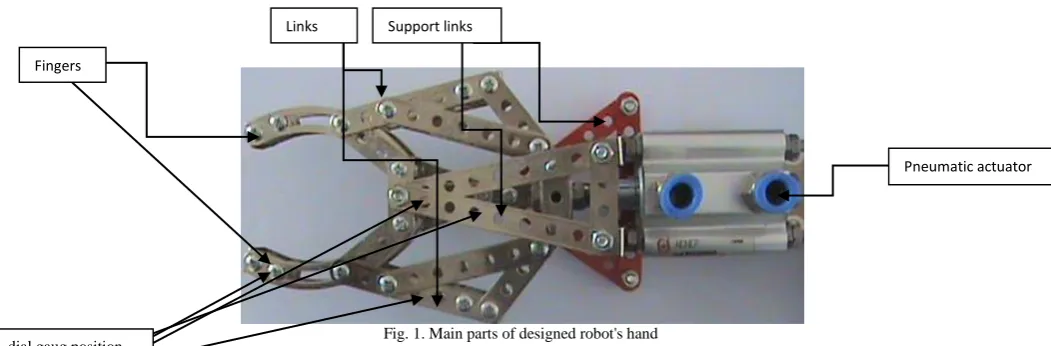
The Designed robot's hand consists of two fingers; they composed from four parallel plate beam, two links, two triangle support links, and a pneumatic actuator to transfer forces and moments from the actuator to the fingers. The amount of the moment is directly related to the supply air pressure which can be regulated by using pressure gauges. This hand can stably grip any object without the breakage or drop.
When a compressed air applied to actuator, in this case double acting pneumatic cylinder, advancing the piston leads to open the hand fingers by help of support and side links (Figure1). Generally when the pressure increases inside one chamber, the hand stretches in the axial direction but the actuator bends in opposite direction to the pressure increased chamber. Thus, the grip has two degrees of freedom; rotation and transportation of motions.
The deformation characteristic of robot hand depends on the type and position of the applied force, cross sectional area of beams, grip length, and type of the material. Non-linear finite element analysis is very effective to design
suitable hand [14].
Fig. 1. Main parts of designed robot's hand dial gaug position
Links
Fingers
Support links
IV. THEORETICAL ANALYSIS [14]
During grasping an object, the force Fy (object weight) and the act in the direction of gravity on both fingers,
will
longitudinal (due to air pressure) will act in the
p
force F
direction of both fingers. The two fingers are symmetrical based on the horizontal center axis of the direction of , and vertical center axis of the direction of
y
applied force F
. force Fp applied
In the hand, as in fingers it composed of two symmetric structures of beams of the same size the amount of force Fyy
on each side can be expressed as:
Where Fyy is y-direction force applied to the plate beam
due to force Fy which representing the object weight.By the
same way, the force Fpp can be calculated by:
Where Fpp is x-direction force applied to the plate beam
due to force Fp which representing axial force of air
pressure.
The free body diagrams for analyzing the deflection of applied on the are
p
F and
y
each plate beam when the force F hand and their effect are shown in fig. 2.
1. Deflection calculations
The Total extension (contraction) of each uniform beam in pure tension (compression) was found by:
𝑦1= ± 𝐹𝑃.𝑙
𝐴𝐸
The amount of bending of the beam when it is subjected to the vertical force (object weight) was found by:
𝑦2= ±
(𝐹𝑦. 𝑑𝑖𝑠𝑡𝑎𝑛𝑐𝑒). 𝐶
𝐼
Then the total deflection (y) of each beam can be found by summing the equations (3) and (4).
So the total deflection for cantilever beams (Fig. 3. a, b, d) was found by
𝑦 =−𝐹𝑃.𝐿 𝐴𝐸 +
𝐹𝑦.𝐿.𝐶 𝐼
Where: y- is the total deflection of the flat beams, Fp- axial force of air pressure in the x-direction,
where Fp = Pressure × cross sectional area of the
piston, l- total length of each part, E- modulus of elasticity, I- moment of inertia, A- cross sectional area of the flat beam., Fy- weight of the object ( Fy = m × g)
where m-mass of object, g- gravitational acceleration.
While for simply supported beam as shown in (Fig. 2. c), by assuming the load as intermediate the total
𝑦 =−𝐹𝑃.𝑙 𝐴𝐸 +
𝐹𝑦.𝑏.𝑥 6𝐸𝐼𝑙 (𝑥
2+ 𝑏2− 𝑙2) (6)
Where: b=l4/2, x= l3/2, l=l3+b.
According to the results of deflections, it found the maximum deflection due to pressure force is very small if compared with the effect of object weight, therefore it was neglected in stress calculations.
2. Stress calculations
Force Fy due to deflection y in a cantilever beams a, b,
and d was related by
stress σ and deflection y are related by
(5)
Where
Also the force Fy due to deflection y in a simply
supported beam c was related by
Then stress σ due to deflection y was related by
(6)
Where
According to the equations (7) and (8), the experimental stresses of the flat beams were calculated.
V. FEMSIMULATION
In order to confirm the stress and deflection which calculated through the theoretical analysis, the finite element analyses were performed on the flat beams of the robot hand. In this study three different values of pressure with respect to twenty different values of object weight were studied. In COMSOL Multi physic’s software, which is one of the most popular commercial FEM software; for each part, von misses stress and total deflection were found by assuming the remained parts rigid. The flat beams properties; material: low carbon steel (AISI 1015 HR) with modulus of elasticity 200 GPa, yield and tensile strengths 190 and 340 MPa respectively, Poisson’s ratio v = 0.3, density of 7850 kg/m³, cross sectional area 10 mm², inertias Ix1=Ix2=6251𝑚𝑚4, Ix3=Ix4=563𝑚𝑚4, length of l1= 90 mm,
l2= 60 mm, l3= 90 mm, l4=70 mm, the total mass of grip is
150 g, and a pneumatic double acting cylinder with 32 mm
piston diameter, length of stroke 20 mm was used Figure 3 shows the FEM model of the robot grip.
Fig. 2. Free body diagram of plate beams under the force Fy, and air pressure Fp.
VI. RESULTS
A. Theoretical results
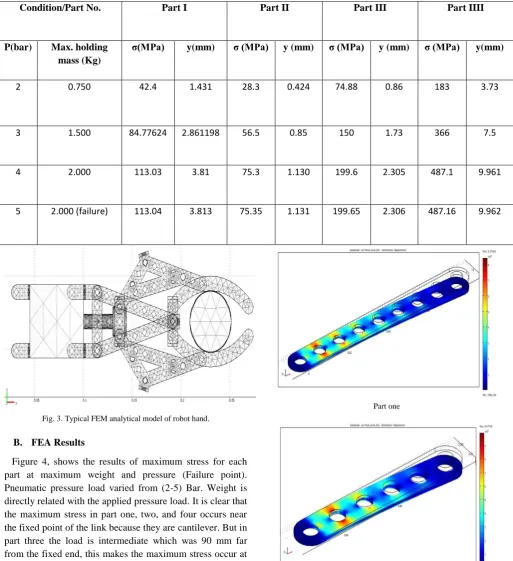
Depending on equations derived from hand modeling the stresses and deflections for each part of the built hand the results were as follows:
(a) Upper beam support link, part one
(b) Lower beam support link, part two
(c) Pressure transmitting link, part three
(d) Robot finger, part four
F
yyM
Fyz ppF
l1
F
yyF
ppM
Fyzl2
Beam
1
Beam
F
yF
ppl4
Fyz
M
l4/2
l3
F
ppyy
Condition/Part No. Part I Part II Part III Part IIII
P(bar) Max. holding mass (Kg)
σ(MPa) y(mm) σ (MPa) y (mm) σ (MPa) y (mm) σ (MPa) y(mm)
2 0.750 42.4 1.431 28.3 0.424 74.88 0.86 183 3.73
3 1.500 84.77624 2.861198 56.5 0.85 150 1.73 366 7.5
4 2.000 113.03 3.81 75.3 1.130 199.6 2.305 487.1 9.961
5 2.000 (failure) 113.04 3.813 75.35 1.131 199.65 2.306 487.16 9.962
Fig. 3. Typical FEM analytical model of robot hand.
B. FEA Results
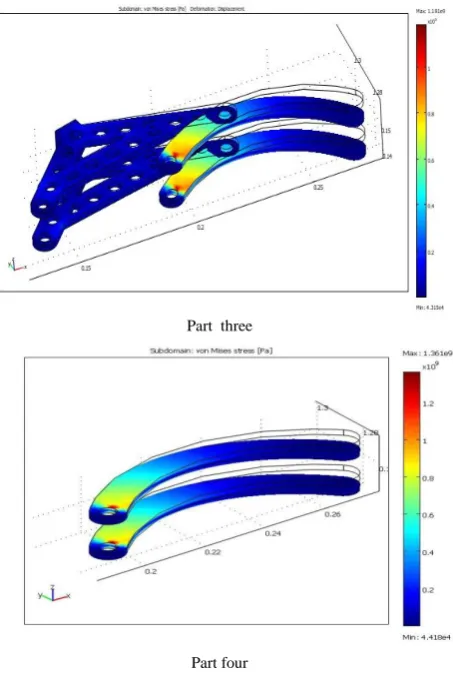
Figure 4, shows the results of maximum stress for each part at maximum weight and pressure (Failure point). Pneumatic pressure load varied from (2-5) Bar. Weight is directly related with the applied pressure load. It is clear that the maximum stress in part one, two, and four occurs near the fixed point of the link because they are cantilever. But in part three the load is intermediate which was 90 mm far from the fixed end, this makes the maximum stress occur at hinged point.
Part one
Part three
Part four
Fig. 4. Stress distribution at different parts (Failure point)
Figure 5, shows the maximum deflection results of each part in the same conditions. It found that the maximum deflection occurs in the position of applied load, which was the object weight
Part One
Part Two
Part Three
Part Four
Fig. 5. Deflection at different parts (Failure point)
while pressure in other chamber was kept at atmospheric pressure.
C. Experimental results
Designed grip was built and tested by using twenty different object weights with different amounts of input pressure (2-5)bar . Four dial gauges were used, to indicate the value of deflection in four critical positions of the hand. The test started from a two bar of pressure input, because the fingers weren’t able to hold objects with less than this amount of pressure due to low grasping force. In this pressure the maximum holing weight was only 750g, with increasing pressure to three Bars, the weight is increased to 1500g, and in 4 Bar object weight reached 2000g without slippage. Failure of the grip was occurred in pressure input of five bar.
It found that grip can hold the maximum preferable object weight of not more than 400 grams, with a safety factor up to 2.
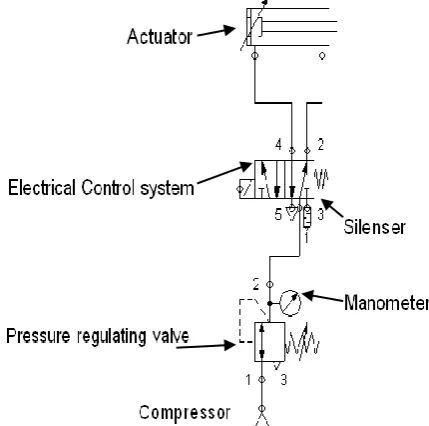
Detail of experimental instrument, and The position of dial gauges for indicating the amount of deflection for variable object weights are shown in Fig. 6-a, while the pneumatic circuit diagram is shown in figure 6-b.
Pneumatic circuit Installed dial gauge
Fig. 6-a. Experimental sketch of the grip.
Fig. 6.b. Pneumatic circuit diagram of the grip.
VII. DISCUSSION AND CONCLUSION
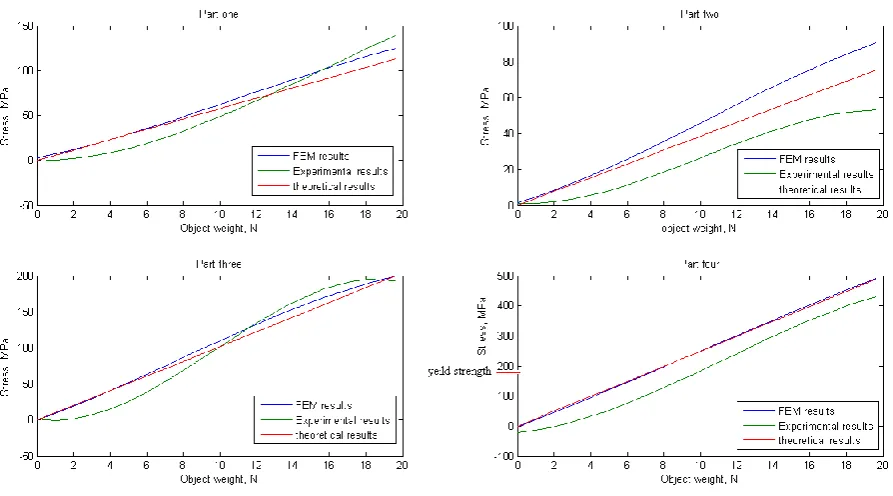
By comparing the results of three analyses, a very good
agreement was found to us ( Figures 7, 8).Fig. 7. Relationship between Maximum stress and object weight by three analysis.
Fig. 8. Relationship between deflection and object weight by three analysis.
CONCLUSION
This investigation shows a new design and prototyping method for pneumatic grip hand. The method enables us to
Design pneumatic gripper optimally and efficiently based on static analysis using non-linear finite element method.
objects in (Kg) not more than quarter of its working pressure in Bars.
COMSOL Multi physics is dependable soft ware for the purposes of analyzing and design.
Using finite element analysis is the best method for design purposes because it’s quicker and dependable method.
In comparison between three deferent analyses the results are near to each other with error about to 5%, therefore the derived equations in this paper are judged to be useful in the stress and the deflection for designing the grip.
REFERENCES
[1] Pneumatics hand book, by Antony barber, 8thedition, 1997. [2] Gob-Soon Kim, “Design of two-axis force sensor of robots
finger”, vol.3, No.1, March, 2001.
[3] JianqiangWang “Intelligent gripper design and application for automated part recognition and gripping”, October 2002. [4] Mitsuru Higashimori, Makoto Kaneko, Akio Namiki, Masatoshi
Ishikawa, Design of 100G Capturing robot based on dynamic preshaping, International journal of robotics research, volume 24 No. 9, pp 743-753, September 2005.
[5] Ho Choi, Muammer Koc ,”Design and feasibility tests of a flexible gripper based on inflatable rubber pockets”,. International Journal of Machine Tools & Manufacture 2006:46; 1350–1361.
[6] B.B.Biswal,” Design and development of a two-jaw parallel pneumatic gripper for robotic manipulation”, 2010.
[7] Aaron M. Dollar, Robert D. Howe The Highly Adaptive SDM Hand: Design and Performance Evaluation, International Journal of Robotics Research, April 2010; vol. 29, 5: pp. 585-597.,first published on February 2, 2010.
[8] Jiang Tian and Yan-Bin Jia, “Toward Two-Finger Grasping of Deformable Curve-like Objects”, Department of Computer Science, Iowa State University, Ames, 2011, USA.
[9] Aaron M Dollar & Robert D Howe, Joint coupling design of under actuated hands for unstructured environments, International Journal of Robotics Research ,vol. 30 , pp1157-1169August 1, 2011.
[10] Fei Chen, Kosuke Sekiyama, Baiqing Sun, Pei Di, Jian Huang, Hironobu Sasaki and Toshio Fukuda, Design and Application of an Intelligent Robotic Gripper for Accurate and Tolerant Electronic Connector Mating, Journal of Robotics andMechatronicsVol.24 No.3, pp. 441-451,2012.
[11] Naoki Saito, Toshiyuki Satoh, Yoshinao Suzuki, and Hideharu Okano, Placing Motion of an Object by a Robot Hand with a Flexible Sensor, Journal of Robotics andMechatronicsVol.24 , No.1, 2012.
[12] Alberto Rodriguez, Matthew T Mason, Grasp invariance, International Journal of Robotics Research vol. 31, pp. 236-248 February 1, 2012 .
[13] G. S. Kim, “Design and strain analysis of precision 3-component load cell”, International Journal of KSPE, 2000. [14] Richard G. Budynas., and J. Keith Nisbett., Shigley's
Mechanical Engineering Design, 8th edition, McGraw-Hill,
2008.