International Journal of Video&Image Processing and Network Security IJVIPNS-IJENS Vol:14 No:01 15
Improved SPI Calculus for Reasoning on
Cryptographic Protocols
Hasan Al-Refai
Khaldoun Batiha
Ali Alawneh
Saleh Bani Hani
Philadelphia university Philadelphia university Philadelphia university Philadelphia university
[email protected] [email protected] [email protected] [email protected]
Abstract-- Most of cryptographic protocols are subjects to very subtle attacks. Therefore, many researchers have developed tools to model and analyze protocols to guarantee their security properties. The spi calculus has proved to be useful for analyzing and reasoning on cryptographic protocols. However, current works assumed that the spi calculus dealt with transferring a single unstructured message for sending each message in a single action, which is mostly needed in implementing real protocols with an open environment, such case cause a problem in proving the freshness of generated keys for each output action. In this paper, we introduced an improved version of spi calculus called the Tspi calculus that provides the ability for solving the problem of tuple of messages using nested partial map function and guarantee the freshness of generated keys by the use of an evolution function for each action in the running processes for making suitable decision during interaction with an open environment such as e-commerce protocols.
Index Term-- Cryptographic protocol, Cryptographic protocol analysis, spi calculus, partial map function, evaluation function, testing equivalence.
1. INTRODUCTION
In computer science, a communication protocol is a convention for the communication between two or more computing parties called principals. The Handbook of Applied Cryptography defines it as a multi-party algorithm, defined by a sequence of steps precisely specifying the actions required of two or more parties in order to achieve a specified objective (A. Alfred, et al. 2001).
Over the years, the problems of network security have become more and more complex. Solving these problems usually requires the design of protocols that rely on cryptographic systems to hide some secret information: these protocols are “cryptographic.”
The use of cryptographic protocols is widely spread – Transport Layer Security (TLS, formerly SSL) and Secure Shell (SSH) are common cryptographic protocol used to secure connections over the Internet. However, they assumed to be secured by protocols using cryptographic methods as encryption or digital signatures, promising security properties as secrecy or authentication.
Most of research works in formal methods has been focused on analysis of discrete system. This is understandable with regard to the fact that many security problems in protocol
analysis can be formulated in terms of the properties of a discrete system.
Secure data exchanges between several principals are often subject to attack by an intruder. Such an intruder can do any sequence of a finite set of operations such as intercepting data, concatenating and non-concatenating data, encrypting and decrypting data, and so forth. However, some sort of discrete formal analysis can enable us to avoid attacks especially since attacks are often non-intuitive, exploitations of protocol.
For this reason, formal methods are useful for the analysis of the security of cryptographic protocols. They allow one to do a thorough analysis of the different paths intruders can take, and to specify precisely the environmental assumptions that have been made.
In 1997, the spi calculus (M. Abadi, A. Gordon 1997) introduced as a new approach to formal cryptographic protocol analysis, the spi calculus proposed as an extension of the π-calculus (R. Milner. 1992). The spi calculus is a process calculus designed for the description and formal verification of cryptographic protocols. The spi calculus enables us to consider cryptographic issues in more detail. In spi calculus, protocols represented as processes and state their security properties in terms of protocol equivalence
Current spi calculus suffered from several limitations, these limitations due to number of restrictions and assumptions they have built in their work in order to reach specific approaches for a specific type of environment and protocols.
One of the most problems in current spi calculus the deal with transferring a single unstructured message by sending each message in a single action which cause a huge number of transactions between parties, where a tuple of messages is mostly needed in implementing real protocols, such as for sending timestamp, user identity, user certificate and its validation date from the user to the merchant all in one output action that result in simplifying the process of tracing and testing.
International Journal of Video&Image Processing and Network Security IJVIPNS-IJENS Vol:14 No:01 16
146001-5959-IJVIPNS-IJENS © February 2014 IJENS I J E N S
________ __________ __________ __________ __________ __________ __________
) ( |
) (
M : | |
) ( N
: |
) ( |
| |
,
_______ __________ __________ __________ __________ __________ __________
} { |
2 , 1 | ,
s expression |
) ( 2 | ) ( 1 | 2 , 1 | | ,
_______ __________ __________ __________ __________ __________ __________
N ,
, ..., , , , ..., , ,
M
Calculus the of Syntax The : 3.1.a TABLE
decryption in
z let
ility adecomposa is
name free a is equality guards tt
messages M
k Enc M
M a N M
a
names z
y x n m l k c b a
name) bound a (is N
: ζ
) ζ ( #
) i (ζ η Enc | ) i (ζ η Dec | ) i (ζ η Dec | ) i (ς η Enc
:: :: ::
operators needed in such protocols such as timestamp, hash function, digital signature and asymmetric key cryptosystem. Hence, Tspi calculus ready is to be used for real protocols such as e-commerce protocols.
The improved Tspi calculus ready to be used for real protocols such as e-commerce protocols, which it includes all operators needed for such protocols such as timestamp, hash function, digital signature and asymmetric key cryptosystem as well as the messages are structured to be same as in real protocols that have a tuple of messages.
2. THE TSPI CALCULUS
This section gives the syntax and operational semantics of the TSpi calculus to improve the original works of (M. Abadi and A. Gordon. 1998) followed by the work of (H. Al-Refai. 2009) that includes an evaluation function.
2.1 Syntax
This section introduces the language of Tspi calculus. Names and operators are the basic constructs the syntax of Tspi calculus. Other structures are built based on them. Protocol model, is representative structure of TSpi-calculus. In this structured messages, expressions, logical formula and processes define the attributes needed to express all the objects and the activities driven in establishing protocols.
Tables 1.1.a and 1.1.b summarize the syntax of Tspi calculus
as given in (H. Al-Refai. 2009). The bolded expressions,
guards and processes are newly added. Names N range over
communication channels, data (variables or clear texts and a message) or keys. Along the declaration, names are used alternatively through the syntax regardless of their representations. Any name would be tagged to the type by its appearance order.
Notation 1: We reserve the lower case letters a, b, ch to
denote channels and k, l to denote keys and m, n to denote
messages.
Expressions are those descriptions that are obtained by applying encryption, decryption, paring and projection operators to names and ciphertext. For example, the
expression is a plaintext, when it is encrypted using the
value as a key, the overall actions would be given by
)
(
Enc
, yielding that as a plaintext is encrypted underthe key , conversely the decryption action Dec{} stands to
decrypt the ciphertext using the value of as a key. We
assume that a key should be a name and the encryption action uses shared key in a simple and nested modes.
Definition 2.1.1: A finite set of terms, T = {t1, t2,…., tn}.
(H. Al-Refai, 2009).
Following the work of (H. Al-Refai. 2009), the difference to
the old version of spi calculus is that we assumed the set T to
be defined, so that we can associate each state to a term t. In
order to define the notion of state we have to introduce the
International Journal of Video&Image Processing and Network Security IJVIPNS-IJENS Vol:14 No:01 17
Definition 2.1.2: A finite multiset
over a set L is a map
such that
- 1(M 1) is finite. We define thefollowing operations on finite multisets: (H. Al-Refai, 2009).
(a) The difference of the multisets
and
is the multiset
|
where (
|
)(l) = max (0,
(l) -
(l));(b) The union of two multisets
and
is the multiset
where (
)(l) =
(l) +
(l);(c) We say that l >
iff
(l) > 0.We define formally our notion of state as follows:
Definition 2.1.3: We define a state,
t tT, to be afamily of multisets indexed by the terms, where each
trepresents the local state of the term t. We denote the set of
all states by
from (H. Al-Refai. 2009).A first approach to the definition of state would be a family of
sets. If we consider each
t as a set, we were restricting thepossibility of a principal to have many copies of the same term. We want to deal with the possibility of existing several
inputs of the terms and verify that our system has the desired properties for input transitions.
Definition 2.1.4: The participant only accepts the
fresh key generated by S as server.
If two processes can be made equal by conflict-free renaming of bound names then they are alpha-equivalent. Substitutions
are mappings
x
from names x to messages
,following the usual assumption that name-capture is avoided through implicit alpha conversion. Substitutions are applied to processes, expressions and guards very simply as for
example, P
x
replace all free occurrence of x in P by
,possibly renaming bound names in P avoiding name capture.
Definition 2.1.5: A substitution is a finite partial map from
the set of names N to the set of messages M; {Mi /xi }.
The definition shows the effect of applying a substitution to
a process P. This is essentially to replace each free occurrence
of each name (i.e.;x) in P by (xi) = Mi , for some xiand Mi .
The mapping must, however, be done in such a way that unintended capture of names by binders is avoided. Substitutions are applied to processes, expressions and guards
in straightly, i.e. P
Mi xi
replace all free occurrence of xiin P by Mi , possibly renaming bound names in P avoiding
name capture.
Definition 2.1.7: (-convertibility)
1. If the name w does not occur in the process P, then
P{w/z} is the process obtained by replacing each free
occurrences of z in P by w.
2. A change of bound names in a process P is the
replacement of a subterm x(z).Q of P by
x(w).Q{w/z}, or the replacement of subterm vz Q of
P by vw Q{w/z}, where in each case w does not
occur in Q.
3. Processes P and Q are -convertible, P = Q, if Q can
be obtained from P by a finite number of changes of
bound names.
Remark: we have use the symbol „=‟ for -convertibility
because we intend to identify -convertibility processes.
In our spi calculus, the entities of interest are the
equivalence classes of processes modulo -convertibility.
The domain and co-domain of are denoted as dom() and
range()
respectively
.Let n()=) M ( n )
( dom
) ( range M
When a tuple of
distinct names
x
(
x
1,
x
2,...,
x
n)
and a tuple of messages)
,...,
,
(
M
1M
2M
nM
are given , the substitutions mappingof each xito Miwill be convenient. Usually, a tuple is a set of
________ __________ __________
__________ __________
__________ __________
) / ( |
) (
|
) ( )
( |
) ( !
|
) ( |
) (
| | | |
) ( 0
| , ,
________ __________ __________
__________ __________
__________ __________
|
Calculus the of Syntax The 1.b TABLE
Timestamp) (
P : η let
prefix) (output .P
n ζ .., ... , 1 ζ η
prefix) (input ).P
n x ., ... , 1 η(x
decryption encryption P
in z let
guard boolean P
n restrictio P
n v
n replicatio P
choice Q
P
compositon parallel Q
P
null Ρ processes R
Q P
International Journal of Video&Image Processing and Network Security IJVIPNS-IJENS Vol:14 No:01 18
146001-5959-IJVIPNS-IJENS © February 2014 IJENS I J E N S
its component.
M
x
is the substitution
whichrepresents union of and
M
x
. Such case is referred toas
extends .Processes are diverse forms of processes that have a distinct function for each. A process could be built using a set of
operators that include standard -calculus (Milner et al. 1992)
and four new ones; symmetric and asymmetric cryptosystem, Boolean guards, timestamp and structured message. However, process forms are used to explain the following:
0, is a null process that dose nothing.
An input process; (
1,
...
,
n).P represents inputof a generic message x along the channel : the only
useful case is when is a name , otherwise the
whole process is stuck .
An output process
(
1,
...
,
n).
P
represents out of along the channel .The only useful case is when
is a name and is a message, otherwise the whole
process is stuck.
Non-deterministic choice P + Q: can behave either
as P or Q; the choice might either be triggereazd by
the environment, or by internal computations of P or
Q.
Parallel composition P | Q; is the parallel execution
of P and Q.
Restriction (n)P: creates a new name a which is
only known to P.
Replication !P behaves like many unbounded copies
of P running in parallel, i.e. P | P | P | …. .
Boolean Guard P behaves like P if the formula is
logically true, otherwise is stuck.
Encryption/Decryption let z = ( 1 , ….., 2 ) in P:
referring to definitions 2.1.4 and.2.1.5 attempts
evaluation of : if the evaluation succeeds, the result
bound to z within P, in other words, the process will
attempts to encrypt/decrypt z with the key ᶯ.If z has
the form {M1, …, Mn}k, then the process behaves as
the process P, where each i hasbeen replaced by
Mi, ie. as the process P{M1/x1, …….,
Mn/xn}.otherwise the whole process is stuck.
Timestamp: the process let T:P means T time is
evaluated as a valid current time of process P.
Usual calculus abbreviate ( a)( b) P into ( a, b) P, and
)
(
N
M
.0 intoM
(
N
)
. In the Tspi calculus, processes areidentified up to renaming of bound names. Bound names are
the entities that are enclosed within a process definition P,
and not those that have explicitly been tagged with any other outside the process. So the closed process will then be
defined as the process that has no free variables; Proc is used
to define a set of closed processes. For that we will propose in
our operational semantics an evaluation function to validate if
the bound names did not disclosed with an environment out of the process definition.
Let fn(P) denote the set of free names in P and fv(P) is the set
of free variables in P , and alpha-equivalence arises as
expected , n(P) is fn(P) bn(P). In this context, similar
notations are used for formulae, expressions and messages.
Definition 2.1.8: Let P represent the running process, Q for
any other process running in the environment, and e
represent the knowledge of the environment then the set of all
free names known to the environment is defined by
, suchthat, ) ) ) .
Definition 2.1.9: Let P represent the running process, Q for
any other process running in the environment, and e
represent the knowledge of the environment then the set of all
free variable known to the environment is defined by
, suchthat, ) ) ) .
Logical formulae generalize the usual equality
operator of the -calculus by conjunction and negation.
Moreover we introduce some new predicates let η :P ,
]
:
[
N
,[
:
M
]
and
:
N
. The predicate let η:Pmeans η time is evaluated as a valid current time of process
P, and the predicate
[
:
N
]
which tests for the format ofthe argument
, whether it evaluates to a name or not, andthe predicate
[
:
M
]
which test for the argument
,whether it evaluates to a compound ciphertext or not, and
with “Let” construct that binds the value of some expression
to a name z, and
:
N
which tests for the format of theargument
, if it is bounded in the process P and not belongto names in any other processes in the environment, such as
(
fn
(
P
)
bn
(
Q
)
.There are other expressions denote hash function and the encryption/ decryption using public and private keys:
Hash function: ) hashing of . The hashing
function assumed to be perfect and noninvertible.
) Encrypt the structured message using a
public key .
) Encrypt the structured message using a
secret key .
Encrypt the structured message ) that
signed digitally by public key .
2.2 Operational Semantics
In (Abadi and Gordon 1998), there are two operational
semantics presented for spi-calculus - the reaction relation
and the commitment relation. The reaction relation is an
otherwise ff if tt ] : [ otherwise ff ) ) ( bn (.) fn if tt ] : [ otherwise ff if tt ] : [ otherwise ff ) ) if Tt P : let otherwise ff ) ( bn (.) fn N x and M if i x i M in i i z let tt tt ) P ( ( fn N M and N N N N M
proofs (because it relies on an auxiliary notion of structural equivalence). Therefore, an alternative characterization of
reaction is provided defining the commitment relation, in
style of (R. Milner 1999). We will present both as in (Abadi and Gordon 1998).
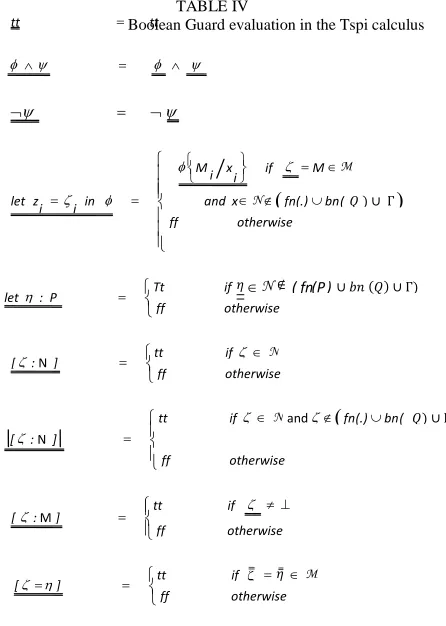
However, to provide a calculus to be toward automation, this needs for two main evaluation functions are used (H. Al-Refai. 2009). The first is utilized for expressions while the second is used for Boolean Guards. These two evaluations are denoted as follows:
- For an expression
: M ,
)
M
(
symbol
distinct
a
is
where
where ( . ) is represent an expression.- For an evaluation of a Guard
,
,
.
:
tt
ff
is
defined
by
induction
on
Where
is represent guard.The evaluation function is defined recursively according to
tables 3, and 4. We have introduced one new expression
{ ̿̿̿̿̿̿)} and four Boolean guards:
{ }
evaluations. In these two tables, it is obvious that expression
evaluations rely on the implementation of let and guard only.
Hence, the decryption is bounded along this evaluation scheme.
The evaluation function performs a tracing to every process action in the protocol for deciding either to proceed or terminate that process. The role of each function is indicated in the tables. For example:
. otherwise k and M if ) M ( k Enc ) (
Enc M N
Evaluated as: the plaintext η is evaluated as a message and
belong to the defined set of messages M and the key
evaluated as a name and belong to the defined set of names N,
if these conditions success the operation evaluated to be valid otherwise terminate the process.
TABLE 3
Expression evaluation in the Tspi calculus
Table IV shows, most of the operational semantics of the TSpi-calculus used in our work is similar to the work of (H.
Al-Refai, 2009). Let and guard items are used as primitive
rules driven to decrypt messages.
TABLE IV
Boolean Guard evaluation in the Tspi calculus
International Journal of Video&Image Processing and Network Security IJVIPNS-IJENS Vol:14 No:01 20
146001-5959-IJVIPNS-IJENS © February 2014 IJENS I J E N S
A process P behaves like P provided that evaluates to
true, otherwise, P is stuck. A process let z = ( 1 , ….., 2 )
in P provided that the evaluation of succeeds; otherwise,
let z = ( 1 , ….., 2 ) in P is stuck. If z has the form {M1, …,
Mn}k, then the process behaves as the process P, where each
i hasbeen evaluated by Mi, ie. as the process P{M1/x1, …….,
Mn/xn}.otherwise the whole process is stuck.
Rule (E-OUT) details the case when the environment receives
a message M and updates its knowledge accordingly, and for
the sake of a transition to occur, all channels are supposed to be well announced to the environment.
Rule (E-INP) details the case, when the environment sends a
message M to the process. Message m is not arbitrary and the
expression describes how this message is built out of the
environment and of the names
b
to define M. Creation ofnew names
b
is recorded by
b
x
, and in this case a mustbelong to the knowledge of the environment to explain its announcement.
In table IV, the evaluation function is built in the operational semantic to strengthens the validation rules of the language.
4. Case Study: Kerberos Protocol
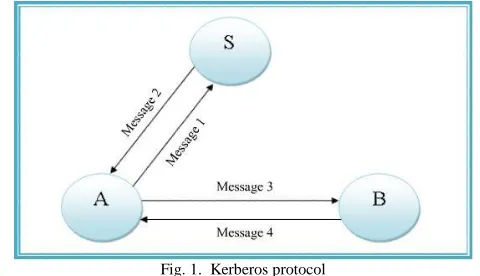
The Kerberos protocol (Figure 1) is a key distribution
protocol between a client and an applied server which is based on Needham- Schroeder protocol. We only consider a version taken for this protocol proposed in (M. Burrow et al. 1990) and (M. Boreale et al. 2000). We consider such protocol which has a structured message that contains set of elements in a single transaction to prove one of our contributions. That is, one of the improvements for the language we have introduced in this work concern output structured message case.
The system in our case has two agents (initiator) and λ
(responder) that each one of them share long term key with a
server S ), where communicate with the server
S to establish new connection with λ. The symbols used in
our case study are shown in Table 5.
Informally, this protocol is shown below:
Message 1 : λ
Message 2 : λ λ λ
Message 3 λ: λ λ
Message 4 λ : λ
First of all, to implement such protocol in Tspi calculus we consider the run of the protocol under the hypothesis that the old session key possible has been released to the environment. So, the new generated keys should not release any of this knowledge to the environment till the running session completely finished and evaluate the knowledge
gained previously by the environment for old keys in previous sessions.
Table V Case study symbols
Symbol Represent
Initiator
Responder
Initiator ID
Responder ID
Is a MessageIs a key
Is a timestamp
Responder Certificate
Public channel
In the following we present some notational shorthand, in order of convenience, which define the outputted messages that will be sent through public channels:
)
)
{ })
{ })
{ })
{ })
denotes the old message including the old timestamp(nonce) and session key μ supposed to be known by the
environment. indicates that it is a new certificate awarded
by the Kerberos server S to the initiator .
The specifications are similar to (M. Boreale et al. 2000). Firstly, we have to describe the implementation of this protocol in the Tspi calculus in order to formally give the specification.
) ̅
) ) ̅
))
) ) ( ) )Where: x derived from the partial-map function as:
)
⁄ ) ⁄ ⁄ ) )
⁄ ) ⁄ ⁄ ⁄ ⁄ ) )
⁄ ) ⁄ ⁄ ) )
⁄ ) ⁄ )The evaluation function will verify the freshness of all generated nonces, as well as the encryption/decryption operations and validate the structure of messages, the bound names projection of structured messages; all of these empower the analysis and tracing of the protocol. As well as prove later in this paper. Therefore, the specification will be followed simply for verifying authentication and secrecy as we will prove later in this paper.
The specification of kerb is formally described as:
̅
) ) ̅
) )
) ̅
)
)
)) | | ) )
Proof:
To prove the authentication property, the set of names should be all distinct from each other and not known by the
environment. For example we can prove the validity of
,such as:
Firstly, we evaluate the freshness nonce as a
timestamp by and that means ιs is
freshly generated as a name and bounded in the
running process. Such that, the is valid timestamp if
ι N and ι ) ) ) for the running
process P and any other process Q in the environment.
The same for evaluating by for is
valid if N and ) )) for the
running process P and any other process Q in the
environment.
The encryption process evaluated as ̿̿̿̿̿̿̿̿̿̿̿̿̿̿̿̿̿
)that is, it valid if ̿̿̿̿̿̿̿̿̿̿̿̿̿̿̿̿̿̿̿̿̿̿̿̿̿̿̿ and
) ̿̿̿̿ N and ̿̿̿̿ ) ) )) forP is a running process and for any other process Q in
the environment. According the definition 4.2.1, and
by evaluating for the input transactions we can
observe that and each x of
them is distinct from the others.
Now, the evaluation of all actions in and S in
kerb can verify the authentication property for kerb
and .
Definition 4.2.1: The participant only accept the
fresh key generated by S.
For any case, where the evaluation function result an error that will signal to break the process .
This will prove that kerb and are testing equivalence
(≃) which mean that the authentication property proved.
Definition 4.2.2: Secrecy: the keys and are never
released.
Formally, it holds that
≃
Where represent "eavesdropping", for whom passively grab or learned from the messages known to the environment.
) ) )⁄
Mean that contains all free names and all names collected
previously from all sessions possibly learned or disclosed accidently by the environment excluding the bound names generated to be closed in running process.
CONCLUSION
Many researchers tried to enhance the original work of Abadi and Gordon (M. Abadi and A. Gordon 1998), but most of their works built over some restriction and assumption that made the language fit to specific protocols.
International Journal of Video&Image Processing and Network Security IJVIPNS-IJENS Vol:14 No:01 22
146001-5959-IJVIPNS-IJENS © February 2014 IJENS I J E N S
changeability in environment behaviors as well as evaluating and validating each output action in the running processes for making suitable decision to prove the main security properties as authentication and confidentiality.
The Tspi calculus ready to be used for real protocols such as e-commerce protocols with all needed operators.
ACKNOWLEDGMENTS
We thank Morad Mouach, Read Jabri, Khalid Sarayra for discussions and suggested improvements in its presentation that contributed to this work.
REFRENCES
[1] Tiu and J. Dawson. (2010). Automating Open Bisimulation Checking for the Spi Calculus. 23rd IEEE Computer Security Foundations Symposium.
[2] Al-Refai (2009) Evaluation Technique in the Spi-Calculus for Cryptographic Protocols. Third International Symposium on Innovation in Information Communication Technology- ISIICT.
[3] X. Li; G. Zheng; L. Li; J. Wu; W. Chen. (2009). Stochastic extension for real time process algebra with urgency executing policy Proceedings - 2009 International Conference on Computational Intelligence and Software Engineering, CiSE 2009, pp.1 - 4.
[4] Zheng; X. Li; L .Li; J. Wu. (2009). Process algebra for web servers with timed-priority executing policy Proceedings – 2009 International Conference on Computational Intelligence and Software Engineering, CiSE 2009, Wuhan China.
[5] S. Matsuo, K. Miyazaki, A. Otsuka, and D. Basin. (2009) How to Evaluate the Security of Real-life Cryptographic Protocols? The cases of ISO/IEC 29128 and CRYPTREC.
[6] C. V´eronique. D. St´ephanie. (2009) A method for proving observational equivalence. 22nd IEEE Computer Security Foundations Symposium, pages 266- 276, 2009.
[7] Borgstrom. (2009). A Complete Symbolic Bisimilarity for an Extended Spi Calculus. Published by Elsevier Science B. V.
[8] Blanchet, M. Abadi, and C. (2008). Fournet. Automated verification of selected equivalences for security protocols. Journal of Logic and Algebraic Programming, 75(1):3–51.
[9] S. Delaune, S. Kremer, and M. D. Ryan. (2007). Symbolic bisimulation for the applied pi-calculus. In Proc. 27th Conference on Foundations of Software Technology and Theoretical Computer Science (FSTTCS‟07), pages 133–145.
[10] Albrechts. (2006). Automatic Analysis of Recursive Cryptographic Protocols. Master Thesis.
[11] Haack A. Jeffrey. (2006). Pattern-Matching Spi-Calculus. presented at the IFIP workshop on Formal Aspects of Security and Trust in Toulouse. [12] Haack and A. Jeffrey. (2006). Timed Spi calculus with Types for Secrecy and Authenticity. This material is based upon work supported by the National Science Foundation under Grant. No. 0208459. [13] T. Kahsai. (2006). Towards semi automated equivalence checking of spi
calculus processes. Master Thesis.
[14] M. Baudet. (2005). Deciding security of protocols against off-line guessing attacks. In Proc. 12th Conference on Computer and Communications Security (CCS‟05). ACM Press, 2005.
[15] Y. Gu, Y. Fu and Guoqiang Li. (2005). A Simple Process Calculus for the analysis of Security Protocols. Proceedings of the Sixth International Conference on Parallel and Distributed Computing, Applications and Technologies (PDCAT‟05) 0-7695-2405-2/05 © 2005 IEEE
[16] Fléchais. (2005). Designing Secure and Usable Systems. PhD thesis. University of London.
[17] Al-Refai; T. Sembok; M. Yusoff. (2004). Decidablity of Cryptographic Protocol Properties through Framed bisimulation. Proc. International conference on Informatics. 2(1): 779-796.
[18] -spi Calculus at Work:
Authentication Case Studies. Work partially supported by MIUR project „Modelli formali per la sicurezza‟ and EU Contract IST-2001-32617
„Models and Types for Security in Mobile Distributed Systems‟ (MyThS).
[19] Gordon A. Jeffrey (2003). Types and effects for asymmetric cryptographic protocols. Submission to Journal of Computer Security. This material is based upon work supported by the National Science Foundation under Grant No. 0208549.
[20] Bodei M. Buchholtz P. Degano F. Nielson H. Riis Nielson. (2003). Automatic Validation of Protocol Narration. Supported in part by the Information Society Technologies programme of the European Commission, Future and Emerging Technologies
[21] Durante, R. Sisto, and A. Valenzano. (2003). Automatic testing equivalence verification of spi calculus specifications. ACM Transactions on Software Engineering and Methodology, 12(2):222– 284.
[22] H. Huttel. (2002). Deciding framed bisimulation. In Proc. 4th Int. Workshop on Verification of Infinite State Systems (INFINITY‟02). [23] R. Amadio, D. Lugiez. (2000). On the reachability problem in
cryptographic protocols, In Proceedings of the 12th International Conference on Concurrency Theory (CONCUR‟00), 2000.
[24] M. Boreale, R. De Nicola. and Rosario Pugiiese. (2000). Process algebraic analysis of cryptographic protocols lFlP Conference Proceedings Vol. 183: 375-392.
[25] M. Boreale. Symbolic analysis of cryptographic protocols in the spi calculus. in: Proceedings of LICS '99, IEEE (1999),
[26] M. Abadi, A. D. Gordon. (1999). A calculus for cryptographic protocols: The spi-calculus. In Fourth ACM Conference on Computer and Communication Security, pages 36-47, ACM Press, 1999.
[27] R. Milner. Communicating and Mobile Systems: The
-Calculus. Cambridge University Press, June 1999.[28] M. Abadi A. Gordon. (1998). A calculus for cryptographic protocols: The Spi Calculus. Research Report 149, Digital Systems Research Center, Palo Alto, CA, USA.
[29] M. Abadi and A. Gordon. (1998). A bisimulation method for cryptographic protocols. Nordic Journal of Computing, 5(4):267–303. [30] Abadi A. Gordon. (1997). A calculus for cryptographic protocols: The
Spi Calculus. Proc. Zurich, Switzerland Computer and Communications Security. pp. 36–47.
[31] Abadi A. Gordon. (1997). Reasoning about cryptographic protocols in the Spi Calculus. Proc. of the CONCUR‟97, 8th International Conference on Concurrency Theory, 1243: 59-73. Springer-Verlag. [32] S. Schneider. (1997) Verifying authentication protocols with CSP, In
Proceedings of the 10th Computer Security Foundations Workshop (CSFW‟97), Rockport, Massachusetts, USA. IEEE Computer Society Press.
[33] Alfred J. Menezes, Scott A. Vanstone, and Paul C. Van Oorschot. Handbook of Applied Cryptography. CRC Press, Boca Raton, FL, USA, 1996.
[34] Hermanns and M. Rettelbach. (1994). Syntax, Semantics, Equivalences, and Axioms for MTIPP. In U. Herzog and M. Rettelbach, editors, Proc. of the 2nd Workshop on Process Algebras and Performance Modelling, Regensberg, July 1994. IMMD, Universitat Erlangen-Nurnberg.
[35] R. Milner, J. Parrow, and D. Walker. (1992). A calculus of mobile processes, parts I and II. Information and Computation, 100(1):1–40, 41–77, September 1992.
[36] M. Burrows and M. Abadi. (1990). A Logic of Authentication. ACM Transactions on Computer Systems, Vol. 8, No. 1, February 1990. University of Cambridge Computer Laboratory.
[37] R. Milner. (1989) Communication and Concurrency. Prentice Hall. [38] Dolev, A.C. Yao. (1981). On the security of public key protocols, In
Proceedings of the 22nd Symp. On Foundations of Computer Science, pages 350-357, Nashville, Tennessee, USA. IEEE Computer Society Press.
[39] R. Milner. (1980). A Calculus of Communicating Systems, volume 92 of Lecture Notes in Computer Science. Springer-Verlag, New York, NY, USA, 1980.